Atlanta’s Role in Digital Transformation Leadership

Atlanta's digital transformation story shows up in daily IT operations, not just in growth headlines. The region gives IT managers a workable combination of enterprise demand, implementation partners, logistics capacity, and compliance support. That changes how modernization plans get executed, especially when projects involve hardware refreshes, cloud migration, data governance, and site-level deployment at the same time.
Transformation is an operating model. It depends on asset visibility, procurement timing, endpoint control, secure data handling, and a clear retirement path for equipment that no longer belongs in production. Teams that ignore the back end of that lifecycle usually create problems they have to pay for later. Data-bearing devices sit in storage. Audit records go missing. E-waste piles up outside policy. Replacement schedules drift because no one planned decommissioning alongside rollout.
Atlanta stands out because the market supports the full technology lifecycle, from acquisition through redeployment and final disposition. For IT managers, that means better options for regional vendors, shorter handoffs between project phases, and more realistic planning for chain of custody and environmental compliance. A growing base of enterprise technology adoption in the region also shapes those decisions on the ground, as shown in Atlanta's growth in enterprise technology adoption.
That full-lifecycle view is where digital transformation leadership becomes practical. A modernization program is only as sound as its controls for retired laptops, failed drives, surplus network gear, and warehouse pallets of aging endpoints. Regional support matters there too, including partner ecosystems with Southern Tier Resources network expertise. In Atlanta, strategy and disposal are connected. Strong programs treat ITAD and e-waste management as part of transformation from day one, not as cleanup work after the budget is spent.
Why Atlanta Is a Hub for Digital Transformation
Digital transformation isn't a software shopping exercise. It's the work of redesigning how the business runs, how data moves, how teams make decisions, and how infrastructure supports those decisions without creating security gaps. Atlanta stands out because the city gives organizations enough regional depth to do that work with less friction than many markets.
The labor base is the first reason. A market with more engineers, product teams, infrastructure specialists, and adjacent service providers gives IT leaders more room to execute. Hiring gets easier. Pilots get staffed faster. Integration work doesn't rely on a handful of overextended specialists. That's one reason Atlanta's growth matters beyond headlines.
What that means for an IT manager
If you're planning a refresh, migration, or consolidation project, Atlanta gives you practical advantages:
- Broader partner access: You can source cloud, networking, security, logistics, and disposal support inside the same regional ecosystem.
- Faster issue resolution: Projects move better when implementation partners, internal stakeholders, and operations teams can work in the same market.
- Better lifecycle planning: Mature transformation programs account for procurement, deployment, support, redeployment, and retirement from day one.
For teams that need to map the service side of that lifecycle, the Southern Tier Resources network expertise is a useful example of how organizations evaluate operational support across complex business environments.
Practical rule: If your transformation plan starts with a platform demo and ends before hardware retirement, it isn't a transformation plan. It's a partial procurement plan.
Atlanta also benefits from strong local demand for enterprise modernization. That matters because markets with active demand tend to produce better implementation habits. Teams learn faster when they repeatedly handle migrations, office closures, device refreshes, and infrastructure turnover. This is the operational backdrop behind Atlanta's growth in enterprise technology adoption, and it's one reason local IT leaders should think in systems, not isolated purchases.
The Pillars of Atlanta's Tech Ecosystem
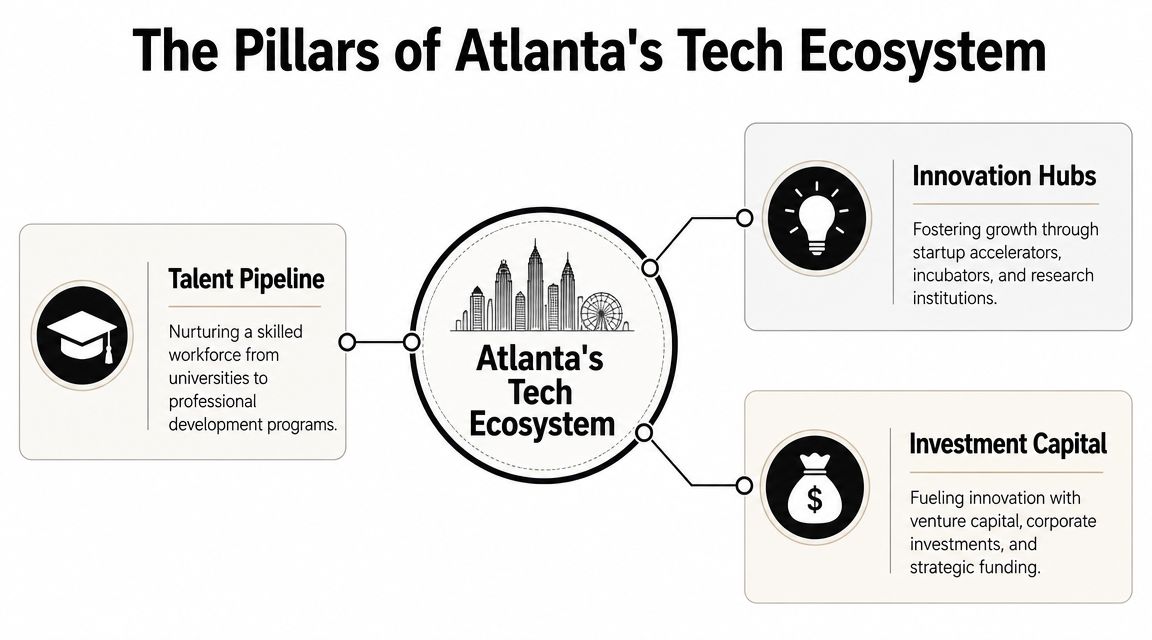
Atlanta's tech strength comes from the way enterprise scale, startup pressure, and sector expertise operate in the same market. For IT managers, that mix affects real decisions about procurement standards, deployment speed, security controls, and what happens to equipment at end of life.
Corporate scale and operational discipline
Large organizations set the tone for how technology gets managed in Atlanta. They require identity governance, segmented networks, retention schedules, approved vendor lists, documented chain of custody, and formal decommissioning procedures. Those expectations shape the regional service market because MSPs, logistics providers, recyclers, and staffing pipelines all have to meet higher standards to win business.
That matters even if your company is smaller.
A mid-market IT team in Atlanta can often adopt enterprise-grade practices without building every process from scratch. The regional baseline is already higher. You can find partners who understand audit trails, device tracking, serialized asset reporting, and secure data destruction. That lowers execution risk during migrations, office consolidations, hardware refreshes, and cloud transitions.
Startup energy and implementation speed
Startups bring a different discipline. It is not governance first. It is speed, iteration, and fast feedback. That pressure improves the wider market because established companies are pushed to shorten deployment cycles, reduce approval bottlenecks, and automate work that used to sit in email threads and ticket queues.
There is a trade-off. Fast implementation can create weak documentation, inconsistent endpoint control, and poor retirement planning if nobody sets standards early. Smart IT managers take the useful part of startup culture, fast testing and shorter delivery cycles, then pair it with controls that hold up under audit and during asset disposition.
Specialized clusters and domain knowledge
Atlanta's industry concentration gives IT leaders access to partners who understand specific operating requirements. Healthcare teams need tighter handling for regulated data and device disposition. Logistics environments care about uptime, scanning hardware, fleet connectivity, and distributed-site support. Financial firms put more weight on retention, access control, and documented destruction. Public sector and education teams face their own procurement and records obligations.
Those differences show up at the end of the lifecycle, not just at deployment. A laptop retired from a finance team, a kiosk pulled from a logistics site, and a workstation removed from a healthcare office do not follow the same risk profile. Digital transformation leadership is stronger when those distinctions are built into the plan before assets are purchased.
| Pillar | Why it matters in practice | IT manager takeaway |
|---|---|---|
| Corporate HQ environment | Strong controls, formal governance, repeatable operations | Apply documented standards to procurement, deployment, and retirement |
| Startup activity | Faster experimentation and workflow redesign | Pilot quickly, but set asset, security, and approval controls early |
| Sector specialization | Better alignment to compliance and business process realities | Choose partners who understand your data, equipment, and regulatory obligations |
The local focus on Atlanta IT infrastructure security trends reflects a useful shift in priorities. Mature transformation programs do not stop at cloud adoption or software rollout. They account for endpoint control, data handling, redeployment, and e-waste management with the same discipline used in implementation.
Powering Progress with World-Class Infrastructure
Atlanta's digital ambitions rest on physical infrastructure. That sounds obvious, but many transformation conversations still pretend software exists independently of power, connectivity, rack density, equipment refresh cycles, and disposal logistics. It doesn't.
Data centers are part of the leadership story
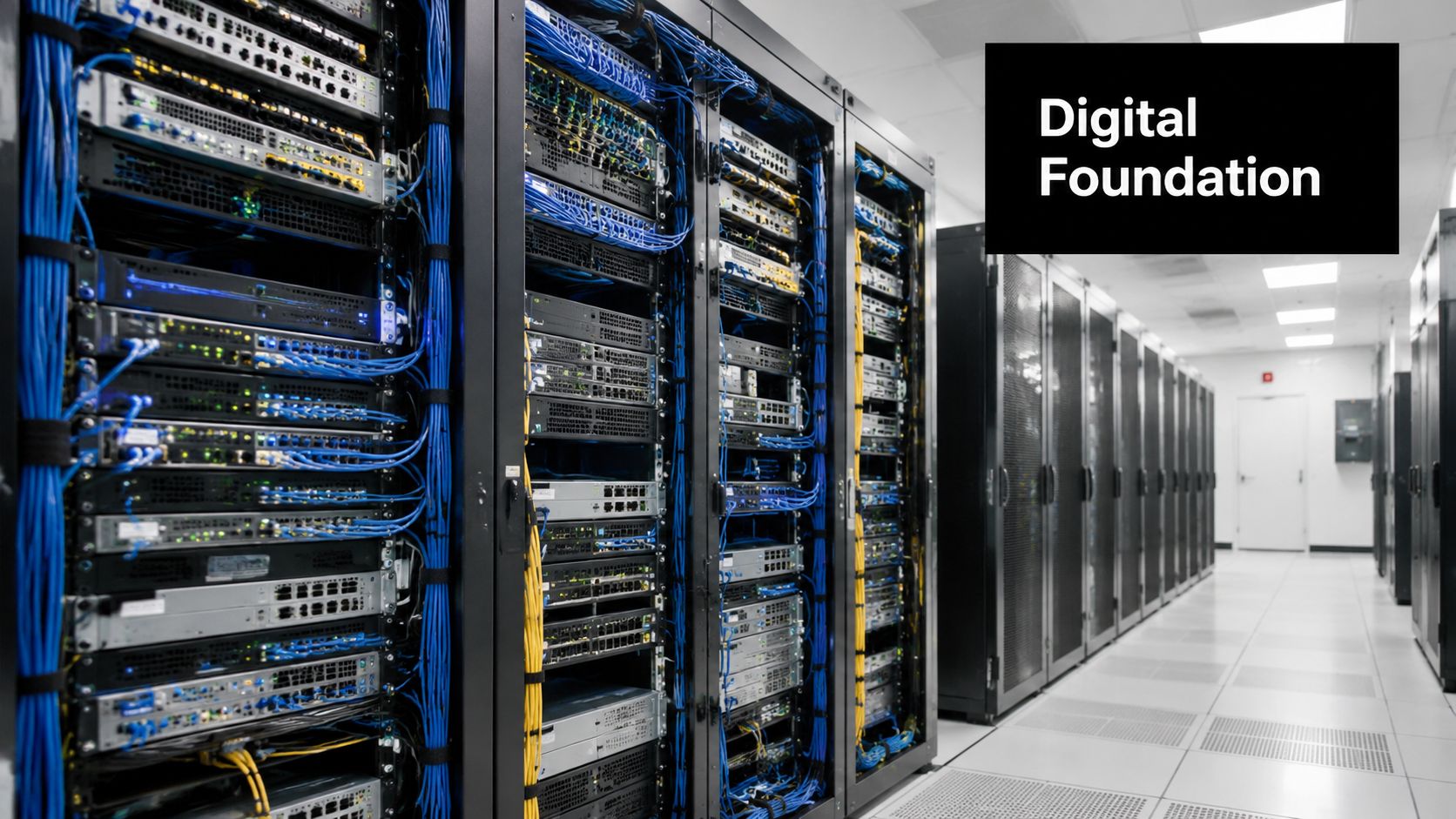
Atlanta's data center market matters because modern businesses need environments that support cloud access, AI workloads, low-latency interconnection, and always-on operations. Industry reporting describes Atlanta as a place “where data fuels innovation,” and frames the city as a key hub where strong power and connectivity support modernization in practice, as outlined in Digital Realty's discussion of Atlanta data centers.
For an IT manager, this changes planning in three ways:
- Workload placement gets more flexible: You can align application needs with colocation, cloud, or hybrid models without treating infrastructure as an afterthought.
- Business continuity improves when infrastructure planning is local and deliberate: Teams can coordinate migration, failover preparation, and decommissioning with fewer handoff gaps.
- Hardware turnover becomes more strategic: Dense infrastructure environments create more frequent refresh and retirement decisions.
The circular economy is not a side issue
Georgia Tech's CDAIT has pushed a more useful definition of transformation than most boardroom slide decks offer. The idea is straightforward. Modernization should create business value through integration, reuse, and lifecycle thinking rather than just adding new systems.
That matters in Atlanta because infrastructure-heavy growth produces physical consequences. New servers, storage arrays, network appliances, and user devices don't disappear when they're replaced. Someone has to inventory them, sanitize them, remove them from records, determine reuse potential, and route the rest into responsible recycling.
Retiring equipment badly can erase the operational gains you expected from the new environment.
This is why the conversation around Atlanta's increasing need for data center services should include de-installation and end-of-life management, not just capacity. The strongest digital transformation programs treat infrastructure as a lifecycle system. Acquisition, production use, redeployment, and disposition all belong in one operating plan.
Developing a Pipeline of Digital Talent
Atlanta's talent story isn't just about producing coders. The stronger pattern is that the region develops people who can connect technology choices to operating outcomes. That distinction matters because organizations rarely fail transformation for lack of tools. They fail because teams can't align systems, workflows, accountability, and timing.
From technical education to business execution
Georgia Tech's digital transformation research emphasizes that these efforts work best when they're embedded in a broader business agenda, with value created through circular-economy and integration-driven models, as described by Georgia Tech CDAIT's digital transformation work. For employers, that means the local pipeline isn't limited to technical implementation. It increasingly reflects an understanding of modernization as cross-functional change.
In practical terms, this improves the quality of conversations inside project teams. A stronger candidate pool asks better questions:
- What systems have to integrate before automation is worth deploying?
- What assets can be reused instead of replaced?
- What controls must be documented before equipment leaves service?
- Who owns the cutover, and who owns the retirement trail afterward?
Retention matters as much as recruitment
Talent development breaks down if companies treat staff as interchangeable. The Atlanta market gives employers access to capable people, but it also raises the standard for management. Teams stay where projects are coherent, tools are supported, and leadership removes obstacles instead of adding new ones.
For organizations trying to hold onto infrastructure and security talent during refresh cycles, these strategies for retaining top engineers are useful because they focus on management conditions rather than empty culture slogans.
A local workforce also changes how leaders should think about community and quality of life. Even lighter regional content like day trips from Atlanta hints at a broader point. Good labor markets keep skilled people when the region supports long-term living, not just short-term hiring.
The most valuable transformation hires aren't the people who know one platform best. They're the people who can move a project from design to adoption without losing control of data, process, or assets.
How Public-Private Initiatives Drive Innovation
Atlanta's role in digital transformation leadership is strongest where strategy meets delivery. Plenty of cities can assemble advisory panels, publish innovation language, or announce modernization efforts. Fewer can build routines that keep projects moving through procurement, coordination, and operational follow-through.

Execution capacity is the real differentiator
Atlanta's Mayor's Office includes an Office of Innovation, Delivery and Performance focused on “meaningful progress and tangible results,” which is a more useful signal than broad transformation branding. The city's model suggests that Atlanta's advantage may come from execution capacity, not just ambition, as reflected by the Mayor's Office of Innovation, Delivery and Performance.
That matters for commercial IT leaders because public-sector execution habits spill into the regional environment. They influence procurement expectations, service-delivery norms, implementation partnerships, and the practical standard for what “done” looks like.
What businesses can learn from that model
Private companies often overemphasize strategy decks and underinvest in delivery mechanics. The Atlanta approach points in the other direction.
Consider the contrast:
| Weak transformation habit | Strong transformation habit |
|---|---|
| Buying tools before defining operating ownership | Assigning decision rights and escalation paths first |
| Treating legacy hardware retirement as an afterthought | Planning decommissioning during project scoping |
| Measuring launch dates only | Measuring adoption, control, and clean asset exit |
| Isolating IT from facilities, legal, and compliance | Running cross-functional implementation reviews |
That's why regional institutions like the Fulton County Chamber of Commerce in Georgia matter indirectly. They support the networks where public agencies, vendors, and business operators exchange practical information about how projects get approved and delivered.
A city earns a leadership role when organizations inside it can carry change across departments, not just announce it.
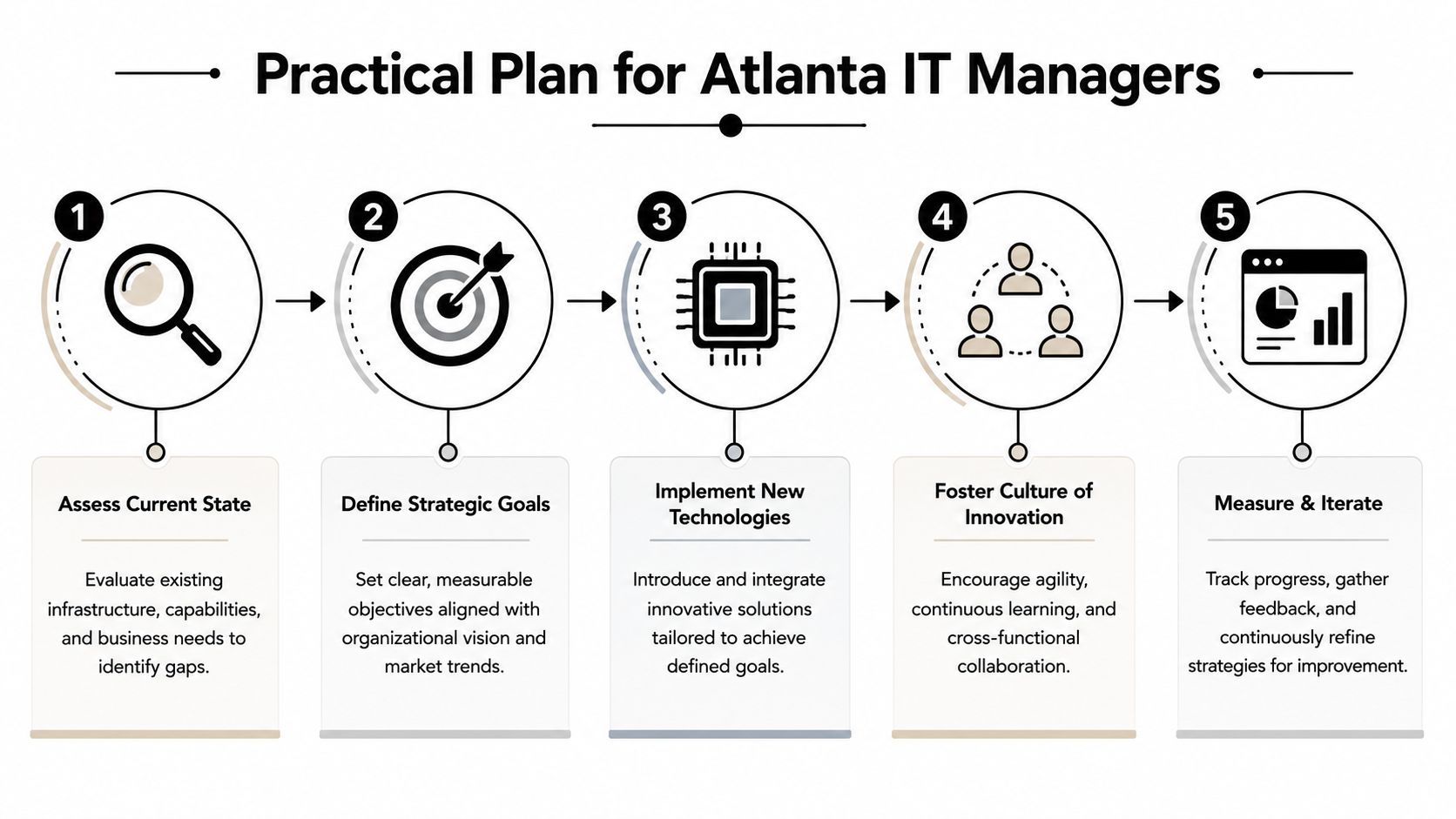
A Practical Plan for Atlanta IT Managers
Analysts at Deloitte frame digital transformation as an operating-model problem, not a technology-purchase problem, which is why programs stall when leadership upgrades systems without coordinating data, process, and governance changes, according to Deloitte's guidance on leading digital transformation.
For Atlanta IT managers, that point has direct operational consequences. The region gives you access to strong vendors, logistics capacity, enterprise talent, and fast-moving implementation partners. It also raises the standard. If the rollout plan covers cloud migration but not asset retirement, data-bearing media control, and downstream e-waste handling, the plan is incomplete.
Start with the current-state audit
Start with evidence, not vendor demos.
Review the environment across three areas:
Asset inventory
Identify servers, endpoints, storage, network gear, and media by owner, location, data sensitivity, and support status. If your inventory cannot tell you which devices hold regulated data and which sites still have aging equipment in service, the migration plan will drift as soon as execution starts.Process dependencies
Map what breaks when a system changes. Include authentication, backup routines, reporting feeds, facilities dependencies, and line-of-business applications. Atlanta's mix of distributed offices, clinics, campuses, warehouses, and branch locations is especially relevant. A missed dependency at one site can create delays across the region.Governance controls
Confirm retention rules, wipe standards, chain-of-custody requirements, and documentation needs before any migration or refresh begins. These controls should apply to retired hardware as clearly as they apply to production systems.
Build the roadmap around decisions, not products
A workable plan answers a few hard questions early, while the cost of changing course is still low.
What stays, what moves, what retires?
Future-state classification should happen before procurement and scheduling. Otherwise, teams buy replacement hardware without a clear exit path for the old estate.Which partners can execute locally?
Regional proximity matters when you need staging, pickup, de-installation, packing, or fast issue resolution across multiple Atlanta-area sites. National coverage can help on policy. Local execution usually decides whether the project stays orderly.Where does compliance risk shift during the project?
Risk often peaks during transition. Old equipment still holds data, but ownership gets fuzzy once business teams focus on the new environment and facilities starts clearing space.
Treat end-of-life planning as part of implementation
Here, experienced IT managers protect the project.
Teams usually fund new infrastructure and migration labor first. Then retired laptops, switches, storage arrays, and backup media sit in server rooms or storage closets because no one assigned budget, custody, or disposition rules. That creates three avoidable problems at once: weak auditability, delayed inventory reconciliation, and unnecessary exposure from data-bearing assets that are no longer in active use.
Set the end-of-life path during project scoping:
- Reuse path: Equipment suitable for internal redeployment
- Remarket path: Assets with residual value and acceptable disposition controls
- Recycle path: Obsolete or damaged devices that need material recovery
- Destruction path: Media and hardware that require physical destruction
Atlanta Computer Recycling is one example of a business-focused provider serving Atlanta-area projects when organizations need collection, de-installation, secure data handling, and responsible electronics disposition.
Field advice: The project isn't finished when the new system goes live. It's finished when the old environment is accounted for, sanitized, documented, and removed from risk.
Secure and Sustainable ITAD in Atlanta
IT asset disposition belongs inside every digital transformation plan because retired equipment still carries legal, operational, and reputational risk. A server that's powered off can still expose regulated data. A batch of laptops in storage can still fail an audit trail. A pile of obsolete networking gear can still undermine sustainability commitments if it ends up in the wrong downstream channel.
What goes wrong when ITAD is handled casually
The most common failures are operational, not dramatic. No one updates the inventory. Drives are pulled but not documented. Devices sit in a staging room for months. Facilities teams move pallets without chain-of-custody records. The project team celebrates the rollout while the riskiest assets are now the least visible.
For healthcare organizations, schools, and public agencies, that's a serious governance problem. If you handle protected information, student data, financial records, or internal government systems, you need defensible destruction and disposition procedures. “We wiped them later” is not a control.
What a sound ITAD process includes
A secure and sustainable process usually has these elements:
- Documented chain of custody from pickup through final disposition
- Verified data sanitization or physical destruction for media that can't be reused safely
- Serialized inventory reconciliation so retired equipment leaves your records correctly
- Downstream recycling discipline that supports environmental commitments instead of shifting waste elsewhere
Sustainability and security shouldn't compete. In mature programs, they reinforce each other. Reuse reduces waste when devices remain fit for service. Recycling protects environmental goals when reuse is no longer appropriate. Destruction protects data when neither route is acceptable without higher risk.
The key point is simple. If digital transformation is supposed to improve control, then unmanaged retired assets are a direct contradiction of the project's purpose.
Frequently Asked Questions for Atlanta IT Leaders
Do Georgia businesses need formal data destruction procedures for retired devices
If your organization handles sensitive business, healthcare, educational, legal, or public-sector information, the practical answer is yes. The issue isn't just state geography. It's whether you can prove that data on retired devices was handled under a documented process. IT leaders should define wipe or destruction standards, chain-of-custody steps, and inventory reconciliation before any refresh or closure project starts.
Can we recover value from older IT equipment
Sometimes, yes. The right question isn't “Is it old?” It's “Is it still functional, supportable, and marketable under our risk standards?” Laptops, desktops, servers, and network hardware may have reuse or remarketing potential if they can be processed securely and documented correctly. But value recovery should never override sanitization, compliance, or custody controls. If there's a conflict, protect the data first.
How should sustainability goals affect end-of-life planning
They should affect the plan at the beginning, not after the equipment is removed. Good sustainability practice means separating assets into reuse, resale, recycling, and destruction streams with documentation for each path. That approach supports environmental reporting and avoids sending recoverable materials into landfill channels. It also forces better inventory discipline, which improves security.
What should an IT manager ask an ITAD provider before signing anything
Keep the questions operational:
- How is chain of custody documented from pickup through final disposition?
- What sanitization or destruction methods are available for different media types?
- Can the provider support de-installation, packing, and logistics for larger projects?
- How are serialized assets tracked and reconciled?
- What happens to equipment that can't be reused?
- How is downstream recycling managed and documented?
A provider should answer clearly. If the process sounds vague, the risk is real.
Atlanta organizations don't need more transformation rhetoric. They need operational control from deployment through disposition. If your team is planning a refresh, office closure, data center cleanout, or hardware retirement project, Atlanta Computer Recycling provides business-focused IT asset disposition and electronics recycling services across the metro area, including pickup, de-installation support, secure data handling, and responsible downstream processing.