Mastering 2026 IT Infrastructure Security Trends in Atlanta

If you manage IT in Atlanta, you're probably dealing with two competing realities at once. The business wants faster cloud rollout, cleaner remote access, smoother office moves, and less downtime. At the same time, your team still owns old laptops in a storage room, decommissioned servers in a cage, network gear waiting for pickup, and compliance questions nobody wants to answer during an audit.
That gap is where a lot of infrastructure risk lives. Most discussions about IT infrastructure security trends in Atlanta stay focused on phishing, ransomware, and endpoint tools. Those matter. But they don't cover the full problem. Security doesn't stop at the firewall, and it doesn't stop when hardware leaves production.
Atlanta's Evolving IT Security Landscape
Atlanta is one of the few markets where cybersecurity growth and cyber risk are both obvious at the same time. Georgia's cybersecurity sector generates about $5 billion annually, centered in Atlanta, while Georgia ranked 11th nationally for cybercrime complaints, with losses exceeding $420 million, up 40% from the prior year, according to Georgia Trend's reporting on the state's cybersecurity landscape.
That combination creates pressure for local IT managers. You're operating in a metro area with a deep bench of security vendors, university talent, and enterprise infrastructure. You're also dealing with a threat environment where attacks are frequent enough to shape budget decisions, staffing priorities, and board-level reporting.
What's changed for Atlanta IT teams
A few years ago, many infrastructure teams could separate responsibilities pretty cleanly. Network security handled firewalls and VPNs. Server teams patched systems. Desktop teams replaced devices. Disposal happened at the end, often with minimal oversight.
That model doesn't hold up well now.
Security decisions now cut across:
- Hybrid infrastructure: cloud workloads, colocated systems, branch offices, and legacy on-prem gear all need consistent control.
- Human risk: user behavior, contractor access, and internal mistakes often create the opening for an incident.
- Compliance exposure: healthcare, education, and public-sector organizations can't treat a technical failure as only a technical failure.
- Asset lifecycle management: retired equipment can still hold regulated or business-sensitive data long after it's been removed from production.
Practical rule: If your security plan ends when the device powers off, it's incomplete.
The useful way to look at Atlanta's environment is this: the city's growth has made infrastructure more distributed, faster-moving, and harder to inventory. The controls that work now are the ones that connect access, monitoring, configuration discipline, and end-of-life handling into one operating model.
Combating Atlanta-Specific Ransomware and Phishing
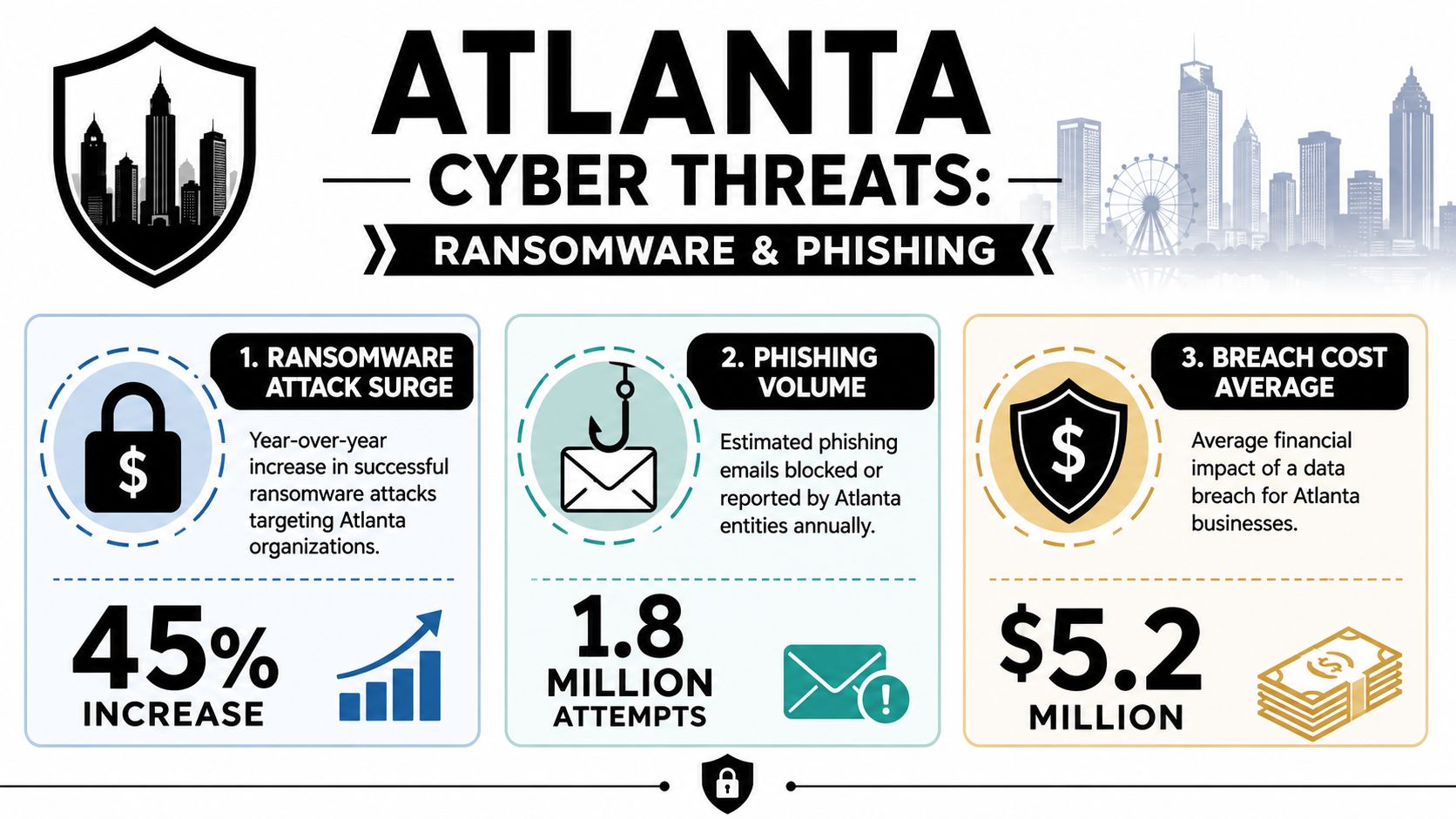
Ransomware and phishing still cause the most immediate operational pain for many Atlanta organizations because they disrupt normal work fast. A hospital can lose access to systems that staff depend on. A finance team can approve a payment they shouldn't. A logistics business can get locked out of scheduling and communications. The mechanics vary, but the path in is often familiar: a user, a credential, a weak approval flow, or an exposed system that wasn't meant to be reachable.
The pressure point now is speed. Attackers aren't limited to crude mass emails anymore. Attackers are using AI to automate phishing, enumerate vulnerabilities, and accelerate ransomware campaigns. In response, zero-trust architecture that verifies every access request and enforces least privilege is now considered a baseline control model for Atlanta businesses, as described in local guidance on cybersecurity trends for Atlanta businesses in 2026.
What breaks first
Traditional controls still matter, but they fail when teams rely on them in isolation.
A common pattern looks like this:
| Weak point | Why it fails | What works better |
|---|---|---|
| Email filtering alone | It reduces noise but can't stop every socially engineered message | Layer it with conditional access, user verification steps, and privileged workflow controls |
| Annual awareness training | Users forget, contractors miss it, and attack methods change quickly | Shorter recurring exercises tied to real business tasks |
| Flat internal access | One compromised account can reach too much | Role-based access and segmented admin paths |
| MFA everywhere without policy depth | MFA helps, but it doesn't fix overprivileged access or bad device trust | Combine MFA with device posture checks and session monitoring |
Zero trust is now the practical baseline
A lot of teams still hear "zero trust" and picture a long transformation project with expensive tooling. In practice, the useful version is narrower. Trust fewer assumptions. Verify identity each time. Reduce standing access. Watch for abnormal behavior after login, not just before it.
Start with the access paths that attackers use:
- Privileged accounts: Separate admin identities from daily user accounts.
- Remote access: Tighten policy around VPN replacements, browser-based access, and unmanaged endpoints.
- Email-driven actions: Add approval friction around wire transfers, vendor bank changes, and password resets.
- High-risk endpoints: Treat laptops used by executives, finance staff, and admins as a different security tier.
For teams tightening endpoint controls, this guide on how Atlanta firms improve endpoint security is useful because it focuses on the operational side, not just product checklists.
Most phishing defenses fail because the organization assumes a successful login means the session is safe. It doesn't.
What doesn't work is buying one more detection tool while keeping broad access rules, weak device standards, and loose approval processes. What works is making the attacker re-earn trust at every step.
Securing Atlanta's Cloud and Data Center Boom
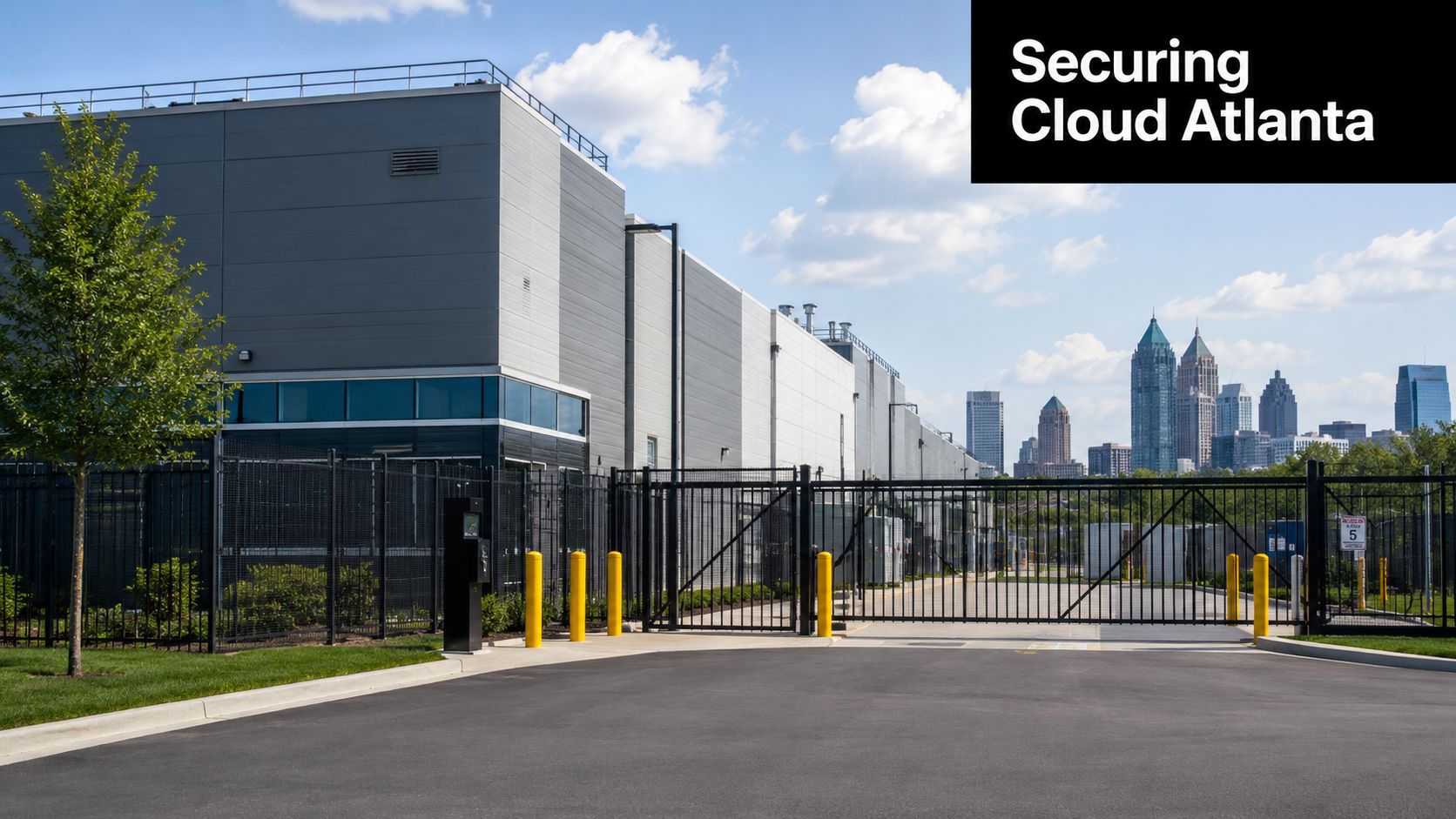
Atlanta's infrastructure story isn't only digital. It's physical, and that matters. Atlanta has become the country's hottest data center market, with the amount of space under construction roughly doubling every six months since mid-2023, according to GovTech's coverage of the Atlanta area data center market. For security teams, that expansion means more racks, more interconnects, more third-party handling, and more equipment eventually leaving service.
The perimeter isn't where you think it is
Many Atlanta businesses now split workloads across public cloud, private infrastructure, and colocated environments. That gives flexibility, but it also creates blind spots. One team owns identity. Another owns backup. A third party manages the cage. Meanwhile, legacy systems keep talking to cloud services that nobody fully mapped.
The recurring problems are rarely exotic:
- Cloud misconfigurations: storage, access policy, and logging settings drift over time.
- Inconsistent monitoring: alerts exist, but they aren't unified across cloud, colo, and on-prem systems.
- Unclear ownership: nobody can answer who approves changes to a shared platform.
- Weak decommission workflows: systems are removed from service before teams verify what data remains on local media.
Teams that need more discipline around visibility should review these essential strategies for cloud monitoring. The practical value isn't the theory. It's the reminder that observability has to follow the workload across environments.
What to tighten in hybrid environments
If your infrastructure spans cloud and physical facilities, treat lifecycle control as part of security architecture, not an afterthought.
A solid operating model usually includes:
Asset inventory tied to ownership
Every server, storage node, appliance, and virtual dependency needs an owner who can approve changes and retirement.Change control with rollback evidence
Not just ticket approval. You need proof that the team can reverse a bad change without improvising under pressure.Logging that survives platform boundaries
If identity events, admin actions, and storage alerts sit in separate silos, you'll lose time during investigation.Decommission plans written before migration starts
Without such plans, many projects slip. The move gets funded. The retirement plan doesn't.
A good operational reference point is a data center migration checklist for Atlanta teams, especially when migrations involve old storage arrays, backup hardware, or mixed-vendor network gear.
The risky moment isn't only when a system goes live. It's also when everyone assumes the old one is gone.
The most overlooked issue in Atlanta's infrastructure growth is simple: expansion creates more forgotten assets. Forgotten assets become unmanaged risk.
Managing Hidden Risks in OT IoT and Supply Chains
Not every serious security issue starts with a phishing email or a vulnerable cloud setting. Some start with equipment your IT team doesn't fully control. In Atlanta, that often means building systems, warehouse technology, medical devices, cameras, badge readers, specialty lab hardware, and vendor-managed platforms that sit just outside the normal patching and monitoring process.
That's where infrastructure security gets messy. The device is connected. The data matters. But ownership is split between IT, facilities, operations, procurement, and outside providers.
Where these hidden risks show up
In practice, the most dangerous assets are often the least standardized.
Consider the difference:
| Environment | Typical blind spot | Result |
|---|---|---|
| Manufacturing or logistics | OT systems can't be patched on the same cadence as office IT | Old vulnerabilities stay exposed longer |
| Healthcare facilities | Connected clinical or imaging devices run vendor-controlled software | Security teams have limited change authority |
| Office campuses | Smart devices and physical security platforms are deployed for convenience | Default settings and weak segmentation remain in place |
| Third-party software and service providers | Access persists long after a project or contract changes | External compromise becomes your internal incident |
A workable review process
You don't need to boil the ocean. You need a repeatable way to identify which nontraditional assets can hurt you most.
Start with these questions:
- Does the device or vendor touch sensitive data? If yes, treat it as a security asset, not just an operational tool.
- Who can patch, reset, or remove it? If the answer is unclear, that's already a control gap.
- What happens if it goes offline? Some devices are annoying to lose. Others halt patient care, receiving, production, or building access.
- Can it reach the rest of the network? If segmentation is weak, a small system can become a pivot point.
Then sort assets into response tiers. High-impact systems need stricter network boundaries, tighter vendor access rules, and clearer incident ownership. Lower-risk devices still need inventory and retirement controls, but they don't need the same response playbook.
Vendor risk is infrastructure risk
A lot of teams still separate "supply chain security" from "infrastructure security." That split causes delays during incidents. If a managed service provider administers your backup environment, or if a building systems vendor has persistent remote access, they are part of your infrastructure attack surface.
Use contract reviews to force operational clarity:
- Access terms: define how vendors authenticate and when access is removed.
- Logging expectations: require records of administrative activity where possible.
- Escalation paths: know who answers after hours and who can authorize containment steps.
- End-of-contract handling: verify account removal, hardware return, and data disposition.
For a structured way to think through these external dependencies, review these supply chain risk management strategies for Atlanta organizations.
What doesn't work is assuming a vendor-managed system is a vendor-only problem. Once that system connects to your environment or stores your data, your team inherits the consequences.
Meeting Strict Compliance in Healthcare and Government
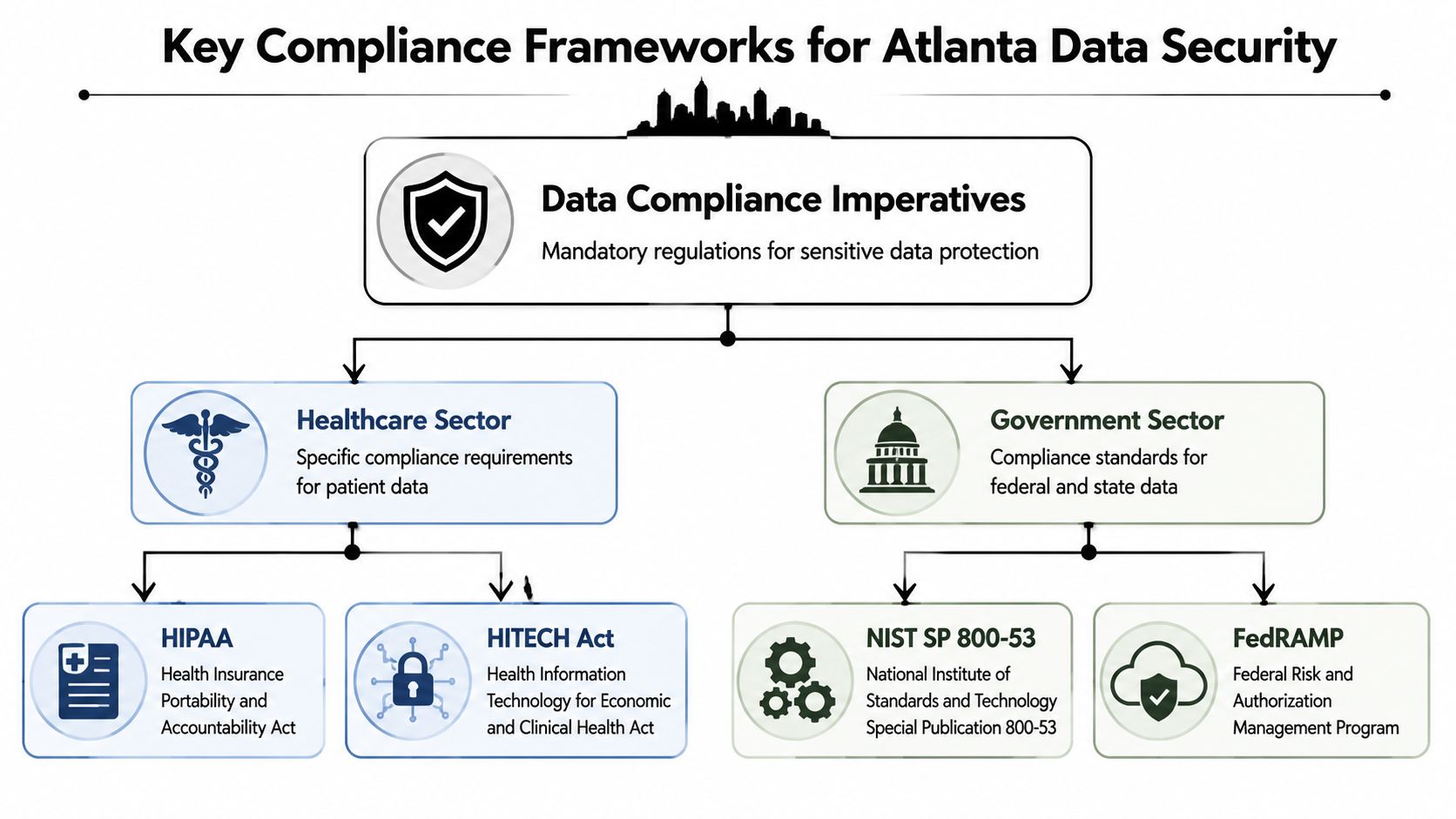
In regulated environments, a security incident isn't only an outage. It can become an investigation, a reporting event, a legal issue, and a records problem at the same time. That's why healthcare systems, schools, universities, and government agencies in Atlanta need tighter linkage between technical controls and compliance operations.
Local coverage often focuses on front-end threats, but there's an important gap. For regulated Atlanta organizations, residual risk from forgotten hard drives containing sensitive data means secure ITAD is a critical, mandatory component of HIPAA-aligned data handling, as noted in Atlanta-focused coverage on cyber security and retired-asset risk.
Compliance failures usually start as operational shortcuts
A ransomware event can trigger compliance exposure if protected data becomes inaccessible or potentially exposed. A misplaced backup drive can do the same. So can an old workstation that sat in a closet after a department refresh.
The point isn't that every retired device creates a breach. The point is that regulated teams need evidence-based handling from deployment through disposal.
For healthcare organizations reviewing current obligations, CloudOrbis's 2026 HIPAA guide is a useful operational reference because it pushes teams to connect policy language with day-to-day asset handling.
What auditors and internal reviewers care about
The questions are usually straightforward:
- Can you identify where sensitive data lived?
- Can you show who handled the device after retirement?
- Can you prove data was destroyed or sanitized appropriately?
- Can you match disposal records to asset inventory and policy?
If you can't answer those cleanly, the weakness isn't just technical. It's procedural.
Compliance doesn't end when a device leaves the rack, the nursing station, or the office. It ends when the organization can prove the data is no longer recoverable.
A better compliance standard for local teams
For healthcare and government environments, strong practice usually includes these controls:
| Control area | Weak approach | Strong approach |
|---|---|---|
| Device retirement | Informal handoff to another team | documented chain of custody |
| Media handling | "We removed it from service" | sanitization or destruction with verification |
| Audit support | scattered emails and spreadsheets | matched inventory, disposition records, and certificates |
| Policy scope | focused only on active systems | includes storage rooms, backup media, and dead equipment |
If you need a process tied directly to regulated media handling, this resource on HIPAA-compliant data destruction for Atlanta organizations is worth reviewing.
The organizations that struggle most in audits usually aren't the ones without any controls. They're the ones with decent controls in production and weak controls at the end of the asset lifecycle.
Closing the Loop with Secure IT Asset Disposition
The final control in infrastructure security is the one many teams leave outside the security program entirely. That's IT asset disposition, or ITAD. If your retired servers, laptops, switches, storage shelves, and backup devices still hold data, then disposal isn't a facilities task. It's a security control.
The broad conversation about IT infrastructure security trends in Atlanta takes on a practical dimension. You can improve identity security, tighten cloud monitoring, and segment high-risk systems. But if old drives leave the building without verified sanitization or destruction, you've left a clean exit path for sensitive data.
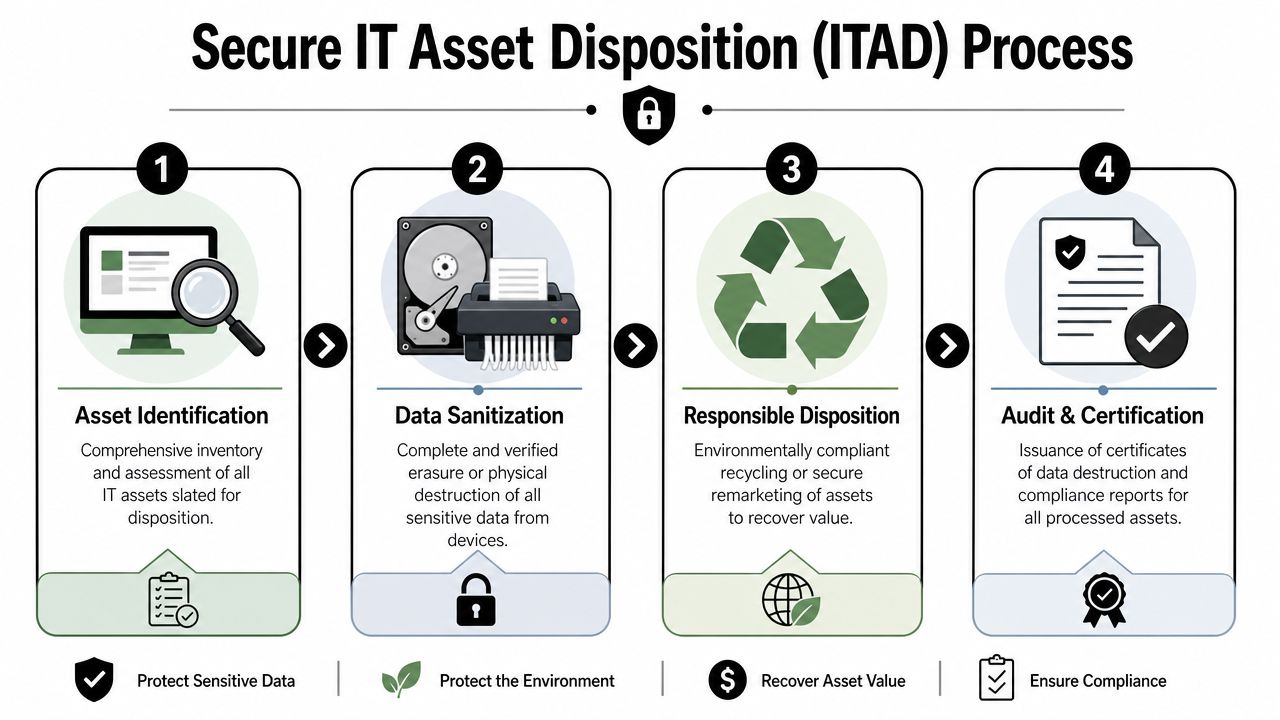
What a secure ITAD process actually includes
A credible ITAD process isn't just pickup and recycling. It should include several controls that your security, compliance, and audit teams can all live with.
Asset identification before removal
Teams should know what is leaving, which devices contain storage, and which business unit owned them.Data sanitization or physical destruction
The method depends on device condition, media type, and reuse policy. Reusable assets may be wiped. Failed or obsolete media may need shredding.Chain of custody through transport and processing
The handoff record matters. If nobody can document who handled the equipment, you don't have defensible control.Audit documentation
Certificates, inventory reconciliation, and disposition records need to be easy to produce later, not rebuilt from memory.
What works and what doesn't
Some organizations still handle end-of-life hardware with ad hoc methods. A staff member collects devices. Equipment gets stacked in a back room. Someone schedules a bulk pickup when space runs out. That may remove clutter, but it doesn't reliably remove risk.
A stronger model looks like this:
- Security, infrastructure, and compliance agree on retirement criteria.
- The asset list is reviewed before anything leaves service.
- Storage-bearing devices are identified explicitly.
- Destruction or sanitization records are tied back to the inventory.
- The team can answer auditor questions months later without scrambling.
Old hardware is not harmless hardware. It's often a portable archive of credentials, records, configurations, and business history.
For Atlanta organizations that need local handling of servers, laptops, network gear, and data center equipment, Atlanta Computer Recycling is one example of a provider offering business-focused ITAD, including data wiping, physical shredding for obsolete media, logistics support, and documentation tied to disposition.
When to bring ITAD into the security program
If any of these sound familiar, your ITAD process belongs in your security governance cycle:
- You run regular refreshes and retired equipment waits for months before final disposition.
- You manage regulated data and can't easily match old assets to destruction records.
- You use colocation or multiple sites and decommissioning happens in batches.
- You inherited equipment from acquisitions, closures, or migrations and inventory quality is uneven.
The mistake is treating disposal as the end of an operational task. The better view is that secure disposition closes the loop on every upstream control you've already paid for.
If your team needs a tighter process for retired servers, storage, laptops, or data center gear, Atlanta Computer Recycling can help you turn disposal into a documented security control instead of a lingering compliance risk. For Atlanta-based IT managers, that means secure pickup, verified data destruction options, and cleaner audit support when equipment reaches end of life.