Atlanta’s Growth in Enterprise Technology Adoption

Atlanta didn't become a serious enterprise technology market because of one breakout company or one headline ranking. It became one because the city built density. The Metro Atlanta Chamber says the region is home to more than 13,000 technology companies in its global center of growth profile. That scale changes how enterprises buy, deploy, and retire technology.
The usual reading of Atlanta's growth is optimistic: more vendors, more talent, more digital transformation. That's true, but it's incomplete. For IT managers, Atlanta's growth in enterprise technology adoption also means more endpoint turnover, more server retirement, more storage media leaving secure environments, and more audit exposure when old equipment isn't tracked to final disposition.
That's the hidden operational story. The faster a market adopts cloud platforms, analytics stacks, fintech systems, collaboration tools, and newer infrastructure, the faster yesterday's hardware becomes a liability. In Atlanta, that liability doesn't show up only in procurement. It shows up at the end of the lifecycle, where security, compliance, logistics, and environmental handling all converge.
Atlanta's Tech Boom and Its Hidden Consequences
Atlanta's tech growth shows up in operations long before it shows up in strategy decks. A dense local market of software firms, integrators, MSPs, cybersecurity providers, and niche consultants gives enterprises more options to deploy new systems quickly. For an IT manager, that usually looks positive at first: shorter sourcing cycles, more local implementation support, and less dependence on out-of-state vendors.
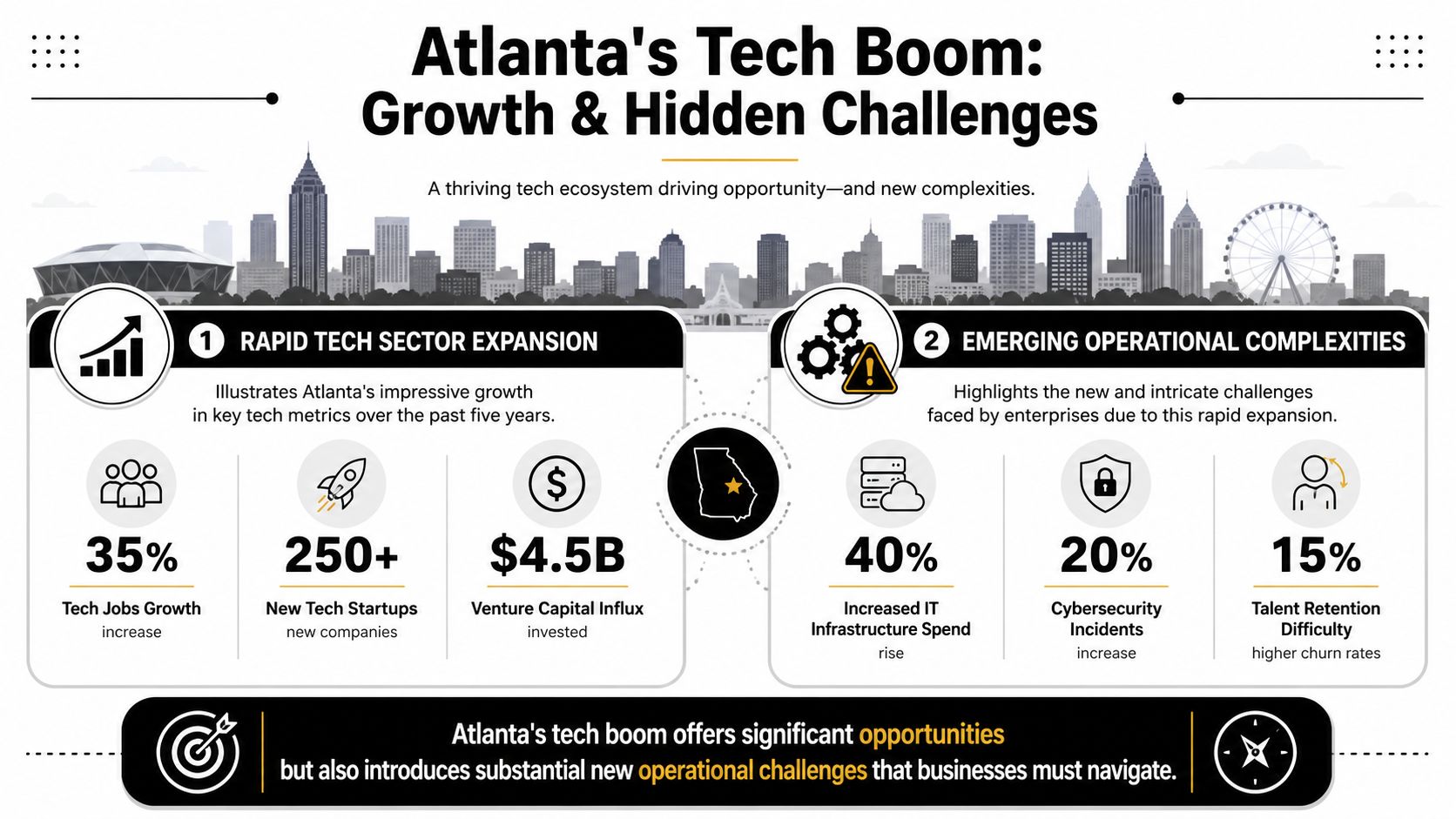
The operational consequence is less visible. Faster deployment capacity also increases the volume of equipment leaving production. As organizations replace endpoints, storage arrays, networking gear, point-of-sale systems, and office technology on tighter timelines, the backlog of assets awaiting collection, sanitization, resale, recycling, or destruction grows in parallel.
That changes the risk profile of growth.
A hospital upgrading storage can retire systems that still contain protected health information. A financial services firm replacing branch hardware can create chain-of-custody problems across multiple sites. A field team adopting newer mobile tools for managing service business operations can also increase the number of devices that need documented recovery, wiping, and downstream disposition. In each case, the project budget often covers procurement and deployment in detail, while end-of-life handling sits in a smaller line item or gets deferred to facilities, desktop support, or a general vendor queue.
That budgeting pattern creates predictable exposure:
- Data-bearing equipment remains a security issue after cutover: Retired laptops, servers, backup media, and failed drives can still hold regulated or sensitive data.
- Distributed environments make asset control harder: Branch offices, clinics, warehouses, campuses, and hybrid work setups increase the chances that equipment leaves service without consistent records.
- Sustainability and compliance now overlap: Companies making ESG claims or facing disposal requirements need documented downstream handling, not informal pickup arrangements. The environmental impact of electronic waste is also a governance issue once auditors, customers, or procurement teams ask for proof.
The practical point is straightforward. In Atlanta, tech adoption speed can compress hardware lifecycles whether or not the organization has planned for that compression. The result is not just more refresh activity. It is more serialized assets to track, more certificates to retain, more vendors to vet, and more chances for a gap between decommissioning and verified disposition.
For Atlanta IT leaders, that gap has direct cost. Emergency pickups cost more than scheduled retirements. Incomplete asset records slow audits and cyber insurance reviews. Weak disposition controls can turn a routine refresh into a compliance event months after the new system is already live.
The Engines Driving Enterprise Tech Adoption in Atlanta
Atlanta's growth isn't random. It's being pushed by labor capacity, sector specialization, and a startup pipeline that keeps introducing new infrastructure demand into the market.
A useful indicator comes from Data Society, which says Atlanta's high-tech workforce grew by nearly 53% between 2014 and 2022, and by 2022 the city had become the eighth-largest tech workforce in the United States in its analysis of Atlanta's sociotechnical growth. The same analysis notes that Atlanta's fintech sector processes 70% of all U.S. transactions. For enterprise IT, those aren't just civic bragging points. They describe a market with the staffing base and business pressure to adopt complex systems quickly.

Workforce growth changes what companies can actually deploy
A bigger technical workforce means more organizations can move beyond basic SaaS adoption. They can run deeper programs: cloud governance, endpoint standardization, security tooling, identity modernization, and analytics infrastructure. Talent growth also changes internal expectations. Once a company can hire the architects, engineers, admins, and security staff it needs, leadership expects faster execution.
That has direct consequences for operations:
- More in-house capability: Teams can support larger migrations and more aggressive refresh schedules.
- More specialization: Security, infrastructure, and procurement stop operating as one blended function and start needing tighter coordination.
- More procurement discipline: Organizations that are managing service business operations across distributed teams often need cleaner device inventories and more structured field asset handling.
Atlanta's sector mix pulls adoption forward
Atlanta's enterprise growth is unusually strong in sectors where downtime is expensive and data handling is tightly controlled. Fintech is the clearest example because payment infrastructure, fraud controls, transaction routing, and customer-facing systems create constant pressure to modernize without losing resilience.
That pressure spreads outward. Logistics operators need visibility systems and mobile tools. Healthcare systems need secure endpoint fleets and dependable infrastructure under clinical applications. Universities and agencies need broad device programs and standardized support models. Those aren't optional upgrades. They're operating requirements.
A practical implication for IT managers is that procurement can't be isolated from retirement planning. Teams evaluating modernization projects should also review IT procurement best practices so every purchase decision includes removal, data sanitization, redeployment, or certified recycling criteria.
In Atlanta, adoption speed is increasingly limited less by whether tools are available and more by whether organizations can operationalize them safely.
The feedback loop is what matters
Here's the pattern I'd pay attention to as an analyst: talent growth attracts more employers, sector concentration creates more mission-critical workloads, and those workloads justify further investment in enterprise systems. That feedback loop produces a market where replacement cycles compress even when the underlying hardware is still technically functional.
For a peer in IT leadership, that means Atlanta's growth story isn't abstract. It shows up in more change tickets, denser asset inventories, more exceptions to standard refresh cycles, and more pressure to prove where every retired asset went.
How Tech Adoption Varies Across Atlanta's Key Sectors
Not every Atlanta organization modernizes the same way. The software stack differs by sector, but the operational pattern is similar. New systems arrive faster, legacy equipment lingers longer than expected, and the riskiest phase is often the handoff between “retired” and “fully disposed.”
The table below is the simplest way to frame it.
Sector-specific technology adoption and ITAD implications in Atlanta
| Sector | Primary Technology Drivers | Key ITAD Challenge |
|---|---|---|
| Healthcare | Clinical applications, telehealth platforms, identity controls, endpoint security, storage modernization | Devices and media may contain protected health information, so chain of custody and verified data destruction are critical |
| Higher education and K-12 | Student laptop programs, classroom technology, wireless upgrades, shared lab environments | Large batch turnover, mixed asset condition, and difficulty reconciling inventory across campuses |
| Government and public sector | Secure endpoint refreshes, records systems, infrastructure upgrades, standardized device fleets | Policy-driven documentation, controlled removals, and public accountability for data and environmental handling |
| Fintech and financial services | Payment systems, fraud tooling, analytics platforms, security hardening, low-latency infrastructure | Retired servers, storage, and network gear may contain highly sensitive transaction and customer data |
| Data centers and enterprise facilities | Density upgrades, power and cooling optimization, compute refreshes, storage replacement | Coordinated de-installation, serial-level tracking, media handling, and downtime-sensitive decommissioning |
Healthcare carries the highest sensitivity
Atlanta's healthcare providers don't just refresh devices. They retire systems that may hold patient records, imaging data, billing details, clinician credentials, and archived logs. Even when workloads move toward hosted or cloud-based applications, hospitals and clinics still deal with local devices, specialty systems, and removable media that require disciplined handling.
That raises the standard for ITAD decisions. A generic hauler isn't enough. Healthcare teams need documented sanitization methods, clear custody records, and internal signoff procedures that stand up to compliance review.
Education faces scale and inconsistency
Schools and universities have a different problem. Their environment is less about a single sensitive dataset and more about sheer volume. Device fleets are spread across classrooms, libraries, labs, offices, and storage rooms. Some assets are in service. Some are broken. Some have been reassigned enough times that inventory records are incomplete.
That creates friction in three places:
- Collection: Devices are distributed across multiple buildings and users.
- Classification: Equipment must be sorted for reuse, resale, parts harvesting, or recycling.
- Verification: Teams need proof that storage media from retired endpoints was handled correctly.
A campus refresh can look straightforward on paper and become messy in practice if no one owns the final reconciliation process.
Government and regulated environments need process discipline
Public sector teams usually have more explicit procedural requirements, even when the technology itself looks familiar. A laptop refresh in a city department may use the same hardware as a private company, but the documentation burden is different. The same goes for agencies managing records, law enforcement devices, or citizen-service systems.
The hard part usually isn't moving old equipment out of the building. It's proving, months later, that every device was handled according to policy.
Data centers and fintech create the sharpest decommissioning pressure
Atlanta's fintech strength gives the region an unusual concentration of organizations where digital systems are core infrastructure, not support functions. In those environments, replacing old compute, storage, or networking equipment is often driven by performance, security, resilience, or compliance rather than outright failure.
Data centers add another layer. A server retirement project may involve rack de-installation, media segregation, serialized inventory, and decisions about remarketing versus destruction. These projects can't be run like office cleanouts.
For Atlanta IT managers, the sector lesson is clear. The technology being adopted may vary, but the downstream issue is consistent: the faster systems evolve, the more important controlled asset retirement becomes.
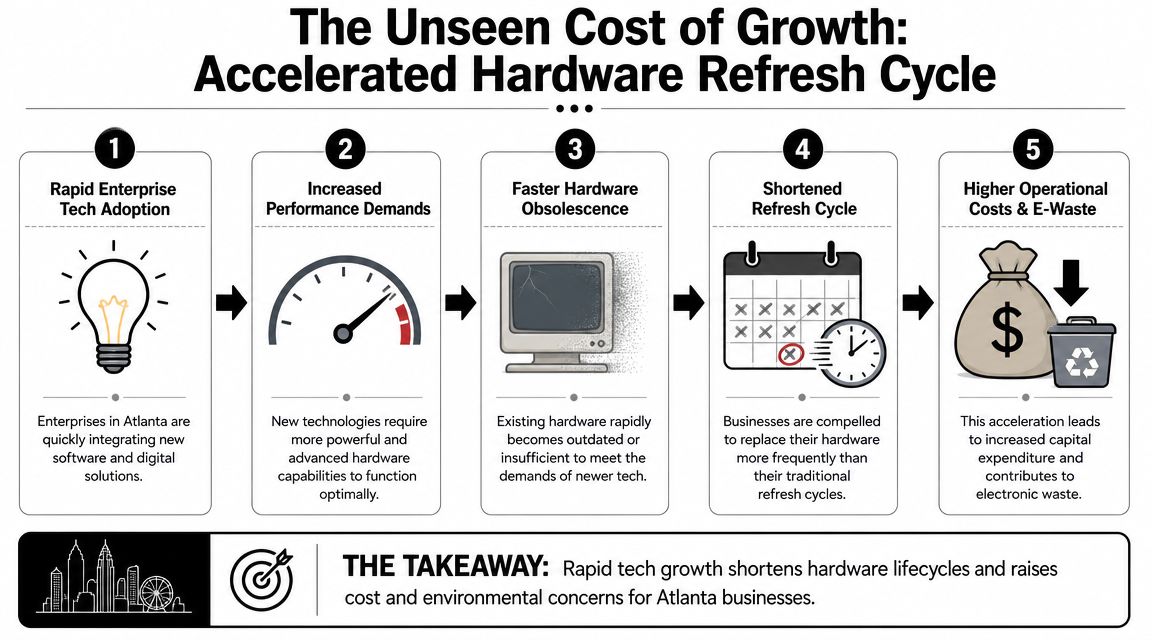
The Unseen Cost of Growth The Accelerated Hardware Refresh Cycle
One of the weakest assumptions in local tech coverage is that growth mostly means more software spending and more cloud usage. Some of it does. But that view misses what IT managers see on the ground. New platforms often trigger infrastructure replacement long before legacy hardware reaches its natural end.
Georgia Tech's ATDC reported that in 2024 it added 34 startups, reached 141 active portfolio companies, and those companies generated more than $203 million in revenue while raising over $216 million in capital, according to ATDC's 45-year impact and growth update. That matters because startup formation and funding don't stay confined to founders. They create downstream demand for cloud services, security tooling, networking, managed infrastructure, office systems, and eventually replacement hardware as firms scale.
Why refresh cycles compress before budgets catch up
Most enterprises still think in planned lifecycle windows. Atlanta's current market reality pushes against that. A new security standard can retire aging laptops early. An analytics rollout can expose weak storage performance. A consolidation effort can leave rooms full of still-functional gear that no longer fits the new architecture.
That's why I think of enterprise growth here as a treadmill. Companies aren't replacing equipment only because it's broken. They're replacing it because adjacent systems changed.
A few common triggers:
- Platform standardization: Mergers, consolidations, and policy changes strand nonstandard assets.
- Security upgrades: Legacy endpoints and network devices may fall short of current controls.
- AI and analytics workloads: New demands can push firms to refresh servers, storage, and higher-performance user devices.
- Office and facility reconfiguration: Hybrid work and relocation projects often accelerate hardware separation and disposal.
The budget problem hides in the back half
CFOs usually see acquisition costs early. They see disposal costs late, often after the project is approved. That's where teams get squeezed. Secure de-installation, transportation, inventory reconciliation, data destruction, and remarketing all take planning. If they're not scoped from the start, the “cheap” project becomes expensive in labor, delay, and audit effort.
For teams trying to benchmark local market conditions, IT asset remarketing trends in Atlanta are useful because they frame retired assets as a financial and governance issue, not just a sustainability one.
A refresh project isn't finished when new equipment goes live. It's finished when the old environment is documented, sanitized, removed, and reconciled.
The strategic point is easy to miss: Atlanta's growth in enterprise technology adoption likely increases physical lifecycle pressure even when headlines emphasize software and cloud. That's why mature IT organizations now treat end-of-life handling as part of modernization, not as janitorial cleanup after it.
Navigating IT Asset Disposition and Compliance in Atlanta
Once hardware starts moving out of production, the issue stops being architecture and starts being governance. This transition often exposes many strong IT teams. They run good deployments and weak retirements.
For Atlanta organizations in healthcare, education, government, and financial services, the compliance risk usually falls into two buckets. First, sensitive data remains on drives, SSDs, backup media, and embedded storage. Second, the organization can't prove what happened to the equipment after it left the site.
Data destruction has to be documented, not assumed
A powered-off device is still a data-bearing asset. So is a failed drive. So is a storage array that won't boot. Teams often underestimate how much residual information exists in equipment that no one plans to reuse internally.
That's why the process matters more than the intention. If you're evaluating outside guidance on governance requirements, broad overviews of IT compliance services can help frame where technology controls, records, and vendor management intersect. But at the asset level, the practical questions are more specific:
- What sanitization method was used
- Who handled the asset at each stage
- Was destruction logical, physical, or both
- What documentation exists for audit review
- Was any equipment remarketed, and under what controls
Environmental handling is also a business risk
A lot of IT managers still hear “e-waste” and think of sustainability reports. Legal, procurement, and compliance teams hear something else. They hear vendor due diligence, downstream handling, and reputational exposure if discarded electronics are mishandled.
That's especially important when projects involve mixed loads: usable laptops, dead printers, monitors, servers, batteries, networking gear, and storage media. A secure program has to separate what can be reused from what must be destroyed, and it needs records that support those decisions.
What a defensible disposition workflow looks like
A workable process usually includes the following:
Inventory before removal
Record serials, asset tags, device type, location, and ownership status before anything leaves the building.Classify by data risk
Treat servers, storage, laptops, and network appliances differently from low-risk peripherals.Define the destruction path
Some media can be sanitized for remarketing. Some should be physically shredded because condition, age, or policy makes reuse inappropriate.Maintain custody records
The handoff between site staff, movers, and downstream processors is where gaps often appear.Retain certificates and reports
If a regulator, auditor, or internal reviewer asks later, the paperwork needs to exist and match the inventory.
For organizations comparing local vendors, a directory of IT asset disposition companies is a practical starting point because it helps teams distinguish between general electronics pickup and true enterprise ITAD workflows.
If your team can't show who handled each retired asset, when it was sanitized, and how final disposition was completed, your process isn't mature enough for regulated environments.
A Practical IT Lifecycle Framework for Atlanta Managers
Atlanta's pace of enterprise change has a practical consequence for IT managers. Hardware reaches retirement faster, project teams close refreshes under tighter timelines, and any weakness in lifecycle controls turns into budget leakage or a compliance problem.
A workable framework starts before deployment and ends only when finance, security, and operations can reconcile every retired asset. That matters in Atlanta because many organizations are scaling cloud, endpoint, and facility changes at the same time. In that environment, retired laptops, servers, storage arrays, and network gear can pile up faster than internal teams can document and process them.
Start lifecycle planning at procurement
Procurement is where lifecycle discipline either gets built in or deferred until it becomes expensive. If the purchase request does not define data sensitivity, expected service life, redeployment rules, and retirement requirements, the cleanup work shifts to the end of the project, when ownership is usually fragmented.
A practical intake standard should answer five questions:
- What data will the asset store or process?
- What business event triggers retirement or redeployment?
- Can the asset be reused internally, and under what conditions?
- What sanitization or destruction method applies at end of life?
- Which team signs off on final inventory reconciliation?
That approach keeps retirement from becoming an afterthought. It also gives procurement and security a common record before the asset enters production, which makes later audit work far easier.
Teams building or revising that process can use these IT lifecycle management best practices as a reference point for aligning purchasing, reuse, and disposition decisions.
Budget for retirement the same way you budget for deployment
Many Atlanta organizations estimate hardware, software, implementation labor, and support with reasonable accuracy. They do not reserve enough for de-installation, packing, transport, sanitization, reporting, and final disposition. The result is predictable. Assets sit in storage longer than planned, project closeout slows down, and finance cannot determine whether the organization recovered residual value or absorbed avoidable disposal cost.
Budgeting works better when it separates retirement into distinct operating categories:
- Removal and logistics: De-installation, packing, transport, site access, and coordination with facilities
- Data handling: Wiping, shredding, verification, and documentation
- Value recovery and write-off support: Reuse, remarketing, recycling, and accounting support for retired assets
For an IT manager, this is not just accounting hygiene. It affects whether a refresh stays within budget and whether the team can prove that retired equipment was handled under policy.
Organizations that need a broader governance reference can review IT compliance services alongside their internal security standards. The local execution question is more specific. Which vendor takes custody, what evidence do they produce, and will that documentation stand up to an internal audit or regulator review?
Evaluate ITAD vendors as security-relevant third parties
Vendor selection should reflect the fact that retired hardware still carries data, ownership history, and compliance exposure. A provider moving loaded storage media out of an Atlanta office or data center is not performing a generic hauling function. That provider is handling a controlled part of your security and records process.
A stronger evaluation usually includes these criteria:
- Recognized certifications: R2 or e-Stewards should be part of the review
- Defined sanitization methods: The provider should specify when data wiping is acceptable and when physical destruction is required
- Asset-level reporting: Device-specific records matter more than broad batch summaries in regulated environments
- Operational capacity: The vendor should be able to support office pickups, campus consolidations, and data center decommissions without ad hoc process changes
- Chain-of-custody controls: Each transfer point should be documented from pickup through final disposition
One local example is Atlanta Computer Recycling. Based on its published service information, the company provides business ITAD, pickup logistics, de-installation support, DoD 5220.22-M 3-pass wiping, and physical shredding for obsolete media. For Atlanta managers, that scope matters because the operational problem is rarely limited to recycling. It is coordinating security, facilities, procurement, and finance without losing the asset trail.
Use lifecycle maturity to improve operations, not just reduce risk
The direct benefit is better control over retired equipment. The larger benefit is operational. Teams with a defined lifecycle model close projects faster, maintain cleaner inventory records, reduce ad hoc storage of retired devices, and give finance a clearer view of recovery value versus disposal expense.
That has a compliance effect too. If legal, audit, or security asks six months later what happened to a retired storage array or a batch of user devices, the answer should come from records, not email reconstruction.
In Atlanta's growth cycle, that distinction matters. Organizations can adopt new technology quickly and still lose ground operationally if old hardware accumulates outside policy. The managers who treat lifecycle management as part of infrastructure governance, rather than as end-of-project cleanup, usually protect budget, reduce audit friction, and keep modernization work from creating a new class of unmanaged risk.
If your organization is planning a refresh, office closure, server retirement, or data center decommissioning in metro Atlanta, Atlanta Computer Recycling is one business-focused option for secure IT asset disposition, electronics recycling, data destruction, and pickup logistics. For IT managers, the practical value is a documented process for removing retired equipment while maintaining control over security, compliance, and environmental handling.