IT Asset Remarketing Trends in Atlanta: 2026 Guide For


You're probably dealing with this right now. A laptop refresh is underway. A floor of users in Midtown is getting new devices. A clinic group on the north side is replacing workstations. A server room in Alpharetta has gear coming out of racks faster than your team can label it. The old habit is to treat all of that equipment as disposal.
That approach leaves money on the table and creates avoidable risk.
The better way to look at IT Asset Remarketing Trends in Atlanta is this: your retired hardware sits inside a local resale and reuse economy, but only if you manage the details correctly. In Atlanta, those details are highly local. Building access, loading dock windows, traffic, healthcare compliance, school refresh cycles, startup demand for affordable hardware, and data-center turnover all shape what value you recover and how safely you recover it.
Why Atlanta's IT Asset Remarketing Scene Is Unique
An Atlanta IT director rarely deals with a simple cleanout. More often, the project is mixed. You have current laptops that still hold resale value, desktops that may fit secondary office use, networking gear that might move through broker channels, and storage media that should never leave your control without verified sanitization.
That mix matters because Atlanta isn't a one-dimensional market. The metro area has large healthcare systems, universities, public agencies, logistics operations, creative production environments, and a steady stream of growing companies that need functional equipment without always buying new. That local demand changes the economics of retirement decisions.

The broader market supports that shift. The global IT asset disposition market was valued at USD 18.4 billion in 2024 and is projected to reach USD 26.6 billion by 2029, with refurbishment and remarketing helping drive growth, according to MarketsandMarkets coverage of the ITAD market. For Atlanta businesses, that means your local refreshes and decommissions feed into an active resale pipeline if assets are wiped, graded, and routed correctly.
What makes Atlanta different on the ground
In practice, Atlanta remarketing depends on a few conditions that aren't always obvious at planning time:
- Dense metro logistics: Downtown and Buckhead pickups are different from a suburban office park. Elevator reservations, dock access, and after-hours removal windows affect chain of custody and labor.
- Mixed buyer demand: A startup may want recent laptops. A school may prefer standardized fleets. A healthcare-adjacent buyer may look for dependable commercial desktops and displays.
- Data-center proximity: The region's enterprise and colocation footprint means more decommissioning work, which creates secondary-market supply for servers, networking components, rails, and parts.
Atlanta projects succeed when IT teams sort inventory before the truck arrives. Assets with resale value need a different path from obsolete gear and failed media.
If you're tracking broader Atlanta IT asset lifecycle trends for growing businesses, this is the key local takeaway: Atlanta gives you more opportunity than a scrap-only mindset assumes, but it also punishes sloppy execution. A pallet of unlabeled mixed equipment loses value fast. So does equipment that sits too long after refresh approval.
The local opportunity
What works in Atlanta is speed plus discipline. Pull serials early. Separate reusable hardware from end-of-life equipment before movers or facilities teams start handling it. Keep powered testing, grading, and sanitization close to the front of the process.
What doesn't work is treating every retired asset as e-waste from day one. In this market, that's often the most expensive decision you can make.
Shifting Your Mindset from IT Disposal to Asset Recovery
A lot of companies still handle retired hardware the way people scrap an old car for metal. It's quick, final, and easy to explain. But if the car still runs, that's the wrong economic decision. The same logic applies to business IT.
If a device can be securely sanitized, tested, and resold, it shouldn't be managed like broken scrap.
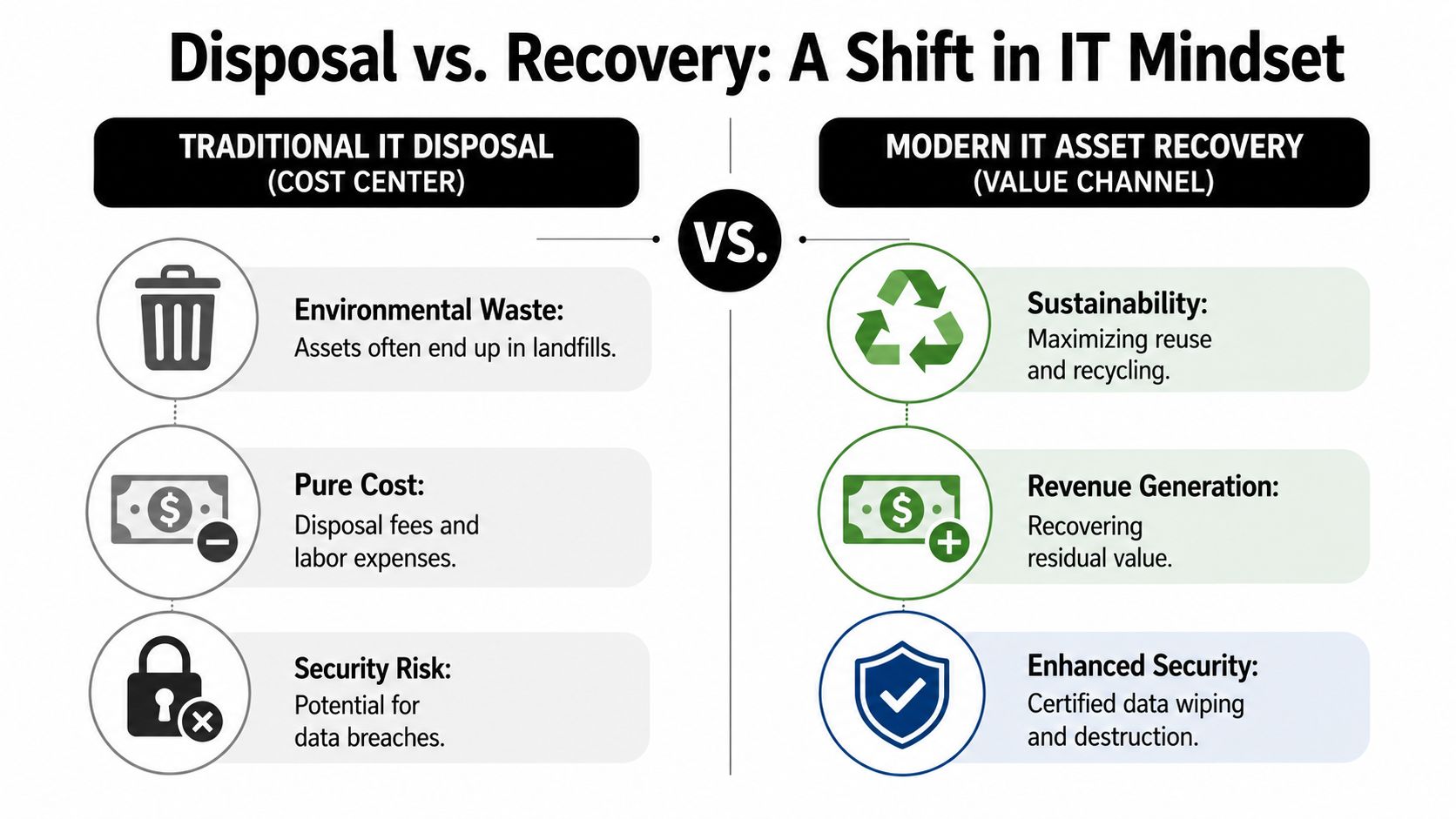
The market is moving in that direction. Market research for 2026 projects the global ITAD market growing from $23.0 billion in 2026 to $34.97 billion by 2030, and it identifies remarketing programs as a major trend, according to Research and Markets reporting on the ITAD market. That matters because enterprises aren't just trying to get rid of equipment anymore. They're trying to recover value without compromising security.
Why the old disposal model underperforms
The disposal-only model usually creates three problems at once.
- You lose residual value: Devices with working CPUs, RAM, SSDs, batteries, and usable cosmetics often still belong in resale channels.
- You reduce optionality: Once media is physically destroyed or units are mishandled, you've eliminated redeployment and remarketing paths.
- You blur reporting: Destruction-only workflows can simplify one part of compliance, but they often obscure which assets still had value and which ones were correctly triaged.
A modern ITAD program starts with a harder question: which assets should be wiped for resale, which should be redeployed internally, and which should go straight to destruction and recycling?
What asset recovery looks like in practice
Strong asset recovery doesn't mean trying to resell everything. That's where some programs fail. Teams waste time boxing obsolete printers, damaged low-value peripherals, or old endpoints that cost more to process than they're worth.
The right approach is selective.
- Identify value-bearing categories early. Laptops, newer desktops, enterprise servers, switches, and certain components usually deserve a recovery review.
- Protect condition during collection. Good hardware loses value when it's stacked carelessly, shipped loose, or tagged late.
- Match sanitization to the endpoint. Devices headed for resale need auditable erasure. Failed or highly sensitive media need physical destruction.
- Expect a settlement mindset. Recovery should show up in reporting, not as a vague promise.
Practical rule: Don't ask, “How do we dispose of this batch?” Ask, “Which portion of this batch still has recoverable value after secure processing?”
That one shift changes how your team inventories devices, how procurement thinks about refresh timing, and how finance looks at retired equipment. It also changes vendor selection. A recycler focused only on outbound removal won't manage grading, resale routing, or value recovery with the same rigor.
For some Atlanta organizations, the first step is learning how old electronics can generate cash through organized value recovery. The key is not the phrase “for cash.” It's the operational discipline behind it. Recovery only works when equipment stays identifiable, secure, and marketable.
Where companies get this wrong
They wait too long. They mix high-value devices with junk inventory. They let facilities teams move sensitive assets without serialized manifests. They ask for destruction on everything because it feels safer, even when erasure and resale would have satisfied policy and preserved value.
Recovery is not a softer version of compliance. It's a stricter one. You need better controls, not fewer.
Identifying Buyers for Your Retired IT Assets in Atlanta
Atlanta's secondary market isn't one buyer. It's several overlapping ones, and they don't want the same things. If you're trying to maximize return, your equipment should be sorted with the buyer in mind, not just the asset type.
A batch of business laptops, for example, may appeal to startup operators looking for standardized user devices. A stack of older but functional monitors may move through budget-conscious office buyers. Enterprise networking components often follow a different route entirely through resellers and specialized brokers.
Buyer demand by segment
Here's a practical way to think about Atlanta buyer demand for refurbished IT assets.
| Atlanta Buyer Segment | Primary Hardware Demand | Key Purchase Driver |
|---|---|---|
| Startups and SMBs | Recent laptops, desktops, monitors, docks | Lower capital cost for office growth |
| K-12 schools and higher education | Standardized laptops, Chromebooks, desktops, displays | Budget control and consistency across users |
| Healthcare-adjacent organizations | Commercial desktops, displays, some mobile devices | Reliable performance with compliance-conscious sourcing |
| Film and creative production teams | Workstations, monitors, storage accessories, networking gear | Short-notice project needs and practical cost management |
| Enterprise resellers and brokers | Servers, switches, RAM, SSDs, CPUs, parts lots | Component value and secondary-market demand |
| Nonprofits and community programs | Usable office endpoints and displays | Affordable access to functional equipment |
This table isn't a price guide. It's a routing guide. The point is to understand why one category sells cleanly and another drags.
What tends to move well
In Atlanta, devices that combine business-grade specs with good physical condition usually have the strongest remarketing path. That includes laptops with current-enough processors, healthy batteries, intact screens, and standard configurations. Uniformity matters. Fifty matching laptops are easier to remarket than fifty different models.
Server and network assets work differently. Buyers often care less about cosmetics and more about part numbers, firmware relevance, rail kits, transceivers, caddies, memory configurations, and whether gear is complete. If your team strips accessories or loses mounting hardware during deinstall, you may reduce resale options before the equipment even leaves the site.
The fastest way to weaken a remarketing lot is to treat accessories as unimportant. Missing power supplies, caddies, and docking stations often make resale harder, even when the core device is still useful.
Atlanta-specific buyer behavior
Local demand in Atlanta often reflects operating reality more than headline trends. Small firms expanding into new space may prefer reliable refurbished fleets over new purchases that tie up budget. Educational organizations care about standardization and supportability. Healthcare buyers and regulated organizations usually won't touch inventory unless the sanitization and chain-of-custody story is clear.
That means your internal asset notes should include more than “used laptop” or “old switch.” Strong resale preparation usually captures:
- Model consistency: Matching units attract more predictable buyer interest.
- Condition visibility: Cracked bezels, dead batteries, engraving, and BIOS locks matter.
- Completeness: Chargers, docks, rails, and drive caddies change marketability.
- Disposition suitability: Some items are resale candidates. Others belong in parts harvest or recycling.
What usually underperforms
Low-end peripherals, heavily damaged endpoints, obsolete printers, random cables, and incomplete desktop lots often absorb handling time without creating much recovery. That doesn't mean they should be ignored. It means they should be processed on a lower-touch track.
Many Atlanta projects frequently stall at this stage. Teams spend too much time trying to extract value from the wrong categories and not enough time protecting the categories that buyers want. If you're planning a larger clearout, it helps to approach it as IT asset liquidation in Atlanta rather than generic recycling. Liquidation forces a harder look at what has market demand, what belongs in wholesale channels, and what should move directly to compliant recycling.
The practical filter
Ask three questions before an item enters your remarketing stream:
- Is there a likely buyer class for this asset?
- Can it be securely sanitized without destroying the asset?
- Is the expected recovery worth the labor, logistics, and reporting effort?
If the answer is no on any of those, recycling may be the better path. Good remarketing is selective, not optimistic.
Navigating Data Security and Compliance in Asset Remarketing
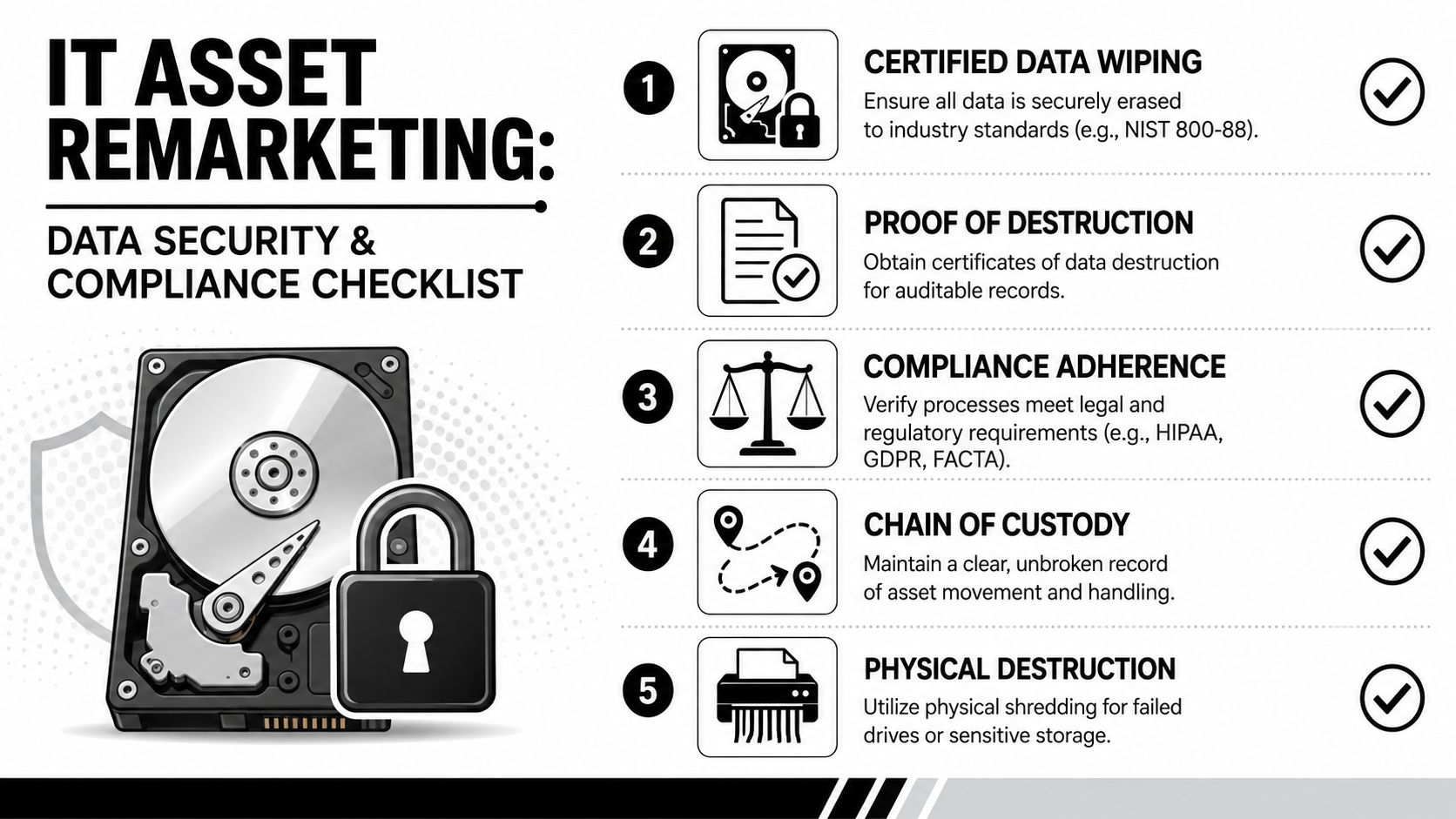
The biggest misconception in remarketing is that resale is less secure than destruction. In a poorly run program, that's true. In a disciplined one, remarketing usually requires tighter process control because the asset remains intact and traceable all the way through sanitization, grading, and downstream disposition.
That's why secure erasure matters so much. Industry forecasts for 2026 project the data erasure segment at 23.5% of the ITAD market, while large enterprises are projected to account for 62.9% of demand, according to Coherent Market Insights coverage of the ITAD market. The practical message is clear. Enterprises want both security and value recovery, and erasure enables resale when it's done correctly.
The real decision is wipe or shred
You don't need one rule for every device. You need disposition rules by category.
For many laptops, desktops, and some servers, auditable data erasure preserves value because the device can still be tested and resold. For failed drives, damaged media, or highly sensitive storage, physical destruction is the correct answer. The mistake is applying one method to everything just because it simplifies the paperwork.
A sound policy usually separates assets into three buckets:
- Resale-eligible assets: Sanitization first, then testing and grading.
- Redeployment candidates: Sanitization, validation, and return to internal use.
- Destruction-only assets: Failed media, unsupported storage, or assets with policy restrictions.
What Atlanta healthcare and public-sector teams should watch
Atlanta has a high concentration of healthcare and public institutions. In those environments, your remarketing partner needs to support auditable handling, not just pickup. That means serialized inventory, chain-of-custody records, certificates tied to media handling, and a process that stands up in an internal review.
When teams get nervous, they often overcorrect and shred everything. That can satisfy one concern while creating another. You lose recoverable value from assets that could have been securely erased and remarketed. The better policy is to define when destruction is mandatory and when verified erasure is sufficient.
A vendor checklist that actually matters
Use this checklist when you vet a remarketing partner:
- Sanitization standard: Ask what data-erasure method they use, how it's documented, and when they require physical shredding instead.
- Serialized chain of custody: Every asset should be trackable from pickup through final disposition.
- Exception handling: Failed drives, encrypted devices, BIOS-locked systems, and damaged assets need documented workflows.
- Reporting quality: You want asset-level reporting, not broad summaries that hide exceptions.
- Facility process: Ask where sorting, wiping, testing, and destruction occur, and who controls each step.
If a vendor can't explain what happens when a drive fails sanitization, you don't yet know their security process.
You should also look at how the partner handles mixed projects. A downtown office closure may include routine endpoints, executive laptops, storage media, and a few legacy systems with special retention concerns. A vendor who only talks about “pickup and recycle” usually won't give you the control you need.
For organizations that need a local benchmark for certified data destruction practices in Atlanta, focus on documentation quality and asset-level traceability. Those are the controls that protect you when audit questions show up months later.
What works and what doesn't
What works is a two-stage model. First, sanitize according to policy and asset condition. Then route assets to resale, redeployment, parts harvest, or destruction.
What doesn't work is blending those decisions after collection with no category rules. That's when assets disappear into gray areas, reports become vague, and compliance teams lose confidence in the whole program.
Managing Logistics for IT Decommissioning in Metro Atlanta
The hard part of remarketing often isn't finding value. It's moving equipment out of active environments without breaking operations or custody.
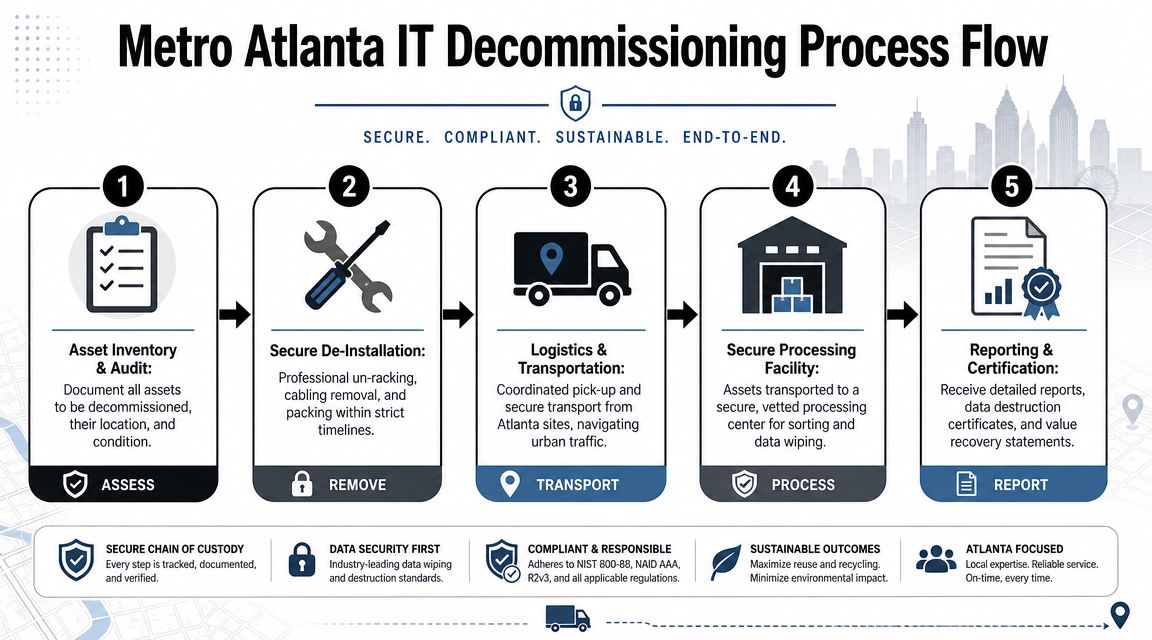
That challenge looks different across metro Atlanta. A downtown tower may require after-hours access, freight elevator reservations, COI paperwork, and tight dock windows. A suburban data-center project may require staged unracking, palletization, and removal sequencing so production systems stay untouched. Both are logistics projects before they become remarketing projects.
The scale of the need is large. The U.S. ITAD market is projected at USD 5.3 billion in 2025, and government agencies alone spend over $200 billion annually on IT, with growth tied to data-center consolidation and compliance requirements, according to GM Insights analysis of the ITAD market. That scale is one reason professional, auditable logistics matter so much.
What a well-run Atlanta pickup looks like
A good decommissioning plan starts before the truck arrives. Your team should know which assets are coming out, where they sit, whether they require deinstallation, and what route they'll follow once removed. That sounds basic, but a surprising number of projects still rely on ad hoc decisions in the loading dock.
The most reliable programs usually include:
- On-site inventory confirmation: Validate serials and physical counts before assets move.
- Deinstallation support: Unrack servers, pull cables, remove accessories, and keep complete kits together.
- Packing by asset class: Laptops, monitors, servers, and loose components shouldn't be packed the same way.
- Secure transportation: Once assets leave your floor, chain of custody should continue without ambiguity.
For organizations trying to tighten transport discipline between sites and processing points, it helps to think in terms of middle-mile logistics, especially when you're coordinating multiple pickups, consolidation stops, or regional decommissioning waves.
Common Atlanta failure points
The most common failures are operational, not technical.
A facilities crew stacks laptops on rolling carts with no scan step. Dock timing forces rushed loading. A server lot loses rails and caddies during removal. A project manager schedules pickup before badges, elevators, and after-hours approvals are confirmed. None of these sound dramatic, but every one of them affects value, security, or both.
Field note: The safest project is rarely the fastest pickup. It's the pickup with the clearest manifest, access plan, and handling sequence.
One practical option for local projects is using a provider with IT equipment pickup services in Atlanta that include deinstallation, packing, and serialized handling rather than basic haul-away. That difference matters most in mixed office and server-room projects, where one bad handoff can wipe out both recoverable value and audit confidence.
The logistics standard to aim for
You want one chain from site survey to final report. Inventory, pickup scheduling, building access, packing method, transport, processing, and documentation should fit together. If each step is handled by a different party with different records, reconciliation becomes painful fast.
In metro Atlanta, logistics discipline is what turns an IT cleanout into a controlled value-recovery project.
A Strategic Framework for Maximizing Your IT Asset Value
A typical Atlanta refresh goes sideways in familiar ways. Laptops from a Midtown office move fast because there is local demand, but aging clinical devices from a healthcare site need tighter documentation, and retired workstations from a film production team may have value only if they stay complete and tested. If you want stronger recovery, set the strategy before anything leaves the building.
Start with internal triage tied to business rules, not just hardware type. Your IT team should know which assets are approved for resale, which must be destroyed because of policy or failed media, and which still make sense for internal redeployment. Companies that do this well recover more value because they are not making disposition decisions on the loading dock.
Build that sort around three filters. First, asset class. Endpoints, servers, network gear, storage, and peripherals move through different resale channels. Second, condition. A clean, late-model laptop with a power adapter belongs on a different path than a damaged unit missing parts. Third, data and compliance exposure. In Atlanta, that distinction matters because healthcare systems, financial firms, and enterprise back offices often have stricter documentation requirements than startup offices clearing general user devices.
A useful operational model comes from warehouse discipline. The same logic in this guide to boosting e-commerce inventory efficiency applies here. Clear categorization, location control, and handling rules protect resale value and reduce reconciliation problems later.
Provider selection should follow that internal sort. Ask questions that expose how the process works in the field.
- How is chain of custody recorded at the serial level?
- What is the disposition rule for assets that fail sanitization?
- How are resale units separated from scrap, destruction-only media, and parts harvest?
- What does the reporting package show for exceptions, missing assets, and final downstream disposition?
- Which local and regional buyer channels are used for endpoints, infrastructure gear, and commodity scrap?
Those answers matter in Atlanta because the buyer mix is not generic. Startup demand can support newer laptops and monitors. Healthcare and corporate environments may create interest in specific commercial-grade equipment. Production companies and post houses can create demand for certain performance workstations and accessories, but only when configuration details are preserved. If your provider treats everything as bulk electronics, you lose margin.
Set asset-level rules in writing before pickup. A newer laptop fleet may go to sanitization, grading, and resale. Failed drives may go straight to shredding. Data center gear may require deinstallation, accessory matching, and parts evaluation before any resale decision is made. One blanket instruction usually causes two expensive mistakes. Valuable equipment gets destroyed, or sensitive equipment gets handled with weak documentation.
The review at the end should be as disciplined as the planning at the start. Check serial reconciliation, destruction records, exception handling, resale versus recycling decisions, and the value recovery summary. If an item was recycled, the report should make the reason clear. If an item was destroyed, you should be able to trace that decision to policy, condition, or sanitization failure.
The strongest programs in metro Atlanta treat remarketing as part of the refresh cycle, not a one-time cleanout. That means pre-approved disposition rules, site-specific handling instructions, and a reporting standard your compliance and procurement teams both accept. That is how you protect data, keep projects moving across a congested metro area, and get the most return from retired IT assets.