Atlanta IT Asset Liquidation: A Guide to Secure & Profitable Asset Retirement


When your company's technology reaches its end-of-life, the subsequent steps represent a significant financial and security decision. Atlanta IT asset liquidation is the strategic process for managing retired equipment—including servers, laptops, and networking gear—to maximize its residual value while ensuring all sensitive data is irretrievably destroyed. It's about converting a potential liability into a calculated financial return.
What IT Asset Liquidation Means for Atlanta Businesses
Consider your company’s outdated IT hardware as a fleet of retired corporate vehicles. You wouldn't send them all to a scrap yard without evaluation. Instead, you would assess each asset, identify which can be sold, which have valuable components for salvage, and only then, responsibly scrap the remainder. IT asset liquidation applies this same business logic to your technology infrastructure.
The process is designed to address the two primary challenges for any Atlanta business undergoing a technology refresh: safeguarding sensitive corporate data and recovering capital from original investments. Without a structured plan, retired assets accumulate in storage, posing both a security risk and a missed opportunity for revenue recovery.
The need for this service is driven by specific business imperatives.
Here is an overview of why Atlanta companies engage in IT asset liquidation:
Key Drivers for IT Asset Liquidation in Atlanta
| Business Driver | Primary Goal | Industries Most Affected |
|---|---|---|
| Technology Refresh Cycle | Recover capital to offset the cost of new equipment. | Data Centers, Tech Companies, Corporate Offices |
| Data Center Consolidation | Securely dispose of redundant hardware and maximize resale value. | Finance, Healthcare, Government Agencies |
| Office Relocation/Closure | Liquidate all assets quickly and efficiently to clear a facility. | Any business undergoing physical transition. |
| Regulatory Compliance | Ensure data destruction meets legal standards (e.g., HIPAA, SOX). | Healthcare, Financial Services, Legal |
| Environmental Mandates | Meet corporate sustainability goals by avoiding landfills. | All industries with ESG commitments. |
Ultimately, a professional liquidation strategy is about more than just equipment disposal.
The Core Goals of IT Liquidation
An effective liquidation plan extends far beyond simple removal. The primary objectives are to:
- Recover Maximum Value: Identify equipment with market viability, channel it to secondary markets, and convert it back into working capital for your business.
- Guarantee Data Security: Ensure every data-bearing device is sanitized or physically destroyed according to certified standards, protecting your organization from a breach.
- Maintain Compliance: Adhere to all environmental regulations and industry-specific data privacy laws, such as HIPAA for healthcare providers in the Atlanta area.
- Promote Sustainability: Responsibly recycle assets with no resale value, keeping hazardous e-waste out of landfills and supporting your corporate social responsibility initiatives.
This entire practice falls under the umbrella of IT Asset Disposition (ITAD), a broader term for managing the complete lifecycle of technology. To learn more, you can explore our guide on what IT asset disposition entails.
This is not a cleanup task; it is an essential component of modern IT and financial management. By treating retired hardware as assets rather than refuse, you can unlock hidden revenue while strengthening your data security posture.
Atlanta has long been a significant center for this industry. In the mid-2000s, as corporations accelerated their technology refresh cycles, the city became a central hub for IT asset liquidation. Local firms emerged to manage the growing volume of electronic waste. This was critical; the U.S. Environmental Protection Agency reported that by 2007, Americans were disposing of over 63 million computers annually, highlighting the scale of the e-waste challenge for businesses nationwide.
The Step-by-Step Liquidation Process Unpacked
Undertaking an IT asset liquidation project can seem daunting, but it follows a clear, methodical process. For any Atlanta business, this is how you transform retired equipment from a logistical challenge into a secure, accountable, and often profitable venture. It begins with a fundamental question: what assets do you possess?
The first phase is a detailed inventory and evaluation. This is more than a simple equipment count; it is a strategic assessment of each asset. A qualified ITAD partner collaborates with your team to categorize every server, laptop, and network switch by its age, condition, and current market value. This step is crucial, as it distinguishes valuable assets from obsolete ones and establishes a clear path for maximizing financial return.
Once the inventory is established, the focus shifts to creating a plan that aligns with your timeline and operational requirements.
De-Installation and Secure Logistics
With a plan in place, the hands-on work begins with professional on-site de-installation. For large-scale projects like a data center decommission, specialized expertise is essential. You can get a deeper look at what that involves in this comprehensive guide to the data center decommissioning process. Our crews manage the entire process—from carefully disconnecting servers in a live environment to palletizing equipment for secure transport, all while minimizing disruption to your operations.
Every device that holds data is cataloged and tracked from the moment it is disconnected. This creates the chain-of-custody, a critical document that provides an unbroken audit trail for every asset. Our dedicated local fleet manages the secure transit, ensuring your equipment is protected from your facility to ours.
This diagram illustrates how the core stages—assessment, security, and recovery—are integrated.
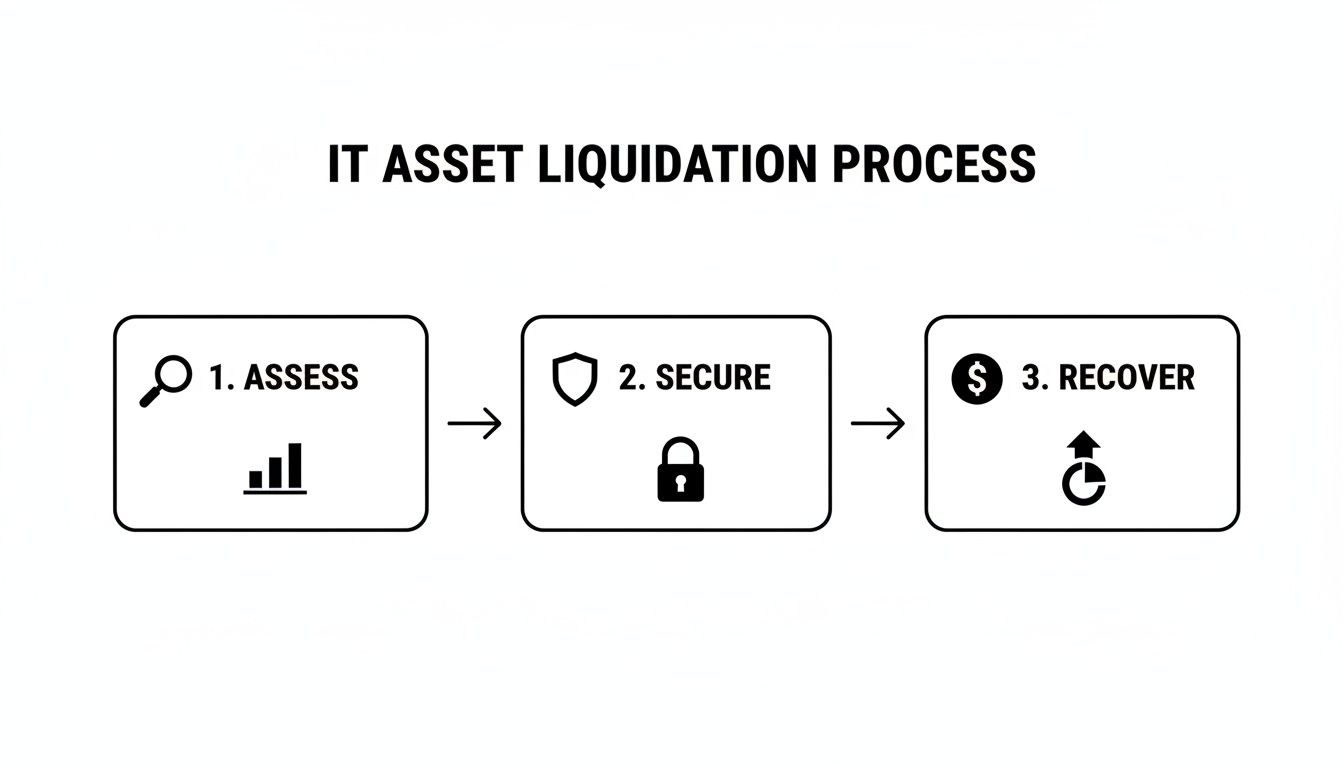
As you can see, a successful liquidation is not a single action. It is a sequence of specialized steps designed to protect your data and extract maximum residual value.
Processing at a Secure Facility
Upon arrival at our secure Atlanta facility, your assets undergo triage. This is where the initial evaluation is validated. Our technicians test and grade each piece of hardware to determine its optimal disposition path.
This part of the process involves several key actions:
- Receiving and Auditing: We verify the shipment against the initial inventory and chain-of-custody documentation, ensuring every asset is accounted for without exception.
- Certified Data Destruction: This is our highest priority. All data-bearing devices undergo a rigorous sanitization process that meets or exceeds standards like DoD 5220.22-M. If a drive cannot be wiped or is non-functional, it is physically shredded for complete destruction.
- Component Testing and Refurbishment: Assets with resale potential are cleaned, tested, and refurbished to market-ready condition. Our technicians often harvest valuable components like RAM, CPUs, and hard drives from non-working units for individual sale.
All this meticulous work occurs behind the scenes, but it is what unlocks the value in your retired technology while guaranteeing your data is permanently eliminated.
The single most critical moment in the liquidation process is when assets leave your premises. A transparent, documented, and secure logistics plan is not optional; it is non-negotiable for protecting your business from data breaches and asset loss.
Finally, we conclude the project with detailed reporting and financial settlement. You receive a Certificate of Data Destruction—your legal proof of compliance—along with a final settlement report. This document itemizes the resale value recovered for each asset and lists any recycling fees. If your equipment generated a positive return, you receive payment, converting a disposal cost into a revenue stream. Any asset without value is responsibly recycled according to R2 standards, ensuring your project is environmentally compliant.
Protecting Your Business with Secure Data Destruction
When your company's technology is retired, the most critical consideration is the sensitive data it contains. The entire process of Atlanta IT asset liquidation is founded on a non-negotiable principle: absolute, verifiable, and permanent data destruction. This is how your business is shielded from devastating legal, financial, and reputational damage.
Neglecting this step is akin to vacating a bank while leaving the vault open. The physical hardware may be gone, but the true value—your customer data, financial records, and intellectual property—remains dangerously exposed. A single improperly sanitized hard drive can lead to a data breach with catastrophic consequences.
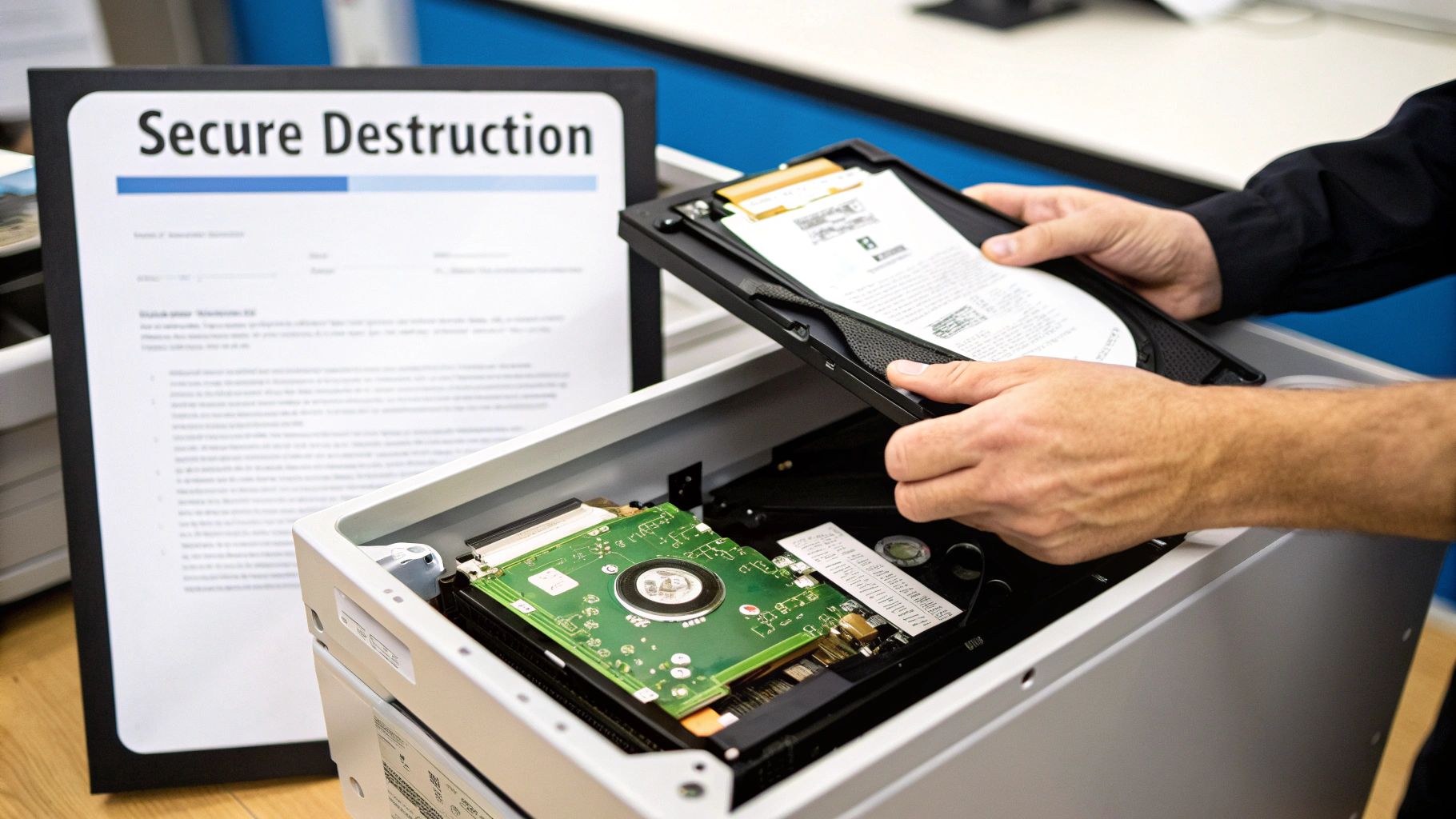
This is especially true for Atlanta's major industries. Healthcare providers are bound by HIPAA regulations, where a single breach can result in millions in fines. Financial and legal firms face similarly stringent compliance requirements. The risk is not a remote possibility; it is a direct threat to your bottom line and the trust you have cultivated with your clients.
Choosing the Right Method of Destruction
Not all data destruction methods are created equal. The optimal approach depends on the device type, your security requirements, and whether the asset retains resale value. The two primary methods are software-based data wiping and physical destruction.
Software wiping, or sanitization, uses specialized programs to overwrite every sector of a hard drive with random characters. This process is repeated, often in multiple passes, to ensure the original information is completely unrecoverable.
- DoD 5220.22-M Standard: This is a well-known military specification for data sanitization that uses a three-pass overwrite process. It is a reliable choice for functional drives intended for resale.
- NIST 800-88 Guidelines: Often considered the modern gold standard, these guidelines provide a comprehensive framework for media sanitization, covering everything from clearing data to complete physical destruction.
For a detailed analysis of these protocols, our guide on secure data destruction provides a full breakdown. Understanding concepts like Advanced Encryption Standards (AES) for data security is also beneficial for any organization serious about data protection.
However, when a drive is damaged or when absolute certainty is required, nothing surpasses physical destruction.
The Finality of Physical Shredding
Physical shredding offers the ultimate guarantee. Much like a paper shredder turns sensitive documents into confetti, an industrial shredder grinds hard drives, solid-state drives, and other media into small, irrecoverable fragments of metal and plastic. Data recovery is impossible. It is the definitive end for your information.
For many organizations, particularly in healthcare and government, the peace of mind afforded by physical shredding is invaluable. It eliminates all doubt and provides indisputable proof of data elimination, simplifying compliance audits and risk management.
Atlanta's IT asset liquidation sector also plays a vital role in responsible e-waste management, which goes hand-in-hand with data destruction. Premier Surplus, Inc., for example, has diverted hundreds of millions of pounds of electronics from Georgia landfills since 2008. This is a significant environmental achievement, especially considering that in 2007, only 15% of electronics in the U.S. were recycled, leaving toxic heavy metals to contaminate the environment. You can learn more about their local environmental impact.
Your Proof of Due Diligence
Once the data is permanently destroyed, a professional ITAD partner provides a critical document: the Certificate of Data Destruction. This is more than a receipt; it is your legal proof of due diligence.
This serialized report lists every asset that was destroyed, the method used, and the date of completion. This certificate serves as your defense against future liability, proving you took all necessary measures to protect your sensitive information.
How to Maximize Your Financial Return

Strategic Atlanta IT asset liquidation is not merely about secure disposal—it is a financial opportunity to convert retired technology back into working capital. The primary question for every business is: what is our old equipment actually worth? Answering this requires a methodical valuation process that distinguishes high-value assets from those destined for recycling.
This initial step is about establishing realistic expectations. Not all IT equipment retains significant value. Enterprise-grade servers, modern networking switches, and newer laptops often have a robust secondary market. Conversely, older desktops, printers, and monitors typically have little to no resale value and are valued based on the recoverable raw materials.
The Asset Valuation Process
Determining an asset's worth is a data-driven assessment, not guesswork. An experienced ITAD partner analyzes several key factors to ascertain an asset's true market price. This detailed evaluation ensures you receive a fair return based on current secondary market conditions.
Here’s what determines an asset's value:
- Age and Generation: Newer equipment, particularly from leading brands like Cisco, Dell, or HP, commands higher prices. A server that is only two or three years old has significant resale potential compared to one that is seven years old.
- Condition: This includes functional, cosmetic, and component completeness. A fully operational unit in good cosmetic condition is worth far more. Missing components, physical damage, or non-functional units will have their value significantly reduced.
- Configuration: Specifications are critical. High-performance CPUs, large amounts of RAM, and high-capacity solid-state drives (SSDs) all add considerable value.
- Market Demand: Like any market, the value of specific models fluctuates based on current supply and demand.
The core principle is straightforward: the easier it is for a device to be refurbished and resold for immediate use, the higher its liquidation value. Assets requiring extensive repairs or that are functionally obsolete will naturally yield a lower return.
Resale Value vs. Responsible Recycling
Identifying which assets have resale potential is key to an effective liquidation strategy. The objective is to pinpoint the equipment that will generate revenue, which in turn helps offset the costs of recycling the remaining assets. It is a balanced approach that connects financial recovery directly to corporate sustainability goals.
Beyond selling retired assets, maximizing your financial return is part of a larger picture of IT efficiency. For a wider perspective, you can explore broader IT cost reduction strategies that complement a smart liquidation plan.
When equipment no longer has resale value, it enters a different value stream: responsible recycling. It is crucial that these items are managed properly for environmental compliance. To understand this process, our guide on what happens to recycled electronics details how materials are recovered and repurposed, guaranteeing nothing ends up in a landfill.
Ready to see how your assets stack up? This table provides a quick overview to help categorize your equipment.
| Asset Valuation Guide: Resale vs. Recycling |
| :— | :— | :— | :— |
| Asset Category | Typical Resale Potential | Common Recycling Indicators | Key Valuation Factors |
| Enterprise Servers | High (if under 5 years old) | 7+ years old, proprietary tech, damaged | CPU model, RAM amount, storage type/size |
| Networking Gear | High (Switches, Routers) | Obsolete standards, low port speeds | Brand (Cisco, Juniper), model, port count |
| Laptops/Desktops | Moderate to High (recent models) | Older than 5-6 years, physical damage | CPU generation (i5/i7/i9), RAM, SSD |
| Monitors | Low | Small screen size (<22"), older tech (CCFL) | Size, resolution, panel type (IPS) |
| Printers/Scanners | Very Low | Most models, especially inkjet or basic laser | High-end multifunction enterprise models may have value |
| Mobile Devices | Moderate | Cracked screens, battery issues, old OS | Model, storage capacity, cosmetic condition |
Ultimately, a reputable ITAD partner will provide a transparent report detailing which items have resale value and which are designated for commodity recovery.
Understanding Revenue Sharing Partnerships
For larger projects, many Atlanta businesses opt for a revenue-sharing partnership. This is a transparent model that aligns our financial interests with yours. Instead of a simple buyout offer, you receive a detailed accounting of every dollar recovered from your assets.
The process typically works as follows: the ITAD partner manages all logistics, data destruction, and processing, deducting these costs from the gross sales revenue. The remaining profit is then split between your company and the partner at a pre-agreed percentage. This model ensures you benefit directly from strong resale values and receive full transparency into the project's financial outcome.
Choosing the Right ITAD Partner in Atlanta
Selecting a partner for your Atlanta IT asset liquidation is one of the most critical decisions in the entire process. This is not about finding a service to simply haul away old equipment; it is about entrusting a company with your sensitive data, regulatory compliance, and corporate reputation.
A correct choice protects you from significant financial and legal liabilities. An incorrect one could expose you to a data breach or environmental fines. You must look beyond the price and evaluate their credentials, processes, and capability to manage your project securely. This vetting process is your first line of defense.
Verifying Certifications and Standards
Begin by verifying their certifications. These are not merely logos for a website—they are hard-earned credentials proving that an independent auditor has scrutinized their processes and approved them for security, safety, and environmental responsibility.
Look for these two industry gold standards:
- R2 (Responsible Recycling): This is the leading global standard for the ITAD industry. An R2-certified partner is guaranteed to follow strict protocols for data sanitization, environmental protection, and worker safety.
- e-Stewards: Another top-tier certification, e-Stewards is specifically focused on preventing the illegal export of toxic e-waste. It demonstrates a profound commitment to ethical and responsible practices.
Choosing a partner with R2 or e-Stewards certification is non-negotiable. It is the most effective way to ensure your retired equipment will not end up in a landfill or become a future data liability.
Essential Questions for Your Potential Partner
Once you have confirmed their certifications, it is time to understand their operational procedures. You are looking for transparency, robust security measures, and clear communication throughout the project.
Prepare a list of questions for any Atlanta ITAD provider you are considering:
- Data Destruction Protocols: How, specifically, do you guarantee our data is destroyed? Ask them to detail their wiping standards (e.g., DoD 5220.22-M or NIST 800-88) and their physical shredding process.
- Chain-of-Custody Documentation: Will we receive a detailed, serialized report tracking every asset from our facility to its final disposition? This documentation is your proof of compliance.
- Logistics and Security: What security measures are in place once our equipment leaves our building? Inquire about GPS-tracked trucks, locked containers, and employee background checks.
- Reporting and Transparency: What final documentation will we receive? You should expect a Certificate of Data Destruction and a final settlement report detailing resale values and recycling fees.
- Insurance Coverage: What is your liability coverage? Ensure they carry sufficient insurance to cover potential data breaches, environmental incidents, or other liabilities.
Engaging a reputable local provider can make a significant difference. For businesses in the Atlanta area, working with an established electronic waste recycling company offers the benefit of local logistical expertise and greater responsiveness. A local partner can often provide more flexible scheduling and faster service, which is invaluable for time-sensitive projects like an office relocation or data center decommission. Performing due diligence now allows you to select a partner you can trust to protect your assets and your business.
Planning Your Liquidation Project Timeline
A successful Atlanta IT asset liquidation operates on a clear, predictable schedule. Just as you would not begin an office renovation without a blueprint, a well-defined timeline serves as your roadmap to a smooth and secure asset retirement project. It helps avoid operational disruptions, manage team resources, and prevent last-minute complications.
While every project is unique, most follow a similar framework. The timeline scales based on the project's size and complexity.
The process begins with an initial consultation and a preliminary inventory assessment, which for a standard office can often be completed within a few business days. This is where we define the scope, identify the assets involved, and provide a preliminary quote.
Typical Liquidation Timeline Scenarios
To provide a realistic expectation, here are a few common scenarios for businesses in the Atlanta area. These examples illustrate how project scope directly impacts the time required for each phase, from on-site execution to final reporting.
-
Scenario 1: 50-Employee Office Move (1-2 Weeks)
- Week 1: We schedule an on-site audit to inventory approximately 50 laptops, desktops, monitors, and associated network gear. A formal proposal is delivered within 48 hours. Upon approval, we schedule the pickup.
- Week 2: Our crew arrives for on-site packing and secure removal, typically completed in a single business day. Within five to seven business days of pickup, you receive your detailed audit report and Certificate of Data Destruction.
-
Scenario 2: School District Summer Refresh (2-4 Weeks)
- Weeks 1-2: The project starts with coordinating logistics across multiple school buildings. We perform audits on several hundred devices—desktops, Chromebooks, interactive whiteboards—and finalize a master project plan.
- Weeks 3-4: We execute staged pickups over several days to align with the district's schedule. Due to the high volume, processing, data destruction, and final reporting can take up to 10-15 business days after the final pickup.
A significant advantage of working with a local Atlanta partner is our logistical agility. We can often schedule pickups with just a few days' notice—a level of flexibility that larger national companies may struggle to match. This can substantially compress your project timeline.
Data Center Decommissioning: A Special Case
Decommissioning a data center is the most complex project we manage, often requiring a timeline of four to eight weeks or more. This extended schedule is necessary to accommodate meticulous project management, including de-racking servers, managing complex cabling, and ensuring zero downtime for any systems remaining in production.
The key phases are as follows:
- Planning & Quoting (1-2 weeks): This requires detailed discovery calls and on-site walkthroughs to map the entire decommissioning sequence.
- On-site Execution (1-4 weeks): A dedicated team works on-site to systematically de-install, palletize, and catalog every asset.
- Logistics & Transport (1 week): We arrange secure, coordinated transport, often involving multiple truckloads.
- Processing & Reporting (2-3 weeks): This final phase is the most intensive, involving in-depth audits, secure data destruction for potentially thousands of drives, and comprehensive financial settlement reports.
By understanding these timelines, your IT team can plan more effectively, communicate clear expectations internally, and ensure your Atlanta IT asset liquidation is completed on schedule and without incident.
Common Questions about IT Asset Liquidation
Even with a well-structured plan, questions can arise. When managing an Atlanta IT asset liquidation project, you need clear, direct answers. Here are some of the most common concerns we hear from local businesses, addressed to help you proceed with confidence.
What Happens to Equipment Too Old for Resale?
It is a common scenario: a storage room filled with hardware that has served its purpose but no longer holds market value. This equipment is never discarded. Instead, it is routed for responsible, certified e-waste recycling.
Our team carefully de-manufactures these assets to recover valuable commodities like metals, plastics, and circuit boards for re-entry into the supply chain. Any hazardous materials are managed according to strict state and federal environmental regulations. This process guarantees your obsolete technology stays out of landfills and supports your company’s sustainability objectives.
A core principle of responsible ITAD is that every asset has a designated, compliant end-of-life path. Whether through resale or certified materials recovery, nothing is wasted, and your environmental liability is eliminated.
How Is My Data Secured During Transport?
The protection of your sensitive information begins the moment we enter your facility. We utilize a documented chain-of-custody process that creates an unbroken audit trail for every data-bearing device, from your location to our secure facility.
Our professional logistics team uses secure, GPS-tracked vehicles for all transports. For clients in highly regulated industries like healthcare or finance requiring an elevated level of security, we offer additional safeguards. These can include on-site hard drive shredding or sealing all drives in locked containers before they leave your premises, ensuring your data is completely secure throughout transit.
What's the Minimum Amount of Equipment for a Pickup in Atlanta?
We specialize in corporate and enterprise-level projects, but we maintain the flexibility to serve the diverse needs of Atlanta’s business community. A complimentary pickup generally requires a sufficient volume of assets with resale potential, such as servers, laptops, or networking equipment.
The best first step is to contact our team with an estimate of your inventory. We can quickly assess the scope and determine the most efficient and cost-effective plan for your organization. Whether you are decommissioning an entire data center or refreshing a small office, we will develop a service tailored to your needs within the Atlanta metro area.
Ready to convert your retired IT hardware into a secure and profitable asset? The experts at Atlanta Computer Recycling are here to assist. We provide certified data destruction and responsible electronics recycling for businesses across the Atlanta metro area. Contact us today for a transparent assessment and see how we can maximize your return on investment.
Learn more and schedule your consultation at https://atlantacomputerrecycling.com.