Atlanta Data Center Recycling: A Playbook for Secure ITAD

As one of the nation's premier data hubs, Atlanta's digital infrastructure is constantly expanding. This growth necessitates a continuous cycle of hardware retirement—a process far more complex than simply removing old servers.
For your organization, this isn't about disposal. It's about navigating a landscape of critical data security risks, complex environmental regulations, and potential asset value recovery. A strategic Atlanta data center recycling plan is not a discretionary item; it's a core business function that protects your company from breaches, fines, and missed revenue opportunities.
Why a Strategic ITAD Plan Is No Longer Optional

The sheer scale of Atlanta's digital footprint is exploding, creating a real and immediate need for structured IT Asset Disposition (ITAD) plans. The relentless demand for increased power and processing density is shortening hardware refresh cycles. What was state-of-the-art equipment yesterday is today's logistical and security challenge.
This trend has direct consequences for every IT director, operations manager, and compliance officer in the metro area. In 2024, Metro Atlanta secured its position as the #1 U.S. data center market, absorbing an unprecedented 705.8 MW of capacity. This growth translates directly into a mountain of decommissioned equipment that requires secure and responsible management.
It's More Than Just "Disposal"
Viewing decommissioning as simple "disposal" is a critical business error. A professional ITAD strategy recognizes it as a multi-stage process where the stakes are incredibly high. Every retired asset carries a potential data security risk, an environmental liability, and a source of recoverable value.
An effective ITAD plan must achieve three primary business objectives:
- Rock-Solid Data Security: You must guarantee that all sensitive corporate or customer data is permanently destroyed. This is non-negotiable for meeting compliance standards like HIPAA, SOX, or DoD regulations.
- Environmental Responsibility: Servers, circuit boards, and UPS batteries contain materials that cannot be sent to a landfill. Proper management is essential for avoiding significant regulatory fines and upholding your corporate reputation. The environmental impact of electronic waste is a serious business issue that certified recycling directly addresses.
- Maximum Financial Return: Not all retired assets are without value. Functional components like CPUs, RAM, and networking gear often have significant resale potential. A qualified partner identifies these assets for remarketing, which can offset project costs and transform the disposition process into a revenue-positive initiative.
The era of ITAD being a secondary task for the IT department is over. It is now a core component of risk management and strategic financial planning. The table below outlines these essential pillars.
Core Components of a Successful Atlanta ITAD Strategy
This table provides a high-level overview of the essential pillars for planning your data center recycling project, tailored for businesses operating in the Atlanta metro area.
| Pillar | Why It Matters for Your Business |
|---|---|
| Data Security & Compliance | Protects against breaches and avoids massive fines from regulations like HIPAA, SOX, and DoD. |
| Logistics & De-Installation | Ensures minimal disruption to your live environment and a safe, efficient removal of heavy, bulky equipment. |
| Asset Remarketing | Turns a decommissioning expense into a potential revenue stream by reselling valuable components. |
| Certified Recycling | Guarantees environmental compliance, avoids landfill penalties, and supports your company’s sustainability goals. |
| Chain-of-Custody Reporting | Provides an auditable paper trail proving every asset was handled securely from start to finish. |
For any Atlanta-based enterprise, neglecting your hardware's end-of-life plan is a significant operational risk, exposing your organization to entirely preventable threats.
This guide serves as your playbook for converting this logistical challenge into a secure, compliant, and profitable process designed specifically for the Atlanta market.
Planning Your Data Center Decommissioning Project
Before a single server is unplugged, a comprehensive plan is essential. Attempting an Atlanta data center decommissioning project without a detailed strategy introduces unacceptable levels of risk and inefficiency. This initial planning phase is what differentiates a smooth, secure project from a chaotic and costly one.
The process begins with a comprehensive inventory audit. You must document exactly what you have, from every server and storage array down to the last Power Distribution Unit (PDU) and network cable. For an IT leader at a financial firm in Buckhead, this inventory is not just a list; it is the foundation of your project's security and financial accountability.
Defining Your Project Goals and Scope
First, define what a successful outcome looks like for your business. Is the primary objective to maximize financial return on the hardware? Or, if you are a healthcare system in Decatur, is absolute HIPAA compliance the non-negotiable goal? Perhaps your primary driver is achieving ambitious corporate sustainability targets.
Pinpointing this main objective will shape every subsequent decision.
- For Value Recovery: The focus shifts to meticulous testing, grading, and identifying newer equipment with strong resale value.
- For Maximum Security: Your plan might mandate on-site physical destruction of every single hard drive and SSD, completely bypassing the remarketing process.
- For Sustainability: Success is measured by achieving a high landfill diversion rate—95% or more—and partnering exclusively with R2 or e-Stewards certified vendors.
A clearly defined goal prevents "scope creep" and aligns all stakeholders, from the CFO to the facilities manager. It transforms a simple equipment removal into a strategic business initiative with measurable outcomes.
Once your goal is established, you can develop a realistic timeline. A common mistake is underestimating the time required for de-installation and logistics management. It is crucial to map out a schedule that minimizes disruption, especially when decommissioning part of a live data center. Phasing the project—clearing one row of racks at a time, for example—is an effective strategy for preventing operational bottlenecks.
Building an Unbreakable Chain of Custody
From the moment an asset is designated for removal, you need a robust chain-of-custody protocol. This is more than a spreadsheet; it's a documented, auditable trail that tracks every piece of equipment from your facility to its final disposition.
Your protocol must cover these key points:
- Asset Tagging: Every item receives a unique serial number or asset tag that is scanned and logged.
- Handling Logs: You require a record of who handled each asset and when, from your internal team to the vendor’s technicians.
- Secure Transport: The plan must specify locked, GPS-tracked vehicles and secure loading/unloading procedures.
- Verified Reception: You need confirmation that every serialized asset that left your site arrived securely at the vendor’s facility.
This meticulous tracking is your primary defense for compliance and risk management. It provides the concrete evidence an auditor requires, proving that no data-bearing device went missing between your Atlanta data center and the recycling facility. For a deeper look at what this involves, you can explore our detailed guide on the data center decommissioning process to ensure your plan is airtight. This upfront work is the single most important factor in a successful ITAD project.
Executing On-Site Logistics and Secure Data Destruction
With your plan finalized, execution begins. This is where strategy becomes action—de-installing assets, managing on-site logistics, and, most critically, destroying data with zero tolerance for error. For any Atlanta business, this phase is the true test of your project's security and efficiency. It is a meticulously coordinated effort to dismantle infrastructure while safeguarding your most critical asset: your data.
The first step is the methodical de-installation of every piece of equipment cataloged in your inventory. Technicians will de-rack servers, disconnect switches, and carefully sort everything from bulky storage arrays to networking components. A crucial part of this process is adhering to the chain-of-custody protocols established earlier, ensuring every asset tag is scanned and logged as it is prepared for secure transport.
The Critical Choice: Data Wiping vs. Physical Shredding
Once the hardware is staged, you face the most important decision of the entire project: how to manage the data on every storage device. The choice between software-based data wiping and physical shredding is a business decision rooted in your security requirements, compliance mandates, and value recovery objectives.
This decision tree helps visualize the key questions that guide the execution of your project.
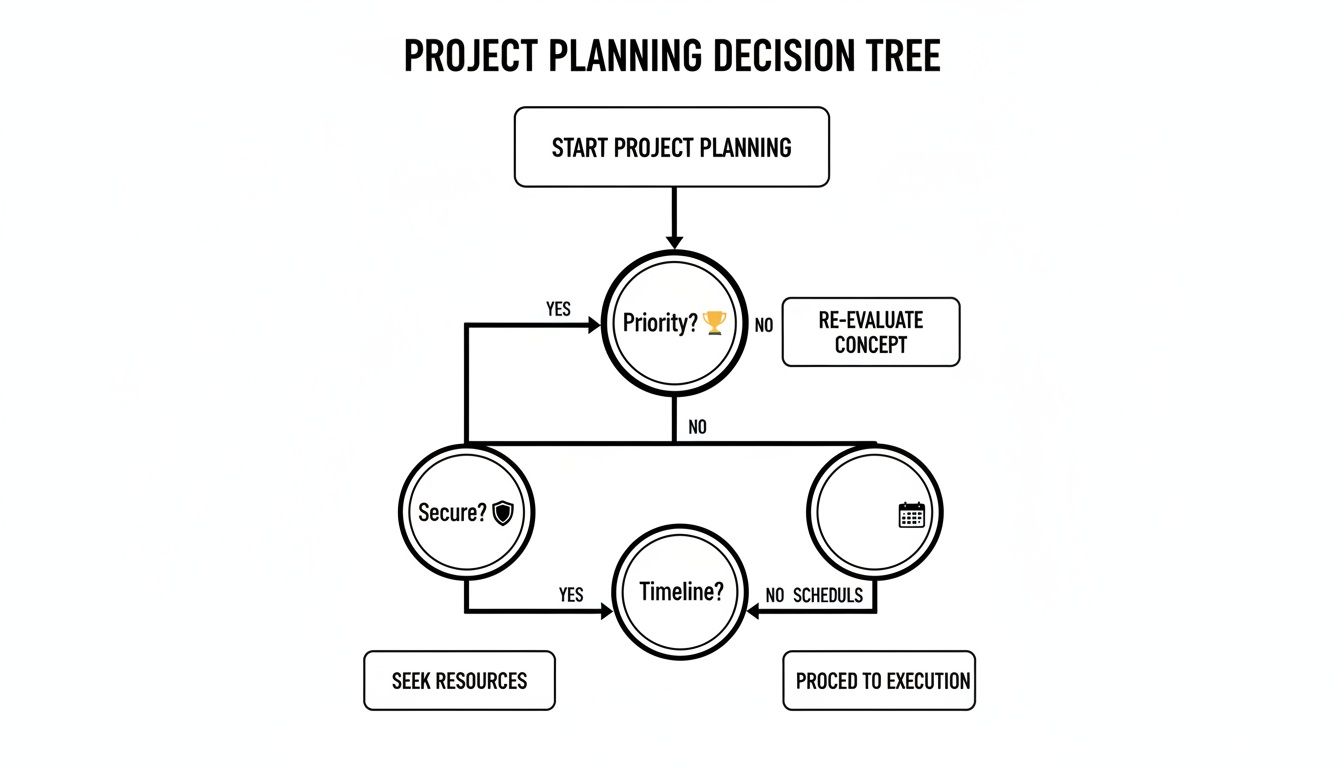
As you can see, defining your primary goal—whether it's maximizing value, ensuring airtight security, or prioritizing speed—directly informs the optimal data destruction and logistical methods.
Choosing the right path for data destruction is critical. Here’s a breakdown to inform your decision.
Data Wiping vs. Physical Shredding: What to Choose
| Method | Best For | Key Benefit | Compliance Alignment |
|---|---|---|---|
| Software Wiping | Newer, functional drives (HDDs & SSDs) with resale potential. | Preserves the hardware's value, generating revenue to offset project costs. | Meets DoD 5220.22-M and NIST 800-88 standards for data sanitization. |
| Physical Shredding | Failed or outdated drives, end-of-life media, or when mandated by policy. | The ultimate guarantee of data destruction; physically impossible to recover data. | The gold standard for HIPAA, DoD, and financial regulations requiring absolute proof. |
For many Atlanta companies, a hybrid approach is the most strategic option. You can wipe and remarket newer, valuable assets while shredding older or non-functional ones. This strategy balances security with financial return.
For organizations in highly regulated industries like healthcare or finance, physical destruction is almost always the required method. There is no room for error. A Certificate of Destruction, providing a serialized record of every shredded drive, is the non-negotiable proof needed to satisfy the most rigorous HIPAA or PCI-DSS audits.
If your policy demands the certainty of physical destruction, our guide on onsite shredding services near you explains how the process can be securely performed at your facility.
Verifying Destruction and Ensuring Compliance
Executing data destruction is only half the task; you must be able to prove it. Maintaining strict data security and privacy protocols during device handling is fundamental, but documentation is what validates compliance in an audit. It is not enough to simply relinquish your drives; you must receive indisputable proof that the data was destroyed according to certified standards.
This proof is delivered in two essential forms:
- Certificates of Data Destruction: This is your official record. It must be highly detailed, listing the unique serial number of every drive that was wiped or shredded, the exact method used, and the date of destruction.
- Serialized Reporting: Your final report must reconcile perfectly with your initial inventory list. It should clearly show the final disposition of every asset—whether it was remarketed, recycled, or destroyed.
These documents are not just for your internal records; they are your liability shield. They prove to internal stakeholders, auditors, and regulators that you fulfilled your legal obligations, protecting your organization from significant risk.
This level of diligence is increasingly critical in Georgia. The state’s data center boom is projected to create 28,350 construction jobs and inject $3.4 billion into the economy by 2025. This explosive growth also brings a tidal wave of e-waste, making secure and sustainable ITAD solutions more vital than ever. Choosing an Atlanta-based data center recycling partner with proven, auditable processes is not just a good business practice—it's a necessity.
Squeezing Every Drop of Value and Nailing Compliant Recycling
Once equipment is securely transported from your Atlanta facility, its journey is just beginning. This next phase is where a strategic ITAD plan creates significant value, transforming a logistical challenge into a financial and environmental success. This involves a two-pronged approach: maximizing revenue from assets with remaining operational life and ensuring all other materials are recycled in a responsible and compliant manner.
Your viable assets first arrive at a processing facility for a thorough audit. Here, technicians evaluate each piece of equipment—from servers and networking switches to individual components like CPUs and RAM. This is far more than a power-on test; it’s a comprehensive audit to determine its precise condition, functionality, and market resale value.
Unlocking the Hidden Cash in Your Retired IT Assets
For many Atlanta businesses, the revenue generated from this IT asset remarketing process is a significant financial benefit. It frequently offsets the entire cost of the decommissioning project, including labor and logistics. In many cases, it results in a net positive return to your company. The key is to partner with a vendor who has an established, transparent sales network.
Here’s what that process looks like behind the scenes:
- Deep-Dive Auditing and Testing: Technicians put every component through its paces to make sure it meets functional specs.
- Smart Refurbishment: We handle any needed repairs or upgrades to maximize what the asset is worth on the open market.
- Strategic Resale: The refurbished gear is then sold through established channels to buyers who are actively looking for reliable, second-hand hardware.
A vendor with a strong resale network can move equipment quickly and at fair market value. This is where you must insist on transparent reporting. You should expect a detailed, serialized report showing the exact sale price for every asset, ensuring you receive your equitable share. That level of clarity is the hallmark of a trusted partner.
Consider every retired server not as scrap, but as a potential revenue source. A well-executed remarketing strategy can directly augment your IT budget, turning a former expense into a sound financial decision.
The Gold Standard for Doing Recycling Right
Of course, not every piece of equipment will have resale value. Older servers, failed components, and proprietary hardware are destined for the recycling stream. However, "recycling" in this context is a highly regulated and complex process. Disposing of e-waste at a local scrap yard is a direct path to compliance fines and environmental liability.
This is where industry certifications are your greatest asset. Reputable Atlanta data center recycling vendors adhere to strict standards like R2 (Responsible Recycling) or e-Stewards. These are not mere logos; they are your guarantee that the vendor has passed rigorous third-party audits and follows best practices for:
- Data Security: Ensuring any residual data is permanently destroyed.
- Environmental Protection: Properly managing hazardous materials found in electronics, such as lead, mercury, and cadmium.
- Zero Illegal Exports: Preventing e-waste from being shipped to developing nations where it is often processed under unsafe and unregulated conditions.
When you select a certified partner, you are assured that your e-waste will be de-manufactured correctly. The equipment is broken down into its core commodities—steel, aluminum, copper, and precious metals. These materials are then sent to vetted downstream partners to be refined and reintroduced into the manufacturing supply chain. This circular model is the foundation of a truly sustainable ITAD program. To explore this further, our guide on IT asset disposal provides a comprehensive overview of the complete lifecycle.
This forward-thinking approach to sustainability is gaining momentum across Atlanta's tech sector. Consider Google's data center near Atlanta, which since 2012 has been a leader in using recycled 'grey water' for cooling, proving that massive operations can be both highly efficient and environmentally conscious. As Data Center Knowledge explains, the conversation around data center water usage is evolving, and that same commitment to sustainability must apply to the end-of-life management of hardware.
How to Choose the Right Atlanta ITAD Partner

Let’s be direct: selecting your IT Asset Disposition (ITAD) partner is the single most critical decision in a data center decommissioning project. The right choice protects your organization. The wrong one exposes you to data breaches, compliance failures, and significant financial repercussions.
In the competitive Atlanta market, you must look beyond sales pitches to evaluate core competencies. You are not just hiring a removal service; you are entrusting a vendor with your company's sensitive data, environmental reputation, and physical assets. A true partner operates as a secure extension of your own team.
Vetting Operational Security and Logistics
Before discussing price, your initial questions must focus on security and logistics. A company's website can be misleading; the real test is how they manage your assets in practice.
Begin by asking if they handle logistics in-house or if they subcontract the work.
The use of subcontractors is an immediate red flag. It adds another link to the chain of custody, introducing complexity and another potential point of failure. The ideal partner utilizes their own background-checked employees and their own fleet of secure, GPS-tracked vehicles. This is the only way to guarantee they maintain complete control over your assets from your loading dock to their facility.
Your ITAD partner's security protocols should be as robust as your own. Ask for specifics on facility security, including access controls, 24/7 surveillance, and alarm systems. This is the only way to ensure your assets are protected at every step.
Investigate their process further. What happens when your equipment arrives at their facility? Is it immediately reconciled against the on-site inventory list? Even a delay of a few hours can create a security blind spot. A professional operation will have a documented, auditable process for every stage.
Demanding Auditable Reporting and Certifications
A verbal promise of "secure destruction" is insufficient. You require documented proof. The foundation of any reliable Atlanta data center recycling service is its capacity to provide serialized, auditable reporting for every single asset. You need a final report that ties the disposition of each item—by its unique serial number—back to your initial inventory.
Certifications are the most efficient way to vet a vendor. They provide independent, third-party verification that a company meets the highest industry standards.
These credentials should be non-negotiable:
- R2v3 or e-Stewards: These are the gold standards for environmental responsibility and ensure e-waste is managed correctly, not illegally exported.
- NAID AAA: This certification is exclusively focused on data destruction, confirming the vendor uses strict, audited protocols for wiping, shredding, and securing data-bearing devices.
Do not just take their word for it—request to see the actual certificates. Any hesitation should be a deal-breaker. By insisting on a certified partner, you leverage proven, audited standards to perform your due diligence. For a clearer understanding of what these certified vendors provide, our overview of a professional electronic waste recycling company can offer valuable insight.
Verifying Comprehensive Insurance Coverage
Finally, you must verify their insurance coverage. A standard general liability policy is inadequate for the high-stakes work of ITAD. Your partner requires specialized policies that protect you from the unique risks associated with handling retired data center assets.
Request their Certificate of Insurance and look for these three specific coverages:
- Data Breach & Cyber Liability: This covers the significant costs of a data breach should one occur while your assets are in their custody.
- Pollution Liability: This protects you from claims related to the improper disposal of hazardous materials found in e-waste.
- Errors & Omissions (E&O): This covers financial losses resulting from errors in their professional services.
Without this specialized insurance, any liability could revert to your company. A properly insured partner demonstrates they understand the gravity of this work and have taken the necessary steps to protect both their business and yours. That is the mark of a true professional.
Answering Your Top Questions About Atlanta Data Center Recycling
When planning a data center decommissioning, numerous questions will arise. It is a significant undertaking, particularly for Atlanta-based companies with complex IT operations. We understand the challenges.
To help you prepare, we have compiled direct answers to the questions we hear most frequently from IT leaders and operations managers. This is practical information designed to help you make sound business decisions.
What Are the Real Costs Involved?
The cost of an Atlanta data center recycling project is highly variable, depending on project specifics—the volume of equipment, the labor required for de-installation, and transportation logistics.
However, the initial quote rarely reflects the final net cost. A significant portion of these expenses can often be offset by remarketing valuable assets. Newer servers, networking equipment, and enterprise-grade storage often retain substantial market value.
A reputable ITAD partner will provide a transparent proposal outlining projected costs alongside the estimated return from asset sales. For many of our projects, this value recovery results in a cost-neutral or even revenue-positive outcome for our clients.
How Do I Guarantee We're HIPAA Compliant?
Ensuring HIPAA compliance during a data center decommissioning hinges on two core principles: an unbreakable chain of custody and certified data destruction. There are no shortcuts. You must be able to prove, definitively, the disposition of every single data-bearing device from the moment it leaves your control.
First, your partner must provide a serialized inventory of all collected assets, down to the individual hard drive level. This creates your auditable trail.
Following data destruction, you must receive a formal Certificate of Data Destruction. This document is your proof of compliance. It must list the serial number of every drive and specify the destruction method, whether wiping to NIST 800-88 standards or physical shredding. This certificate is your primary defense in an audit.
How Long Does a Decommissioning Project Actually Take?
The timeline for a decommissioning project varies significantly with its scale. A small server closet with a few racks might be completed in a single day. Conversely, a large data hall with hundreds of cabinets could require a week or more of systematic work.
An experienced partner will not provide a timeline without a thorough assessment. The process should always begin with an on-site walkthrough to evaluate the full scope of work. This enables them to develop a precise project plan and schedule that aligns with your operational needs. It also allows for phased execution to minimize disruption to your live environment.
What Happens to Old Equipment With No Resale Value?
Any equipment that cannot be remarketed enters a certified recycling stream for controlled de-manufacturing. Each piece is methodically broken down into its core commodities—steel, aluminum, copper, plastic, and precious metals recovered from circuit boards.
These raw materials are then transferred to our vetted and audited downstream partners to be refined and reintroduced into the manufacturing supply chain.
This is why partnering with an R2 or e-Stewards certified vendor is crucial. It is your guarantee that the entire process is managed in an environmentally responsible manner. It ensures hazardous materials like lead and mercury are properly contained and kept out of landfills, protecting both the environment and your corporate reputation.
Navigating the complexities of data center decommissioning requires a partner with proven expertise in security, logistics, and compliance. Atlanta Computer Recycling provides comprehensive, end-to-end ITAD services tailored for Atlanta businesses, ensuring your project is handled securely and sustainably from start to finish. Contact us today to plan your next project.