Secure Electronics Disposal: A Guide to Corporate IT Asset Disposition


Your business is upgrading its technology. Stacks of old laptops, servers, and hard drives are piling up, each one a repository of sensitive corporate data, client information, and financial records. Simply unplugging them doesn't neutralize the risk. What's your next move?
This is where a formal secure electronics disposal strategy is essential. It’s the critical process of sanitizing and responsibly disposing of outdated IT assets to prevent catastrophic data breaches and ensure regulatory compliance.
Why Secure Electronics Disposal is a Business Imperative
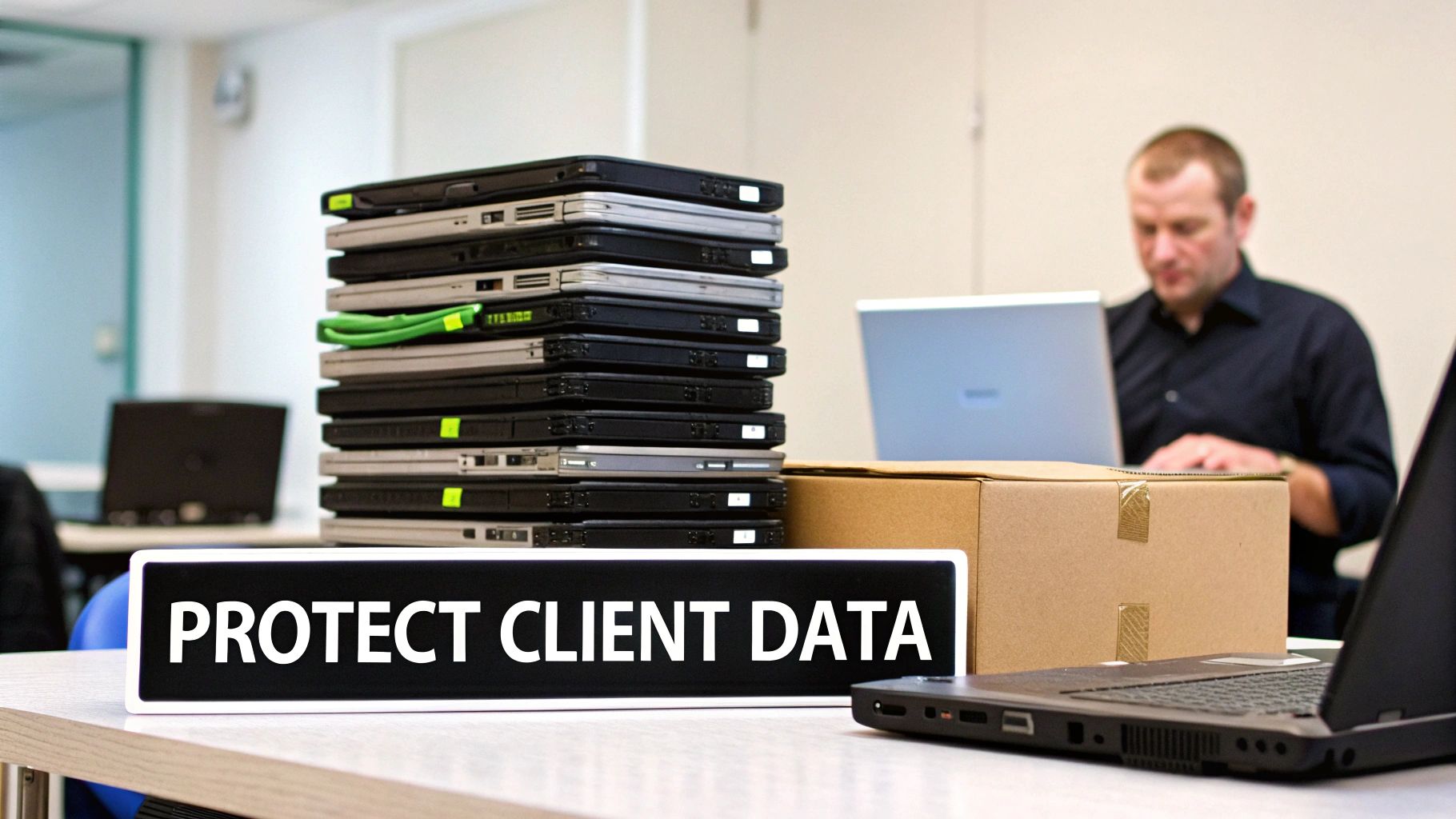
When a financial firm retires a data center or a healthcare system decommissions thousands of laptops, the risk doesn't vanish with the hardware. Those devices remain potential gateways to your most confidential information. Treating end-of-life electronics like ordinary office waste is a direct and significant threat to your brand, bottom line, and legal standing.
This isn't a simple storage clean-out; it's a fundamental component of your corporate risk management framework. A single improperly handled device can expose proprietary trade secrets, customer financial data, or protected health information (PHI), leading to devastating operational and financial consequences.
The High Cost of Negligence
The financial penalties for non-compliance are severe and designed as a powerful deterrent. A single data breach can cost millions in regulatory fines, legal fees, and reputational damage that takes years to rebuild.
Consider these industry-specific scenarios:
- Healthcare: A discarded hospital computer containing unencrypted patient records could trigger a multi-million dollar HIPAA violation. Fines are calculated per violation, meaning one hard drive with thousands of records can create a catastrophic financial event.
- Finance: An old server from a financial institution, if improperly wiped, could expose customer account details. This invites fines from regulators like the SEC and shatters customer trust—your most valuable and fragile asset.
- Corporate & Legal: Law firms, tech companies, and enterprise businesses handle immense amounts of intellectual property and client data. A breach from a retired asset can undermine client confidentiality and lead to significant legal liabilities.
The core issue is that outdated equipment still holds live risks. To regulators, auditors, and cybercriminals, a decommissioned server isn't just scrap metal—it's a potential backdoor into your organization's most sensitive information.
Beyond Data Security: Corporate Environmental Responsibility
While data protection is paramount, secure electronics disposal also addresses a critical environmental responsibility. E-waste is the world's fastest-growing waste stream, filled with hazardous materials like lead and mercury that can contaminate soil and water if landfilled.
Proper IT asset disposition is a key pillar of corporate social responsibility (CSR). To learn more about the broader implications, see this overview of the environmental impact of electronic waste. A certified disposal partner ensures your end-of-life assets are managed ethically, protecting both your corporate data and the environment.
How to Build a Practical IT Asset Disposition Plan
Reactive disposal is a recipe for disaster. A documented IT Asset Disposition (ITAD) plan is the only way to replace guesswork with a systematic process, ensuring every device is handled correctly from retirement to final disposition. This isn't just a procedural document; it's a framework for accountability and risk management.
The foundation of any ITAD plan is a comprehensive Information Security Management System (ISMS), which outlines policies for protecting data throughout its lifecycle. With that governance in place, you can execute the tactical steps of inventory and classification.
Start with a Comprehensive Asset Inventory
You cannot protect what you don't track. The first operational step is to build a detailed inventory of every IT asset slated for decommissioning. This goes beyond a simple device count; it means documenting the specific attributes that will dictate the disposal protocol for each item.
Your inventory log must capture these key data points for every asset:
- Asset Type: Server, laptop, desktop, mobile phone, or network switch.
- Serial Number/Asset Tag: The unique identifier essential for tracking.
- Physical Location: The specific office, data center, or storage closet.
- Data Storage: Presence of a hard drive (HDD), solid-state drive (SSD), or other storage media.
This detailed log becomes the backbone of your ITAD project and the single source of truth for maintaining a secure chain of custody.
Classify Devices by Data Sensitivity
Not all electronics carry the same risk. A retired keyboard requires a different disposal path than a server that processed financial transactions. The next step is to classify each inventoried asset based on the sensitivity of the data it contains. This allows you to allocate security resources effectively.
A functional classification system could be:
- Level 1 (Low Risk): Devices with no data storage capabilities, such as monitors, keyboards, or printers without internal drives.
- Level 2 (Medium Risk): Standard employee workstations or laptops containing general business files but no regulated or highly confidential data.
- Level 3 (High Risk): Servers, storage arrays, or executive laptops containing financial records, intellectual property, Personally Identifiable Information (PII), or Protected Health Information (PHI).
For any business handling regulated data, understanding what is IT asset disposition is non-negotiable for maintaining compliance. Classifying assets ensures Level 3 devices receive the highest level of security, such as on-site physical destruction.
Real-World Scenario: A hospital system is decommissioning 300 workstations from a closed wing. By classifying them, the IT team identifies 250 as standard admin PCs (Level 2) and 50 as clinical workstations containing PHI (Level 3). This allows them to schedule on-site hard drive shredding specifically for the 50 high-risk devices, while the others are securely wiped for potential refurbishment—optimizing both security and cost.
Assign Clear Roles and Responsibilities
An ITAD plan is ineffective without clear ownership. The final step is assigning roles to ensure accountability throughout the disposal process. Without defined responsibilities, critical tasks like inventory verification or vendor coordination will be overlooked.
The global electronics recycling market is projected to grow from $43.2 billion in 2025 to $147.9 billion by 2035, highlighting the increasing importance of formalized ITAD programs.
Assign these key roles within your organization:
- IT Asset Manager: Oversees the entire ITAD plan, from inventory to final certification.
- Department Heads: Responsible for identifying and authorizing the retirement of assets within their teams.
- Logistics Coordinator: Manages the physical collection, secure storage, and scheduling of vendor pickups.
- Compliance Officer: Verifies that all disposal activities meet regulatory requirements and reviews all certificates of destruction.
Choosing the Right Data Destruction Method
With your ITAD plan in place, the next step is selecting the appropriate data destruction method. This decision directly impacts your risk exposure and should be based on data sensitivity, device type, and potential for asset value recovery.
Simply hitting 'delete' or reformatting a drive is insufficient. That data is often easily recoverable, creating a massive liability for any organization handling sensitive information.
This decision tree provides a framework for determining the proper handling of retired assets.
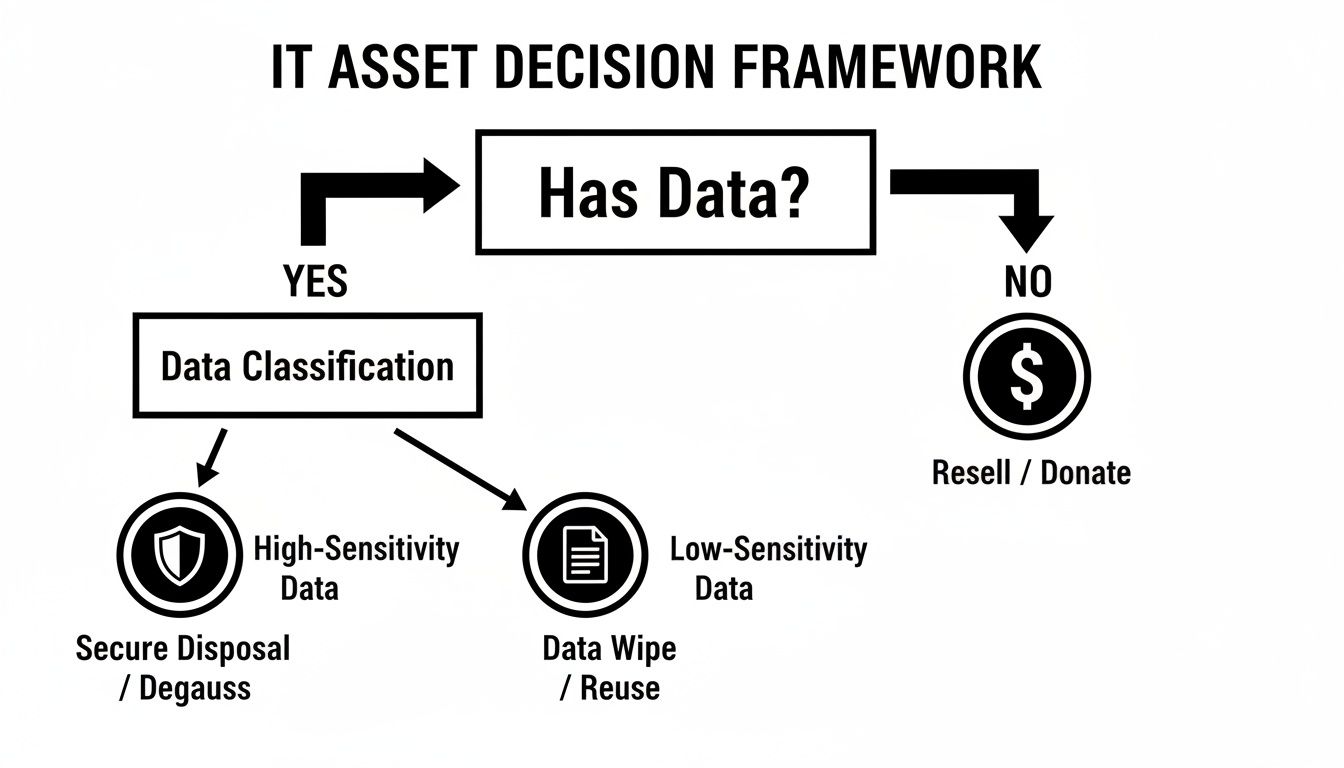
As shown, the primary driver is whether the device contains sensitive data. From there, the appropriate path becomes clear.
Software-Based Data Wiping
For devices intended for resale, donation, or internal redeployment, software-based wiping is the optimal choice. This method uses specialized software to overwrite the entire drive with random data, rendering the original information unrecoverable while preserving the hardware.
The DoD 5220.22-M standard, a 3-pass overwrite method, is a widely recognized commercial benchmark for thorough data sanitization. While federal agencies now use the NIST 800-88 standard, DoD-level wiping remains a trusted industry practice.
Wiping is the ideal solution for:
- Lease Returns: Equipment must be returned with drives wiped clean but physically intact.
- Employee Buy-Back Programs: Staff can purchase their former work devices after secure sanitization.
- Internal Redeployment: A computer from one department is securely repurposed for another.
The primary advantage of wiping is value preservation. However, the process can be time-consuming for large volumes, and meticulous verification is required to certify that every drive sector was successfully overwritten.
Physical Data Destruction
For assets at the end of their useful life—or those that contained highly sensitive data—physical destruction is the only method that provides 100% certainty that data can never be recovered. This approach destroys the storage media itself, eliminating any possibility of a future breach from that device.
Key methods include:
- Shredding: This is the gold standard for secure destruction. Devices are fed into industrial machines that reduce them to small metal fragments. For guaranteed data elimination, exploring physical destruction methods like industrial shredders is the most secure option.
- Degaussing: A powerful magnetic field scrambles the data on magnetic media like traditional hard drives (HDDs) and tapes. It is fast but ineffective on modern Solid-State Drives (SSDs).
- Crushing/Pulverizing: This method uses hydraulic force to puncture or shatter hard drive platters, rendering them unreadable.
Physical destruction is the required method for hospitals disposing of devices with patient records, financial institutions retiring servers with account data, or any business decommissioning drives that stored proprietary R&D. Our guide on secure data destruction offers more detail.
Key Takeaway: The choice between wiping and shredding is a balance between value recovery and absolute risk elimination. If an asset can be securely sanitized to recoup value, wiping is an excellent option. If the data is too sensitive or the device is obsolete, physical destruction is the only acceptable answer.
Comparing Data Destruction Methods
Selecting the right data sanitization method requires understanding the trade-offs between security, compliance, and asset value. This table breaks down the options to help align your approach with your corporate needs.
| Method | Security Level | Asset Reuse Potential | Best For | Verification |
|---|---|---|---|---|
| Software Wiping | High (Data is sanitized) | Excellent (Hardware remains intact) | Resale, donation, redeployment, and lease returns. | A detailed log showing successful overwrites for each drive's serial number. |
| Degaussing | Very High (Data is erased) | None (Drive is rendered inoperable) | High-volume disposal of magnetic media like HDDs and tapes. | Visual inspection and logs confirming degausser operation. |
| Shredding | Absolute (Media is destroyed) | None (Asset is reduced to scrap) | Highest-sensitivity data, end-of-life SSDs, and regulatory compliance. | Certificate of Destruction detailing assets by serial number. |
The Certificate of Destruction is your non-negotiable proof of compliance. It is the official document that serves as your auditable record, confirming your devices were destroyed according to industry best practices. Without it, you lack verifiable evidence of having met your legal and ethical obligations for secure electronics disposal.
Managing a Secure Chain of Custody for Your Assets
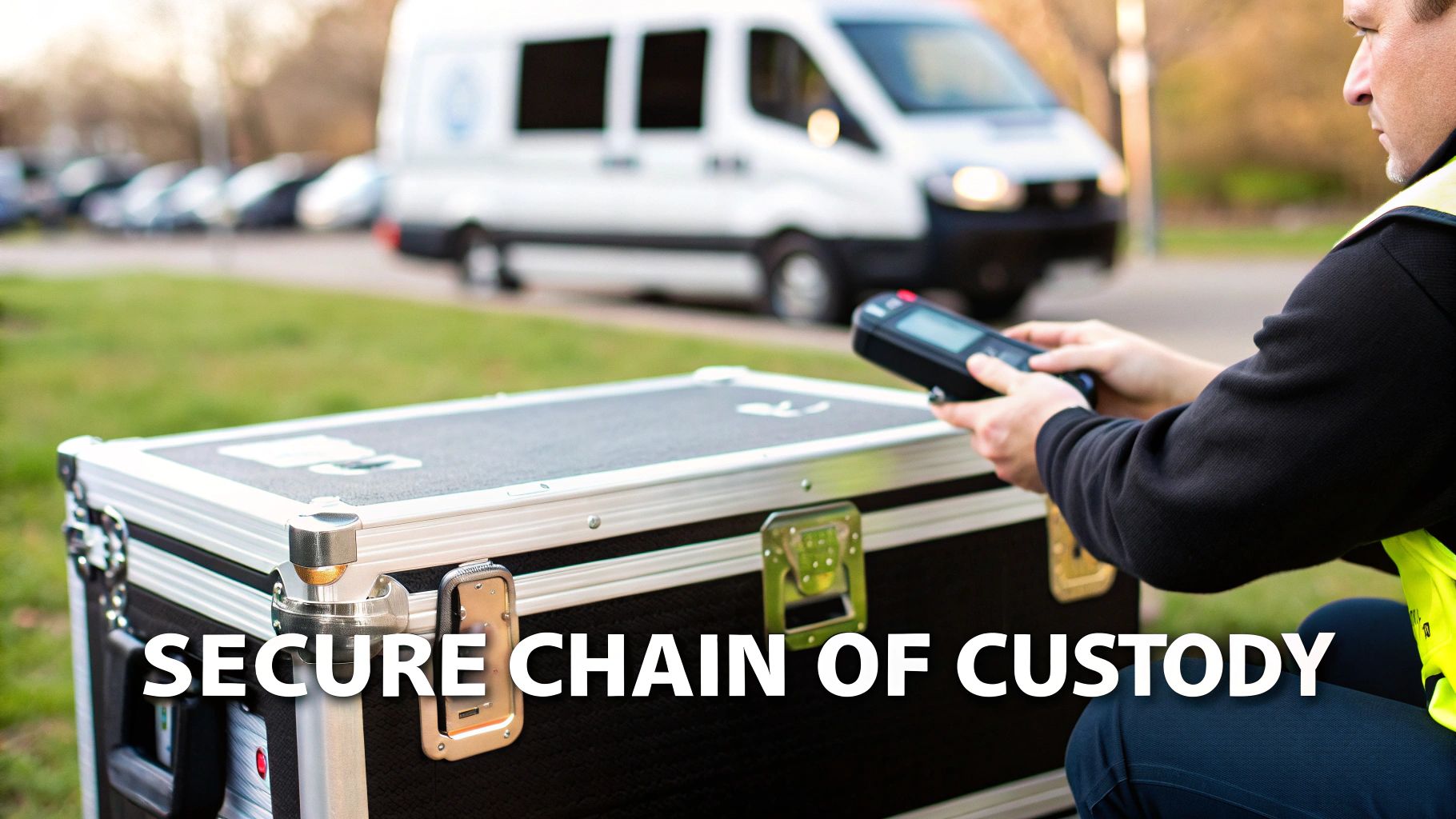
The security of your IT assets does not end when they are disconnected. In fact, the risk often increases during transit and storage. A secure chain of custody—the documented, unbroken trail tracking your assets from your facility to their final destruction—is a mandatory component of any professional secure electronics disposal program.
Without this accountability, devices can be lost or stolen in transit, creating a data breach nightmare and a compliance gap that is indefensible during an audit. This process transforms a simple equipment pickup into a fully verifiable security procedure.
On-Site Inventory and Secure Logistics
The chain of custody begins the moment your disposal vendor arrives on-site. This is not a casual pickup; it is a meticulous, documented handoff.
A professional partner will start with an on-site inventory reconciliation, scanning the serial number of every asset and matching it against your ITAD plan's manifest. This initial scan creates the first link in the chain, confirming that what you designated for disposal is exactly what is being collected.
Next, assets are packed into secure, locked containers. These are durable, tamper-evident bins or cages designed to prevent unauthorized access during transit.
Finally, these sealed containers are loaded onto a GPS-tracked vehicle. This provides real-time visibility and ensures the truck proceeds directly to the secure processing facility without unauthorized stops.
A Data Center Decommissioning Example
Imagine a financial services company decommissioning a data center with 50 servers, 10 network switches, and two storage arrays containing sensitive client data.
A certified partner would establish a chain of custody as follows:
- Serialization: On-site technicians scan the serial number of all 62 assets, creating a digital manifest before any equipment is moved.
- Secure Packing: Hard drives are removed and placed in a locked, tamper-proof container. The remaining server chassis and network gear are packed separately.
- Sealed Transport: Both containers are sealed with numbered security tags, and the tag numbers are recorded on the manifest before loading onto a GPS-tracked truck.
- Facility Check-In: Upon arrival at the disposal facility, the security seals are inspected for integrity before being broken. The assets are scanned again during unloading to confirm receipt of every item.
This continuous documentation ensures that from the moment an asset leaves your control, its location and status are known and accounted for, eliminating opportunities for error or theft.
A strong chain of custody is your proof that you upheld your duty of care. It demonstrates to auditors and regulators that you took every reasonable step to protect sensitive data throughout the entire disposal process.
The Power of Proper Certification
The final and most critical link in the chain is the documentation you receive after the service is complete. These are not mere receipts; they are legal documents that form the cornerstone of your compliance records.
You must receive two key documents from your vendor:
- Certificate of Destruction: This document certifies that your data-bearing devices were physically destroyed or irretrievably sanitized. It must list every asset by serial number, detail the destruction method used, and be signed by an authorized representative.
- Certificate of Recycling: This document confirms that all non-data-bearing components and shredded materials were processed in an environmentally responsible manner, compliant with all federal and state regulations.
These certificates provide the auditable proof required to demonstrate compliance with regulations like HIPAA, GDPR, or FACTA. You can learn more about what constitutes a defensible Certificate of Destruction and its importance for your corporate records. This documentation closes the loop on your ITAD process, providing a complete, defensible record of your secure electronics disposal activities.
Finding a Trustworthy Electronics Disposal Partner
Selecting the right partner for your secure electronics disposal is one of the most critical decisions in your IT asset management strategy. This vendor becomes the final custodian of your company's sensitive data and a direct reflection of your commitment to compliance and environmental stewardship.
You are not merely hiring a hauling service; you are entrusting a partner with your most sensitive assets. A qualified partner provides a verifiable, secure, and transparent process that protects your organization at every stage.
Vetting Vendors with a Critical Eye
When evaluating potential ITAD partners, begin by scrutinizing their certifications and insurance. These are not optional—they are the baseline indicators of a professional and accountable operation, demonstrating that a third party has audited and validated their processes against the industry's highest standards.
Look for these non-negotiable certifications:
- R2v3 (Responsible Recycling): This certification ensures the vendor adheres to best practices for environmental protection, worker health and safety, and data security throughout the recycling chain.
- e-Stewards: Often considered the gold standard, e-Stewards certification guarantees that no hazardous e-waste is exported to developing nations and that data security is managed with extreme diligence.
Beyond certifications, verify their insurance coverage. Request proof of data breach and pollution liability insurance. This coverage protects your business from financial loss in the unlikely event of an incident during transit or processing. Any vendor lacking this is a significant risk.
Asking the Right Questions
Once you have a shortlist of certified and insured vendors, it's time to probe deeper. Their responses will reveal the quality of their operations and their ability to meet your specific security and compliance requirements.
A crucial question is, "Can you provide a detailed map of your downstream recycling process?" A reputable partner will have a transparent and fully documented downstream, proving that every component is handled by vetted partners. They should be able to specify where shredded materials, circuit boards, and plastics are sent for final processing.
Next, inquire about their data sanitization verification: "How do you verify and document successful data wiping for each drive?" They should describe a meticulous process that logs the success of every wipe against a specific serial number, delivering a clean, auditable report.
Choosing a vendor is like hiring an extension of your own risk management team. Their ability to provide clear, confident, and documented answers to tough questions is a direct indicator of their professionalism and reliability.
The Importance of Transparent Reporting
Documentation is your ultimate defense in an audit. A trustworthy partner will provide detailed, transparent reporting that creates a clear and unbroken chain of custody. This includes serialized asset lists, comprehensive certificates of destruction, and recycling reports that detail the final disposition of all materials.
The global e-waste crisis underscores why this accountability is so crucial. E-waste is the fastest-growing waste stream worldwide, projected to surpass 60 million metric tons by 2025. The U.S. alone produces 6.92 million tons annually. As noted by 4thBin.com, partnering with a certified provider is the only way to ensure compliant handling and prevent data breaches.
Ultimately, your choice of partner defines the success of your secure electronics disposal program. Investing time in thorough vetting is a direct investment in your company's security, reputation, and long-term compliance. For more guidance, review our article on how to choose an electronic waste recycling company for your business.
Answering Your Top Questions About Secure Electronics Disposal
Even with a robust ITAD plan, questions inevitably arise when handing over retired corporate hardware. As an IT manager or business leader, you need absolute confidence in the disposal process. Here are straightforward answers to the most common questions from our business clients.
What’s the Real Difference Between Wiping and Shredding?
This is the most frequent question, and the answer depends on the intended future of the hardware.
- Data Wiping (Sanitization): This is a software-based method using specialized programs to overwrite every sector of a hard drive with random data, rendering the original information unrecoverable. Wiping is the ideal choice when you want to preserve the hardware for resale, donation, or internal redeployment.
- Physical Shredding: This method physically destroys the storage media by grinding it into small, useless fragments. Shredding is the mandatory option for end-of-life devices or any hardware that contained highly sensitive data, where absolute, irreversible proof of destruction is required.
Think of it this way: wiping securely erases the content of a book, leaving the book intact for reuse. Shredding turns the entire book into confetti.
How Do I Know My Data Is Actually Gone?
Verification is paramount. A reputable ITAD partner must provide undeniable proof through detailed documentation that serves as your permanent record for compliance and legal purposes.
Always demand a Certificate of Destruction. This is a formal legal document, not a simple receipt. It lists every asset by its unique serial number, specifies the destruction method used (e.g., DoD 5220.22-M wipe or physical shred), and is officially signed and dated. This certificate is your definitive proof of due diligence.
For any high-risk assets, a complete and unbroken chain of custody is non-negotiable. This documented trail tracks your devices from the second they leave your control—using serialized inventory lists, locked transport, and GPS-tracked vehicles—all the way to their final destruction. It leaves zero room for error or security gaps.
Should We Wipe Our Own Devices Before the Vendor Arrives?
While this may seem like an added security measure, it is generally unnecessary and less efficient when using a certified ITAD partner.
Professional vendors utilize specialized, high-volume equipment designed to wipe or shred devices far more efficiently than a corporate IT department. More importantly, their entire process is structured to generate the certified documentation you need for audits. Entrusting a certified partner with destruction ensures a consistent, verifiable, and defensible process, freeing up your internal team to focus on core business functions.
Why Is E-Waste Suddenly Such a Big Deal for Businesses?
Beyond the critical need for data security, the environmental impact of electronic waste has become a major component of corporate social responsibility—and the statistics are staggering.
In 2022, the world generated 62 million tonnes of e-waste, an 82% increase from 2010. This figure is projected to reach 82 million tonnes by 2030. Shockingly, only 22.3% of that e-waste was properly collected and recycled, meaning billions of dollars in valuable resources were discarded. Partnering with a certified recycler who guarantees responsible handling is therefore essential. For a deeper analysis, explore these e-waste statistics and their implications for IT management.
What Do Certifications Like R2v3 or e-Stewards Actually Mean?
These certifications are your ultimate quality assurance, confirming a vendor's adherence to the highest industry standards for security and environmental practices. To become certified, a vendor must pass rigorous, ongoing audits by an independent third party.
- R2v3 (Responsible Recycling): A premier global standard covering environmental protection, worker safety, data security, and the tracking of all recycled materials downstream.
- e-Stewards: Often considered the most stringent standard, e-Stewards enforces a zero-tolerance policy against exporting hazardous e-waste to developing countries and places a heavy emphasis on data security protocols.
Choosing a certified vendor is a critical risk mitigation strategy that protects your brand from being associated with improper and potentially illegal disposal practices.
Ready to implement a secure, compliant, and responsible electronics disposal strategy for your Atlanta-based business? Contact Atlanta Computer Recycling to learn how our certified processes can protect your data and help you meet your sustainability goals. Schedule your consultation today.