What Happens to Your Company’s Recycled Electronics?

When your company’s old electronics are hauled away, they don't just vanish into thin air. Instead, every retired IT asset starts a secure, carefully managed journey to protect your data, recover valuable materials, and keep your business compliant with environmental laws. Let's pull back the curtain on exactly what happens to recycled electronics after they leave your facility.
The Journey of Your Business Electronics After Recycling
For any business, knowing what happens to retired IT assets is more than just a curiosity—it's a critical security measure. The moment you choose a certified recycling partner, you're kicking off a process that turns potential data liabilities and environmental hazards into a secure, responsible outcome.
This isn't just about "getting rid of stuff." It's a key part of what we in the industry call IT Asset Disposition (ITAD). To get a better handle on this essential business function, you can check out our deep-dive guide on what is IT asset disposition.
The whole system is built to minimize your risk while getting the most value back from your old gear. From the second we pick up your equipment, it enters a secure chain of custody. We track every single device until it’s either refurbished, or broken down into its raw materials.
Why Proper E-Waste Management Matters for Your Business
The sheer scale of the e-waste problem really puts things into perspective. In 2022, the world generated a staggering 62 million tonnes of e-waste, but shockingly, only 22.3% of it was properly collected and recycled. That massive gap means millions of tons of devices—and all the sensitive business data on them—are left unaccounted for, creating a significant risk for businesses worldwide.
This flow chart gives you a clear picture of the core stages we follow to secure, recover, and refine the materials from your old equipment.
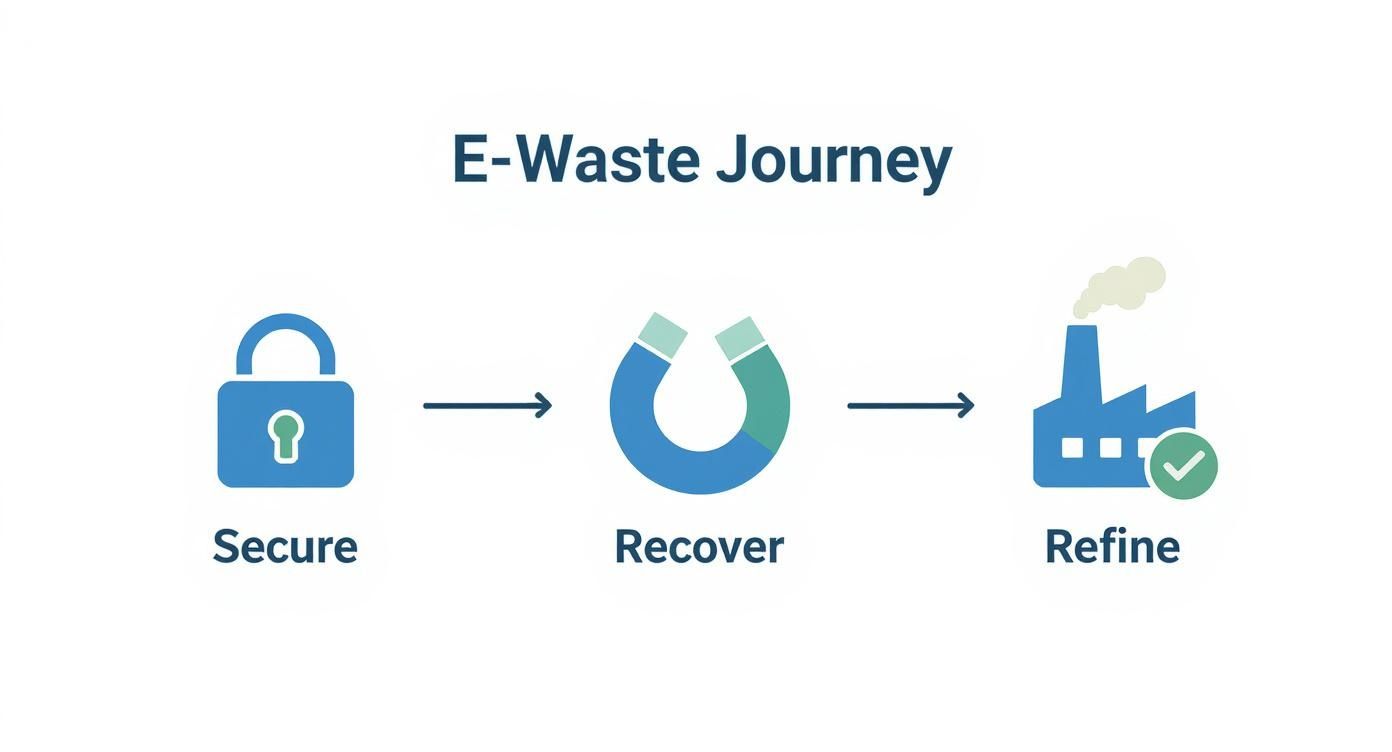
As you can see, it’s a methodical journey that prioritizes security first, then resource recovery. Nothing is left to chance, and nothing is wasted. This structured, documented approach is what separates a certified recycler from a simple scrap hauler.
To help you see the end-to-end process at a glance, we've broken down the lifecycle of your recycled business electronics into these key stages.
Key Stages in the Electronics Recycling Lifecycle
| Stage Number | Process Step | Primary Business Benefit |
|---|---|---|
| Stage 1 | Secure Logistics & Chain of Custody | Protects assets from theft or loss from the moment they leave your facility. |
| Stage 2 | Inventory & Asset Tracking | Provides a detailed audit trail for compliance and reporting. |
| Stage 3 | Certified Data Destruction | Guarantees complete data erasure, eliminating the risk of a breach. |
| Stage 4 | Testing & Refurbishment | Recovers value from functional components, offsetting disposal costs. |
| Stage 5 | Dismantling & Shredding | Physically destroys non-functional devices, ensuring data can't be recovered. |
| Stage 6 | Material Separation & Recovery | Recovers valuable raw materials like gold, copper, and aluminum for reuse. |
| Stage 7 | Responsible Downstream Management | Ensures all separated materials are sent to certified partners for final processing. |
| Stage 8 | Reporting & Certification | Delivers documented proof of secure and environmentally compliant disposal. |
Each step is designed to protect your organization while contributing to a more sustainable, circular economy.
The bottom line for any business is this: professional electronics recycling is a powerful risk management strategy. It’s how you protect your brand, lock down your data, and live up to your corporate social responsibility promises.
Ultimately, this managed process is the only way to ensure your retired assets are handled correctly. It shields your company from the massive financial and reputational damage of a data breach or an environmental fine, turning a growing business challenge into a secure, definitive solution.
Securing Your Data Before Anything Else
Before a single piece of your old equipment is sorted, taken apart, or recycled, it goes through the most important step of the entire process: certified data destruction. This isn't about recovering metals or plastics; it's all about neutralizing the huge risk that comes with the sensitive information stored on every device. What happens to recycled electronics starts with what happens to your data—and for any business, this is non-negotiable.
Think of all your retired servers, laptops, and company phones as digital filing cabinets. They’re packed with a treasure trove of confidential information, from private client records and financial data to employee details and your company’s trade secrets. Just hitting 'delete' or reformatting a hard drive won't cut it. That data is still there, leaving your business wide open to a potentially devastating breach.
This is exactly why professional IT asset disposition (ITAD) partners use strict, verifiable methods to make sure every last byte of data is gone for good. To get a better sense of the technical side, you can learn more about how to completely wipe out a hard drive. This isn’t just a good idea; it’s a foundational security requirement.
The Two Pillars of Data Destruction
For our commercial clients, certified recyclers lean on two main methods for data destruction. Often, we use them together for an extra layer of security. The right choice depends on the device, its condition, and what your company’s compliance rules demand.
- Software-Based Data Erasure: This method uses highly specialized software to overwrite the entire hard drive with random data, usually in several passes. The gold standard is the NIST 800-88 "Purge" or "Clear" specification, a set of guidelines from the National Institute of Standards and Technology. This process completely sanitizes the drive, making it impossible to get the original data back with any known software or hardware.
- Physical Data Destruction: When a hard drive or solid-state drive is too old, broken, or when you need absolute certainty, physical destruction is the only way to go. These devices are fed into massive industrial shredders that grind them into tiny, unrecognizable bits of metal and plastic. This guarantees the data can never be recovered.
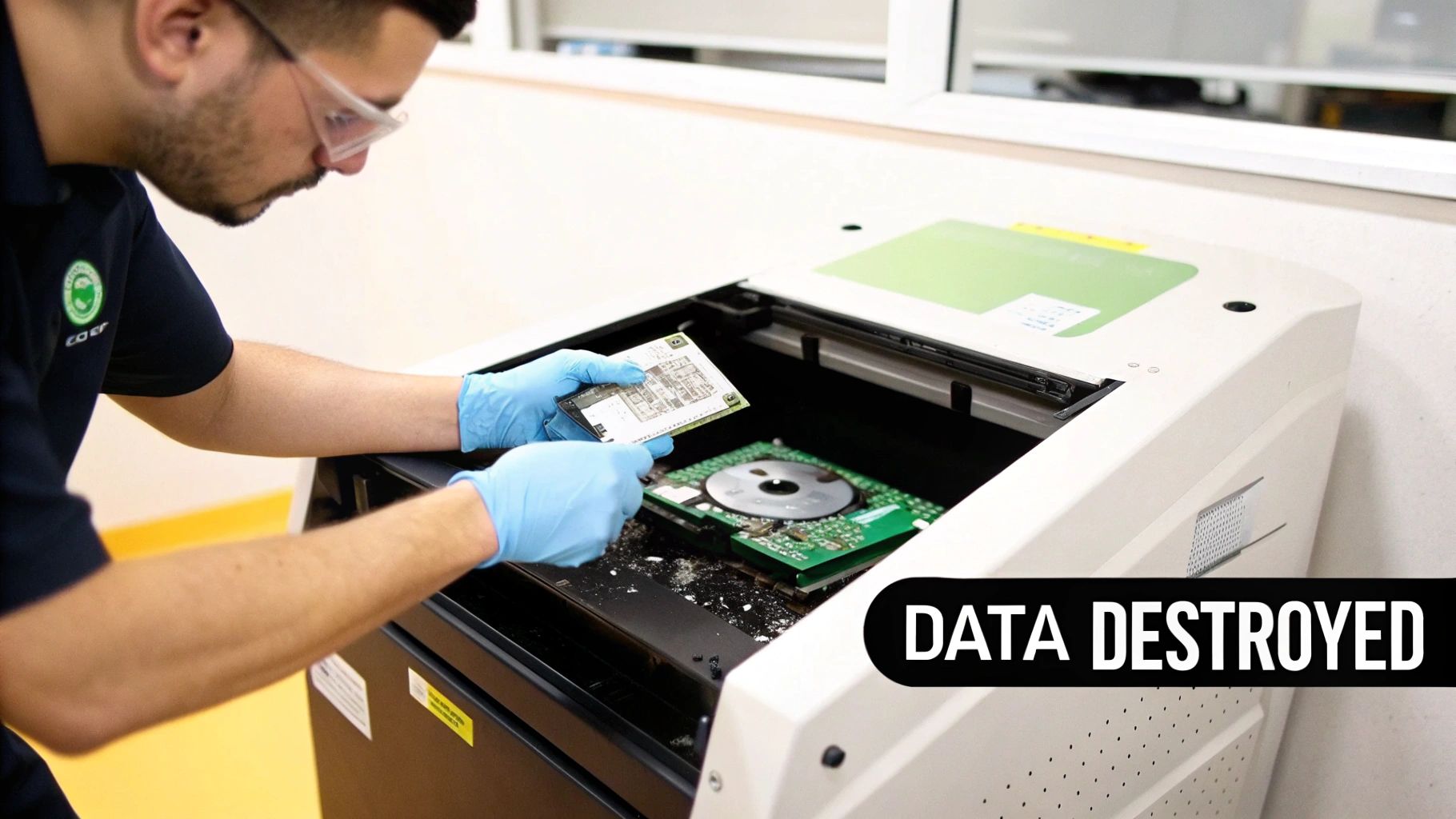
The data on your mobile devices is just as critical. It's vital to ensure that data is secured long before the device itself is recycled. For a deeper dive, these phone repair data security and privacy considerations offer some great insights into protecting mobile information.
Why a Certificate of Data Destruction Is Essential
Once your data is gone, a certified ITAD partner will give you a Certificate of Data Destruction (CoDD). This isn't just a piece of paper; it's a vital legal document that acts as your official audit trail.
A Certificate of Data Destruction is your tangible proof that you have performed due diligence in protecting sensitive information. It transfers liability from your organization to the recycling partner and is essential for demonstrating compliance with regulations like HIPAA, SOX, and GDPR.
This document should be thorough, listing the serial numbers of the specific devices that were sanitized or destroyed. Without this certificate, your business has no verifiable proof that it took the necessary steps to prevent a data breach, leaving you exposed to serious legal and financial consequences.
Proper data destruction protects your business from:
- Financial Loss: A data breach can cost a company millions in fines, legal fees, and customer payouts.
- Reputational Damage: A public breach can shatter customer trust and do permanent harm to your brand.
- Legal Penalties: Failing to comply with data privacy laws like GDPR or HIPAA can lead to massive fines and other regulatory actions.
Ultimately, the journey of what happens to recycled electronics has to start with an unbreakable commitment to data security. By working with a certified expert who provides verifiable data destruction, you ensure your company's most important asset—its information—is protected before the physical recycling even gets started.
Sorting and Dismantling for Maximum Value
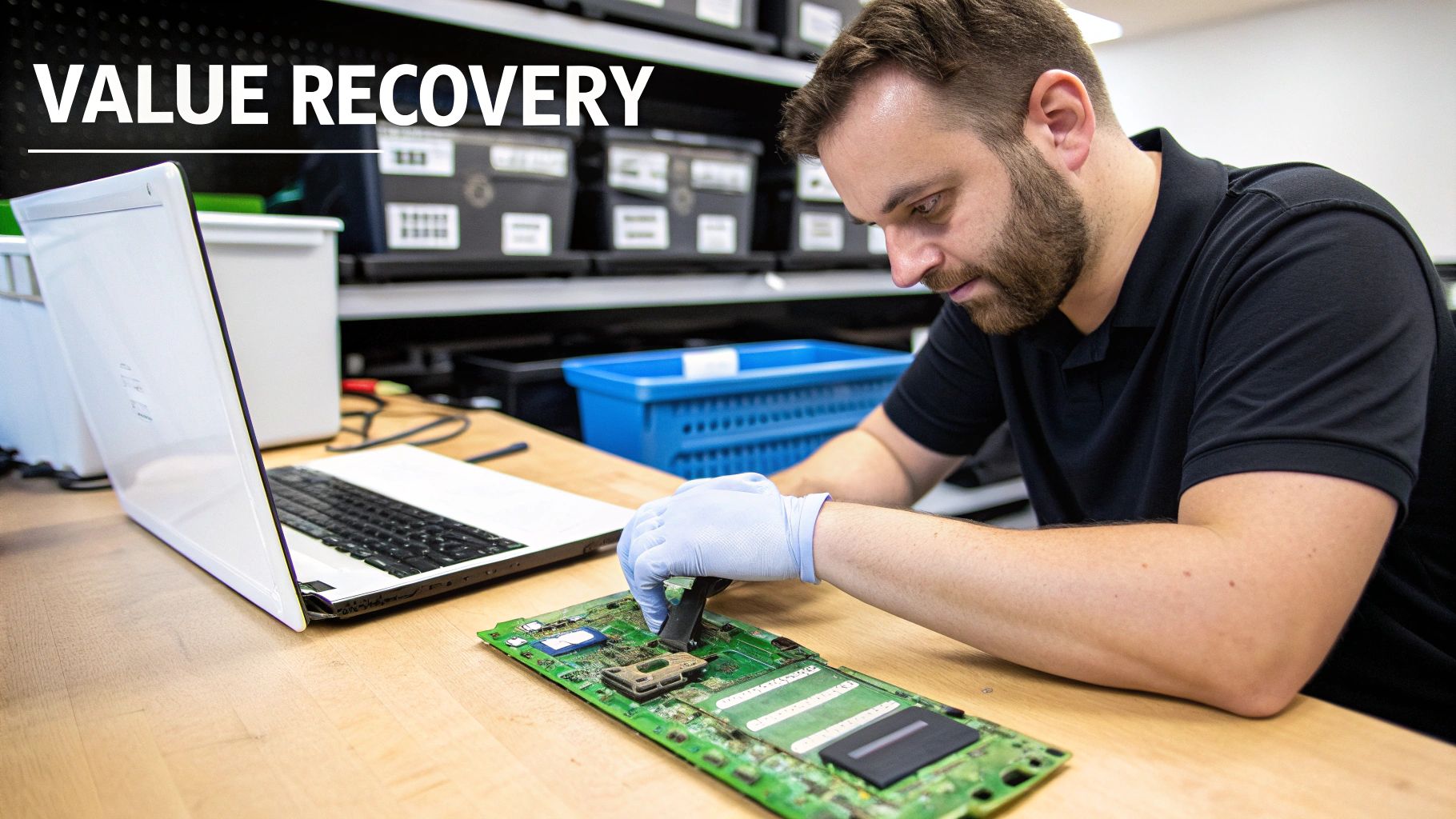
After your data is securely and permanently destroyed, the journey for your old electronics shifts from digital security to physical value recovery. This is the crucial triage stage where our trained technicians get hands-on, manually sorting, categorizing, and inspecting every single device. It’s here that we unlock the true potential of your retired assets.
This process is far from just creating a scrap pile. Think of it as a meticulous audit of physical equipment. A newer laptop might get flagged for refurbishment and resale, while an older server—though obsolete as a whole—could contain valuable components like enterprise-grade RAM, processors, and power supplies that are in high demand.
Just like a professional auto salvage yard carefully strips every usable part before crushing the frame, our manual dismantling process ensures no value is left on the table. This strategic approach is a core pillar of IT Asset Disposition (ITAD) and is what separates a certified partner from a simple scrap hauler.
The Financial Upside of Strategic Dismantling
Let's get straight to the point: the main goal here is to maximize the financial return from your end-of-life equipment. For many businesses, IT disposal is just seen as a cost. But with a detailed sorting and dismantling process, it can actually become a revenue stream that offsets or even exceeds the cost of recycling.
This is especially true for data center hardware. While taking servers offline can be a complex project, the components inside often retain significant value. Properly managing this process ensures you capture that residual value. For a deep dive on this, our server decommissioning checklist offers valuable insights into preparing these assets for disposition.
This financial return is fully documented and shared with you, providing transparent reporting on the value recovered from your assets.
Identifying Reuse, Resale, and Recycling Streams
During the sorting phase, our technicians categorize devices into several key streams. This decision-making is critical for both your bottom line and your environmental goals.
- Remarketing and Resale: Devices with remaining functional life—like recent-model laptops, monitors, and networking gear—are tested, cleaned, and prepared for resale. This is the greenest option, extending the product's life and using the least amount of energy.
- Component Harvesting: For older or non-functional equipment, technicians manually dismantle the units to salvage valuable internal parts. A single server might yield CPUs, memory modules, and hard drives that can be sold individually.
- Material Recycling: Anything with no resale or component value is sent on for raw material recovery. This includes broken plastics, old motherboards, and low-grade cables that will be shredded and separated in the next stage.
The key takeaway for businesses is that a thoughtful dismantling process directly impacts your bottom line and sustainability goals. By prioritizing reuse and component recovery, certified ITAD partners ensure that your retired assets deliver the maximum possible economic and environmental benefit.
This methodical approach prevents usable technology from being prematurely destroyed. It ensures every component is directed to its most appropriate and valuable next life, whether that's in another office, as a spare part for a repair, or as raw material for a new product.
The High-Tech Process of Separating Materials
For electronics that can’t be resold or have their parts harvested, the real teardown begins. This is where devices head to an advanced material separation facility, and it’s where the magic of modern recycling truly happens. The whole point is to answer the big question of what happens to recycled electronics: how do we turn a tangled mess of circuits, plastic, and metal back into pure, reusable materials?
This isn't just a demolition job. It’s a finely tuned system designed to purify a complex stream of e-waste. Devices are first fed into massive industrial shredders that chop them into small, consistent pieces. But that’s only step one. The goal isn’t to just smash everything up; it's to break the bonds between materials so each one can be sorted and reclaimed.
Think of it like trying to separate a jar filled with salt, sand, and iron filings. You wouldn't just pick them apart. You’d grab a magnet to pull out the iron, use water to dissolve the salt, and then filter out the sand. E-waste separation follows the same logic, just on a much bigger and more sophisticated scale.
From Shredded Mix to Pure Streams
Once the electronics are shredded, the jumble of plastic, metal, and glass starts its journey down a complex sorting line. Here, a mix of powerful physical forces and smart technology works to isolate different materials with stunning speed and precision.
The first pass is all about getting the iron and steel out. These are known as ferrous metals, and they make up a big chunk of the weight in things like old computer cases.
- Powerful Electromagnets: The shredded material travels on a conveyor belt under huge overhead magnets. These powerful systems lift all the steel and other iron-based metals right out of the stream, dropping them into their own collection bin. It’s a straightforward but incredibly effective first step.
With the steel gone, the system now has to deal with a much more complicated mix of materials.
Harnessing Physics to Sort Metals
Next up, the remaining material is fed into a machine that uses a pretty amazing bit of physics called an eddy current. An eddy current separator spins a magnetic rotor at high speed, which creates a magnetic field in non-ferrous metals like aluminum and copper.
This newly created field actually repels the metals, effectively launching them off the conveyor belt into a separate chute. All the plastics and other non-metallic materials are unaffected and simply drop off the end of the belt. It's a clever way to cleanly sort valuable conductive metals without ever touching them.
This advanced sorting is a critical link in the circular economy. It transforms what was once a complex, integrated product back into distinct, high-quality raw materials that can be sold to manufacturers, reducing the need for virgin resource extraction.
Thanks to this process, valuable resources like copper—which is needed for everything from new wiring to circuit boards—are efficiently recovered and put right back into the supply chain.
Optical Scanners and Air Jets for Plastics
The final stream is mostly a mix of different types of plastics. To the naked eye, it all looks the same, but different plastic polymers have to be separated to be recycled properly. This is where optical sorting technology shines.
- Near-Infrared (NIR) Scanners: The plastic bits are spread out on a fast-moving conveyor belt and shot with near-infrared light. Sensors read the light that reflects back, instantly identifying the unique signature of different plastics like ABS or polystyrene.
- Precision Air Jets: The moment a specific type of plastic is identified, the system fires a perfectly aimed puff of compressed air, knocking that single piece into the correct bin. This happens thousands of times a minute with incredible accuracy.
This combination of shredding, magnets, eddy currents, and optical scanners is what makes large-scale electronics recycling work. It's a high-tech disassembly line that turns your company’s old equipment back into a valuable resource, ensuring that the final answer to what happens to recycled electronics is both environmentally responsible and economically smart.
After this intricate process, we're left with clean streams of raw materials ready for a new life. The table below shows some of the most common materials recovered from e-waste and how they're typically reused.
Materials Recovered from E-Waste and Their Uses
| Recovered Material | Commonly Found In | Typical End Use |
|---|---|---|
| Steel (Ferrous Metal) | Computer cases, server racks, structural frames | New steel products, automotive parts, construction materials |
| Aluminum | Laptop casings, heat sinks, hard drive chassis | Cans, automotive components, new electronic frames |
| Copper | Circuit boards, wiring, power cords, connectors | New wiring, plumbing pipes, industrial machinery |
| Gold & Silver | Circuit boards, connectors, processors | Jewelry, new electronics, industrial and medical uses |
| Plastics (ABS, PS, etc.) | Keyboards, monitor casings, printer bodies | Automotive parts, office equipment, plastic lumber, new electronics |
| Glass | CRT monitors, scanner beds, photocopier glass | New glass products, tiles, concrete aggregate, reflective paints |
This recovery process is the final step in turning obsolete technology from a liability into a valuable asset, closing the loop and feeding the next generation of manufacturing.
Refining E-Waste into Raw Materials
After the high-tech sorting process isolates clean streams of plastic, steel, and aluminum, the most valuable components still have a long way to go. This final stage is a true transformation, turning sorted electronic scrap into pure, raw commodities ready for the manufacturing floor. This is where we see the real answer to the question of what happens to recycled electronics—it’s not just waste management, it's resource creation.
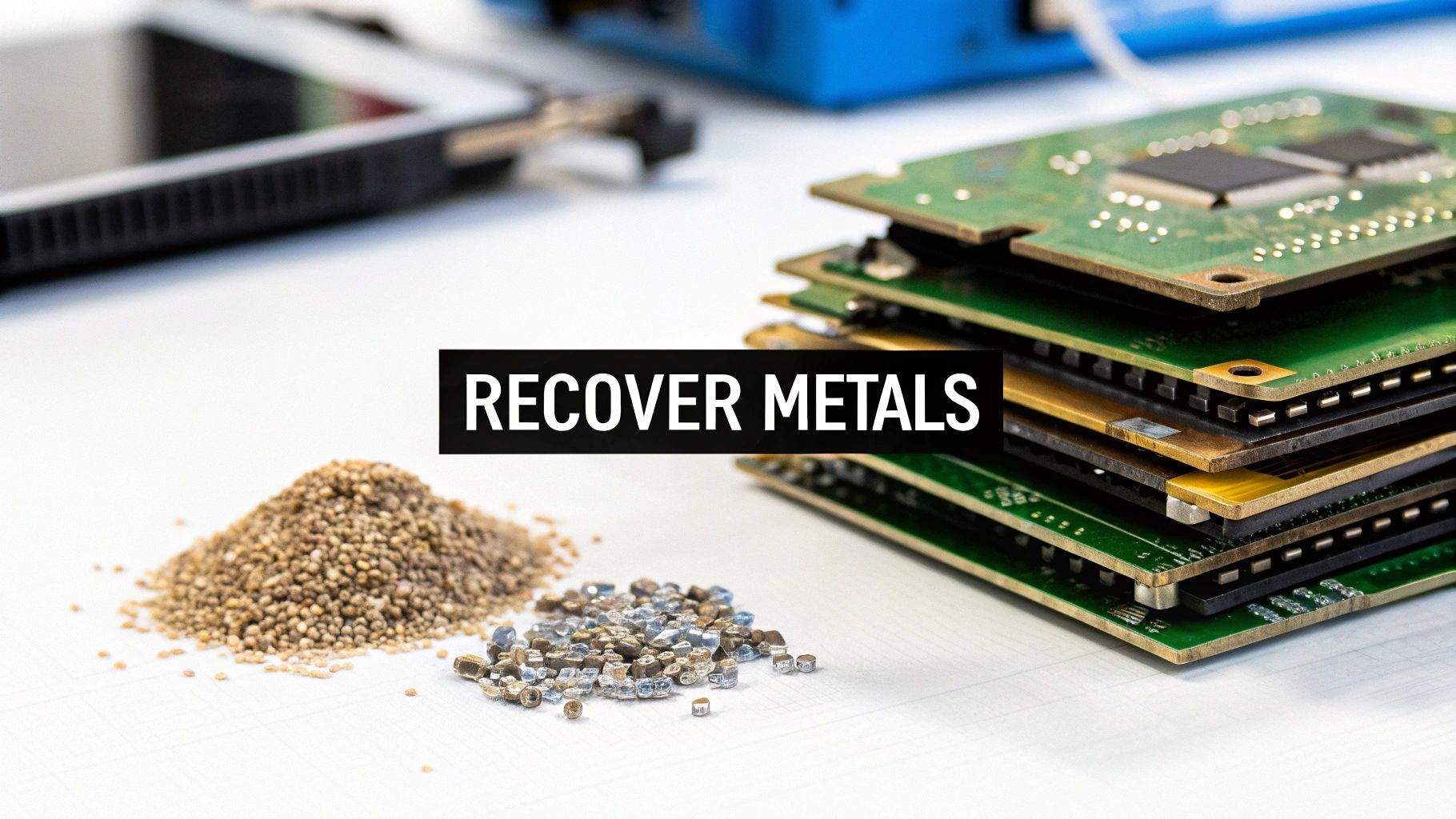
The heart of this entire operation is found in the circuit boards. Those intricate green and gold boards are the nervous system of every electronic device, and they’re essentially a concentrated "urban mine" packed with precious and semi-precious metals. They are loaded with gold, silver, copper, and palladium, which makes them the most valuable part of the e-waste stream by weight.
Unlocking Value Through Extreme Heat and Chemistry
To pull these valuable metals out, recycling facilities turn to advanced metallurgical processes. The most common method is smelting, where the shredded circuit board material is heated to incredibly high temperatures inside a specialized furnace. This intense heat forces the different materials to separate based on their unique melting points and densities.
Think of it as a high-tech blacksmith’s forge. The heat melts down the metals, which pool together, while the fiberglass and plastic components are either burned away as fuel or captured as a waste material called slag. This process leaves behind a concentrated alloy of precious metals, which is then sent for final purification.
Another advanced technique is hydrometallurgy. Instead of pure heat, this process uses a series of liquid chemical solutions to selectively dissolve specific metals from the shredded electronics. Each metal is then recovered from its solution in a highly pure form. This method is especially good for targeting rare earth metals that are tough to separate with heat alone. If you want a deeper dive into this, our guide to recycling circuit boards provides a lot more detail.
Closing the Loop for a Sustainable Supply Chain
Recovering these materials isn't just about their dollar value; it's a massive win for the environment. Mining new ore from the earth is an energy-hungry, destructive process. Recycling existing metals, on the other hand, uses a fraction of the energy and produces far fewer greenhouse gas emissions.
- Recycling one ton of circuit boards can yield 40 to 800 times more gold than mining one ton of ore.
- It also recovers huge amounts of copper, which requires up to 90% less energy to recycle than to mine from virgin ore.
This process is absolutely vital for creating a circular economy. The economic potential locked away in our e-waste is staggering. In 2022, global e-waste contained metals worth an estimated $62 billion, yet only $28 billion of that was actually recovered. That means around $34 billion in valuable resources is lost every year due to improper disposal—a huge missed opportunity. You can explore more about these economic figures and the value of metals in e-waste on Statista.com.
By partnering with a certified recycler, your business directly contributes to a more resilient and sustainable global supply chain. The refined metals from your old servers and laptops are sold back to manufacturers to create the next generation of technology, reducing our collective dependence on finite natural resources.
Ultimately, this final refining step is what completes the lifecycle of recycled electronics. It ensures that your retired assets don't just avoid a landfill—they get reborn as the building blocks for future innovation, protecting both your business and the planet.
How to Choose the Right Recycling Partner
Knowing what happens to your old electronics is one thing, but making sure it’s handled securely and by the book? That’s the real challenge.
For any business, choosing the right IT Asset Disposition (ITAD) partner is a critical decision. Your liability for that equipment doesn’t just vanish when the truck pulls away. It only ends once you have documented, legally-defensible proof that every bit of data was destroyed and every component was recycled in compliance with the law.
This isn't just about hauling away old gear. It's about protecting your company from massive legal, financial, and brand-damaging risks. An uncertified vendor could mishandle your data or illegally dump your e-waste, leaving you on the hook for staggering fines and a public relations nightmare. A professional partner is your shield, offering a transparent, verifiable process from start to finish.
This is where industry certifications become your most powerful vetting tool.
The Gold Standard: R2 and e-Stewards Certifications
When you're evaluating recyclers, two certifications should be at the top of your list: R2 (Responsible Recycling) and e-Stewards. These aren't just fancy logos for a website; they represent a serious commitment to the highest possible standards for data security, environmental safety, and worker protection.
Think of these certifications as a full-scale, third-party audit of a recycler's entire operation. A company can't just say they're responsible—they have to prove it through rigorous, ongoing inspections.
- R2v3 Certification: This is the latest and toughest version of the R2 standard. It forces recyclers to follow a strict "reuse, recover, dispose" hierarchy, meaning functional equipment gets a second life before it's broken down. It also demands secure data destruction and a fully audited downstream, so you know exactly where all your materials end up.
- e-Stewards Certification: Created by the environmental watchdog group Basel Action Network, e-Stewards is famous for its zero-tolerance policy on exporting hazardous e-waste to developing nations. It also places a heavy emphasis on data security and employee health, making sure every step of the process is safe for people and the planet.
Picking a partner with one or both of these certifications is the best guarantee you can get. It’s the quickest way to filter out the unqualified players and focus on true professionals.
For any business, an R2v3 or e-Stewards certification should be non-negotiable. It is the single most effective way to verify that a vendor's promises of security and compliance are backed by proven, audited practices.
Essential Documentation Your Partner Must Provide
Beyond certifications, a reliable partner will give you a detailed paper trail for every single asset they handle. This documentation is your legal proof of due diligence. If an auditor ever comes knocking, this is the evidence you’ll need to show.
Your partner must be able to deliver:
- A Detailed Chain of Custody: This document tracks your equipment from the moment it leaves your building to its final destination. For high-value assets, it should include serial numbers to provide a complete, unbroken log of accountability.
- A Certificate of Data Destruction (CoDD): As we covered earlier, this is a legally binding document confirming that all data was wiped or physically destroyed according to standards like NIST 800-88. It should list the specific serial numbers of the drives that were sanitized or shredded.
- Comprehensive Asset Reporting: If your project involves recovering value from old equipment, you need a transparent report. It should detail what was refurbished, what was sold, and the exact financial return you received. This ensures you’re getting the maximum value back.
This level of transparency is the hallmark of a professional ITAD provider. If a potential vendor gets vague about their reporting or can’t produce these documents, consider it a major red flag.
Finding the right partner can seem complex, but our guide to top electronic waste recycling companies offers valuable insights to help you make an informed choice. Ultimately, choosing the right partner is the final, crucial step in protecting your business and ensuring your electronics are recycled the right way.
Got Questions About E-Waste? We Have Answers.
For any business, diving into electronics recycling brings up a few important questions. Getting a handle on data security, industry lingo, and whether you can get money back is crucial before you hand over your old equipment. Here are some straightforward answers to the questions we hear most often from our commercial clients.
Is It Really Safe to Recycle Devices with Sensitive Data?
Absolutely—as long as you’re working with a certified partner. The entire process for handling recycled electronics is built on a foundation of unshakeable security. Reputable recyclers use sophisticated methods like NIST 800-88 compliant data erasure to forensically wipe every bit of information from your drives, making data recovery impossible.
What about devices that don't power on or when you need absolute, ironclad certainty? For those, we use physical shredding to grind the hard drives and storage media into tiny, useless fragments. Once the job is done, you receive a Certificate of Destruction. This is a legal document that serves as your audit trail, proving you fulfilled your compliance duties and your data was destroyed responsibly.
What Is the Difference Between Recycling and ITAD?
This is a fantastic question, and the distinction is critical for businesses. The simplest way to think about it is that electronics recycling is just one piece of a much bigger, more strategic puzzle called IT Asset Disposition (ITAD).
- Electronics Recycling is what happens at the end of the line. It's the process of breaking down broken or valueless equipment into its base raw materials like plastic, metal, and glass.
- ITAD is the whole strategy. It covers the entire lifecycle of a retired asset, including secure transportation, data destruction, and—most importantly—assessing if the equipment can be fixed up and resold to recover value. Recycling is the final step, but only for assets that truly have no life left in them.
An ITAD approach is all about squeezing the maximum financial return out of your old gear while keeping everything secure and compliant from start to finish.
Can Our Business Get Paid for Old Electronics?
Yes, you absolutely can. This is done through a process called value recovery, which can turn your old equipment from a costly liability into a genuine financial asset. If your retired laptops, servers, or networking gear are still in decent shape and have some market demand, they can be refurbished and resold.
Your net return is the equipment's resale value minus the costs for logistics, data destruction, and refurbishment. For large batches of enterprise-grade hardware, this often results in a significant payment back to your company.
This completely changes the game. Instead of just being an expense, getting rid of old tech becomes a potential revenue stream that directly helps your bottom line.
Ready to turn your retired IT assets into a secure and profitable opportunity? At Atlanta Computer Recycling, we provide certified ITAD services tailored for Atlanta businesses, ensuring your data is destroyed and your hardware’s value is maximized. Contact us today for a seamless and compliant electronics recycling solution at https://atlantacomputerrecycling.com.