How to Choose an Electronic Waste Recycling Company for Your Business

An electronic waste recycling company isn't just a junk hauler. Think of them as specialized partners who manage the secure, environmentally-sound disposal of your business's old electronics. They provide services like certified data destruction and responsible recycling, turning what could be a massive liability into a managed, documented process. This is what stands between your business and a potential data breach or steep regulatory fine.
Why Smart Businesses Partner with E-Waste Recyclers
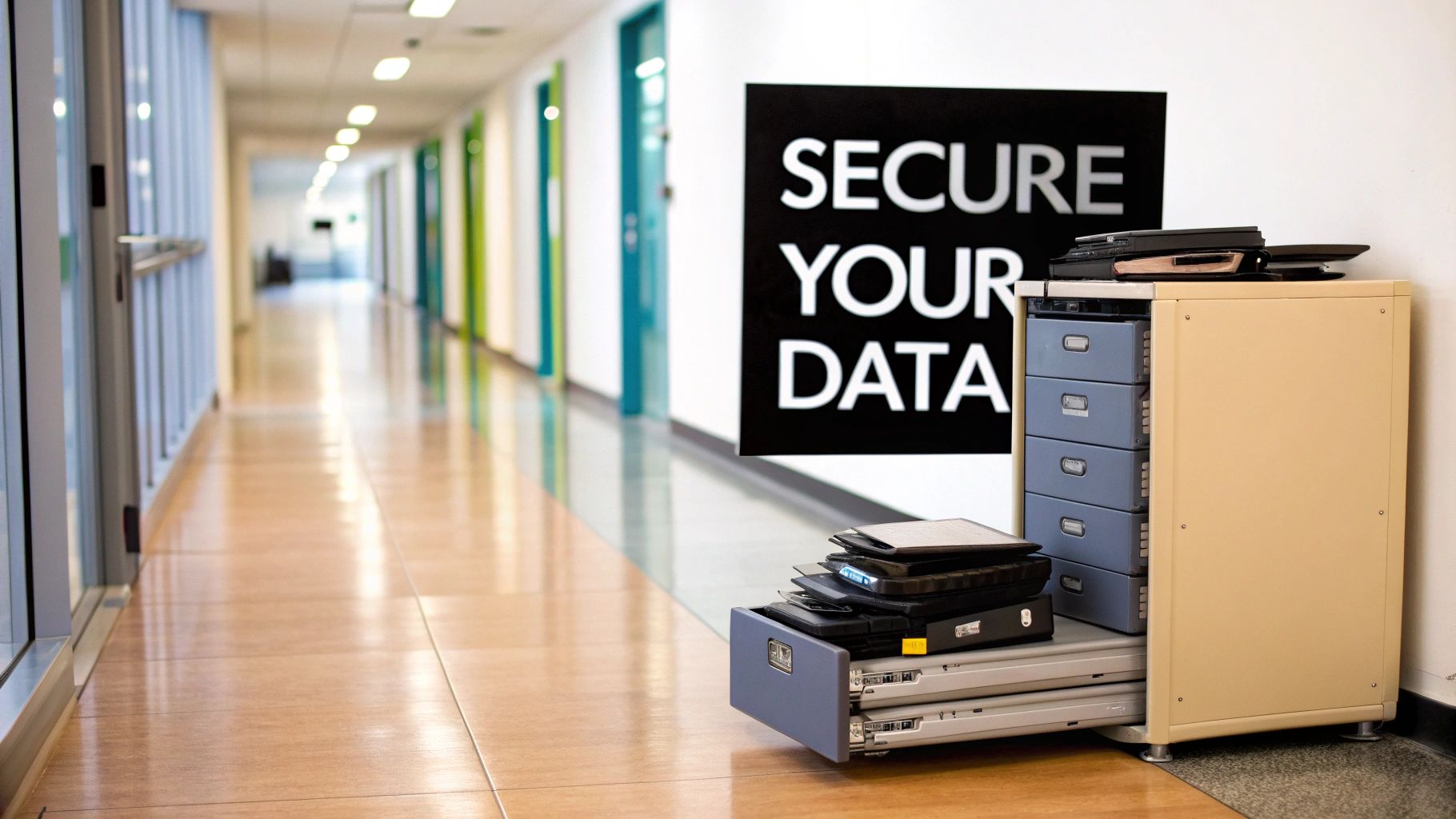
Simply tossing out old company electronics is more than an environmental blunder—it's a serious business threat. Your retired servers, old laptops, and forgotten hard drives are like unlocked filing cabinets. Leaving them in a back room or, worse, in a dumpster is like putting filing cabinets full of sensitive client information, financial records, and company secrets on the curb for anyone to grab.
The risk here is immense. A data breach from a discarded IT asset can trigger catastrophic financial losses, not to mention the legal penalties for violating regulations like HIPAA. It can also cause lasting damage to your brand's reputation. All it takes is one forgotten hard drive to destroy years of customer trust.
Turning Liability into a Secure Process
This is where professional e-waste recycling companies become indispensable. They are risk management specialists, not just waste collectors. Their entire purpose is to transform this liability into a secure, compliant, and fully documented process, safeguarding your business from the dangers lurking in old tech.
When you partner with a certified expert, you’re ensuring that every single piece of equipment is handled according to strict, established protocols. It’s a systematic approach that delivers both peace of mind and tangible proof that you’ve done your due diligence.
A professional e-waste recycler provides a secure chain of custody, ensuring your sensitive data is protected from the moment it leaves your facility until its final, certified destruction. This verifiable process is your best defense against data-related liabilities.
Key Protections Offered by E-Waste Partners
A good recycling partner provides several layers of protection that are nearly impossible to replicate in-house. Their services are built specifically to tackle the challenges businesses face when retiring old IT assets.
- Data Breach Prevention: They use certified methods to permanently wipe all data from your devices and provide official certificates of destruction for your compliance records.
- Regulatory Compliance: They navigate the complex web of data privacy and environmental disposal laws for you, helping you sidestep costly fines.
- Brand Reputation Management: Handling e-waste responsibly shows a commitment to corporate social responsibility, which strengthens trust with customers and stakeholders.
Ultimately, choosing the right partner is about more than just getting rid of old gear. It's a strategic decision that mitigates major risks while also addressing the growing concerns about the environmental impact of electronic waste.
What Professional E-Waste Recycling Actually Involves
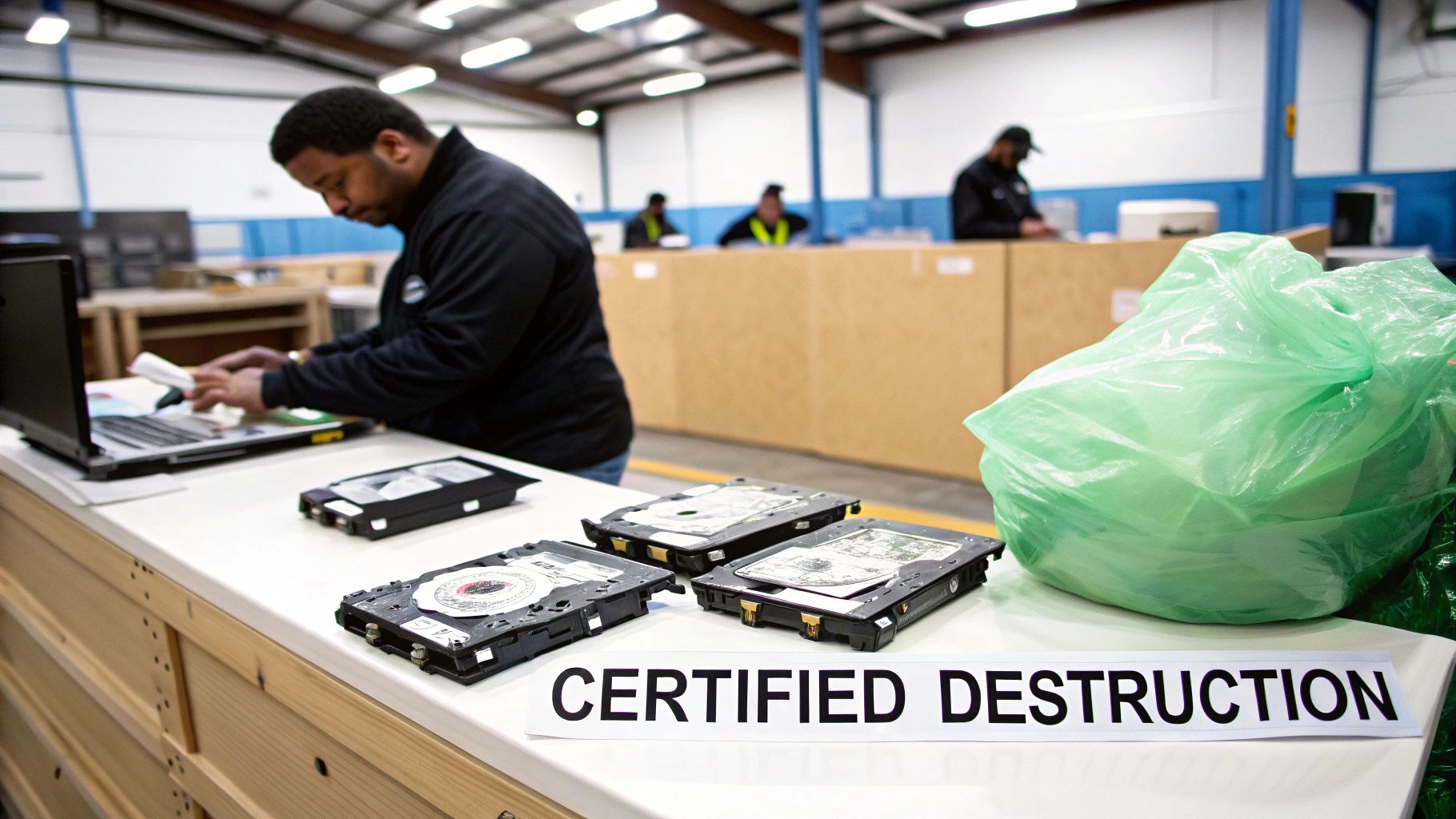
When you partner with a professional electronic waste recycling company, you’re getting a whole lot more than just a pickup service. These experts offer a full suite of services designed to shield your business from risk, turning a potential liability into a securely managed process. It’s not about just hauling junk away; it’s about a documented, defensible procedure from start to finish.
It all begins with secure chain-of-custody logistics. The moment your old electronics leave your office, they are meticulously tracked and monitored until they reach their final destination. This strict protocol closes any gaps where a device—and the sensitive data on it—could get lost or stolen.
Certified Data Destruction: The Digital Shredder
For any business, the single most important part of this process is certified data destruction. Think of it as a high-tech, industrial-strength shredder for your digital files. Simply deleting files or formatting a hard drive isn't enough, as data can often be recovered. Professionals use specialized methods to permanently obliterate all information, making it absolutely impossible to retrieve.
Once the job is done, you receive a Certificate of Destruction. This is a formal, legally recognized document that serves as your proof that the data was destroyed according to privacy laws. It’s your tangible defense against liability—and a key reason to always choose a certified pro.
This step is critical in tackling a massive global issue. Worldwide, a staggering 80% of e-waste is not formally collected or recycled, leaving it to be dumped improperly. This creates enormous risks for both data security and the environment.
Going Beyond Destruction With ITAD
Many top-tier e-waste companies also provide IT Asset Disposition (ITAD) services. This is a much more strategic approach that treats your old equipment not as trash, but as assets that might still have value. Instead of just destroying everything, an ITAD program carefully assesses each item to find its best possible outcome.
An effective ITAD strategy shifts the conversation from disposal costs to asset recovery. It's a business-focused process that maximizes financial return while guaranteeing data security and environmental compliance for every retired device.
This approach brings several powerful benefits to your company.
- Value Recovery: Equipment that's still functional—like newer laptops, servers, or networking gear—can be refurbished and resold. This puts money back into your business.
- Secure Remarketing: The recycler handles the entire process, from data wiping and testing to selling the equipment through secure, established channels.
- Sustainable Practices: Reusing electronics is the most eco-friendly option available. It extends the life of valuable resources and keeps functional hardware out of the shredder.
By offering these integrated services, the best electronic waste recycling companies act more like essential partners in your company’s data security and asset management strategy. To learn more about how ITAD works, feel free to explore our guide on what IT Asset Disposition is. It's a service that is a smart operational investment, not just another disposal cost.
Decoding E-Waste Certifications and Compliance
For any business, compliance isn't just a box to check—it's a core part of keeping your operations safe and secure. When you're weighing your options for an electronic waste recycling company, their certifications are the single best indicator of professionalism and accountability. Think of them like a CPA's license for an accountant; they are a verifiable mark of expertise, ethical conduct, and a commitment to strict protocols for both data security and environmental safety.
These certifications aren't just fancy badges for a website. They prove that a company has undergone rigorous, third-party audits to meet demanding standards. This is what protects your business from massive risks. An uncertified vendor might cut corners, but that could leave your company exposed to data breaches, illegal dumping fines, and irreversible damage to your brand. A certified partner, on the other hand, gives you a documented, defensible process that will stand up to any scrutiny.
The Gold Standards of E-Waste Recycling
While a few different certifications are out there, two really stand out as the most respected benchmarks in our industry. Knowing what they guarantee is the key to making the right choice for your business.
A good way to understand the landscape is to look at the main players. Here’s a quick breakdown of what these certifications mean and why they are so critical.
Key E-Waste Recycling Certifications Explained
| Certification | Core Focus | Key Benefit for Your Business |
|---|---|---|
| R2 (Responsible Recycling) | The entire lifecycle of an electronic device, from environmental impact to worker safety and secure data handling. | Ensures your e-waste is managed properly, not illegally exported, and that hazardous materials are handled safely. |
| e-Stewards | The absolute highest standard, with a strict zero-tolerance policy for exporting hazardous e-waste to developing nations. | Offers the most stringent protection available, guaranteeing ethical recycling and an uncompromising focus on data security. |
Choosing a recycler with one or both of these certifications means you're working with a company that has made a serious investment in the right infrastructure and processes. They don't just say they handle your assets correctly—they've proven it.
A certified e-waste recycler provides a clear, documented trail proving your assets were handled in compliance with all applicable laws. This documentation is your strongest defense in the event of a regulatory audit, protecting your business from fines and legal challenges.
These standards also have a direct, non-negotiable impact on how your data is treated. Certified companies are required to have ironclad data destruction policies. They must be able to prove that all sensitive information is either completely sanitized or physically destroyed before any equipment is resold, refurbished, or recycled.
This verification process culminates in essential documentation for your own compliance records. You can learn more about how this works by exploring what goes into a certificate of destruction for hard drives.
Ultimately, partnering with a certified company is a crucial part of corporate risk management. It’s the only way to be sure that your end-of-life electronics are processed securely and ethically—protecting your data, your reputation, and the environment.
Finding the Hidden Value in Your Old Electronics
Most businesses see a room full of old electronics as a problem to be solved—a line item expense for data security and regulatory compliance. But what if that pile of depreciated assets was actually a hidden revenue stream waiting to be tapped?
This is where the mindset shifts from simple disposal to a strategic IT Asset Disposition (ITAD) program. A smart ITAD plan is all about recovering the maximum possible value from retired equipment that still has life left in it. Think about all those gently used servers, corporate laptops, and networking gear sitting in a storeroom. They're often far from worthless.
Turning Depreciated Assets into Revenue
Instead of just shredding these devices, an ITAD specialist securely wipes them, tests the components, refurbishes what's viable, and resells the equipment on the secondary market. The best part? A professional e-waste partner handles all of that for you, and your business gets a direct financial return from the sales. Suddenly, that "cost" becomes a source of income.
This infographic lays out some of the key certifications to look for, like R2 and e-Stewards. These aren't just fancy logos; they're your assurance that a partner knows how to handle valuable assets and sensitive data securely.

Working with a certified provider is crucial. It’s the difference between recovering value and risking a data breach from improperly handled gear.
Partnering with a certified ITAD provider doesn't just generate revenue; it also helps you avoid the severe financial penalties of non-compliance and the catastrophic costs associated with a data breach from improperly handled equipment.
The scale of this missed opportunity is staggering. In 2022, the world generated a record 62 million tonnes of e-waste, but only 22.3% of it was properly collected and recycled. That means an estimated $62 billion in valuable, recoverable resources was simply lost or mismanaged.
Extracting Value from Components
Even electronics that are too old or broken to be resold as a whole unit still hold significant value. Their internal components, especially circuit boards, are packed with precious metals like gold, silver, copper, and palladium. It takes a sophisticated process to extract these materials safely, which is where a professional recycler comes in.
Here’s a look at what can be recovered:
- Precious Metals Recovery: Gold and silver are pulled from connectors and pins, turning otherwise worthless scrap into a measurable return.
- Base Metal Recycling: Common metals like copper from wiring and aluminum from heat sinks are reclaimed and sold back into the commodity markets.
- Component Reuse: Sometimes, individual parts like RAM modules or processors are still perfectly good and can be harvested and sold on their own.
When you work with an ITAD expert, you get the peace of mind that every piece of your old tech is being evaluated for its highest potential value. Our team can walk you through the specifics of recycling circuit boards and other components, ensuring you get the best possible return.
How to Choose the Right E-Waste Recycling Partner
Picking an e-waste recycler isn’t like hiring someone to haul away old furniture. This decision requires the same diligence you’d use for a financial or legal vendor. You’re not just getting rid of old equipment; you’re trusting a partner with your company’s sensitive data, environmental compliance, and hard-earned reputation.
The right choice protects you from all angles. The wrong one can expose you to some serious risks. Making a confident, well-informed decision starts with asking the right questions and demanding clear, verifiable answers. A true professional will welcome the scrutiny and have all the documentation ready.
Verifying Certifications and Security Protocols
First things first, check for certifications. Any potential partner should hold key industry credentials like R2 (Responsible Recycling) or e-Stewards. These aren't just fancy logos on a website—they are hard-earned proof of rigorous, third-party audits that verify a company’s commitment to data security and environmental standards. Always ask to see a copy of their current certification.
Next, dig into their data destruction process. Do they offer both certified data wiping and physical shredding? A reputable company will provide a Certificate of Destruction for every single hard drive and data-bearing device they handle. This gives you an auditable paper trail, which is crucial for your compliance records.
Choosing an e-waste recycling partner is a critical risk management decision. Your focus should be on their ability to provide a secure, transparent, and fully documented chain of custody that protects your data from the moment it leaves your facility.
This level of accountability is especially important when you look at the bigger picture. While European countries like Germany and the UK recycle over 50% of their e-waste, the United States recycles a mere 15% of its nearly 7,000 kilotonnes of electronic waste. Choosing a certified partner ensures your company is part of the solution, as you can see from global e-waste statistics.
Assessing Logistics and Reporting Capabilities
Beyond certifications, you need to look at the practical side of their operation. A huge piece of the puzzle is their chain-of-custody security. Ask them how they track your assets from your front door to their facility. Look for services that use secure, GPS-tracked vehicles and locked containers to eliminate any chance of loss or theft while your gear is on the move.
Finally, demand total transparency in their reporting. This is non-negotiable, especially if you’re using ITAD services for value recovery. Your partner should provide detailed reports that clearly outline:
- Asset Tracking: A complete inventory of every item they received, identified by serial number.
- Data Destruction Confirmation: Official certificates for all media that was sanitized or destroyed.
- Value Recovery Statements: A clear breakdown of any items that were resold and the financial return you earned.
- Environmental Impact Reports: Documentation showing exactly how much material was recycled versus sent to a landfill.
Following this framework ensures you find more than just a vendor; you find a genuine partner. For businesses looking to see what a professional service looks like in practice, it helps to explore local options, like these computer disposal services near you.
Building Your Internal E-Waste Management Program
Picking the right electronic waste recycling company is a huge first step, but the real win comes from weaving them into your daily operations. A smart e-waste program isn’t a one-time cleanout—it’s an ongoing business function. It’s all about creating a rock-solid internal policy that makes secure asset retirement a normal part of your workflow.
This means you need clear, repeatable steps that every employee can follow. The goal is to build a system where securely disposing of old tech is as routine as locking the doors at night. This is how you continuously protect your business from data risks and compliance headaches.
Establishing Clear Internal Protocols
The foundation of any strong program is clear documentation and training. Your team needs to know exactly what to do when a laptop, server, or phone hits its end-of-life. To get this process down pat, using a good standard operating procedure template is a great way to streamline documentation and ensure nothing gets missed.
This internal process should spell out several key actions:
- Employee Training: Get your staff up to speed on why data security is so critical and show them the exact steps for retiring company assets. No guesswork allowed.
- Device Handling: Create a clear process for wiping devices before they leave the building. You’ll also need a secure, central spot for collecting them.
- Scheduling Pickups: Don’t let old gear pile up in a storage closet. Set a regular collection schedule with your chosen recycler to keep things moving.
A well-defined internal e-waste policy transforms asset disposal from a chaotic afterthought into a predictable, secure, and manageable business process. It closes security loopholes and ensures continuous compliance.
By making these protocols a standard part of how you operate, you create a seamless and secure system. This proactive approach ensures your e-waste management is always protecting your business, turning a potential liability into a well-oiled machine.
Frequently Asked Questions
When it comes to managing electronic waste, businesses have a lot on the line—compliance, security, and efficiency are top priorities. Here are a few of the most common questions we get from commercial clients about partnering with an e-waste recycling company.
What Types Of Electronics Do You Accept?
A professional recycler should be able to handle just about all of your business IT equipment. That means servers, laptops, desktop computers, networking gear like switches and routers, monitors, and all the peripherals like keyboards and mice. Many of us also manage data center hardware, old telecom systems, and company mobile devices.
It’s always a good idea to confirm with your chosen partner, though. Some recyclers might have restrictions on things like large appliances or hazardous materials that fall outside of standard IT assets. A good provider will always give you a clear, upfront list of what they can and can’t take.
How Can I Be Sure My Company Data Is Destroyed?
This is easily the most critical question, and the answer is simple: documentation. Any reputable electronic waste recycling company will provide a Certificate of Destruction for every single data-bearing device they handle for you. This legal document is your official record, proving that all sensitive information was permanently wiped or physically destroyed according to industry standards.
The Certificate of Destruction is your ultimate proof of compliance. It confirms that your business has taken the necessary steps to protect customer and company data, providing a defensible record in case of an audit.
Always, always choose a partner that offers certified data destruction and guarantees this essential documentation. Without it, you’re leaving your business wide open to massive liability.
Do We Have To Pay For E-Waste Recycling Services?
The cost structure really depends on the provider and the type of equipment you have. If your business is getting rid of a large volume of newer, valuable IT assets, IT Asset Disposition (ITAD) services might actually generate a financial return. This can often offset or even completely cover any service fees.
On the other hand, for older, obsolete, or mixed electronics with little to no resale value, there's usually a service fee. This covers the cost of secure logistics, certified data destruction, and responsible recycling. It’s important to see this not as a disposal cost, but as an investment in risk management. Think of it as an insurance policy against the far greater costs of a data breach or a regulatory fine.
Ready to put a secure and compliant e-waste management program in place? Atlanta Computer Recycling offers specialized services for businesses across the metro area, ensuring your data is destroyed and your assets are handled responsibly. Contact us today to schedule your free pickup and protect your business. Learn more at https://atlantacomputerrecycling.com.