Hard Drive Destruction Near Me: Secure & Certified Options for Your Business


When your IT team searches for "hard drive destruction near me," they’re taking a crucial step to shield your entire enterprise from a data breach. Once technology is retired, simply deleting files is not enough. The only way to guarantee your sensitive corporate, employee, and client data is gone for good is through professional, physical destruction. This isn't just another IT task—it's a fundamental investment in your company's security, compliance, and reputation.
Why Physical Hard Drive Destruction Is Non-Negotiable for Businesses
When your company upgrades its technology fleet, what actually happens to the decommissioned hard drives? It's a critical question many organizations overlook, assuming a factory reset or a standard format is sufficient. That common misconception leaves behind a goldmine of recoverable data, creating a significant liability.
Consider a financial services firm in Atlanta retiring dozens of old workstations. The drives, which were only wiped, still contain fragments of client portfolios, financial statements, and proprietary trading algorithms. A competitor or malicious actor could easily acquire those drives and use basic recovery software to reconstruct that sensitive information. The fallout for the firm would be catastrophic, involving regulatory penalties, client lawsuits, and irreparable brand damage.
The Real Risks of Improper Disposal
The danger isn't hypothetical. One forgotten drive can unravel years of corporate strategy and client trust. For businesses, the consequences of improper data disposal are severe and fall into three key categories:
- Financial Loss: The cost of a data breach can be staggering. This includes regulatory fines, legal fees, and the expense of client notification and credit monitoring. The 2020 Morgan Stanley case, which resulted in a $60 million fine for failing to properly decommission old IT assets, serves as a stark reminder of the financial stakes.
- Reputational Damage: Client trust is a priceless asset. A breach resulting from negligent hardware disposal can permanently tarnish your brand, sending customers directly to your competitors.
- Compliance Violations: Businesses in regulated industries like healthcare (HIPAA) or finance (GLBA) are bound by strict data protection laws. For any organization that handles credit card data, understanding and adhering to PCI DSS compliance requirements makes physical hard drive destruction a mandatory, non-negotiable step in the IT asset lifecycle.
This is no longer a niche concern. The global hard drive destruction service market is projected to skyrocket from $1.65 billion to $5.05 billion between 2024 and 2035, driven by a massive increase in corporate data security awareness. This growth signals a clear trend: organizations now recognize secure disposal as a core business function.
Moving Beyond Deletion to Destruction
Software-based wiping has its place in a data sanitization policy, but it is not foolproof. The process can be time-consuming, requires meticulous verification, and often fails on damaged drives or newer solid-state drives (SSDs). That’s why physical destruction—shredding, crushing, or disintegration—has become the gold standard for corporate data security.
Physical destruction is the only method that provides a 100% guarantee that data is irrecoverable. It eliminates the possibility of human error in the wiping process and provides a clear, verifiable end to the data lifecycle.
This entire process is a critical component of a broader strategy called IT Asset Disposition (ITAD). To understand how it integrates into your overall technology management framework, you can learn more by reading our guide on what is IT Asset Disposition. Ultimately, converting your search for "hard drive destruction near me" into a partnership with a certified provider isn’t an operational expense; it’s a strategic investment in risk management and the long-term health of your business.
On-Site Shredding vs. Off-Site Plant Destruction
When it’s time to retire corporate hard drives, the critical decision isn’t if they should be destroyed, but how. The chosen method directly impacts your company's security posture, compliance record, and bottom line. For businesses in the Atlanta area, the two primary service models are on-site mobile shredding and off-site plant-based destruction.
There is no single correct answer. The optimal choice depends on your organization's risk tolerance, data sensitivity, and regulatory obligations. A healthcare system, for example, will almost certainly require on-site shredding to maintain a perfect chain of custody and satisfy strict HIPAA mandates. Conversely, a large enterprise conducting a data center decommissioning may find off-site services provide the necessary scale, security, and cost-efficiency for destroying thousands of drives.
The Case for On-Site Mobile Shredding
On-site shredding brings the destruction process directly to your facility. A specialized truck equipped with an industrial-grade shredder arrives at your location, and your hard drives are destroyed into fine particles right before your team's eyes. This method offers unparalleled transparency and is the preferred choice for organizations with zero tolerance for security gaps.
Its most significant advantage is the unbroken chain of custody. Your data-bearing assets never leave your sight until they are completely obliterated, eliminating any risk of loss or theft during transit.
Here is why many security-conscious businesses mandate it:
- Immediate Verification: Your team can witness the entire process, providing absolute certainty that the destruction was completed to specification.
- Maximum Security: Performing the destruction at your location eradicates all risks associated with transporting live, sensitive data.
- Compliance Certainty: For regulations like HIPAA or FACTA that emphasize a secure chain of custody, on-site shredding provides clear, irrefutable evidence of compliance.
This infographic illustrates the fundamental choice every business faces when retiring data-bearing hardware.
As the visual demonstrates, simply deleting files is a direct invitation for a data breach. Physical destruction is the only way to ensure corporate data security.
Exploring Off-Site Plant Destruction
With off-site destruction, a certified vendor collects your hard drives in secure, locked containers and transports them in a GPS-tracked vehicle to their specialized, access-controlled facility for destruction. While you do not witness the process in person, a reputable provider will have a rigorous, documented protocol to guarantee security at every stage. This is often the more cost-effective and scalable solution, especially for large-volume projects.
The entire system is built on documented trust and process integrity. A secure chain of custody is maintained using GPS-tracked transport, background-checked employees, and detailed, serialized tracking of every asset from the moment it leaves your facility.
To facilitate your decision-making process, here's a direct comparison of how these two service models stack up for corporate needs.
Comparing Hard Drive Destruction Service Options
| Service Method | Security Level | Best For | Typical Cost Factor |
|---|---|---|---|
| On-Site Mobile Shredding | Highest | Businesses requiring absolute, witnessed proof of destruction, such as healthcare, finance, or government contractors. | Higher cost per drive due to specialized equipment and on-site logistics. |
| Off-Site Plant Destruction | High | Companies with large quantities of drives, data center decommissioning projects, or those seeking a more cost-effective, yet still certified, secure solution. | Lower cost per drive, offering economies of scale for bulk disposals. |
Ultimately, both paths lead to secure, compliant destruction. The key with off-site services is partnering with a provider who is transparent and can provide auditable proof of their secure process from start to finish.
Navigating Compliance and Certifications
Regardless of the method chosen, compliance is non-negotiable. Industry standards like NIST 800-88 provide the framework for media sanitization, listing physical destruction as the most effective form. A professional destruction service is your key to meeting these rigorous standards.
The growing focus on data privacy is fueling massive investment in the tools and processes for secure disposal. The global hard disk destruction equipment market was valued at $1,760 million in 2024 and is expected to reach $2,559 million by 2032. This growth is a direct response to data privacy frameworks like GDPR and HIPAA, which require verifiable proof of secure data handling. You can learn more about the trends shaping this industry and its equipment.
For both on-site and off-site services, one document is absolutely essential: the Certificate of Destruction.
A Certificate of Destruction is the cornerstone of any professional data destruction service. This legally binding document is your official record, detailing what was destroyed, when, and how, effectively closing the loop on your data's lifecycle and transferring liability.
This certificate is more than a receipt. It's your auditable proof that your organization met its legal and ethical obligations to protect sensitive information.
How to Find and Vet a Local Destruction Partner
Transforming a search for "hard drive destruction near me" into the right strategic decision for your business requires a methodical approach. You are not just hiring a service; you are engaging a security partner to mitigate significant corporate risk. The objective is to identify a vendor who offers a transparent, secure, and compliant process from initial contact to final certification.
Finding that partner begins with knowing what to look for and, more importantly, what questions to ask. A simple online search is merely the starting point. The real work is in the vetting process, where you can distinguish certified professionals from unqualified operators.
Go Beyond Basic Search Queries
To identify the best providers in the Atlanta market, your procurement or IT team should use more specific search terms. Utilizing precise phrases helps filter out generalists and connects you with vendors specializing in certified, commercial-grade destruction.
Instead of a generic search, employ these targeted queries:
- "NAID AAA certified shredding Atlanta": This focuses on vendors holding the industry's highest certification for secure data destruction, indicating their processes are subject to rigorous, unannounced audits.
- "HIPAA compliant data destruction near me": Essential for any healthcare organization or business associate handling protected health information (PHI). This identifies partners versed in healthcare compliance.
- "On-site hard drive shredding services Georgia": Use this if your corporate policy or risk assessment dictates that you must witness the destruction.
- "Certified electronics recycling with data destruction": An excellent query for finding a single-source partner who can manage both your data security and environmental compliance obligations.
These focused searches will yield a shortlist of potential partners who already advertise the specific credentials and services your business requires.
The Essential Vetting Checklist
Once you have a shortlist of vendors, it's time for due diligence. The initial contact is your opportunity to gauge their professionalism and expertise. A reputable firm will welcome your questions and provide clear, direct answers.
Here are the critical questions every business should ask a potential hard drive destruction partner:
- What certifications do you hold? Look for NAID AAA Certification as the non-negotiable standard. Inquire if they are also R2 or e-Stewards certified, which demonstrates a commitment to responsible and ethical electronics recycling.
- Can you describe your chain of custody process? They must be able to detail every step, from secure collection at your facility to final destruction, explaining asset tracking, secure transport, and personnel protocols.
- Are your employees background-checked and trained? The personnel handling your sensitive media are a critical link in the security chain. The answer must be a confident "yes," supported by details on their screening and training programs.
- Can I witness the destruction process? For on-site services, this is standard. For off-site, a transparent company should offer facility tours or video verification. A refusal is a major red flag.
- What does your Certificate of Destruction include? A proper certificate is a legal document. It must list the date, location, destruction method, and a serialized inventory of the destroyed assets.
- How do you manage the shredded material for recycling? A responsible vendor will have a clear, secure process for transferring shredded material to a certified downstream recycling partner, ensuring environmental compliance.
These questions are designed to test a vendor's commitment to security, compliance, and transparency. Vague or evasive answers are a clear signal to disqualify them from consideration.
Spotting the Red Flags
Knowing what to look for is only half the battle; you also need to recognize what to avoid. Certain signs indicate a vendor may lack the security protocols your business demands.
Be wary of any provider whose pricing seems too good to be true. Secure, compliant hard drive destruction requires significant investment in certified equipment, secure facilities, and trained staff. Rock-bottom prices often mean critical security or compliance corners are being cut.
Here are some common red flags to watch for:
- Lack of Clear Certifications: If a vendor cannot immediately provide proof of NAID AAA or other key certifications, they are not a viable partner for corporate services.
- Vague Answers on Recycling: If they cannot specify their downstream recycling partners, the shredded e-waste may be exported or disposed of improperly, creating a significant environmental liability for your company. To learn more, see our guide on finding reputable electronic waste recycling companies.
- No Option to Witness Destruction: A refusal to allow observation suggests a lack of transparency and could be concealing an insecure or non-compliant operation.
- Pressure to Bundle with Non-Secure Services: Some companies may try to upsell other services without possessing the requisite security framework for the data destruction component itself.
The demand for these specialized services is booming. The hard drive destruction service market was estimated at $2.5 billion in 2025 and is projected to grow at a Compound Annual Growth Rate (CAGR) of 8% through 2033. This growth is fueled by rising data security concerns, data center consolidation, and greater awareness of environmental regulations. As the market expands, it becomes even more critical to select a certified, responsible partner.
By using targeted search terms, asking the right questions, and watching for red flags, you can confidently select a local partner in Atlanta who will protect your data, ensure compliance, and provide genuine peace of mind.
Decoding the Costs of Hard Drive Destruction
When planning for professional hard drive destruction, one of the first questions from any business unit is, "What is the cost?" While a valid question, viewing this as a simple line-item expense is a strategic error. The true cost isn't the price of shredding; it's the cost of not doing it.
A single data breach can result in millions of dollars in fines, legal fees, and brand damage. In that context, the fee for professional destruction is a high-value investment in risk management.
Common Pricing Models Explained
In the Atlanta market, vendors typically structure their pricing in a few standard ways. Understanding these models will help you evaluate quotes and find a solution that aligns with your project needs and budget.
- Per-Drive Fee: The most straightforward model. You pay a flat rate for each hard drive, ideal for projects with a known, specific quantity of media.
- Per-Pound Rate: Highly effective for large-scale disposals with mixed media types. The vendor charges based on the total weight, simplifying the quotation process for complex data center cleanouts.
- Flat-Rate Bin Service: An excellent option for businesses with a continuous stream of retired IT assets. The provider supplies a secure, locked container; you fill it, and they service it for a flat fee on a set schedule.
The type of media being destroyed is also a factor. For instance, SSDs (Solid-State Drives) may cost more to destroy than traditional spinning hard drives. Their durable construction requires more powerful shredders to ensure complete data obliteration. You may also encounter additional labor charges if your internal team has not removed the drives from servers or laptops.
Getting an Accurate Quote
A vague service request will result in a vague and likely inaccurate estimate. To secure a firm quote that can be used for budgeting, you must provide specific details.
Before contacting a vendor, your team should have the following information ready:
- Quantity of Drives: An accurate count of the hard drives, tapes, or other media slated for destruction.
- Type of Media: Be specific. Are they 3.5" HDDs, 2.5" laptop drives, enterprise SSDs, or LTO backup tapes?
- Service Method: Specify whether you require on-site mobile shredding at your facility or are using off-site plant-based destruction.
Position professional hard drive destruction as a non-negotiable line item in your security budget. It is not an IT disposal task but a fundamental strategy that protects the entire enterprise from financial and legal disaster.
Watching Out for Hidden Fees
A reputable, professional vendor will be transparent about their pricing. However, it is prudent to inquire about any potential additional charges that could arise. These are typically related to logistics or services beyond the standard scope of work.
Be sure to ask about fees for:
- Transportation or Fuel Surcharges: Particularly if your location is outside their standard service radius.
- Stairs or Difficult Access: If equipment is located in a data center basement or an office floor without elevator access, expect a fee for additional labor.
- Detailed Reporting: A standard Certificate of Destruction should always be included. However, a serialized asset report that logs every individual serial number may be an additional service.
Understanding these factors allows for accurate budgeting for this critical security function. Proper hardware disposal is foundational to a robust security posture. For a broader look at managing the entire disposal lifecycle, review our guide on computer disposal services near me. Choosing a certified partner ensures your investment delivers true peace of mind and bulletproof compliance.
Preparing Your Media for Secure Disposal
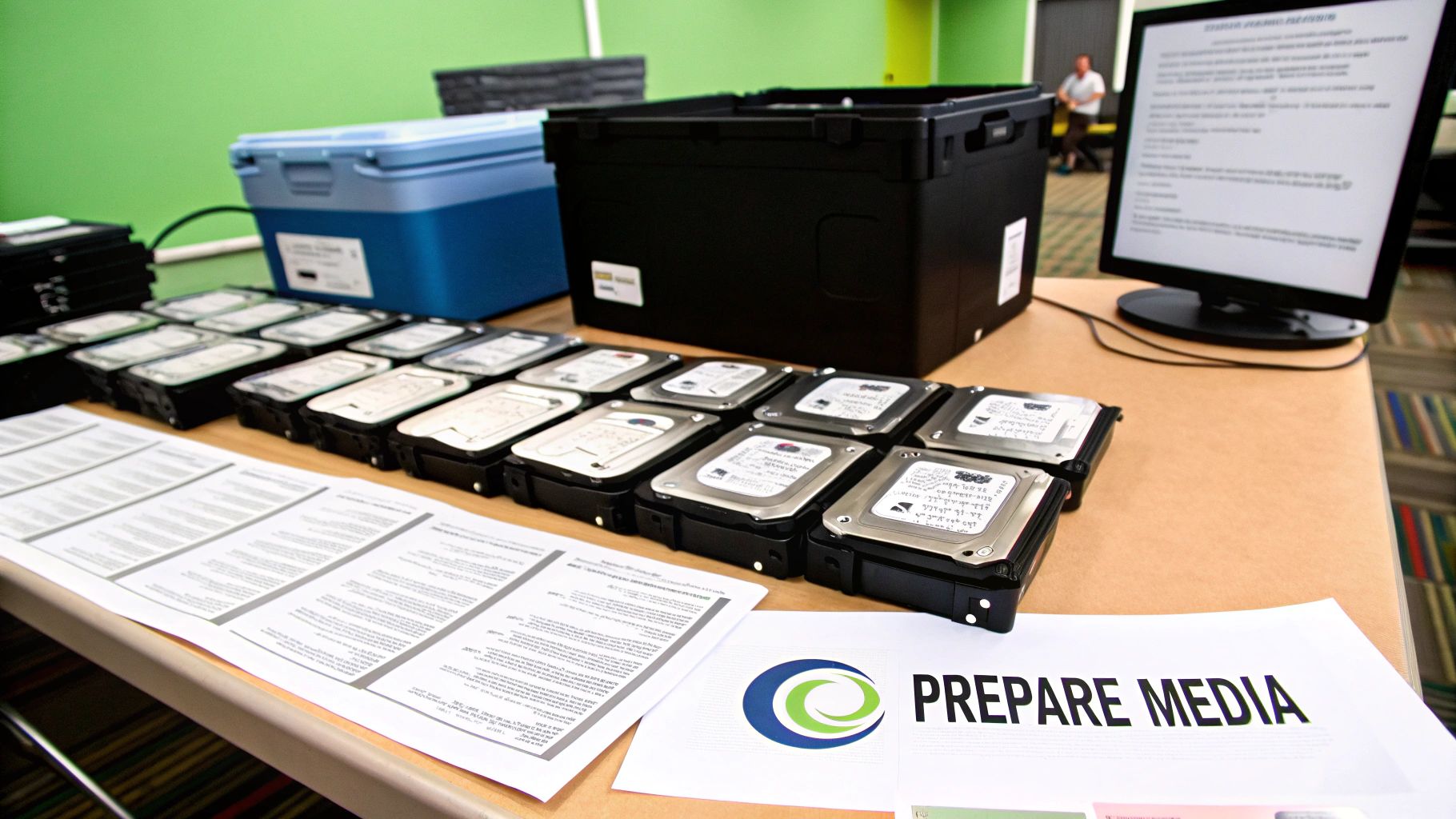
A smooth, secure destruction project is the result of effective preparation. Before the shredding truck arrives or your media is collected, a few key internal steps can prevent logistical friction, strengthen your security posture, and ensure the entire process is auditable from end to end.
This preparation phase is where your internal controls intersect with the vendor's secure process. A well-organized effort ensures every asset is accounted for, tracked, and ready for secure and final disposition.
Create a Detailed Inventory Log
First and foremost, you must have an exact record of what you are destroying. This is not merely about a headcount; it's about creating a verifiable asset list that you will later reconcile with the vendor's Certificate of Destruction.
Create a simple spreadsheet. For each device slated for destruction, log the following:
- Asset Tag Number: Your company’s internal tracking ID.
- Device Type: e.g., laptop, server, desktop, or loose HDD.
- Serial Number: The most critical identifier for verification and audit purposes.
- Location: The department, office, or data center row the device originated from.
This inventory log becomes your single source of truth. Upon receiving the final Certificate of Destruction, you can perform a one-to-one reconciliation of serial numbers, providing concrete proof that every single asset was properly destroyed. This documentation is invaluable during a compliance audit.
Establish a Clear Chain of Custody
Long before a third-party vendor touches your equipment, you must maintain a secure internal chain of custody. This is the documented audit trail of your assets from the moment they are decommissioned until they are formally transferred to the destruction vendor. It is a process of accountability.
A strong internal chain of custody minimizes the risk of a device "walking away" or being misplaced before it can be securely destroyed. It designates clear responsibility and creates a secure, documented path for every asset.
Designate a specific, secure area—such as a locked IT storage room or a restricted-access cage—where all media awaiting destruction will be consolidated. Appoint one or two trusted IT team members to be responsible for collecting, logging, and securing these devices. This prevents a scenario where drives are left unsecured on desks or in common areas. You can find more detailed guidelines for media handling in standard SOPs for IT departments, which often cover these critical asset management steps.
Handle the Physical Preparation
A common logistical question is how much physical preparation is required from the client-side. The answer depends on your vendor and the agreed-upon scope of work.
Does your IT staff need to remove the hard drives from every laptop, desktop, and server? Not necessarily. Many full-service vendors offer drive removal as part of their service, though this may incur an additional labor cost. This should be clarified upfront. If your team has the technical resources, removing the drives internally can sometimes reduce costs.
It is also best practice to consolidate media types. Keep hard drives separate from backup tapes, and SSDs separate from traditional HDDs. This simple organization facilitates the vendor's process and can accelerate on-site service times. While physical destruction is the final step, it helps to understand what precedes it. For more on that, you can read our guide on how to wipe a hard drive completely. By taking these preparatory steps, your business is not just facilitating the vendor's job; you are taking an active, responsible role in your own data security.
Common Questions About Hard Drive Destruction
Even with a well-defined plan, it is normal for stakeholders to have questions before engaging a service for "hard drive destruction near me." You are not just disposing of obsolete hardware; you are safeguarding corporate assets and reputation. Obtaining clear, accurate answers is a critical part of the due diligence process.
Let's address some of the most common questions we hear from Atlanta-based businesses regarding professional data destruction.
Is Deleting Files or Reformatting a Drive Good Enough?
Unequivocally, no. This is perhaps the most dangerous assumption in corporate data security. When a user deletes a file or an IT technician reformats a hard drive, the data itself is not erased. These actions merely remove the pointers that tell the operating system where the data is located.
The actual binary data remains on the drive platters and can be easily recovered with widely available, low-cost software.
Physical destruction is the only method that guarantees data is 100% irrecoverable. It physically pulverizes the storage media, rendering data retrieval impossible. For any business subject to compliance regulations like HIPAA or seeking to protect intellectual property, physical destruction is not just the best option—it is the only acceptable one.
What Is a Certificate of Destruction and Why Is It Important?
A Certificate of Destruction is your official, legally-defensible proof that your data has been permanently eliminated. This document is far more than a simple receipt; it is a cornerstone of your compliance framework and risk management program.
A legitimate certificate must contain specific details to be valid for audit purposes:
- A unique serial number for tracking and verification.
- A clear statement on the transfer of custody, documenting the point at which the vendor assumed liability for your assets.
- The specifics of the destruction, including the method used, date, and location.
- A serialized list of all destroyed hard drives, enabling you to reconcile it against your internal inventory log.
This document formally transfers liability from your organization to your destruction partner. It is your proof of due diligence. To understand the components of a legally sound document, review our detailed guide on the Certificate of Destruction for hard drives. It represents the final, crucial step that closes the loop on your data's lifecycle.
"A Certificate of Destruction is the cornerstone of a compliant ITAD program. It provides the auditable evidence that an organization has fulfilled its legal and ethical duty to protect sensitive data through to its end-of-life."
What Happens to the Shredded Material Afterwards?
Once your hard drives are reduced to unrecognizable fragments, the process is not yet complete. A professional, responsible destruction partner is also committed to environmental stewardship. The shredded mix of metal and plastic is securely transported to a certified recycling facility.
There, an advanced separation process begins. Powerful magnets, eddy currents, and optical sorters separate the various materials—primarily aluminum, steel, and plastics—into pure commodity streams. These materials are then processed and reintroduced into the manufacturing supply chain as raw materials for new products. This ensures your obsolete equipment avoids a landfill and contributes to a circular economy.
Choosing a vendor with a transparent, certified downstream recycling process is as important as the destruction itself. It ensures your company meets both its data security mandates and its corporate environmental responsibilities.
At Atlanta Computer Recycling, we provide NAID AAA Certified on-site and off-site hard drive destruction services designed to give your business complete peace of mind. We ensure your data is permanently destroyed and provide the certified documentation you need to stay compliant. Contact us today to secure your retired IT assets. https://atlantacomputerrecycling.com