Finding Computer Disposal Services Near Me for Your Business


When your business searches for "computer disposal services near me," you’re doing more than just decluttering the office. You're making a critical decision that impacts your company's data security, compliance posture, and financial liability. One wrong move with a single retired server can lead to devastating data breaches and eye-watering regulatory fines, turning that pile of obsolete hardware into a ticking corporate liability.
Why Your Business Can't Afford Improper Computer Disposal
Decommissioning old IT assets feels like a simple logistics task, but for any business, it’s a moment packed with potential risk. Every desktop, laptop, and server your company retires is a time capsule of your operations. It holds sensitive customer data, employee records, financial reports, and proprietary corporate information.
Simply hitting 'delete' or, worse, tossing that hardware in a dumpster is practically leaving your company's digital vault wide open for corporate espionage or cybercrime. Imagine a competitor stumbling upon your trade secrets from a discarded server. Or a client's personal data getting exposed from a laptop you thought was wiped clean. The damage to your corporate reputation could be permanent.
The Financial and Legal Consequences
The fallout from improper disposal goes way beyond the cost of new equipment. Businesses are legally obligated to comply with a growing list of data privacy laws, and the penalties for non-compliance are severe.
To avoid these painful fines and maintain client trust, you need a solid grasp on regulations like GDPR compliance, where a single violation can cost millions. In the healthcare field, HIPAA is the law of the land, and a breach traced back to an old device can trigger crippling financial penalties and years of legal headaches.
A data breach traced back to a hard drive you thought was erased can cost a company six-figure fines and years of rebuilding customer trust. This frames professional disposal not as an expense, but as an essential investment in risk management.
The Escalating E-Waste Problem
Beyond the immediate security threats, there's a serious corporate and environmental responsibility to consider. The world is on track to generate a staggering 65.3 million metric tons of electronic waste in 2025, a mountain of discarded tech that includes millions of computers from businesses like yours. What's worse is that less than 18% of this e-waste is properly collected and recycled. You can learn more about the environmental impact of electronic waste right here on our blog.
Choosing a certified disposal partner is about more than just protecting your data; it’s about making sure your retired assets don't add to this growing global problem. It's a move that aligns your business with sustainable practices that protect both your bottom line and the planet.
How to Vet and Choose a Disposal Partner

Finding the right partner to handle your company's retired IT assets is a high-stakes decision. This goes way beyond a quick search for "computer disposal services near me." The provider you choose becomes the final guardian of your sensitive data and your company's environmental reputation.
Let's be clear: not all services are created equal. The difference between a certified ITAD specialist and a basic scrap hauler is massive, and getting it wrong can have serious consequences for your organization.
Your vetting process should kick off with one simple question: "Are you certified?" Certifications aren't just fancy badges for a website; they are hard-earned proof that a vendor adheres to rigorous, independently audited standards for both data security and environmental responsibility.
Look for these two gold standards:
- R2v3 (Responsible Recycling): This is the leading global standard for electronics recycling, covering everything from environmental protection and worker safety to secure data destruction.
- e-Stewards: Developed by the Basel Action Network, this certification has a strict, zero-tolerance policy on the illegal export of hazardous e-waste to developing countries.
If a potential partner holds one or both of these, you know they've already cleared a very high bar for operational excellence.
Asking the Right Questions
Once you have a shortlist of certified vendors, it's time to dig deeper. The quality of their service will shine through in how they answer a few key questions. A professional IT Asset Disposition (ITAD) firm will have clear, confident answers ready to go. To get a better handle on the full scope of these services, you can check out our guide on what IT Asset Disposition is.
The need for this level of diligence is huge. The United States is the world's second-largest producer of e-waste, generating a staggering 6.9 million metric tons every year. Even more shocking is that the U.S. recycles just 15% of it. This is exactly the gap that responsible, certified recyclers are working to fill.
A reputable partner won’t hesitate to walk you through their entire process, from secure pickup at your facility to the final documentation that proves your assets were handled correctly.
Choosing a vendor is about establishing a chain of trust. Your goal is to find a partner who treats your assets with the same level of security and diligence as you do. Anything less introduces unacceptable risk to your business.
To really see the difference, it helps to compare a certified pro against a typical scrap hauler.
Certified ITAD Specialist vs Uncertified Scrap Hauler
The table below highlights the crucial differences in security, compliance, and value recovery between a certified IT Asset Disposition (ITAD) partner and a standard scrap hauler.
| Service Aspect | Certified ITAD Specialist | Uncertified Scrap Hauler |
|---|---|---|
| Data Security | Offers audited, NIST 800-88 compliant data destruction with Certificates of Destruction. | May offer informal "wiping" with no guarantees or documentation. |
| Compliance | Provides a full, auditable chain of custody and serialized asset tracking. | Offers a basic receipt; no liability transfer or compliance documentation. |
| Environmental Handling | Adheres to R2 or e-Stewards standards, ensuring no illegal exporting. | Often ships unprocessed material overseas or to domestic landfills. |
| Value Recovery | Assesses assets for resale potential, often providing a revenue share. | Pays a low, bulk price based on scrap metal weight only. |
As you can see, the choice directly impacts your company's risk exposure and potential return on investment. A certified ITAD partner provides a secure, compliant, and often profitable solution, while an uncertified hauler can leave you vulnerable.
Understanding Your Data Destruction Options
When a business starts looking for computer disposal services, the real conversation isn’t about logistics. It's about how you're going to irretrievably destroy the sensitive information they hold. Let’s be clear: your biggest liability isn't a five-year-old desktop; it's the customer lists, financial records, and proprietary strategies sitting on its hard drive.
Simply deleting files or reformatting a drive is a rookie mistake. That data can often be recovered with basic tools, leaving your company completely exposed. A professional ITAD partner doesn't just "delete"—they use specific, verifiable methods to ensure that data is gone for good.
The Core Methods of Sanitization
When you talk to a disposal vendor about data security, you'll likely hear them mention three core techniques. Knowing the difference is what separates a secure, compliant process from a risky one.
-
Data Wiping (or Sanitization): This is a software-based approach that overwrites every single sector of a hard drive with random data, often in multiple passes. This process essentially buries the original information, making it unrecoverable. For a closer look at how this works, our guide explains how to wipe a hard drive completely.
-
Degaussing: Think of this as a powerful magnetic blast. A degausser destroys the magnetic field on traditional spinning hard drives (HDDs), instantly scrambling all the data they hold. It's incredibly fast and effective for HDDs, but it’s completely useless on modern Solid-State Drives (SSDs).
-
Physical Shredding: This is the most definitive, brute-force solution. The hard drive is fed into an industrial shredder that grinds it into small, mangled metal fragments. Once a drive is shredded, there's absolutely no way to recover data from it.
The most reputable disposal services align their processes with standards like NIST 800-88, which is the gold standard for media sanitization. A great way to gauge a potential vendor’s expertise is to simply ask them how their methods meet these guidelines.
Choosing the Right Method for Your Hardware
The right destruction method isn't one-size-fits-all; it really depends on the type of storage media you're dealing with.
Traditional spinning hard drives (HDDs) are flexible—they can be effectively wiped, degaussed, or shredded.
However, Solid-State Drives (SSDs), which are standard in most modern laptops and desktops, are a different beast. Because of how they store data, software wiping is the best method for sanitization if you plan to reuse the drive. Degaussing has zero effect on SSDs, which makes physical shredding the only guaranteed method for complete destruction when the drive is at its end of life.
A quick, informed conversation with your disposal partner will ensure they’re using the right technique for every single asset you hand over.
Why a Paper Trail Is Your Best Defense
In the world of corporate compliance and audits, there's a simple rule: if it isn't documented, it never happened. When it comes to disposing of business computers, a vendor’s verbal promise of data destruction is worthless if you're ever questioned by regulators or face a legal challenge. Your only real defense is a solid, auditable paper trail.
This documentation creates a clear chain of custody, which is a chronological record that tracks your old equipment from the moment it leaves your facility. This paper trail is definitive proof that you did your due diligence to protect sensitive company and client data. It's your ultimate safeguard.
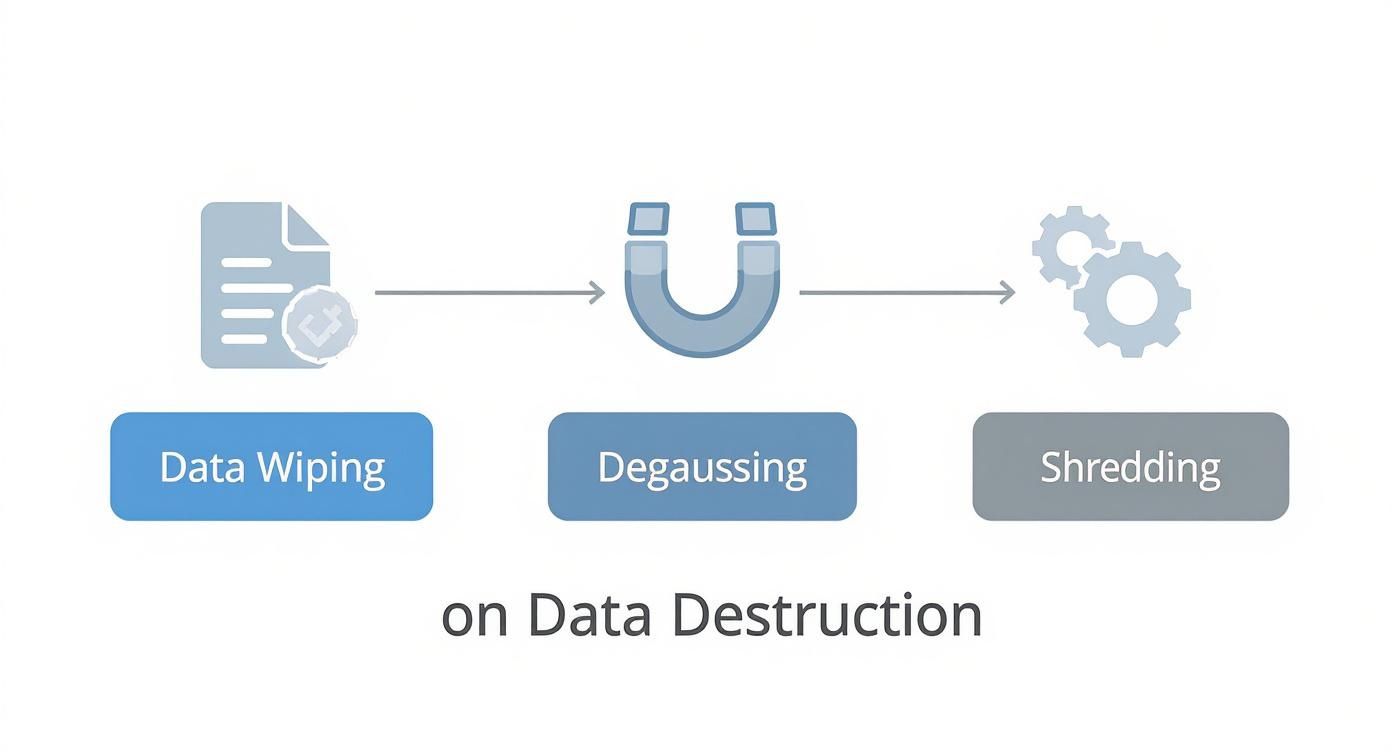
As you can see, while wiping or degaussing hard drives are valid steps, physically shredding the hardware is often the final, most conclusive way to ensure data is gone for good, especially for equipment at the very end of its life.
The Documents You Absolutely Need
A professional and reputable disposal partner must provide a few key documents to complete that chain of custody. Don't ever settle for a simple invoice or a generic receipt—it just won't cut it in an audit.
Your paperwork should always include these three things:
- Serialized Asset Report: This is a detailed inventory list that identifies every single device by its unique serial number. It’s how you confirm exactly what the vendor received from you.
- Transfer of Liability: This is the signed agreement that formally passes the legal responsibility for the equipment from your business over to the disposal company.
- Certificate of Destruction: This is the most important piece of paper in the whole process. It legally certifies that the data on all the listed assets has been permanently destroyed according to specific, recognized standards.
Imagine a compliance auditor asking how you disposed of a batch of old laptops that held customer financial records. Without a serialized report and a Certificate of Destruction, you have no way to prove you handled it securely. But with that paperwork in hand, you can immediately demonstrate you took responsible, documented action, likely ending the inquiry right then and there.
This documentation is completely non-negotiable. We go into more detail on why in our guide to the Certificate of Destruction for hard drives. It's this paper trail that turns a simple disposal service into a core part of your company's risk management strategy.
Turning Retired Tech Into Revenue
Disposing of old business computers doesn't have to be just another line item on your expense report. In fact, it can be a surprisingly smart financial move. This is where IT Asset Disposition (ITAD) shifts the entire conversation from "how do we get rid of this" to "how can we strategically recover its remaining value."
Working with a professional computer disposal service is what makes this possible. They don't see a pile of old hardware; they see a collection of potential assets. A certified ITAD partner will carefully assess your retired equipment, evaluating each device based on its age, model, physical condition, and its current fair market value.
From Cost Center to Revenue Stream
The process itself is straightforward. Any equipment that still holds real value is securely refurbished and prepped for resale. Instead of just sending everything to be destroyed, businesses can actually generate revenue by selling refurbished computers and laptops. It’s an approach that gives the hardware a second life—a core principle of a sustainable, circular economy.
The best part? Many reputable vendors work on a revenue-sharing model. After they handle the secure data destruction and refurbishment, they sell the equipment and provide a return to your business. This can easily offset—or even completely cover—the cost of the disposal service itself.
By partnering with the right ITAD service, your business can transform a recurring expense into a source of income. This not only improves your budget but also demonstrates a commitment to sustainable and resourceful business practices.
This idea of value recovery is more critical now than ever before. Globally, only about 22% of e-waste is formally collected and recycled. That means over $62 billion worth of recoverable materials were simply lost in 2022 alone. To learn more about this staggering loss of resources, you can discover more insights about e-waste on ewastemonitor.info.
Figuring out what to do with outdated computers is the first step toward reclaiming some of that value for your own business.
Frequently Asked Business Questions
When it's time to retire old company computers, many practical questions arise for IT managers and business owners. Getting clear answers is the first step to making a smart, compliant decision on who to trust with your equipment. Here are some of the most common questions we hear from businesses.
Does My Small Business Really Need Professional Services?
Without a doubt. The risk of a data breach and the rules around environmental compliance don’t just apply to large corporations—they apply to every business entity. A single hard drive tossed in a dumpster with old client or employee files on it can lead to massive fines and completely tank your business's reputation.
Hiring a professional service isn't about the size of your company; it's about transferring your liability. They provide the certified security, auditable paperwork, and peace of mind you need to operate safely.
The most important thing to remember is that liability doesn't shrink just because your company is small. A certified partner ensures a one-person shop gets the same level of data security and documented proof as a Fortune 500 company.
What Should I Expect to Pay for Disposal?
The final cost depends on several factors:
- Volume of Equipment: Are we talking about a dozen laptops or a full data center decommissioning?
- Required Services: Do you need on-site hard drive shredding for maximum security, or is a standard pickup sufficient?
- Logistics: Your location and the ease of access to the equipment will factor into the transportation costs.
However, it's not always just an expense. If your old computers still have marketable value, a good IT Asset Disposition (ITAD) partner might offer a rebate or a revenue-sharing agreement. This could significantly reduce your net costs—or even turn the project into a net positive for your budget.
What Kind of Documentation Is Essential?
This is non-negotiable. Never work with a vendor that can’t provide a complete, auditable paper trail. You absolutely need to secure these three documents:
- A serialized inventory of every single asset they take.
- A signed transfer of liability agreement.
- A formal Certificate of Destruction.
This documentation is your legal proof that you fulfilled your due diligence and that your sensitive data was securely and verifiably destroyed. If you ever face an audit, this paperwork is your complete defense.
For businesses in the Atlanta metro area, Atlanta Computer Recycling offers secure, compliant, and documented ITAD solutions tailored to your needs. Ensure your company is protected by partnering with a certified expert. Schedule your free pickup and consultation at https://atlantacomputerrecycling.com.