Your Guide to Commercial Computer Recycling in Atlanta, GA

For any business in Atlanta, managing decommissioned IT hardware is a significant operational challenge. It’s not just about reclaiming office space; it’s a critical function of data security, regulatory compliance, and corporate responsibility. A misstep in your IT asset disposition (ITAD) strategy can lead to substantial fines, reputational damage, or a catastrophic data breach.
A Strategic Approach to Atlanta Computer Recycling for Businesses
Consider your inventory of retired assets: every hard drive, server, and company laptop holds a repository of sensitive corporate and client data. Improper disposal is an open invitation for a data breach. We developed this guide to provide Atlanta’s IT managers, compliance officers, and business owners with a clear, actionable framework for implementing a secure and efficient ITAD program.
Protecting Corporate Assets and the Environment
At its core, a strategic ITAD plan addresses several key business concerns. By proactively managing these elements, you can transform a potential liability into a streamlined, value-driven component of your operations. For example, when executing a business relocation checklist, integrating a plan for e-waste is a non-negotiable task that prevents logistical bottlenecks and security risks.
A robust recycling strategy must deliver on:
- Absolute Data Security: All confidential company, client, and employee data must be verifiably destroyed. This requires certified data erasure or physical shredding that renders storage media completely unrecoverable.
- Regulatory & Environmental Compliance: Electronics contain hazardous materials like lead and mercury. A certified recycling program ensures these toxins are diverted from local landfills, keeping your business compliant with all environmental regulations.
- A Defensible Audit Trail: You require documented proof of compliance. A professional recycling partner provides official documentation, such as a Certificate of Destruction, creating a complete and defensible record for internal audits and stakeholder inquiries.
Partnering with a certified e-waste recycler is the most strategic decision a business can make. It transfers liability and logistical burdens to a specialized vendor equipped to manage the entire process securely and efficiently.
This guide will navigate the critical details, from risk assessment to scheduling commercial pickups. We’ll cover every facet of secure, responsible disposal, including the wide array of assets we manage. For a comprehensive list, review our full scope of electronics recycling services in Atlanta GA. Upon completion, you will be equipped to manage your company's e-waste with professional precision.
Why Responsible E-Waste Management Is a Business Imperative
For any enterprise in Atlanta, certified computer recycling is not merely a "green" initiative—it is a fundamental component of risk management. Disposing of old computers in a dumpster or engaging an unvetted vendor is a critical operational failure. It exposes your organization to severe financial, legal, and reputational harm.
The decision to implement a professional e-waste program is a strategic one, designed to protect your bottom line.
Improperly disposing of IT assets containing sensitive data can trigger significant penalties under regulations like the Health Insurance Portability and Accountability Act (HIPAA) and the Fair and Accurate Credit Transactions Act (FACTA), which mandate the secure destruction of personal information. A single discarded hard drive could contain thousands of customer or patient records, leading to fines that can easily reach six or seven figures, not to mention the irreparable damage to your brand.
The True Cost of Non-Compliance
The risks extend beyond data breaches. Your retired electronics are filled with hazardous materials that can become a long-term environmental liability if not managed correctly.
Here in Atlanta, computer recycling plays a vital environmental and economic role because of these very materials. Substances like cadmium and chromium, present in many older devices, can leach into the soil and groundwater if landfilled, contaminating local ecosystems.
Responsible recycling not only prevents this pollution but also supports specialized jobs and contributes to the local economy. You can learn more about the positive local impact of recycling initiatives on ecycleatlanta.com.
This is precisely why professional computer recycling in Atlanta GA is a business necessity, not an option.
Failure to properly manage e-waste is not just an environmental lapse; it is a direct threat to business continuity. A single compliance failure can instigate legal action, erode customer trust, and create financial burdens that far surpass the cost of professional recycling services.
Protecting Your Brand and Future Viability
Ultimately, your e-waste management policy reflects your company's core values.
A commitment to responsible disposal sends a clear message to clients, partners, and stakeholders that you prioritize both data security and corporate social responsibility. This strengthens your brand reputation and builds a resilient defense against future liabilities.
A documented, certified recycling program provides a clear audit trail—verifiable proof that you executed every necessary step to protect sensitive data and the environment. This documentation is invaluable for compliance reporting and serves as a shield against legal challenges. Understanding the full environmental impact of electronic waste underscores why a structured program is so critical.
By selecting a certified partner, you convert a complex obligation into a streamlined, secure process that safeguards your company’s future in Atlanta's competitive marketplace.
Ensuring Total Data Security Before You Recycle
For any Atlanta business, the most critical step before recycling IT assets is ensuring the complete and permanent eradication of all sensitive data. Transferring a server or laptop without certified data destruction is analogous to leaving your office unlocked—an unacceptable risk no organization can afford.
This process goes far beyond deleting files. Standard deletion leaves data intact on the hard drive, easily recoverable with basic software tools. True data security requires professional methods that render information permanently unreadable.
Data Wiping Versus Physical Destruction
When securing data on end-of-life assets, there are two primary, industry-accepted approaches: software-based wiping and physical destruction. The appropriate method depends on the age, condition, and intended disposition of the equipment.
- Software-Based Data Wiping: This method uses specialized software to overwrite a hard drive's entire surface with random data, often in multiple passes. It adheres to rigorous standards like NIST 800-88, guaranteeing the original information is irretrievable. This is the ideal solution for newer, functional equipment slated for refurbishment and resale.
- Physical Destruction (Shredding): For older, non-functional, or highly sensitive storage media, physical destruction provides 100% certainty. The drives are processed through industrial shredders that pulverize them into small metal fragments, completely destroying the storage platters and any data they contained.
Even with robust security protocols, preparedness is key. A comprehensive data breach response plan is a critical layer of corporate governance that protects your business in a worst-case scenario.
Your Action Plan for Secure IT Asset Disposition
To manage this process efficiently, IT managers must establish a clear, repeatable workflow. Best practice begins with creating a detailed inventory of every asset being decommissioned, recording serial numbers and asset tags. This forms an essential audit trail.
Next, determine the appropriate destruction method for each device. For a batch of five-year-old laptops, software wiping is likely sufficient. However, for a failed server that housed critical financial data, direct-to-shred is the only prudent choice. For a deeper look at the technical specifications, see our guide on how to wipe a hard drive completely.
Your final, non-negotiable step is to demand documentation. Always require a Certificate of Data Destruction from your recycling partner for every serialized asset. This document serves as your legal proof of due diligence, protecting your company from significant liability.
A reliable partner specializing in computer recycling in Atlanta GA will provide this documentation as a standard part of their service. It is the ultimate confirmation that your data was handled responsibly, transforming the disposal process from a potential risk into a documented, compliant business practice.
Arranging a Commercial E-Waste Pickup in Atlanta
Once your data security protocols are defined, the next phase is managing the logistics of removing retired IT equipment from your facility. For a dynamic Atlanta business, this process must be efficient and predictable. A disorganized pickup can disrupt daily operations, but with proper planning, it becomes a seamless component of your asset management lifecycle.
The first step is to conduct a thorough inventory of all items designated for recycling. This requires more than a simple device count. Document asset tags, serial numbers, and specific models—for instance, Dell Latitude laptops or HP ProLiant servers. This detailed list is vital for your internal records and provides your recycling partner with an accurate scope of work, ensuring they arrive with the appropriate vehicle and personnel.
Vetting Your Atlanta Recycling Partner
With your inventory finalized, it's time to select the right partner. Avoid choosing the first company in a search result. A true partner in computer recycling in Atlanta GA will be fully transparent about their entire process, from pickup to final disposition.
To assess their professionalism and commitment to security, ask the following questions:
- Downstream Auditing: Where do the materials ultimately go? Inquire about their downstream partners. A reputable recycler maintains a fully vetted network and can prove that your assets are processed responsibly, never illegally exported or landfilled.
- Insurance Coverage: Confirm they carry adequate liability insurance, including coverage for data breaches and environmental incidents. This protects your business from liability during transit and processing.
- Chain of Custody: Request an overview of their chain-of-custody documentation. You should be confident that every asset is tracked from the moment it leaves your facility.
This infographic outlines the core data security steps any credible partner should follow.
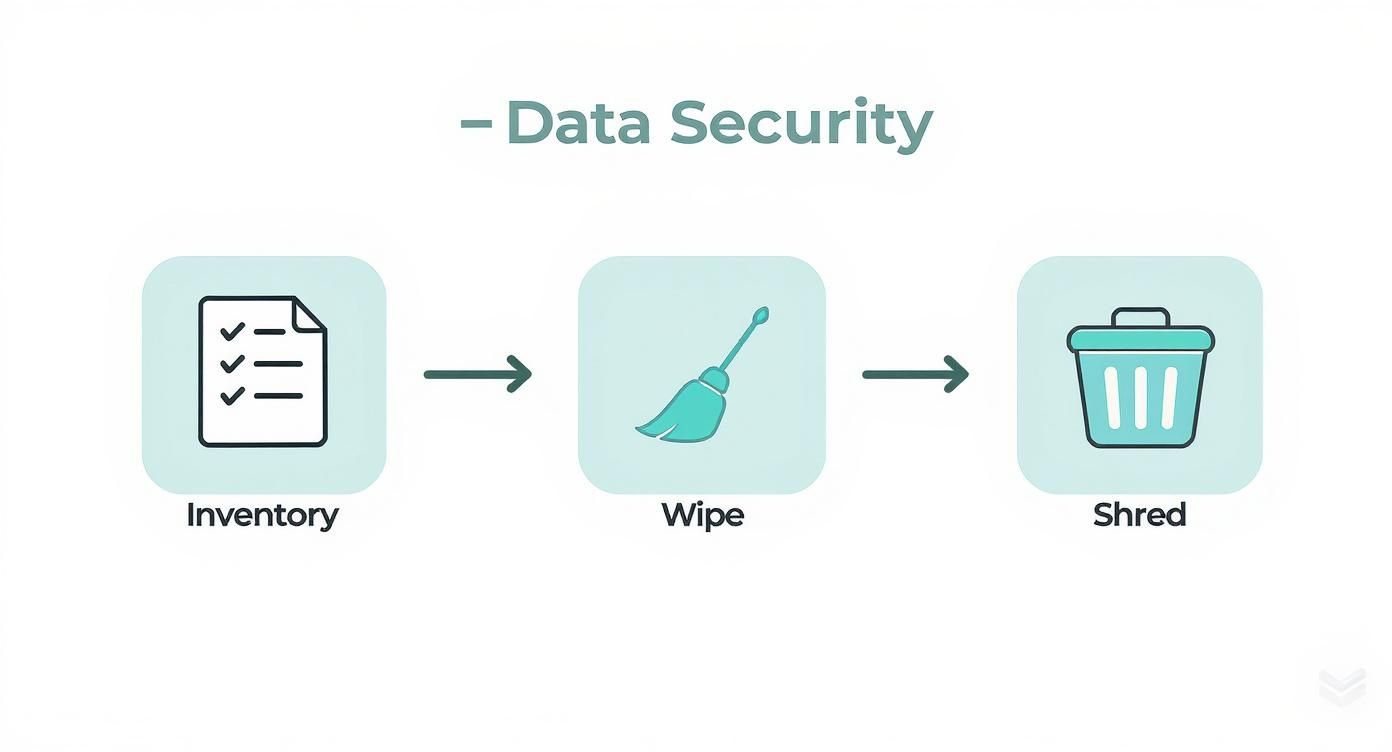
As illustrated, a secure process always begins with a detailed inventory. It then proceeds to certified data wiping and, for maximum security, physical shredding to guarantee permanent data elimination.
When evaluating potential recycling vendors in Atlanta, the options can be overwhelming. This checklist will help you identify a partner that truly protects your business interests.
Choosing Your Atlanta Computer Recycling Partner
| Evaluation Criteria | What to Look For | Why It Matters for Your Business |
|---|---|---|
| Certifications | R2 or e-Stewards certifications are essential. | These are the industry's gold standards, guaranteeing environmental compliance and responsible recycling practices. |
| Data Destruction Methods | The ability to perform both DoD-compliant software wiping and physical shredding. | This provides flexible, verifiable options to meet your company’s specific security and compliance requirements. |
| Chain of Custody | A clear, documented process with serial number tracking from pickup to final destruction. | This is your proof of compliance and mitigates liability in the event of an audit or data breach investigation. |
| Insurance & Liability | Request a certificate of insurance (COI) covering data breach and environmental liability. | This ensures your business is protected if an incident occurs during transit or processing. |
| Downstream Transparency | The ability to demonstrate where processed materials are sent for final recovery. | This ensures your e-waste is not illegally exported or landfilled, protecting your corporate reputation. |
| Local Presence & Logistics | A local Atlanta-area presence and their own logistics fleet. | A local team offers greater scheduling flexibility and reduces the risks associated with third-party transportation. |
Using a structured framework like this ensures you are not just disposing of old equipment, but doing so in a secure, compliant, and responsible manner.
Preparing Your Equipment for a Smooth Pickup
Once you have selected your partner, some preparation will ensure pickup day is seamless. Consolidate all equipment in an easily accessible area, such as a loading dock or ground-floor conference room. For larger projects, this typically involves palletizing the assets.
Pro Tip: Clearly label each pallet with your company name and the pickup date. I always advise clients to photograph the prepared pallets before they are loaded—it serves as an excellent visual record for your files.
Properly stacking and shrink-wrapping pallets keeps the equipment secure during transit. Your recycling partner can provide specific guidance, but a well-prepared shipment saves time and minimizes risk for everyone involved.
With a clear plan, the final step is simple. Many certified recyclers in the Atlanta area offer streamlined online scheduling. You can finalize all arrangements by visiting their site to schedule a pickup for your business. This removes the guesswork from the process, allowing you to return your focus to core business operations.
Navigating Recycling Compliance and Certifications

For any Atlanta-based business, recycling end-of-life IT equipment is more than an operational task—it is a core compliance function. Selecting the right recycling partner requires looking beyond basic pickup services to focus on the certifications that verify your assets are managed legally and ethically from start to finish.
These certifications are more than mere logos; they are your organization's defense against significant legal and environmental risks. When a vendor holds a top-tier certification, it signifies they have passed rigorous third-party audits covering data security protocols, environmental safety, and employee health and safety.
Understanding Key E-Waste Certifications
Within the electronics recycling industry, two certifications represent the gold standard for responsible processing. When vetting a partner for computer recycling in Atlanta GA, confirming they hold one of these is a non-negotiable step in your due diligence.
- R2 (Responsible Recycling): The R2 Standard governs the entire lifecycle of an electronic device, establishing strict requirements for environmental protection, data security, and worker safety. An R2-certified partner maintains a proven, transparent process for tracking all materials downstream.
- e-Stewards: Developed by the Basel Action Network, the e-Stewards certification is widely regarded as the industry's most stringent. It maintains a zero-tolerance policy against exporting hazardous e-waste to developing nations and mandates the highest levels of data security.
Engaging a vendor with either certification is a powerful risk mitigation strategy. It guarantees your e-waste will not be improperly disposed of, protecting your company's reputation and shielding you from future liability.
Consider these certifications a form of corporate insurance. They verify that your recycler operates under the strictest industry guidelines, providing peace of mind that your brand, your data, and the environment are protected.
The global e-waste challenge is substantial, with annual generation projected to exceed 60 million metric tons. In this context, certified recycling is crucial for managing computer equipment, a primary component of the US electronic recycling market. This sector supports a national industry valued at $27.7 billion, demonstrating the economic and environmental importance of proper disposal. You can explore further industry trends and data in this comprehensive report from IBISWorld.
The Essential Audit Trail Documentation
Beyond certifications, the documentation provided by your recycling partner serves as your tangible proof of compliance. This paperwork creates an indispensable audit trail, demonstrating due diligence to stakeholders, auditors, and regulators.
Your final documentation package must include two key documents: a Certificate of Recycling and a Certificate of Data Destruction. The former confirms your equipment was processed in accordance with environmental regulations. The latter provides definitive proof that all sensitive information was permanently destroyed. For a detailed breakdown, review our guide on the importance of a Certificate of Destruction for hard drives.
By prioritizing certified partners and maintaining meticulous records, Atlanta businesses can transform a compliance requirement into a powerful demonstration of corporate responsibility.
Common Questions About Atlanta Business Computer Recycling
Even with a well-defined strategy, specific questions often arise. We frequently consult with IT managers and business owners across Atlanta and have compiled answers to the most common inquiries to help you proceed with confidence.
Are There Costs for Commercial Recycling?
This is a primary concern for many businesses, and the answer depends on the composition of your assets.
For newer, functional IT equipment with remarketing potential—such as recent-generation laptops, servers, and networking gear—many certified recyclers can offer free pickup and processing. The residual value recovered from reselling these assets covers the costs of logistics, data destruction, and labor.
Conversely, a fee is typically associated with older, obsolete, or non-functional items that have no resale value and require significant labor to de-manufacture responsibly. This often includes:
- Legacy CRT monitors
- Large enterprise copiers and printers
- Data tapes, floppy disks, and other outdated media
A reputable partner specializing in computer recycling in Atlanta GA will always provide a transparent, itemized quote upfront, ensuring there are no hidden costs.
What Other Electronics Can I Include with My Computers?
An effective recycling partner should serve as a single-source solution for your ITAD needs. The objective is to simplify the process, eliminating the need to coordinate with multiple vendors for a complete cleanout.
You can almost always include a full spectrum of office electronics along with your computers and servers, enabling you to clear an entire IT storage area in one operation.
Commonly accepted items include:
- Networking equipment (routers, switches, firewalls)
- Peripherals like keyboards, mice, and cabling
- Office phone systems and corporate mobile devices
- Uninterruptible Power Supplies (UPS) and battery backups
Consolidating all items into a single pickup is the most efficient method for managing a large-scale hardware retirement project.
How Should We Handle Our Leased Equipment?
This common scenario requires careful coordination. Before scheduling a pickup for leased equipment, your first step must be to review the lease agreement, specifically the end-of-lease terms. Most leasing companies require that all data be professionally erased before the assets are returned.
Your recycling partner is essential here. They can perform certified data destruction on the leased hard drives and provide a Certificate of Data Destruction. You can then submit this official documentation to the leasing company as proof that you have fulfilled your contractual data security obligations before returning the physical assets.
For leased assets, documentation is paramount. A certified data wipe and the corresponding certificate are your proof of responsible data handling, protecting your business from liability on equipment you don't even own.
Is There a Minimum Number of Items for a Pickup?
For commercial services, yes. Most e-waste recyclers establish a minimum quantity to justify the logistics of dispatching a truck and crew. This minimum varies, but a general benchmark is 10-20 major assets (like computers, laptops, or servers) or one full pallet of mixed electronics. For smaller quantities, many recyclers offer convenient drop-off locations.
The City of Atlanta is committed to waste diversion, as evidenced by recent data showing 29,175 tons of recyclables collected over just five months. This city-wide initiative highlights the importance of corporate participation, and professional recycling services are structured to facilitate business contributions. You can explore how these programs are tracked in the findings from Atlanta's detailed waste audits.
At Atlanta Computer Recycling, we provide secure, certified, and efficient e-waste solutions tailored for Atlanta's business community. From certified data destruction to logistical management, we handle every detail of the ITAD process. Get your free quote today!