Fulton County Chamber of Commerce GA: Business Growth Guide

If you're running a business in Fulton County right now, you're probably not looking for another breakfast mixer and a stack of business cards. You need better access to buyers, stronger local credibility, and a cleaner path into the kinds of relationships that drive revenue. For a managed service provider, healthcare vendor, school technology supplier, or ITAD firm, that usually means finding the right people inside hospitals, campuses, municipalities, and fast-growing private employers before an RFP ever lands.
That’s where the fulton county chamber of commerce ga becomes useful. Not as a social club, and not as a passive listing fee. Used well, it can help a business shorten trust cycles, spot procurement pathways earlier, and position itself in the middle of local growth instead of reacting to it late.
Your Partner in Atlanta's Economic Boom
A common Fulton County scenario looks like this. An IT manager is planning a device refresh. A healthcare operations lead is trying to tighten vendor oversight. A service company wants deeper roots in Atlanta, but keeps meeting the same peers instead of decision-makers. The market is active, but access is uneven.
That pressure isn't likely to ease. Fulton County's projected 2025 population is 1,109,720, with a projection of 1,175,914 by 2030, and the county's labor force participation rate is 68.30%, according to the Georgia Chamber Data Hub. The same source notes that benchmark data for counties with participation rates this high often shows 15-20% annual rises in IT refresh cycles, which matters for firms serving offices, hospitals, schools, and public agencies.
For B2B providers, more hiring and more facilities activity usually means more equipment turnover, more vendor reviews, and more compliance scrutiny. That's good news if you're visible and trusted. It's frustrating if you're not.
Why the Chamber matters in that environment
The Chamber gives structure to local market access. Instead of guessing which employers are expanding, which institutions are active, or where partnerships are forming, you get a place where those conversations already happen.
That matters in a county where business growth creates operational demand, not just headline excitement. If you're evaluating local positioning, the Fulton County business landscape gives useful context on the types of organizations active across the market.
The companies that win in Fulton County usually aren't the loudest. They're the ones that show up repeatedly in the right rooms, with a clear service story and a local reputation people can verify.
What the Fulton County Chamber Actually Does for Your Business
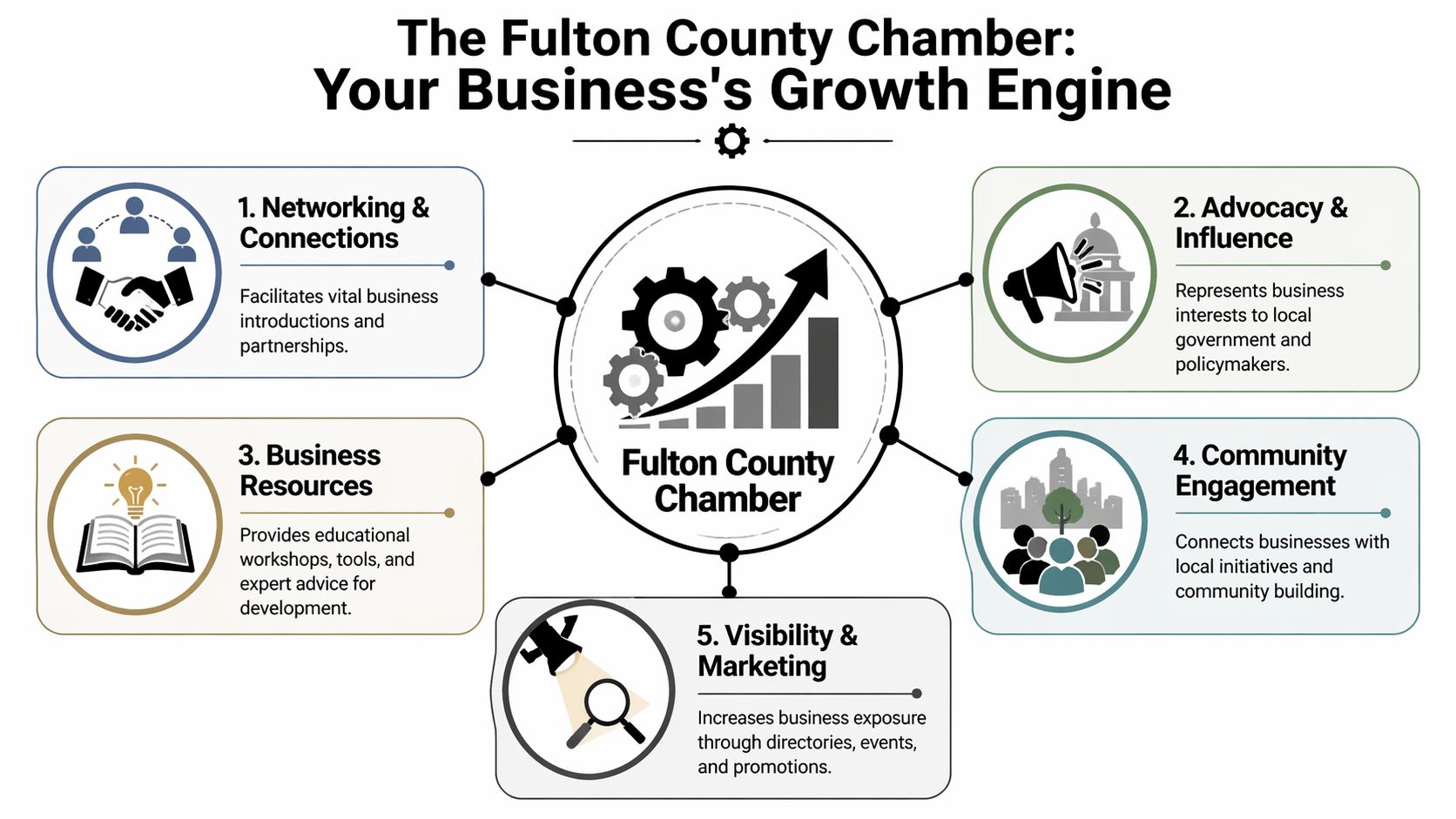
Think of the Chamber as a business navigator. It doesn't sell your services for you, and it won't replace direct outreach. What it does is reduce friction in three places that matter: local visibility, access to decision-makers, and credibility with the market.
Fulton County gives that work real weight. The county ranked #4 nationally in 2024 for economic development projects, up from #11, and attracted investment from major companies including Adobe, Microsoft, Amazon Music, Mastercard, and Nike, according to Fulton County's economic development announcement. In practice, that kind of growth creates more demand for facilities support, technology vendors, compliance services, and specialist providers that can operate professionally at scale.
The practical value behind the Chamber label
A Chamber usually helps in five ways, but they don't all matter equally for every company.
- Local advocacy: If your business depends on permitting, facility access, public policy shifts, or municipal relationships, Chamber advocacy helps you stay closer to the decisions that shape the operating environment.
- Economic visibility: When a county is pulling in new projects and employers, the Chamber often becomes one of the fastest ways to understand where commercial activity is clustering.
- Relationship building: Not generic networking. Better introductions. The useful kind tends to happen when members see you repeatedly in an industry-relevant setting.
- Market education: Good chambers surface local business context that helps you tailor your pitch. That's especially useful if you sell specialized services that require buyer education.
- Community legitimacy: In regulated sectors, buyers often prefer vendors who show local commitment and can be vouched for through known business circles.
What it won't do
The Chamber won't fix weak positioning. If your website is vague, your capability statement is generic, or your team can't explain your compliance process clearly, membership won't rescue that.
It also won't turn random attendance into pipeline. Businesses get disappointed when they join, attend two events, and expect immediate contracts. The stronger pattern is slower and more deliberate. Attend with a purpose, follow up fast, and show that you understand the buyer's operating risks.
Choosing Your Membership Level and Benefits
Most businesses overcomplicate Chamber membership. The key question isn't which tier sounds prestigious. It's which level gives you enough access to justify the time you'll invest.
If you're a B2B service provider, evaluate membership like you would any sales channel. Ask three things. Will this improve access to buyers? Will it increase trust with partners? Will it create repeatable visibility in the right circles?
How to think about the tiers
An entry-level membership usually makes sense for firms that want a local footprint, member directory presence, and basic event access. A mid-tier membership tends to work better for businesses that need more promotional exposure or want staff involved in councils and committees. A top-tier or partner-level option is usually best for companies that want influence, sponsor visibility, and a stronger role in shaping conversations.
For service firms in regulated categories, mid-tier often delivers the best balance. It gives enough room to be seen consistently without paying for benefits you won't use.
If you're comparing local options, this overview of the Fulton County chamber business landscape helps frame what matters for commercial vendors.
Fulton County Chamber Membership Tiers at a Glance
| Benefit | Basic Tier (e.g., Entrepreneur) | Mid-Tier (e.g., Business) | Top-Tier (e.g., Corporate Partner) |
|---|---|---|---|
| Directory presence | Standard listing for basic discoverability | Enhanced visibility and stronger profile value | Priority positioning and stronger brand prominence |
| Event access | Access to general events | Broader event participation and better team involvement | Highest access and stronger sponsorship integration |
| Marketing exposure | Limited promotional reach | Better opportunities for announcements and visibility | Highest-profile exposure across Chamber channels |
| Committee or council participation | May be limited | Better fit for joining targeted groups | Best fit for leadership roles and deeper involvement |
| Procurement relevance | Useful for initial presence | Strongest value for active business development | Best for firms pursuing strategic influence and partnerships |
| Best for | Solopreneurs and early-stage firms | Growth-minded B2B service companies | Established companies investing in market leadership |
What benefits actually convert into business value
A few examples make this easier to judge:
- Enhanced profile visibility: This matters if procurement staff, administrators, or operations leads use Chamber channels to identify local vendors.
- Sponsorship rights: Useful when you need repeated brand exposure in front of a narrow buyer group, not when you're just hoping to look bigger.
- Committee access: Often the most underrated benefit. Committees create familiarity. Familiarity lowers resistance when your name comes up later.
- Multiple staff seats: Smart if your sales lead, technical lead, and executive sponsor each need different relationships.
Practical rule: Buy the tier you can activate for a full year. A cheaper membership used consistently beats a premium membership that sits idle.
What usually doesn't work
Businesses waste membership fees when they treat the Chamber like advertising. A logo placement isn't a growth plan. Neither is showing up only when you need a lead. The firms that get the best return usually pick one lane first. Healthcare, education, municipal, or technology. Then they use Chamber access to build density in that lane.
How to Join and Activate Your Membership
Joining is the easy part. Activation is where most of the return comes from.
Once you're approved, don't wait for an event invite to start using the membership. Treat the first month like an onboarding sprint. Complete your company profile fully, add service categories that match how buyers search, and name the industries you serve. "Technology services" is too vague. "HIPAA-conscious device disposition" or "K-12 surplus equipment pickup" gives buyers something concrete to recognize.
Your first 30 days
- Finish the profile completely. Include your service area, operating categories, and a short buyer-focused description.
- Assign more than one representative. Your sales contact and operations lead shouldn't rely on one person to carry every relationship.
- Register for the next orientation or member event. This is often where you'll spot the members who are active versus the members who are only listed.
- Build a follow-up list. Tag likely partners, not just prospects.
- Prepare one clean capability sheet. You need a one-page explanation of what you do, who you serve, and how your process lowers risk.
If you need a direct path to begin a vendor conversation or prepare an internal handoff, the Atlanta contact page is a good example of keeping next steps simple and operational.
Dormant memberships don't fail because the Chamber lacks value. They fail because nobody inside the company owns the follow-up.
A Strategic Guide to Chamber Events and Networking
Not all Chamber events serve the same purpose. Some are for broad visibility. Others are for trust-building with a smaller group. If you use them the same way, you'll waste time.

The Greater North Fulton Chamber offers a good signal here. It operates from an 8,000 sq ft headquarters in Alpharetta and uses a modern tech stack that includes JavaScript, HTML, and PHP to support data-driven networking, according to this Greater North Fulton Chamber profile. The same source ties that business environment to areas where development activity has boosted data center decommissions by 25% in mixed-use zones. For commercial vendors, that means events in this market can connect directly to real operating needs, not just general branding.
Match the event to the outcome
Use a simple filter before you register.
- Monthly lunches and large mixers: Best for top-of-funnel familiarity. You won't close much there, but you can establish name recognition.
- Industry roundtables: Better for nuanced conversations. These are stronger if you sell technical or regulated services.
- Leadership forums and civic events: Useful when your work intersects with public agencies, facilities planning, or policy.
- Galas and signature celebrations: Better for maintaining visibility and deepening existing relationships than for cold outreach.
How to prepare like a seller, not an attendee
Don't walk in asking, "What do you do?" all night. Research companies beforehand, identify likely buyers or referral partners, and prepare two questions tied to their role. A CIO hears a different opening than a school operations director.
If you're sponsoring a table or event presence, presentation matters. Teams that want better in-person visibility can borrow ideas from this guide to winning trade show booth design, especially when they need to communicate a specialized service quickly in a crowded room.
For North Fulton activity specifically, this snapshot of the North Fulton Chamber business environment is useful when you're mapping where to spend time.
What strong event strategy looks like
A good event plan usually includes one broad visibility event, one targeted industry event, and one follow-up coffee or site meeting afterward. That's where networking becomes business development.
Unlocking Procurement and Partnership Opportunities
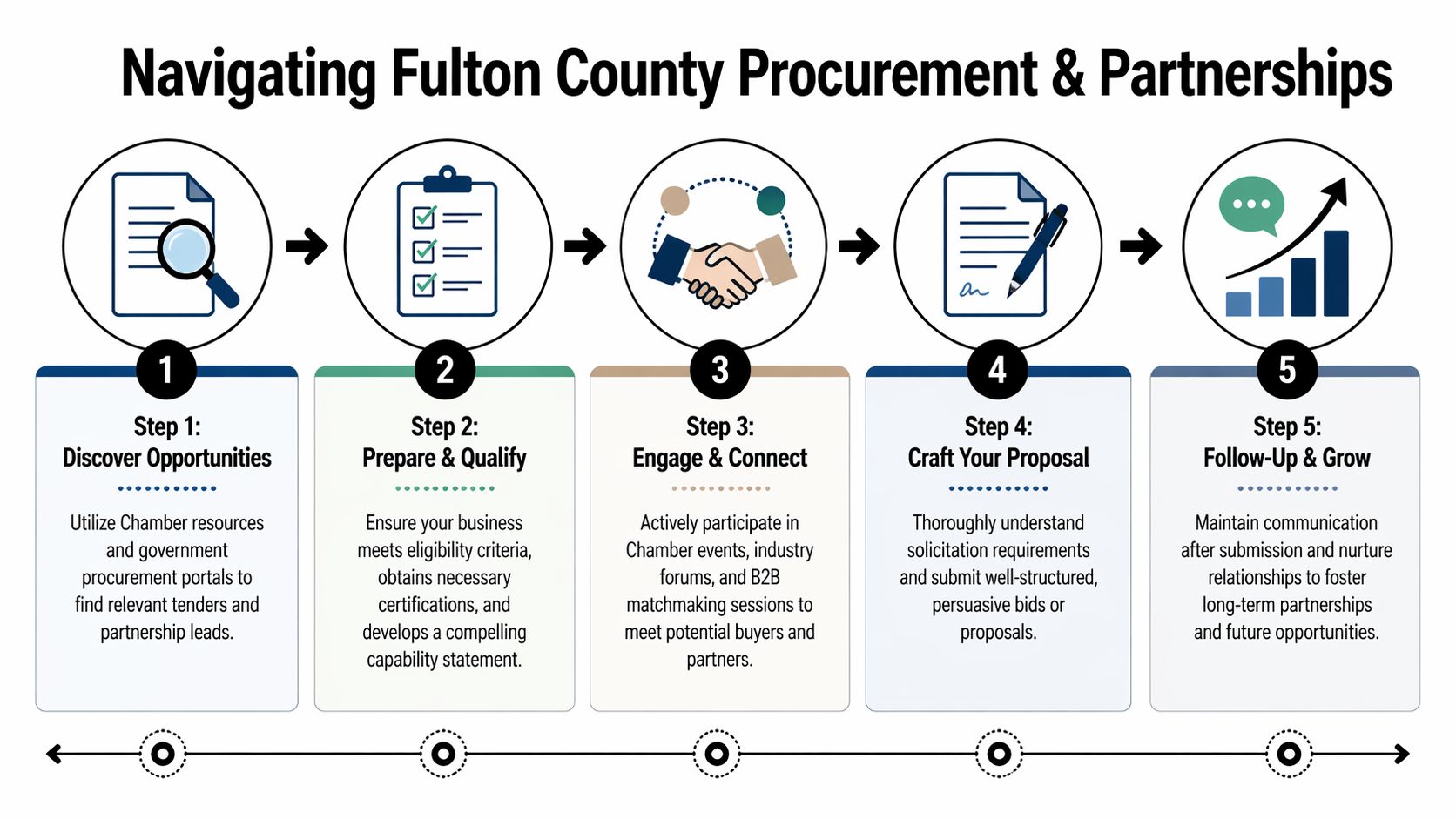
A hospital system in Fulton County needs a certified ITAD partner after a device refresh. A school network is replacing classroom hardware and wants chain-of-custody documentation that will satisfy auditors. A growing company is moving offices and needs secure disposition tied to its MSP and facilities team. In each case, the buying decision starts before a formal RFP appears.
For B2B service providers, Chamber participation can support procurement positioning. Buyers in healthcare, education, and public-sector-adjacent organizations often start with known operators, local referrals, and partners who have already proven they can handle risk, documentation, and follow-through.
A significant obstacle exists here. If you provide services tied to devices, records, infrastructure, or regulated disposal, trust affects whether you even make the shortlist. Buyers want to know who has seen your process, who will vouch for your team, and whether your controls will hold up under internal review. Fulton County's community development materials help show how closely local institutions tie vendor selection to community relationships and program alignment.
Where Chamber membership helps procurement
Used well, Chamber membership helps in four practical ways:
- Referral validation: A buyer is more comfortable taking a meeting when other local members can speak to your responsiveness, documentation, and delivery style.
- Earlier access to demand: Healthcare, education, technology, and public affairs groups often surface operational needs before purchasing issues a bid.
- Partner alignment: Relationships with MSPs, movers, AV firms, facilities vendors, and compliance advisors can place your service inside a broader solution.
- Lower perceived risk: A warm introduction from a credible member reduces the burden of proving you are safe to bring into the process.
Build a partner map around the buyer
Direct outreach still matters, but specialist firms usually grow faster when they map the companies already surrounding the account. For ITAD, that may mean managed IT providers, office relocation firms, commercial furniture dealers, shredding companies, e-waste handlers, or compliance consultants. For healthcare and education vendors, it can include facilities planners, EHR consultants, telecom providers, and project managers.
That approach gets stronger when paired with a disciplined co-marketing strategy. Shared workshops, joint checklists, and coordinated outreach often make more sense than separate pitches because they answer the buyer's bigger operational problem.
For teams tightening internal qualification and vendor approval, these IT procurement best practices provide a useful reference point.
Buyers in regulated environments ask two questions at once. Can you do the work, and will your process create risk for them later?
What stalls procurement conversations
Three mistakes come up often with specialized service providers.
- Leading with capabilities before credibility. Certifications, chain of custody, insurance, and process controls usually matter more than feature lists in the first conversation.
- Using vague language. Terms like "secure" or "compliant" need specifics such as reporting, destruction standards, audit trails, and project ownership.
- Ignoring the partner chain. An incumbent MSP, facilities manager, or compliance lead may shape the vendor list long before procurement steps in.
Putting the Chamber to Work for Your Business
The Chamber becomes valuable when you use it as an operating tool, not a badge. Join with a reason. Show up where your buyers already gather. Build local proof through committees, referrals, and partner relationships. Then turn that access into cleaner procurement conversations.
If you're an IT manager, use Chamber relationships to identify vendors whose process stands up to internal scrutiny.
If you're a B2B sales leader, focus on one vertical and build a referral web around it instead of collecting loose contacts.
If you're a CEO or owner, use Chamber involvement to increase local influence with the institutions and employers that shape buying patterns in Fulton County.
For companies that sell into agencies, school systems, or civic institutions, it also helps to learn more about public sector procurement so your outreach matches how public buyers evaluate vendors.
Frequently Asked Questions About Fulton County Chambers

Is there one Fulton County chamber or several business groups
There are multiple chamber and business-network structures operating across Fulton County. Some are countywide in focus, while others are subregional or city-centered, such as North Fulton or South Fulton organizations. The right fit depends on where your customers are, where your team can participate consistently, and whether your growth strategy is hyperlocal or countywide.
Which chamber is best for a specialized B2B service provider
For most specialized providers, the best chamber is the one that gives access to the buyer environment you serve. If your clients cluster in Alpharetta, Roswell, or nearby business corridors, North Fulton involvement may be more useful than a broad but shallow footprint elsewhere. If you sell into hospitals, schools, or municipalities across the county, a broader approach may work better.
Are chambers still relevant with hybrid work and office changes
Yes, but the value has shifted. The strongest use case now is relationship infrastructure. Verified local context shows that economic stability advisory boards in North and South Fulton have aided over 63,000 residents, while there has been a lack of recent 2025-2026 Chamber-led announcements addressing a 25% rise in corporate IT disposals due to hybrid work shifts, according to United Way of Greater Atlanta's Fulton County page. That creates an opening for businesses to lead practical conversations around office decommissioning, sustainable e-waste handling, and vendor accountability.
How should a company use the chamber if procurement is the real goal
Start by identifying the people who influence buying before procurement formalizes anything. That may include operations leaders, IT directors, compliance managers, facilities teams, and incumbent vendors. Join the events and groups where those people already exchange information, then follow up with something useful, not a generic pitch.
What's the biggest mistake new members make
They confuse attendance with traction. A Chamber can open doors, but it won't make your positioning sharper, your proposal cleaner, or your compliance story easier to trust. Those still have to be built inside the business.
If your organization needs a reliable local partner for secure electronics recycling, data destruction, or large-scale IT asset disposition, Atlanta Computer Recycling helps Fulton County businesses handle device retirement responsibly. The company supports commercial clients across offices, hospitals, schools, government facilities, and data centers with pickup, de-installation, compliant data handling, and environmentally responsible disposition.