Your Guide to the Chamber of Commerce Fulton County

An IT manager in Fulton County usually doesn’t need another breakfast mixer. They need a faster way to find vetted vendors, reliable referral paths, and local partners who understand compliance, procurement, and operational risk.
That’s where the phrase chamber of commerce fulton county gets more important than it first appears. In practice, business leaders across Atlanta often search for one central chamber and then discover a more fragmented business environment. That can feel inefficient until you realize the structure is useful. Different chambers connect you to different buyer groups, municipalities, and industry circles.
For regulated organizations, that distinction matters. A hospital system replacing endpoints, a school district clearing storage rooms, or a data center team planning a retirement project all need more than generic networking. They need introductions that shorten vendor screening and reduce execution risk. The best chambers can help with that, but only if you treat membership as a business development system instead of a badge.
Your Local Growth Partner in Atlanta
A familiar scenario plays out every quarter in Atlanta. An operations lead has a closet full of retired laptops, a few racks scheduled for decommissioning, and internal pressure to move quickly without creating a data security problem. Procurement wants approved vendors. Legal wants documentation. Facilities wants the equipment gone.

In that moment, the local chamber isn’t just a civic group. It can be a filter for trust. It helps you identify who already serves businesses like yours, who keeps showing up in the right rooms, and who has enough local credibility to be worth a serious conversation.
That’s especially true in Fulton County because Atlanta’s business environment is broad. North Fulton buyers don’t always behave like South Fulton buyers. Enterprise technology firms, healthcare operators, school systems, and public agencies often move through different networks even when they sit inside the same county.
A chamber is most useful when you stop asking, “Should we join?” and start asking, “Which relationships are we trying to build in the next six months?”
The practical takeaway is simple. If you’re responsible for IT, facilities, compliance, or vendor sourcing, chamber participation can support three things at once:
- Better introductions: Warm paths into local decision-makers and service partners.
- Lower screening friction: Member directories and recurring events help narrow the field.
- Stronger local visibility: Buyers often prefer vendors they’ve seen in trusted community settings.
The chambers won’t solve every sourcing problem for you. They will, however, give you a better operating map of the market.
Understanding the Fulton County Chamber Network
The first confusion to clear up is that there isn’t one single chamber that fully represents every business need across Fulton County. It can be compared to a university system. You’re still inside one ecosystem, but each campus has its own strengths, audience, and culture.
The phrase chamber of commerce fulton county often points people toward several overlapping organizations. That isn’t a flaw. It’s a targeting advantage if you know how to use it.
North, South, and Metro are different lanes
The Greater North Fulton Chamber is usually the strongest fit if your business development goals center on places like Alpharetta, Milton, and Roswell. That region tends to be attractive for technology, professional services, and growing mid-market companies.
The South Fulton Chamber matters more when your work depends on relationships in the southern part of the county, including underserved business communities and local growth initiatives. It can be especially relevant if your company serves organizations that value local presence and practical community partnerships.
The broader Metro Atlanta Chamber sits at a different level. It’s often more useful for regional influence, large-employer visibility, and policy or economic development conversations that extend beyond one slice of Fulton County.
A more detailed local breakdown appears in this Fulton County chamber overview for Atlanta businesses.
Why this structure helps B2B operators
A single countywide chamber might sound simpler, but it would also be noisier. Separate organizations let you choose where to invest time.
Use this quick comparison:
| Chamber path | Best fit | What it tends to help with |
|---|---|---|
| North Fulton | Tech firms, B2B services, suburban growth markets | Directory search, professional introductions, local business visibility |
| South Fulton | Community-rooted businesses, underserved growth areas, public-facing services | Relationship building, local trust, partnership opportunities |
| Metro Atlanta | Larger enterprises, regional strategies, broader advocacy | Market influence, executive access, cross-county reach |
The legacy matters more than most buyers think
The chamber model itself isn’t new. A similar-named chamber in Fulton County, Indiana, was established in 1945 to help businesses manage the postwar economy, a reminder that chambers have long existed to support business conditions and community strength, as reflected in Fulton County history.
That legacy still shows up in how chambers work today. They organize trust at the local level. For IT and operations managers, that matters because local trust often determines who gets the first meeting.
Core Benefits of Chamber Membership for Atlanta Businesses
A chamber membership only pays off when it changes who knows you, who trusts you, and who includes you in buying conversations. If it doesn’t do that, it’s a dues expense with a logo attached.

The timing matters. Fulton County’s population is projected to increase 6.1% from 2025 to 2030, rising from 1,109,720 to 1,175,914, according to the Georgia Chamber Data Hub. More people means more business activity, more competition, and more vendors chasing the same accounts.
What actually improves when you join
The strongest benefit is usually credibility by association. In B2B markets, buyers look for low-risk choices. Chamber visibility doesn’t replace due diligence, but it can move you from unknown vendor to plausible candidate.
The second benefit is access. Member directories, committee meetings, and sponsor opportunities create repeated contact with the same business community. Repetition matters. Buyers rarely hire based on one introduction.
Third is signal quality. A chamber can help you spend time around organizations that are already committed to local business development. That’s different from random prospecting.
Practical rule: Join only if you’re willing to attend, follow up, and contribute. Passive members rarely get meaningful return.
What works and what doesn’t
What works:
- Targeted committee participation: Industry, policy, or community committees create smaller, more useful circles than general mixers.
- Educational positioning: Teaching a useful topic often outperforms self-promotion.
- Consistent follow-up: One event rarely produces a contract. A sequence of useful interactions can.
What doesn’t:
- Collecting business cards without a plan: That creates activity, not pipeline.
- Treating every event as a sales floor: People avoid members who only pitch.
- Joining the wrong chamber: Geographic mismatch wastes time quickly.
Some teams also extend chamber engagement through digital events. If your audience includes busy operators who won’t attend every in-person program, tools like best webinar software for small businesses can help you host educational sessions that keep your local network active between events.
Businesses focused on North Fulton relationships can also review this North Fulton chamber resource for local growth to evaluate fit before joining.
Navigating Chamber Events and Networking Opportunities
Most chamber event advice is too soft. “Be yourself” doesn’t help much when you’re trying to solve a vendor sourcing problem or open a high-value account.
A better approach is to treat each event type as a different operating environment. A casual after-hours gathering is useful for breadth. A committee lunch is better for specificity. A sponsored panel gives you authority if you have something concrete to say.
Use the directory before you enter the room
Start with pre-event research. Review the member list, identify likely attendees, and narrow your goals. You don’t need to meet everyone. You need a short list of people tied to procurement influence, facilities operations, compliance, or industry leadership.
Use a three-part prep note:
- Who you want to meet: Names, companies, and likely relevance.
- What you want to learn: Vendor criteria, project timing, referral paths.
- What you can offer: Insight, introduction, or operational guidance.
If your team needs ideas for choosing stronger events in the first place, this guide on finding effective networking events is useful as a planning reference.
Follow-up is where the value appears
Most chamber members are polite in the room and forgettable by the next morning. The follow-up is what separates visible people from useful people.
Send a short note within a day or two. Reference the actual conversation. Offer one relevant next step. That could be a resource, an introduction, or a short call.
A practical local example is this Atlanta Braves business networking angle, which shows how place-based conversations can open doors when you connect your outreach to shared local context instead of a generic pitch.
If your follow-up could be sent to anyone, it won’t be remembered by anyone.
For IT and operations leaders, events work best when they answer a real purchasing question. Who can handle this project, who has done it before, and who can be trusted when the timeline gets tight.
A Strategic Guide for Specialized Industries
General chamber advice breaks down fast in specialized industries. The buying criteria are different. A hospital, a school district, a municipal department, and a private technology firm may all need the same category of service, but they don’t evaluate vendors the same way.
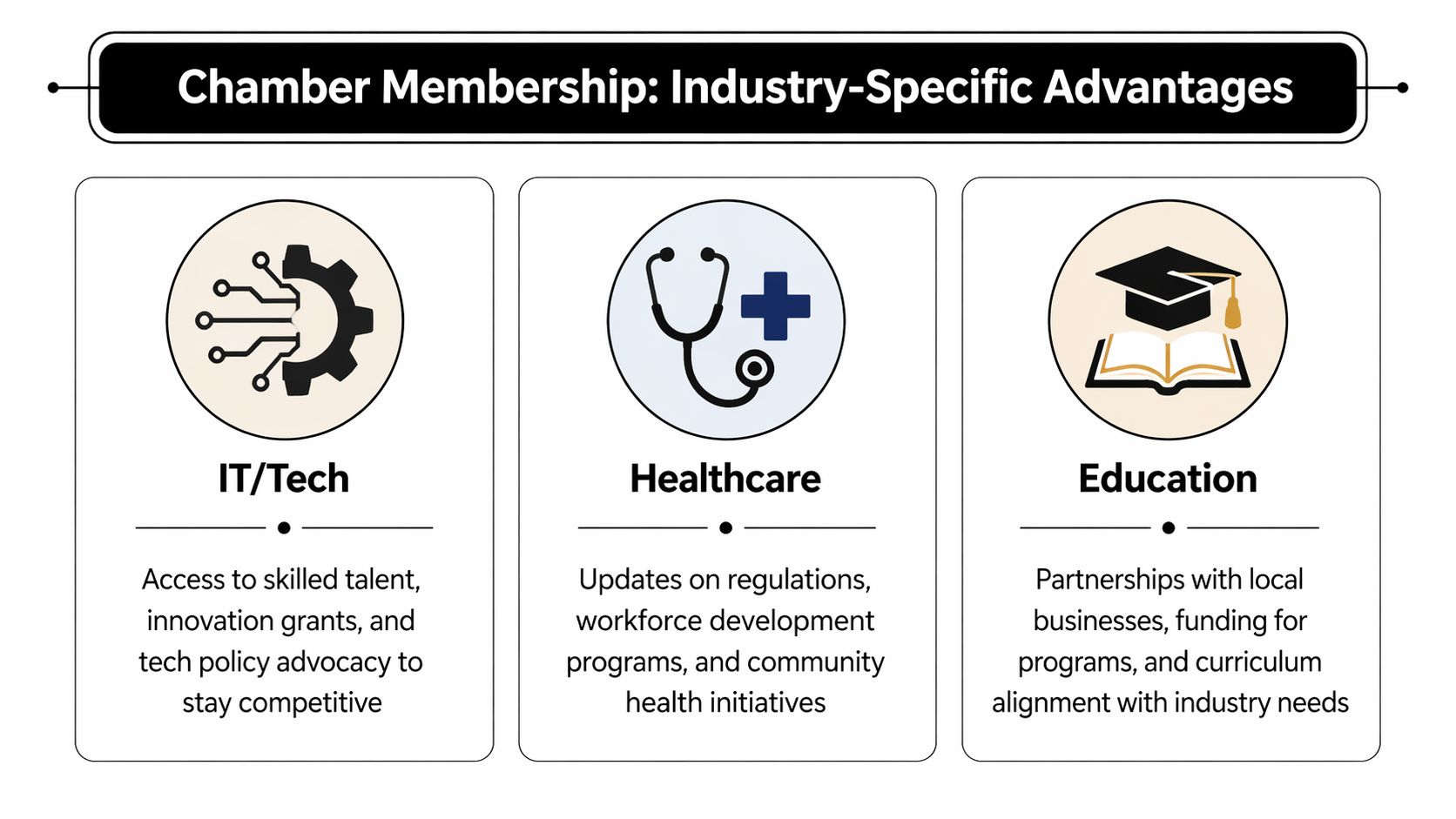
The useful move is to use chamber membership as an industry filter. You’re not just joining a local organization. You’re looking for the parts of that organization where your sector’s risk, workflow, and procurement habits are already understood.
IT and technology
Technology teams should pay close attention to the chamber’s digital infrastructure. The Greater North Fulton Chamber uses JavaScript, HTML, PHP, and 26 additional web technologies, and its member portals and directories can support more targeted prospecting. For a tech-savvy business, those tools can support 15 to 20% faster client acquisition compared with cold outreach, according to the referenced chamber profile at RocketReach.
That matters because IT buyers often search with specificity. They aren’t looking for “services.” They’re looking for a partner who understands decommissioning, chain of custody, data-bearing assets, scheduling around production systems, and internal approvals.
For tech teams, the practical use of a chamber looks like this:
- Directory-first outreach: Search by category, company size, and regional fit before you attend events.
- Committee participation: Look for technology, innovation, or infrastructure groups.
- Operational conversations: Ask peers who they trust when a project involves uptime risk or sensitive equipment handling.
Healthcare
Healthcare organizations care about vendor trust in a different way. Reputation alone won’t carry much weight if a provider can’t speak clearly about compliance, documentation, and patient-data risk.
The chamber helps most when it shortens the referral chain. A hospital administrator doesn’t want to start from scratch each time a storage room fills up with retired devices or a site refresh creates a disposal project. The smart move is to ask the chamber network who already serves healthcare organizations well and who can communicate with compliance and facilities in the same meeting.
A useful healthcare checklist inside chamber conversations includes:
- Data security language: Can the vendor explain destruction and sanitization processes clearly?
- Pickup coordination: Can they work around active clinical operations?
- Documentation quality: Will records satisfy internal audit expectations?
Education
K-12 districts, colleges, and universities usually face a mix of volume and budget pressure. Equipment turns over in waves. Timelines are often tied to summer projects, grant cycles, lab refreshes, or campus moves.
Chambers help education leaders when they surface practical local partners instead of broad directories with no context. A school system often needs someone who can handle bulk pickups, mixed device conditions, and coordination across multiple buildings without turning the project into a burden on internal IT staff.
For education buyers, referrals from chamber members can be more useful than generic search results because they carry local operating context. That includes who shows up on time, who communicates with district staff well, and who can adapt when the inventory list changes.
Government and public sector
Public agencies need a different kind of confidence. They’re often balancing procurement rules, internal controls, public scrutiny, and security requirements at the same time.
In chamber settings, government-adjacent conversations usually happen through civic committees, regional development groups, and relationships with firms that already understand public timelines. The value isn’t speed alone. It’s predictability.
The best chamber referral is often not the loudest company in the room. It’s the one multiple members describe the same way: responsive, clear, and easy to work with under constraints.
For government teams, useful chamber questions include whether a vendor can support on-site logistics, whether they understand asset records, and whether they can work within building access restrictions and project sequencing.
Across all four sectors, that’s the core pattern. The chamber works best when you use it to locate specialized competence, not generic visibility.
The Untapped Opportunity in Sustainable IT and Compliance
Most chambers talk a lot about growth. Far fewer give members practical help with sustainable IT disposition, electronics recycling decisions, or secure handling of retired equipment. That gap matters because many businesses now face both environmental expectations and data security obligations at the same time.

The disconnect is especially visible in South Fulton. The South Fulton Chamber received a $1 million SBA grant to support underserved entrepreneurs, yet resources for environmental compliance and secure IT asset disposition remain notably absent, according to this overview of the Community Navigator work. The same assessment notes that this gap affects an area where 70% of small businesses fail to meet that sustainability-related need.
Why this matters for operations leaders
If you manage IT assets, this isn’t a side issue. It affects storage space, risk exposure, internal labor, and vendor accountability. Old equipment lingers because no one owns the decision, or because leadership assumes “recycling” is simple when the actual challenge is secure, documented disposition.
That creates an opening inside the chamber itself. Members who can explain the overlap between sustainability and compliance become unusually valuable. They’re no longer just another service provider. They become the person the chamber can call when members ask hard operational questions.
Useful reference material can come from broader general compliance resources, but chamber members still need local, practical interpretation. They need to know who can execute.
The strongest chamber play is often educational
A lot of businesses wait for chambers to launch the perfect program. That’s backwards. The better move is to bring the missing program to the chamber.
For example, a workshop on secure device retirement for healthcare clinics, schools, or local offices can do more than a sponsorship table ever will. It demonstrates expertise, helps members solve a neglected problem, and gives chamber staff a reason to keep inviting you back.
A regional sustainability angle also matters. This circular economy resource for electronics in Atlanta captures the kind of local operational thinking chambers often lack but members increasingly need.
When a chamber has a content gap, the member who fills it often becomes the default referral.
That’s the underused opportunity in the chamber of commerce fulton county ecosystem. The most valuable position isn’t being visible everywhere. It’s being useful where almost no one else is.
How to Join and Maximize Your Membership
Joining a chamber is easy. Building value from it takes discipline.
A lot of companies make the same mistake. They compare dues, pick the cheapest option, show up twice, and decide chambers don’t work. The operating plan was what failed.
Choose based on market fit, not habit
Start with three filters.
Location fit. If your revenue depends on North Fulton relationships, join where those companies already gather. If your work is rooted in South Fulton partnerships or local community growth, that should drive the decision.
Buyer fit. Ask where your likely customers, referral partners, and influencers spend time. A chamber full of good people still won’t help much if they’re outside your buying universe.
Participation fit. Don’t join the chamber whose calendar you’ll never attend. The right membership is the one your team will use.
Treat tiers like investment levels
Membership tiers often confuse first-time members because they look like menu pricing without context. The better way to evaluate them is by access.
Use this lens:
| Tier question | What to ask |
|---|---|
| Basic membership | Does it get you into the directory, events, and member communications? |
| Mid-level visibility | Does it include sponsor options, featured listings, or committee access that matters to your goals? |
| Premium involvement | Will your leadership team actually use the executive exposure or high-visibility benefits? |
If your team won’t use premium benefits, don’t buy them. If your growth plan depends on authority and repeated exposure, the cheapest tier can become the most expensive choice because it limits your visibility.
The fastest path to relevance is contribution
Many members stall when they pay dues and wait to be discovered. That rarely happens.
The chamber usually rewards people who make the organization easier to run and more valuable to members. That can mean joining a committee, helping with event logistics, contributing educational content, or volunteering for ambassador-style roles.
Search behavior points to an opening here. Assessments of local resources note that searches for “fulton county chamber e-waste disposal” often produce no specific answers, which creates a practical opportunity for a member to propose a workshop and own that conversation inside the business community, as highlighted by the Fulton County chamber resource landscape.
A helpful local starting point is this Fulton County chamber page for Atlanta businesses, especially if you’re trying to decide where to focus outreach.
Use a simple first-90-days plan:
- Attend consistently: Don’t sample one event and stop.
- Book short follow-ups: Turn introductions into working conversations.
- Join one committee: Depth beats random visibility.
- Offer one useful topic: Education creates authority faster than selling.
- Track referral sources: Treat chamber activity like a real channel.
That’s how membership becomes a system instead of a line item.
Conclusion From Member to Leader
The primary value of the chamber of commerce fulton county network isn’t access alone. It’s structured access with context. You’re not walking into a random room full of local businesses. You’re entering a set of communities where geography, trust, and industry fit all shape who works together.
That’s why the best results don’t come from passive membership. They come from targeted participation. Choose the chamber that matches your market. Use events to learn, not just to appear. Focus on specialized problems that other members still struggle to solve. Then contribute something useful enough that people remember your name when those problems surface again.
For IT managers, healthcare operators, school leaders, and public sector teams, that approach is practical. It reduces sourcing friction and improves the quality of local partnerships. For service providers, it does something even more powerful. It moves you from vendor to resource.
The businesses that get the most from chambers don’t just join. They lead where the need is still unmet.
If your organization needs a local partner for secure, business-focused electronics recycling and IT asset disposition, Atlanta Computer Recycling helps Atlanta-area companies handle retired computers, servers, network gear, and data-bearing devices with compliance and operational efficiency in mind. That includes on-site pickups, de-installation support, hard drive wiping using the DoD 5220.22-M 3-pass standard, and physical shredding for obsolete media. For hospitals, schools, government offices, and enterprises planning office closures or data center decommissioning, ACR provides a practical path from equipment removal to responsible final disposition.