Fulton County Chamber of Commerce: A B2B Growth Guide

You search for the fulton county chamber of commerce, click a few results, and quickly realize the problem. There isn’t just one. There are multiple chambers in counties named Fulton across the country, and if you’re an Atlanta B2B service provider, most of those results are noise.
That confusion matters more than people think. If you’re selling commercial services such as IT asset disposition, secure recycling, decommissioning, managed IT, facilities support, or compliance consulting, the wrong chamber contact list wastes time. Worse, it sends your outreach into the wrong market and gives your team a false sense that “chamber marketing doesn’t work.”
For Atlanta-based firms, chamber membership can work. But only if you treat it as a business development channel, not a civic badge. The right chamber can help you get closer to operators, procurement teams, school systems, healthcare administrators, and business owners who already buy services like yours. The wrong one just gives you another directory listing no one uses.
Understanding the Right Fulton County Chamber for Atlanta Businesses
If your company operates in metro Atlanta, the chamber that matters is the Fulton County Regional Chamber of Commerce and Industry Inc. It isn’t merely a luncheon organizer. It’s a 501(c)(6) nonprofit business league focused on improving business conditions in the Atlanta market.
That distinction matters because it changes how you should use it. A networking club gives you social access. A business league gives you market access, local visibility, and a more credible route into serious commercial conversations.
To ground the difference, use this quick visual.
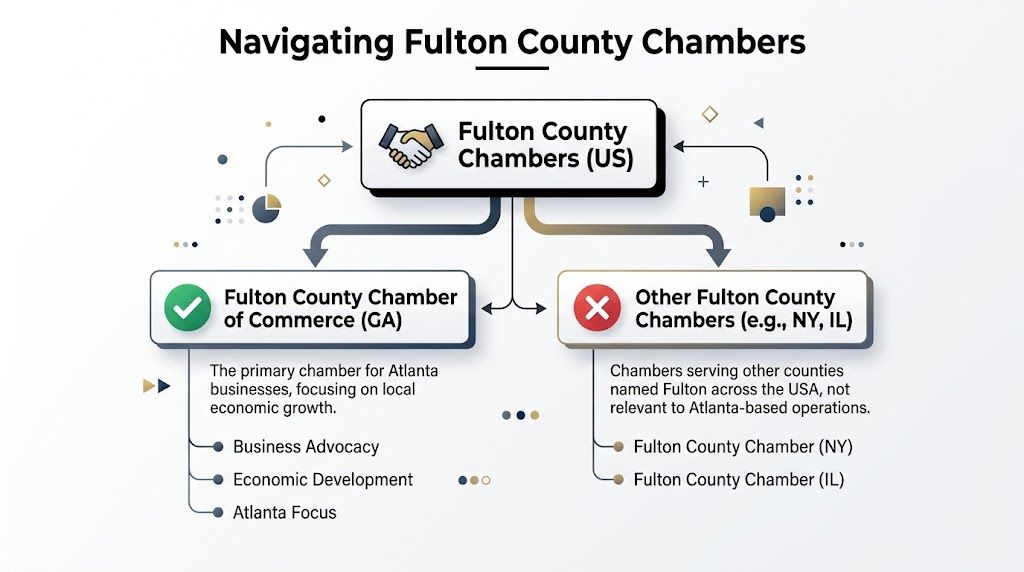
Why the Georgia chamber is the one that matters
A lot of online confusion comes from similarly named chambers in Indiana, Pennsylvania, and other Fulton counties. Those organizations may be legitimate and longstanding, but they don’t serve your Atlanta pipeline.
The Atlanta-relevant chamber has measurable operating stability. In its 2022 filing, the organization reported $1,247,890 in total revenue, with 71.5% from membership dues, and a current ratio of 2.42, according to the Fulton County Regional Chamber's 2022 nonprofit filing. For a B2B service firm, that signals something practical. You’re dealing with an organization built to keep programs, advocacy, and member engagement running over time.
A chamber with stable operations is easier to integrate into your sales process. Staff turnover is less disruptive. Programs are more likely to continue. Partnerships have a better chance of lasting beyond one event cycle.
What this means for service-based companies
For commercial service providers, the chamber’s value isn’t “community exposure” in the abstract. It’s targeted proximity to companies with real operational problems.
If you sell to office managers, IT directors, healthcare groups, schools, logistics teams, or facilities leaders, your goal isn’t broad visibility. It’s to show up where local business operators already gather to solve vendor, compliance, and growth issues. That’s the practical lens.
Here’s the simplest filter:
| Search result | Useful for Atlanta sales | Why |
|---|---|---|
| Fulton County chamber in Georgia | Yes | Relevant market, local business relationships, Atlanta ecosystem |
| Fulton County chamber in another state | No | Wrong geography, wrong buyer pool, wrong referrals |
| Generic chamber directories | Sometimes | Useful only if they connect you to active local programming |
Practical rule: Before joining any chamber, confirm the member base overlaps with your target accounts, not just your preferred geography.
If your team needs a local market reference point for county-specific business activity, Fulton County commercial recycling support in Georgia is a more relevant operational lens than any out-of-state chamber page.
The main takeaway is simple. For Atlanta businesses, the correct fulton county chamber of commerce conversation starts with the regional chamber tied to the local market, not with any chamber that happens to share the same county name.
Decoding Membership Benefits for IT and Operations
Most chamber benefit lists are written for general audiences. They mention visibility, advocacy, sponsorships, and networking. That language is fine, but it’s too soft for an IT manager, operations director, or compliance lead trying to solve specific business problems.
The better question is this. What does chamber membership do for a company that handles equipment, data-bearing devices, facilities changes, and regulated workflows?

Vendor vetting is the hidden benefit
In the Atlanta market, healthcare is a leading industry, and retired laptops, servers, and storage devices create real compliance exposure. According to economic development data cited for Metro Atlanta context, chambers that facilitate vendor vetting can help members cut data breach risks by up to 40% by connecting them with certified partners for work such as HIPAA-compliant data destruction.
That’s the benefit many operators miss. The chamber isn’t just introducing you to buyers. It’s also helping buyers reduce the risk of choosing the wrong vendor.
For operations teams, that changes the buying process in three ways:
- Shorter trust-building cycles because an introduction from a chamber contact carries more weight than a cold email.
- Better internal justification because the buyer can point to a vetted local network instead of a random internet vendor.
- Lower perceived risk when the service involves sensitive data, regulated materials, or on-site access.
If your team handles regulated disposal or secure device retirement, it helps to understand what HIPAA-compliant electronics recycling in Atlanta looks like before you walk into those conversations.
Where chambers help and where they don’t
A chamber can be useful at the point where buyers are narrowing options. It’s less useful if your offer is poorly defined, your process is unclear, or your team can’t explain chain of custody in plain language.
What works:
- Using chamber access to meet operations buyers early before they issue a formal vendor search
- Listening for trigger events such as relocations, office closures, hardware refreshes, mergers, and compliance reviews
- Showing operational competence with straightforward explanations of pickup, inventory handling, wiping, shredding, and documentation
What doesn’t work:
- Pitching generic “green solutions” without tying them to legal, operational, or cost concerns
- Treating every member as a prospect even when they aren’t in a buying role
- Assuming attendance equals traction without follow-up and qualification
Buyers in regulated environments don’t reward vague sustainability messaging. They respond to clear process, documented controls, and predictable execution.
Translate benefits into internal ROI
The strongest chamber users inside service firms don’t talk about “brand awareness.” They talk about avoided friction.
A chamber introduction can help a facilities manager find a recycler. But the bigger value is often internal. Procurement gets comfort. Legal gets a cleaner vendor trail. IT gets a partner that understands data destruction requirements. Leadership gets fewer surprises.
That’s how membership stops being a line item and starts acting like a practical risk-reduction tool.
Strategic Networking at Chamber Events and Committees
Most companies waste chamber events by showing up without a target. They collect cards, make pleasant conversation, and leave with nothing they can put into a CRM.
That approach fails because events are not the outcome. Events are the fieldwork.
The better method is to treat every breakfast, roundtable, after-hours mixer, or committee meeting as one of three things: a relationship opener, an intelligence-gathering session, or a credibility-building opportunity. If you know which one you’re attending, your conversations improve immediately.
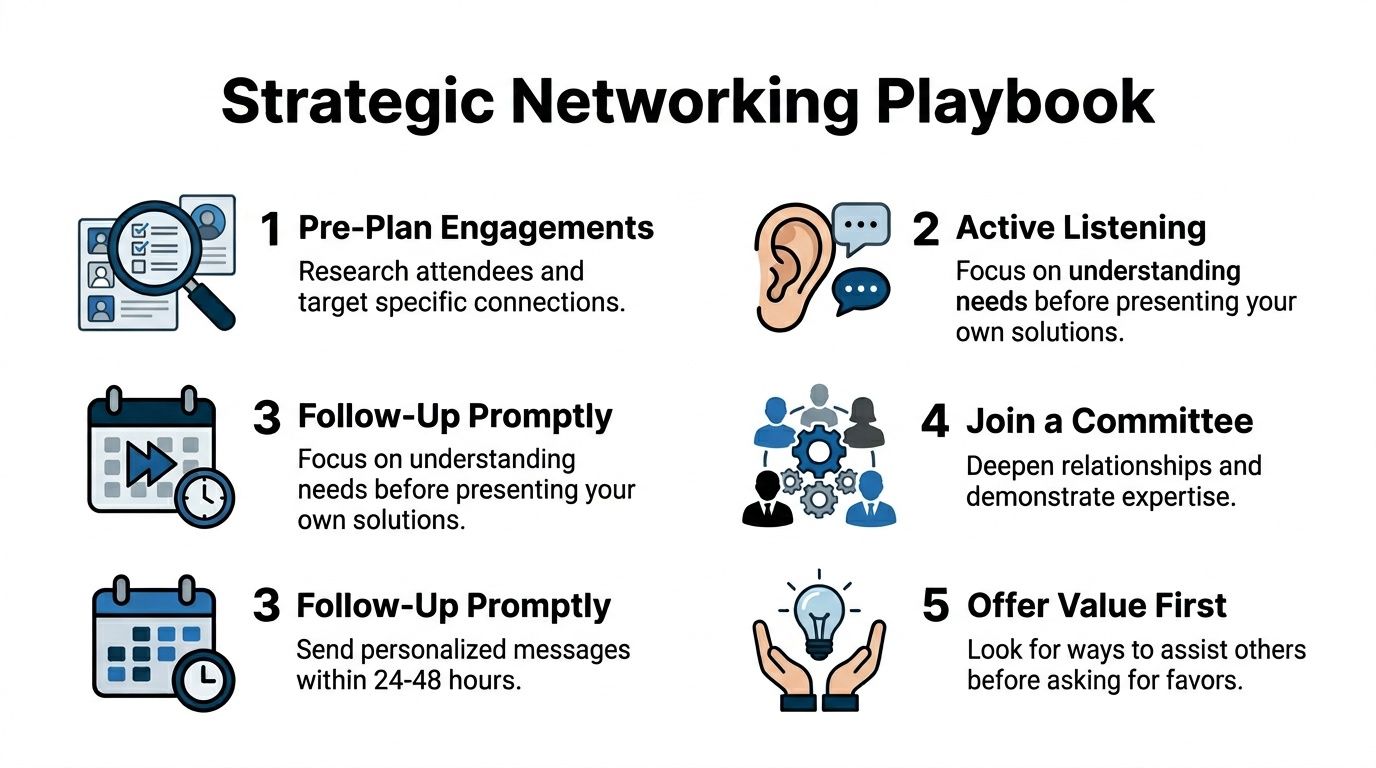
Pick the right event for the right outcome
Not all chamber activity deserves the same effort. A broad social event and a focused committee meeting produce different returns.
Use this framework:
| Event type | Best use | Weak use |
|---|---|---|
| Business mixer | Opening new relationships | Deep technical selling |
| Breakfast briefing | Learning local priorities | Hard pitching |
| Committee meeting | Building repeated visibility | Fast lead generation |
| Sponsored event | Signaling market presence | Expecting instant deals |
A service firm selling to hospitals, schools, or office operators should usually value repeated exposure over single-event volume. One solid committee relationship often matters more than a stack of business cards from a crowded mixer.
Prepare before you walk in
The best chamber networkers do their work before the event starts.
Use a short prep list:
Identify target account types
Decide whether you want to meet healthcare admins, school operators, facilities leaders, MSPs, property managers, or public sector contacts.Set one conversation goal
Don’t try to sell your entire service line. Aim to learn one thing, such as who handles decommissioning, who signs off on surplus equipment disposal, or who influences vendor approval.Bring a useful point of view
A practical comment beats a brochure. For example: “We’re seeing more teams struggle with retired devices during office consolidations because facilities, IT, and compliance are working on different timelines.”Know your follow-up path
If someone shows interest, your next step should already be clear. Intro call. Site walk. Referral exchange. Committee invitation.
Reliable chambers have existed for decades. The Fulton County Chamber in Indiana, for example, was established in 1945 to support post-war recovery, which shows why chambers remain durable relationship hubs for B2B firms that invest consistently rather than casually, as noted on the chamber's history page.
That long-term pattern is useful for one reason. Chamber relationships compound. The people you meet this quarter may not buy this quarter. But they often move roles, join boards, change employers, or refer peers.
Work the room without sounding like a vendor
The quickest way to kill a chamber conversation is to open with your service menu. Ask operational questions instead.
Try prompts like these:
- “What kinds of projects are taking up the most time for your team this quarter?”
- “When equipment leaves service, who usually owns that process internally?”
- “Are you seeing more pressure around documentation, data handling, or sustainability reporting?”
These questions do two things. They reveal current pain points, and they tell the other person you understand real workflows.
If your company handles technology-related disposition, your goal is to earn a second conversation around a business process, not to force a product pitch at the coffee table. Teams that want a practical reference for corporate e-waste recycling workflows often find those details are what make the follow-up credible.
Committees beat random attendance
For many B2B firms, committees outperform events. They create repetition, and repetition creates trust.
A committee setting lets you do work with people, not just talk near them. That’s where subject matter expertise becomes visible. If you’re dependable, informed, and useful in a working group, people remember you as a contributor first and a vendor second.
That order matters.
A Step-by-Step Guide to Joining and Getting Involved
Joining a chamber is easy. Getting value from it takes structure.
Too many companies pay dues, show up once, then let the membership sit untouched. That usually happens because no one owns the rollout internally. The sales team assumes marketing will use it. Marketing assumes leadership joined for reputation. Operations never hears about it.
Treat chamber membership like a small business development project with an owner, a timeline, and a narrow set of goals.

Start with fit, not enthusiasm
Before you join, answer three practical questions:
Who on our team will own the relationship?
If there’s no accountable person, the membership will drift.Which buyer groups do we want to reach?
Be specific. School districts, healthcare operators, property managers, public agencies, MSPs, or regional employers.What kind of chamber activity fits our sales cycle?
Some firms need committee visibility. Others benefit more from sponsorships, educational panels, or direct introductions.
Membership tiers only matter after those answers are clear. A bigger package won’t fix weak internal ownership.
Use the first 90 days well
Chambers evolve over time, and new programs often appear around emerging member needs. The Fulton County Chamber in Pennsylvania, founded in 1951, later added a Tourist Promotion Agency in 1976, which is a good reminder to actively look for specialized initiatives instead of assuming the member benefits stop at the basics, according to Fulton County Pennsylvania heritage information.
A practical first-90-days plan looks like this:
Weeks 1 to 2
Get listed correctly. Make sure your company description is written for buyers, not for your internal team. Use plain language, define your service category clearly, and include the business problems you solve.
Weeks 3 to 4
Attend orientation or the nearest equivalent member onboarding session. Ask which programs attract operations leaders, not just business owners.
Month 2
Pick one committee or recurring event series. One is enough at first. The goal is consistency, not overcommitment.
Month 3
Schedule direct conversations with a small number of relevant members and referral partners. Think MSPs, office movers, facilities vendors, commercial real estate contacts, compliance consultants, and education-sector service firms.
New members get the best results when they narrow their focus early. Broad participation feels productive, but targeted participation usually produces better conversations.
Avoid the common mistakes
The pattern is predictable. Firms underperform in chambers when they do one of these:
- Delegate attendance to the wrong person who can network but can’t discuss operational details.
- Lead with promotional language instead of buyer problems.
- Ignore committees and rely only on large events.
- Fail to log follow-ups inside their CRM.
- Expect the chamber staff to do all the connecting.
The strongest chamber users behave differently. They show up repeatedly, ask smarter questions, and give the organization a clear idea of the kinds of introductions they value.
Leveraging Your Membership for B2B Sales and Partnerships
A chamber membership becomes valuable when it enters your pipeline. Until then, it’s an expense.
That doesn’t mean every chamber activity needs immediate attribution. It means your company should know how the membership supports lead generation, referral creation, market intelligence, and trust transfer. If you can’t map chamber activity to one of those four outcomes, your team is probably participating too loosely.
Use the chamber like a sales channel
One reason this matters now is that many businesses are actively looking for guidance on sustainability and compliance, but the content market around those needs is thin. There’s a documented content gap in Georgia around chamber-related guidance for compliance-focused services, and search interest for “green business certification” in Georgia shows a 40% spike. That creates an opening for service providers that can connect chamber participation to practical business outcomes.
Here’s where chamber membership can produce commercial value.
Targeted prospecting
The member directory shouldn’t be treated like a cold list. It works better as a prioritization tool.
Look for categories adjacent to your service, such as:
- MSPs and IT consultants
- Commercial movers
- Property and facility management firms
- Healthcare service providers
- School and university contacts
- Local professional service firms with regulated clients
Those groups may become buyers, but they can also become multipliers. A managed service provider that doesn’t handle retired hardware can become a steady referral partner if you make their life easier.
Trigger-event monitoring
Pay attention to chamber newsletters, event topics, and member announcements. They often reveal useful timing signals.
Examples include office relocations, expansions, consolidations, school refresh cycles, leadership changes, and facility upgrades. Those moments often create demand for disposal, pickup, equipment removal, inventory management, or secure data handling.
The chamber doesn’t just tell you who’s in the market. It often tells you when they’re likely to buy.
Build partnerships before chasing direct deals
Many service firms overfocus on end clients and ignore channel relationships inside the chamber. That’s a mistake.
Non-competing member partnerships often convert faster than direct prospecting because the trust is already established elsewhere. If you sell ITAD services, good chamber partners might include office relocation companies, copier providers, managed IT firms, cabling contractors, and commercial real estate contacts.
A simple way to strengthen those relationships is to stay visible between events. For professionals who want a better system for that, this guide on how to get more LinkedIn connections is useful because it focuses on building relevant professional networks rather than collecting random contacts.
Thought leadership beats generic promotion
Chamber audiences hear plenty of promotional language. They remember useful education.
If you get a speaking slot, avoid a company overview. Teach something operational. Examples:
- How to reduce confusion between IT, facilities, and compliance during equipment retirement
- What documentation buyers should request before approving a recycling vendor
- How to handle devices from office closures without losing chain-of-custody visibility
- Where reuse fits and where shredding is the safer choice
That approach positions your firm as a subject matter resource, which usually leads to better follow-up conversations than a sales presentation ever will.
For companies that also recover value from surplus hardware, old electronics for cash programs can be part of that conversation when buyers are balancing compliance, sustainability, and asset recovery.
Measure what actually matters
Don’t judge chamber ROI by one event or one quarter. Track a tighter set of indicators:
- qualified introductions
- referral partners added
- second meetings booked
- target accounts identified
- speaking opportunities earned
- opportunities influenced, not just sourced
That gives leadership a realistic picture. Chambers rarely act like paid ads. They work more like a relationship infrastructure. Used properly, that infrastructure can support sales for years.
Your Next Steps with Atlanta Computer Recycling
The right fulton county chamber of commerce can become a serious growth asset for an Atlanta service business. But only if you use it with discipline. Pick the correct chamber, focus on the buyer groups that matter, show up consistently, and turn activity into a repeatable business development process.
For companies dealing with retired laptops, servers, network equipment, office closures, or data-bearing devices, the chamber strategy only goes so far without a reliable execution partner. Secure pickup, documented handling, compliant data destruction, and responsible recycling still have to happen on the ground.
That’s where Atlanta Computer Recycling fits. If your team needs a practical plan for commercial electronics recycling, secure IT asset disposition, or a larger decommissioning project, the next move is to start a direct conversation and map the workflow around your site, equipment mix, and compliance requirements. You can schedule a pickup with Atlanta Computer Recycling when you’re ready to turn planning into action.
If your organization needs a dependable B2B partner for secure electronics recycling, data destruction, and IT asset disposition in metro Atlanta, contact Atlanta Computer Recycling. They help hospitals, schools, government agencies, offices, and data center teams manage retired technology with a process built for compliance, sustainability, and minimal disruption.