Fulton County Georgia Chamber of Commerce: A Business Guide

If you search for a fulton county georgia chamber of commerce, are you looking for one door to walk through, or the right set of doors for how your business grows?
That distinction matters. Most companies start with the wrong assumption. They expect a single countywide chamber, a single membership, and a single event calendar. Fulton County doesn't work that way. The business network is more fragmented than that, but it's also more useful once you understand how to work it.
For B2B service providers, this isn't a naming issue. It's a market access issue. If you sell to hospitals, schools, corporate offices, logistics firms, or public sector buyers in and around Atlanta, chamber strategy affects who you meet, which committees you join, where you sponsor, and how quickly you move from being unknown to being referred.
Your Guide to Fulton County's Business Network
Business owners ask a straightforward question: how do you join the Fulton County chamber? The practical answer is that there is no centralized Fulton County Chamber of Commerce. Fulton County is served through a chamber ecosystem that includes the Greater North Fulton Chamber and the Greater South Fulton Chamber, which creates a real knowledge gap for companies trying to choose the right network for targeted benefits and relationships, as noted by Roswell Inc partner resources.
That surprises people the first time they hear it. It also explains why many businesses join one organization, attend a few events, and then conclude that chambers "don't work." Often, the issue isn't chamber value. It's poor chamber fit.
Start with territory, not branding
In Fulton County, geography usually determines where your first chamber relationship should begin. If your buyers, projects, and referral partners cluster in Alpharetta, Roswell, Sandy Springs, Johns Creek, Milton, or nearby communities, your local networking rhythm will look different than it will in South Fulton.
If your work spans the county, don't force yourself into an either-or decision too early. Start by mapping three things:
- Buyer location: Where are your best-fit customers physically based?
- Sales motion: Do you win through referrals, procurement, committee relationships, or broad visibility?
- Operational footprint: Where do your staff, facilities, service teams, or install crews spend time?
A company with countywide aspirations still needs a first hub. That's the practical lens to bring to the fulton county georgia chamber of commerce question.
What works and what doesn't
What works is choosing a chamber based on access to the business community you need, not on the assumption that the biggest name automatically produces the best leads.
What doesn't work is joining passively, showing up once a quarter, and expecting a directory listing to create demand.
Practical rule: Pick the chamber that puts you in the same room, repeatedly, with the people who influence your deals.
For firms serving commercial organizations across the county, it also helps to understand the local business environment itself. A useful local reference point is Fulton County commercial service coverage in Atlanta, because county geography and service density often shape where chamber participation pays off fastest.
Understanding the Fulton County Chamber Ecosystem
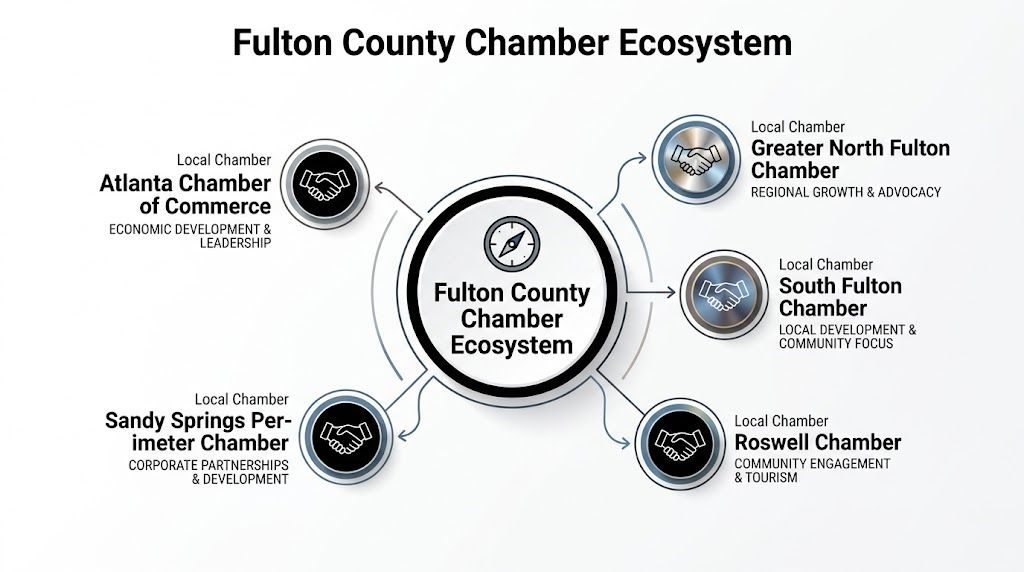
The cleanest way to understand this structure is to picture a network of hubs, not a ladder. Local chambers handle community-level relationships. Regional organizations influence broader market connections. State-level groups shape policy and competitiveness.
The local hubs
At the local level, Greater North Fulton Chamber of Commerce serves the North Fulton business corridor, including Alpharetta, Johns Creek, Milton, Mountain Park, Roswell, and Sandy Springs. Greater South Fulton Chamber of Commerce serves the South Fulton side of the county across its municipalities. This split is why businesses often ask which chamber serves their part of Fulton County. The answer depends on where you sell, where you operate, and which local stakeholders matter to you.
Local chambers are where B2B firms usually build the first layer of traction. That's where referrals form, where recurring faces become trusted contacts, and where smaller committee settings often produce better conversations than large public events.
The regional and state hubs
Above the local level, two bigger organizations matter.
The Metro Atlanta Chamber has deep roots in regional economic connection. The organization was established in 1859, reorganized in 1871, and famously organized the 1895 Cotton States and International Exposition, which brought over 1.8 million visitors to Atlanta during its six-month run, according to the Georgia Historical Society marker on the Metro Atlanta Chamber. That history matters because it reflects a long-standing regional role rather than a neighborhood networking role.
The Georgia Chamber of Commerce operates at the statewide level. Its main office is in Atlanta, Fulton County, it was officially incorporated in 1915, and it represents tens of thousands of members statewide, as documented by the Georgia Historical Society marker on the Georgia Chamber of Commerce. If your company cares about policy, statewide business climate, or wider economic advocacy, this is the broader orbit.
How businesses should use the ecosystem
Don't think in terms of replacing one chamber with another. Think in terms of layered participation.
- Local chamber: referral relationships, community credibility, nearby buyers
- Metro Atlanta Chamber: regional visibility, larger market initiatives
- Georgia Chamber: statewide advocacy and business climate alignment
That layered approach is especially relevant for firms that work in sustainability, operations, logistics, and asset recovery, where regional demand is tied to broader market shifts such as the circular economy for electronics in Atlanta.
A local chamber helps you get known. A regional chamber helps you get seen. A state chamber helps you stay aligned with where business is moving.
Choosing Your Chamber Membership Tiers and Benefits
Most companies evaluate chamber membership backwards. They start with dues, skim a benefit page, and ask whether the package looks "worth it." A better method is to start with the business result you want.
Match membership to the job it needs to do
For B2B service providers, chamber membership usually serves one of four jobs:
Visibility
You want your company name in circulation with local businesses, referral partners, and buyers who may not need you today but will need you later.Lead development
You need recurring introductions, committee participation, event conversations, and enough repetition that people remember what you do without checking your website mid-conversation.Market credibility
You want the kind of social proof that comes from being active in the business community rather than solely advertising to it.Influence
You care about policy, regional growth, public-private partnerships, or being in the room when local business priorities are discussed.
A basic membership can be enough for visibility if someone on your team will actively use it. A higher tier makes sense when you need sponsorship slots, speaking access, council participation, or stronger placement in the member ecosystem. What doesn't work is buying a premium tier to compensate for weak follow-through.
North Fulton vs South Fulton Chamber At-a-Glance
| Attribute | Greater North Fulton Chamber (GNFCC) | Greater South Fulton Chamber (GSFCC) |
|---|---|---|
| Geographic fit | Best for companies targeting Alpharetta, Johns Creek, Milton, Mountain Park, Roswell, and Sandy Springs | Best for companies focused on South Fulton municipalities |
| Best use case | Strong fit for firms selling into established North Fulton business clusters and professional networks | Strong fit for firms building relationships in South Fulton growth corridors and community business networks |
| Buyer access style | Useful when your sales rely on recurring introductions within mature business communities | Useful when your sales depend on local trust-building and municipal or community-level connections |
| Good fit for B2B services | Often effective for IT, healthcare-adjacent, office services, facilities, and professional services working Northside accounts | Often effective for construction support, local services, workforce-related offerings, community-facing vendors, and firms expanding in South Fulton |
| Membership scale signal | The verified brief notes 1,800+ members in areas like North Fulton, with 75% being small businesses under 20 employees through Georgia Chamber context, which suggests a large small-business referral base in the broader area | The verified brief describes support across 8 South Fulton cities, from solopreneurs to global headquarters, which signals range more than a single dominant profile |
| Decision risk | Joining because of name recognition without checking whether your buyers are actually active there | Joining because it seems countywide when your target accounts sit mostly in North Fulton |
| What usually works | Regular event attendance, selective sponsorship, and committee participation tied to your target verticals | Relationship-first participation, local visibility, and direct involvement in community business initiatives |
The trade-offs that matter
A North Fulton-focused membership can be powerful if your pipeline depends on business density and recurring exposure to established commercial networks. A South Fulton-focused membership can be the better play if your growth depends on entering developing corridors, local government relationships, or high-trust community introductions.
Neither chamber is automatically better. The stronger question is whether your target accounts are present and engaged.
Join where your buyers already gather. Don't join where you hope they might gather.
A practical selection method
Use this short filter before you commit:
- Choose local first if your deals are relationship-driven and close geographically.
- Choose regional first if your business spans multiple jurisdictions and needs broader visibility.
- Add state-level involvement when regulation, economic policy, or executive visibility affects how you grow.
For many B2B service firms, the right answer isn't a single chamber forever. It's a phased approach. Start local, prove participation discipline, then expand only when you can support the extra calendar and follow-up load.
How to Leverage Events and Networking Opportunities
Events don't create business on their own. They create context. Your job is to turn that context into follow-up, then into relevance, then into trust.

The Metro Atlanta Chamber's long history shows why organized business gatherings still matter. Its role in the 1895 Cotton States and International Exposition, which drew over 1.8 million visitors, is an early example of how Atlanta's business institutions have used events to create commercial momentum, as noted by the Georgia Historical Society's Metro Atlanta Chamber entry.
Two events, two different plays
Consider an IT manager from a commercial services company attending two chamber events in one month.
The first is a large evening mixer. The room is broad. Attendees include bankers, insurance producers, law firms, staffing companies, consultants, and a few operations leaders from larger employers. This isn't the room for a deep technical discussion. It's the room for clear positioning.
At that kind of event, a good introduction sounds like this: who you serve, what problem you solve, and what kind of referral is useful. Short. Specific. Easy to repeat.
The second event is a smaller industry council meeting. Now the audience is narrower. People talk about operational constraints, compliance headaches, procurement timing, office moves, equipment refresh cycles, or vendor selection. In this setting, expertise carries more weight than pitch polish.
What to do before, during, and after
Before a large networking event:
- Study the attendee mix: You don't need every name. You need a working guess about who will likely be in the room.
- Prepare one referral sentence: Make it easy for others to introduce you later.
- Set a realistic goal: A few quality follow-ups beat a stack of low-context business cards.
At the event itself, don't try to "close" anyone. Ask practical questions. What kinds of clients are they working with? What projects are active? Where are they seeing friction? People remember useful conversations more than polished monologues.
Afterward, follow up fast and with context. If you're refining your outreach process, this guide to lead generation strategies for small businesses is a helpful complement to chamber networking because it focuses on how initial contact turns into actual pipeline.
The event isn't the sale. The event is the permission to continue the conversation.
Where busy executives often miss opportunities
Many executives attend only the biggest public events because they're visible and easy to understand. That's usually not where the best B2B relationships form.
Smaller roundtables, councils, and recurring groups tend to outperform broad mixers for firms with specialized services. Those settings let buyers hear how you think, not just what you sell. The same principle shows up in other Atlanta business community settings, including local relationship-building covered in this Atlanta business playbook tied to a major civic brand.
Engaging with Advocacy and Economic Development
Networking gets attention. Advocacy and economic development shape the market you're trying to sell into.
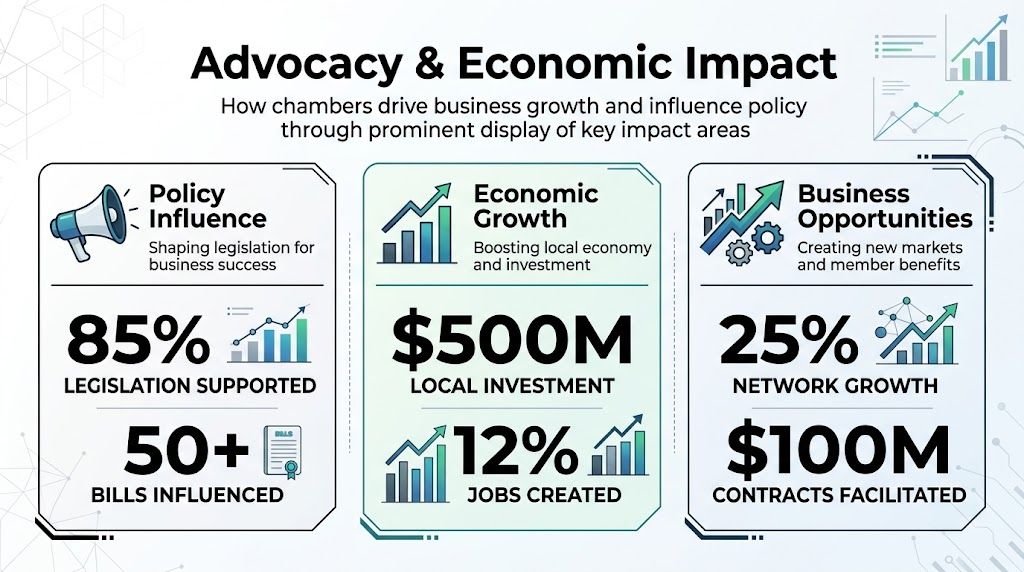
When chambers and economic development organizations help attract investment, the impact doesn't stop at ribbon cuttings. It flows into site work, office buildouts, technology deployment, logistics expansion, hiring, procurement, and eventually refresh and replacement cycles. B2B service providers often focus on the front end of growth and miss the downstream work that follows.
Why county growth matters to service providers
Fulton County was ranked 11th nationally for attracting corporate facility investments in 2023, and those projects contributed to over 1,200 new jobs and $1.2 billion in capital investment, including a major Microsoft data center expansion, according to Fulton County Government's announcement on its national economic development ranking.
For a B2B service provider, that kind of investment creates a chain reaction.
A new facility or expansion means equipment purchases, infrastructure support, vendor onboarding, compliance reviews, service contracts, and eventually asset turnover. A company that enters Fulton County today becomes a prospect for multiple categories of commercial services over time. That's why advocacy isn't abstract. It affects your addressable market.
How to participate without becoming a policy insider
You don't need to be a lobbyist to benefit from chamber advocacy. You do need a method.
- Join the right committee: Pick one issue area tied to how clients buy from you. Infrastructure, workforce, healthcare, education, logistics, or technology all shape different buying environments.
- Track public-facing development activity: When expansions and relocations are announced, identify which service categories will follow.
- Use chamber directories and introductions well: A warm introduction into a newly expanding employer is often more effective than a cold outbound sequence.
- Watch procurement timing: Growth announcements are early signals. Actual vendor opportunities often appear later, once facilities, systems, and internal teams mature.
The practical connection to revenue
A lot of businesses treat economic development news as civic background noise. That's a mistake.
If a county attracts more large employers, local chambers become more valuable because they sit closer to the conversations around operations, staffing, vendor needs, and business integration. If your service solves a real operational problem, chamber engagement can position you before the need becomes urgent.
Economic development creates demand in stages. The companies that win are usually present before buyers start searching.
That is the key strategic benefit of the fulton county georgia chamber of commerce. It isn't just who you can meet this month. It's how early you can align with the next wave of local commercial activity.
Case Study Partnering with Atlanta Computer Recycling
A hospital IT director in Sandy Springs faces a common problem. A technology refresh is moving ahead, old laptops and servers are stacked in a secure room, compliance pressure is high, and internal staff don't want a disposal project to interrupt patient-facing operations.

The director doesn't start by searching the entire internet. They start with the business network they already trust. A chamber member directory, a referral from another member, or a conversation at a healthcare-focused gathering narrows the field to a local provider that understands business pickup, chain of custody, and data-sensitive workflows.
How the engagement typically unfolds
First comes a consultation. The client outlines what needs to leave, what must stay in service until the last minute, and which departments can't tolerate disruption.
Next comes scheduling and on-site coordination. Equipment is identified, packed, and removed in a way that works around the facility's operating reality. For healthcare and other regulated organizations, this part matters as much as the final disposition method because poor pickup logistics can create internal headaches before any recycling work begins.
Then comes data destruction and documentation. The client needs confidence that retired assets were handled properly and that there is a clean audit trail.
Why chamber-based referrals are different
This kind of project is high-trust. Buyers aren't just comparing convenience. They're evaluating risk, responsiveness, and whether a provider understands the expectations of commercial clients.
That is where chamber ecosystems often perform better than generic listing sites. A referral from a chamber contact carries context. It tells the buyer that the vendor operates in the local business community, shows up consistently, and has enough credibility to be recommended by people with something to lose if the recommendation goes badly.
For businesses evaluating this kind of service workflow, the clearest starting point is to review how the Atlanta Computer Recycling process works, from pickup logistics through secure handling and final disposition.
In commercial recycling and IT asset disposition, trust usually forms before the first truck arrives.
The broader lesson is simple. Chambers don't just create introductions for accountants, attorneys, and consultants. They also help buyers find specialized operational vendors when the implications of failure are greater and the margin for error is smaller.
Your Strategic Next Steps for Chamber Engagement
Most businesses don't need a more complicated chamber strategy. They need one they will execute.
If you're trying to use the fulton county georgia chamber of commerce ecosystem for real growth, start small and stay deliberate. The winners aren't the companies with the longest membership history. They're the ones that show up with a clear market focus, build recognizable relationships, and follow up consistently.
Do these three things this week
Pick your first chamber based on buyer concentration
Look at where your best prospects are located. If most of them sit in North Fulton, start there. If your opportunities cluster in South Fulton, begin there. If your reach is broader and policy matters, add a regional or state layer later.Choose one event type that fits your sales motion
If you need broad awareness, attend a general networking event. If you sell a specialized service, look for a smaller council, committee, or recurring member group where buyers can understand your expertise.Build a short follow-up system
Decide now how you'll handle post-event outreach. One concise email, one relevant follow-up conversation, and one reason to stay in touch is enough to create momentum.
Keep your expectations realistic
A chamber isn't a vending machine for leads. It's a relationship infrastructure. Used well, it shortens trust cycles and puts you closer to decision-makers. Used poorly, it becomes another paid logo placement.
If you're ready to act instead of just observe, your next move should be simple. Pick the right local entry point, commit to regular participation, and make it easy for people to understand what kinds of introductions help you most. When you need a direct conversation with a local commercial services partner, use the Atlanta Computer Recycling contact page to start that discussion.
Atlanta businesses that need secure, business-to-business electronics recycling and IT asset disposition can turn to Atlanta Computer Recycling for practical support across pickups, de-installation, data destruction, and responsible disposition. If your organization is planning an office refresh, data center cleanup, school equipment turnover, or healthcare IT retirement project, ACR is built for commercial workflows and compliance-sensitive environments.