A Business Guide to IT Asset Disposition in Fulton County GA US


Fulton County is far more than just a spot on the map—it’s the economic engine of Georgia. Its unique geography and incredible growth make it a phenomenal place to do business. But that same success brings serious operational challenges, especially when it comes to managing technology infrastructure at end-of-life.
Why Fulton County Is a Magnet for Business

Operating a business here provides a powerful competitive edge, much of which is rooted in the county's unusual "dumbbell" shape. This layout links the dense, urban core of Atlanta with the thriving, affluent suburbs to the north, creating an incredibly diverse and interconnected commercial ecosystem.
For any commercial service provider, this geography is a goldmine. It translates to a massive and varied client base, with major industries thriving side-by-side.
- Corporate Headquarters: Downtown and Midtown Atlanta are packed with Fortune 500 companies.
- Technology Hubs: The northern corridor, including cities like Alpharetta and Sandy Springs, is a well-known tech powerhouse full of IT firms and data centers.
- Healthcare and Education: The county is a hub for world-class hospitals, pioneering research centers, and major universities.
- Logistics and Finance: As a major transportation crossroads, the area supports a huge logistics sector that works hand-in-hand with a robust financial industry.
To put it in perspective, here's a quick look at the core numbers that define the business landscape.
Fulton County Business Snapshot
| Metric | Data | Implication for Businesses |
|---|---|---|
| Population (2020) | 1,066,710 | A large, diverse talent pool and customer base. |
| Population Growth | +16.1% (2010-2020) | Rapidly expanding market, but also increased competition and infrastructure strain. |
| Median Household Income | $81,099 | Strong consumer spending power and an attractive market for premium goods/services. |
| Major Industries | Tech, Finance, Healthcare, Logistics | Access to a rich ecosystem of B2B partners, clients, and specialized talent. |
| Geography | 534 square miles (urban and suburban) | A large and logistically complex service area requiring efficient planning. |
This data paints a clear picture: Fulton County is a place of immense opportunity, but its scale and density present real operational challenges for IT and facilities managers.
The Side Effect of Explosive Growth
That population number isn't just a statistic; it has a direct impact on your day-to-day operations. The 2020 census clocked 1,066,710 residents—a massive 16.1% jump from 2010. This boom means more businesses, schools, hospitals, and government agencies than ever, and every single one of them runs on technology. You can see the story of this expansion on related Fulton County educational pages.
For IT managers and business leaders, this has a very real side effect. As companies grow and upgrade their tech to stay competitive, the mountain of retired IT assets gets bigger and bigger.
The constant cycle of technological upgrades in a dense, competitive market like Fulton County turns IT asset disposition (ITAD) from a background task into a critical component of operational security, financial planning, and environmental responsibility.
From Opportunity to Obligation
It starts as an opportunity—you invest in new technology to drive growth and efficiency. But that opportunity quickly becomes an obligation. Every new server, laptop, and network switch you buy will one day hit its end-of-life.
For one company, that might be a few dozen devices a year. But when you look at the entire Fulton County, GA US business landscape, we're talking about hundreds of thousands of assets that need to be disposed of securely and responsibly.
This is where having a smart ITAD strategy becomes non-negotiable. It’s not just about "getting rid" of old equipment. It’s about protecting your company’s sensitive data, staying compliant with environmental laws, and recovering value from retired assets. For any business serious about succeeding here, a plan for this lifecycle isn't just a "best practice"—it's fundamental to operating securely and efficiently.
Navigating E-Waste and Recycling Regulations for Your Business
For any business operating in Fulton County, GA, understanding the rules around e-waste isn't just good practice—it's a critical part of staying compliant and protecting your company's reputation. Ignoring these regulations is like turning off your company’s firewall. The financial and brand damage from one misstep can be devastating.
Simply tossing old computers into a dumpster isn’t just irresponsible; it’s a direct violation of state and federal environmental laws. These rules exist for a good reason. Electronic waste is loaded with hazardous materials like lead, mercury, and cadmium, which can seep into soil and groundwater if left in a landfill.
This guide will walk you through what your business needs to know to ensure you’re handling your end-of-life technology the right way.
State-Level Rules for Georgia Businesses
Georgia has its own laws for managing electronics disposal, primarily the Georgia Computer Equipment Recovery and Recycling Act. While this law mainly sets rules for manufacturers, it created the formal, statewide recycling system that directly impacts how your business must get rid of its old IT assets.
The bottom line for businesses? There's a clear legal expectation for responsible disposal. Unlike the recycling programs for residents, which are often voluntary, businesses are held to a much higher standard. Regulators know companies generate e-waste in large volumes and that their devices hold sensitive data, so they place the burden of proof on you to show you did things correctly.
The core difference is accountability. While a household might drop off a single PC at a weekend recycling event, a business decommissioning 50 laptops must provide a clear, documented trail proving where those assets went and how their data was destroyed.
This distinction is everything. Your business is expected to be a professional caretaker of its electronic equipment from the day you buy it to the day it's properly retired.
Why Commercial Standards Are Stricter
The rules for businesses are tougher for a few key reasons. Once you understand them, it becomes clear why partnering with a certified e-waste recycler is less of a choice and more of a business necessity.
- Volume and Scale: A single office cleanout can generate more e-waste than an entire neighborhood produces in a year. The combined environmental impact from commercial sources is massive and demands a formal management process.
- Data Security: Business computers, servers, and hard drives are packed with confidential information. We’re talking about everything from customer lists and financial records to your company's trade secrets. Improper disposal is an open invitation for a data breach.
- Hazardous Materials: Corporate-grade IT equipment, especially older models, often contains a higher concentration of hazardous materials. Things like old CRT monitors, large server batteries, and industrial printers need special handling to keep them from harming the environment.
Think about it this way: your company's IT assets aren't just tools. They are containers of both sensitive information and potentially harmful substances. That’s why state and federal laws treat their disposal with such seriousness. To get a deeper look at the risks, you can learn more about the environmental impact of electronic waste in our detailed article.
Falling short of these standards can lead to hefty fines and legal trouble, especially if a data breach is traced back to a computer you threw away. For IT managers and compliance officers, the goal isn't just to get rid of old gear—it's to build a disposal program that's bulletproof.
Mastering Data Destruction and Compliance
When your business retires a hard drive, it's not just getting rid of old equipment. It’s holding a potential liability. For any organization in Fulton County, GA US, looking past buzzwords like "secure" is the first step toward real protection. You need to understand what true data destruction means for your company’s legal and financial future.
Simply deleting files or reformatting a drive is a dangerous shortcut. Think of it like tearing a sensitive document into a few large pieces—anyone determined enough can tape it back together. Data recovery software can do the exact same thing with your "deleted" files, leaving your business exposed to massive risk.
The Language of Compliance
Fulton County is a hub for healthcare, finance, and legal services, which means data privacy compliance isn't just a good idea; it's the law. These regulations come with serious teeth, and regulators are paying close attention to how organizations handle data at the end of its life.
- HIPAA (Health Insurance Portability and Accountability Act): The absolute standard for healthcare. Any device that ever held patient information must have its data made completely unrecoverable. No exceptions.
- FACTA (Fair and Accurate Credit Transactions Act): This affects nearly every business handling consumer data, from banks to retailers. It requires the proper disposal of consumer information to fight identity theft.
- GLBA (Gramm-Leach-Bliley Act): A mandate for financial institutions to create and maintain a formal security plan. That plan must cover the secure disposal of all media containing nonpublic personal information.
Getting this wrong isn't a slap on the wrist. A single data breach from an improperly discarded hard drive can trigger six-figure fines, force public breach notifications, and do permanent damage to your brand.
Take a look at how business equipment is regulated differently from residential items.
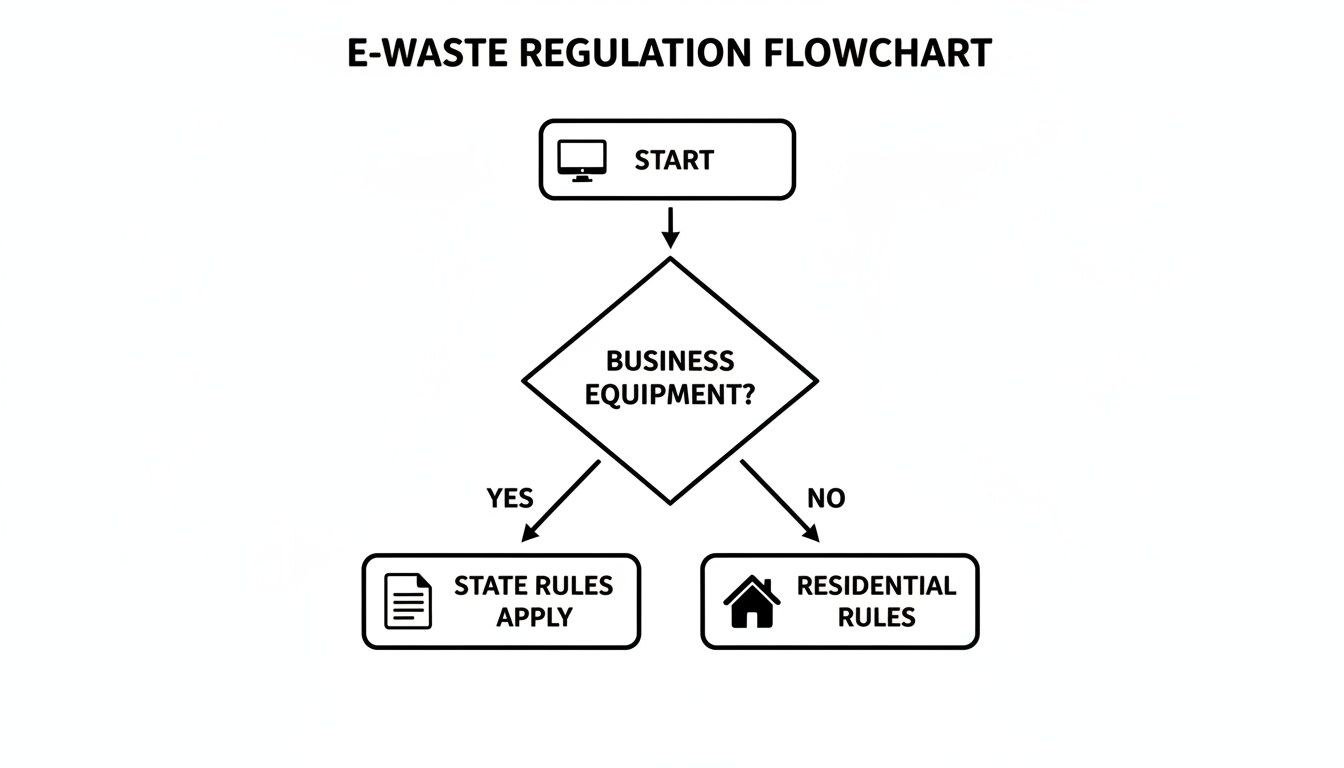
The takeaway here is clear: commercial equipment is held to a much stricter standard under state and federal rules, demanding a higher level of care from your business.
Data Wiping vs. Physical Shredding
To meet these compliance standards, your business has two core methods for data destruction: software-based wiping and physical destruction. The right choice comes down to the device itself, your security needs, and your industry’s rules.
Think of DoD 5220.22-M wiping as a digital paper shredder for your working hard drives. Instead of just deleting a file, this process overwrites the entire drive, multiple times, with random patterns of ones and zeros. It’s a forensically sound method that makes data recovery impossible, even with sophisticated lab tools. This is a great choice for newer, functional drives that might be resold or reused.
But software wiping can’t do it all. It won't work on damaged drives, and it can be less effective on solid-state drives (SSDs), which can sometimes retain data fragments. For those cases—and for maximum security—physical destruction is the only answer.
Physical shredding is the final, undisputed end for any data-bearing device. We mechanically grind hard drives, backup tapes, and cell phones into small, mangled metal fragments, making data recovery physically impossible.
This is the gold standard for the highest security needs and the only truly foolproof option for non-working equipment.
Real-World Scenarios in Fulton County
These concepts hit home when you think about real businesses right here in our community.
Imagine a hospital in the Sandy Springs medical district retiring a fleet of patient monitoring stations. Those devices are loaded with protected health information (PHI) governed by HIPAA. If just one hard drive slips through the cracks and its data gets out, that hospital is looking at huge fines and a public relations nightmare. For them, certified physical shredding isn't a choice; it's a necessity.
Or take a law firm in Midtown Atlanta upgrading its servers. Those machines hold decades of privileged client communications, case files, and settlement details. A leak would shatter client trust and create serious ethical breaches. A smart strategy of DoD-standard wiping for newer, reusable drives and shredding for the older ones provides a documented, defensible process. You can learn more in our business leader's guide to secure data destruction.
In both scenarios, the risk isn’t just about losing data. It’s about the catastrophic legal, financial, and reputational fallout that comes after. Proper data destruction isn't an IT expense—it's one of the best insurance policies your business can have.
Solving Your Commercial ITAD Logistics

Retiring old technology isn't just a matter of hauling it away—it's a complex logistical puzzle. For IT managers across Fulton County, GA US, decommissioning assets brings a flood of real-world challenges that demand professional planning and execution.
Think of an IT Asset Disposition (ITAD) partner as a specialized logistics provider, but for your most sensitive equipment. Instead of just boxes of files, we’re handling devices loaded with private data, all governed by strict environmental and privacy laws. The entire process hinges on precision.
On-Site Considerations for Business Continuity
The first challenge is always the pickup itself. How do you get old equipment out without disrupting your daily operations? A clumsy removal process can create safety hazards, kill productivity, or even cause downtime if active systems are disturbed.
A professional ITAD process is carefully choreographed, especially when taking equipment out of a live environment. It could be a single server rack in a busy data center or hundreds of workstations in an active office.
Key logistical steps always include:
- Smart Scheduling: Coordinating pickups after hours or during quiet periods to keep your business running smoothly.
- Safe De-installation: Properly disconnecting and removing hardware from racks, desks, and server closets without touching adjacent systems.
- On-Site Inventory: Creating a detailed manifest of every single asset before it leaves your facility.
- Secure Packing: Using the right materials to protect equipment in transit and prevent any damage.
This attention to detail ensures your end-of-life assets are removed securely while your business continues without a hitch.
Navigating Fulton County’s Unique Geography
The sheer size and sprawling shape of Fulton County add another layer of complexity. The county’s geography was dramatically reshaped in 1932 when it annexed Milton and Campbell counties, ballooning its area from about 180 square miles to 528.7 square miles. This created the long, 70-mile corridor we have today.
That elongated "dumbbell" shape means the logistics for a project in Alpharetta are completely different from one in Downtown Atlanta.
A multi-story office cleanout in a secure Midtown skyscraper requires coordinating with building management, freight elevators, and loading docks. By contrast, a large-scale data center retirement in a northern suburb might involve de-installing hundreds of servers and managing secure transport for multiple truckloads of equipment.
A one-size-fits-all plan simply won't cut it. You need a partner who understands the diverse business environments across the county and can build a custom plan for your specific location.
Maintaining a Secure Chain of Custody
The single most critical part of ITAD logistics is maintaining an unbroken chain of custody. This is the documented trail that follows your assets from the moment they leave your control until their final destruction and recycling.
This process is your proof of compliance. If a data breach were ever questioned, a rock-solid chain of custody record proves you took every necessary step to protect your sensitive information. It confirms that nothing was lost, stolen, or mishandled along the way.
A professional partner delivers this with secure, GPS-tracked vehicles and a documented process at every single step. For companies retiring large volumes of hardware, our services for IT equipment pickup in the Atlanta area are built to handle these exact logistical demands. Without that secure chain, your business is exposed to risk until you have the final certificate of destruction in hand.
How We Serve Fulton County Businesses
Knowing you need a plan for IT asset disposal is one thing, but actually executing it is another challenge entirely. At Atlanta Computer Recycling, we provide a direct, hands-on solution built specifically for organizations across Fulton County, GA US. Our entire process was designed from the ground up to solve the real-world problems commercial clients face, ensuring total security and compliance without disrupting your business.
It all starts with a simple conversation. We listen to understand your exact situation—whether you're a hospital in Atlanta dealing with a HIPAA-mandated cleanout, a data center in Alpharetta decommissioning servers, or a corporate office in Sandy Springs refreshing hundreds of laptops. This lets us build a plan that works with your schedule, security protocols, and unique logistics.
From there, our professional team takes over. We handle everything from on-site pickup to secure transport, making sure every single asset is tracked and accounted for from the moment it leaves your facility.
Specialized Services for B2B Clients
We aren't a residential drop-off service; our sole focus is on business-to-business (B2B) solutions. This specialization gives us the expertise to manage the large-scale, high-stakes disposals common in the corporate, healthcare, and government sectors.
- Bulk Disposal Management: We’re fully equipped to handle huge volumes of equipment from data centers, office parks, and schools, ensuring your project is handled quickly and efficiently from start to finish.
- Certified Data Destruction: Our service includes complimentary DoD 5220.22-M standard data wiping for all working drives. For damaged media or for clients who require the highest level of security, we offer certified physical shredding.
- Compliance-Focused Solutions: Our processes are built to satisfy strict regulations like HIPAA, giving healthcare providers and other regulated businesses the documentation they need to prove compliance and gain peace of mind.
Because we only work with businesses, we get the pressures IT managers and compliance officers are under. Our job is to act as an extension of your team, taking the entire burden of IT asset disposition off your plate.
Your Business Challenges Solved
Fulton County's unique history as a logistical powerhouse—shaped by the 1932 annexations that created a sprawling 528.7-square-mile economic corridor—also means it generates a massive amount of electronic waste. This concentration of Fortune 500 headquarters, major hospitals, and tech firms puts constant pressure on IT departments to manage retiring assets. Professional ITAD isn't a luxury here; it's a necessity. You can read more about how this came to be on the county's official history page.
We directly solve the problems created by this dense, high-stakes environment. Here’s exactly how our services map to the challenges you face every day.
| Your Business Challenge | Our Direct Solution | The Benefit to You |
|---|---|---|
| Data Breach Fears | Certified data wiping (DoD 5220.22-M) and physical shredding. | Complete Peace of Mind. Your sensitive data is verifiably destroyed, eliminating risk. |
| HIPAA/FACTA Compliance | Issuance of Certificates of Data Destruction and Recycling. | Audit-Proof Documentation. You get the official records needed to prove compliance. |
| Operational Disruption | Flexible scheduling and professional on-site de-installation and pickup. | Business Continuity. Your operations continue uninterrupted during the removal process. |
| Limited Staff/Resources | Full-service logistics, from inventorying to secure transport. | Resource Optimization. Your IT team stays focused on core business tasks, not disposal logistics. |
Our approach is designed to turn your biggest ITAD headaches into simple, resolved tasks, letting you get back to business.
A Case Study in Compliance and Peace of Mind
Think about a recent project with a Fulton County healthcare provider. They needed to retire hundreds of outdated computers and servers across multiple clinic locations, all loaded with Protected Health Information (PHI). For them, it was a logistical nightmare and a huge compliance risk.
We developed a multi-phase plan to de-install and collect the equipment after hours, ensuring zero disruption to patient care. Every hard drive was inventoried on-site, transported in a secure vehicle, and physically shredded at our facility.
In the end, the client received a comprehensive Certificate of Data Destruction that detailed every single serial number, giving them an ironclad record for their HIPAA audits. They didn't just get rid of old equipment; they gained total assurance that their patients' data was protected and their legal obligations were met. This is the dedicated, secure service we bring to every client in the county.
To learn more about what we can do for you, check out our complete guide for services in Fulton County.
Answering Your Commercial E-Waste Disposal Questions
When it comes to disposing of old IT gear in Fulton County, GA US, a few questions always come up from our business clients. To help you build a secure and compliant IT asset disposition (ITAD) plan, we’ve put together straight answers to the things IT managers and business owners ask us most.
Do You Charge for Commercial E-Waste Pickup?
This is usually the first question on everyone's mind. We provide free pickups for businesses throughout Fulton County, as long as the equipment meets our qualification criteria. Our goal is to make professional, responsible e-waste recycling easy and accessible for local companies.
Qualification is based on the type, age, and volume of your IT assets. For instance, a full pallet of newer servers, laptops, and networking gear will almost always qualify for a no-cost pickup. A handful of very old desktops, on the other hand, may not.
The best way to know for sure is to just give us a call. Our team can usually determine if you qualify right over the phone, helping you budget accurately while ensuring your old equipment is handled the right way.
What Is the Difference Between Data Wiping and Physical Shredding?
Knowing the difference here is key to choosing the right level of security for your business. Both are proven methods for destroying data, but they’re used for different reasons.
Data Wiping (Software-Based): Think of this as digitally scrubbing a hard drive clean. We use specialized software that follows the DoD 5220.22-M standard, overwriting every single sector of the drive with meaningless data. This process makes the original information impossible to recover, even with forensic tools. It’s the perfect option for newer, working hard drives that might be reused or remarketed, since it keeps the hardware intact.
Physical Shredding (Hardware Destruction): This is the most final form of data destruction, period. The hard drive is literally fed into an industrial shredder that grinds it into a pile of mangled metal fragments. This is the only option for non-working or damaged drives, and it's the required method for organizations under strict compliance mandates like HIPAA. It’s also the go-to choice for anyone wanting the absolute highest level of security assurance.
The choice comes down to your needs: wiping allows for potential asset value recovery, while shredding provides ultimate, indisputable destruction. Both methods are designed to protect your organization from a data breach.
Can You Provide Documentation for Our Compliance Records?
Absolutely. We know the job isn't finished until the paperwork is in your hands. For our commercial clients, proper documentation is everything—it's your proof of compliance for any internal or external audit.
For every single job, we provide two essential documents:
- Certificate of Data Destruction: Your official record confirming that all data on your devices has been securely and permanently destroyed according to industry standards.
- Certificate of Recycling: This certifies that your electronic assets were responsibly recycled in line with all local, state, and federal environmental rules, keeping hazardous e-waste out of landfills.
These certificates create a clear audit trail, demonstrating your company’s commitment to both data security and environmental responsibility. They are non-negotiable for any business operating under regulations like HIPAA, FACTA, or GLBA.
Our Office Is in a High-Rise in Midtown Atlanta. Can You Handle the Logistics?
Yes, and it's a situation we handle all the time. Managing the unique logistics of different business environments across Fulton County is one of our specialties, and pickups from secure, high-rise office buildings in Midtown Atlanta are a regular part of our work.
We know these jobs require a ton of coordination. Our professional crew works directly with your building management to schedule access to freight elevators and loading docks, making sure we follow every building rule and security protocol to the letter.
Our whole process is designed to be discreet and efficient, causing minimal disruption to your business and your neighbors. We have the experience and equipment to manage complex removals from high-rise offices, secure data centers, hospitals, and other challenging locations throughout the Fulton County, GA US area. Whether you’re in Alpharetta or Union City, we’ll create a logistics plan that works for you. If you want to dive deeper, you can learn more about where to recycle electronics in our related guide.
Ready to take the next step toward a secure and compliant ITAD solution? Contact Atlanta Computer Recycling today to schedule a consultation or request a pickup. Let us handle the complexities of e-waste so you can focus on running your business. Visit us at https://atlantacomputerrecycling.com to get started.