Circular economy electronics Atlanta GA: A Guide for Businesses

For most businesses, retired IT equipment is seen as a liability—a pile of old computers and servers collecting dust in a storage closet. This traditional "take, make, dispose" approach isn't just inefficient; it’s a missed opportunity. A circular economy for electronics in Atlanta, GA, flips that script, turning old hardware from a costly problem into a valuable asset.
The core idea is simple: instead of throwing technology away, your business focuses on securely recovering, reusing, and recycling it. This creates a smarter, more profitable way to manage the lifecycle of your IT assets.
Rethinking IT Assets in Atlanta’s Tech Economy
Think of your decommissioned hardware not as junk, but as a library of untapped resources. That fleet of laptops, rack of servers, or box of network switches contains valuable components that can find a second life, generating revenue and ensuring your business stays compliant.
The old linear model of buying, using, and discarding electronics just doesn't work anymore. It’s expensive, risky, and environmentally irresponsible. For a booming tech hub like Atlanta, there’s a much better way for your business to operate.
The Problem With The Old Model
Sticking with the "take-make-dispose" system creates significant headaches for modern organizations:
- Financial Loss: Tossing out old hardware is like throwing cash in the dumpster. Many devices still have residual value and can be resold, while others can be donated for a tax benefit or have their parts harvested.
- Data Security Risks: A single hard drive disposed of improperly can lead to a catastrophic data breach. The consequences include steep fines, legal battles, and permanent damage to your company's reputation.
- Environmental Liability: E-waste is a massive and growing global problem. Companies that don't use certified recycling methods can face non-compliance penalties and public backlash.
The circular model solves these problems by creating a closed-loop system. Assets are managed securely from start to finish, maximizing their value at every stage, from redeployment to final materials recovery.
To see the difference in practice, it helps to compare the two approaches side-by-side.
Comparing Linear Vs Circular IT Asset Management
| Business Aspect | Linear Economy (Take-Make-Dispose) | Circular Economy (Recover-Reuse-Recycle) |
|---|---|---|
| Asset Value | Seen as zero after initial use; becomes a disposal cost. | Residual value is recovered through resale, refurbishment, or parts harvesting. |
| Data Security | High risk; often an afterthought, leading to potential breaches. | A top priority; secure data destruction is integrated into the process. |
| Cost Model | A constant expense: purchase, maintain, then pay to dispose. | A revenue opportunity: disposal costs are offset or eliminated by asset remarketing. |
| Compliance | Difficult to track and prove; risk of non-compliance is high. | Managed by a certified partner with clear documentation and chain of custody. |
| Sustainability | Generates e-waste and contributes to landfill problems. | Minimizes waste, conserves resources, and supports corporate ESG goals. |
As the table shows, shifting to a circular model isn't just about being "green"—it's a strategic business decision that strengthens your financial health and protects you from risk.
Atlanta’s Unique Position in the Circular Economy
Atlanta's explosive growth as a technology and data center powerhouse makes this shift more important than ever. Our city is home to major tech companies, healthcare systems, and corporate headquarters, all generating huge amounts of electronic equipment every year. This presents both a challenge and a massive opportunity for businesses.
As new tech is adopted, old hardware is decommissioned at a staggering rate. In fact, the Metro-Atlanta area is projected to have the highest net absorption in the U.S. data center market, hitting 705.8 MW in 2026. All that hardware turnover requires a smart, scalable strategy for managing retired assets.
This is where a circular economy for electronics in Atlanta, GA becomes a true competitive advantage. Instead of seeing this constant turnover as a disposal headache, forward-thinking businesses view it as a continuous stream of recoverable value. To learn more about this, you can read up on environmentally responsible electronics recycling in Atlanta.
By adopting a circular approach, your Atlanta-based organization can transform its IT asset disposition (ITAD) process from a chore into a strategic function. It’s about making smarter choices that generate revenue, ensure compliance, and benefit your bottom line and our community.
How Circular ITAD Unlocks Hidden Asset Value
For most Atlanta businesses, old IT hardware feels like a problem. It's a pile of decommissioned assets that represents a logistical headache and a line item expense. But what if that perspective is completely backward?
A circular economy approach flips the script. Instead of seeing 'e-waste,' you start to see a cache of valuable resources—and untapped revenue. This isn't just about basic recycling. It's a deliberate strategy for value recovery, making sure every retired asset is put to its highest and best use. It’s good for your bottom line and a powerful statement about your company’s commitment to sustainability.
The Hierarchy of Value Recovery
An effective circular IT Asset Disposition (ITAD) plan follows a simple, powerful hierarchy. The goal is always to climb as high up the value ladder as possible, leaving materials recycling as the absolute last resort. This structured approach guarantees you squeeze the maximum return from every single device.
Think of it as a progression, from most to least valuable:
- Reuse and Redeployment: The highest-value move is giving a device a second life inside your own company. That laptop from the marketing team? It might be perfect for a new intern, saving you the cost of buying a new machine.
- Refurbishment and Resale: If a device isn't needed internally but still has plenty of life left, it can be professionally refurbished and sold. This generates cash that can directly offset the cost of your next IT refresh.
- Parts Harvesting: Even equipment that won't power on can be a goldmine. A dead server, for example, often has perfectly good CPUs, RAM modules, and power supplies that can be harvested and sold to the repair market.
- Materials Recovery: This is the final stop for assets with no functional or component value. Certified recycling breaks the equipment down to its raw materials—metals, plastics, and glass—which are then sent back into the manufacturing supply chain.
This diagram shows the clear choice between the old-school linear path and the modern circular model for your IT hardware.
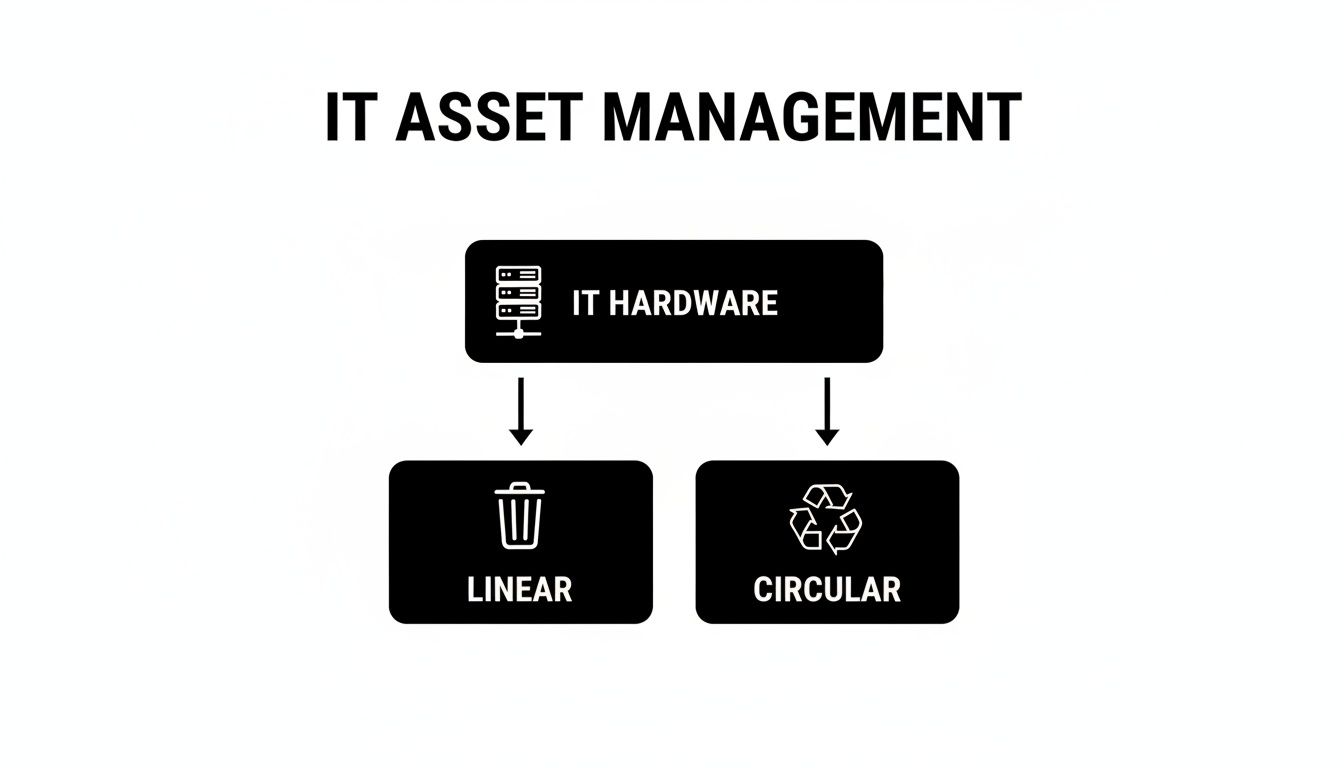
As you can see, the linear path is a dead end. The circular path, on the other hand, creates multiple opportunities to reclaim value before you even think about recycling.
Tangible Returns for Your Atlanta Business
This value hierarchy isn't just a concept—it delivers real, measurable returns. We all understand how extending the life of your iPhone from repair to refurbishment keeps it useful longer. The exact same principle applies at a corporate scale with servers, laptops, and networking gear.
Let's look at some real-world examples for an Atlanta company:
- Data Center Decommissioning: A local tech firm refreshing its server racks could get back thousands of dollars by having a professional ITAD partner test and resell the memory and processors. Suddenly, a huge capital expense becomes a revenue-positive project.
- Office IT Refresh: A business upgrading 200 office laptops could have them wiped, refurbished, and sold on the secondary market. Or, they could be donated to a local charity for a significant, fully documented tax deduction.
The bottom line is that your retired electronics are not trash. With the right circular economy strategy, they become a consistent source of recoverable value for your Atlanta business. A professional partner can even show you how to get cash for old electronics through a secure and structured program.
The Growing Market for Recovered Materials
Even when equipment has reached its true end-of-life, there's still value in the final step: materials recovery. In fact, Georgia's electronics recycling market is growing, driven by the demand for valuable metals like gold, silver, and palladium recovered from circuit boards.
The global challenge is staggering. In 2019, the world generated a massive 53.6 million metric tons of e-waste, but only 17.4% of it was properly recycled. For Atlanta businesses, adopting an ITAD process that recovers hardware value is a chance to be both profitable and sustainable.
By working with a certified ITAD provider, you ensure these precious materials are extracted responsibly. This not only prevents environmental harm but also feeds a sustainable supply chain. It's the final step that closes the loop, turning your "end-of-life" assets into the building blocks for tomorrow's technology.
Secure Data Destruction Is A Non-Negotiable First Step
Before any retired electronic asset can find its next life through reuse, resale, or recycling, there's a critical first step: making sure every last bit of your company's data is gone for good. In any real circular economy electronics Atlanta GA program, data security isn't an add-on; it's the foundation everything else is built on.
This is non-negotiable. A single hard drive slipping through the cracks can expose sensitive client information, proprietary trade secrets, and financial records. The consequences—from steep compliance fines to a damaged reputation—are just too high.
That's why choosing a partner who provides certified, auditable data destruction isn't just a good idea. It's an essential part of your company's risk management strategy.
Understanding The Methods of Data Destruction
Not all data destruction techniques are the same. The best approach will depend on the device, its condition, and your specific industry regulations, whether it’s HIPAA in healthcare or SOC 2 for tech firms. A professional ITAD provider will deploy the right method to guarantee absolute security.
Here are the three primary techniques you'll encounter:
- Software-Based Data Wiping: This process uses specialized software to overwrite a drive with meaningless data, usually following strict protocols like the Department of Defense (DoD 5220.22-M) or NIST 800-88 standards. It makes the original information completely unrecoverable and is perfect for functional drives that can be refurbished and resold.
- Degaussing: For magnetic storage like older hard drives and backup tapes, degaussing is a powerful and immediate solution. It uses a high-powered magnet to scramble the magnetic field on the drive platters, instantly wiping all data permanently.
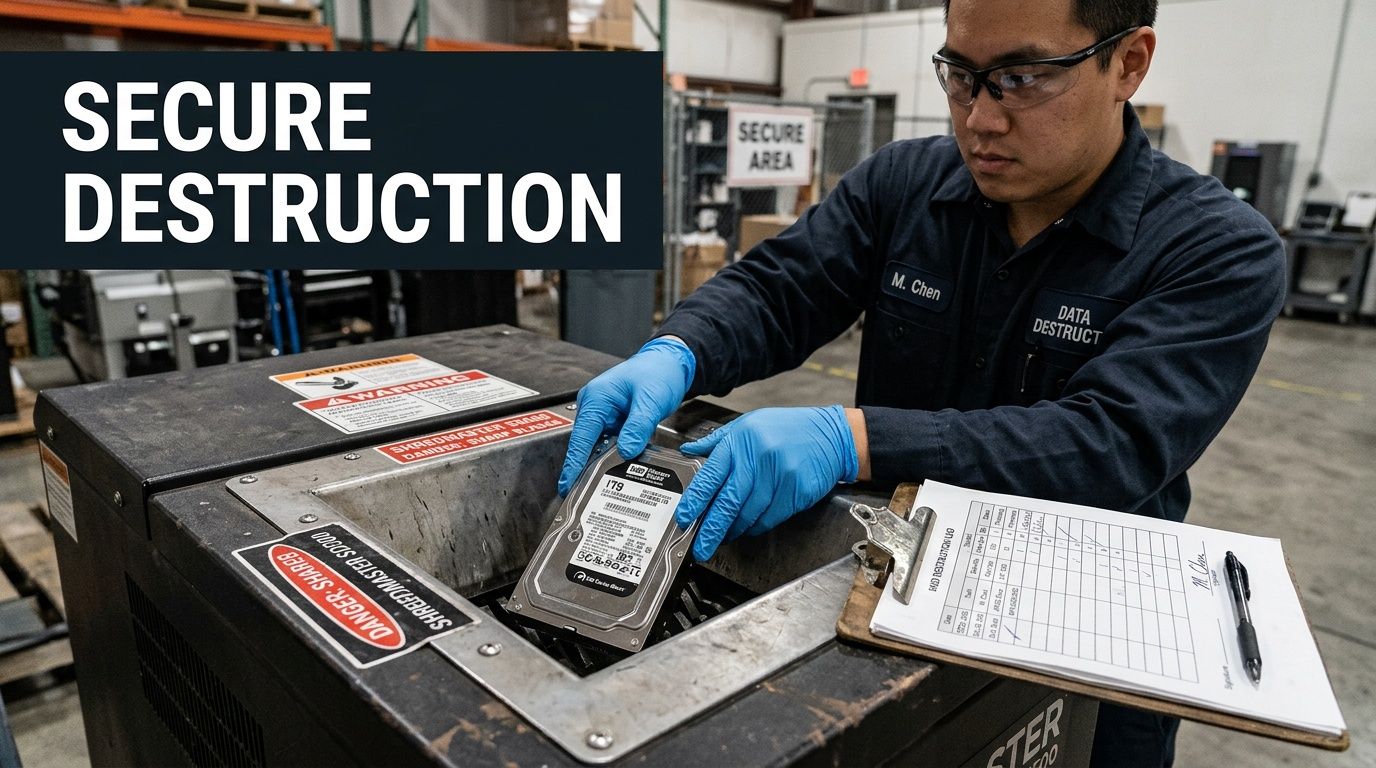
- Physical Shredding: This is the most definitive form of data destruction. The hard drive or solid-state drive (SSD) is fed into a commercial shredder that chews it up into tiny, unsalvageable metal fragments. Once a drive is shredded, there is zero chance of data recovery, making it the gold standard for failed drives or devices containing extremely sensitive data.
Compliance and The Importance of Certification
For any business, especially those in regulated fields, destroying data isn't enough—you have to be able to prove it. This is where a Certificate of Data Destruction is indispensable.
This official document is your auditable proof that every asset was handled and destroyed according to industry best practices and legal standards. It’s not optional; it should be a standard part of any credible ITAD service.
A proper Certificate of Data Destruction isn't just a receipt. It's a serialized document that itemizes every single asset by its unique serial number, details the destruction method used, and confirms the date of completion. This creates a clear, unbroken chain of custody for your compliance and audit records.
This level of detail is the hallmark of a professional partner. To understand what a truly secure program looks like, you can explore the specifics of what a secure data destruction program in Atlanta should offer. It will help you ask the right questions when vetting a provider.
When evaluating a partner for your circular economy electronics Atlanta GA program, make sure you get clear answers to these questions:
- Do you offer on-site data destruction so our most sensitive assets never leave our facility?
- What data destruction standards (NIST, DoD) do you adhere to?
- Will we receive a serialized Certificate of Data Destruction for our audit trail?
Getting these questions answered upfront ensures you’re working with a vendor who puts your data security first. With that secure foundation in place, you can confidently move forward and unlock the financial and environmental rewards of the circular economy, knowing your most critical information is completely protected.
Building A Practical ITAD Program In Your Business
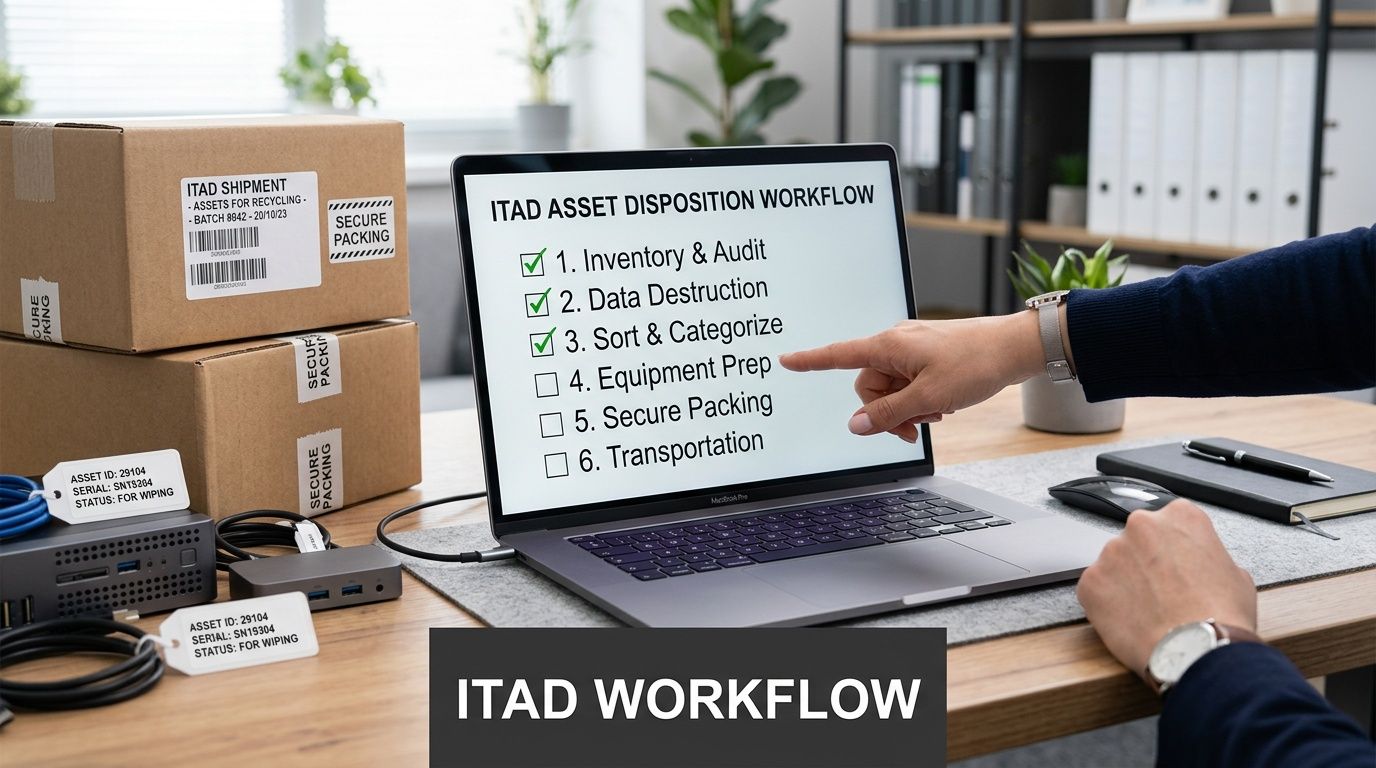
So, how do you take the big-picture idea of a circular economy and make it work for your organization? It starts by building a clear, repeatable IT Asset Disposition (ITAD) program. This isn't about waiting until a storage closet is overflowing with old gear. It's about having a formal, proactive plan that turns retired electronics from a headache into a managed asset.
A proper ITAD program gives you structure. It protects your business from data risks, keeps you compliant, and gets the most value back from your old tech. Let’s walk through the phases of building a program that actually works.
Phase 1: Smart Procurement and Asset Tracking
A great ITAD program starts the day you buy new equipment, not the day you get rid of it. When looking at new devices, you should already be thinking about their end-of-life. This is a core part of the circular economy for electronics in Atlanta, GA.
Look for vendors with buy-back options or those who build devices with standardized, easy-to-replace parts. As soon as that new machine comes out of the box, it needs to go into a solid asset tracking system. This is a step far too many companies miss.
A strong IT Asset Management (ITAM) system is the central nervous system for your ITAD program. It should track each asset's serial number, user assignment, physical location, and maintenance history, providing a clear chain of custody from deployment to decommission.
This detailed record-keeping is non-negotiable. It’s essential for financial depreciation, security audits, and making end-of-life processing smooth and efficient. For a deeper dive, check out these essential IT asset management best practices that provide the foundation for any successful program.
Phase 2: Secure Decommissioning and Logistics
When it's time to retire a device, the decommissioning phase kicks in. This is where having documented procedures is critical to protect your organization. The goal is to make sure every device is handled securely and all its data is managed before it leaves your building.
A solid decommissioning checklist should include:
- Asset Verification: Double-checking that the device's serial number matches your asset management records.
- Data Security Protocol: Wiping data on-site or prepping the device for secure transport to a certified data destruction facility.
- Chain of Custody Transfer: Formally signing over the assets to your ITAD partner, with every single item documented.
In a sprawling area like the Atlanta metro, logistics can be a real challenge. A good ITAD partner can handle everything—from on-site de-installation and packing to secure transport—with zero disruption, whether you’re in a downtown Atlanta high-rise or a corporate campus in the suburbs.
Phase 3: Partnering with a Certified ITAD Vendor
Choosing the right partner is the final—and most important—step. This is the company that will handle the secure data destruction, value recovery, and recycling of your assets. Think of them as an extension of your team, because their performance directly impacts your company’s security and compliance.
Don’t just go with the first "free pickup" offer you find. You need a vendor who offers transparent, comprehensive services backed by industry certifications like R2v3. A certified partner guarantees your old equipment is managed according to the highest environmental and data security standards.
The sheer volume of electronics in our state shows why this is so important. Consider this: Georgia's public sector computer purchases shot up from 2,000 units in 2013 to over 55,000 in 2017—that’s a 2,650% spike. This trend in schools, hospitals, and government offices means hundreds of thousands of devices will eventually need secure and responsible management. You can discover more about Georgia's rising electronics consumption and what it means for our local waste stream.
By creating a formal, multi-phase ITAD program, your Atlanta business can manage its technology lifecycle with confidence. It’s a structured approach that ensures security, maintains compliance, and helps you tap into the real financial and environmental benefits of the circular economy.
How To Choose The Right Atlanta ITAD Partner
Picking an IT Asset Disposition (ITAD) partner is one of the most critical decisions you’ll make for your company’s security and compliance. In a city like Atlanta, you’ll find plenty of vendors offering circular economy electronics services, many promising free pickups and easy, no-hassle solutions. But the stakes are far too high to settle for a simple "scrap hauler."
A true ITAD partner is an extension of your own IT and compliance teams. They're your frontline defense against data breaches, your guide to navigating environmental regulations, and your expert in recovering value from retired equipment. Choosing the right one means looking past the sales pitch and asking the right questions.
Look For Premier Industry Certifications
Your first and most important filter should always be certifications. Think of them as an independent, third-party guarantee that a vendor walks the walk when it comes to data security, environmental safety, and ethical operations. In the world of electronics recycling, two certifications are the gold standard.
When you're vetting a potential partner, make sure they can show you proof of at least one of these:
- R2v3 (Responsible Recycling): This is the leading global standard for our industry. To earn R2v3 certification, a company’s entire process gets put under the microscope—from their data destruction methods and equipment testing to how they track every single material downstream. It's a comprehensive seal of approval.
- e-Stewards: Often seen as the most rigorous environmental standard, e-Stewards enforces a strict zero-tolerance policy against exporting hazardous e-waste to developing countries. It’s an absolute promise that your assets will be handled responsibly, from start to finish.
A partner who holds these certifications has poured significant time and money into building processes that protect your business. It’s your best insurance against future liability and proof they take data security as seriously as you do.
Going with a certified partner isn’t just a "best practice"—it's a fundamental step to protect your company from risk. A vendor without these credentials simply can't offer a verifiable guarantee of security and compliance.
Ask These Critical Vetting Questions
Once you've shortlisted certified vendors, it's time to dig a little deeper. How they answer the following questions will tell you everything you need to know about their professionalism and transparency.
- "Can you provide a complete, serialized chain of custody report?" A handshake and a basic invoice won't cut it. A real partner will give you detailed documentation that tracks every asset by its serial number, from the moment it leaves your building to its final outcome. That report is your ironclad proof of compliance for any future audit.
- "What is your downstream vendor policy?" No recycler processes everything in-house; they all rely on specialized partners for materials like plastics or CRT glass. You need to ask how they vet those downstream vendors. A certified partner is required to audit their entire network, ensuring your assets are never passed off to an irresponsible operator.
- "What are your liability and insurance coverages?" Don't be shy—ask to see their Certificate of Insurance. Any reputable ITAD provider will carry substantial liability coverage, including specific policies for data breaches and environmental pollution. This is what protects your business if something unexpected happens.
The responses you get will quickly separate the true professionals from the basic scrap collectors. A great partner will have no problem providing clear, confident answers supported by documentation. You can learn more about what to expect from a premier electronic waste recycling company that puts these standards first.
Finding the right fit means you can finally embrace all the benefits of the circular economy, knowing your brand, your data, and your bottom line are completely protected.
Common ITAD Questions We Hear from Atlanta Businesses
Even after seeing the benefits, we know that starting a formal IT Asset Disposition (ITAD) program brings up some very practical questions. For businesses here in the Atlanta area, these usually boil down to cost, security, and making sure all the compliance boxes are checked. Here are the direct answers to the concerns we hear most often.
Are ITAD Services Really Free for My Business?
It's the first thing most businesses ask. For many commercial clients, core ITAD services—including logistics and certified data destruction—are often provided at no direct cost. This is especially true for businesses liquidating a sufficient volume of standard equipment like servers, laptops, and networking gear.
This is possible because a certified partner operating on a circular economy electronics Atlanta GA model is an expert at value recovery. Revenue generated from refurbishing and reselling functional devices, harvesting valuable components like RAM and CPUs, and recycling raw materials covers our operational costs.
That said, fees may apply for items with no resale value (like CRT monitors or printers) or for premium services like on-site hard drive shredding. A reputable partner will always provide a transparent, itemized quote so there are no surprises.
What’s the Difference Between R2v3 and e-Stewards Certifications?
Both R2v3 (Responsible Recycling) and e-Stewards are the gold standards for the ITAD industry. If a potential partner holds either one, it’s a great sign you’re dealing with a true professional. These certifications aren't just badges; they represent rigorous third-party audits confirming that a vendor meets incredibly strict environmental and data security standards.
Here’s a quick way to think about them:
- R2v3 is a comprehensive standard that looks at the entire lifecycle of an asset. It verifies that a vendor has a secure process for destroying data, tracks all equipment, and audits everyone in their downstream recycling chain.
- e-Stewards is known for being even more stringent on environmental protection. It includes an absolute ban on exporting hazardous e-waste to developing nations, giving you the highest possible guarantee of responsible materials handling.
At the end of the day, these certifications are your proof that a partner is committed to protecting your company from liability. It’s your best defense against your brand ending up in the news for an e-waste scandal.
How Can I Guarantee Our Company Data Is 100% Destroyed?
This is the single most critical concern for any organization, and rightly so. A premier ITAD partner uses a multi-layered approach to guarantee data is gone for good, and you should never settle for anything less.
The method depends on the hardware:
- For working drives, we use certified software to completely overwrite the data according to standards like NIST 800-88 or DoD 5220.22-M. This makes the original information impossible to recover while keeping the drive intact for resale.
- For failed or highly sensitive drives, physical destruction is the only answer. This means either degaussing (using a powerful magnet to scramble the data) or, for ultimate security, shredding the drive into tiny, confetti-like fragments.
But the most important piece for your compliance records is the documentation. You must receive a serialized Certificate of Data Destruction. This document is your auditable proof, listing every single device by its serial number and confirming your data was handled securely.
Can We Use an ITAD Partner for Our Leased Equipment?
Yes, and this is an incredibly smart move. Your lease agreement likely states you have to return the physical machines to the leasing company, but you remain 100% responsible for the data on those machines. That liability does not transfer back with the hardware.
You can, and should, bring in an ITAD partner specifically for on-site data destruction. We can perform certified data wiping or physical shredding at your facility before the leasing company comes to pick everything up. We’ll issue the same serialized Certificate of Data Destruction, giving you indisputable proof of compliance and cleanly separating your data responsibilities from your hardware contract.
Ready to implement a secure, compliant, and value-driven ITAD program? Atlanta Computer Recycling provides comprehensive solutions for businesses across the metro area, ensuring your retired electronics are managed responsibly. Contact us today to schedule your free assessment.