Environmentally Responsible Electronics Recycling for Atlanta Businesses in 2026

For any business in Atlanta’s fast-moving tech, healthcare, or legal sectors, environmentally responsible electronics recycling is no longer a “nice-to-have.” It’s become a crucial business function.
A solid IT Asset Disposition (ITAD) plan does more than just clear out old equipment. It’s your front line of defense against six-figure data breach fines, environmental penalties, and the kind of brand damage that’s hard to shake. This isn't just a logistical headache; it's a strategic move that protects your bottom line.
The Modern Business Case for E-Waste Responsibility
Managing old electronics has graduated from a backroom storage problem to a boardroom-level concern. For Atlanta businesses, it’s where data security, regulatory compliance, and corporate reputation all meet.
The risks of getting it wrong are massive and often underestimated, especially if your company handles sensitive client, patient, or proprietary data. A single misplaced hard drive can spiral into a full-blown data breach, triggering expensive notification requirements, regulatory audits, and painful fines. For a healthcare provider, that’s a HIPAA violation. For a law firm, it's a breach of client confidentiality. The financial hit is bad enough, but the long-term damage to your company's reputation can be far worse.
Beyond Compliance Risks: Protecting Your Corporate Brand
It’s not just about the data, either. There's a growing demand for corporate environmental stewardship. Your clients, partners, and even your own employees want to know you’re managing your environmental footprint responsibly.
Electronic waste is a huge part of that picture. It's one of the fastest-growing waste streams globally and is packed with hazardous materials that can cause real harm if they end up in a landfill. Understanding how your ITAD program fits into broader corporate sustainability initiatives shows your partners and customers that you take this responsibility seriously.
A forward-thinking ITAD program tackles these issues directly. It creates a clear, documented process for handling all your end-of-life electronics. Partnering with a professional for environmentally responsible electronics recycling in Atlanta, GA, is about more than a simple pickup service—it's a partnership in risk management.
A proactive approach to electronics recycling isn’t just about disposal. It’s a critical business process that safeguards your data, ensures compliance, and strengthens your brand's commitment to responsibility.
This guide gives Atlanta’s IT managers, compliance officers, and business owners a clear roadmap to building a secure, compliant, and environmentally sound electronics recycling program. You can learn more about the broader environmental impact of electronic waste and see exactly why your company’s choices make a difference.
How to Create Your Internal ITAD Program
Before you even think about calling for environmentally responsible electronics recycling in Atlanta, GA, you need a solid internal plan. This isn't just about jotting down a quick list; it's about creating a formal IT Asset Disposition (ITAD) policy from the ground up. A strong framework is what protects your company from liability, plugs compliance gaps, and makes the entire recycling process run smoothly.
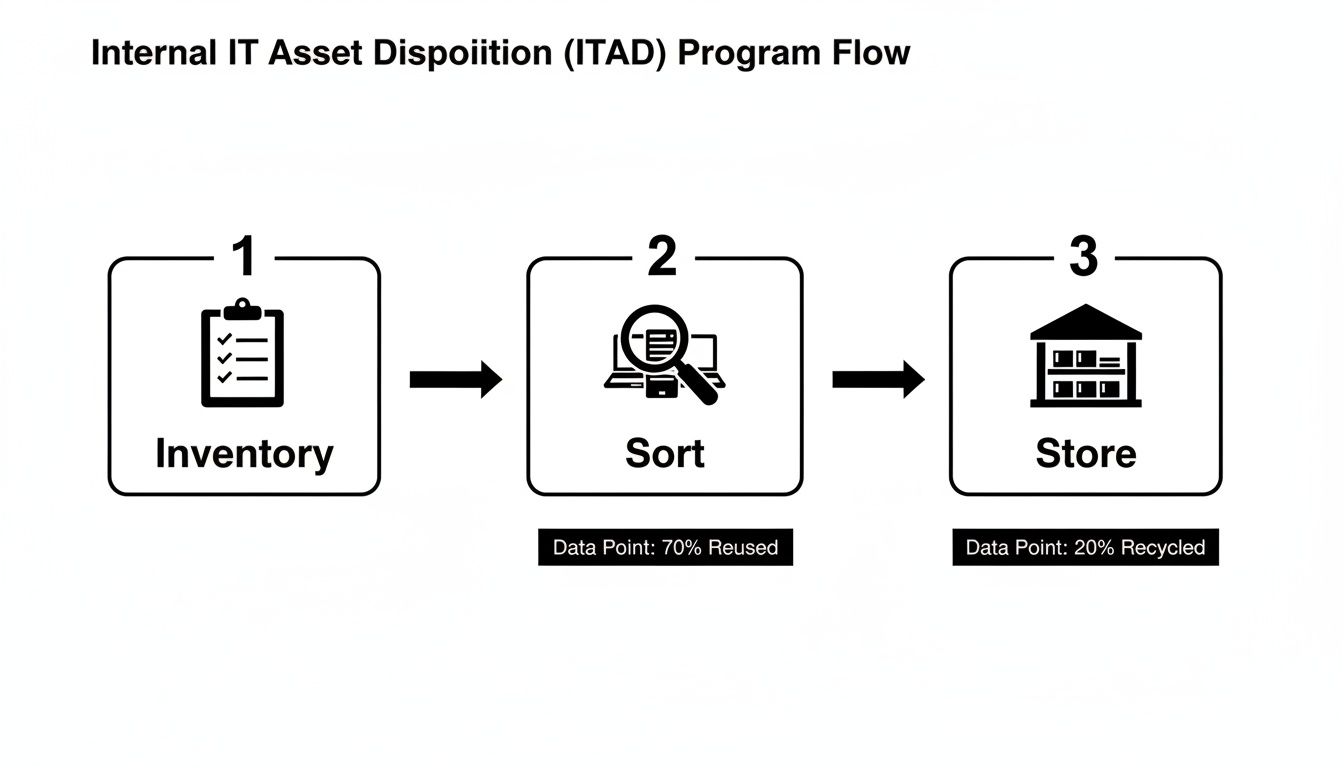
Your first move is always a thorough inventory. You can't manage what you don't measure. This means going way beyond just counting old laptops and desktops. Your inventory has to capture every single piece of retired corporate hardware.
This includes business-critical equipment like:
- Data Center Equipment: Servers, storage area networks (SANs), and blade chassis.
- Networking Gear: Switches, routers, firewalls, and access points.
- End-User Devices: Laptops, desktops, tablets, and company mobile phones.
- Peripherals: Printers with internal memory, VoIP phones, and external hard drives.
Building out your internal ITAD program means getting your systems in order. Adopting proven inventory management best practices is the only way to accurately track your corporate electronics from the moment they're unplugged.
Categorizing Assets for Secure Handling
With a complete list in hand, it's time to categorize each item. Not all electronics are created equal, and how you handle them should reflect that. Often, a simple spreadsheet or asset management software is all you need to get started.
Sort your assets by three main factors:
- Condition: Is it working, repairable, or totally non-functional? This tells you if it's a candidate for resale or headed straight for recycling.
- Age: A two-year-old server might have significant resale value. A ten-year-old desktop almost certainly doesn't. Age helps you see which assets could generate a return on investment.
- Data Sensitivity: This is the most critical factor. A server that held customer financial data needs a much higher level of security than an old conference room monitor.
Think about a mid-sized Atlanta law firm refreshing its equipment. They can use this system to tag every device. Laptops used by partners with sensitive client files would be flagged for on-site data destruction. Meanwhile, old displays with no data storage could be marked for standard recycling. You can get a closer look at how we handle this in our professional IT asset disposal services.
Establishing a Chain of Custody
Once your assets are inventoried and sorted, you have to lock them down. This is where your chain of custody begins—the documented paper trail that tracks an asset from your office to its final destination.
Start by designating a secure, locked storage area just for retired IT assets. This can't be an open closet or a random corner of the warehouse. Access must be limited to authorized personnel only.
A clear chain of custody is your best defense in a compliance audit. It proves you maintained control over data-bearing devices at all times, even before they left your building.
Assigning one person or department to manage this process is a game-changer. This individual is responsible for logging every device that comes in or goes out of the secure area. A simple digital log should track the item's serial number, its condition, who moved it, and when. This simple step eliminates the risk of a device "walking away" and turning into a data breach.
This detailed internal prep work is what sets you up for a successful partnership with a commercial recycler. When you come to the table with a clean, organized inventory and a documented chain of custody, the handover is seamless and secure.
Secure Data Destruction and Compliance
Once your old equipment is inventoried, the real work begins: dealing with the data. For any Atlanta business, from a healthcare provider in Decatur to a financial firm in Buckhead, data destruction isn't just a good idea—it's a critical security mandate. A single mistake can lead to a devastating data breach, costing you customer trust, hefty fines, and years of reputational damage.
Don't be fooled into thinking that just deleting files is enough. Recovering "deleted" data is surprisingly simple, leaving your company completely exposed. To truly protect your organization, you need professional-grade methods that make data permanently unreadable.
Before any hardware leaves your building, it's smart to have a clear internal process. This ensures every asset is accounted for and securely prepped for handover to your recycling partner.
Choosing the Right Data Destruction Method
There are three primary ways to destroy corporate data. The best choice depends on your business goals—whether you want to reuse the hardware for value recovery or ensure it can never be used again.
- Software Wiping: This is the go-to for functional hard drives and SSDs that you plan to resell or repurpose. Specialized software overwrites the entire drive with random data, often in multiple passes, effectively sanitizing it without causing physical damage.
- Degaussing: A degausser unleashes a powerful magnetic field that instantly scrambles the magnetic storage platters in hard drives and tapes. It’s incredibly fast and thorough, but it also renders the drive useless afterward.
- Physical Shredding: When you need absolute, 100% certainty, this is the answer. An industrial-grade shredder grinds hard drives, SSDs, and other media into small, shredded fragments. Data recovery isn't just difficult; it's physically impossible. This is the best option for damaged, obsolete, or highly sensitive drives.
To help you decide, we've compared these common methods.
Data Destruction Methods for Business Compliance
Choosing the right data destruction method is key to meeting your specific security and compliance obligations. This table breaks down the options to help you make an informed decision based on your company's needs.
| Method | Process Description | Best For | Compliance Level (HIPAA/DoD) |
|---|---|---|---|
| Software Wiping | Overwrites drive data with random characters using certified software. | Reusable/resellable hard drives and SSDs. | Meets most standards, including DoD 5220.22-M (3-pass wipe). |
| Degaussing | Uses a powerful magnetic field to erase data from magnetic media. | Tapes and hard drives needing fast, permanent erasure. Renders media unusable. | Exceeds most standards by making data irrecoverable. |
| Physical Shredding | Grinds media into small, unrecognizable pieces. | Damaged drives, SSDs, and devices with the highest security needs. | The ultimate solution for compliance; guarantees no data can be recovered. |
Ultimately, physical shredding provides the most definitive end-of-life security for data-bearing assets.
Navigating Strict Regulatory Standards
For many Atlanta organizations, data destruction is dictated by law. Regulations like the Health Insurance Portability and Accountability Act (HIPAA) for healthcare and the Department of Defense (DoD) 5220.22-M standard set a very high bar.
A Sandy Springs healthcare provider, for instance, must ensure no patient health information (PHI) can ever be pulled from a decommissioned server. Failure to comply isn't just about a fine—it can trigger legal battles and destroy your credibility.
A Certificate of Data Destruction isn't just a piece of paper. It's your legal proof of compliance, listing the serial number of every single drive that was wiped or shredded. This document is your ironclad defense in a HIPAA or financial audit.
Why R2 Certification Is Your Security Guarantee
When you're vetting a partner for environmentally responsible electronics recycling in Atlanta, GA, the R2 (Responsible Recycling) certification should be at the top of your list. This isn't just a sticker on a truck; it’s a tough, third-party-audited standard that confirms a recycler adheres to strict protocols for both data security and environmental safety.
An R2-certified recycler is required to:
- Maintain and follow a documented data security policy.
- Sanitize or destroy 100% of the data on every device they process.
- Operate from a secure facility with controlled, monitored access.
- Provide a complete chain-of-custody record for your assets.
Partnering with a certified recycler is the single most important decision you can make. It transfers the risk to an expert who is proven to meet the industry's highest standards. They have the audited processes and specialized equipment to ensure your data is gone for good.
For a deeper look at the specifics of wiping, degaussing, and shredding, check out our complete guide on secure data destruction services in Atlanta, GA. It has all the details you need to protect your business.
Streamlining Logistics with On-Site Services
Once your data security plan is solid, it's time to tackle the physical side of things: getting all that old equipment out of your office and to the recycling facility. For many Atlanta businesses, the logistics of moving pallets of electronics can seem like a major operational headache. This is precisely where a local partner offering hands-on, on-site services proves its worth for environmentally responsible electronics recycling in Atlanta, GA.
The real benefit isn't just convenience; it's about minimizing disruption to your business operations. Instead of pulling your own staff away from their core responsibilities to pack, wrap, and haul heavy gear, you can bring in our professional crew. We handle the entire process from start to finish, ensuring everything is moved safely and efficiently.
From Simple Office Cleanouts to Data Center Decommissioning
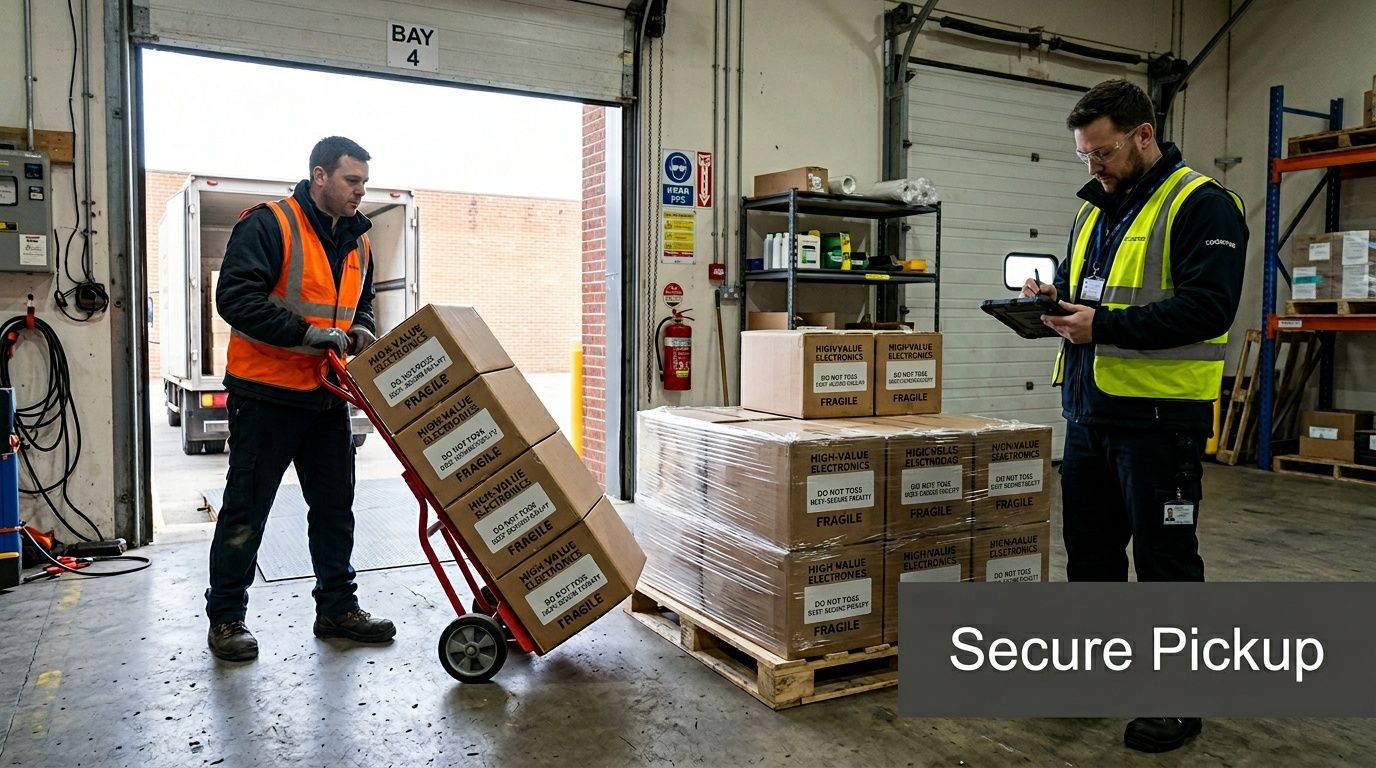
The scope of an on-site pickup varies dramatically. A marketing agency in Midtown might need to clear out 50 old laptops and monitors. For them, the job is often a straightforward pickup of equipment you've already consolidated. Our crew arrives, loads the gaylord boxes or pallets, and is out of your way in less than an hour.
A full data center decommissioning in Alpharetta, on the other hand, is a much more involved project. This can require:
- Systematic De-installation: Methodically disconnecting and removing servers, networking gear, and entire racks.
- Heavy Equipment Handling: Using specialized tools to move heavy server racks and enterprise storage arrays without damaging your facility.
- On-Site Asset Tagging: Applying serial number tags to every single asset before it's moved, initiating the chain of custody right there on your premises.
A capable ITAD partner has the experience to manage both scenarios. We'll coordinate with your facilities team to schedule the pickup—often during off-hours—to ensure a smooth, organized removal with zero impact on your employees.
The most effective on-site services are about more than just muscle. They are a precise, coordinated effort to safely and securely transfer assets from your environment to ours with zero operational impact on your business.
Ensuring a Seamless Pickup Experience
To make sure your scheduled service goes off without a hitch, a little prep work on your end goes a long way. Having a clear plan allows our team to work quickly and stay out of your way.
Your Facility Preparation Checklist:
- Clear Access Paths: Ensure hallways, loading docks, and elevator paths are free of obstructions.
- Designate a Staging Area: Set aside a specific, secure area where equipment can be consolidated for pickup.
- Confirm Logistics: Double-check building access times, freight elevator availability, and any specific loading dock rules with your property management.
- Assign a Point of Contact: Have one person from your team ready to greet the pickup crew and sign the initial paperwork.
This simple preparation prevents last-minute snags and makes the entire process as fast and unobtrusive as possible.
The Importance of Chain-of-Custody Documentation
Perhaps the single most critical element of the logistics process is the chain of custody. This is the unbroken, documented trail that follows your assets from the moment they leave your control, and it's your auditable proof of responsible disposal.
The process begins the moment our team arrives. They will verify the inventory against your asset list, record the number of pallets or containers being collected, and have your designated contact sign a bill of lading. That document is the first official link in the chain.
From there, secure transportation takes over. We use our own fleet of GPS-tracked trucks to move your assets directly to our secure facility. Upon arrival, the assets are logged again, and the chain of custody documentation is updated. This paper trail provides an ironclad record for compliance audits, proving every device was accounted for from your door to its final disposition. This same level of security also applies to services like on-site hard drive shredding in Atlanta, which provides an even greater degree of assurance for your most sensitive data.
How to Vet and Choose an Atlanta Recycling Partner
Picking the right partner for your environmentally responsible electronics recycling in Atlanta, GA, is one of the most critical choices you'll make for your business. In the e-waste world, not all recyclers are created equal. Your decision will determine if your old assets become a secure, compliant success story or a costly, lingering liability.
The field is crowded with everyone from highly certified IT Asset Disposition (ITAD) vendors to basic scrap haulers. For any Atlanta business, the difference is night and day. A cheap, uncertified hauler might quote a low price, but they're also handing you a bundle of hidden risks, from massive environmental fines to brand-destroying data breaches.
A professional, certified partner just operates on a different level. They have the documented processes, security protocols, and paperwork your organization needs to stay protected.
Start with the Non-Negotiable Certifications
Your first and most important filter should always be certifications. These aren't just fancy logos for a website—they are hard-earned proof that a recycler submits to rigorous, ongoing, third-party audits of their security, environmental practices, and vendor management.
In the electronics recycling industry, two certifications stand out as the gold standard:
- R2v3 (Responsible Recycling): This is the leading global standard for a reason. An R2v3-certified facility must follow strict, audited protocols for data destruction, environmental health, and tracking all materials through their entire downstream journey. It’s your best assurance that your e-waste won’t be illegally dumped or exported.
- e-Stewards: Developed by the Basel Action Network, the e-Stewards standard is famous for its zero-tolerance policy against exporting hazardous e-waste to developing nations. It provides another powerful layer of verification that your partner is truly committed to the highest ethical and environmental practices.
Never, ever partner with a recycler who can't show you proof of an active R2v3 or e-Stewards certification. The absence of these is a major red flag that indicates a lack of verifiable systems for protecting your company's data and reputation.
Know the Difference: Professionals vs. Scrap Haulers
It’s crucial to understand the vast gap between a true ITAD partner and a simple scrap hauler. The wrong choice here can have serious consequences for your business's reputation and bottom line.
A certified ITAD vendor guarantees audited, certified data destruction (both wiping and shredding) and provides serialized reports to prove it. A scrap hauler offers no such guarantee, making every data-bearing device a high-risk liability.
With a professional partner, they assume liability through robust insurance and give you a Certificate of Destruction. With a hauler, you retain all the liability for any data breach or environmental problem that occurs down the line.
Finally, certified vendors offer total transparency, with clear downstream tracking so you know where every component goes. Haulers often operate with zero transparency, meaning your assets could easily end up in a landfill or be illegally exported. The initial savings are never worth that risk.
Critical Questions for Any Potential Partner
Once you've narrowed your list down to certified vendors, it's time to dig deeper. A reputable partner will have clear, confident answers to these questions.
- Can you detail your downstream vendor process? Ask how they vet the partners who handle materials they can't process themselves. A top-tier vendor will have a formal, audited system for this.
- What does your standard reporting package include? You should expect, at a minimum, serialized asset lists, Certificates of Data Destruction, and weights for all recycled materials.
- What are your insurance coverage limits for data breaches? Make sure their policy is strong enough to protect you in a worst-case scenario.
- Can you provide references from other Atlanta-area businesses? Speaking with a current client—especially one in a regulated industry like healthcare or finance—gives you invaluable real-world insight.
- What is your process for asset tracking from pickup to final disposition? They need to be able to describe their chain-of-custody protocol in detail. For more information, you can explore the services offered by a dedicated electronic waste recycling company.
Choosing a certified partner is essential for Atlanta businesses, where compliance and data security are paramount. Professional end-to-end services help IT managers in our local hospitals, universities, and data centers meet strict regulations by safely diverting huge volumes of equipment from the waste stream.
Common Questions About Atlanta Business E-Waste
Even with a solid plan, questions always pop up when it's time to retire old IT gear. As a business, you need clear, direct answers.
Here are the answers to the most common questions we hear from IT managers and business owners across Atlanta, designed to help you finalize your e-waste strategy with confidence.
What Does Commercial Electronics Recycling Cost in Atlanta?
This is the number one question, and the answer is: it depends entirely on your equipment. There’s no flat fee for responsible IT recycling. For many businesses, the service can be free or even put money back in your budget through asset value recovery.
For instance, if you’re retiring a batch of newer servers, enterprise networking switches, or a fleet of recent-model laptops, their resale value can easily cover the costs of pickup and data destruction. In many cases, it exceeds them. This is the key difference between partnering with an ITAD specialist and calling a standard scrap hauler.
The final quote comes down to a few factors:
- Asset Value: The age, condition, and current market demand for your equipment.
- Service Scope: Whether you need our team on-site for de-installation, packing, and removal.
- Equipment Type: Some items, like old CRT monitors or certain batteries, have a recycling fee due to their hazardous materials. Most modern IT hardware doesn't.
A certified recycler will always give you a transparent quote breaking down any costs and potential returns upfront. Critically, secure data destruction is part of the core service—not an expensive add-on.
How Can I Be Certain Our Company Data Is Destroyed?
This is non-negotiable, and you should never just take a recycler’s word for it. The only real answer is official documentation.
A professional, certified partner provides a formal Certificate of Data Destruction. This document is your official record, protecting you from liability and serving as your proof for any compliance audit.
Your Certificate of Data Destruction is the cornerstone of your ITAD compliance strategy. It serves as your legal proof that you fulfilled your duty to protect sensitive information, shifting liability from your organization to your certified partner.
This isn’t just a simple receipt. It’s a detailed report listing the serial numbers of every single drive or data-bearing device that was sanitized or physically destroyed. This is the level of detail required to meet strict standards like HIPAA or financial regulations.
Can We Resell Our Functional Equipment?
Absolutely. In fact, that's exactly what you should do. Giving your retired assets a second life through IT asset remarketing is the most sustainable and financially smart approach. It’s a core part of any modern ITAD program.
A professional partner will test and grade all functional gear to find its fair market value. After a certified data wipe that meets NIST or DoD standards, they can sell the equipment on your behalf and share the revenue back with your company.
This turns a disposal cost into a revenue stream. That five-year-old server might be retired from your data center, but it could be the perfect fit for a small business's test lab or a company's development environment.
What Electronics Do You Take from Businesses?
As a dedicated commercial recycler, we accept nearly all electronics and IT hardware used in a business environment. Our services are built specifically for commercial clients—we do not handle residential drop-offs. This allows us to focus entirely on the security, compliance, and logistical needs of Atlanta’s businesses, schools, and organizations.
We commonly handle:
- Data Center Equipment: Servers, storage arrays, blade chassis, and uninterruptible power supplies (UPS).
- Networking Gear: Switches, routers, firewalls, and modems.
- Office Hardware: Laptops, desktops, monitors (LCD and LED), and docking stations.
- Peripherals & Media: Printers, copiers, VoIP phones, keyboards, mice, and backup tapes.
If it was used in your business and plugs into a wall or runs on a battery, we can almost certainly manage its secure and responsible disposal.
Ready to implement a secure, compliant, and environmentally responsible electronics recycling program for your Atlanta business? Contact Atlanta Computer Recycling today to discuss your specific needs and get a transparent quote for your project. Visit us at https://atlantacomputerrecycling.com to learn more.