A Business Guide to Onsite Hard Drive Shredding in Atlanta, GA

For any Atlanta business that handles sensitive information, physical data destruction is more than a best practice—it's your last line of defense against catastrophic data breaches. Onsite hard drive shredding in Atlanta, GA delivers the highest level of security possible, bringing a mobile shredding truck right to your facility. Data-bearing devices are destroyed before they ever leave your property, offering unmatched peace of mind for Atlanta's healthcare, finance, legal, and tech companies.
Why Onsite Shredding Is Non-Negotiable For Atlanta Businesses
In a city known for its vibrant tech, healthcare, and financial sectors, data is the lifeblood of your organization. Every retired server, laptop, and desktop computer stores a history of sensitive information, from client PII and financial reports to your most valuable intellectual property. Just deleting files or reformatting drives is not a compliant data destruction method; it leaves your data dangerously exposed.
The risks of cutting corners on hard drive disposal are real and severe. A single misplaced drive can spiral into a catastrophic data breach, leading to crippling regulatory fines and, even worse, an irreversible loss of client trust. For Atlanta businesses, onsite shredding is a fundamental part of any secure IT disaster recovery plan, protecting your assets and your reputation.
The True Cost of a Data Breach
Consider the business fallout from just one improperly handled device. Under regulations like the Health Insurance Portability and Accountability Act (HIPAA) or the Georgia Personal Identity Protection Act (GPIPA), non-compliance penalties can soar into the millions. Beyond the financial hit, the damage to your reputation can be devastating, destroying customer confidence that took years to build.
Onsite shredding turns data destruction from a potential liability into a verified, documented security measure. It offers several critical advantages for your business operations:
- Unbroken Chain of Custody: Your hard drives never leave your premises. They are destroyed onsite, eliminating the risk of being lost or stolen in transit. You stay in control from beginning to end.
- Verifiable Destruction: You and your team can witness the entire process, either in person or through a camera feed on the truck. You get visual confirmation that every single drive is shredded into unusable fragments.
- Immediate Peace of Mind: There’s no uncertainty or anxious waiting. The moment the shredding is done, your data is gone for good, and you’re handed a Certificate of Destruction as auditable proof.
A Growing Mandate for Security
This sharp focus on physical destruction is reflected in market trends. The global hard drive shredding services market hit USD 0.72 billion in 2024 and is expected to climb to USD 1.2 billion by 2033. This growth is fueled by the sheer volume of data businesses create—over 120 zettabytes in 2023 alone.
In tech hubs like Atlanta, the e-waste from data centers and corporate offices only adds to the urgency. In 2022, Georgia diverted 1.2 million tons of electronics from landfills through certified recyclers, highlighting the scale of the challenge. You can find more details in this market analysis about stationary versus mobile shredding.
For Atlanta's healthcare systems, financial institutions, and law firms, onsite shredding isn't just an IT task—it's a fundamental component of corporate governance and risk management. It’s the definitive final step in the data lifecycle.
This guide will walk you through everything you need to know about planning and executing onsite hard drive shredding in Atlanta. We’ll cover how to assess your needs, vet vendors, and ensure your process is fully compliant. If you need immediate assistance or want to understand your options, you can explore more about our onsite shredding services near you.
Planning Your Hard Drive Destruction Project
A successful hard drive shredding service doesn't just happen. It’s the result of careful planning that starts long before a shredding truck arrives at your Atlanta office. Establishing a clear internal process first not only guarantees every bit of sensitive data is destroyed but also makes the entire service faster and smoother for your team. The first move is always a thorough inventory.
You need to know exactly what assets require destruction. Start by cataloging every single device with a data-bearing drive. This isn’t just about the obvious servers in the data center—it includes desktops, laptops, external hard drives, and even office multifunction printers that often have internal storage. A simple spreadsheet is your best tool for this task.
Building Your Asset Inventory
A detailed inventory is the foundation of your entire project. It’s what you’ll use to get an accurate quote, and it’s essential for creating a bulletproof chain of custody on the day of service. For each asset, your IT or facilities manager should log:
- Asset Tag or ID: Your internal tracking number.
- Device Type: e.g., Dell Latitude Laptop, HP ProLiant Server, Seagate External HDD.
- Serial Number: This is absolutely critical. A professional vendor scans this number for every drive before it's shredded, creating an auditable, serialized record.
- Physical Location: e.g., Storage Closet B, Data Center Rack 12, Marketing Department.
- Data Sensitivity: A general tag like Confidential, PII, or PHI helps you prioritize and demonstrate due diligence.
This may feel like a lot of upfront work, but for any organization that takes data security seriously, it's a non-negotiable part of responsible IT asset disposition (ITAD). An incomplete list is a recipe for a potential data breach down the road.
Shred vs. Wipe: The Critical Decision Framework
With your inventory complete, your team will face a key decision: does a drive need to be physically shredded, or is data wiping a better fit? This choice has major security and budget implications, and the right answer depends entirely on the data and the asset's future.
For instance, a law firm in Midtown Atlanta retiring laptops that hold confidential client files has only one real option: physical destruction. Shredding is the only way to ensure that data is 100% unrecoverable, a must for meeting legal and ethical standards. Likewise, a healthcare provider near Emory must shred any drive that ever contained Protected Health Information (PHI) to stay compliant with HIPAA’s strict disposal rules.
Key Takeaway: If a drive held regulated data (PHI, PII, financial records) or sensitive IP and is at its end-of-life, onsite shredding is the only defensible choice. Wiping is for drives you plan to safely reuse or redeploy within your organization.
On the other hand, if you're just reassigning a laptop to another employee and the data on it isn't highly sensitive, a professional data wipe can work. If you're exploring this path, it's important to know what secure wiping actually entails. You can learn more about how to wipe a computer hard drive using DoD-compliant methods in our guide. For any drive leaving your possession for good, though, shredding offers unmatched security.
Securing Internal Buy-In and Budget
Once you have your inventory and a clear strategy, the last step is getting executive buy-in. Don’t position onsite hard drive shredding in Atlanta, GA as a simple IT cost. Frame it for what it is: a crucial risk management investment.
Present your plan to the key stakeholders in finance, legal, and compliance. Your asset list gives them a clear scope of work, which allows you to get an accurate quote from a certified vendor like us. Remind them that the cost of shredding is a tiny fraction of the potential fines and reputational fallout from a data breach—which, under Georgia's GPIPA, can be severe. Securing that budget and support early on ensures your project moves forward without a hitch.
How To Vet And Schedule An Atlanta Shredding Vendor
Once you have an inventory of assets ready for retirement, your next decision is the most critical one: choosing the right partner to destroy them. Selecting a vendor for onsite hard drive shredding in Atlanta, GA, is a choice that directly impacts your company’s security and compliance. Your organization's reputation rests on their process and trustworthiness, and not all providers are created equal.
You're entrusting a third party with your most sensitive information, even if it's just for a few moments before it's turned into fragments. That’s why your vetting process has to be rigorous.
Key Questions For Vetting Your Shredding Vendor
Think of this as an interview for a critical role on your security team. The answers you get will quickly separate a truly secure partner from a potential liability. A professional vendor will be proud of their certifications and happy to answer these questions directly.
Hesitation is a major red flag.
Here is a quick checklist of non-negotiable questions to ask every potential data destruction partner in Atlanta. Use this table to make sure you cover all your bases and understand why each question is so important for protecting your business.
| Question Category | Specific Question to Ask | Why It Matters |
|---|---|---|
| Certification | Are you NAID AAA Certified for mobile (onsite) hard drive destruction? | This is the gold standard. NAID certification requires surprise audits covering hiring, training, and security protocols, ensuring the highest level of compliance. |
| Transparency | Can our team witness the entire destruction process from start to finish? | The main advantage of onsite shredding is transparency. You should be able to watch everything, usually on a monitor mounted on the truck. A "no" is a deal-breaker. |
| Process | What does your chain-of-custody documentation look like? Can you provide a sample Certificate of Destruction? | A professional service provides auditable records, including serialized tracking for every drive. This documentation is your proof of compliant destruction. |
| Personnel | Are your technicians background-checked, security-trained, and uniformed? | The people handling your data are just as important as the shredder. They should be easily identifiable, screened professionals who understand the gravity of their work. |
A vendor who can’t give you clear, confident answers on these points isn’t worth the risk. True professionals are proud of their security protocols and will be eager to show you why they deserve your trust.
The data destruction market is growing fast for a reason. Physical shredding dominates because software wiping can't guarantee 100% data removal, especially on older or damaged drives. In fact, industry research shows that using a certified onsite service can slash the risk of a data breach by up to 90% compared to having drives transported offsite. You can read the full research on data destruction market trends to see just how critical this service has become.
Scheduling The Service And Preparing Your Site
After you’ve selected your certified Atlanta shredding vendor, the last step is handling the logistics. A little prep work on your end guarantees the service is fast, efficient, and doesn't disrupt your workday.
First, get the shredding day on the calendar. If your facility is busy, think about scheduling the service during off-peak hours or even a weekend. This gives the technicians clear access and keeps things moving smoothly.
Next, get the site ready. Here’s a quick checklist for your team:
- Designate a Staging Area: Gather all the hard drives or devices in one secure, accessible spot. Have your inventory list ready so the technician can verify the count before they start.
- Clear a Path: Make sure there’s an unobstructed path from your staging area to where the shredding truck will park.
- Reserve Parking: The mobile shredding truck is big and heavy. You’ll need to reserve a flat, stable parking spot for it as close to your building’s entrance as possible. Be sure to let your security team or property manager know ahead of time.
Taking care of these details beforehand makes all the difference. On shredding day, the vendor can pull up, verify the assets, and get right to work. As a full-service provider, we often help our clients plan these logistics, as it's an integral part of what an electronic waste recycling company does.
What To Expect On Your Onsite Shredding Day
All the planning and vetting are behind you. The day the mobile shredding truck arrives at your Atlanta office is when that careful preparation truly pays off. Knowing what to expect turns a potentially chaotic day into a smooth, secure, and satisfying process.
This is a completely transparent operation. You’ll get to witness your data security policy executed perfectly, right before your eyes.
When the uniformed, background-checked technician arrives, they’ll first check in with your designated point person. They aren't just there to haul away boxes; they are security professionals carrying out a documented procedure. They will review the scope of work, confirming the number and location of the devices slated for destruction. This initial check-in gets everyone on the same page before a single hard drive is moved.
Arrival And Inventory Verification
This first step is where the chain of custody begins. The technician will bring the work order you approved, and their first job is to match it against the assets you have staged for them. They’ll work with your contact to count every single server, laptop, and loose drive, ensuring the physical count matches your inventory list.
A premier vendor providing onsite hard drive shredding in Atlanta, GA, takes this a step further with a serialized audit.
- Serial Number Scanning: Using a handheld scanner, the technician captures the unique serial number of every hard drive.
- Real-Time Reconciliation: This information is logged into their system, creating a digital record that ties each specific drive to its destruction.
- Discrepancy Reporting: If a drive on your list is missing—or an extra one turns up—it’s flagged and resolved immediately, long before the shredder is even powered on.
This meticulous process ensures no device can slip through the cracks. It’s your first layer of proof that every asset you intended to destroy was accounted for and properly processed.
The Secure Transfer To The Shredding Truck
Once the inventory is confirmed, the drives are securely transported from your staging area to the mobile shredding truck parked outside. The technician will use locked, tamper-proof containers for the transfer. This isn't a casual stroll through the office; it's a controlled movement designed to eliminate any chance of loss or theft.
You or a designated employee should absolutely accompany the technician during this stage. Maintaining constant visual contact with your assets is a key benefit of onsite service. It guarantees an unbroken chain of custody from your storage closet all the way to the shredder's intake chute.
For businesses in highly regulated industries like healthcare or finance, this witnessed transfer is non-negotiable. It provides the irrefutable proof that sensitive PHI or financial data never left your secure oversight until the exact moment of its physical destruction.
Witnessing The Physical Destruction Process
Now for the main event. The technician will start feeding the hard drives, one by one, into the industrial-grade shredder built right into the truck. You don't just have to trust that it's happening—you get to watch.
Reputable shredding trucks are equipped with a camera system and an external monitor. This "shred cam" provides a clear, live view as your drives are dropped into the shredder and pulverized into tiny, unreadable fragments. This visual confirmation delivers the ultimate peace of mind. You see with your own eyes that your data is gone for good.
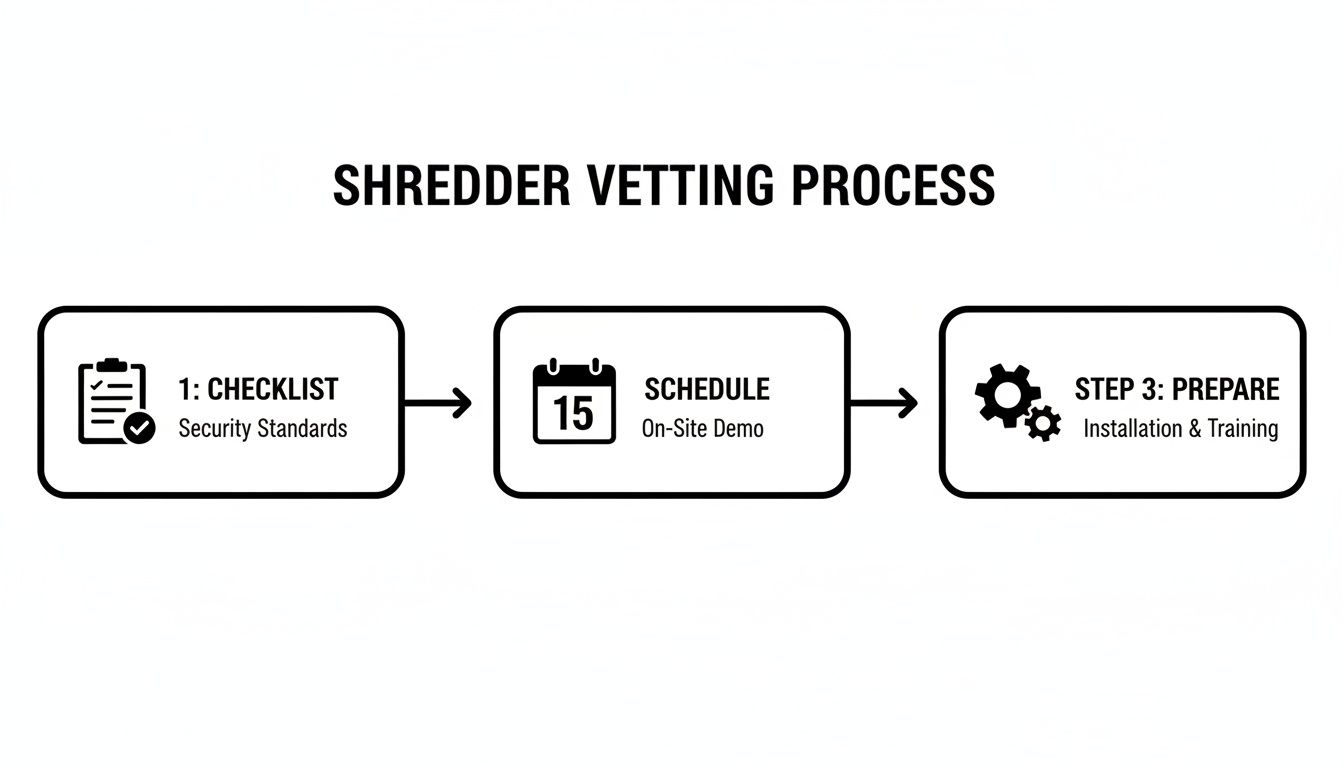
This visual shows just how simple the process is: vet your vendor, schedule the service, and prepare your site for a seamless operation.
After the last drive is destroyed, the technician finalizes all paperwork on-site. Before they even leave your facility, they will present you with a formal Certificate of Destruction, closing the loop on your data security project.
If you have other old electronics to clear out, you might also want to look into scheduling an e-waste pickup in Atlanta, GA, which can often be coordinated with your shredding service.
Finalizing Documentation And Proving Compliance
The shredding truck may be gone, but the job isn't quite finished. Your onsite hard drive shredding service is only truly complete once you have the official paperwork in your hands. This documentation is your armor—the hard evidence that proves you fulfilled your legal and ethical duty to protect sensitive data.
Without this final, crucial step, all that effort is just an unverified claim. For any Atlanta business, that’s a risky position to be in, especially during an audit. This paperwork is the final link in the chain, officially closing out your IT asset disposition (ITAD) process and delivering real peace of mind.
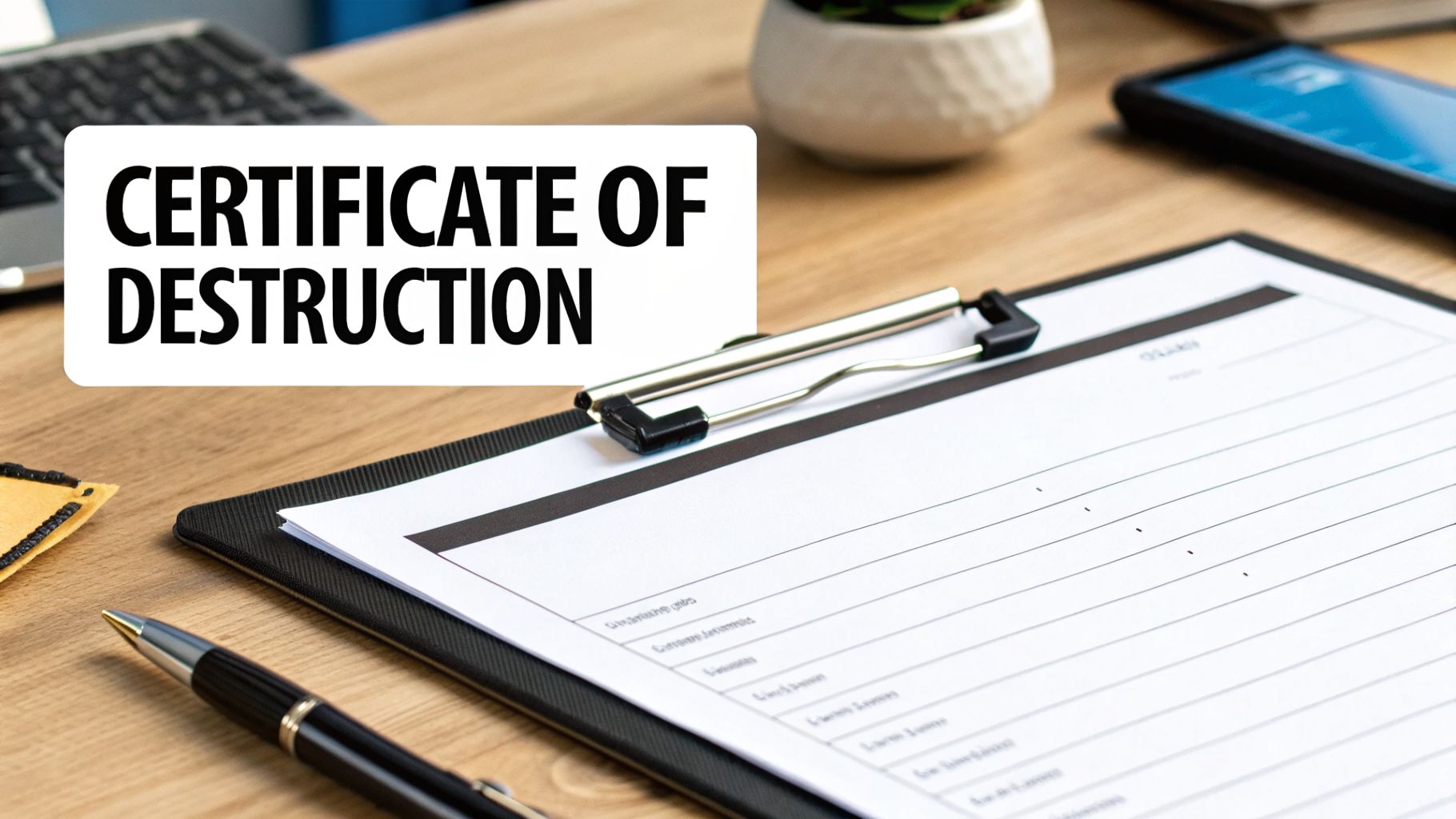
The most important document you’ll get is the Certificate of Destruction. This isn’t a simple receipt. It's a formal, legal record attesting that your data-bearing devices were permanently and irreversibly destroyed.
Anatomy of a Bulletproof Certificate of Destruction
A legitimate Certificate of Destruction has to contain specific, verifiable details to hold up under scrutiny. When your vendor provides this document, don't just file it away. Your compliance officer or IT manager should give it a quick review to make sure it includes these essential elements:
- Unique Serial Number: A specific tracking number for the certificate itself.
- Client Information: Your organization's full legal name and the Atlanta service address.
- Vendor Information: The destruction company’s name, address, and contact details.
- Service Date and Location: The exact date the shredding happened at your site.
- Jurisdiction Statement: A formal clause confirming the service was performed in line with relevant laws.
- Witness Signature: A line for your team member who oversaw the shredding process.
- Authorized Signature: The signature of the vendor’s trained employee who did the work.
Critically, the certificate must include a detailed, itemized list of every asset that was destroyed, complete with their scanned serial numbers. This serialized inventory is the foundation of a defensible audit trail, proving exactly which devices are gone for good.
A Certificate of Destruction is the official conclusion to your chain-of-custody process. It transforms the physical act of shredding into a documented, defensible compliance event that will stand up to scrutiny from regulators, auditors, or legal counsel.
From Compliance Task to Administrative Proof
Picture a financial services firm in downtown Atlanta facing a routine SOX audit. The auditor asks for proof that a batch of servers decommissioned last year were disposed of securely. Instead of scrambling, the IT manager simply pulls up the Certificate of Destruction from their onsite hard drive shredding Atlanta GA service.
The document instantly shows the service date, the vendor’s NAID AAA Certification number, and the serial numbers of every server hard drive—all matching the company's internal asset log. The auditor is satisfied. What could have been a high-stakes fire drill becomes a simple check-the-box moment. That’s the power of having the right paperwork.
Understanding what constitutes valid proof of purchase is a good parallel; your Certificate of Destruction serves the exact same function for your data security service.
Retaining Records For Future Audits
Once you have your certificate, your organization must protect it. Georgia's laws, like the Georgia Personal Identity Protection Act (GPIPA), and federal regulations like HIPAA have strict requirements for keeping records. A good rule of thumb is to hold onto all destruction records for at least six years.
Make sure you store these documents (usually digital PDFs) in a secure, backed-up location where they can be found easily. You never know when an auditor will come knocking.
If you want to see what a proper document looks like ahead of time, you can review a sample Certificate of Destruction. Taking a look beforehand ensures you know exactly what to expect on service day, so you can walk away confident your compliance is locked in.
Common Questions About Hard Drive Shredding
Deciding to physically destroy your old hard drives is a huge step toward securing your company’s data. But once you’ve made that call, a few practical questions almost always come up. That’s perfectly normal.
Let’s walk through some of the most common things Atlanta businesses ask us, so you can move forward with total confidence.
Understanding Onsite Hard Drive Shredding Costs in Atlanta
The main factor driving the cost of onsite hard drive shredding in Atlanta, GA, is the quantity of drives. For smaller batches, vendors typically charge per drive, and you can expect to pay anywhere from $7 to $15 per drive.
Of course, that per-unit price drops when you're dealing with a large-scale project, like a data center cleanout or a company-wide hardware refresh involving hundreds of drives. Most professional services also have a minimum trip charge, usually starting around $150 to $250, just to cover the logistics of bringing a specialized mobile shredding truck to your location.
When you request a quote, make sure it’s all-inclusive. Factors like your office's specific location in the metro area, the type of media being destroyed (standard HDDs vs. tiny SSDs), or labor for de-installing drives from servers can all influence the final price. A transparent partner will detail all costs upfront.
Is Onsite Shredding Really More Secure Than Offsite?
Yes, absolutely. For any organization that handles sensitive or regulated data, onsite shredding provides a much higher level of security, and it all comes down to one thing: an unbroken chain of custody.
Your hard drives are destroyed right there at your facility, often while your team watches. This completely closes the window on any risk of data loss or theft while the drives are in transit—a vulnerability that has been the weak link in some major data breaches.
With offsite shredding, you’re trusting that your assets will make it to another location securely. With onsite, you get immediate, verifiable proof of destruction before your assets ever leave your property. For businesses accountable to HIPAA, SOX, or FACTA, that peace of mind is invaluable.
Should Our Team Wipe Drives Before They Are Shredded?
No, there’s no need to wipe your hard drives if they are ticketed for physical shredding. It’s a redundant step that just wastes your team's time and your company's resources.
Think of it this way: data wiping is a software-based process for sanitizing drives you plan to reuse internally. Shredding is the final, irreversible form of data destruction. It physically pulverizes the platters and memory chips, making the data completely unrecoverable by any means. A reputable partner will advise you to skip this redundant step and help you save the extra effort.
What Kind of Documentation Should We Expect?
After the job is done, you must receive a formal Certificate of Destruction. This isn't just a receipt; it's a legal document that serves as your official, auditable proof that you handled the data disposal process correctly and in compliance with regulations.
A proper certificate needs to include specific details:
- The shredding vendor’s name, contact info, and certification credentials (like their NAID AAA Certification number).
- The exact date and address where the shredding took place.
- A detailed inventory of what was destroyed, including quantities and ideally scanned serial numbers.
- A clear statement confirming the destruction method.
- The signature of the technician who performed and witnessed the destruction.
This document is your key evidence for any future security audit. It's a good practice here in Georgia to hold onto these records for at least six years to stay aligned with state policies and protect your organization.
What Happens to the Shredded Metal Afterwards?
Once your drives are reduced to a pile of tiny metal fragments, the material is securely transported to the vendor’s certified facility. There, it’s combined with other shredded metals and sent to a licensed downstream recycling partner.
The raw materials—mostly aluminum and steel—are then melted down and repurposed into new products. This final step ensures your old IT assets are not only securely destroyed but also handled in an environmentally responsible way, keeping hazardous e-waste out of Georgia landfills.
Ready to secure your data with the ultimate peace of mind? Atlanta Computer Recycling offers NAID AAA Certified onsite hard drive shredding across the metro area. We provide a transparent, compliant, and secure process from start to finish. Get your free quote today.