A Business Guide to the City of Union City GA


Welcome to the City of Union City, GA—a strategic commercial hub in the Atlanta metro area. For IT managers, facility coordinators, and business leaders, navigating this rapid growth requires a proactive approach to operational challenges, particularly when it comes to managing technology and infrastructure.
Your Business Guide to the City of Union City, Georgia

For any business establishing or expanding in the City of Union City, GA, the pace of development is a defining feature. The city isn’t just growing; it’s strategically positioned for commerce. Its proximity to Hartsfield-Jackson Airport and major interstate highways has made it a prime location for logistics, warehousing, and industrial operations.
This is evident in the corporate landscape, with major employers like the Georgia-Pacific Tissue Plant anchoring the industrial sector. This commercial boom has fueled a population surge projected to reach 28,751 by 2026, creating a deep talent pool and a dynamic economic environment for businesses.
What This Growth Means for Your Commercial Operations
The city's infrastructure and business environment are evolving rapidly. Consider this: Union City's population exploded by 131% between 2000 and 2020. That kind of urbanization translates directly to more offices, more data centers, and more facilities—all generating a constant stream of retiring technology and e-waste.
This fast-moving environment demands sophisticated, forward-thinking operations. Your company will be managing everything from vendor relationships and facility logistics to regulatory compliance. Staying on top of legal and administrative tasks is crucial, which is why having access to essential contract templates can streamline your procurement and service agreements.
The core issue for businesses is what this growth means for your operational responsibilities. Increased business activity directly translates to a faster technology refresh cycle. Suddenly, a clear, compliant plan for managing and disposing of IT assets isn't just a good idea—it's a business necessity.
To provide a clearer picture of the local business landscape, we've compiled a snapshot of key data points.
The City of Union City GA at a Glance for Businesses (2026 Projections)
| Metric | Data Point |
|---|---|
| Projected Population | 28,751 |
| Median Age | 32.8 years |
| Median Household Income | $65,400 |
| Key Industries | Logistics, Manufacturing, Retail |
| Proximity to Airport | ~10 miles from Hartsfield-Jackson |
These figures highlight a young, dynamic workforce and a market with significant logistical advantages for commercial enterprises. Understanding this unique character is the first step toward protecting critical business assets, especially your company's technology and data. Now, let’s examine why a well-defined IT asset disposal strategy is so crucial for security, compliance, and sustainability in this thriving market.
Why E-Waste Management Is Critical for Commercial Entities in a Growing City
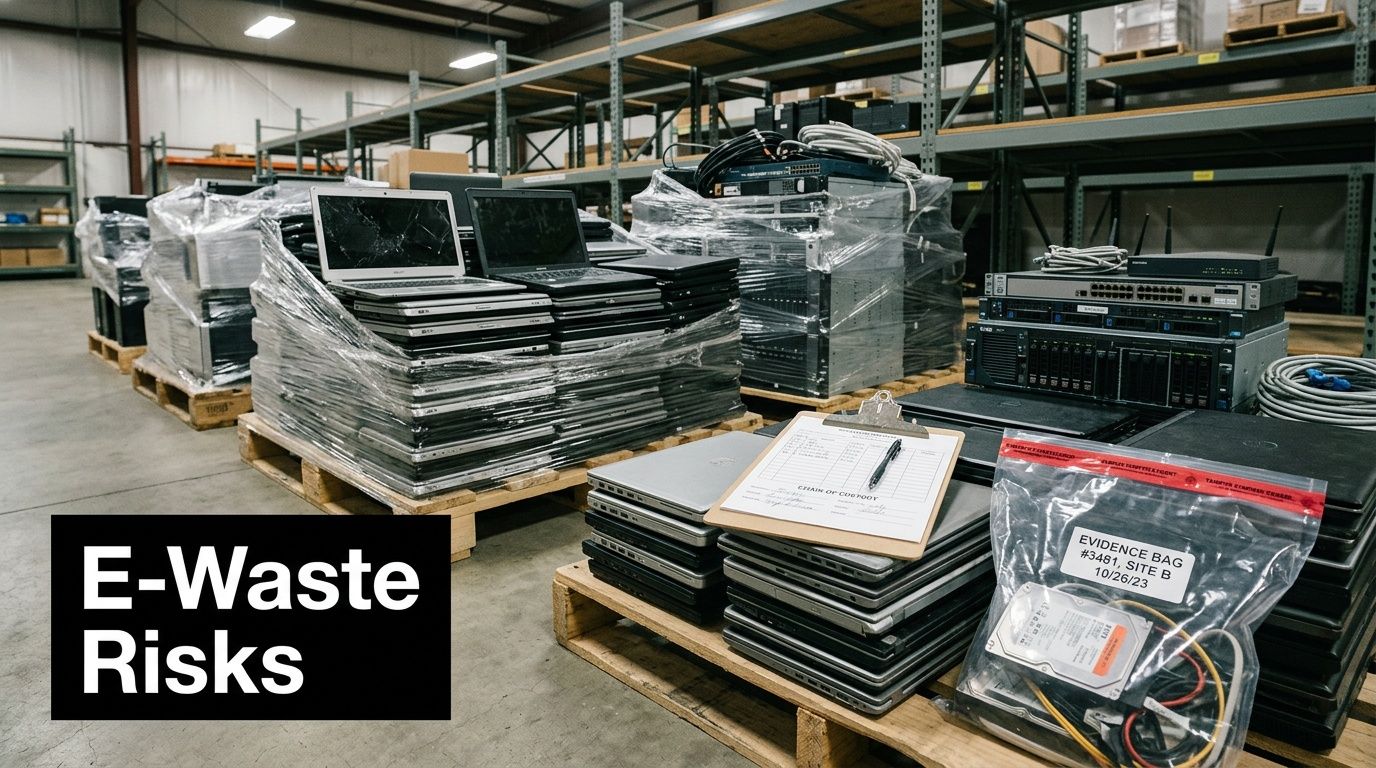
As the city of Union City, GA, continues its commercial expansion, so does the volume of outdated corporate technology. For local businesses, this electronic waste—or e-waste—is a serious operational hurdle. Every server, computer, and network switch eventually reaches its end-of-life, and each asset requires a compliant disposal plan.
Think of your company's retired tech as its "digital footprint." If not managed correctly, it can leave a permanent stain of environmental liability and create a significant security risk. This isn't just about environmental stewardship; it's about smart, secure business practice.
The Dual Risks of Improper Disposal for Businesses
Ignoring responsible e-waste practices exposes your business to two primary threats: environmental liability and data breaches. Obsolete electronics are filled with hazardous materials like lead, mercury, and cadmium. When that equipment ends up in a landfill, those toxins can contaminate local soil and groundwater.
For a business, this isn't an abstract environmental issue—it's a direct threat to your corporate reputation and a potential legal liability. A single disposal misstep can erode years of goodwill and customer trust.
Simultaneously, the data residing on retired devices presents an even more immediate danger. A single discarded hard drive can be a treasure trove of sensitive corporate information, including:
- Employee records and personal data (PII)
- Confidential client data and proprietary trade secrets
- Corporate financial reports and internal communications
Leaving this data unsecured is the digital equivalent of leaving your office doors wide open. For businesses in the city of Union City, GA, protecting this information is a non-negotiable part of risk management. To better understand the stakes, you can learn more about the environmental impact of electronic waste and its implications for your business.
Shifting from an Operational Cost to a Strategic Investment
This brings us to a critical business perspective. Responsible IT Asset Disposition (ITAD) is not merely an operational expense. It’s a strategic investment in your company’s security, reputation, and long-term viability. A professional e-waste strategy minimizes risk, ensures regulatory compliance, and demonstrates corporate responsibility.
When you begin viewing ITAD as an investment, the focus shifts from the cost of disposal to the value of protection. This proactive approach is what safeguards your data, protects the local environment, and strengthens your position as a responsible corporate citizen in the Union City community.
Understanding Union City's Regulations for Business Waste & Recycling
If you operate a business in the City of Union City, GA, you must understand the local rules for commercial waste and recycling. It's a common but costly mistake to assume commercial regulations mirror residential curbside services—they don't. The rules for businesses are stricter, and non-compliance can lead to significant penalties.
Here is the single most important fact every business owner, IT manager, and facilities coordinator must know: the city does not provide municipal e-waste pickup for businesses. This is not a minor detail. It’s a critical gap in public services that your company is legally obligated to fill through a certified, private-sector partner. You cannot legally dispose of old computers, servers, or monitors with your regular commercial trash.
The Responsibility Falls Squarely on Your Business
This gap means the burden of proof for proper disposal rests entirely on your company. It is analogous to managing payroll taxes—the government doesn’t handle it for you, but you are held fully accountable for executing it correctly. Failure to properly manage your end-of-life electronics can result in substantial fines and legal complications.
But the consequences extend beyond financial penalties. Improper disposal creates a serious liability risk. If equipment bearing your company’s asset tags or logo is found illegally dumped, the damage to your brand reputation can be devastating. A documented, professional disposal process isn't just "best practice"—it's an essential risk-mitigation strategy for any business in the City of Union City, GA.
Why a Chain of Custody Is a Non-Negotiable Requirement
This brings us to a crucial business concept: chain of custody. This is the formal documentation that proves exactly what happened to your retired IT assets, from the moment they left your facility to their final, certified recycling and destruction.
Without this documentation, you have no evidence that you complied with regulations. A certified ITAD partner provides this proof through essential documents, including:
- Serialized Inventories: A detailed manifest of every asset collected, tracked by its unique serial number.
- Certificates of Data Destruction: Your official, auditable proof that all sensitive data was permanently destroyed according to certified industry standards.
- Certificates of Recycling: Confirmation that all hardware was dismantled and processed in an environmentally responsible manner.
This documentation serves as your legal shield. It protects your business from legal challenges and demonstrates your commitment to being a responsible corporate citizen.
Union City's stable business environment—recognized with accolades like being named one of the safest cities by Forbes.com—is built on the foundation of responsible local companies. This long history of commerce, which you can discover more about through Union City’s rich history, has paved the way for modern IT infrastructure in the city's hospitals, schools, and enterprises, all of which require secure disposal practices.
Ultimately, municipal services have their limits. Where public options end, a professional partner delivers the specialized, secure, and compliant electronics recycling your business requires. To see how a professional service bridges this critical gap, check out our guide on IT asset disposal in Union City, GA and get a clear picture of your obligations.
Protecting Your Business with Compliant Data Destruction
For any business in the City of Union City, GA, the data stored on retired devices is far more valuable—and dangerous—than the hardware itself. Simply recycling a computer is insufficient. Protecting that information is a critical component of corporate governance, especially as the need for compliant, secure e-waste solutions grows.
When your company decommissions a server, computer, or hard drive, you can't just set it aside. Discarding an old server without proper data sanitization is like leaving unlocked filing cabinets on the curb. For businesses in regulated industries like healthcare, finance, and education, this isn't just poor practice; it's a legal violation under regulations like HIPAA, FERPA, and GLBA.
The Different Levels of Data Security for Businesses
Not all data destruction methods offer the same level of security. Understanding the differences is key to selecting the appropriate process for your business and ensuring your sensitive corporate information is permanently irrecoverable.
Here's a closer look at the three primary methods a professional ITAD provider will utilize.
Data Destruction Methods Compared
This table breaks down the most common methods, helping you align the right process with your specific security requirements.
| Method | Security Level | Best For | Compliance Alignment |
|---|---|---|---|
| Software Wiping | High | Devices intended for refurbishment or remarketing. | Meets DoD 5220.22-M and NIST 800-88 standards for data sanitization. |
| Degaussing | Very High | Magnetic media like HDDs and tapes where reuse is not a concern. | Exceeds most compliance standards by rendering the media unusable. |
| Physical Shredding | Absolute | Obsolete, damaged, or highly sensitive devices where zero risk is acceptable. | The ultimate standard for HIPAA, PCI-DSS, and government data. |
Now, let's explore what these methods mean in a business context.
H3: Choosing the Right Method for Your Assets
Software Wiping: This process uses specialized software to overwrite a hard drive with random data, often multiple times. The DoD 5220.22-M 3-pass wipe is a common industry standard that makes data recovery virtually impossible. This is the ideal choice for equipment that retains value and can be resold or redeployed.
Degaussing: Employing a powerful magnet, degaussing completely scrambles the data on magnetic storage like hard disk drives (HDDs) and tapes. It is an instant and permanent solution, but it also renders the drive completely inoperable.
Physical Shredding: This is the definitive solution for data security. The hard drives and other storage media are fed into an industrial shredder and torn into tiny, unrecognizable fragments. This method is best for the most sensitive data or for hardware that is obsolete or damaged beyond repair.
For a deeper look into these methods and how they fit into a comprehensive data security policy, you can learn more about secure data destruction services.
Ensuring Compliance and Corporate Peace of Mind
The steady commercial growth in the city of Union City, GA, makes secure disposal more critical than ever. The area’s youthful median age of 33.1, diverse population, and major industrial employers fuel a constant cycle of technology upgrades. With a population projected to reach 28,751 by 2026, the volume of retired corporate technology will only continue to increase. You can discover more about Union City's economic and demographic trends to see the full picture.
When you hand over your retired equipment to an ITAD provider, you are transferring a significant legal and ethical responsibility. Your vendor must be able to prove they have handled that responsibility with the utmost diligence.
A reputable partner will always provide a Certificate of Destruction upon completion of the service. This document is your official, auditable proof that your data was destroyed in full compliance with all relevant regulations. It’s the final piece of the puzzle that confirms your company's sensitive information is gone forever, providing complete corporate peace of mind.
Your Step-By-Step Guide to Commercial IT Asset Disposal
So, you understand the regulations and risks. Now, how do you actually execute IT asset disposal for your business in the City of Union City, GA? For a busy IT or facilities manager, the process can seem daunting, but a professional ITAD partner transforms it into a simple, manageable workflow.
We've broken down the entire process into a straightforward, secure, and stress-free plan for your business.
Step 1: Inventory Your Assets for Disposal
First, you need a rough count of the equipment you're decommissioning. You don't need a perfect, granular list at this stage, but a good estimate is the ideal starting point. Simply group your gear by type: How many desktops? How many laptops, servers, or monitors?
This initial tally provides an ITAD provider with the scope of the project. Think of it like getting a quote from a moving company—they need to know if they're moving a small office or a large corporate headquarters. A rough count is all it takes to initiate the process.
Step 2: Request a Transparent Quote
With your inventory in hand, you can request a formal quote. Any reputable partner will want to know if you have specific requirements, like on-site hard drive shredding or if the equipment is located on multiple floors or at different sites.
This is your opportunity to ask critical questions. Ensure the quote details all services—pickup, transport, data destruction, and recycling—with no hidden fees. Gaining clarity at this stage prevents budget surprises later.
Step 3: Schedule a Seamless and Secure Pickup
Once you’ve approved the quote, it’s time to schedule the pickup. A professional ITAD team will work around your business hours to minimize disruption. They handle all the labor, including packing, palletizing, and loading onto secure, GPS-tracked trucks. Your staff's involvement is minimal.
Step 4: Secure Off-Site Processing and Data Destruction
After pickup, your assets are transported to a secure, access-controlled processing facility. At the facility, every item is formally logged into an inventory system, and any device containing data is immediately segregated for destruction. The most appropriate destruction methods are then applied to ensure your data is completely irrecoverable.

This process illustrates the multi-layered approach to data security, from software wiping for assets that can be remarketed to physical destruction for absolute data elimination.
Step 5: Receive Your Certificates of Destruction and Recycling
This final step is the most critical for your compliance records. Within a few weeks, you will receive a Certificate of Destruction and a Certificate of Recycling.
These certificates are your official proof of compliance. They create an auditable, legally defensible record that protects your business, confirming you have met all legal and environmental obligations for your retired technology.
This paperwork closes the loop on the entire process, providing you with documented proof that your assets—and the sensitive corporate data they contained—were handled responsibly from start to finish. For more details, you can explore a complete overview of professional IT asset disposal.
Choosing the Right ITAD Partner for Your Business in the Atlanta Area
Selecting the right IT Asset Disposition (ITAD) partner is one of the most critical vendor decisions a business can make. For companies in the City of Union City, GA, and across the metro Atlanta area, this choice directly impacts your security posture, regulatory compliance, and public reputation. This is not about waste hauling; it’s about comprehensive risk management.
A top-tier ITAD partner does more than just remove old equipment. They provide complete, verifiable peace of mind by entrusting your retired hardware and sensitive data to a certified team you can have absolute confidence in.
Core Capabilities to Demand from a Vendor
When vetting potential partners, there are several non-negotiable capabilities you should demand. These form the foundation of a secure and professional ITAD program.
Certified Data Destruction: Your business needs documented proof that its data is irretrievably destroyed. This requires a partner who can perform and certify multi-pass wiping or physical shredding that meets rigorous standards like DoD 5220.22-M and NIST 800-88.
Secure Logistics and Chain of Custody: How does your equipment get from your office to their facility? Insist on a provider that uses a dedicated, company-owned, GPS-tracked fleet to maintain a secure and unbroken chain of custody from pickup to final disposition.
Proven Industry Expertise: The partner you choose should have demonstrable experience with projects of your scale and complexity, whether it's a routine office cleanout or a highly regulated data center decommissioning.
These are the core safeguards you must expect from any commercial ITAD provider. You can see how a leading electronic waste recycling company integrates these elements into every client project.
Ultimately, a professional ITAD service functions as an extension of your own compliance and security teams. Their performance is a direct reflection of your business, making the right choice paramount for protecting your corporate assets and reputation in the bustling Atlanta market.
Focusing on these key capabilities ensures your business can implement a compliant, secure, and sustainable IT asset management strategy, turning a potential liability into a documented strength.
Answering Your Union City Commercial Recycling Questions
For businesses operating in the City of Union City, GA, proper management of end-of-life electronics isn't just best practice—it's a legal and operational requirement. If you are unsure how to manage your company's e-waste, you're not alone. Here are the answers to the most common questions we hear from commercial clients.
Does The City of Union City GA Collect E-Waste From Businesses?
No. The city’s waste services are designated for residential use only and do not include the collection of commercial e-waste. As a business, you are legally responsible for arranging your own disposal through a certified IT recycling partner.
This means you cannot place old computers, servers, or monitors with your regular commercial trash. The full responsibility for secure and environmentally compliant disposal rests with your organization.
What Documents Prove Our Business Disposed of E-Waste Correctly?
When you partner with a professional IT asset disposal (ITAD) company, you should always receive two critical documents that prove compliance and protect your business from liability.
- A Certificate of Destruction: This is your official, auditable proof that all data on your devices was professionally destroyed according to industry standards, releasing your company from liability for potential data breaches.
- A Certificate of Recycling: This document confirms that your hardware was recycled in an environmentally sound manner, in accordance with all local, state, and federal regulations.
Think of these certificates as your legal receipts for responsible disposal. They create an essential paper trail that will stand up to any internal or external audit.
These documents are your absolute proof that you have followed all environmental and data security regulations when disposing of company assets. They are a non-negotiable component of any commercial ITAD service.
Is Data Wiping Sufficient for HIPAA or Financial Compliance?
While professional data wiping is an effective method for sanitizing devices intended for reuse, it may not be the most appropriate choice for end-of-life assets, particularly those governed by strict regulations like HIPAA or GLBA. Physical destruction (shredding) is the undeniable gold standard for maximum data security and compliance.
For older hard drives, damaged media, or equipment containing highly sensitive information, shredding is the only method that guarantees the data is 100% irrecoverable. A qualified ITAD partner can advise on the best approach for each asset type based on your risk profile and compliance needs.
Ready to implement a secure and compliant IT disposal plan for your Union City business? Contact Atlanta Computer Recycling for a no-obligation quote and expert consultation. Learn more at atlantacomputerrecycling.com.