Your 2026 Guide to Zero Landfill Electronics Recycling for Atlanta Businesses

For any IT manager or business leader in Atlanta, managing retired electronics has evolved from a back-burner task to a critical business function. We're talking about zero-landfill electronics recycling in Atlanta, GA — a strategy that's now essential for both data security and corporate responsibility. A genuine zero-landfill policy ensures every single component of your retired IT assets is either remarketed for a second life or meticulously demanufactured into raw commodities for new products. Absolutely nothing goes to a landfill.
A Strategic Guide to IT Asset Disposition for Atlanta Companies

If you're managing a business anywhere in the Atlanta metro, you know the challenge of dealing with end-of-life technology. It’s not just about clearing equipment out of a storage room. It’s a serious matrix of data security risks, environmental regulations, and protecting your company’s brand reputation. The sheer volume of hardware that cycles out of a business can become a major logistical and compliance burden.
This guide is built for you—the IT director navigating a server room refresh, the facilities manager executing an office cleanout, or the C-suite executive who must ensure corporate compliance. We'll walk you through a practical, step-by-step plan to achieve true zero-landfill electronics recycling for your organization.
The E-Waste Challenge for Atlanta's Commercial Sector
The rate of technology turnover in business is staggering. A look at the public sector here in Georgia illustrates the trend: computer purchases shot up from 2,000 units in 2013 to over 55,000 by 2017. This created a massive wave of retired equipment requiring disposition, a trend that has accelerated across the private sector ever since.
This flood of outdated tech creates unique challenges for different industries around Atlanta:
- Healthcare Providers: Disposing of old workstations and servers requires navigating strict HIPAA compliance to protect electronic patient health information (ePHI).
- Technology Companies: Decommissioning an entire data center is a monumental task, especially when assets are filled with proprietary code and sensitive business intelligence.
- Financial & Legal Firms: Regular tech refreshes for employee laptops and back-office systems mean dealing with bulk disposals containing highly confidential client data.
A common misconception I encounter with business clients is that "recycling" automatically means zero-landfill. The reality is, many general recyclers cherry-pick valuable components and may landfill the rest. A true B2B zero-landfill partner provides a documented, auditable process for every last screw and circuit board.
Turning a Business Liability Into a Strategic Advantage
A smart IT Asset Disposition (ITAD) program transforms this challenge into an opportunity. When you partner with a specialist in commercial electronics recycling, that logistical nightmare becomes a secure, documented, and streamlined process. You can learn more about what a professional service entails in our guide on professional IT asset disposition services in Atlanta.
Ultimately, a well-planned strategy does far more than clear out storage space. It’s your best defense against a catastrophic data breach, a clear path to achieving corporate sustainability goals (ESG), and a powerful way to strengthen your reputation as a responsible leader in the Atlanta business community. Let's outline how to execute it properly.
Building Your Corporate E-Waste Management Plan
To achieve a zero-landfill goal for your electronics, your business must move from ad-hoc disposals to a proactive, documented strategy. For any Atlanta company, this isn't just about environmental stewardship; it’s about creating a repeatable, auditable process that protects your data, your budget, and your brand.
The entire framework begins with one critical action: a complete audit of your IT assets. You simply can't manage what you haven't measured. This isn't a quick headcount—it's a detailed inventory that forms the foundation of your entire recycling program.
Start with a Full IT Asset Audit
Before a single device leaves your facility, you must know exactly what you have. Move beyond the vague concept of a "storage room full of old computers." Your objective is a specific, itemized list that provides clarity for your internal team and your recycling partner.
For a successful audit, get specific with your categorization for each asset.
- Type: Desktops, Laptops, Servers, Switches, Routers, Firewalls, Monitors, Mobile Devices, Printers.
- Condition: Is it functional with potential resale value? Is it repairable? Or is it truly end-of-life and destined only for commodity recycling?
- Age: Note the purchase or deployment date. This helps identify hardware that's past its useful life and may represent a security vulnerability.
- Data Sensitivity: This is the most critical step. Tag every single device that ever stored or processed sensitive corporate, customer, or employee data. Every single one.
This master inventory list becomes your strategic roadmap. It dictates every subsequent decision, from selecting a data destruction method to planning the pickup logistics.
The biggest mistake we see is companies treating all their electronics as a single, homogenous group. A 10-year-old server holding proprietary R&D data requires a completely different disposition path than a 3-year-old marketing laptop. Sorting your assets by type and data risk from the outset prevents major security and compliance headaches.
Segregate and Secure Your Assets
With your audit complete, it's time for physical and logical segregation. All equipment you flagged as data-bearing must be physically separated from non-sensitive items like monitors, keyboards, and mice. This is a non-negotiable security protocol.
Establish a secure, locked space—a storage cage or a dedicated room—exclusively for these data-bearing assets as they await disposition. This simple action is your first and most effective defense against an internal or external data breach.
This is also where you align your asset list with your security requirements. For example, you might designate a batch of newer laptops for certified data wiping because they have resale value. Meanwhile, older server hard drives containing trade secrets are tagged for on-site physical shredding. Pre-sorting in this manner makes the process with your recycling vendor incredibly efficient.
Formalize Your E-Waste Policy
A plan that only exists verbally isn't a corporate policy. To truly build a sustainable zero-landfill program, you must create a formal, written e-waste policy. This document becomes the single source of truth for your entire organization, ensuring procedural consistency and accountability.
A strong policy doesn't need to be overly complex. It should be a clear, direct guide that outlines procedures and assigns responsibility. It gives your team the authority to enforce proper disposal and creates a defensible record of your company's commitment. You can find more on this in our guide to sustainable electronics recycling in Atlanta.
At a minimum, your policy should include:
- Scope: Define exactly which corporate electronic assets are covered.
- Roles & Responsibilities: Clearly state who owns the process—the audit, segregation, and vendor management (e.g., the IT Director or a designated asset manager).
- Data Security Mandate: Require certified data destruction for 100% of data-bearing devices before recycling or reuse. No exceptions.
- Zero-Landfill Commitment: State explicitly that the company will only engage recycling partners who provide auditable proof that no hardware or byproducts will end up in a landfill.
- Documentation Requirements: Mandate the collection, verification, and archiving of all certificates of data destruction and recycling for compliance purposes.
This formal policy transforms e-waste management from a chaotic, reactive task into a structured, secure, and sustainable business process. It's the framework that guarantees no device is ever disposed of improperly again.
Guaranteeing Ironclad Data Security and Compliance
For any Atlanta business, from a Midtown healthcare system to a Buckhead financial firm, electronics recycling is fundamentally a conversation about data security. Retiring IT assets without an auditable data destruction plan isn't just risky—it's an open invitation to a data breach, severe regulatory fines, and brand damage that is difficult to repair.
Simply handing over your old equipment is insufficient. You need absolute, verifiable proof that the sensitive information they once contained is permanently destroyed. This is where you must be specific about data wiping versus physical destruction—a choice that directly impacts your security posture and your ability to demonstrate compliance.
Comparing Data Destruction Methods for Your Business
Choosing the right data destruction method depends on your internal security policies, compliance requirements, and the residual value of the assets.
| Method | Best For | Security Level | Allows for Reuse? | Typical Use Case |
|---|---|---|---|---|
| Software Wiping | Newer, functional devices with remarketing value. | High (Meets NIST 800-88 & DoD 5220.22-M standards). | Yes | Refurbishing corporate laptops for resale to recover value. |
| Physical Shredding | Obsolete, non-functional, or highly sensitive data-bearing devices. | Absolute (Data is physically irrecoverable). | No | Destroying server hard drives containing trade secrets, financial records, or patient data (ePHI). |
Ultimately, your choice balances the opportunity to recover value from retired equipment against the need for the total, irreversible elimination of sensitive data.
Data Wiping vs. Physical Shredding
Not all destruction methods are equal. The right approach depends on the device, its potential for reuse, and the sensitivity of the data it holds.
Software-based data wiping uses specialized programs to overwrite every sector of a drive, rendering the original data unrecoverable. The industry gold standard is the NIST 800-88 guideline, often executed with a DoD 5220.22-M 3-pass method. This is perfect for newer, functional laptops and desktops where you want to recover value through resale. It is the required process for assets being redeployed internally or sold on secondary markets.
Physical destruction is precisely what it sounds like. Industrial-grade shredders pulverize hard drives, SSDs, and other media into small, useless fragments. It offers the ultimate guarantee of data elimination. We recommend this for aging servers, non-functional drives, and especially for Solid-State Drives (SSDs), which can be difficult to wipe completely using software alone. When absolute certainty is the primary requirement, shredding is the answer.
A simple "recycling receipt" is worthless for compliance. You absolutely must demand a Certificate of Data Destruction. This is a legal, auditable document that lists the serial numbers of the destroyed devices, the method used, the date of destruction, and a full chain-of-custody record.
This flowchart illustrates how to structure your e-waste plan, beginning with a thorough audit.
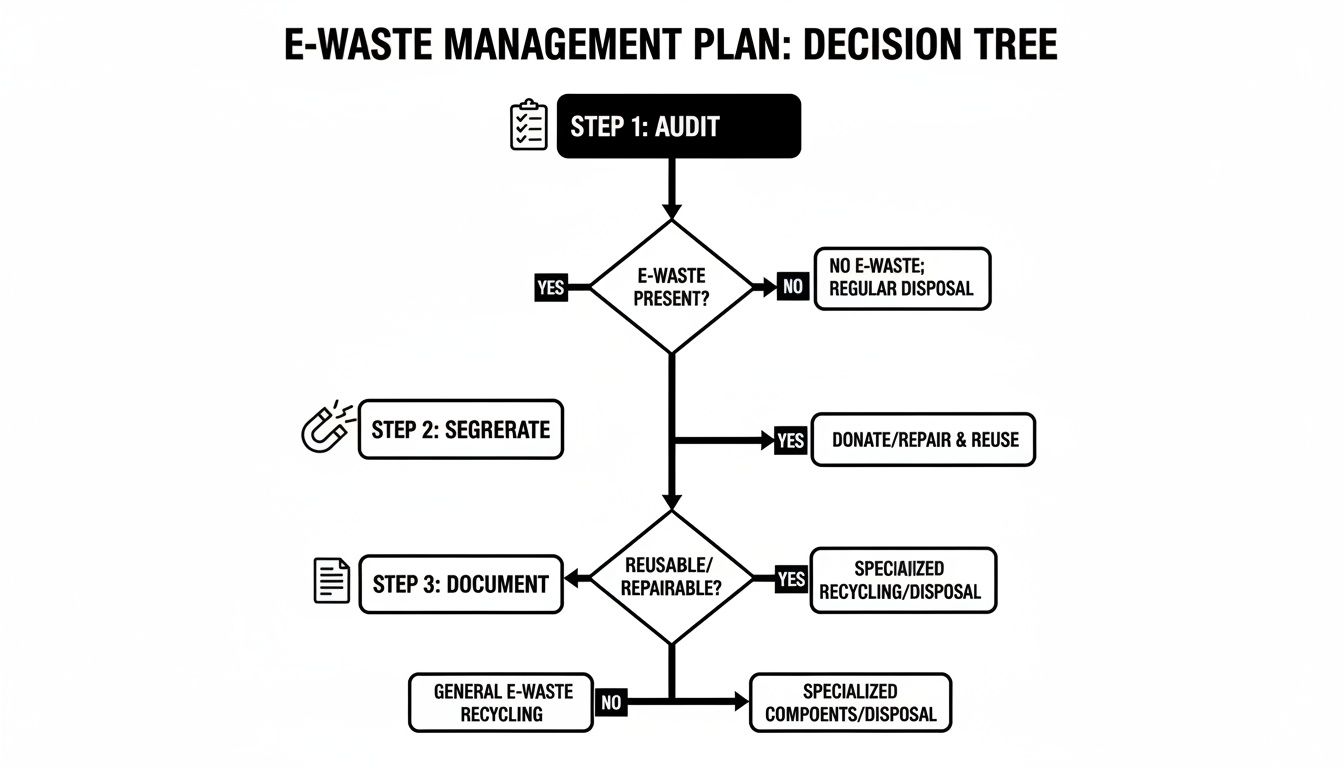
As shown, a successful program starts with a detailed inventory. That initial audit and segregation step informs every subsequent decision, particularly your data destruction strategy.
Meeting Compliance Mandates in Atlanta
For most Atlanta businesses, a documented data destruction strategy isn't just a best practice—it's a legal requirement.
- HIPAA: Any organization handling Protected Health Information (ePHI) must ensure it's rendered completely unreadable and irrecoverable upon disposal. Penalties for non-compliance are severe.
- GLBA: Financial institutions are required to protect consumers' nonpublic personal information (NPI). This includes implementing a formal plan for destroying that data when hardware is retired.
- GPIPA: The Georgia Personal Identity Protection Act (GPIPA) requires businesses to notify residents of a data breach. A breach originating from an improperly disposed hard drive constitutes a clear violation, triggering costly notification obligations and potential legal action.
You can learn more by reading our in-depth guide on secure data destruction in Atlanta.
A certified and auditable data destruction process is your best insurance policy. It provides a defensible position that demonstrates you took every required step to protect sensitive information, satisfying auditors and regulators.
How to Vet and Select an Atlanta Recycling Partner
Choosing your electronics recycling vendor is one of the most critical decisions in your entire IT asset disposition strategy. This is not about finding someone to haul away old equipment. Your partner is a direct extension of your company's security and environmental policies, and a poor choice can expose your Atlanta business to significant financial and reputational risk.
The market is crowded, but not all vendors are created equal. A true B2B specialist in zero-landfill electronics recycling provides a completely different level of service than a residential drop-off center or a general scrap metal yard. You need a partner who understands the demands of a commercial environment, from complex on-site logistics to ironclad compliance.
The Certification Litmus Test
Before discussing services or pricing, the first filter should always be certifications. These are not merely logos for a website; they are hard-earned credentials proving that a recycler adheres to strict, third-party audited standards for data security, environmental processing, and employee safety.
For any Atlanta business serious about responsible e-waste management, these certifications are non-negotiable.
- R2v3 (Responsible Recycling): This is the premier global standard for the electronics recycling industry. An R2v3 certified facility has a proven, documented, and audited process for tracking all materials downstream. It’s your guarantee that your assets won’t be illegally exported or landfilled.
- NAID AAA: This certification focuses exclusively on secure data destruction. A NAID AAA certified vendor undergoes rigorous, unannounced audits of their security protocols, employee background checks, and destruction processes. It provides the highest level of assurance that your sensitive data is handled securely from pickup to final disposition.
If a potential vendor in Atlanta cannot provide you with current R2v3 or NAID AAA certificates, the conversation should end. These are the table stakes for any professional, credible B2B partner.
Key Questions to Ask Every Potential Partner
Once you have a shortlist of certified vendors, it's time for due diligence. Their answers to these questions will reveal their true capabilities and determine if they are the right fit for your company. Be wary of vague or evasive responses.
1. How do you verify and document your zero-landfill policy?
A legitimate partner will detail their entire downstream process. They should explain how they demanufacture equipment into commodity streams (e.g., plastics, metals, circuit boards) and provide documentation tracing those materials to certified downstream processors. Ask to see a sample environmental report or certificate of recycling.
2. Is all processing handled domestically?
This is a critical point. Exporting unprocessed e-waste is a major source of environmental pollution and data security breaches. A responsible partner must confirm that 100% of all sensitive materials and data-bearing devices are processed in the United States, in full compliance with federal and state laws.
3. What are your specific data destruction capabilities?
Do not accept "we wipe hard drives." Demand specifics. Do they offer DoD 5220.22-M 3-pass wiping in alignment with NIST 800-88 standards? Do they operate an industrial shredder for physical destruction? Crucially, can they bring a mobile shred truck to your Atlanta location for on-site shredding to achieve maximum security?
Evaluating Their Logistical Competence
A great recycling program can fail if the logistics are poorly executed. Your partner must be equipped to handle the realities of a commercial pickup. When vetting any external vendor, using tools like third party risk management software can provide powerful oversight into their compliance and security posture, ensuring your selection meets all corporate standards.
Assess their operational capabilities by asking:
- Do you offer on-site services? For large-scale projects like a data center decommission or an office-wide refresh, you need a team that comes to you. This includes services like de-installing servers from racks, palletizing equipment, and securely loading everything for transport.
- What does your chain-of-custody documentation look like? Request a sample. It should be a detailed, serialized report that tracks your assets from the moment they leave your facility to their final disposition. This document is your proof of compliance. To learn more about what to look for, check out our guide on finding the right electronic waste recycling company.
- How do you manage pickups at secure facilities? If you operate in healthcare, finance, or a government-regulated space, your vendor must have experience navigating visitor protocols, background checks, and access to restricted areas.
Ultimately, choosing the right partner is about building trust and verifying their ability to deliver securely and professionally. By asking these pointed questions and demanding proof through certifications and sample documentation, you can confidently select a recycler that will protect your business and uphold your commitment to a true zero-landfill strategy.
Executing a Smooth E-Waste Pickup and Disposition
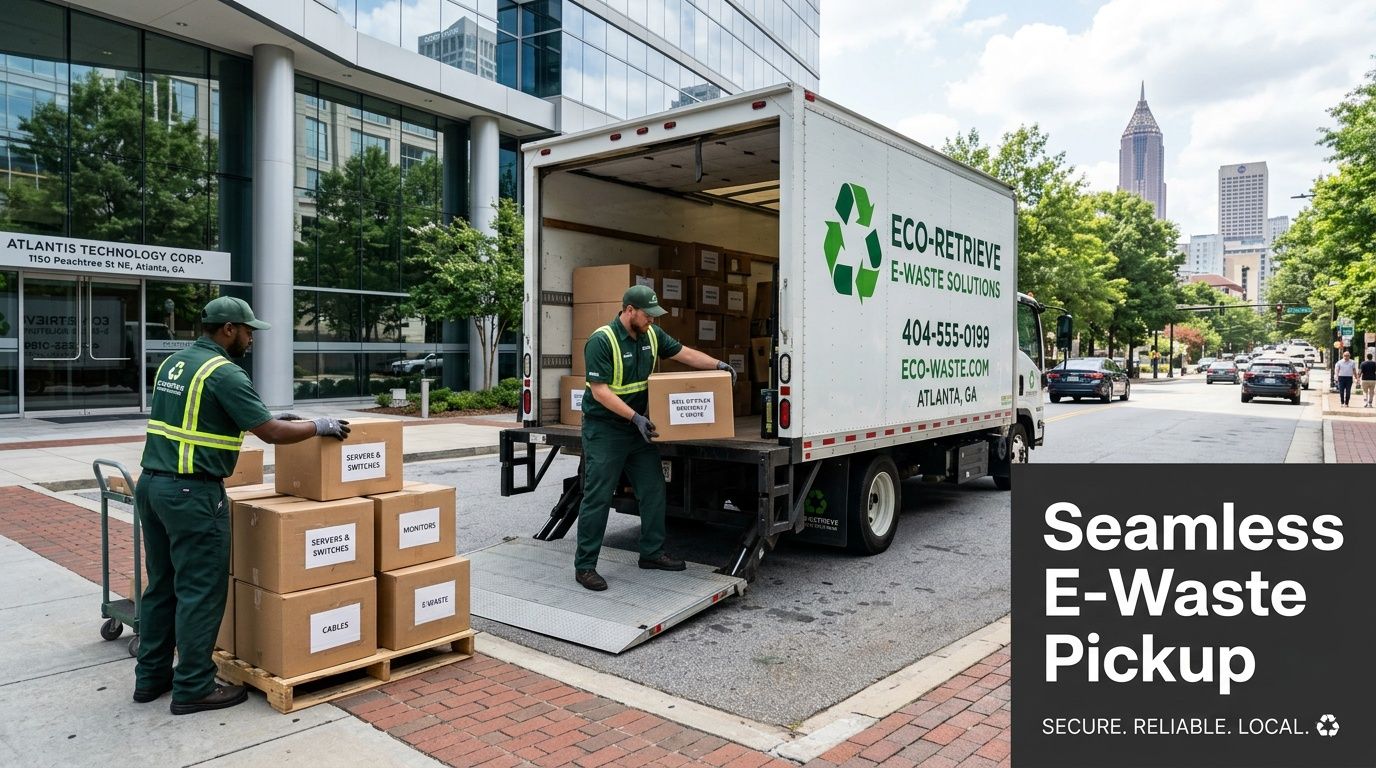
This is where your strategic planning translates into action. A successful e-waste project culminates in a logistical execution that is secure, efficient, and minimally disruptive to your core business operations.
Whether you're clearing out a single IT closet or decommissioning an entire office, the pickup process requires precise coordination. We understand that a commercial pickup in a busy Atlanta high-rise is fundamentally different from a residential drop-off. A true B2B recycling partner should operate as a seamless extension of your facilities and IT teams.
Coordinating On-Site Logistics and De-Installation
Clear communication with your vendor is the first step to a flawless pickup. Before their truck arrives, you should provide your finalized asset inventory list. This allows the partner to plan for the correct truck capacity, bring necessary equipment like pallet jacks and secure bins, and assign a team with the right skills for the job.
Key logistics to coordinate with your partner include:
- Scheduling: Work together to select a date and time that causes the least disruption to your operations. For major cleanouts, this often means scheduling after business hours or on a weekend.
- Site Access: Provide clear, detailed instructions for building access, security check-in procedures, freight elevator usage, and specific loading dock areas.
- On-Site Services: If you're retiring a data center, confirm that your vendor’s team will handle the physical de-racking of servers, switches, and other hardware. This specialized service saves your IT staff a significant amount of time and physical labor.
When executed correctly, a professional pickup should be almost invisible to your daily workflow. The right partner handles all the heavy lifting. You can learn more about our process by reading our guide on scheduling an IT equipment pickup in Atlanta.
Real-World Example
A mid-sized Atlanta law firm recently needed to retire 150 workstations following a hardware refresh. Their top priorities were ironclad HIPAA compliance for the old hard drives and zero disruption to their attorneys' billable hours.
By scheduling a phased weekend pickup, their ITAD partner de-installed and removed equipment one floor at a time. All hard drives were serialized on-site before being transported in locked bins for secure shredding. The firm received full, auditable documentation, achieving both zero landfill impact and verifiable data security without impacting a single business day.
Documentation: The Final, Critical Step
The project isn't finished when the truck departs. It is only complete once you have a full set of documentation in hand, providing a clear, auditable trail that proves your assets were managed according to your corporate policy. This paperwork is your official proof of compliance and due diligence.
Your documentation package from any top-tier recycling partner must include two key items:
- A Serialized Chain-of-Custody Report: This document must correspond to the inventory you provided, confirming that every single asset was received and tracked by serial number through the process.
- Certificates of Data Destruction and Recycling: This is the most crucial deliverable. You should receive a formal certificate detailing how your data was destroyed (e.g., shredding to specific particle sizes, per NIST 800-88 guidelines) and confirming that all materials were recycled according to zero-landfill principles.
These documents are more than just receipts; they are your legal defense in a potential compliance audit and a testament to your company’s commitment to environmental and data security standards. Insist on receiving, verifying, and archiving these records as a core component of your zero landfill electronics recycling Atlanta GA program.
Clearing Up Common E-Waste Recycling Questions for Businesses
Even with a thorough ITAD plan, a few final questions often arise. We get it. Here are direct answers to the questions we hear most often from Atlanta-area IT managers and business owners, designed to help you finalize your disposition strategy.
What Range of Equipment Can We Recycle?
A common concern for businesses is whether one partner can truly handle the full scope of their retired technology. The last thing you need is a vendor who only takes certain items, leaving you to find other solutions for the rest.
A true commercial partner should serve as your single point of contact for all e-waste. We accept and responsibly process nearly all business-related electronics, providing a one-stop solution for your zero landfill electronics recycling in Atlanta, GA.
This includes the full spectrum of corporate IT assets:
- Data Center Equipment: Servers, SANs, server racks, and uninterruptible power supplies (UPS).
- Networking Gear: Switches, firewalls, routers, and modems.
- Office & End-User Devices: Laptops, desktops, monitors (both LCD and CRT), docking stations, and peripherals like mice and keyboards.
- Mobile Devices: All company-issued smartphones and tablets.
- Miscellaneous Office Technology: Printers, scanners, copiers, and telecommunications systems.
This all-inclusive approach ensures everything—from a single pallet of laptops to an entire data center's worth of hardware—is managed under one secure, documented, and compliant process.
The biggest mistake we see is businesses assuming all recyclers offer the same scope of service. A professional B2B partner specializes in commercial-scale projects. That means having the logistical capacity and expertise to handle everything from a few hundred devices to multiple truckloads during an office move or a full data center decommissioning.
Is a Certificate of Recycling the Same as a Certificate of Data Destruction?
Absolutely not. Understanding this distinction is critical for protecting your business from a data breach and ensuring compliance. They are two separate documents that serve two different, but equally important, purposes.
A Certificate of Recycling is your proof of environmental stewardship. It confirms that your electronic assets were processed responsibly according to zero-landfill standards and not illegally dumped. It speaks to your company's ESG commitments.
A Certificate of Data Destruction, on the other hand, is the legal document proving that all sensitive data was permanently destroyed in a compliant manner. This certificate, which must list device serial numbers, is your key to proving compliance with regulations like HIPAA, GLBA, or the Georgia Personal Identity Protection Act (GPIPA).
How Can We Be Certain Nothing Goes to a Landfill?
This is the core promise of a zero-landfill policy, and you should demand more than just a verbal assurance. True certainty comes from partnering with a recycler who operates with a transparent, auditable process.
Your first step is to vet your partner's credentials. Ask to see their environmental policy in writing and, most importantly, confirm they hold a current R2v3 (Responsible Recycling) certification. This is the premier global standard, and it legally requires certified recyclers to track their entire downstream material flow.
An R2v3 certified partner can provide a complete chain-of-custody paper trail, showing you exactly where demanufactured commodities like plastics, metals, and circuit boards are sent for reuse. It’s the only way to have complete confidence that your old equipment is fueling a circular economy, not creating a future landfill liability for your company.
Ready to implement a secure, compliant, and truly zero-landfill electronics recycling program for your Atlanta business? Atlanta Computer Recycling offers end-to-end ITAD services tailored for commercial needs, from on-site pickups to certified data destruction. Contact us today to get started.