Fulton County GA Chamber of Commerce: North vs. South


The most common advice on the fulton county ga chamber of commerce question is also the first mistake. People search as if Fulton County has one central chamber, one membership desk, and one event calendar. It doesn’t.
If you're leading business development for a commercial service firm, that misunderstanding costs time. You can join the wrong organization, show up to the wrong rooms, and spend a quarter meeting people who will never buy what you sell.
In Fulton County, chamber strategy starts with geography, buyer type, and operating model. A healthcare-facing IT services company should think differently than an industrial contractor. A firm targeting municipal buyers should work the market differently than one selling into corporate headquarters. That’s why a generic “join the chamber” recommendation usually falls flat.
The smarter move is to treat Fulton as a set of distinct business ecosystems. If your work touches northern Atlanta business districts, this local context matters as much as your offer. For businesses trying to map that footprint more precisely, this overview of Buckhead and Fulton County business service coverage is a useful local reference point.
Navigating the Fulton County Chamber Landscape
The phrase “Fulton County Chamber of Commerce” sounds official. It also creates the wrong mental model.
There isn't a single county-wide chamber coordinating all business activity across Fulton. Businesses instead deal with separate regional organizations, and that split changes how you build partnerships, pursue procurement opportunities, and decide where to invest membership dollars.
For a B2B company, this isn't semantics. It affects who attends events, which industries dominate the room, and whether your membership translates into real introductions. If your ideal clients sit in Alpharetta, Roswell, or Milton, your chamber approach should look different from a company focused on South Fulton municipalities, airport-adjacent operations, or industrial users.
Why search intent and market reality don't match
Search engines flatten local business structures. Buyers type one county name and expect one governing organization. Fulton doesn't work that way.
The practical consequence is simple:
- Wrong assumption: You look for one master chamber that covers all of Fulton.
- What actually happens: You encounter separate chambers with different service areas and relationship networks.
- Business impact: Your outreach gets broader but weaker.
Businesses usually don't need more networking. They need the right room, with the right mix of decision-makers.
What experienced operators do instead
Strong chamber users don’t start with dues. They start with buyer mapping.
They ask a short list of questions first:
- Where are our target accounts concentrated?
- Who signs or influences the purchase?
- Which chamber is closest to that decision-maker network?
- Can we contribute expertise, or will we just attend events passively?
That framing turns the chamber from a civic membership into a business development channel. For commercial services, that’s the only lens that matters.
The Reality of Chamber Representation in Fulton County
The cleanest way to understand Fulton County is this. Fulton County is a geography, not a unified chamber system.
The confusion persists because companies expect county-level business representation to mirror county government boundaries. In practice, chamber coverage follows local economic communities and regional business identities.
Core fact: There is no unified county-wide chamber, but rather distinct organizations like the Greater South Fulton Chamber of Commerce and the Greater North Fulton Chamber of Commerce, leaving many businesses unsure how to select the right one for B2B networking, as noted by the Greater South Fulton Chamber.
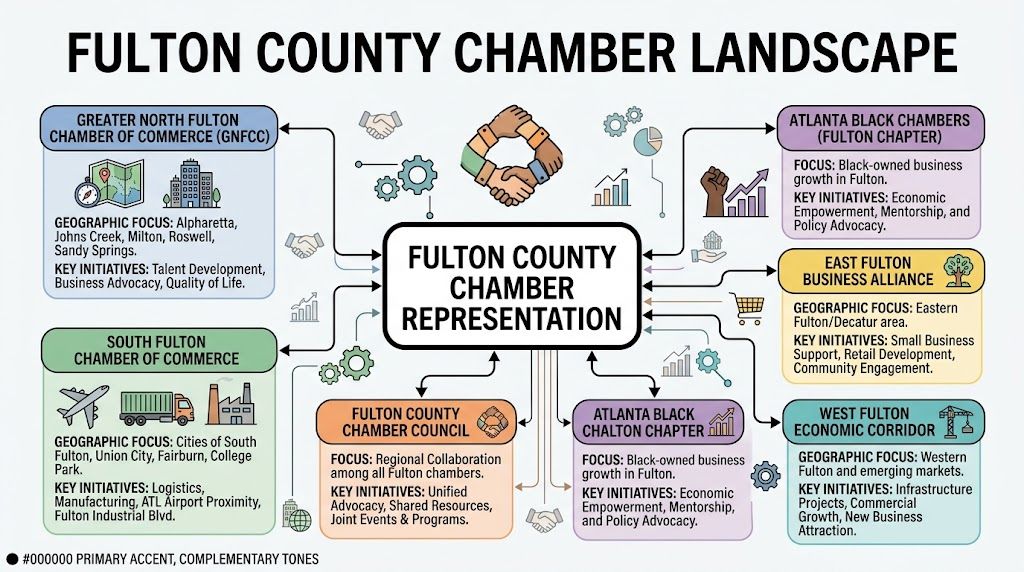
The two names most businesses need to know
When most commercial firms ask about a Fulton chamber, they’re usually trying to identify one of these regional bodies:
Greater North Fulton Chamber of Commerce
Serves the northern portion of Fulton County and operates in a business environment closely tied to corporate services, technology, and professional networks.
Greater South Fulton Chamber of Commerce
Serves South Fulton communities and offers a different relationship map, often more relevant for firms focused on local business growth, public-facing services, and region-specific partnerships.
That distinction matters because chamber value comes from adjacency. You join to get closer to the people who buy, refer, influence, regulate, or partner. If those people aren’t active in the chamber you chose, the membership may still be reputable, but it won’t be productive.
Why the split is actually useful
A single giant county-wide chamber would sound simpler. It would also be less targeted.
Regional chambers often work better for B2B teams because they create tighter circles of familiarity. Members see each other repeatedly at breakfasts, committee meetings, policy discussions, and sponsor-led events. That repetition helps move a company from unknown vendor to recognized local operator.
A practical screening method is to evaluate each chamber on three things:
- Buyer density: Are your likely customers active there?
- Partner fit: Are there adjacent firms that can introduce you?
- Conversation quality: Do events produce useful follow-up meetings?
If you can't picture three real prospects or partners you'll likely meet through a chamber, you're not ready to join yet.
Businesses that understand this early avoid one of the most common mistakes in metro Atlanta business development. They stop looking for a fictional county-wide gateway and start choosing a regional platform that matches how they sell.
Choosing Your Chamber North Fulton vs South Fulton
If you're deciding between North Fulton and South Fulton, don't frame it as a branding choice. Treat it like territory planning.
The best chamber for your business is the one that puts you in front of the right commercial relationships most often. That means looking at market composition, not just event photos or membership language.
What North Fulton signals to a B2B seller
Historically, the North Fulton County Chamber of Commerce operated at meaningful scale, with approximately 1,800 members, and about three-quarters were small businesses employing fewer than 20 people, according to Georgia Trend’s reporting on North Fulton business growth. That tells you two useful things.
First, North Fulton has long supported a broad business base rather than only large enterprises. Second, a commercial services company entering that market should expect to meet both small operators and larger organizations through layered referral networks.
If your service model benefits from accountants, MSPs, property managers, facilities groups, legal firms, or outsourced technology advisors opening doors, North Fulton can be attractive. A broader small-business base often means more connectors in the room.
What South Fulton tends to mean in practice
South Fulton requires a different commercial posture. The pitch usually needs to be more local, more operational, and more grounded in community relationships.
That doesn't make it smaller in opportunity. It changes the path to trust. In many cases, companies gain more traction by showing up consistently, aligning with local business priorities, and building credibility through service relevance instead of purely polished branding. For teams evaluating municipal and southern metro footprints, this look at the City of South Fulton commercial environment helps connect geography to actual business planning.
North Fulton vs South Fulton Chamber Comparison for B2B Tech Services
| Criterion | Greater North Fulton Chamber (GNFCC) | Greater South Fulton Chamber (GSFCC) |
|---|---|---|
| Primary business feel | More aligned with professional services, technology-forward businesses, and corporate-facing networking | More aligned with regional growth, local business relationships, and community-centered commercial engagement |
| Buyer access style | Often stronger for firms selling through referrals, strategic partnerships, and executive networking | Often stronger for firms selling through local presence, trust-building, and sustained regional visibility |
| Typical networking payoff | Useful when your team needs introductions to service buyers, advisors, and business influencers | Useful when your team needs local market familiarity and direct ties to South Fulton business communities |
| Membership profile | Historical scale included approximately 1,800 members, with about three-quarters small businesses under 20 employees | Qualitative fit is more important than scale. Assess event relevance and member overlap with your target accounts |
| Best fit for tech services | Strong fit for managed services, cybersecurity, IT support, compliance consulting, and other B2B offerings that depend on recurring relationships | Strong fit for providers serving local organizations, operational sites, public-facing entities, and relationship-driven service lines |
| Sales motion that works | Consultative, referral-heavy, insight-led | Locally rooted, relationship-first, operationally practical |
| What usually doesn’t work | Joining and expecting large enterprise deals without committee participation or follow-up | Showing up with a broad metro pitch that ignores local priorities and decision paths |
A simple decision filter
Use this test before you join:
- Choose North Fulton if your ideal client sits in a professional office, corporate environment, or tech-forward operating context.
- Choose South Fulton if your ideal client is more likely to value local visibility, operational responsiveness, and regional trust.
- Use both carefully if your company has enough sales capacity to follow up consistently in two separate networks.
For most firms, one well-used chamber beats two neglected memberships.
Key Membership Benefits for B2B Technology Firms
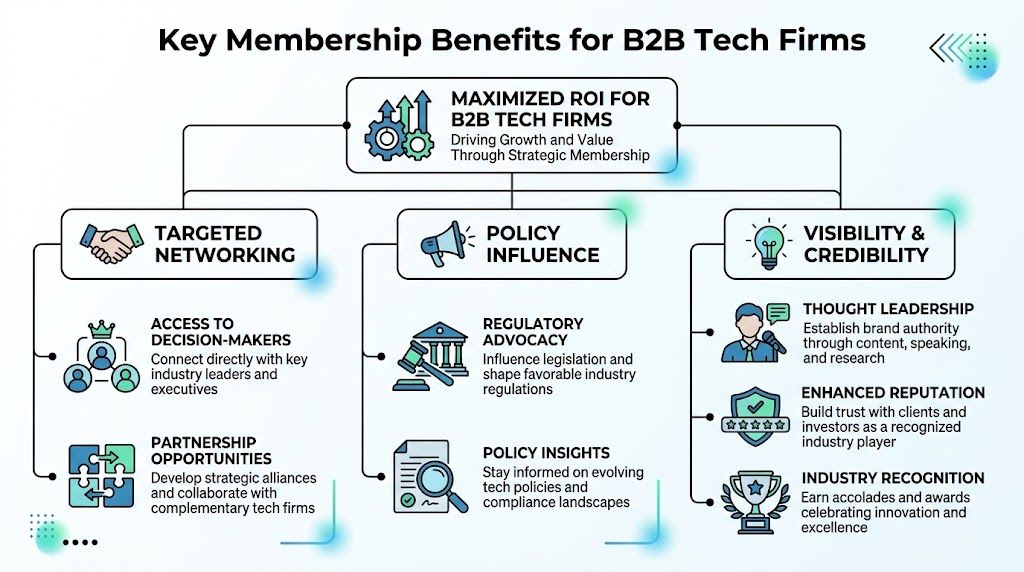
A chamber membership only pays off when it improves deal flow, market access, or credibility. For B2B technology firms, the strongest value usually comes from combinations of those three, not from generic “exposure.”
The North Fulton market offers one clue about how a modern chamber can support that work. The Greater North Fulton Chamber of Commerce utilizes over 29 web technologies, including analytics tools like Hotjar, according to its technology profile. That doesn't guarantee results on its own, but it does signal a tech-forward operating culture that tends to align better with advanced service providers.
What actually creates ROI
For technology and commercial service firms, chamber value usually comes from four practical channels:
- Warm introductions: Membership can shorten the path to operations leaders, finance contacts, facilities teams, and outside advisors who influence vendor selection.
- Higher trust on first contact: Chamber affiliation won't close a deal, but it can lower skepticism when you're approaching buyers who don't know your firm.
- Partnership Advantage: Many chamber wins come through adjacent providers. MSPs, office movers, brokers, legal advisors, and compliance consultants often create stronger referral routes than direct cold outreach.
- Better local intelligence: You hear which companies are moving, consolidating, hiring, opening facilities, or changing vendors before that information becomes obvious in the market.
Where firms miss the point
Some companies join and immediately ask for leads. That almost never works.
What does work is using the chamber as a relationship framework around a disciplined outreach system. If your internal process is weak, chamber activity just adds noise. If your process is solid, membership can improve message relevance, contact quality, and response rates. Teams refining that outreach side can pair chamber work with these proven B2B lead generation tactics from Feather to tighten follow-up and qualification.
Practical rule: A chamber should amplify your sales motion, not replace it.
Benefits that matter for procurement-minded buyers
Commercial buyers respond to clarity and risk reduction. Chamber membership can help when your firm needs to look established, responsive, and easier to validate.
That’s especially true when your team is building local credibility around process-heavy services, vendor onboarding, or secure handling requirements. Buyers often don't need another brochure. They need evidence that your company understands procurement realities and can communicate cleanly. This guide to IT procurement best practices is a good example of the type of operational framing that tends to resonate in those conversations.
A membership is most valuable when it gives your company repeated chances to demonstrate competence in public, not just advertise privately.
Using Chamber Events for Strategic Partnerships
Most chamber event advice is too soft. “Go network” isn't a strategy.
Treat events like field meetings. Each one should have a target account hypothesis, a partner hypothesis, and a follow-up plan. That matters even more in a growing county. The Georgia Chamber Data Hub projects Fulton County’s population to reach 1,109,720 by 2025, and that projected expansion increases the need for service capacity and business connections in the market, according to the Georgia Chamber Data Hub.

How to work an event before you arrive
A productive event starts the day before, not at check-in.
Review the attendee list if it's available. If it isn't, review sponsors, speakers, board members, and recent chamber posts. Build a short target list with three categories:
- Direct prospects you want to understand better
- Referral partners who already advise those prospects
- Market interpreters who know what's changing locally
That prep keeps you from drifting into low-value conversations. It also gives your team a reason to attend events selectively instead of reactively. If you track business development by geography, this look at Suwanee event strategy and local engagement patterns offers a useful model for thinking beyond simple attendance.
What good event conversations sound like
The strongest chamber conversations are specific. They don't start with “We do a little bit of everything.”
A better approach is to anchor your introduction in a real operating problem. For example, a tech services company might ask how a business is handling office transitions, vendor consolidation, hardware lifecycle planning, or compliance-driven technology changes. Those topics invite operational discussion instead of polite small talk.
The fastest way to waste a chamber event is to pitch too early. The fastest way to get traction is to ask a sharp question tied to a business process.
What follow-up separates professionals from attendees
Many individuals collect cards and send a generic email. That doesn't move anything.
A stronger sequence looks like this:
- Same day: Send a short note tied to the exact conversation
- Next step: Offer one relevant idea, introduction, or resource
- Within a week: Ask for a focused meeting with a reason
- After that: Keep them in a low-noise follow-up rhythm
The event itself is rarely the opportunity. The event reveals whether there’s an opportunity worth pursuing.
A Roadmap for Joining and Maximizing Your Membership
The chamber system in Georgia has staying power. The Georgia Chamber of Commerce was officially incorporated in 1915, following earlier organizing activity that began in 1911, and it has since grown into a broad advocacy network with over 180 local and binational chambers under its umbrella, according to the Georgia Chamber’s historical overview. That history matters because you're not joining a novelty. You're entering an established business institution.

The first 30 days
Start with clarity, not enthusiasm.
Book an introductory conversation with the chamber team and explain your goals in business terms. Name the buyers you want to reach, the industries you serve, and the kinds of partnerships that matter. If you stay vague, the chamber can't point you toward the right people.
Then build a simple internal brief:
- Ideal accounts: List the company types that match your offer
- Ideal partners: Identify firms that can refer or bundle with you
- Ideal events: Choose only the formats where those people are likely to show up
Days 31 through 60
Visibility matters, but forced visibility backfires.
Attend a small number of events consistently enough that people recognize your firm. Join one committee or working group where your expertise makes sense. If your company can contribute on operations, technology, compliance, hiring, or business continuity, make that visible through participation rather than self-promotion.
Membership works best when other members can explain your value clearly, even when you're not in the room.
Days 61 through 90
By this point, your company should move from attendee to contributor.
That can mean sponsoring a relevant event, offering a concise educational session, or making targeted introductions inside the membership community. Keep the topic practical. Procurement, data security, technology planning, office transitions, and sustainability all tend to land better than broad brand messages.
A simple 90-day scorecard helps:
- Meetings booked
- Useful partner conversations
- Relevant follow-ups still active
- One visible contribution to the chamber community
If those are all at zero after three months, the problem usually isn't the chamber. It's the engagement plan.
Building Your Fulton County Growth Engine in 2026
A useful fulton county ga chamber of commerce strategy starts with accepting the actual structure of the market. There is no single switch to flip. There are regional chambers, different buyer communities, and different paths to trust.
That’s good news for disciplined B2B teams. It means you can choose your ground instead of broadcasting everywhere. North Fulton and South Fulton don't require the same message, the same cadence, or the same partnership model. Companies that respect those differences usually waste less effort and build stronger local traction.
There’s also a gap smart firms can own. One underserved angle in Fulton County is the lack of chamber-linked discussion around sustainable business practices like IT asset disposition and e-waste diversion, which creates an opening for companies to lead on green IT disposal for offices, schools, and data centers, as reflected in the Development Authority of Fulton County material. For commercial service companies, that kind of whitespace is valuable. If your expertise sits in a topic chambers haven't fully organized around, you can become the person members remember.
A strong chamber plan should sit inside your wider growth system, not outside it. Teams thinking about market positioning, local partnerships, and repeatable account development can borrow from these small business growth strategies from ReachLabs.ai while adapting them to Fulton’s regional chamber reality. For a more local view of service territory and commercial opportunities, this guide to Fulton County business support and electronics recycling logistics is also worth reviewing.
Use the chamber as an engine, not an accessory. Pick the right region, show up with intent, contribute expertise, and build around real buying networks.
If your organization needs secure, business-focused IT asset disposition in metro Atlanta, Atlanta Computer Recycling provides end-to-end support for commercial electronics recycling, data destruction, pickups, de-installation, and data center equipment removal. The team works with businesses, schools, healthcare organizations, government departments, and other institutions that need practical service, strong data handling, and responsible e-waste processing across Fulton County and the greater Atlanta market.