Atlanta’s Increasing Need for Data Center Services

Atlanta's data center market is projected to reach 1.82 GW of installed IT power in 2026. For operators, that number matters less as a headline than as a warning. More capacity means more hardware coming in, more hardware coming out, and more opportunities to lose control of data-bearing assets during refreshes, consolidations, and site exits.
That pressure shows up well before a full shutdown. Teams expanding into new colocation space, replacing aging racks, or shifting workloads to better-designed environments often focus on deployment first. In practice, the overlooked work is retirement. Displaced servers, storage arrays, network gear, and backup appliances still carry chain-of-custody risk, audit exposure, and disposal costs until they are wiped, documented, and removed properly.
This is the part of the boom that gets missed, even by companies investing in expert data center design. Growth changes the front end of infrastructure planning, but it also raises the stakes at end of life. If your business operates IT equipment in Atlanta, secure decommissioning and compliant IT asset disposition need to be planned before the next migration starts, not after equipment starts piling up in a cage or storeroom.
Atlanta's Data Center Boom and Your Business
Atlanta's data center market is projected to reach 1.82 GW of installed IT power in 2026 and continue climbing sharply through the end of the decade. For businesses operating in that environment, the practical issue is not only new capacity coming online. It is the volume of equipment that gets displaced as companies refresh, consolidate, and relocate infrastructure.

I see the same gap in fast-growth markets repeatedly. Teams budget for deployment, cutover, and occupancy. They leave retirement work loosely defined, then discover old servers, storage, network gear, and backup media are still sitting on the books and still carrying data risk weeks after the migration is supposed to be finished.
That gap becomes expensive quickly.
The first signs usually show up in operations, facilities, and compliance at the same time:
- Space gets tied up: retired assets sit in cages, closets, and staging areas because pickup, wiping, and documentation were never assigned to one owner.
- Projects stay open longer: production may be moved, but the old environment cannot be signed off until equipment is removed and records are closed out.
- Security exposure remains: failed drives, backup appliances, and partially decommissioned hardware stay in circulation longer than policy allows.
- Asset records drift: IT, finance, security, and facilities often end up tracking the same equipment differently once a move happens fast.
Businesses planning growth in Atlanta need lifecycle planning to start earlier. Facility decisions around loading access, staging space, chain of custody, and removal windows affect how cleanly a site can be cleared later. Companies investing in expert data center design should account for decommissioning at the same time they review power, cooling, and rack layout.
For companies expanding local infrastructure, this broader pattern also tracks with Atlanta's growth in enterprise technology adoption. More technology entering the market means more technology reaching end of life, often on a tighter schedule than internal teams expect.
The cleanest decommissioning projects start before the first migration date is set.
The Market Forces Driving Unprecedented Growth
Atlanta has moved into a category where demand is no longer theoretical. CBRE reported a 0.72% colocation vacancy rate in H1 2025 in metro Atlanta, which means available capacity is being consumed almost as soon as it reaches market (CBRE's H1 2025 Atlanta market profile). That matters for enterprise buyers because tight supply changes behavior. Teams commit faster, expand in phases, and make less room for indecision around legacy environments.
Why operators are choosing Atlanta
The draw isn't one factor. It's the combination of network connectivity, business demand, and utility planning. AI workloads and cloud deployments are pushing operators toward larger footprints with more power density, and Atlanta has become one of the places where that demand is concentrating.
Independent reporting also notes that Atlanta has been the country's hottest data center market since 2023 and that the region has roughly doubled space under construction every six months since mid-2023, while rising from the sixth-largest U.S. hub to the second-largest. For local enterprises, that's more than a headline. It changes vendor lead times, lease flexibility, and the speed at which “temporary” legacy equipment turns into a long-term liability.
A useful companion read is this look at Atlanta's growth in enterprise technology adoption, especially if you're trying to connect broader infrastructure demand with what's happening inside business IT environments.
What this does to decision-making
In a loose market, companies can wait. In a constrained one, they can't.
Here's the practical shift:
| Market condition | What businesses often do |
|---|---|
| Tight vacancy | Lock in capacity before every migration detail is finalized |
| Faster absorption | Move production workloads first and postpone cleanup work |
| Large tenant demand | Reassess whether smaller legacy sites still make sense |
| Utility pressure | Put more scrutiny on power efficiency and hardware age |
That last point matters more than many teams expect. Newer facilities are being built for denser, more efficient operations. Older enterprise environments often weren't. Once leadership sees what modern colocation or hyperscale-grade environments can support, old racks full of underutilized equipment become harder to justify.
Capacity pressure doesn't just affect where you deploy. It affects how quickly you need to retire what no longer fits.
How Market Growth Creates Operational Pressure
The next operational problem is straightforward. New construction raises the standard, and older environments get exposed. CBRE reported 2,076 MW under construction at the end of 2025, a clear sign that modern, high-density space is expanding rapidly (CBRE on Atlanta's fast-growing data center hub). When that kind of capacity enters the market, enterprises start comparing their existing rooms, cages, and inherited hardware against a much higher bar.

That comparison usually leads to one of three decisions. Upgrade in place. Consolidate into fewer environments. Exit and relocate. All three create decommissioning work, and all three create risk if asset handling gets pushed to the end of the project.
What inaction usually looks like
Most organizations don't get into trouble because they made one terrible decision. They get there because they leave old infrastructure half-retired.
Common examples include:
- Powered down but not processed: equipment is no longer in service, but it still contains drives and isn't cleared for removal.
- Moved without a data plan: gear is transported to another room or warehouse without documented sanitization status.
- Split ownership: facilities removes racks, IT owns the servers, security owns the destruction policy, and nobody controls chain of custody.
- Deferred recycling: obsolete hardware piles up because resale value is unclear and nobody wants to authorize disposal.
Those gaps create business friction. They consume floor space. They tie up staff. They complicate insurance, audits, inventory accuracy, and lease closeout. They also increase the odds of downtime if teams are working around abandoned or poorly labeled equipment. This discussion of IT downtime risks for Atlanta companies is useful because downtime often starts with operational disorder, not dramatic failure.
The hidden cost of old gear
Legacy gear carries more than technical debt. It creates handling debt.
A switch that's no longer routing production traffic may still hold configuration data. A storage array that's “been offline for months” may still contain regulated records. Backup appliances, failed drives, and lab equipment are especially easy to overlook because they sit outside the main migration path.
Short-term delay can feel harmless, but it usually makes the job worse later. Asset records drift. Labels fall off. Staff changes roles. Lease deadlines get closer. The last mile becomes chaotic.
Practical rule: If equipment has left production but hasn't entered a documented disposition process, you haven't reduced risk yet. You've just moved it.
What works better
The teams that stay ahead of this pressure do a few things consistently:
- They define end-of-life triggers early. Not every asset should wait for annual cleanup.
- They separate shutdown from disposition. Powering off a server isn't the same as retiring it.
- They assign one project owner. Cross-functional work still needs one accountable lead.
- They clear assets in batches. Small, regular removals are easier to secure than one oversized event.
- They align IT, compliance, and facilities before migration weekend. That's when avoidable mistakes usually happen.
Planning for Secure Data Center Decommissioning
A secure decommissioning project isn't a truck, a few pallets, and a certificate at the end. It's a controlled process that starts with asset truth and ends with documented disposition.
Atlanta operators also need to account for growing local complexity. Reporting on the region's development pipeline notes tighter scrutiny around water usage for cooling, stormwater management, and noise from generators, which adds regulatory and permitting pressure to both new builds and old-site retirement (GovTech on Atlanta's data center growth pressures). That's one reason sloppy decommissioning has become more expensive. It collides with compliance, facilities coordination, and environmental expectations all at once.

A practical overview of the data center decommissioning process is helpful here, especially for teams building a formal runbook instead of handling removals ad hoc.
Start with inventory, not extraction
The first bad decommissioning decision usually happens too early. Teams start pulling hardware before they know exactly what they have.
Build a defensible asset list before anyone removes anything. That list should distinguish between servers, storage, networking gear, PDUs, appliances, loose media, and failed components. It should also identify which assets are leased, which are owned, which hold data, and which require special destruction handling.
A short pre-removal table keeps teams aligned:
| Project area | What must be confirmed |
|---|---|
| Asset control | Serial numbers, rack location, owner, disposition status |
| Data security | Sanitization method, destruction requirement, approval path |
| Facilities | Access windows, lift needs, loading path, power-down dependencies |
| Compliance | Retention rules, certificate requirements, reporting format |
Treat data destruction as a control point
Data sanitization shouldn't be folded into general removal work as if it were just another task on the checklist. It needs its own decision path.
Some assets can be wiped and remarkedeted. Others should be physically destroyed because they're failed, obsolete, encrypted under retired controls, or tied to sensitive workloads. The key is consistency. If your policy says one thing and the crew onsite improvises another, your documentation won't survive scrutiny.
Security and environmental compliance are not separate workstreams during decommissioning. They are the workstream.
Sequence matters more than most teams think
A disciplined project usually follows this order:
- Validation first: confirm the asset list against the room, not just against procurement records.
- Sanitization next: wipe or destroy data-bearing media according to policy before uncontrolled movement.
- Controlled de-installation: remove gear with labels, rack references, and chain-of-custody checkpoints intact.
- Transport and final disposition: move only after packaging, manifests, and receiving procedures are clear.
- Closeout reporting: reconcile what left the site, how it was processed, and what evidence supports it.
What doesn't work is mixing these steps together because the loading dock is available or the project is behind schedule. That's how organizations lose track of drives, miss lease-return obligations, or discover after the fact that equipment was recycled when it should have been destroyed.
Don't ignore the non-server equipment
Many post-project disputes involve assets outside the core compute stack. UPS batteries, KVM gear, rails, cable bundles, patching hardware, spare optics, and old firewalls tend to become “miscellaneous.” That category causes trouble because miscellaneous assets still require ownership, handling, and documentation.
If the room is being vacated, include everything in scope or explicitly document what stays. Partial decommissions fail when everyone assumes someone else is handling the leftovers.
Selecting the Right ITAD Partner in Atlanta
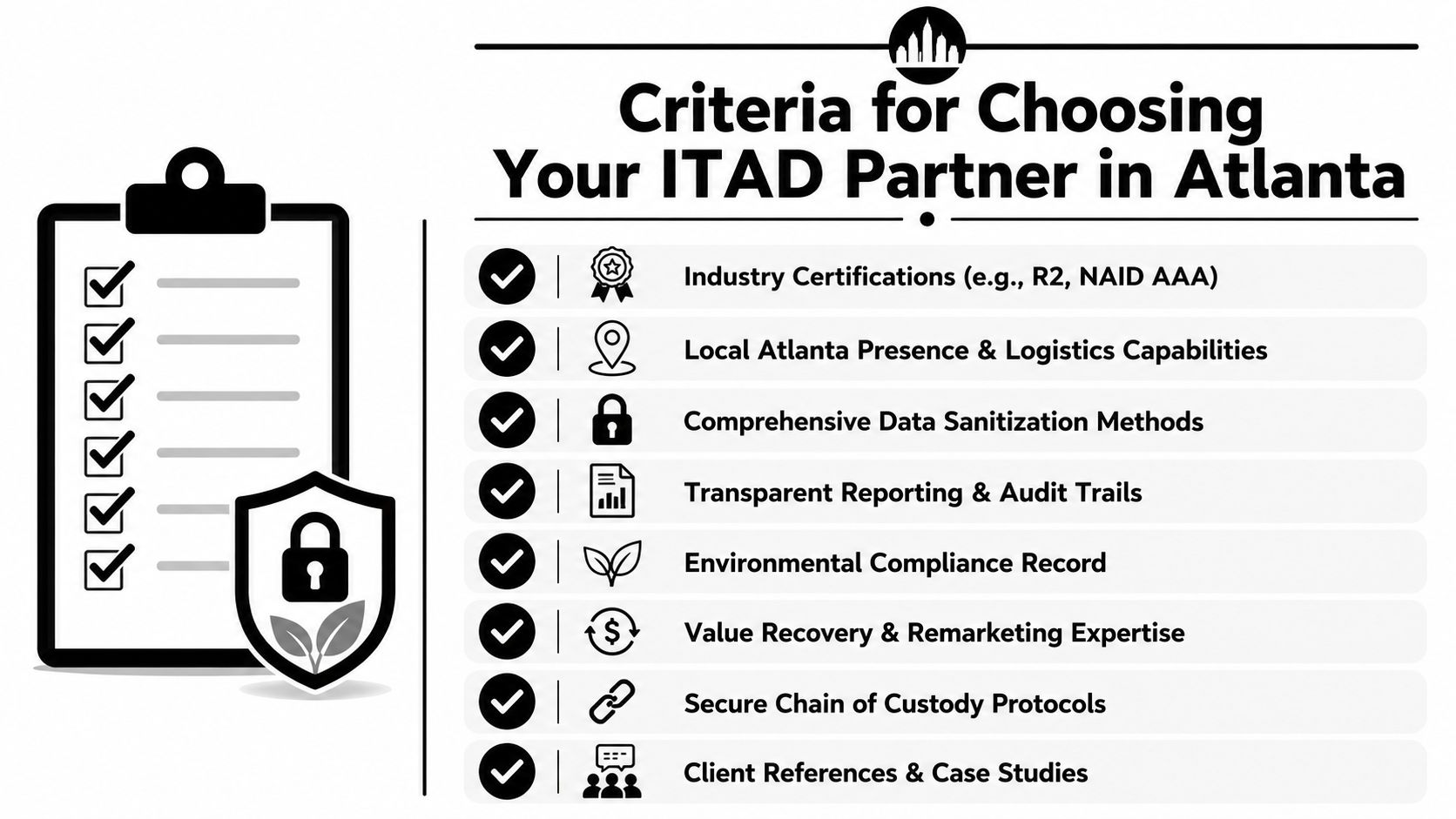
Choosing an ITAD partner in Atlanta isn't mainly about who can show up with a truck. It's about who can control risk when the project stops being simple.
That distinction matters because most decommissioning projects are messy in predictable ways. Asset lists are imperfect. Devices are spread across cages, closets, labs, and temporary storage. Some equipment still has value. Some needs destruction. Some sits in a compliance gray area until somebody with authority makes the call. A qualified ITAD partner knows how to work inside that reality without breaking custody, reporting, or timing.
If you're comparing providers, this page on ITAD services in Atlanta, GA is a useful baseline for what a business-focused service scope should include.
The non-negotiables
Start with controls, not marketing claims.
- Documented chain of custody: You should know how assets move from rack to pallet, from pallet to vehicle, and from vehicle to final processing.
- Clear data destruction methods: A provider should explain when it uses wiping, when it uses physical shredding, and what proof you'll receive.
- Environmental handling discipline: Recycling isn't enough as a vague promise. You need to know how the downstream process is managed and documented.
- Project-ready logistics: On-site de-installation, packing, pickup coordination, and load-out planning matter as much as downstream processing.
A provider that can't explain these basics in plain language usually can't execute them under deadline pressure either.
Questions worth asking before you sign
A good selection process sounds less like procurement theater and more like operational due diligence.
Ask questions such as:
- How do you reconcile asset lists when onsite reality doesn't match the spreadsheet?
- What happens to failed drives or damaged storage devices that can't be sanitized conventionally?
- How do you separate assets for remarketing from assets designated for destruction?
- What documentation do you provide at pickup, in transit, and at final disposition?
- How do you handle equipment spread across multiple rooms or phases of a shutdown?
These questions reveal process maturity quickly. They also show whether the vendor has worked in active enterprise environments, healthcare settings, and data center spaces where access windows, escorts, and sign-off requirements are normal.
What strong partners do differently
Reliable ITAD firms don't just remove hardware. They reduce decision fatigue for your team.
They flag missing serials before pickup day. They ask about compliance obligations before they touch media. They understand that a certificate without accurate asset reconciliation has limited value. They can also support de-installation sequencing so your operations team isn't improvising around live equipment.
One local option in this category is Atlanta Computer Recycling, which provides business ITAD, on-site pickup, de-installation, hard drive wiping using the DoD 5220.22-M 3-pass standard, physical shredding for obsolete or non-functional media, and coordinated data center equipment removal for commercial clients in the metro area. That doesn't remove the need for due diligence, but it does illustrate the type of service mix many Atlanta organizations need when projects involve both logistics and compliance.
A credible ITAD partner should make your inventory cleaner, your audit trail stronger, and your project simpler to close. If the process gets murkier after kickoff, you chose the wrong vendor.
Red flags that deserve attention
Vendor risk often shows up in small signals before it appears in a major failure.
| Red flag | Why it matters |
|---|---|
| Vague answers about destruction | Usually means weak process control |
| No clear manifest procedure | Increases the chance of missing assets |
| One-size-fits-all disposition | Ignores value recovery and compliance differences |
| Heavy focus on pickup speed alone | Suggests logistics are stronger than governance |
| Unclear reporting timelines | Slows audit closeout and internal reconciliation |
You don't need a flashy presentation. You need a provider that can work cleanly through ambiguity, document exceptions, and help your team finish the project with fewer loose ends than it started with.
Building a Future-Ready IT Asset Strategy
Atlanta's increasing need for data center services isn't only about building more capacity. It's about managing the full lifecycle of the equipment that capacity displaces, absorbs, or makes obsolete.
That's the strategic shift many organizations still need to make. Deployment planning gets executive attention because it feels tied to growth. End-of-life planning often gets pushed down the list because it feels administrative. In a market shaped by rapid expansion, facility churn, and tighter operational standards, that assumption no longer holds.
Treat lifecycle planning as infrastructure planning
A future-ready IT asset strategy includes more than procurement and deployment. It also defines who owns retirement decisions, what triggers removal, how data-bearing media is classified, and what documentation closes the loop.
For many businesses, the practical move is to formalize these decisions inside broader IT lifecycle management best practices. That reduces the number of last-minute projects where old equipment sits in limbo after a migration or office consolidation.
What a durable strategy includes
The strongest programs usually share a few traits:
- Defined retirement criteria: teams know when equipment moves from production support to disposition.
- Standing chain-of-custody procedures: custody doesn't get invented during a rushed shutdown.
- Asset reconciliation discipline: finance, IT, and compliance work from the same records.
- Approved vendor pathways: legal and security don't have to restart vendor review for every event.
- Regular cleanup cadence: organizations retire hardware before storage rooms become shadow inventories.
This approach does more than reduce clutter. It protects data, supports audits, shortens project closeout, and frees technical staff to work on active systems instead of babysitting dead ones.
Atlanta's market will keep rewarding organizations that move quickly and operate cleanly. The businesses that handle asset retirement with the same seriousness they bring to deployment will be easier to scale, easier to audit, and less exposed when infrastructure changes happen fast.
If your organization is planning a migration, facility shutdown, hardware refresh, or full data center cleanout, Atlanta Computer Recycling offers business-focused ITAD and decommissioning support across the Atlanta metro area, including secure pickup, data destruction, de-installation, and responsible downstream disposition.