IT Compliance Risks Facing Atlanta Companies: Navigating IT

Most Atlanta IT teams know how to talk about firewalls, endpoint protection, MFA, and patching. Fewer have a clean answer when someone asks a simpler question: what's sitting in the back room right now, and what data is still on it?
That gap matters more in Atlanta than many teams realize. The metro's mix of hospitals, universities, logistics operators, fintech firms, and enterprise data environments creates a dense compliance environment where physical devices often carry the same legal and operational risk as live production systems. A retired laptop with cached files, a backup tape from an old migration, or a decommissioned server pulled from a rack can create the exact kind of exposure auditors, regulators, insurers, and outside counsel care about.
Most compliance failures around retired equipment don't come from dramatic negligence. They come from ordinary operational drift. A storage closet fills up. A department keeps old laptops for “just in case.” A move, merger, refresh cycle, or data center cleanup happens faster than the documentation process. By the time anyone asks for a destruction record or a chain-of-custody log, the answers are incomplete.
Your IT Storage Closet Is a Ticking Compliance Time Bomb
The scenario is familiar. An Atlanta IT manager opens a locked room and sees three generations of laptops, a stack of failed drives, old VoIP gear, retired access points, and a few servers that were pulled during a rushed upgrade. None of it is in production. That's exactly why it gets ignored.
The problem is that retired hardware doesn't become low risk when it leaves the network. In many environments, it becomes harder to control. Production systems usually have monitoring, patching, access restrictions, and some level of formal ownership. Stored equipment often has none of that. It sits outside the normal security workflow, but it may still hold customer records, employee data, patient information, credentials, browser caches, email archives, or backup fragments.
That's where a lot of Atlanta companies get into trouble. They treat old hardware as a facilities issue, a recycling issue, or a procurement cleanup task. It's a compliance issue first.
Old equipment creates risk in quiet ways. Nobody logs into it, so nobody notices it. Nobody notices it, so nobody documents it. Nobody documents it, so nobody can prove it was handled correctly.
The physical lifecycle of technology now has to be part of your control environment. If your endpoint security policy ends when a device is unplugged, your program has a blind spot. Teams working on endpoint security improvements for Atlanta firms usually discover that the handoff from active use to retirement is one of the least disciplined points in the entire device lifecycle.
What usually goes wrong
A few patterns show up repeatedly in medium and large organizations:
- Informal storage: Equipment gets boxed and shelved without tagging the owner, data type, or retirement reason.
- Ambiguous custody: Nobody can say who last handled the device, when it was moved, or whether the drive was wiped.
- Delayed decisions: Assets remain in limbo because finance, IT, security, and facilities all view disposal as someone else's task.
- Incomplete records: When an audit, litigation hold question, or breach review starts, the documentation trail is thin.
In a city where regulated data is common, that's not a minor process flaw. It's a latent incident.
The Atlanta Compliance Landscape Explained
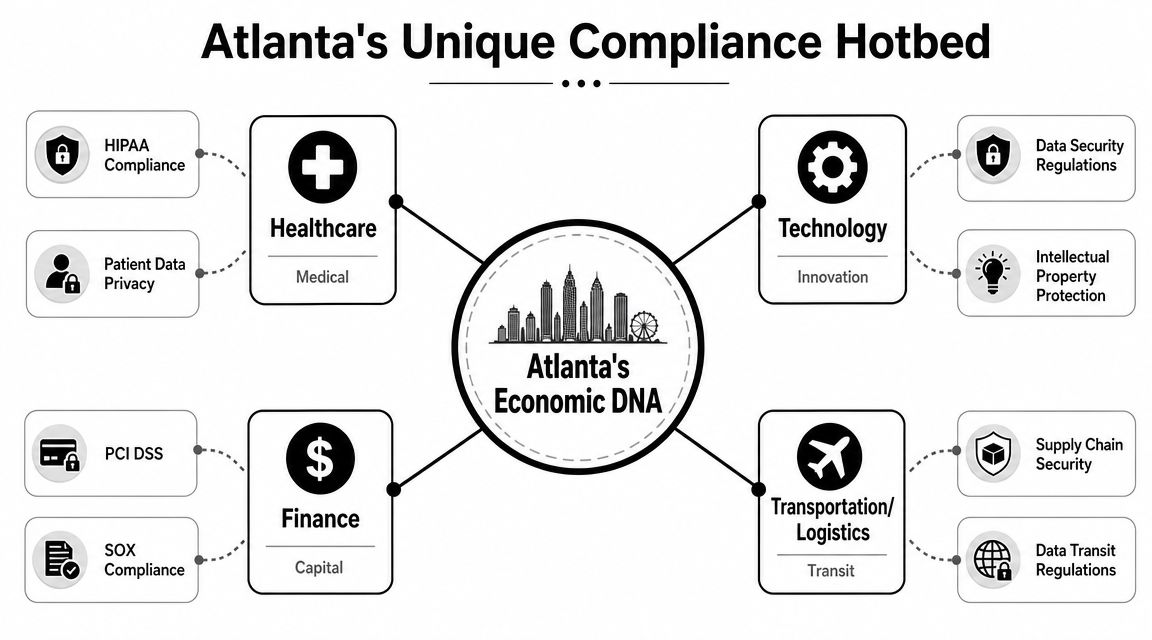
Atlanta creates a different compliance profile than a market dominated by one industry. The city combines healthcare systems, financial services, higher education, logistics networks, and large enterprise technology environments. That mix puts more organizations in contact with regulated data, third-party oversight, vendor security requirements, and audit pressure at the same time.
One Atlanta-focused industry guide reports more than $220 million in confirmed cyber losses tied to local organizations in 2024 and points to weak identity and access management, public cloud buckets, flat network access, and decentralized logging as common control failures in those incidents, according to this Atlanta cybersecurity industry guide. Those are digital control failures, but they tell you something broader about the local market. Many organizations still struggle with basic control consistency across environments, teams, and asset states.
Why Atlanta raises the stakes
Several local business realities push compliance from a policy topic to an operational one:
- Healthcare concentration: Devices often hold or touch sensitive clinical and administrative data, even outside core medical systems.
- Fintech and payment exposure: Equipment retirement can affect cardholder data environments, audit trails, and vendor risk reviews.
- University and school infrastructure: Large fleets of endpoints circulate across departments, labs, classrooms, and administrative offices.
- Logistics and distributed operations: Devices move between sites, warehouses, field teams, and shared facilities, which complicates custody and proof.
That makes IT compliance risks facing Atlanta companies more interconnected than many teams expect. A laptop refresh may involve privacy obligations. A storage cleanup may involve records management. A server decommission may affect environmental handling and legal defensibility at the same time.
Where compliance gets misread
Many companies still think of compliance as a narrow industry obligation. In practice, the baseline has widened. Modern privacy and breach-notification expectations apply far beyond hospitals and banks, and they increasingly focus on whether an organization can demonstrate reasonable safeguards across systems, users, vendors, and documentation.
A related issue is waste handling. Teams that understand data risk sometimes miss environmental handling obligations during disposal events. That's one reason some organizations fold IT retirement planning into broader universal waste management practices instead of treating electronics as an afterthought.
Compliance pressure in Atlanta doesn't come from one regulator or one framework. It comes from overlapping expectations that all ask the same question: can you show control, or are you assuming it?
Sector-Specific Risks and Regulatory Demands
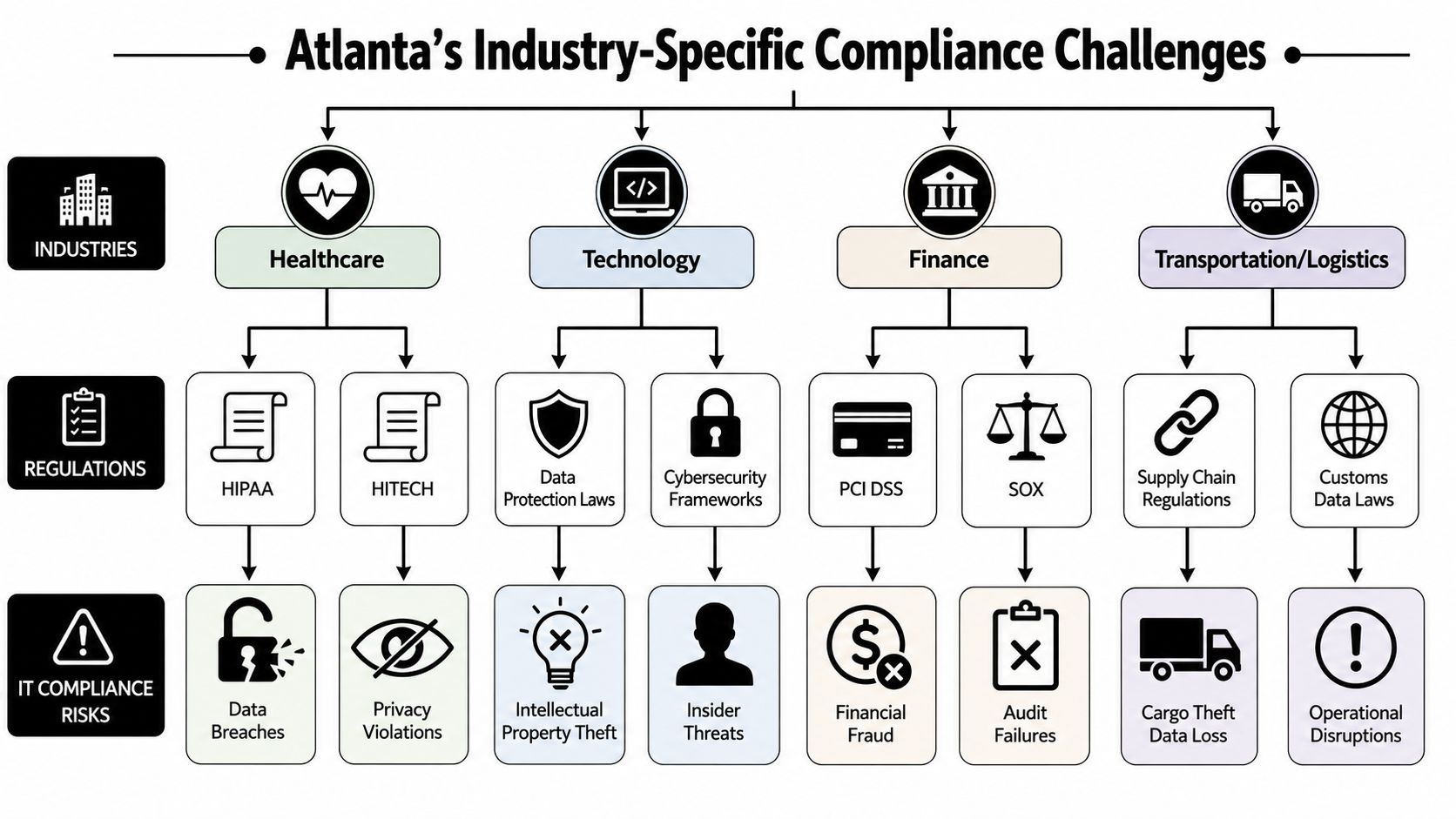
Atlanta's industry mix means the same disposal mistake can create very different consequences depending on who owns the device and what data passed through it. The hardware may look identical. The compliance exposure doesn't.
Georgia ranked 11th in the nation for cybercrime complaints in 2024, with losses surpassing $420 million, and the same reporting notes that over 133 million patient records were exposed nationally in 2023. That's especially relevant in Atlanta's healthcare-heavy market because device retirement can turn an ordinary operations task into HIPAA-related exposure if storage media isn't securely wiped or shredded, as discussed in this Atlanta cyber-risk overview.
Healthcare and clinical operations
Healthcare teams usually understand the sensitivity of live EHR systems. The blind spot is everything adjacent to them. Retired nursing station PCs, imaging workstations, biomedical support systems, copier drives, and old backup media often sit outside the same scrutiny as the core clinical platform.
Common failures include:
- PHI left on secondary devices: Shared workstations, local exports, and cached files survive long after formal use ends.
- Incomplete retirement workflows: Clinical engineering, IT, and facilities don't always use the same sign-off process.
- Poor documentation: The organization can't prove when media was sanitized, destroyed, or transferred.
If you support a hospital or specialty practice, the question isn't just whether data was deleted. It's whether you can prove that deletion method, custody path, and final disposition in a way an auditor or investigator will accept.
Education and research environments
Universities, colleges, and school systems create a different kind of sprawl. Devices move constantly. Labs are repurposed. Departments buy their own hardware. Faculty laptops, registrar systems, admissions offices, bursar teams, and research groups may all follow different retirement habits.
That creates risk when a central IT group assumes local departments are handling disposal correctly, while local departments assume central IT has already approved a process. In practice, old student records, HR files, research datasets, and access credentials often persist on machines nobody has inventoried recently.
A workable approach in education usually includes stronger intake controls during refreshes and clearer separation between reusable assets and media that should go straight to destruction.
Finance, payments, and corporate operations
Financial services and payment-heavy businesses tend to have better formal controls on active systems. Their weak point is often edge equipment and business-process sprawl. Think call center desktops, branch devices, retired point-of-sale hardware, file servers kept for reference, and employee laptops that handled shared spreadsheets, downloaded reports, or exported customer data.
A few recurring issues stand out:
| Risk area | What it looks like in practice |
|---|---|
| Access evidence | Missing logs showing who handled a device before retirement |
| Data residue | Local files remain on endpoints outside managed storage |
| Vendor oversight | A disposal provider can move equipment without giving usable audit records |
| Mixed inventories | Regulated and non-regulated assets get processed together without classification |
Logistics and distributed enterprises
Atlanta's logistics and transportation footprint creates a custody problem as much as a data problem. Devices may sit in depots, warehouses, vehicles, remote offices, and third-party sites before anyone schedules retrieval. That increases the chance that equipment retirement becomes fragmented.
If your organization has multiple facilities, don't assume a disposal policy becomes real once it's published. It becomes real only when every site follows the same intake, storage, release, and documentation process.
For these organizations, the strongest control is usually operational discipline. Standard pickup rules, labeled containers, approved handoff points, and a single documentation standard matter more than a polished policy nobody uses.
The Hidden Threat of Improper IT Asset Disposition
Organizations often spend far more time discussing cyber defense than IT asset disposition. That's understandable, but it creates a serious imbalance. A server in production gets scrutiny from IT, security, and leadership. The same server, once retired, often gets downgraded to a logistics task.
That's backwards.
The financial exposure from compliance failures is large enough that disposal mistakes should be treated as board-level operational risk. A compliance benchmark cited the average global cost of compliance at $5.47 million, while the average cost of non-compliance reached $4,005,116 in revenue losses and was reported to be more than twice the cost of maintaining compliance. The same benchmark also reported an average data breach cost of $3.86 million and a cost of about $148 for each lost or stolen record, according to Hyperproof's compliance benchmark summary.
Why retired hardware is so often mishandled
Teams underestimate disposal risk for a few practical reasons:
- It feels inactive: People assume unplugged devices are harmless.
- Ownership blurs: Security, infrastructure, desktop support, facilities, and procurement all touch the process.
- DIY methods create false confidence: A quick format, manual file deletion, or undocumented wipe often gets treated as “good enough.”
- Vendor assumptions replace evidence: Companies assume a recycler handled data properly because pickup happened smoothly.
The primary issue is proof. If a device once held sensitive data, you need a defensible record of what happened to it, who handled it, what sanitization method was used, and when final destruction or recycling occurred. Without that, your process may be operationally convenient but legally fragile.
The four risk buckets that matter
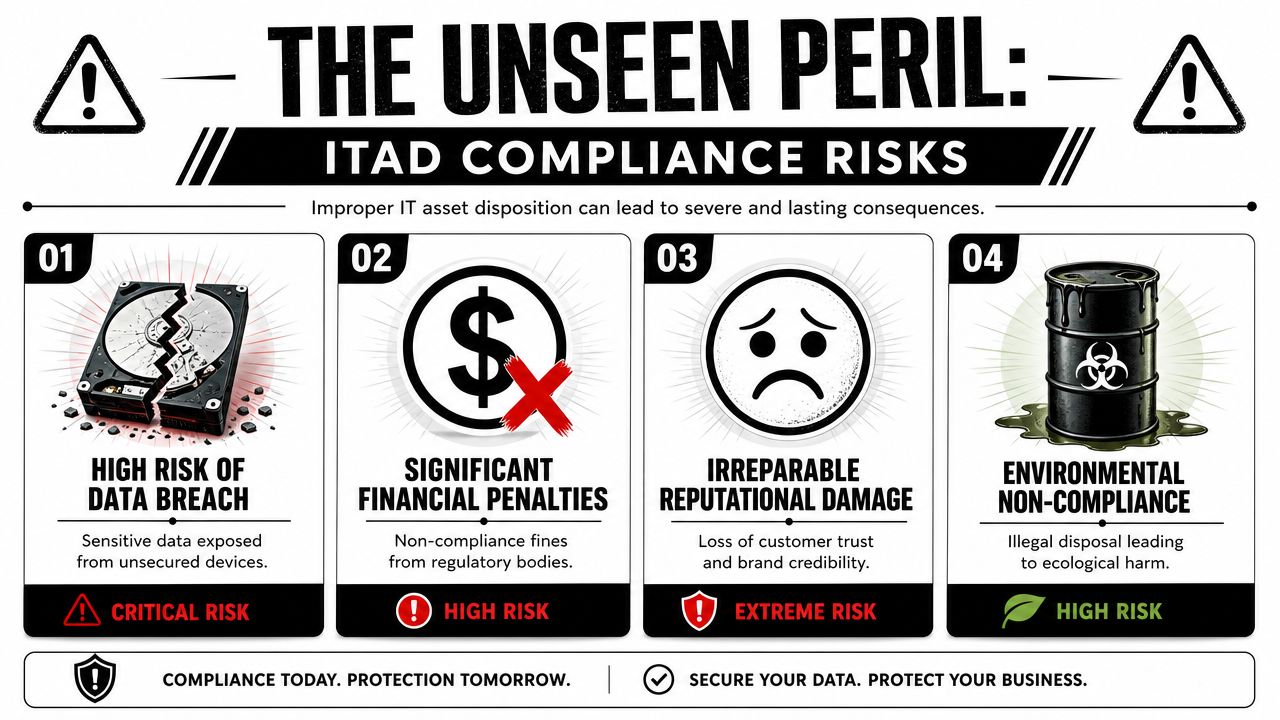
Improper ITAD usually creates exposure in four directions:
- Data exposure from residual information on drives, SSDs, backup media, or embedded storage.
- Compliance failure when the organization can't show documented safeguards and documented disposal.
- Environmental liability if downstream handling doesn't follow responsible recycling requirements.
- Vendor risk when third-party processors create a gap in custody, documentation, or incident response.
For organizations reviewing providers, looking at IT asset disposition companies in Atlanta is useful only if the evaluation goes deeper than pricing and pickup speed. The hard questions are about sanitization standards, chain of custody, serialized tracking, destruction records, and incident support.
A Practical Mitigation Framework for Your Business
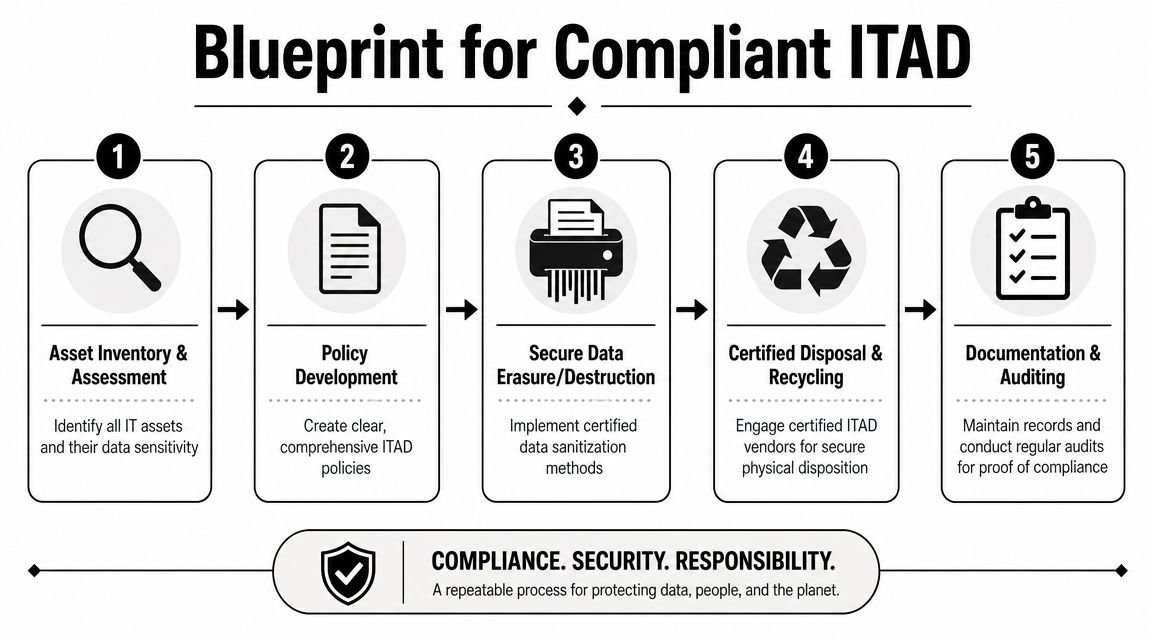
A compliant ITAD program doesn't need to be flashy. It needs to be consistent, documented, and repeatable. Regulators and vendors increasingly assess whether organizations can demonstrate reasonable safeguards such as documented incident response and access auditing, which makes auditable asset disposition a real compliance control, as noted in this review of why compliance now matters broadly for Atlanta businesses.
Start with asset truth
Before you can sanitize or destroy anything, you need a reliable inventory of data-bearing assets. That includes obvious items like laptops, desktops, servers, and external drives. It also includes less obvious devices such as copiers, appliances, phones, legacy backup media, network gear with storage, and specialized systems with embedded memory.
A useful inventory process should capture:
- Device identity: Serial number, asset tag, location, and current owner or custodian.
- Data sensitivity: Whether the asset handled patient, employee, customer, student, payment, or legal data.
- Disposition path: Reuse, resale, redeployment, destruction, or certified recycling.
- Evidence requirements: What records your audit, legal, or customer commitments require.
If this part is weak, everything after it becomes harder to defend.
Match the destruction method to the risk
Not every device needs the same end-of-life treatment. Some assets can be sanitized for reuse. Others shouldn't leave your control without physical destruction. The right decision depends on media condition, reuse value, data sensitivity, and the level of proof you need later.
Use this simple decision model:
- Wiping fits reusable media when the process is validated and documented.
- Degaussing may fit certain magnetic media where reuse isn't the priority.
- Physical shredding is often the safer path for failed media, obsolete storage, or highly sensitive environments.
One practical option in the local market is Atlanta Computer Recycling's supply chain risk guidance, which is relevant because disposal isn't just about destruction. It's also about controlling who handles assets before final disposition.
Operational rule: Choose the sanitization method before pickup, not during warehouse triage. Last-minute decisions usually create documentation gaps.
Lock down custody and response
An unbroken chain of custody is what separates a compliant process from an assumption. Every transfer should identify who released the asset, who received it, when that happened, and what condition the equipment was in. This matters even more if a discrepancy or suspected exposure appears later.
Georgia-specific response timing also raises the bar. Entities handling data on behalf of others may face a 24-hour breach reporting requirement, which makes immediate documentation and triage critical if a disposal-stage incident is suspected, according to Miles Hansford's digital security insights and the state-focused obligations discussed by local compliance counsel.
Treat paperwork as a control, not an afterthought
A strong ITAD program produces records that your legal, security, procurement, and audit teams can all use. That usually means serialized inventories, pickup manifests, destruction certificates, recycling documentation, and exception logs for missing or damaged assets.
What works is boring on purpose. Standard forms. Standard approvals. Standard evidence retention. That's what survives scrutiny.
How to Choose the Right Atlanta ITAD Partner
Most vendor reviews focus on service coverage, turnaround time, and whether pickup is easy to schedule. Those matter. They're not enough.
A disposal partner is part of your compliance chain. If that partner can't document its process, your organization inherits the weakness. A local provider's understanding of state-specific obligations can be a meaningful differentiator, especially because Georgia's 24-hour breach reporting requirement for entities handling data on behalf of others leaves little room for confusion if an incident occurs during transport, storage, or processing. The operational point is simple: your vendor needs a process for immediate documentation and triage, not just general security language, as outlined in this Atlanta-focused discussion of hidden cyber-risk and reporting timing.
Questions worth asking before you sign
Use a short, direct checklist in vendor interviews:
- How do you document chain of custody? Ask to see the actual handoff records, not just a marketing statement.
- What sanitization and destruction options do you perform? The answer should distinguish between reusable media and media that should be physically destroyed.
- What evidence will we receive? You want serialized documentation, destruction confirmation, and recycling records where applicable.
- How do you handle exceptions? Missing drives, damaged assets, mislabeled equipment, and mixed loads should trigger a defined process.
- What happens if a potential incident is discovered? The vendor should be able to explain escalation, containment, and documentation steps immediately.
What separates a usable partner from a risky one
A strong provider usually sounds operational, not theatrical. They can explain logistics, proof, media handling, and escalation clearly. A weaker one leans on broad claims about security without showing how the process works on pickup day.
A local review should also include whether the provider understands certified downstream handling and responsible recycling. If your team is screening a certified electronics recycler in Atlanta, treat environmental and data controls as part of the same vendor risk review.
Good ITAD partners reduce uncertainty. Weak ones ask you to trust a process they can't demonstrate.
Frequently Asked Questions About IT Compliance and Disposal
Is physical destruction always required?
No. It depends on the media, the data sensitivity, the reuse plan, and the level of proof your organization needs. Reusable devices may be candidates for documented wiping. Failed drives, obsolete media, or highly sensitive assets are often better handled through physical destruction.
What's the difference between wiping and shredding?
Wiping is a data sanitization process intended to clear media for possible reuse. Shredding physically destroys the media itself. The mistake many teams make is treating them as interchangeable. They solve different problems and support different disposition paths.
Can internal IT staff handle this themselves?
Sometimes, but only if the process is formal. DIY disposal usually breaks down on inventory discipline, custody tracking, evidence retention, and exception handling. The technical act of erasing data is only one piece of compliance. The audit trail is the other.
What documentation should we expect from an ITAD vendor?
At minimum, expect records that identify the assets handled, the disposition path, and the final data destruction or recycling outcome. If your legal, audit, or security team can't use the paperwork to reconstruct what happened, it's not enough.
What's the biggest misconception about retired equipment?
That “out of service” means “out of scope.” It doesn't. If the device held regulated or sensitive data, the compliance obligation usually follows the data until the organization can prove secure disposition.
Atlanta businesses don't need more abstract warnings about cyber risk. They need disposal processes that stand up to audits, customer scrutiny, and real incident response. Atlanta Computer Recycling provides business-focused electronics recycling and IT asset disposition services across the Atlanta metro area, including secure handling of servers, laptops, drives, and data center equipment with documentation designed to support operational and compliance needs.