Why Use a Certified Electronics Recycler? A Business Guide


That back room full of retired laptops, failed hard drives, old switches, and decommissioned servers isn't just an operations nuisance. It's a security exposure, a compliance issue, and an environmental liability waiting for someone to make a bad shortcut.
Most organizations don't get in trouble because they meant to handle e-waste poorly. They get in trouble because they treated end-of-life equipment like a pickup problem instead of a controlled business process. That's the gap a certified electronics recycler is supposed to close.
Your E-Waste Problem Needs a Professional Solution
Monday morning after a refresh cycle, the new equipment is deployed and the old gear is still there. Laptops with intact drives are stacked in a storage room. Retired switches are sitting on a cart outside the server room. A project lead wants it all gone by Friday. That is usually the point where a routine cleanout turns into a security, compliance, and disposal problem.
If the plan is only to schedule a pickup, the plan is incomplete.
IT managers need a recycler that fits the same control standards applied to active assets. The central question is not who will haul the equipment away. It is who can document custody, protect data, account for every device, and handle downstream recycling in a way that will hold up under an internal review or an outside audit.
What makes the risk real
End-of-life hardware rarely moves through a clean process unless someone designs one. Devices sit in offices, closets, and staging areas. Asset tags go missing. Systems change hands between departments. Drives stay installed because nobody had time to pull them. By the time pickup is scheduled, the inventory is often less reliable than people assume.
That creates several business risks at once:
- Data exposure: Retired devices can still hold customer files, employee records, credentials, emails, and internal documents.
- Weak chain of custody: Once equipment leaves your control without logs and signed documentation, proving what happened gets much harder.
- Environmental liability: Electronics contain components that require controlled handling, not informal disposal.
- Audit and legal problems: If compliance, legal, procurement, or leadership asks for proof, a verbal assurance from a hauler does not answer the question.
The environmental side matters here too, especially once you review the environmental impact of electronic waste. For an IT department, that is not a separate sustainability topic. It is part of vendor risk management.
Practical rule: If a vendor cannot show custody records, destruction documentation, and downstream accountability, your risk has not been reduced. It has been transferred to a process you cannot see.
What a professional solution looks like
A professional recycler operates like a controlled business service, not a junk removal company. The workflow should include documented intake, itemized tracking, secure storage, defined data destruction procedures, and reporting your team can keep on file.
That matters because e-waste disposition is not just an environmental task. It touches security policy, records retention, vendor management, and sometimes industry-specific compliance requirements. A recycler that only talks about landfill diversion is addressing one part of the job.
A qualified commercial partner should be able to meet the standards your organization already applies elsewhere. Who handled the assets. When custody changed. How data was destroyed. Where the material went after processing. If those answers are vague, the vendor is not ready for business equipment.
The goal is straightforward. Close out retired hardware with the same discipline used to deploy it.
What 'Certified' Really Means for Electronics Recycling
"Certified" gets overused in this industry. On some websites, it sounds like a marketing adjective. In practice, it should mean something much narrower and much more useful. The recycler is operating inside a formal standard, and an independent party audits that operation.
That puts real distance between a certified electronics recycler and an informal hauler that says the right things but can't show how materials move through the process.
Think CPA, not "someone who does taxes"
The easiest analogy is a CPA versus a person who's good with spreadsheets. Both may touch financial records. Only one operates under a recognized professional framework with external accountability.
Electronics recycling works the same way. A non-certified recycler may still say they wipe drives, recycle responsibly, or track assets. The issue is whether they have to prove it through an audited system.
That's why it's worth understanding what electronics recycling certification signals. It isn't perfection. It is structure, oversight, and evidence.
Why the audited model matters
The need for disciplined handling isn't theoretical. The world generated 53.6 million metric tons of e-waste in 2019, but only 17.4% was formally documented and recycled, according to reported global e-waste statistics. That gap is exactly why documented downstream controls matter.
When only a limited share of material enters formal recycling channels, your organization can't afford a black-box vendor. You need to know what happens after pickup, after sorting, and after data-bearing devices leave your building.
A certified process should give you confidence on questions such as:
- Where did each asset go
- Who handled data-bearing media
- Was anything reused, remarketed, or dismantled
- Which downstream vendors received material
- What records will exist six months later during an audit
If the vendor's answer to downstream handling is vague, treat that as a warning sign, not a minor paperwork issue.
What certification does not mean
Certification doesn't mean every recycler offers the same service model. It doesn't tell you how responsive they are, whether they can manage a hospital pickup, or whether they can de-install a data center cleanly. It also doesn't replace your own vendor review.
What it does mean is that you're starting from a stronger baseline. The recycler isn't asking you to trust a claim. They're operating under a standard that requires documented controls. For an IT manager, that's the difference between disposal as an afterthought and disposition as a governed process.
Decoding Key Certifications R2, e-Stewards, and ISO
A recycler can sound credible in a sales call and still leave major gaps in your control environment. Certifications help separate marketing claims from audited operating practices, but only if you know what each one covers.
For electronics recycling, the two names that matter most are R2 and e-Stewards. Those are the standards buyers usually mean when they ask whether a vendor is a certified electronics recycler.
R2 and e-Stewards in plain English
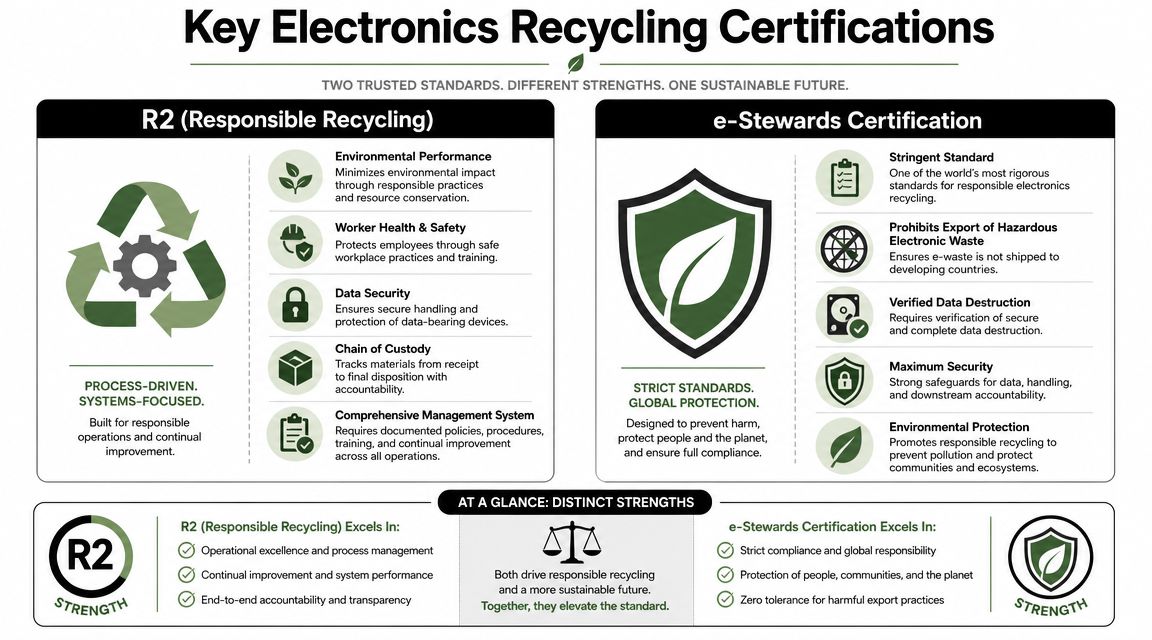
R2 is common in commercial IT asset disposition programs because it addresses the operating controls IT managers usually care about first. That includes data-bearing equipment handling, documentation, downstream accountability, and process discipline across reuse, recycling, and material flow.
e-Stewards is also a core electronics recycling certification, but many organizations view it as the stricter choice on environmental controls and downstream restrictions. If your legal, ESG, or procurement team has a low tolerance for export risk or unclear vendor chains, that difference matters.
Neither certification tells you the vendor is automatically the right fit. A recycler may hold a valid certification and still be weak on scheduling, packaging guidance, de-install support, or enterprise reporting. Certification sets a baseline. Your job is to confirm that baseline matches your internal security and compliance requirements.
R2 vs. e-Stewards at-a-glance
| Attribute | R2 (Responsible Recycling) | e-Stewards |
|---|---|---|
| Primary role | Core electronics recycling certification | Core electronics recycling certification |
| General focus | Data-bearing asset controls, documented process management, downstream tracking, environmental practices | Environmental protections, tighter downstream restrictions, strong control over end markets |
| Common buyer fit | IT teams that need a practical ITAD framework aligned with operations and audit needs | Organizations with stricter environmental policies or higher downstream risk sensitivity |
| What to verify | Current certification, facility scope, applicable process coverage | Current certification, facility scope, applicable process coverage |
Where ISO fits
ISO certifications matter, but they answer a different question.
ISO standards usually show that a company has formal management systems for quality, environmental practices, or health and safety. That can be a good sign. It suggests the operation is documented, reviewed, and managed with more discipline than an informal local hauler.
Still, ISO is not the same as a dedicated electronics recycling certification. If a vendor leads with ISO 14001 or ISO 45001 but stays vague on R2 or e-Stewards, treat that as a prompt to ask harder questions. Ask which facility is certified, what activities fall under the scope, and whether the certified operation includes the services you are buying.
For teams building a shortlist, start with commercial electronics recycling providers that clearly identify their certification status, then verify the details yourself.
What IT managers should take from this
Read certifications as a risk signal, not a logo collection exercise.
R2 usually aligns well with organizations that need documented ITAD controls across data security, asset tracking, and downstream handling. e-Stewards can make sense where environmental restrictions and end-market controls carry more weight. ISO can strengthen confidence in how the company is managed, but it does not replace the need for a true electronics recycling standard.
The practical test is simple. If an asset leaves your building, can the recycler show which certified process governs its handling, where it goes next, and what records will still be available when audit, legal, or security asks later.
How to Vet a Recycler and the Questions You Must Ask
Certification logos on a homepage don't complete your due diligence. They start it.
A proper review looks more like vendor risk management than a quick facilities service quote. You're checking whether the recycler can support your internal security policies, your audit needs, and your actual operating environment.
Start with verification, not conversation
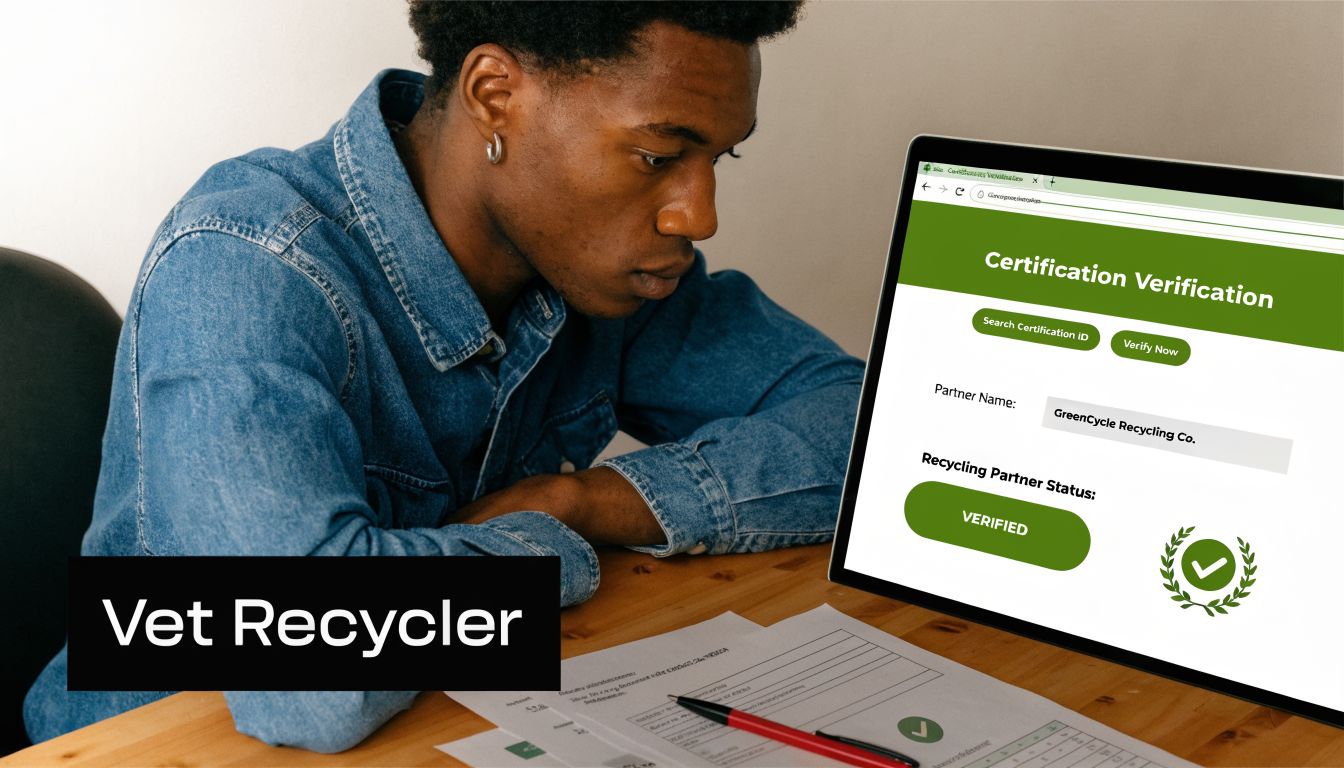
Before you discuss pickups, pricing, or convenience, verify credentials independently. Don't outsource that step to the sales rep.
Use this sequence:
- Check current certification status in the official directory for the claimed standard.
- Request the certificate and compare the legal entity name and facility address.
- Review scope so you know what operation is covered.
- Ask for a tour. In-person is best, but a virtual walkthrough is still useful.
- Test transparency by asking detailed process questions early.
If you need a baseline list of providers to evaluate, start with commercial-focused electronic waste disposal companies and then narrow the field with the controls below.
The questions that reveal the real operation
Some questions produce polished generic answers. Others force a recycler to show whether they run a disciplined process.
Ask these:
How do you maintain chain of custody?
You want specifics on intake, labeling, tracking, transport, and reporting.Can you provide serialized reporting?
For many business environments, batch-level reporting isn't enough.What data destruction methods do you use?
The recycler should explain wiping, degaussing where appropriate, and physical destruction without sounding improvised.How do you manage downstream vendors?
This is one of the most important questions in the meeting.Do you offer on-site de-installation and packing?
This matters for offices, server rooms, labs, and healthcare spaces where internal staff can't spare time.What documentation do clients receive after completion?
You should hear about inventory records, destruction records, and disposition reporting.
What weak answers sound like
Weak vendors often rely on broad reassurance. They say things like "we handle everything," "all data is destroyed," or "we're environmentally friendly." None of that is useful without documentation and process detail.
Strong vendors answer operationally. They describe handoff, transport, media handling, audit records, and what you'll receive after the job closes.
A recycler that resists scrutiny during the sales process usually won't become more transparent once your equipment is on their truck.
The best vetting question is often the simplest one. Ask, "Show me what a finished client file looks like." That single request tells you whether their process exists on paper or only in conversation.
Understanding Data Destruction and Compliance Standards
For most organizations, the hardest part of e-waste isn't recycling. It's proving that the data is gone.
A certified electronics recycler should be able to match destruction method to media type, business risk, and compliance requirements. That's where a lot of sloppy programs fail. They treat all storage media the same, even when the correct handling method depends on the device.
The three methods you should hear about
Most business disposition programs rely on a mix of these methods:
Software wiping
Best for reusable assets when the media can be sanitized and documented properly.Degaussing
Relevant for certain magnetic media, but not a universal answer.Physical destruction
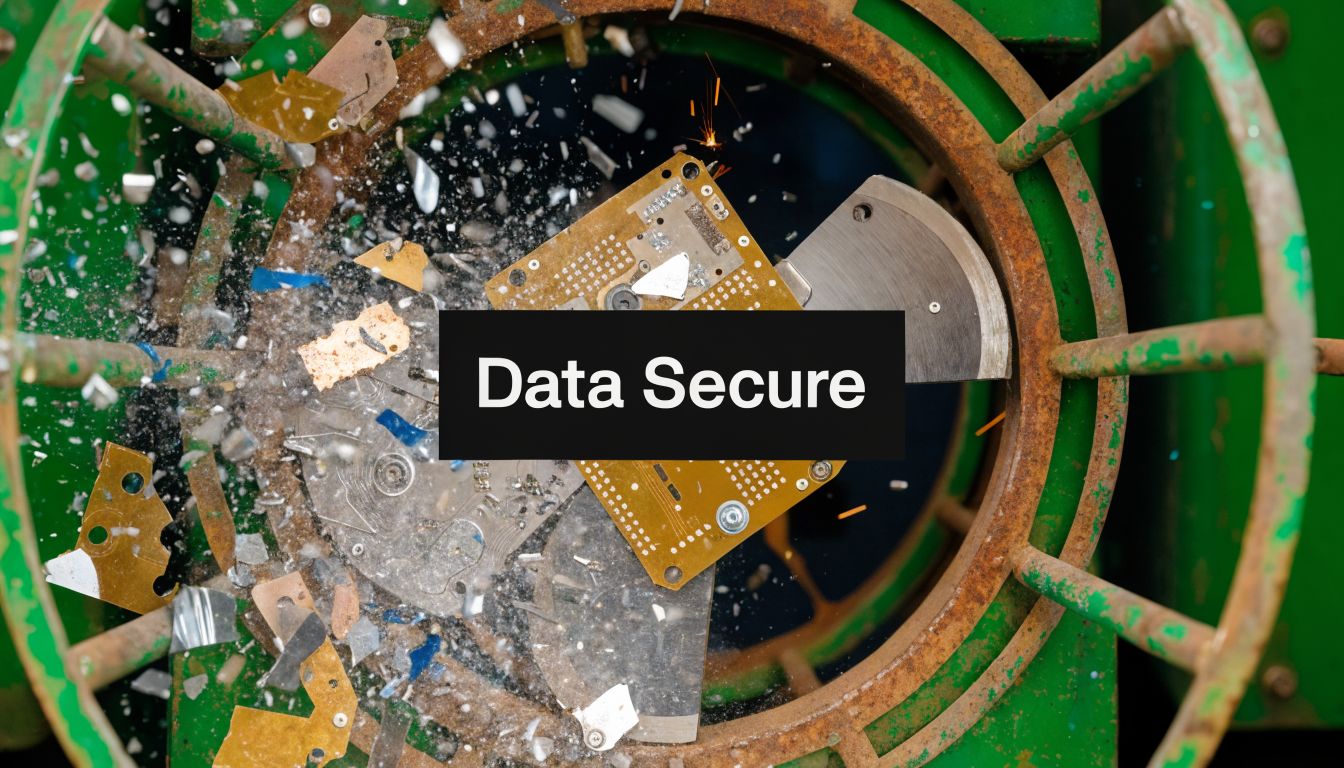
The right choice when media is damaged, obsolete, high-risk, or not worth remarketing.
A good vendor won't push one method for every scenario. They should explain when reuse makes sense and when destruction is the safer call.
Why standards matter
In practice, buyers often ask about NIST 800-88 and DoD 5220.22-M because those names show up in security reviews, procurement documents, and compliance discussions.
The key issue isn't dropping the right acronym. It's whether the recycler can carry out the method consistently and document it. If they say they wipe media, ask what the report includes. If they shred drives, ask whether serial-number-level documentation is available before destruction.
For many regulated environments, the paper trail matters as much as the destruction event itself. That's why businesses often require certified data destruction records that tie each media item to a documented outcome.
For HIPAA-sensitive environments, "we destroyed the drives" is not strong enough. You need records that can survive an audit.
What compliance teams usually need
Legal, privacy, and compliance teams generally look for the same fundamentals:
| Need | What the recycler should provide |
|---|---|
| Proof of custody | Documentation showing who handled assets and when |
| Proof of destruction | Certificates or reports tied to completed destruction activity |
| Asset traceability | Model, serial, or other identifying detail where required |
| Defensible process | A repeatable procedure aligned with your policy requirements |
IT managers can prevent future problems. Build the destruction standard into the service scope before pickup happens. Don't wait until the devices are already gone to ask what proof you'll receive.
Core Services to Expect from a Commercial Partner
A commercial recycler should solve workload problems, not create new ones for your IT team.
In the field, the most useful partners don't just collect equipment. They take ownership of the ugly middle of the job. Asset staging, packing, removal planning, secure transport, reporting, and coordination with facilities all matter because that's where internal projects usually bog down.
What a mature service model includes
A business-focused engagement often starts with IT asset disposition, or ITAD. That can include inventory capture, sorting reusable versus non-reusable equipment, coordinating data destruction, and issuing final documentation.
Then come the services that determine whether the project is smooth or disruptive:
- On-site de-installation: Useful when racks, networking gear, or workstation setups must be removed without tying up internal staff.
- Packing and palletization: Important when equipment is spread across floors, buildings, or departments.
- Secure logistics: The transfer from your site to the processing facility should be treated as part of the security process, not a basic courier task.
- Project-based decommissioning: Necessary for server rooms, office closures, lab cleanouts, and data center transitions.
Where teams often get stuck
A common failure point is assuming the recycler and facilities team will somehow coordinate informally. They usually won't unless someone owns the sequence.
For office moves or consolidations, companies also need to think beyond electronics. Furniture, fixtures, and layout changes often happen at the same time, which is why resources like professional office furniture installation can be useful during broader workplace transition planning.
Another issue is underestimating labor. A small internal team can disconnect a few desktops. It can't always clear a floor of mixed assets, sort media for destruction, label everything, and keep business operations running.
What works best in practice
The cleanest projects usually have one owner on the client side, one project contact on the recycler side, and a written scope covering pickup points, media handling, access rules, and final reporting requirements.
That structure isn't glamorous. It works.
When the service model is mature, your team spends less time babysitting retired equipment and more time closing the actual refresh, relocation, or decommissioning project.
Your Atlanta Partner for Compliant E-Waste Recycling
For organizations in the Atlanta metro area, local execution matters as much as certification. The recycler still needs to show up on schedule, handle commercial volumes, manage chain of custody, and provide the records your business requires after the job is done.
One local option is commercial e-waste recycling in Atlanta. Atlanta Computer Recycling focuses on business-to-business electronics recycling and IT asset disposition for offices, schools, healthcare organizations, government entities, and data center environments. Its published service scope includes pickup, de-installation, packing, secure transport, hard drive wiping using the DoD 5220.22-M 3-pass method, and physical shredding for media that shouldn't be reused.
That combination fits what many commercial clients need. Not just responsible recycling, but a controlled disposition workflow that aligns with internal security and compliance expectations.
For an IT manager, the practical value is straightforward:
- One vendor handles removal and disposition
- Data-bearing assets receive defined destruction handling
- Commercial pickups reduce strain on internal staff
- Documentation supports audit and compliance review
The right next step isn't to assume any local provider meets those standards. It's to ask for documentation, review service scope carefully, and confirm the operating details that matter in your environment.
If your organization is planning a refresh, office closure, equipment purge, or decommissioning project, treat e-waste disposition like any other risk-bearing vendor engagement. Verify credentials. Define the chain of custody. Require destruction records. Make the recycler prove the process before the first pallet leaves your building.
If your team needs a business-focused recycling and ITAD partner in Atlanta, contact Atlanta Computer Recycling to discuss pickup logistics, data destruction requirements, and documentation for your next equipment disposal project.