Your 2026 Guide to Commercial E-waste Recycling in Atlanta, GA


For Atlanta businesses, partnering with a certified provider for commercial e-waste recycling in Atlanta GA has moved beyond an environmental talking point—it’s a core business strategy. Proper IT asset disposition (ITAD) is your front-line defense against steep data breach fines, the key to securing sensitive corporate data, and a powerful way to reinforce your brand’s reputation.
Why E-Waste Management Is a Strategic Imperative for Atlanta Businesses
In Atlanta’s dynamic economy, the constant cycle of technology upgrades generates a mountain of retired IT assets. For IT managers, compliance officers, and business leaders, this "e-waste" represents a significant and often underestimated risk. A single improperly discarded server or stack of old company phones can expose your organization to immense financial and reputational damage.
This isn’t about being ‘green.’ It’s about smart, defensive business management.
A formal e-waste strategy shifts your company from a reactive, cost-based mindset to a proactive, value-driven one. It’s the difference between seeing an old server as a bulky piece of trash and recognizing it as a potential liability that must be neutralized. For sectors like healthcare, finance, and legal, that distinction is everything.
Here in Atlanta, the conversation around e-waste is maturing. Businesses are beginning to grasp the full scope of what’s at stake: data security, regulatory compliance, and brand integrity.
To put this in perspective, let’s review the data. The numbers paint a clear picture of both the risks and the rewards of managing retired IT assets correctly.
The Business Case for E-waste Recycling at a Glance
| Metric | Statistic | Business Implication |
|---|---|---|
| Global E-Waste Generation | 62 million metric tons in 2022, projected to rise 32% by 2030 | Your company's retired assets are part of a massive, growing stream. Without a plan, liability increases. |
| National Data Breach Cost | Average cost of a data breach in the U.S. is $9.48 million | Improperly disposed of devices are a primary source of data breaches. The cost of non-compliance is staggering. |
| Atlanta-Area Material Recovery | Local certified facilities recover up to 98% of materials from electronics | Partnering locally ensures maximum resource recovery and minimal environmental impact, supporting ESG goals. |
| Regulatory Fines (Example) | Fines under GDPR can reach €20 million or 4% of annual global turnover | A single lost or stolen device with customer data can trigger massive penalties. A certified process provides a legal shield. |
As the table shows, the cost of inaction is simply too high for any business. A proactive, documented recycling program isn't an expense—it's an insurance policy against catastrophic financial and reputational loss.
The Core Business Benefits of a Formal ITAD Program
A well-defined ITAD plan delivers far more than a clean storage closet. It’s a fundamental component of modern risk management that offers tangible rewards for your organization.
Ironclad Data Security: The top priority is ensuring the complete and verifiable destruction of all data. Certified partners provide Certificates of Data Destruction, which are essential for proving compliance with HIPAA, SOX, or government contracts.
Brand and Reputation Shield: Today, customers and B2B partners actively seek out companies with strong ethical and environmental commitments. A data breach or news of improper dumping can destroy a brand’s credibility overnight.
Regulatory Compliance: The legal landscape around data privacy is unforgiving and constantly changing. A formal recycling process provides an auditable chain of custody that proves your due diligence and protects you from devastating fines.
Cost Efficiency and Potential Returns: Professional ITAD isn't just a cost center. Newer, functional equipment can often be refurbished and resold, generating a return on your original investment. At a minimum, a professional partner streamlines the logistics, saving your team valuable time and resources.
We’ve seen it firsthand: viewing e-waste through a strategic lens transforms it from a logistical headache into a critical function of risk management, compliance, and corporate stewardship.
The push for responsible e-waste handling is particularly strong right here in Atlanta. Local facilities are setting a new benchmark, recovering up to 98% of electronic components from discarded devices—a rate that far surpasses national averages.
This local expertise gives Atlanta businesses a distinct advantage. Partnering with a certified recycler in our community means you're not just protecting your own business; you're contributing to a broader effort to build a more sustainable local economy. By handling your retired assets responsibly, you play a direct role in minimizing the environmental impact of electronic waste.
Ultimately, a proactive approach to commercial e-waste recycling in Atlanta GA is a competitive advantage. It secures your data, protects your brand, and aligns your business with the forward-thinking values that define Atlanta's corporate community.
Planning Your Commercial IT Asset Disposition Project
A successful e-waste recycling project doesn’t just happen when the truck shows up. It starts with a solid internal plan. Preparing in advance saves time, prevents logistical headaches, and ensures you achieve maximum security and value from your retired IT assets.
This initial planning is critical for any Atlanta organization, whether you’re a hospital decommissioning a single server rack or a corporation refreshing 500 employee laptops.
The Power of a Detailed Asset Inventory
Your first step is to create a detailed inventory of every asset slated for disposition. This list is your project roadmap, guiding every decision from data security protocols to potential revenue recovery.
An effective inventory goes beyond a simple device count. For each piece of equipment, you should capture key details to inform the process.
- Asset Tag or Serial Number: A unique ID for tracking every device from your office to final disposition.
- Device Type: Is it a laptop, desktop, server, switch, or mobile phone?
- Physical Location: Note the department, floor, or specific data center rack for efficient collection.
- Data-Bearing Status: A simple "yes" or "no" flags devices that require secure data destruction.
- Condition and Age: This helps determine which assets may have resale value versus those destined for recycling.
For instance, an IT manager at a Midtown Atlanta law firm might identify 50 laptops containing sensitive client files, earmarking them for on-site physical destruction. At the same time, they could tag 20 newer monitors as "non-data bearing," making them prime candidates for resale to offset project costs. This level of detail makes the partnership with your recycler far more efficient and cost-effective.
This initial work connects directly to the bigger picture of a smart ITAD process.
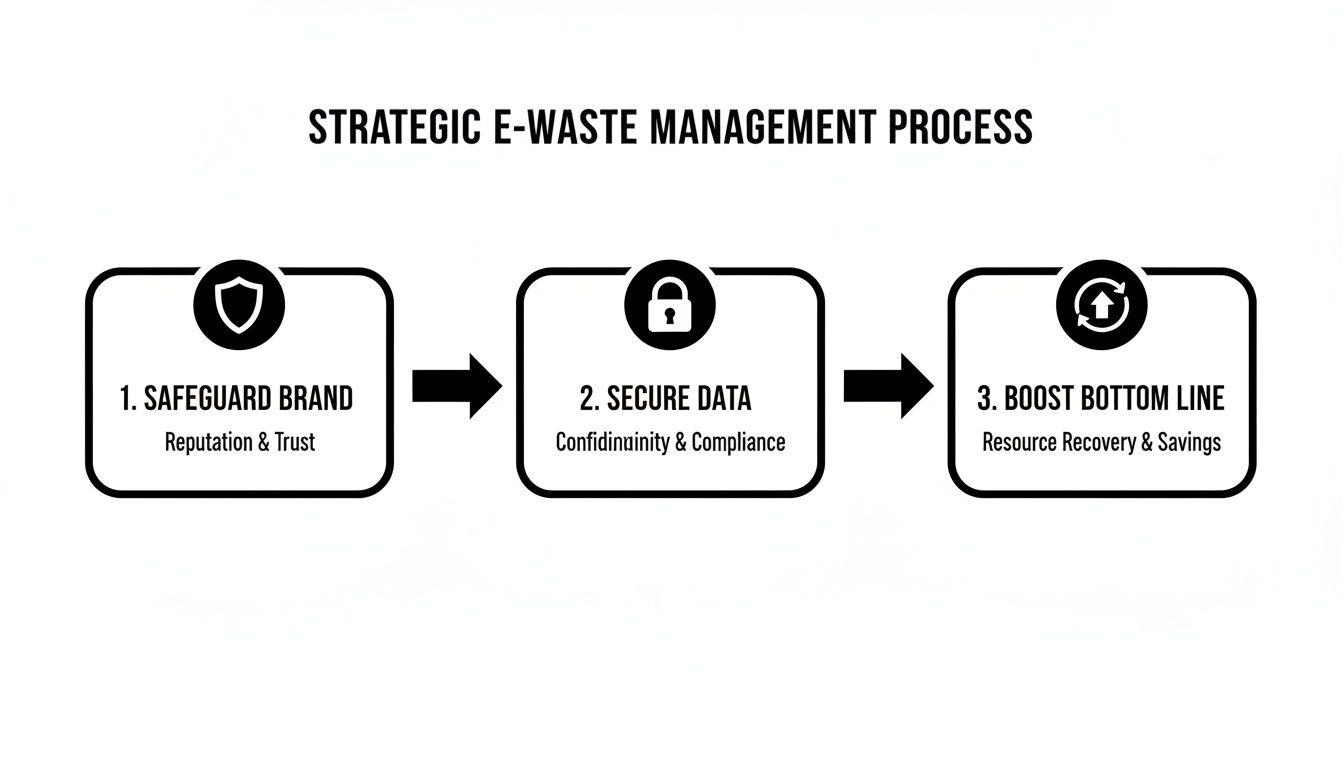
As you can see, every step—starting with your own internal prep—is designed to protect your brand, lock down your data, and benefit your company’s bottom line.
Classifying Assets for Action
With your inventory complete, sort the assets into logical groups. This determines how each item is handled, guaranteeing both security and a smooth, organized pickup.
1. Data Sensitivity Level
This is the most critical classification. A healthcare provider in Buckhead, for example, must be meticulous about segregating devices that hold Protected Health Information (PHI).
- High-Sensitivity: These devices hold financial records, patient data (HIPAA), or your company’s intellectual property. They demand the highest level of certified data destruction.
- Standard-Sensitivity: Think general employee laptops or corporate servers with business data not subject to strict regulations.
- Non-Sensitive: This includes peripherals like keyboards, mice, monitors, and cables that don’t store any data.
2. Remarketing vs. Recycling Potential
Not all your old equipment is waste. Many items retain value that can offset the cost of the recycling service.
- Assets for Resale: Newer-model servers, laptops, and networking gear in good working order can be refurbished and sold, generating ROI.
- Assets for Recycling: This is for obsolete, broken, or low-value items that need to be de-manufactured to recover raw materials like copper, aluminum, and plastic.
By sorting your equipment based on these criteria before you even call a recycler, you streamline the entire process. You’ll receive a more accurate quote, and the on-site pickup will be faster and more organized, causing minimal disruption to your business operations.
This internal organization is a core part of a strong IT asset disposal strategy, setting your project up for success. Preparing your assets isn't just about tidying up—it's about taking control of your data, budget, and compliance needs right from the start.
How to Vet and Select a Certified Atlanta Recycling Partner
Choosing the right partner to handle your retired electronics in Atlanta is one of the most critical risk-management decisions your business will make. This isn't like hiring someone to haul away old office furniture. The wrong choice can expose you to staggering data breach fines, compliance penalties, and a damaged reputation that’s hard to rebuild.
A cheap, uncertified hauler might seem like a bargain, but they can quickly become a million-dollar liability. You need a partner who operates as an extension of your own IT and compliance teams, actively shielding you from risk.
Why Certifications Are Non-Negotiable
In the IT asset disposition (ITAD) industry, certifications are the ultimate verification. They are the only way to confirm a company has passed a rigorous, independent audit of its data security, environmental, and employee safety processes. They prove a recycler handles your equipment—and your data—according to the highest industry standards.
For any business in Atlanta, there are two key certifications you absolutely must look for:
- R2v3 (Responsible Recycling): This is the leading global standard. An R2v3 certified partner has a documented, audited process for the entire recycling chain, ensuring your data is secure and all materials are handled in an environmentally sound manner.
- e-Stewards: This is often considered the most stringent certification. It has a strict zero-tolerance policy against exporting hazardous e-waste to developing nations and using prison labor, guaranteeing your assets are managed ethically from start to finish.
A potential partner without at least one of these certifications is a deal-breaker. It means their promises of security and compliance have not been verified by a third party. Entrusting them with your data is a gamble no business can afford.
Key Questions to Ask Every Potential Vendor
Once you've shortlisted vendors with the right certifications, it's time to dig deeper. Their answers to the following questions will separate the true professionals from the rest.
Imagine you're a healthcare provider in Decatur with thousands of patient records on old laptops. The stakes couldn't be higher. For you, a vendor's documentation isn't just paperwork—it's your proof of HIPAA compliance.
Here are the critical questions to ask every single time:
- Can you provide a complete, serialized chain-of-custody report?
- What are your exact protocols for securing data-bearing devices upon arrival at your facility?
- Do you offer on-site services, like hard drive shredding, at our Atlanta location?
- Can I review a sample Certificate of Data Destruction?
- Who are your downstream recycling partners, and can you provide documentation that they are also certified?
A capable partner will have confident, immediate answers and documentation ready. They should be eager to show you their processes and even invite you to tour their secure facility. Transparency is the hallmark of a reliable ITAD partner.
Beyond the Checklist: Evaluating Service and Fit
While certifications and processes are the foundation, the day-to-day partnership also matters. You need a team that is responsive, flexible, and understands the real-world pressures your business faces.
When you call, do you get a knowledgeable expert or an answering machine? Can they accommodate your tight schedule for a data center decommissioning? This level of service is what turns a one-time vendor into a long-term strategic partner.
Ultimately, you’re looking for more than just a hauler; you’re looking for an expert consultant. The best Atlanta recycling partners don’t just take your old equipment off your hands—they take on the immense responsibility that comes with it, giving you the documented proof and peace of mind to focus on your core business.
Mastering Data Destruction for Total Compliance
For any business, the data left on retired assets isn't just an afterthought—it's the single greatest liability you face during an IT refresh. A forgotten server hard drive or an improperly wiped laptop can quickly escalate into a full-blown data breach, leading to brand damage and steep regulatory fines.
Mastering secure data destruction isn't an IT luxury; it's a core component of modern risk management. For IT professionals overseeing commercial e-waste recycling in Atlanta GA, the objective is clear: ensure every last byte of corporate, customer, or patient data is completely and verifiably destroyed. Let's walk through the industry-standard methods that make that happen.
Software-Based Erasure: The DoD 3-Pass Wipe
One of the most trusted methods for software-based data sanitization is the DoD 5220.22-M 3-pass wipe. This process overwrites the entire hard drive with patterns of ones and zeros in multiple passes, which renders the original data unrecoverable using software tools.
The primary benefit is that the physical hard drive remains intact and functional. For newer, high-value equipment like enterprise servers or recent laptop fleets, wiping the drives allows them to be refurbished and resold. This often generates a significant financial return, helping offset the costs of your entire IT asset disposition project.
Physical Destruction: The Ultimate Failsafe
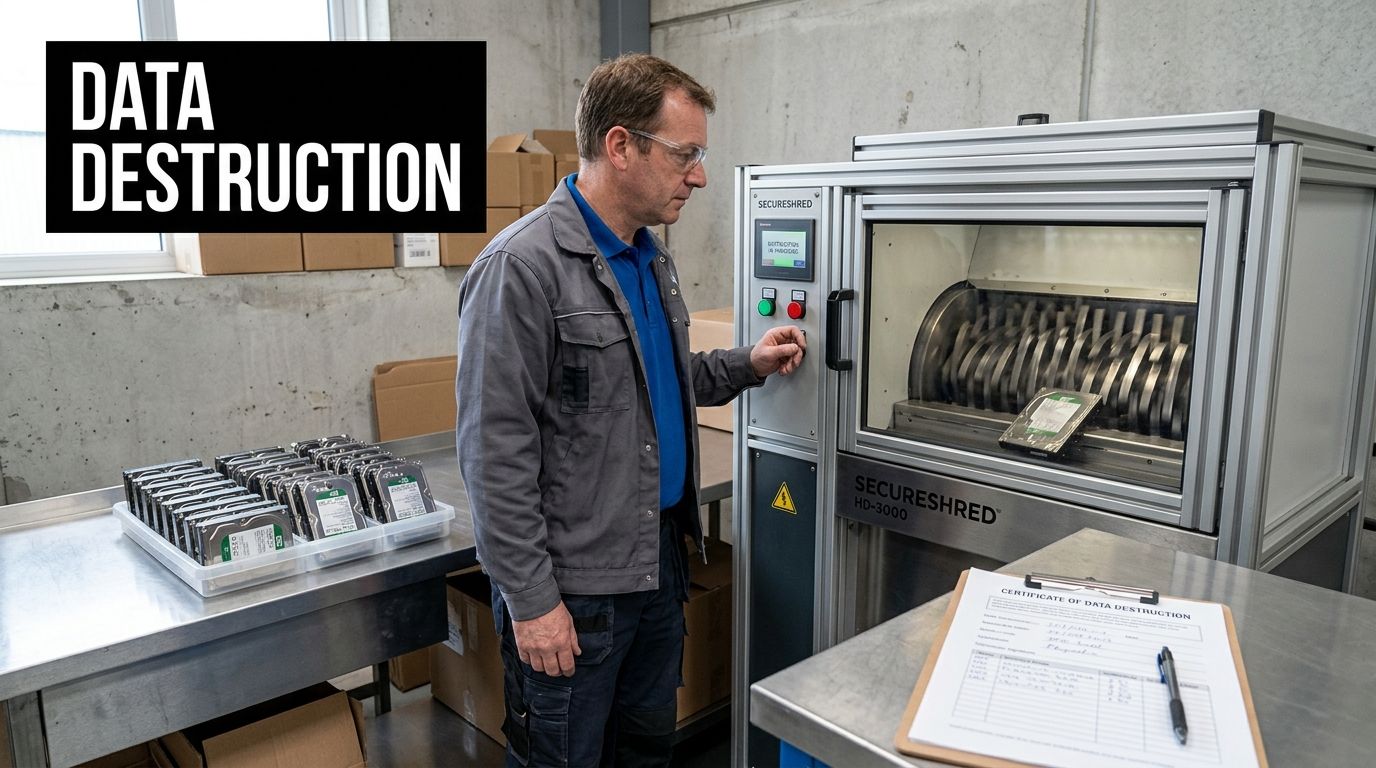
When data security is absolute and asset value is a secondary concern, physical destruction is the only answer. This is industrial-grade shredding that pulverizes hard drives into tiny, unreadable fragments of metal and plastic.
- Absolute Security: For drives containing financial records, protected health information (PHI), or proprietary R&D, shredding provides complete peace of mind. Data recovery is simply not possible.
- Compliance Certainty: For businesses governed by strict regulations like HIPAA or SOX, physical destruction provides a clear, undeniable endpoint for data, dramatically simplifying audit trails.
- End-of-Life Media: It’s the perfect solution for old, failing, or physically damaged drives that can no longer be reliably sanitized using software.
Choosing Your Data Destruction Method
The choice between wiping and shredding depends entirely on your company's risk profile and asset value. A financial services firm in Buckhead might choose to shred every drive from client-facing systems while wiping newer employee laptops for resale. A healthcare system in Decatur, however, may enforce a strict shred-all policy for any device that has ever touched patient data.
| Method | Process | Best For | Compliance Level |
|---|---|---|---|
| DoD 3-Pass Wipe | Software overwrites all data on the drive in multiple passes. | Newer, high-value assets intended for resale or reuse. | High (Meets NIST 800-88 Clear) |
| Physical Shredding | Industrial shredders grind drives into small, irrecoverable fragments. | Highly sensitive data, failed drives, or when compliance demands it. | Highest (Meets NIST 800-88 Destroy) |
Ultimately, a hybrid approach, guided by an expert partner, is often the most practical and cost-effective strategy.
The most critical document you'll receive from your recycling partner is a Certificate of Data Destruction. This legally binding report lists the serial numbers of every single drive that was sanitized or destroyed, specifying the method used. It's your ultimate proof of compliance and a legal safe harbor in an audit.
Your Proof of Regulatory Compliance
This documentation isn't just a formality—it’s your first line of defense in any compliance audit. A Certificate of Data Destruction directly addresses the due diligence requirements baked into numerous data privacy laws, proving you took every necessary step.
This is especially critical for organizations navigating regulations like:
- HIPAA, which can levy fines up to $1.5 million per violation for exposing patient health information.
- SOX, which governs the integrity of financial records for public companies.
- GDPR, which protects EU citizen data with penalties reaching 4% of global annual revenue.
The need for these strict protocols is only growing. Responsible commercial e-waste recycling in Atlanta GA is more critical than ever, especially as global recycling rates are projected to fall from 22.3% in 2022 to just 20% by 2030. This is happening while e-waste generation—including 4.6 million tonnes of small IT equipment with only a 22% recovery rate—is rising five times faster, according to research from the UN.
By choosing a certified partner who provides meticulous documentation, you aren't just following a best practice. You are building a robust defense against future liability.
The On-Site Pickup Process: Logistics and Security
You've done the planning and selected a certified recycling partner. Now it's time for execution: getting the retired equipment out of your facility and on its way to secure processing. A professional ITAD team turns a potentially chaotic project into a smooth, orderly process.
Whether your business is in a packed Alpharetta office park or a high-security data center downtown, the goal is always the same: execute the pickup with zero disruption to your daily operations.
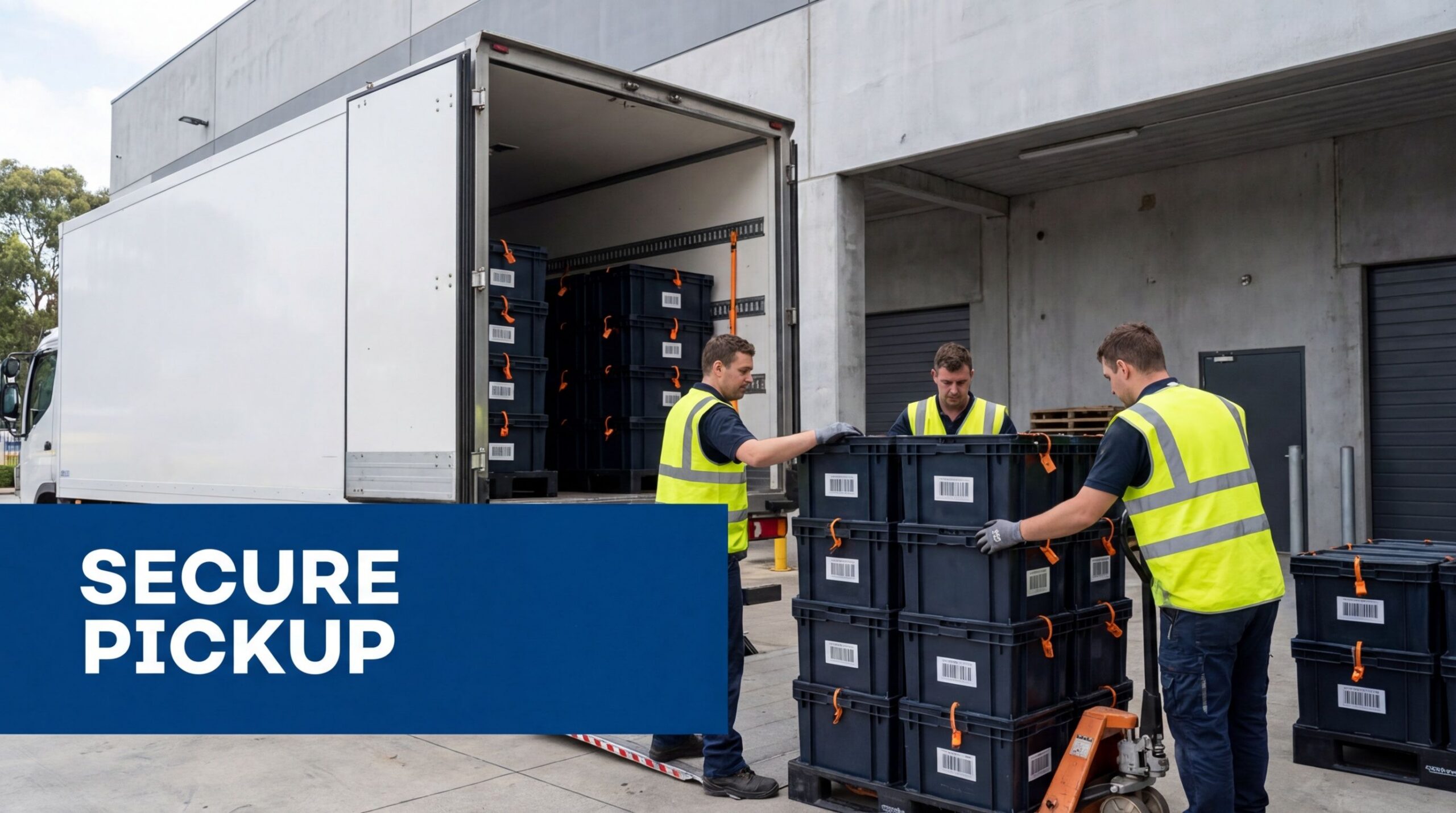
This isn't just sending a couple of people with a dolly. A true ITAD partner coordinates the on-site logistics with precision. From the moment our team arrives to the second the truck is sealed, every action is designed for maximum security and efficiency.
Setting the Stage for a Smooth Pickup
A little prep work on your end can make a world of difference. It helps the pickup go faster and keeps our team out of your employees' way, letting your business continue uninterrupted.
Our crew will arrive with all necessary equipment—pallets, shrink wrap, secure rolling bins, and tools. To help things run like clockwork, you can:
- Clear the Path: Ensure hallways, loading docks, and elevators are free of any obstructions.
- Create a Staging Area: If possible, gather all equipment in one secure, designated spot. This is a huge time-saver and minimizes our team's movement through sensitive areas of your facility.
- Designate a Point Person: Have one contact from your team ready to direct our crew and verify the assets being removed against your inventory list.
This proactive coordination is the backbone of our specialized IT equipment pickup service in Atlanta, GA. We're focused on getting in and out with minimal impact on your day-to-day operations.
What to Expect on Larger Projects
For a full data center decommissioning or a campus-wide tech refresh, the logistics get more complex. In these scenarios, a professional ITAD team doesn’t just show up and start hauling. We execute a carefully planned operation.
I remember a large financial institution in Midtown that needed to decommission an entire data center floor. We worked with them for weeks beforehand to create a detailed project plan that included pre-scheduled freight elevator access and coordination with their on-site security personnel to oversee the entire move. It was a major undertaking, but the planning paid off.
For these larger jobs, here's what you should expect from our on-site team:
- On-Site Asset Verification: Our team will work with your point person to cross-reference every single server, switch, and storage array against your master inventory list. Nothing leaves without being accounted for.
- Secure Packing and Palletizing: All equipment is professionally packed into sealed containers or strapped securely to pallets. Any devices holding sensitive data are segregated into their own locked bins for high-security transport.
- Documented Chain of Custody: Once the truck is loaded, your representative signs a chain-of-custody document. This is a critical step—it officially transfers liability to us and begins the auditable trail that follows your assets to our secure facility.
This level of detail provides verifiable peace of mind and is a world away from calling a generic junk hauler. There’s a big opportunity here for Atlanta businesses to lead. While the national recycling rate for municipal solid waste is around 26%, a recent city audit report found Atlanta's rate is lagging at 23%.
This gap highlights the need for dedicated commercial e-waste recycling in Atlanta, GA. When you partner with a professional ITAD provider, you’re not just protecting your data and your business—you're actively helping close an important sustainability gap for our city.
Your E-Waste Questions, Answered
When planning an IT asset disposition project, a few key questions always come up. Here are the straightforward answers we provide to Atlanta businesses every day, helping you plan your next project with confidence.
Understanding the Costs of Commercial Recycling
You might be surprised to learn that professional recycling doesn't always come with a hefty price tag. In fact, for most standard business electronics like PCs, laptops, and servers, we can often handle the pickup and data wiping at no charge. The value recovered from functional parts and raw materials helps fund the operation.
Of course, some services and items do have costs. You can generally expect a fee for:
- Items with Low or No Value: Think old CRT monitors, office printers, and broken keyboards. These have high processing costs and little to no resale value, so they typically incur a small disposal fee.
- Specialized Services: If you need on-site hard drive shredding, detailed asset reports with serial number tracking, or help with a complex office de-installation, these premium services will have an associated charge.
A reputable partner will always provide a transparent, itemized quote before any work begins. There should never be any financial surprises at the end of a project.
How Do We Guarantee HIPAA Compliance for Old Computers?
For any healthcare organization or business associate, guaranteeing HIPAA compliance comes down to one thing: an auditable paper trail from a certified partner. This is non-negotiable.
The process starts the moment your equipment leaves your facility, with a secure chain of custody that tracks every single device. After your equipment is processed, the most important document you will receive is the Certificate of Data Destruction.
This certificate is your legal proof of due diligence. It must list the serial numbers of the hard drives that were destroyed and specify the exact method used—whether a DoD 5220.22-M software wipe or physical shredding. Without this document, you have no way to prove you met your HIPAA obligations in an audit.
We’re a Small Business with Only 25 Devices. Is That Too Few?
Not at all. This is a situation we handle all the time. Professional commercial recyclers in Atlanta are built to serve businesses of every size—not just Fortune 500 companies with massive data centers.
While we do manage large-scale clear-outs, we have efficient programs designed specifically for small and medium-sized businesses. The best approach is to consolidate your 25 devices for a single, scheduled pickup.
Some providers may have a minimum number of items for a free pickup, but they can almost always service smaller batches. Most importantly, you get the same rigorous data security and environmental standards we provide to our largest clients. Your 25 devices will receive the exact same secure, professional treatment as a 500-device project.
What Really Happens to Our Equipment After You Pick It Up?
Once your equipment reaches our certified facility, it's not just tossed in a bin. Every asset goes through a meticulous process to maximize security, value, and sustainability.
First, everything is tested and sorted. Any functional, newer devices that have resale value are set aside. Extending a device's life through reuse is the most sustainable form of recycling.
Next, anything with a hard drive or storage is immediately routed for data destruction. Drives are either wiped using certified software or physically shredded into tiny pieces, based on your service plan.
Equipment that is old or broken is then carefully de-manufactured by hand. Our team breaks it down into its core components—motherboards, RAM, power supplies, steel casings, and plastics. These sorted materials are then sent to specialized, audited downstream partners to be smelted and reused in new products. Our goal is a zero-landfill policy, ensuring your data is gone and your old equipment is handled with maximum responsibility.
Are you an Atlanta business looking for a reliable partner to manage your IT assets securely and sustainably? Atlanta Computer Recycling offers expert, end-to-end solutions tailored for organizations of any size. From certified data destruction to efficient on-site pickups, we help you meet your compliance goals while protecting your data. Get in touch with us today to plan your next project at https://atlantacomputerrecycling.com.