AAA NAID Certified: A Guide for Business Data Security

Retired laptops are stacked in a conference room. A server rack is scheduled for removal after hours. Facilities wants the floor cleared by Friday, legal wants proof of destruction, and your security team wants to know one thing: who is taking custody of the data, and how are you going to prove it later?
That's the moment where aaa naid certified stops being a marketing phrase and becomes a vendor management requirement.
In commercial ITAD work, the primary risk rarely starts at the shredder. It starts earlier, when assets leave user desks, storage rooms, branch offices, clinics, or data halls and enter a disposal workflow that your organization still owns from a liability standpoint. If a provider can't show disciplined handling, documented custody, and verifiable destruction, you're not outsourcing risk. You're moving it.
Your Guide to AAA NAID Certified Data Destruction
A typical trigger is a refresh project that looks operational on paper and legal in practice. You're replacing desktops across multiple offices, decommissioning storage arrays, or clearing out a closed location. The hardware may be old, but the data isn't. Credentials, patient records, finance files, student information, engineering documents, and cached email all tend to survive longer than teams expect.
That's why experienced IT leaders don't ask only, “Can this vendor haul equipment?” They ask whether the provider can survive procurement scrutiny, internal audit review, and post-project documentation requests. A disposal partner needs more than trucks and a shredder. It needs controls.
NAID AAA certification gives buyers a structured way to evaluate those controls. It signals that the provider isn't just claiming secure destruction practices. The provider is subject to third-party verification around how materials are handled, secured, and destroyed.
Practical rule: If your team would require evidence for a firewall change, you should require evidence for media destruction too.
For commercial clients, that matters because disposal events often happen during periods of operational distraction. Office moves, data center shutdowns, mergers, and refresh cycles create handoff points where mistakes happen. A disciplined process reduces the chance that retired media gets mixed with reusable equipment, left unsecured in staging, or documented poorly.
If you need a baseline on what auditable destruction proof should include, this overview of data destruction certification requirements is a useful starting point. It helps separate formal controls from generic “we destroy drives securely” claims.
What Exactly Is NAID AAA Certification
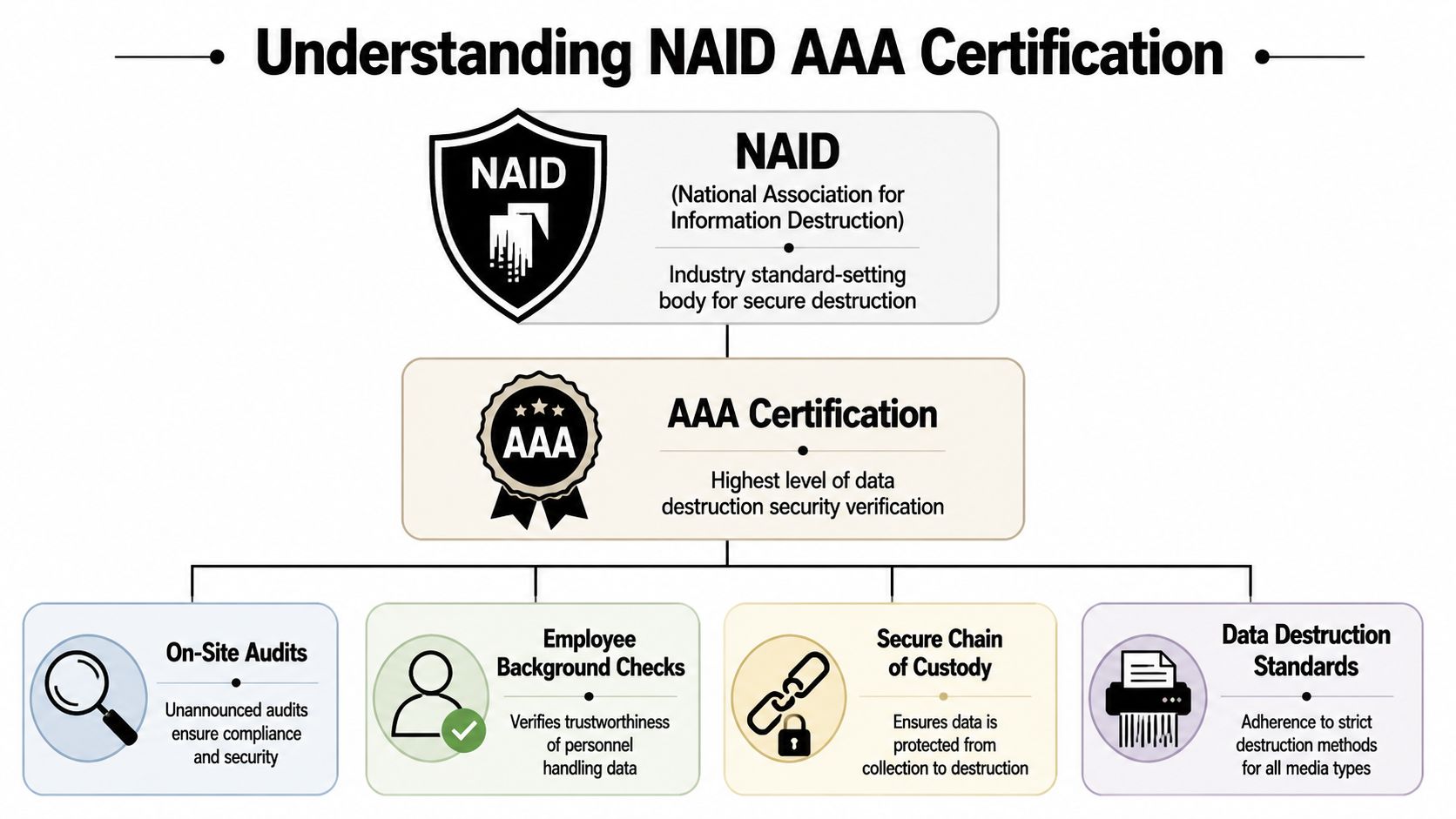
NAID stands for the National Association for Information Destruction. It was founded in 1994 and later merged with PRISM International to form i-SIGMA. Its NAID AAA Certification program has become a global standard, with approximately 2,500 service providers across six continents, which is why many enterprise buyers treat it as the benchmark for secure information destruction, as outlined by IBECI's summary of NAID AAA certification.
Think of it like a compliance audit, not a badge
The easiest way to explain aaa naid certified status to a business audience is this: it works more like a CPA audit for destruction operations than a self-issued credential. A vendor doesn't get to publish a policy and call itself secure. Independent security professionals inspect how the work is performed.
That distinction matters in procurement. Plenty of vendors can draft a strong process document. Fewer can show that the process is consistently enforced under outside review.
What buyers should expect it to cover
At an operational level, the certification centers on controls that matter during real-world disposition work:
- Facility and access security: Who can enter processing areas, how media is segregated, and whether handling is controlled from intake through destruction.
- Employee screening: The audit regime includes background review requirements for personnel who handle sensitive material.
- Chain of custody: Buyers should expect documented transfer points, traceable handoffs, and records that stand up during customer or regulator review.
- Destruction methods: The provider must use approved, auditable methods for the specific media types it handles.
A stronger buying question is not “Are you certified?” It's “Which services and locations are certified, and how does that match my scope?”
A vendor may be credible in one part of the workflow and weak in another. Certification helps you define where the controls begin and end.
That nuance is often missed. NAID AAA is highly relevant for destruction and sanitization, but buyers still need to evaluate adjacent ITAD services on their own terms. If a provider is transporting intact servers for remarketing, warehousing assets before disposition, or using downstream recycling partners, those parts of the workflow deserve separate review.
For teams comparing providers, this guide to electronics recycling certifications is helpful because it puts NAID in context rather than treating it as the only credential that matters.
Why This Certification Matters for Your Business
Most organizations don't lose sleep over retired hardware itself. They worry about the consequences if disposal controls fail. The financial, regulatory, and reputational exposure sits with the data that remained on the device, not with the age of the asset.

The clearest business case is risk transfer through documented due diligence. Partnering with a NAID AAA certified provider helps mitigate financial exposure because the provider's scheduled and unannounced audits verify adherence to data protection laws. That matters in a threat environment where the average global cost of a data breach reached $4.88 million in 2024, according to the source cited in Secure Records Solutions' discussion of NAID AAA and breach risk.
It strengthens your vendor file
When internal audit, compliance, privacy, or legal asks why your team selected a particular destruction vendor, “they were low-cost” is a weak answer. “They maintained third-party certified destruction controls and could provide supporting records” is far stronger.
That difference becomes practical in several common scenarios:
- Healthcare disposal events: HIPAA-sensitive media needs more than informal assurances.
- School and university refreshes: Student and employee data can appear on endpoints, servers, lab systems, and backup devices.
- Office closures and M&A integration: Large volumes of mixed equipment create easy opportunities for custody errors.
- Data center decommissioning: High-density projects demand precise handling, timing, and documentation.
It gives security teams something they can validate
Security leaders usually care less about slogans and more about evidence. A certified provider can support that mindset because the discipline is built around verification, not promises. That changes the procurement conversation from “trust us” to “review the controls.”
If your vendor can't explain how custody is documented from pickup to final destruction, the problem isn't paperwork. The problem is process maturity.
This is also why aaa naid certified status should sit inside your broader third-party risk program. It doesn't replace your contract review, insurance review, location validation, or service-scope analysis. It does give you a more defensible foundation when selecting a vendor whose work directly affects compliance exposure.
How to Verify a Provider's NAID Certification
A logo on a website isn't verification. It's branding. Buyers need to confirm that the provider's status is active, that the certified location matches the one doing the work, and that the certified service scope matches the project.
Use a simple verification sequence
Start with the official i-SIGMA directory and search for the vendor by company name and location. Then compare what you find to the proposal in front of you. If the quote is coming from one branch but the directory shows another location, ask which site is certified.
Next, confirm the service type. Certification can apply to specific destruction or sanitization services. Your project may involve on-site work, plant-based processing, hard drive destruction, or hard drive sanitization. Those details shouldn't be assumed.
Then ask for current supporting documents. A serious provider should be able to produce status details and explain how certified operations map to your project workflow.
Check the technical standard, not just the name
The audit's specialized nature ensures high standards. Auditors for NAID AAA, who are Certified Protection Professionals (CPPs), verify destruction efficacy against specific technical requirements, including shredding hard drives to particles under 2mm² and validating erasure against NIST 800-88, as described in Securis' explanation of why ITAD buyers should verify NAID AAA status.
That gives procurement and security teams a practical filter. You're not only checking whether the vendor is “approved.” You're checking whether the provider is being measured against concrete destruction benchmarks.
A good final step is to ask for a sample Certificate of Destruction. That document often reveals more than a sales pitch does. If it lacks clarity on asset identifiers, dates, service type, or chain-of-custody detail, expect the same weakness when your actual project closes.
Your ITAD Compliance Checklist
Vendor vetting works best when your team uses the same review process every time. That keeps rushed projects from turning into exception-heavy projects later.
Use the checklist below when comparing destruction or ITAD vendors. It won't replace legal review or internal policy, but it will catch the weak spots that usually show up after a pickup has already happened.
Data Destruction Vendor Vetting Checklist
| Verification Step | Status (Yes/No) | Notes |
|---|---|---|
| Verify active NAID AAA status in the official i-SIGMA directory | ||
| Confirm the exact service location performing the work is the certified one | ||
| Match certified services to project scope, such as on-site destruction, plant-based destruction, or sanitization | ||
| Request a sample Certificate of Destruction and review its level of detail | ||
| Confirm chain-of-custody procedures from pickup through final processing | ||
| Ask how assets are segregated between reuse, resale, recycling, and destruction streams | ||
| Review employee screening and handling protocols for staff with data access | ||
| Verify insurance coverage and ask what incidents the policy is designed to address | ||
| Confirm how exceptions are handled, such as unreadable drives, failed devices, or mixed loads | ||
| Ask whether public-facing certification claims apply to all locations or only selected facilities |
What usually works
The strongest commercial vendors answer operational questions directly. They can explain intake controls, pickup documentation, serial tracking when applicable, and how they close the loop once destruction is complete.
They also understand that your project may involve more than destruction. Some assets may be wiped and reused, some shredded, and some recycled because they have no remarketing value. Mature vendors can explain those decision points without becoming vague.
What usually does not
These are common warning signs:
- Broad claims without scope: “We're certified” means little unless the provider identifies where and for what service.
- Weak paperwork samples: If sample documents are inconsistent, final project records often are too.
- No clear exception handling: Projects always generate odd cases. Good vendors have defined procedures for them.
- Conflating ITAD with destruction: Destruction controls matter, but they don't automatically validate every adjacent service.
For broader procurement comparisons, this overview of commercial IT asset disposition companies can help your team frame what belongs in a serious vendor review beyond the certification label itself.
Secure and Compliant Disposal in Atlanta
For Atlanta-area organizations, the practical question isn't whether secure disposal matters. It's which provider can execute the work with the least uncertainty. That means verified destruction controls, reliable logistics, clear documentation, and a process that fits real business timelines.
This is especially important in healthcare, education, government, and multi-site corporate environments where equipment leaves service in batches and custody changes hands quickly. A provider may need to coordinate de-installation, packing, pickup, data-bearing media handling, and environmentally responsible disposition in the same project. If any part of that chain is sloppy, the paperwork at the end won't fix it.
One local option businesses evaluate is secure IT asset disposal in Atlanta, which covers commercial collection, destruction, and responsible downstream handling for retired equipment. For teams that also want a broader environmental planning resource, REDCHIP's e-waste disposal guide gives useful context on how organizations can think about disposal beyond simple pickup.
The right operating model is straightforward. Verify certification status. Confirm location and service scope. Review the custody process before the project starts. Inspect the closeout documentation before you award the work. That approach is less about buying a label and more about reducing avoidable exposure.
When buyers treat aaa naid certified status as part of active due diligence, they make better decisions. They ask better questions, catch scope gaps earlier, and build a cleaner record for compliance and audit teams after the assets are gone.
If your organization is planning a refresh, office closure, medical equipment turnover, or data center decommissioning, Atlanta Computer Recycling is a practical resource for commercial ITAD and secure data destruction planning in the Atlanta market. Reach out to review project scope, handling requirements, and the documentation your team will need before pickup begins.