Master Electronics Recycling Certification Options

A hardware refresh usually starts as a routine project. New laptops arrive. Old desktops move into a back room. Retired switches, servers, and backup devices pile up beside spare monitors and cable bins. Then someone asks the question that changes the whole job: what exactly is on those drives, and who is responsible once the equipment leaves the building?
That's where a lot of organizations get exposed. The issue isn't just disposal. It's IT asset disposition with chain of custody, documented data destruction, and defensible vendor oversight. If you hand sensitive equipment to an uncertified recycler, you're not outsourcing risk. You're often just moving it offsite.
Corporate IT teams, hospitals, school systems, and public agencies run into the same problem. They need equipment gone quickly, but they also need proof that data was destroyed, materials were handled responsibly, and downstream vendors didn't create an environmental or compliance problem later. If you're evaluating bulk pickup or commercial electronics scrap services, certification should be one of the first screens, not an afterthought.
The Hidden Risks in Your IT Storage Closet
A storage closet full of retired electronics looks harmless until you audit what's inside. Old laptops may still hold employee records. Decommissioned servers may still contain client files, archived emails, or protected health information. Even failed drives that “won't boot” can still create liability if they haven't been sanitized or destroyed under a documented process.
I've seen organizations focus on the visible problem first. They want to reclaim space, finish an office move, or clear out a server room before the next deployment. That urgency is understandable, but it often leads to the wrong first question: “Who can pick this up fastest?” The better question is, “Who can document every step after pickup?”
What looks like junk is still regulated risk
An old firewall, copier hard drive, or nurse-station workstation isn't just obsolete hardware. It's an asset with three separate exposure points:
- Data exposure: Storage media can retain business records, credentials, user files, and regulated data.
- Environmental exposure: Electronics contain materials that require controlled handling and proper downstream management.
- Reputational exposure: If equipment is mishandled, exported irresponsibly, or found intact outside approved channels, your organization owns that outcome in the eyes of auditors, customers, and leadership.
Practical rule: If a device ever stored data or connected to your network, treat its retirement like a compliance event, not a janitorial task.
Why casual disposal fails
Uncertified vendors often sound fine in early conversations. They promise pickup, recycling, and “hard drive destruction.” What they don't always provide is facility-specific certification, scope details, downstream documentation, or a clear explanation of how data-bearing devices are handled from dock to final disposition.
That gap matters. When procurement, compliance, or legal asks for evidence later, a verbal assurance won't help. A certificate, chain-of-custody records, and audit-backed process will.
Why Certification Matters Beyond a Green Initiative
Electronics recycling certification gets framed too often as a sustainability badge. That's incomplete. For business clients, certification is primarily a risk control system. The environmental benefit matters, but the operational value comes from documented procedures, third-party audits, and a standard you can verify independently.

The scale of the problem makes that clear. The world generated 136 billion pounds of electronic waste in 2022, only about 22 percent was formally recycled, and approximately 5.1 million tonnes of e-waste crossed borders, with roughly 65% moving illegally from high-income to low-income countries, according to this global e-waste analysis. Once you know that, vendor selection stops being a housekeeping task.
The four business risks certification addresses
Certified recyclers help reduce four problems that hit commercial clients directly:
- Data security risk: Certified programs require defined handling for data-bearing devices and complete data destruction on used electronics.
- Environmental liability: The EPA states that both major certification programs are based on strong environmental standards that maximize reuse and recycling while minimizing exposure to human health or environmental risks.
- Worker safety and ethical handling: Certifications evaluate worker health practices and safe material management.
- Brand and governance risk: A certified partner gives procurement and compliance teams something they can defend in audits, board discussions, and ESG reviews.
If you want a plain-language overview of the broader environmental impact of electronic waste, that resource is useful context for nontechnical stakeholders who need to understand why end-of-life electronics deserve tighter controls.
What certification changes in practice
Certification changes the conversation from trust me to show me. It gives your team a framework for asking better questions:
- Is the facility certified, or just the parent company?
- Does the certification apply to the actual services being offered?
- How are downstream handlers controlled?
- What documentation will you receive after pickup and processing?
The EPA actively encourages electronics recyclers to become certified through R2 or e-Stewards, and both are independently audited third-party programs, as outlined on the EPA guidance for certified electronics recyclers. For a corporate client, that's the point. Certification gives you a stronger basis for due diligence than marketing language ever will.
Comparing Major Electronics Recycling Certifications
If you're vetting vendors, most of the market narrows quickly to two serious certifications in the United States: R2v3 and e-Stewards. Everything else should be understood as either supporting evidence or a specialty credential, not a substitute.
Here's the short version.
| Standard | Primary business value | What it emphasizes | Where it fits best |
|---|---|---|---|
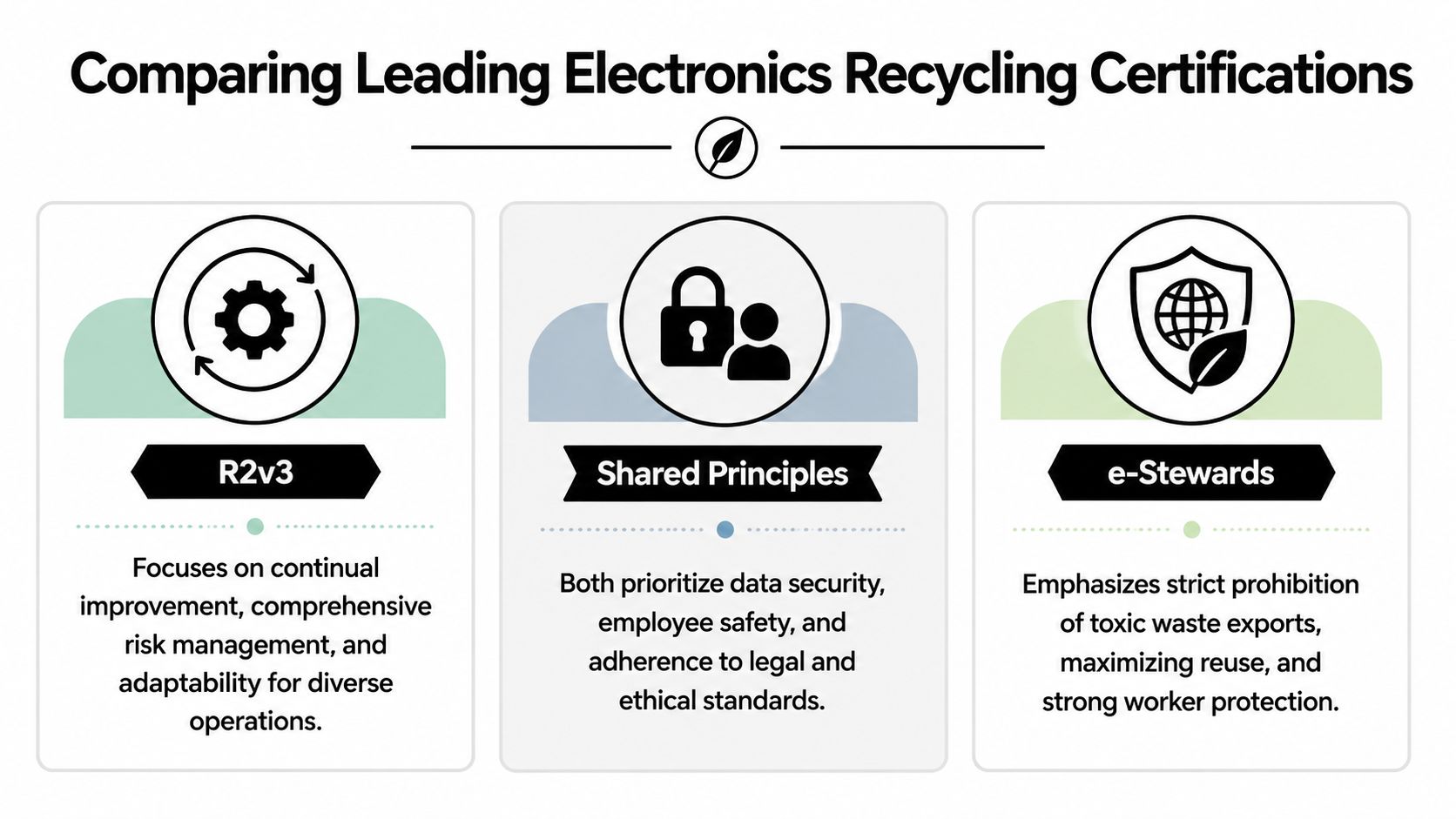
| R2v3 | Process control and traceability | Data security, downstream tracking, worker safety, auditable chain of custody | Broad ITAD programs, data center decommissioning, enterprise refreshes |
| e-Stewards | Ethical and environmental guardrails | Prohibitions on hazardous e-waste export to developing countries, prison labor restrictions, environmental rigor | Organizations with strong ESG mandates, public sector scrutiny, high-sensitivity reputational concerns |
| ISO 14001 | Environmental management baseline | Formal environmental management system | Useful supporting credential, not enough by itself for electronics ITAD |
| NAID AAA | Data destruction specialization | Secure destruction process controls | Strong add-on when media destruction is a core requirement |
R2v3 for operational accountability
R2 is now in its third version, R2v3, and the EPA identifies it as the most widely adopted electronics recycling certification globally. That matters because broad adoption usually means your procurement team is more likely to encounter it across regional and national ITAD providers.
The practical strength of R2v3 is operational discipline. It establishes seven mandatory CORE requirements that apply across certified facilities, and it requires organizations to maintain complete traceability throughout the recycling chain. That includes international vendors and secondary processors, which is exactly where many corporate risk teams lose visibility.
R2v3 is built for organizations that need documentation, repeatability, and downstream accountability more than broad sustainability language.
The standard's downstream due diligence requirements, including CORE 1 and CORE 5, are especially important for data center and enterprise projects. Those controls require identification and tracking of equipment streams, creating an auditable chain of custody through handling and disposition. If your team needs confidence that retired assets won't disappear into unknown channels, this is one of the strongest reasons to prioritize R2v3. A useful companion read is this overview of data destruction certification requirements, especially if your procurement process separates recycling from media handling.
e-Stewards for stricter ethical boundaries
e-Stewards occupies a different position. It is managed by the Basel Action Network and is widely recognized as the most stringent certification in the industry. The standard is often described as the gold standard for environmental purity, and that framing is relevant if your organization is under pressure to demonstrate stronger environmental and social governance.
Its practical value is simple. It places hard limits where some other frameworks rely more on managed controls. According to NSF's overview of e-waste recycling certification, R2v3 requires a foundational certification to a formal Environmental, Health & Safety Management System (EHSMS) to address industry-specific hazards, while e-Stewards requires ISO 14001 as its environmental management baseline and explicitly prohibits the export of hazardous e-waste to developing countries and the use of prison labor.
e-Stewards appeals to clients who want firm prohibitions, not just process management.
That distinction matters in healthcare, higher education, and government procurement. If leadership cares strongly about where material can and cannot go, e-Stewards gives you a cleaner ethical position.
ISO 14001 and NAID AAA in context
ISO 14001 is not an electronics recycling certification. It's an environmental management framework. That can be valuable, but it doesn't tell you enough about data-bearing devices, downstream vendors, or IT-specific material controls.
NAID AAA serves a different purpose. It is centered on data destruction practices rather than full electronics recycling governance. That means it can strengthen a vendor's profile, especially if your project centers on drives, backup media, and regulated records, but it should not be treated as a replacement for an electronics-specific certification.
What works and what doesn't
What works is matching the certification profile to your actual risk.
- R2v3 works well when your biggest concern is disciplined process, facility controls, chain of custody, and complex asset streams.
- e-Stewards works well when your organization wants stricter environmental and social guardrails built into vendor selection.
- Dual credential logic can make sense for clients with both operational and ESG pressure.
- ISO 14001 alone doesn't work as your primary screen for ITAD.
- NAID AAA alone doesn't work if the vendor also handles broader recycling and downstream processing.
The mistake I see most often is treating all certificates as interchangeable. They aren't. A recycler may have a legitimate management certification and still not provide the level of electronics-specific oversight your legal, privacy, or procurement teams need.
Connecting Certification to HIPAA and Data Security
Healthcare organizations usually come to this issue from one angle first. They need proof that retired devices containing protected health information were handled under a documented destruction process. That's why electronics recycling certification matters, but it's also why certification alone isn't the whole answer.
HIPAA doesn't care that a laptop was old, broken, or headed for recycling. If it stored patient data, your organization still has an obligation to control access to that information until it is destroyed or sanitized.
What certification contributes to a HIPAA workflow
The EPA notes that both major certification programs require complete data destruction on used electronics and provide benefits that include assessing environmental and worker health practices and ensuring safe material management by downstream handlers. For a healthcare client, that's useful because it means data handling is embedded into the recycling framework rather than bolted on later.
R2v3 is particularly helpful when chain of custody matters across multiple handoffs. If equipment leaves a hospital, moves through a logistics process, and reaches a processor, your compliance team needs records that show who controlled the asset at each stage.
Wiping versus physical destruction
Not every device should be handled the same way. Functional drives that can be sanitized may be wiped under a documented standard. Failed media, obsolete formats, and devices with higher sensitivity often move to physical destruction.
That distinction should be written into the vendor's process, not improvised on pickup day.
- Software wiping fits reusable devices and situations where asset recovery still matters.
- Physical destruction fits failed drives, heavily regulated data, and media that can't be reliably sanitized.
- Certificates matter because they document which method was used and when.
For teams building broader internal controls around regulated environments, guidance on HIPAA IT support services from MackTechs can help frame how disposal fits into the larger security program, especially when device retirement intersects with endpoint management and access control.
What to ask your recycler
A vendor handling healthcare equipment should answer these without hesitation:
- How do you maintain chain of custody from pickup to destruction?
- Which media are wiped, and which are physically destroyed?
- Do you issue a Certificate of Destruction for processed assets?
- Does your documentation identify serialized devices or media quantities in a way our auditors can use?
One provider that fits this type of workflow is certified data destruction services from Atlanta Computer Recycling, which offers DoD 5220.22-M 3-pass wiping for qualifying drives and physical shredding for obsolete or non-functional media. The key point isn't the brand. It's the model. You want a recycler whose destruction method, documentation, and custody controls line up with your compliance obligations before any equipment leaves the site.
If a vendor talks more about recycling volume than data handling procedure, they're solving the wrong problem for a HIPAA-regulated client.
How to Verify a Vendor's Certification Status
A certificate file in a sales email is not verification. It's a starting document. Real due diligence means confirming that the certification is current, facility-specific, and relevant to the work you're assigning.
Many vendor reviews fall short. A procurement team sees a logo on a website, receives a PDF, and assumes the issue is closed. It isn't. Certifications can be facility-based, limited in scope, or no longer active. You need to verify the claim yourself through the certifying body's official directory.
The vetting workflow
Use a simple sequence every time:
Request the actual certificate
Ask for the current certificate, not a screenshot of a badge. Review the legal entity name, facility address, and scope.Check the official directory
SERI maintains the public directory for R2-certified facilities, and the Basel Action Network manages e-Stewards listings. Match the vendor's submitted information against the live listing.Confirm the exact facility
The physical site on the certificate should match the location where your assets will be processed. A parent company may have one certified site and several non-certified locations.Review the scope carefully
Make sure the certification covers the kind of equipment and services involved in your project, especially data-bearing assets.Ask about downstream controls
R2v3 requires complete traceability throughout the recycling chain through downstream management protocols, including CORE 1 and CORE 5, creating an auditable chain of custody, as summarized in this explanation of R2v3 downstream accountability.
Red flags that should slow the deal
Most bad vendor decisions aren't caused by one dramatic failure. They come from a cluster of small warning signs.
- Name mismatch: The certificate shows a different entity than the one on the proposal.
- Address mismatch: The certified facility isn't the one handling your materials.
- Scope ambiguity: The document is real, but it doesn't clearly cover the services being sold.
- Vague downstream answers: The vendor can't explain where material goes after first-stage processing.
- Expired-looking paperwork: The certificate appears current at a glance, but the directory tells a different story.
A strong due diligence process should also include a practical market check. Reviewing how firms present themselves among electronics waste disposal companies can help your team compare claims, service models, and documentation standards before issuing an RFP.
Don't ask only whether a vendor is certified. Ask whether the certified facility, certified scope, and documented downstream process all match the work you're assigning.
What actually holds up in an audit
Auditors and internal investigators usually care about traceability, not branding. They want to see that your organization verified the vendor, validated the location, and obtained records tying disposition activity back to your assets.
That means your file should include the certificate, directory verification notes, service scope confirmation, and post-service documentation. If any part of that chain is missing, your team is relying on assumption.
Your Atlanta ITAD Vetting Checklist
An effective procurement checklist should force clarity fast. If a recycler can't answer these questions cleanly, keep looking.

The shortlist questions
- Certification first: Is the recycler currently certified to R2v3 or e-Stewards, and can your team verify that status through the official directory?
- Facility match: Does the certified address match the site where your assets will be processed?
- Data process: What is the documented method for handling data-bearing devices, including wipe criteria, destruction criteria, and final reporting?
- Chain of custody: Can the vendor explain custody from pickup through final disposition without gaps or hand-waving?
- Downstream accountability: Will they explain how downstream handlers are approved and tracked?
- Project fit: Have they handled office closures, school refreshes, hospital cleanouts, or data center decommissioning comparable to your environment?
- Documentation quality: Will you receive records your compliance, legal, or internal audit team can use without rewriting the whole file?
Practical screening for Atlanta organizations
Local service matters, but local service without controls doesn't solve much. For Atlanta businesses, schools, healthcare systems, and agencies, the right vendor should be able to coordinate pickup logistics, minimize disruption, and still produce the paperwork a compliance team expects.
That becomes even more important during larger events like moves and consolidations. If your team is also planning around office churn, this guide to managing IT infrastructure during office relocations is useful because it connects asset tracking, retirement planning, and operational continuity.
The final decision test
Use one final filter before award:
If the vendor disappeared tomorrow, would the documents in your file still prove your team exercised proper due diligence?
That standard removes a lot of weak options. A qualified provider should leave a paper trail strong enough to stand on its own. If you're comparing IT asset disposition companies in Atlanta, that's the level to hold them to.
If your team needs a recycler that can support business-to-business pickups, data-bearing asset handling, and documented ITAD workflows in the Atlanta metro area, Atlanta Computer Recycling is one option to evaluate alongside your other certified vendor candidates. The right next step is simple: ask for the certificate, verify the facility, review the data destruction process, and make the vendor prove the chain of custody before any equipment leaves your building.