Electronic Recycling Columbus Ohio: 2026 Business Guide

You're probably dealing with a familiar Columbus problem. A storage room has turned into a graveyard of retired laptops, dead monitors, old switches, and a few servers nobody wants to touch because they still hold data. Finance wants the space back. Facilities wants the pallets gone. Legal wants proof nothing leaves the building without controls.
That's where electronic recycling Columbus Ohio becomes a business process, not a cleanup task. In a city known for advanced recycling infrastructure, the standard for handling waste is already high. Columbus is home to North America's largest and most advanced recycling facility, the Rumpke Recycling & Resource Center, which opened in 2024, a sign of how seriously the region takes waste diversion and advanced sorting technology, as described in Rumpke's Columbus recycling guide.
For commercial organizations, though, electronics require a different playbook than bottles, cardboard, or household drop-offs. If you're planning an office move, hardware refresh, lease return, school device turnover, or server retirement, the challenge looks a lot like any other operational transition. The logistics matter, the documentation matters, and the handoff matters. That's why planning lessons from professional office relocation from Home Removals Sydney are surprisingly relevant here. The companies that avoid losses are the ones that treat disposal as a controlled project, not an afterthought.
A business should also think beyond “where do we take this stuff?” and ask “who tracks every asset, sanitizes every drive, and documents every outcome?” That's the difference between general recycling and formal IT asset disposal services.
Your Guide to Commercial E-Waste Recycling in Columbus
A lot of Columbus organizations start in the wrong place. Someone searches for a free drop-off event, finds a local list, and assumes the same option works for a medical office, a school district, or a regional employer closing a floor. It usually doesn't.
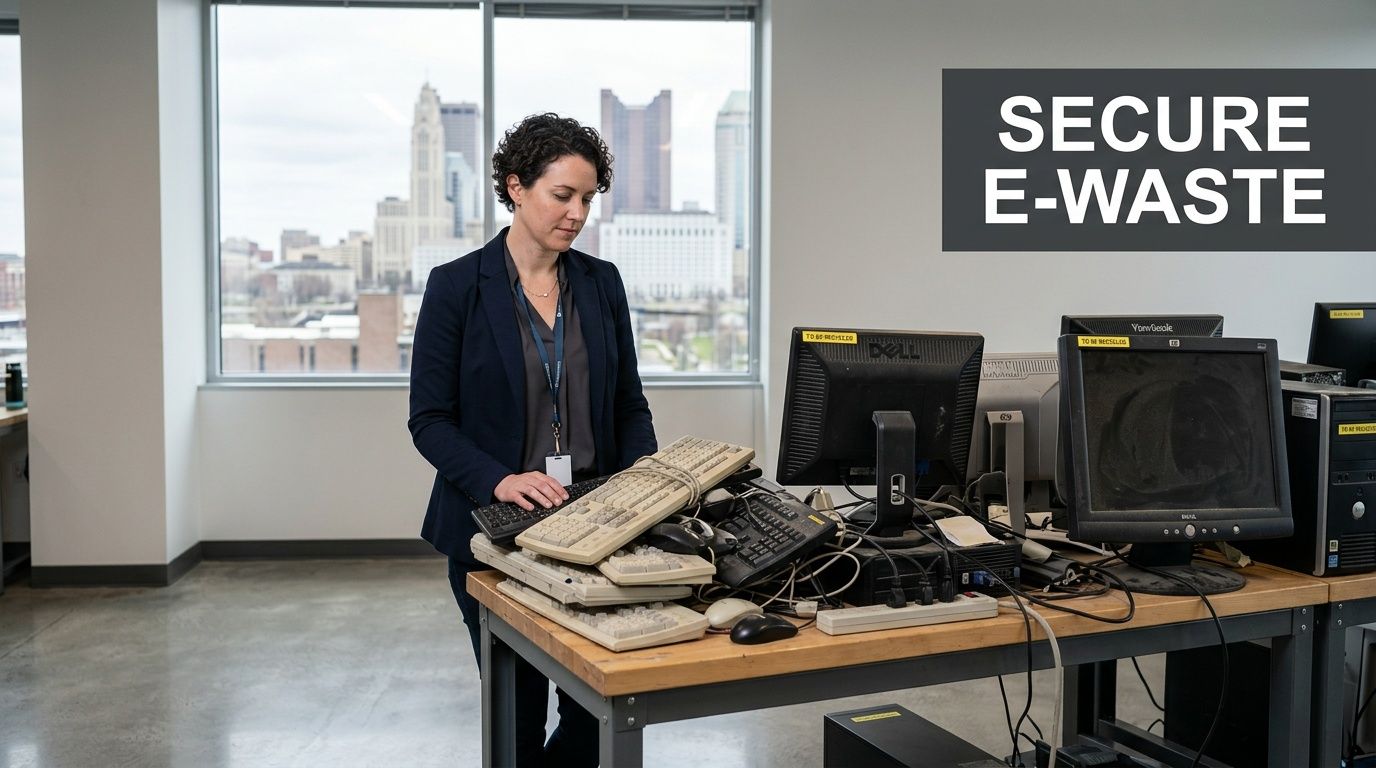
What business users actually need
Commercial electronics recycling has four moving parts:
- Asset control. You need a documented list of what left the building.
- Data destruction. You need a repeatable process for drives, SSDs, and mobile devices.
- Compliance records. You need paperwork that stands up in an audit.
- Operational efficiency. You need pickups, scheduling, packing, and a vendor that can handle volume.
A free resident event might solve none of those points. It may help an employee recycle a broken keyboard at home. It won't reliably support a fleet retirement, a clinic workstation refresh, or a rack decommissioning.
Why Columbus raises the bar
Columbus already has strong recycling infrastructure. The city's connection to advanced sorting and waste diversion is real, and that creates a useful benchmark. If the region can build advanced systems for mainstream recycling, businesses should expect the same seriousness from electronics recyclers handling data-bearing assets.
Businesses don't get in trouble because they recycled electronics. They get in trouble because they handed off electronics without proving what happened next.
That's the practical frame for this guide. Not household recycling. Not event calendars. Commercial controls.
Why Business E-Waste Is a Liability Not Just Trash
The wrong view is “we're just getting rid of old hardware.” The correct view is “we're disposing of regulated assets that may still contain sensitive data.”
Many Columbus guides blur residential recycling and business ITAD. That creates risk for companies because residential options often don't include DoD 5220.22-M wiping or an auditable chain of custody, both of which matter when an organization has to prevent data exposure and meet standards such as HIPAA, as noted in this Columbus business recycling reference.
Residential convenience vs business accountability
For a household, convenience is usually the priority. For a business, accountability is the priority.
| Feature | Residential Drop-Off | Certified Business ITAD |
|---|---|---|
| Data security | Often limited or not clearly documented | Formal sanitization and destruction workflow |
| Chain of custody | Usually minimal | Documented from pickup through final processing |
| Compliance support | Not designed for regulated industries | Built for audit, policy, and legal review |
| Volume handling | Best for small personal loads | Designed for bulk office and institutional loads |
| Reporting | Usually receipt-level or none | Certificates, serialized records, disposition reports |
| Pickup and logistics | Often self-delivery | Scheduled pickup, packing, and project coordination |
A free drop-off site isn't “bad.” It's just built for a different user. The problem starts when an IT manager applies a household solution to a commercial problem.
What liability looks like in practice
The risk isn't abstract. It shows up in ordinary scenarios:
- Old laptops in storage that still contain employee files.
- Returned desktops from a clinic with patient scheduling data.
- Chromebooks from a school refresh assigned to named users.
- Retired servers that were removed quickly during an infrastructure change and never fully documented.
In each case, the hardware still carries business obligations. If there's no clear chain of custody, no media handling standard, and no final destruction record, your company is relying on trust instead of process.
Practical rule: If a recycler can't explain how they log assets, sanitize media, and document downstream handling, they're not an ITAD partner. They're just a disposal outlet.
What works and what doesn't
What works is a provider that treats electronics as controlled assets from the moment of pickup. What doesn't work is tossing devices into a free event stream and hoping the vendor's process matches your compliance obligations.
That distinction matters most for healthcare, education, legal, finance, and any company with internal security policies stricter than basic recycling needs.
Navigating Columbus and Ohio E-Waste Regulations
A Columbus IT manager approves a cleanout, pallets of retired laptops leave the building, and six months later legal asks for proof that every drive was sanitized and every asset went to an approved downstream processor. That is the point where “recycling” becomes a compliance problem.
For commercial e-waste, the standard is documentation. Residential drop-offs and community collection events serve a different purpose. Business disposal has to stand up to an audit, an internal policy review, or a breach investigation. If your provider cannot show what happened to each data-bearing asset, your organization is carrying the risk.
The rules that matter for Columbus businesses
Ohio and local business users usually need to address three issues at once.
Data privacy obligations
Devices that held employee records, customer information, student data, patient information, financial files, or internal documents need verified sanitization and disposal records. A recycler's verbal assurance is not enough.Environmental handling requirements
Certain electronics and component streams can trigger hazardous material handling rules, especially when batteries, screens, lamps, or specialized equipment are involved. Your recycler should be able to explain how it identifies regulated materials and routes them correctly.Internal authorization and recordkeeping
Disposal decisions should match your company's retention policies, security standards, and approval controls. In practice, that means IT, compliance, procurement, and facilities all need the same paper trail.
A useful benchmark is a formal certificate of data destruction. If a vendor cannot produce equivalent documentation tied to specific assets, the audit trail is weak.
Good compliance work also starts before pickup. Basic inventory control and securing computer data reduce the chance that a rushed refresh turns into a records exposure issue.
What a compliant process looks like on the ground
The vendors that work well for Columbus businesses treat disposal as an asset disposition project, not a junk haul. The process should include:
- Serialized asset tracking at pickup or intake
- Chain-of-custody records that show who handled the equipment and when
- Documented sanitization methods for data-bearing media
- Certificates of destruction or sanitization tied to specific devices or batches
- Downstream vendor accountability for dismantling, recycling, and final disposition
Downstream accountability gets overlooked often. If your recycler cannot explain where material goes after collection and processing, you do not have full control of the risk. You have a gap in vendor oversight.
A recycling receipt shows that equipment left your site. It does not prove compliant data destruction.
The management takeaway
The practical divide in Columbus is simple. Household recycling options help residents clear space. Commercial ITAD services help businesses control liability, document disposition, and satisfy security requirements.
That distinction matters most in regulated environments, but it also matters for any company with confidential data, cyber insurance obligations, or board-level security reporting. Treat retired electronics as controlled assets until the paperwork says the obligation is closed.
How to Prepare Devices for Secure Disposal
The biggest mistake I see is assuming deletion equals destruction. It doesn't. Deleting files is like wiping writing off a whiteboard. The board is still there, and the surface can still reveal what was written if the process was sloppy. Physical shredding is different. That's turning the whiteboard into confetti.
Certified Columbus recyclers use stronger workflows than simple deletion. According to Integrated Building Systems' e-waste information, certified recyclers implement DoD 5220.22-M equivalent destruction, combining multi-pass overwrites with physical shredding to less than 2mm particles. That same source states incidents in Ohio showed 20% of “wiped” drives were recovered using forensic tools, and the controlled process also supports 95%+ material recovery.

Start with data identification
Before anything leaves your site, classify the devices.
- User endpoints such as laptops and desktops often hold browser data, saved credentials, local files, and cached email.
- Servers and network storage may contain backups, virtual machine data, or application records.
- Mobile devices and tablets can still sync to cloud services even after an employee reset.
- Printers and copiers are often overlooked despite internal storage.
This is also the point to verify backups. If your team needs a refresher on securing computer data before retirement, that's worth doing before sanitization begins.
Match the method to the media
Different media types require different handling.
Software wiping
Best for equipment you may remarket, redeploy, or return. This works well when the drive is healthy and the device still has value. A practical reference for the process is this guide on how to wipe a computer hard drive.
Physical shredding
Best for failed drives, highly sensitive systems, or devices that won't be reused. Once media is shredded, reuse is off the table, but so is the risk of someone trying to recover data from a defective drive.
Degaussing
Sometimes used for certain magnetic media. In practice, businesses usually focus on wiping or shredding because those methods align more directly with modern mixed-device inventories.
Build a release checklist
Use a short operational checklist before pickup:
- Remove devices from MDM and management consoles
- Confirm legal hold status
- Label ownership and location
- Record serial numbers
- Separate reusable equipment from destroy-only media
- Assign one internal owner for signoff
A good sanitization process ends with evidence, not assumptions.
That evidence should include what method was used, which assets were processed, and when the work was completed.
Finding Certified E-Waste Partners in Columbus
Columbus has a mature recycling market, which is helpful but also makes vendor selection harder. More options mean more room for surface-level marketing. Central Ohio's recycling industry includes 372 establishments, and SWACO's School E-Waste Diversion Program works with R2V3 certified recyclers such as Columbus Micro Systems and AVAY to manage electronics from schools, government agencies, communities, and residents, according to SWACO's School E-Waste Diversion Program.
That's a useful starting signal. It isn't the full vetting process.
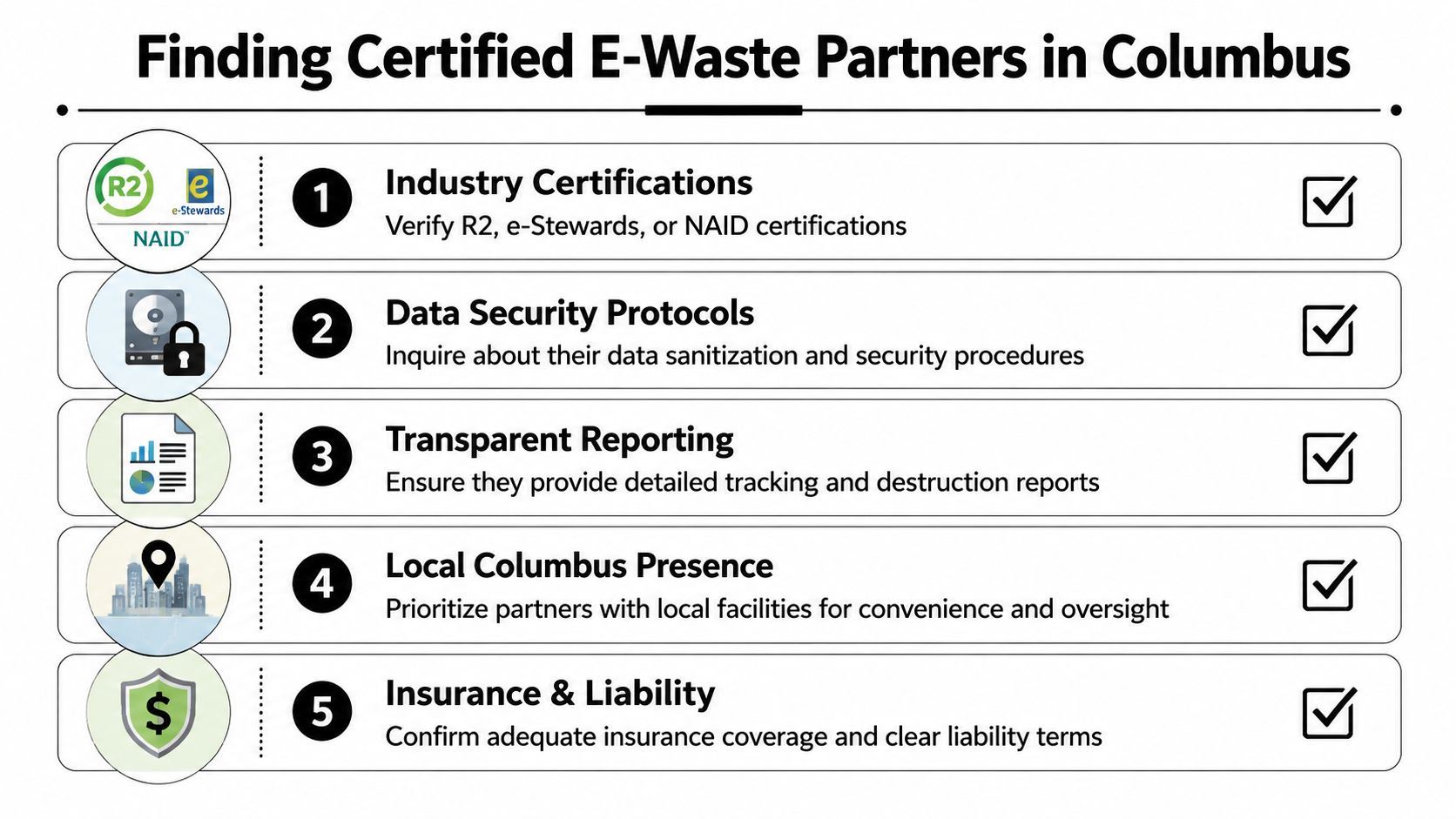
What to verify before you sign anything
If you're evaluating providers for electronic recycling Columbus Ohio, use this screening list.
R2v3 or equivalent certification
Certification doesn't guarantee perfect execution, but it tells you the vendor operates within a recognized framework for responsible electronics handling.Data destruction standards
Ask exactly how they sanitize HDDs, SSDs, flash media, and failed drives. If the answer is vague, move on.Chain-of-custody reporting
You want a process that logs equipment at pickup, during transport, and through final disposition.Downstream transparency
Ask where commodities and residual materials go. Strong vendors can explain their downstream controls.Commercial pickup capability
Resident drop-off is not commercial project management. If you have an office cleanup, refresh cycle, or multi-site haul, the vendor needs actual logistics capability.
If you're comparing providers more broadly, reviewing how businesses assess IT asset disposition companies can help sharpen your criteria.
Questions that expose weak vendors
A weak vendor usually sounds fine until you ask operational questions. Use these:
| Question | What a strong answer sounds like |
|---|---|
| How do you track devices from pickup forward? | Serialized logging and documented custody steps |
| What happens to failed SSDs? | Media-specific destruction, not generic wiping claims |
| Can you issue certificates tied to serial numbers? | Yes, with asset-level reporting |
| Who receives your downstream materials? | Named, vetted downstream partners |
| How do you handle mixed loads with reusable and destroy-only assets? | Segregated workflows and documented disposition |
Local examples and what they signal
Local names such as Columbus Micro Systems and AVAY matter because they show there are certified options in the Columbus market. Other providers may also be suitable, but the lesson is this: look for providers that already work in controlled environments such as schools, agencies, and businesses where documentation matters.
The best recycler for a business isn't the one with the easiest drop-off. It's the one with the strongest controls after the truck leaves.
Red flags worth taking seriously
Avoid vendors that:
- Market only “free recycling” without mentioning business compliance
- Can't describe sanitization by media type
- Offer no certificates or only generic receipts
- Rely on event-based intake instead of scheduled business logistics
- Avoid questions about downstream partners
Those gaps usually show up later, when legal, procurement, or auditors ask for records you never received.
Specialized Recycling for Healthcare Education and Data Centers
A Columbus clinic clearing out nurse station PCs, a school district collecting thousands of student devices over summer break, and a data center removing racks after a refresh are all handling “electronics recycling.” The label is the same. The operating requirements are not.
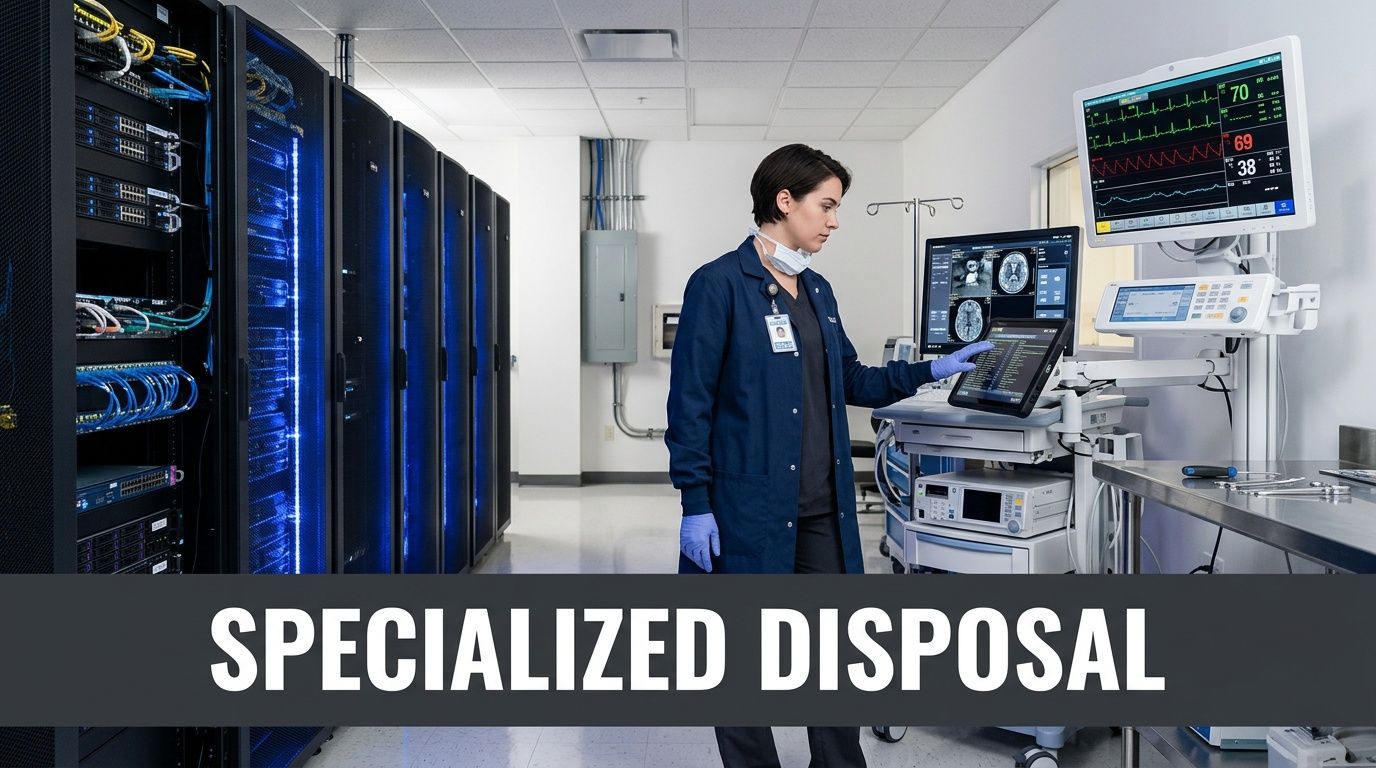
Healthcare needs custody and discretion
Healthcare teams retire more than laptops. They also deal with tablets, label printers, intake kiosks, nurse station workstations, and storage media that may have touched protected health information. The disposal plan has to protect patient data without disrupting care delivery.
That changes the service model. A medical office or hospital department needs scheduled pickup windows, controlled handling on site, and documented sanitization or destruction. Staff should not be making ad hoc decisions about where devices go or how they leave the building.
In practice, healthcare recycling succeeds or fails on process discipline. Who signs assets out. Where they wait before pickup. Whether failed drives are destroyed separately. Whether the vendor can produce records that hold up if compliance or legal asks questions six months later.
Education needs serialized accountability
Education environments usually face volume and timing. Device turnover often lands in a narrow window between terms, and the asset mix can be messy. Chromebooks, classroom PCs, lab systems, smart boards, and networking gear may all hit surplus status at once.
For K-12 districts and higher education, the priority is documentation that ties disposition to the actual device, not a generic truckload receipt. Schools need serial-level tracking, documented custody from campus pickup forward, and sanitization methods that fit the media type. That matters for FERPA exposure, internal audit, insurance questions, and parent or board scrutiny after a loss.
The practical distinction is simple. Residential drop-off recycling may be fine for a broken monitor from home. It is not a suitable operating model for a district technology refresh or a university lab retirement.
Data centers need project control
Data center retirements are infrastructure projects. The recycler has to fit into shutdown sequencing, access controls, cabling plans, rack removal, drive disposition, and loading windows. If that coordination slips, the recycling work starts affecting uptime, contractor schedules, and facility turnover.
A qualified ITAD partner should be able to handle de-installation, staged removals, segregation between redeployable equipment and destroy-only assets, and media workflows that match your security standard. Teams planning larger server and storage retirements should review a defined data center decommissioning process before pickup day. It prevents avoidable mistakes such as mixing reusable hardware with drives queued for destruction or leaving chain-of-custody gaps during a rushed shutdown.
In data center work, poor recycling coordination creates operational risk fast. Missed access windows, mislabeled media, and undocumented removals turn a disposal job into an incident review.
What Columbus businesses should take from this
Healthcare, education, and data centers all need the same outcome. Controlled removal, verified sanitization, and records that stand up to audit. The difference is execution. Household recycling options serve residents. Commercial ITAD services serve organizations that need documented custody, data security, and predictable project management.
Frequently Asked Questions for Business E-Waste
Are free Columbus recycling events good enough for a business
Usually not. They may work for household electronics or a one-off employee item. Businesses need pickup scheduling, data destruction controls, serialized tracking, and formal documentation.
Do “free” events really stay free
Not always. Some Columbus options charge for hard-to-recycle displays. According to Stark Electronics Recycling, fees can include $25 for CRT monitors and $10 for flat-screens. For a business clearing out multiple displays, that changes the economics quickly. Certified B2B recyclers may absorb some of those costs inside a larger service arrangement.
What should be on a certificate of destruction
At minimum, it should identify the assets processed and confirm the destruction or sanitization event. Stronger documentation ties the certificate to serial numbers, the method used, and the processing date. If a certificate is generic and not asset-specific, it has limited audit value.
Can a recycler pick up from our office or data room
Yes, many business-focused recyclers offer pickups and coordinated logistics. That matters when you're dealing with bulk quantities, loading dock controls, or devices that shouldn't sit unattended waiting for transport.
Should we wipe devices ourselves before pickup
Sometimes, but only if your process is consistent and documented. Many businesses are better served by keeping devices intact, recording serials, and letting a certified partner perform the final sanitization under a controlled chain of custody.
What's the biggest mistake companies make
They choose a disposal option based on convenience instead of documentation. That works until someone asks for evidence.
If your organization operates in Atlanta and needs the same business-first approach to secure electronics recycling, Atlanta Computer Recycling provides commercial ITAD, hard drive wiping, pickups, decommissioning support, and compliant disposition built for offices, schools, hospitals, and data center environments.