Atlanta Commercial Recycling Washers and Dryers 2026


A facilities upgrade rarely happens in isolation. The same quarter you’re replacing laundry equipment in staff housing, patient care, student residences, or hospitality operations, you may also be retiring laptops, kiosks, access points, or back-of-house systems. That’s where many organizations make a costly mistake. They treat old washers and dryers like bulky junk instead of retired business assets.
For a commercial team, recycling washers and dryers sits much closer to asset disposition than junk hauling. These units are heavy, hard to move, built with recoverable metals, and often tied to utility disconnects, internal electronics, and compliance questions that consumer guides barely mention. If you manage a hospital, university, hotel group, senior living property, or corporate campus, the wrong disposal path can create audit gaps, safety issues, and avoidable liability.
Why Your Business Needs a Commercial Appliance Recycling Strategy
A facilities manager usually notices the problem when the replacement schedule is already underway. New units are arriving. Old ones are still connected. Loading docks are booked. Maintenance wants the space back, and procurement assumes someone else has disposal covered.
That approach works for a single residential pickup. It does not work for a multi-unit commercial retirement.
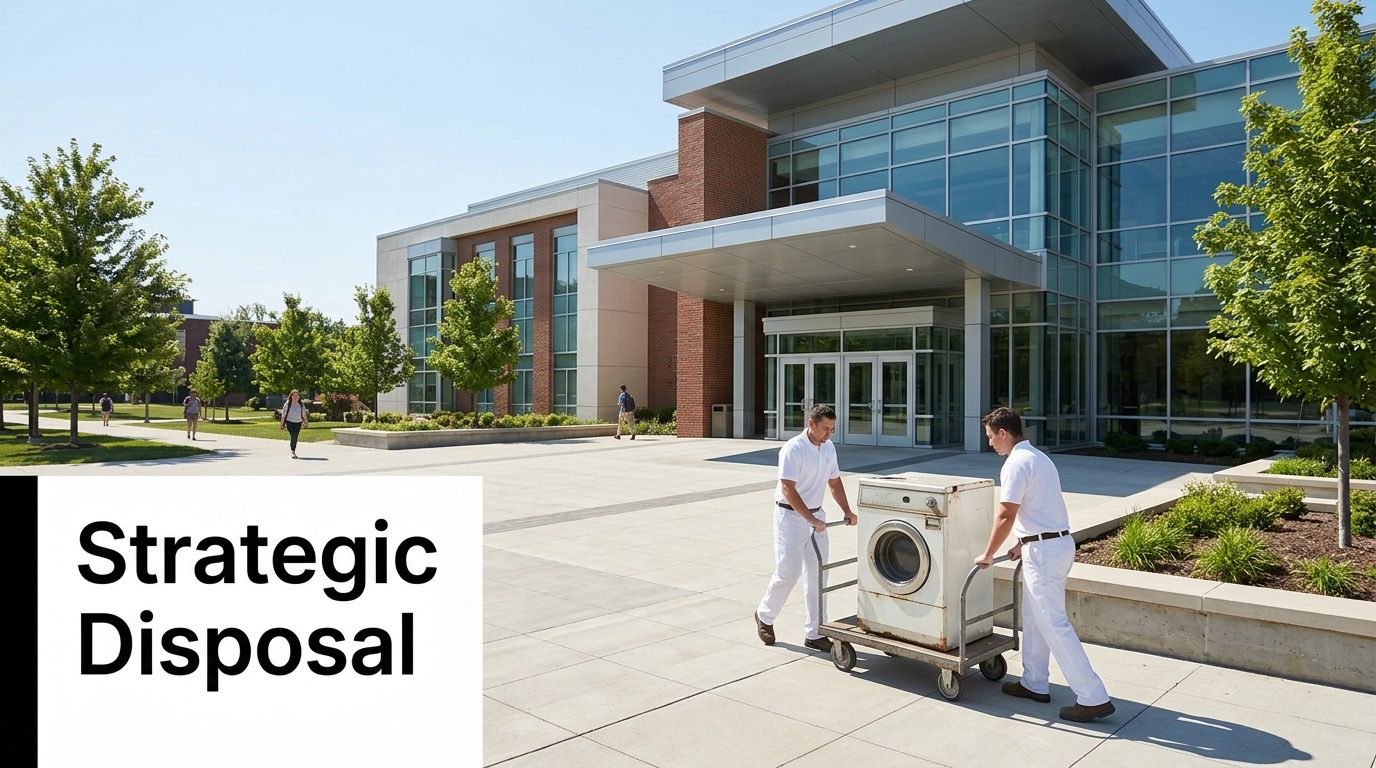
These aren't just old machines
Commercial washers and dryers have material value, but they also carry operational and regulatory baggage. Units can contain metals worth recovering, along with motors, wiring, electronic assemblies, oils, capacitors, and other components that need proper handling. Major appliances are a meaningful part of the waste stream, and as of 2017 major appliances in U.S. municipal solid waste reached 5,160 thousand tons, with 3,110 thousand tons recycled, a 60.2% recycling rate according to Junk King's appliance disposal facts.
That’s the environmental side. The business side is just as important.
A commercial disposal project needs chain of custody, site coordination, unit tracking, clear pickup scope, and proof of proper downstream handling. Those are familiar requirements in IT asset disposition, which is why the same thinking behind environmentally responsible electronics recycling in Atlanta applies here. If your organization already demands documented handling for servers and laptops, it should apply comparable discipline to connected facility equipment.
Practical rule: If an asset is expensive to install, difficult to remove, and capable of creating compliance exposure, it needs a written disposition process.
The market is moving toward professionalized recycling
This isn’t a niche service anymore. The global home appliance recycling sector was valued at USD 22.85 billion in 2026 and is projected to reach USD 37.92 billion by 2033, growing at a 7.5% annual rate, according to Coherent Market Insights on the home appliance recycling market. That growth reflects regulatory pressure and the economic value of recovered materials.
For facilities leaders, that means two things.
First, recycling washers and dryers has become a specialized commercial service, not an afterthought. Second, the market’s growth doesn’t guarantee every hauler, scrap yard, or pickup service is set up for business-grade accountability. You still need to separate providers that can handle enterprise requirements from providers built for one-off residential removals.
What works and what fails
What works is a project plan that treats old appliances like controlled assets. Inventory them. Decide whether each unit is headed for reuse, parts recovery, or destruction. Confirm disconnect responsibilities. Require documentation.
What fails is “free pickup” with no written scope, no condition log, no downstream visibility, and no answer to a simple question: who owns the risk once the truck leaves your site?
Donation, Scrap, or Certified Recycling Which Path to Choose
Businesses usually have four realistic paths for old laundry equipment. Donation. Scrap. Retailer or manufacturer haul-away. Certified recycling. The right answer depends less on the appliance itself and more on your compliance posture, volume, and need for documentation.
Compare the options like an asset manager
A common mistake is picking the lowest-cost outlet first and asking questions later. That often leads to rework. The vendor can’t handle stairs, won’t accept non-functional units, won’t document pickup by serial number, or sends equipment into an opaque downstream channel.
While many services advertise free appliance removal, businesses need to examine who assumes environmental compliance liability and whether the provider supplies audit documentation. Those issues often differ sharply between residential and commercial removal, as noted in Take My Appliance's discussion of pickup and liability concerns.
| Commercial Appliance Disposal Options Compared | ||||
|---|---|---|---|---|
| Disposal Option | Best For | Scalability | Documentation Provided | Liability Risk |
| Donation | Working units with clear resale or charitable use potential | Limited for large, mixed-condition batches | Often inconsistent | Higher if condition, transfer, or data issues aren't documented |
| Scrap metal yard | Dead units with obvious commodity value | Moderate if you can transport and sort | Usually basic weight tickets, not asset-level records | Higher if hazardous components or electronics aren't handled properly |
| Retailer or manufacturer haul-away | Simple replacement swaps | Good for small, direct replacement jobs | Often limited to service receipts | Moderate, depends on scope and downstream handling |
| Certified recycler | Mixed-condition fleets, regulated sites, audit-sensitive projects | Strongest for multi-unit commercial work | Best fit for inventory, pickup records, and recycling documentation | Lower when chain of custody and downstream controls are defined |
Donation sounds simple until volume and accountability show up
Donation can make sense when units still function and your organization is comfortable transferring them out of service. In practice, donation is hardest when you have mixed brands, uneven condition, missing parts, or a hard deadline.
There’s another concern. Once units leave your site for reuse, you need to know what was transferred, in what condition, and under what terms. If a smart appliance still contains network credentials or paired account data, donation without a sanitization step creates exposure that most donation workflows were never designed to address.
Scrap is fast, but narrow
Scrap yards can be useful when equipment is clearly beyond repair and your priority is metal recovery. Washers and dryers contain recoverable materials, but scrap is usually a blunt instrument. It works best when your team has already separated units that are at their end of life and removed the guesswork around utility disconnects, electronics, and hazardous components.
If your site wants a local metal outlet for certain streams, a dedicated metal recycling center may fit part of the project. It usually won’t replace a full commercial disposition plan.
The cheapest path at pickup can become the most expensive path after an internal audit.
Certified recycling is usually the right path for mixed commercial loads
For a hospital laundry room refresh, student housing turnover, or hotel renovation, certified recycling is usually the cleanest answer because it handles the complexity you have. Some units may be candidates for reuse. Some may need full dismantling. Some may require more careful handling because of electronics, contamination concerns, or site access issues.
What works here is a written scope that defines:
- Accepted condition ranges so dead units don't get rejected at the dock
- Pickup packaging and staging rules so your team doesn't lose time on removal day
- Documentation deliverables such as inventory lists, transfer receipts, or recycling confirmation
- Liability language that makes downstream responsibility explicit
Retailer haul-away still has a place, especially for direct swap-outs of a small number of units. It just isn’t built for the governance standards most commercial sites need.
How to Prepare Units for Safe and Efficient Removal
Most delays in appliance pickups happen before the truck arrives. Someone assumes engineering disconnected everything. Another team leaves water in the drums. A third stacks units in a corridor and blocks egress. Good prep prevents all of that.
Here’s the operating standard that consistently works on large projects.

Start with utilities and internal condition
Professional appliance recycling includes a mandatory depollution phase that removes oils, capacitors, and other hazardous materials before disassembly, according to SAMR Inc.'s washer and dryer recycling guidance. Your site team should prepare units so that this downstream step can happen safely and without surprises.
Use a simple sequence:
- Disconnect power, water, and gas correctly. Assign this to qualified maintenance staff or a licensed trade, not a general mover.
- Drain washers completely. Residual water causes leaks during transport and can damage floors, elevators, and trucks.
- Dry interiors and trays. That reduces odor, mold, and contamination complaints.
- Secure doors, cords, and hoses. Tape doors shut if needed and coil loose lines to prevent snags.
If your crew needs a practical refresher on handling the machines themselves, these tips for moving large appliances are useful for planning safe movement and avoiding property damage.
Build a staging plan before pickup day
A lot of facilities teams focus on the appliance and ignore the route. The route matters just as much.
Walk the path from room to dock and check for thresholds, ramps, elevator access, parked vehicles, and floor protection needs. If the project is on an occupied site, schedule around patient flow, residents, students, or guest traffic. Appliance removal becomes expensive when the truck sits idle because your team is still clearing a hallway.
Use this checklist:
- Create a staging zone: Pick a secure area near the loading point where removed units can wait without blocking operations.
- Protect the building: Use floor coverings, corner guards, and elevator padding when needed.
- Separate special units: Keep contaminated, damaged, or unusually heavy equipment clearly apart from standard loads.
- Assign one site lead: One person should approve counts, answer access questions, and sign transfer paperwork.
If the vendor arrives and starts asking where the units are, who disconnected gas, or which elevator they can use, the job is already off schedule.
Document like you would for IT equipment
Appliance projects improve fast when facilities borrows from ITAD.
Track serial numbers if available. Record asset tags. Note condition. Mark whether the unit is approved for reuse, scrap, or recycling. Photograph exceptions such as impact damage, missing panels, or contamination. If a unit came from a healthcare or lab environment, record any cleaning or decommissioning steps your team completed before release.
For teams handling mixed facility assets, even a short internal procedure borrowed from projects like how to dispose of a gas grill helps standardize disconnect, staging, and risk review before pickup.
The point isn’t paperwork for its own sake. The point is preventing disputes, delays, and compliance blind spots.
The Hidden Compliance Risks in Modern Appliances
A facilities team clears out 40 laundry units from employee housing, student residences, or a healthcare campus. The project looks simple until one of those machines has Wi-Fi credentials saved in memory, another was removed without a documented gas signoff, and a third gets resold through a secondary channel with no clear chain of custody. At that point, appliance recycling stops being a janitorial task and starts looking a lot like IT asset disposition.
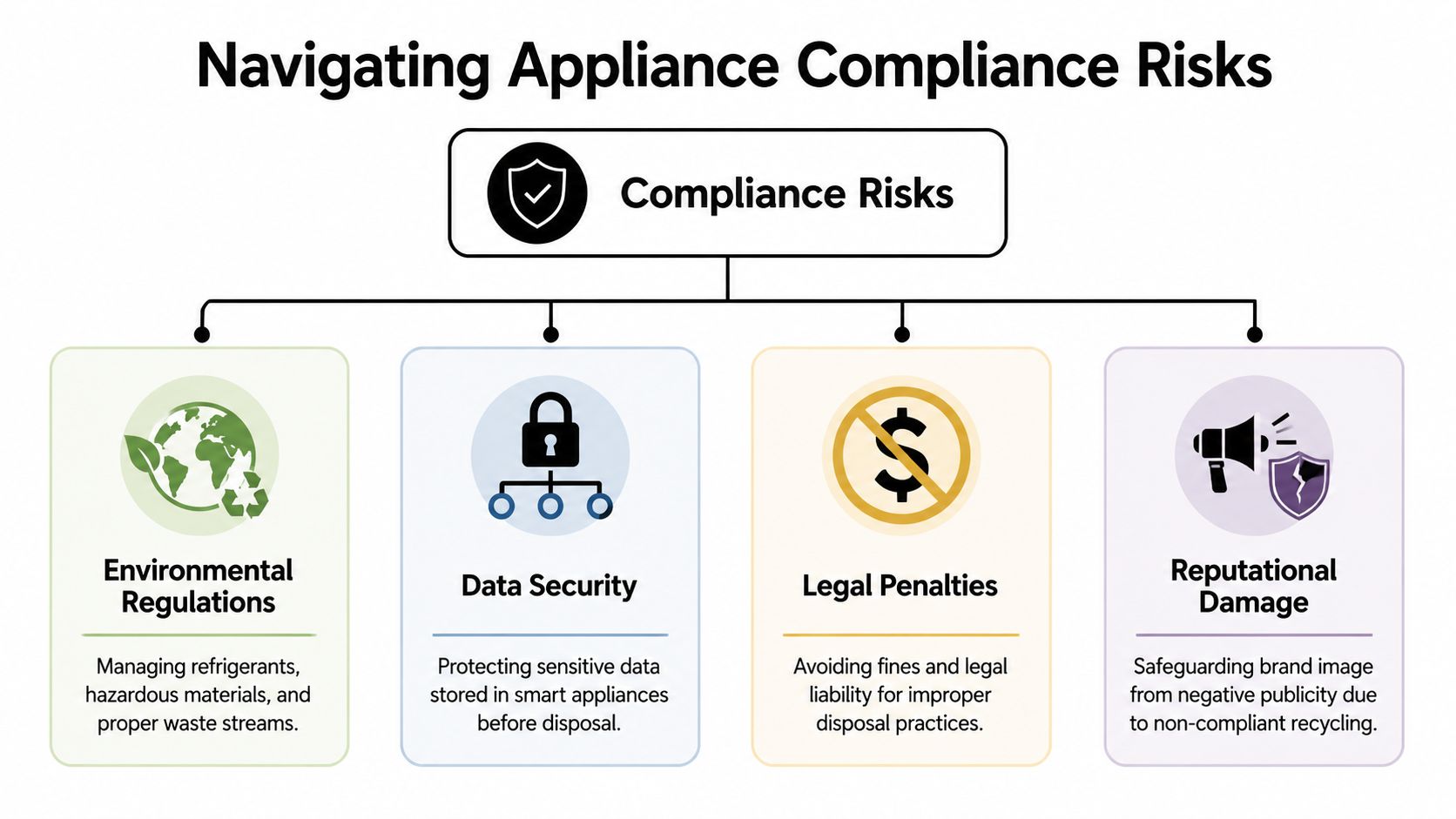
Smart appliances create a data problem
Commercial washers and dryers are no longer just steel, motors, and control boards. Many newer models store network settings, service histories, app pairings, and account information. Standard consumer recycling advice often misses that risk, as shown in 1800GOTJUNK's discussion of washer and dryer disposal blind spots.
For a business, the exposure is practical, not theoretical. A connected unit may retain:
- Wi-Fi credentials entered during setup
- Cloud account links used for monitoring, diagnostics, or maintenance
- Location or resident identifiers tied to housing or facility operations
- Service and configuration records that reveal how the unit was managed
That matters in student housing, multifamily operations, senior living, and healthcare environments. If a vendor removes smart units for resale without wiping or destroying the electronics-bearing components, your organization may have released data-bearing equipment with no controls.
Utility, environmental, and chain-of-custody failures create avoidable exposure
Data is only part of the issue.
Gas dryers need documented disconnects by qualified personnel. If your records cannot show who isolated the line, when the work was completed, and which units were cleared for pickup, you have a weak hand if there is an incident, an insurance question, or a dispute with a landlord or contractor. For teams tightening utility signoff procedures, Voyager Plumbing's gas compliance guide is a useful reference point.
Environmental handling also gets missed. Some appliance components enter regulated waste streams or need controlled downstream processing. A hauler can remove the load on time and still leave your team with liability if the material goes to the wrong processor. That is why many organizations fold appliance retirement into broader universal waste management programs for regulated facility waste streams.
The operational control that ties this together is chain of custody. IT teams already expect it for laptops, phones, and printers. Facilities should expect the same standard for smart appliances, especially when units may be reused, harvested for parts, or transferred through more than one downstream vendor.
A smart washer or dryer should be handled with the same discipline you apply to a networked printer.
Questions every vendor should answer
I look for one thing first. Can the recycler tell me exactly what happens to a connected or higher-risk unit after pickup?
If the answer is vague, the process is weak.
Ask direct questions:
- How do you identify smart or connected appliances before disposition?
- Do you wipe embedded settings, remove electronics-bearing components, or send certain units straight to destruction?
- Which units are approved for reuse, and who makes that decision?
- What chain-of-custody records do you provide from pickup through final disposition?
- Which downstream processors handle boards, controls, and other electronic components?
- Can you document utility disconnect status for gas units before removal?
Reuse can be the right outcome for some equipment. It also creates more governance work. If your organization cannot allow a unit with stored credentials, operational history, or site identifiers to enter resale channels, say that up front and put it in writing. That is standard ITAD practice, and it belongs in appliance projects too.
Consumer junk haulers rarely build their process around those controls. A commercial recycler with ITAD discipline will.
Understanding Recycling Costs and Choosing an Atlanta Partner
A 40-unit laundry room shutdown can look cheap on paper and still turn into an expensive haul. The invoice usually reflects stairs, tight turns, utility disconnect problems, loading delays, tenant access, and paperwork your compliance team needs after the truck leaves.
Commercial washer and dryer recycling is a labor and controls job first, a scrap job second. If a vendor leads with "free pickup" before asking about access, unit count, utility status, or documentation, the quote is probably built around best-case assumptions that do not match a business site.

What actually drives cost
The number of units matters, but it is rarely the main cost driver. Site conditions usually decide whether the project runs cleanly or burns time.
Common pricing factors include:
- Access conditions: Basement rooms, elevators, upper floors, long pushes to the dock, and narrow doorways increase labor and slow removal.
- Utility status: Units that are still connected to water, drain, gas, or power can require your maintenance team or licensed trades before the recycler can touch them.
- Condition mix: Leaking, damaged, or heavily rusted units take more time to handle safely than a uniform batch of dry, dead equipment.
- Documentation: Asset logs, pickup manifests, chain-of-custody records, and final disposition reporting add back-office work that low-cost haulers often leave out.
- Scheduling: Occupied buildings, after-hours windows, and multi-site coordination raise project cost fast.
Ask what is excluded from the quote. That question surfaces hidden cost better than asking for a lower rate.
Choose a partner that can separate resale value from compliance risk
Some units should be scrapped without debate. Others may have reuse value. The problem for businesses is that reuse creates more control points, more recordkeeping, and more exposure if the wrong item re-enters the market.
That is why I look for a vendor with an ITAD mindset. The same discipline used for retired printers, kiosks, and access-control hardware applies here. Track the asset. Document custody. Define whether a unit can be reused, harvested for parts, or destroyed. Put those rules in writing before pickup.
A provider with experience in commercial e-waste recycling in Atlanta is often better prepared to support mixed projects where appliances, electronics, and connected equipment leave the site under one documented process.
What to ask before signing
Use a short vendor screen and listen for direct answers:
- What is included in the quoted price, and what triggers added charges?
- Can you provide pickup records and final disposition documents by asset group or by unit?
- How do you separate items approved for resale from items restricted to destruction or material recovery?
- Who performs the removal work, your employees or subcontractors?
- What must our maintenance or facilities team complete before your crew arrives?
- Have you handled occupied multifamily, hospitality, healthcare, or campus removals in Atlanta before?
A qualified partner will answer in operational terms. Crew size. Scope assumptions. Disconnect requirements. Documentation delivered after pickup. A weak vendor will keep returning to scrap value and ignore the parts of the job that create risk.
Integrating Appliance Disposal Into Your Asset Management Plan
The best long-term fix is simple. Stop treating appliance retirement as an occasional cleanup job. Treat it as part of your asset lifecycle program.
That means washers and dryers should enter the same governance lane as retired laptops, printers, networking gear, and access-control hardware. Keep an inventory. Define approved disposition paths. Require documented transfer. Flag any equipment with connectivity, stored credentials, or higher environmental handling requirements. Build these steps into renovation plans, procurement replacements, and site closure checklists.
Put facilities and IT on the same page
Most organizations already have the bones of this process. IT tracks custody. Facilities manages disconnects and site access. Compliance defines recordkeeping expectations. Procurement knows the replacement schedule. The problem is that each team often works its own queue.
A better model is a shared retirement workflow:
- Facilities identifies outgoing equipment early
- IT or security reviews connected units for data risk
- Compliance sets documentation standards
- Approved recyclers handle pickup and downstream processing
- Project leads close the file only after documentation is complete
When appliance disposal is folded into asset management, surprises drop fast. So do finger-pointing disputes between departments.
The practical takeaway
For business sites, recycling washers and dryers is not just about keeping bulky machines out of a landfill. It’s about controlling risk from disconnect through final disposition. The organizations that do this well apply the same discipline they already use for ITAD. They classify assets, document transfers, and choose vendors that can support compliance instead of creating gaps.
That’s the standard worth adopting in Atlanta and anywhere else you run multi-site operations.
If your organization needs a secure, well-documented way to retire appliances alongside computers, servers, and other electronic assets, Atlanta Computer Recycling can help you build a cleaner disposition process. Their commercial focus, logistics support, and ITAD experience make them a strong fit for Atlanta businesses that need more than a haul-away service.