IT Security Awareness Trends in Atlanta Workplaces: 2026

Monday starts with a ticket that looks routine. An employee in Buckhead gets an email that appears to come from a known vendor, the branding is right, the tone is right, and the request is just urgent enough to bypass common sense. They don't click the link. They forward it to IT. You investigate, confirm it was a credential-harvesting attempt, and realize the company avoided a breach because one person paused for ten seconds.
That's what IT security awareness looks like in Atlanta workplaces now. Not posters. Not annual slide decks. Not a quiz everyone forgets by Friday. It's the daily behavior of employees who handle email, files, devices, printouts, and retired hardware.
A lot of teams in the metro area already know the phishing side of the problem. Fewer connect that same human risk to what happens later, when laptops are replaced, servers are pulled from racks, or old drives get tossed into a surplus pile. That gap is where strong awareness programs still fail.
If you're responsible for IT, compliance, infrastructure, or operations, you need a broader model. Security awareness has to cover the full asset lifecycle. That includes active use, remote access, reporting habits, and end-of-life handling. If you're tightening controls around endpoints, this practical guide on how Atlanta firms improve endpoint security is worth reviewing alongside your awareness plan.
Your Team Is Your First Line of Defense
The old model treated employees like the weakest link. I think that mindset is lazy and expensive.
In real Atlanta environments, employees are your broadest control surface. They see the fake DocuSign message before your tools do. They notice the unusual MFA prompt. They catch the misaddressed spreadsheet. They also decide whether an old laptop with regulated data gets handed to IT properly or left in a storage closet.
What the near misses are telling us
Most organizations don't get taken down by one cinematic attack. They get chipped away by ordinary decisions.
A finance coordinator responds to a spoofed invoice thread. A clinic employee stores files in the wrong place. A school department keeps retired desktops for months without a chain of custody. None of that feels dramatic at the time. All of it creates exposure.
Security awareness only works when employees know what to do next, not just what to avoid.
That's why IT security awareness trends in Atlanta workplaces are moving toward operational behavior, not policy acknowledgment. Good programs train people to report quickly, escalate correctly, and handle data responsibly whether it's in an inbox, on a laptop, or sitting on a shelf waiting for disposal.
What I tell local IT leaders
If your program still revolves around annual completion rates, you're measuring administration, not risk reduction.
Use awareness to improve the handful of behaviors that change outcomes:
- Suspicious email reporting: Make reporting faster than deleting.
- Credential protection: Train users to treat unexpected login prompts as events, not annoyances.
- Sensitive file handling: Tie access habits to role and business context.
- Hardware retirement behavior: Teach staff that “I wiped it” isn't a disposal process.
That shift is the starting point. Your people already influence your security posture every day. The question is whether you've trained them to do it well.
Why Security Awareness Is a Critical Control in 2026
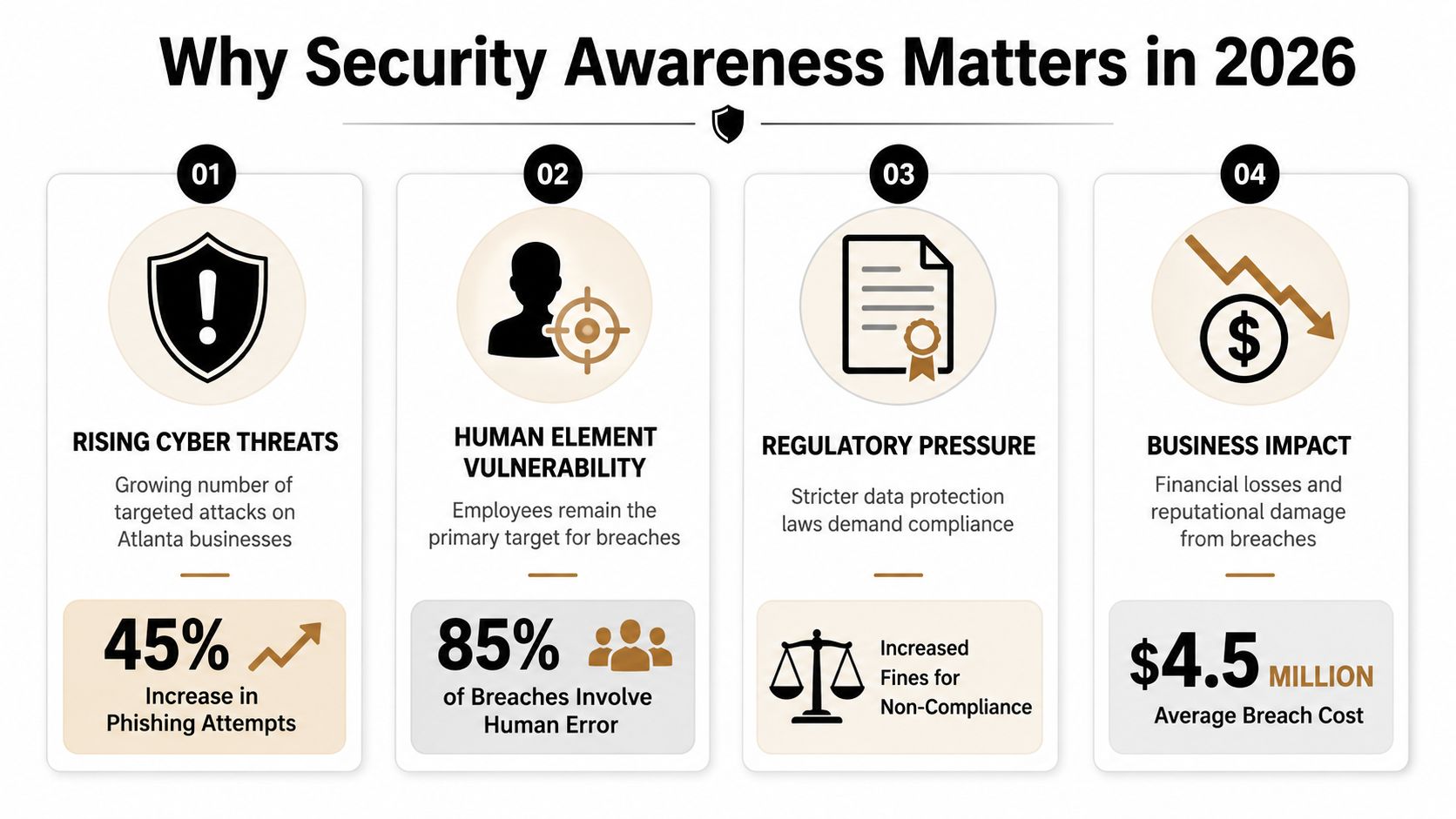
Security awareness matters more now because most organizations can't hire their way out of human risk.
The talent market is tight, and Atlanta isn't insulated from that reality. The U.S. Bureau of Labor Statistics projects information security analyst employment will grow 29% from 2024 to 2034, with about 16,000 openings per year on average and a median annual wage of $124,910 in May 2024, according to the BLS outlook for information security analysts. The same verified market summary notes a global cybersecurity workforce shortfall of 4.8 million unfilled positions and 470,000+ openings in the U.S.
That changes how you should think about awareness. It isn't soft training. It's compensating control.
Why this hits Atlanta businesses directly
Atlanta employers compete for the same scarce security talent as healthcare systems, universities, public agencies, logistics firms, and enterprise IT shops. That means many teams are short on specialized defenders while their environment gets more complex.
When that happens, the rest of the workforce has to become part of the defense model.
Here's the practical version:
| Business reality | What it means for awareness |
|---|---|
| Security hiring is expensive | You need employees to catch obvious threats earlier |
| Security teams are stretched | Reporting workflows must be simple and fast |
| Regulated data is widespread | Training must focus on real handling behavior |
| Hybrid operations increase variation | Employees need repeated reinforcement, not one annual reminder |
If you're planning infrastructure upgrades or risk reviews, this broader perspective aligns with current IT infrastructure security trends in Atlanta.
Awareness is now an operations decision
A lot of leadership teams still frame awareness as a compliance line item. That's outdated.
If your SOC, infrastructure team, or managed provider can't investigate every signal instantly, employees need to become reliable signal generators. They need to recognize suspicious behavior, report it early, and avoid turning small incidents into account takeovers or data exposure.
Practical rule: If you can't staff every security gap with specialists, train the people already touching the systems.
That doesn't mean pushing technical burden onto end users. It means building predictable habits around email, access, files, and devices. In 2026, that's a hard control. Treat it that way.
Key Security Awareness Trends in Atlanta Workplaces
The strongest programs in Atlanta don't look like “training” anymore. They look like an ongoing operating rhythm.
That's the right direction. According to Keepnet Labs security awareness training statistics, 45% of employees say they receive no security training at all. The same summary reports that organizations running security awareness programs consistently can see up to a 70% reduction in security incidents, and ongoing training can reduce employee-driven cyber incident risk by up to 72%. Local hiring also reflects the shift. Atlanta employers are filling Security Awareness Analyst roles to design role-based content, run phishing simulation campaigns, and track effectiveness, as shown in an Atlanta-area Security Awareness Analyst posting.

Continuous training replaced annual theater
Annual security modules still exist because auditors like to see them. They're not enough.
Modern programs use short, recurring content tied to what people face. That means quick phishing refreshers, file-sharing reminders, remote work hygiene, and role-specific prompts that show up throughout the year.
The reason is simple. People forget generic content, especially when it has no connection to their daily work.
Simulation is now a measurement tool
Phishing simulations used to be treated like gotcha exercises. Good teams use them differently now.
They test whether training changed behavior. They also reveal where reporting breaks down. If users spot the phish but don't know how to escalate it, your awareness program didn't finish the job.
A useful simulation program should answer questions like these:
- Who reports suspicious messages quickly: Not who just ignores them.
- Which departments need different examples: Finance, HR, and clinical teams don't face the same lures.
- Whether managers reinforce the process: Employees copy local culture faster than they absorb policy.
Dedicated ownership is becoming normal
One of the clearest signs of maturity is ownership. When an organization assigns awareness to someone whose job is to build content, run campaigns, and track results, the program starts acting like a control system instead of an annual obligation.
That's why I pay attention when local employers hire for dedicated awareness work. It means they've accepted a basic truth. Human behavior produces measurable risk, so it needs measurable management.
Treat awareness like endpoint management. Set a baseline, monitor behavior, fix weak spots, repeat.
If your current program is just LMS completion and a policy signature, you're behind the market.
Tailoring Awareness for HIPAA and Public Sector Compliance
Generic security training is a problem in regulated environments. It checks a box and leaves the actual exposure untouched.
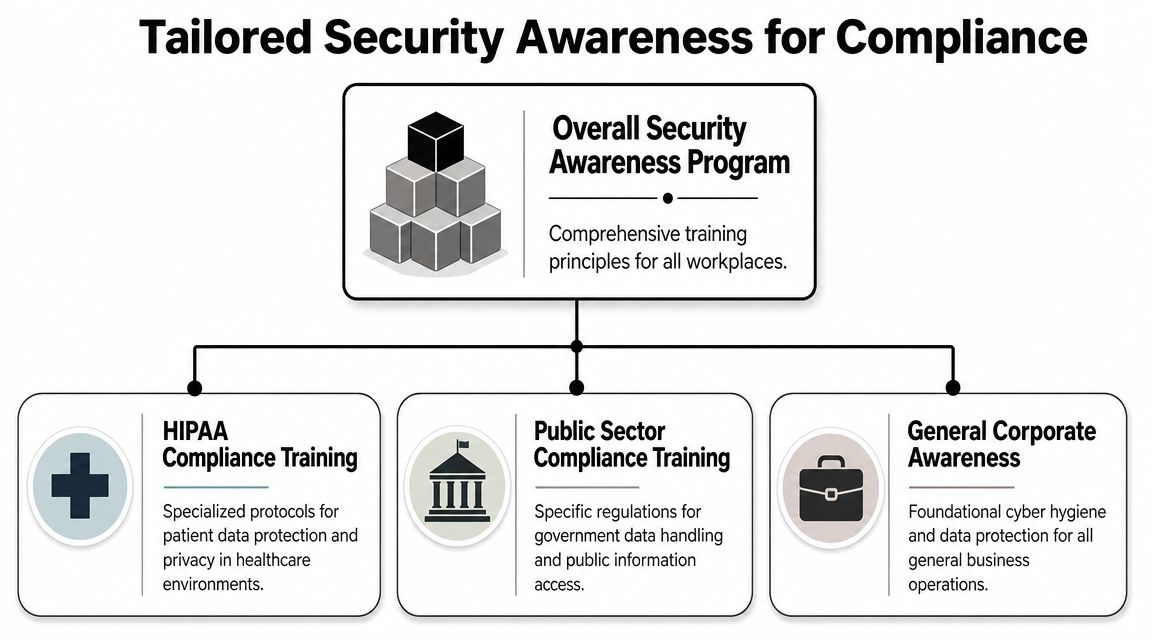
That matters in Atlanta because so many local organizations sit in healthcare, education, and government-adjacent operations. These teams don't just need users who know not to click bad links. They need people who understand the exact data, systems, and workflows attached to their jobs.
Healthcare needs role-based training, not generic reminders
A peer-reviewed review of workforce security awareness found that programs work best when they connect security actions directly to an employee's role and daily tasks. The same review notes that in one healthcare report, nearly 20% of files were open to every employee, highlighting the stakes in environments with broad data exposure, as discussed in the research on workforce security awareness in healthcare and related settings.
That should change how hospitals, clinics, and medical offices train.
A clinician needs different scenarios than a front-desk employee. A billing administrator needs different warnings than a help desk technician. If everyone gets the same script, nobody gets enough context.
Public sector and education need the same discipline
Government offices and school systems often have mixed workforces, older systems, contractors, broad permissions, and large device inventories. That combination makes generic awareness especially weak.
Use role patterns instead of broad categories:
- Front-line staff: Focus on impersonation, document handling, and escalation.
- Managers: Add approval fraud, sensitive sharing decisions, and response expectations.
- IT and operations teams: Cover removable media, retired hardware, handoff controls, and documentation.
- Contractors and temporary staff: Limit training to the systems and data they touch, then enforce it.
If your team needs a disposal process aligned with regulated environments, review these HIPAA-compliant data destruction practices.
Compliance also depends on clarity
A lot of organizations bury important expectations inside policy language that nobody reads under pressure.
Plain language works better. Short decision rules work better. Real examples work better.
That's one reason I often point teams to outside references that show how privacy expectations are documented in practice. Even if the jurisdiction or company is different, the structure in these details of our privacy policy is useful because it reinforces a simple idea. People handle sensitive information better when they can see how the organization defines responsibility, collection, retention, and protection in concrete terms.
If an employee can't explain how security applies to their own job, your training is too generic to help.
Building Your High-Impact Awareness Program
Most awareness programs fail for boring reasons. The content is generic, delivery is inconsistent, and success gets measured with completion rates instead of behavior.
Fix that, and the program gets useful fast.
Start with a small set of behaviors
Don't try to train everything at once. Pick the few actions that reduce risk in your environment.
For most Atlanta organizations, that list usually includes suspicious email reporting, MFA prompt recognition, safe file handling, escalation of unusual payment or access requests, and proper handoff of retired equipment. Those behaviors are observable, coachable, and relevant.
Build your first version around a short matrix like this:
| Role group | Core behavior to train | What to measure |
|---|---|---|
| Office staff | Report suspicious email | Reporting speed and quality |
| Finance and admin | Verify payment and account changes | Escalation before action |
| Managers | Reinforce process and approvals | Consistency of follow-through |
| IT and facilities | Handle devices and media correctly | Documented handoff and chain of custody |
Use delivery methods people will actually tolerate
Nobody wants a bloated annual module. Break content into short sessions and tie it to current tasks or recent incidents.
For distributed teams, live sessions still help when they're short and interactive. If you're comparing tools for remote enablement, this roundup of top webinar platforms for online training is a practical starting point for choosing how to deliver manager briefings, phishing reviews, or role-based refreshers.
Then mix formats:
- Micro-learning: Good for recurring reminders and focused habits.
- Manager-led discussions: Useful when specific departments keep seeing the same mistake.
- Simulations and drills: Best for testing what people do under pressure.
- Job-aid checklists: Ideal for asset moves, offboarding, and disposal events.
Measure behavior, not attendance
Completion data matters for governance. It doesn't tell you whether the program is working.
Track operational outcomes instead. Are suspicious emails being reported faster? Are employees escalating odd requests instead of improvising? Are teams following handoff procedures when devices leave service? Those are the signals that tell you whether awareness is changing behavior.
I also recommend tying your awareness work to broader IT lifecycle management best practices. That forces the program to address onboarding, active use, reassignment, offboarding, storage, and retirement instead of stopping at email hygiene.
Keep the culture usable
Fear-based awareness backfires. If people think one mistake will get them punished, they hide problems.
Create an environment where users report early, ask questions, and hand over devices or media without guessing what procedure applies. You want alert employees, not silent ones.
Extending Awareness to Secure IT Asset Disposition
This is the part too many security programs miss.
They teach users how to handle suspicious links, then say almost nothing about what happens when a laptop is replaced, a network closet is cleaned out, or a server gets decommissioned. That's a serious gap because data risk doesn't end when the device leaves daily use.
A security awareness trend worth paying attention to is the move from cyber-only messaging to full lifecycle responsibility. According to SecurityMentor's security awareness training statistics and trends, improper document and hardware disposal accounted for 14% of data breaches caused by physical attacks in one report. The same verified summary notes 55% of IT leaders rely on employees to alert them to incidents and 89% of incidents led to repercussions for employees, which tells you reporting culture and employee behavior matter far beyond phishing.
The disposal gap is a training failure
I still see organizations with decent phishing programs and weak retirement habits. Old drives sit in cabinets. Printers get moved without storage review. Surplus laptops are stacked for months with no manifest, no chain of custody, and no clear owner.
That isn't a recycling problem first. It's an awareness problem first.
Employees need to understand three basic truths:
- Retired hardware still contains risk: Especially laptops, desktops, servers, network gear, printers, and removable media.
- Factory reset is not a governance process: Even when a device appears clean, the organization still needs controlled handling.
- Informal disposal creates blind spots: If equipment leaves the business without documentation, you've lost control of the event.
Train the end of life process like any other control
Your awareness program should include practical asset retirement scenarios. Not abstract policy. Real workflow.
Use prompts such as:
- Who owns the device handoff
- Where equipment waits before pickup
- What employees must never do on their own
- How data-bearing media gets separated, tracked, and destroyed
- Which departments must sign off during office moves and decommissions
For organizations that need a concrete baseline, these IT asset disposal best practices are a useful reference.
If you need a service provider for the physical side, Atlanta Computer Recycling handles business IT asset disposition, pickup logistics, hard drive wiping, physical shredding for obsolete media, and data center decommissioning for Atlanta-area organizations. That's not a substitute for awareness training. It's the operational endpoint that keeps awareness from failing at the last step.
A user who reports a phishing email but leaves a data-bearing laptop in an unsecured surplus pile is still part of the problem.
That's why digital awareness and physical disposition belong in the same conversation.
Making Security Awareness a Complete Lifecycle Strategy
The strongest Atlanta teams have stopped treating awareness as an annual class. They use it as a control that follows people through the entire lifecycle of technology.
That means employees know how to respond when they receive a suspicious message, when they access sensitive files, when they work remotely, when they offboard a user, and when they retire hardware. Anything less leaves gaps between policy and operations.
What good looks like now
A mature program has a few obvious characteristics:
- It's continuous: Not a once-a-year event.
- It's role-based: Not one generic script for everyone.
- It's measurable: Not just tracked by completion.
- It includes physical handling: Not only email and passwords.
That last point is where many businesses still lag. They train people to protect active systems, then get casual when those same systems leave service. That's backwards. End-of-life equipment is still part of your security program until it's properly sanitized, documented, and removed under control.
If you want IT security awareness trends in Atlanta workplaces to translate into real risk reduction, build the program around behavior across the full lifecycle. Train reporting. Train handling. Train retirement. Then support those expectations with documented processes and qualified downstream vendors.
If your team needs a practical way to close the gap between employee awareness and secure equipment retirement, Atlanta Computer Recycling provides business-focused IT asset disposition, secure data destruction, pickup logistics, and support for office cleanouts and decommissioning across the Atlanta metro area.