Atlanta’s Expanding Role in Tech-driven Innovation

Atlanta's tech story is usually told through growth, funding, and hiring. The more useful question for an IT manager is what that growth leaves behind.
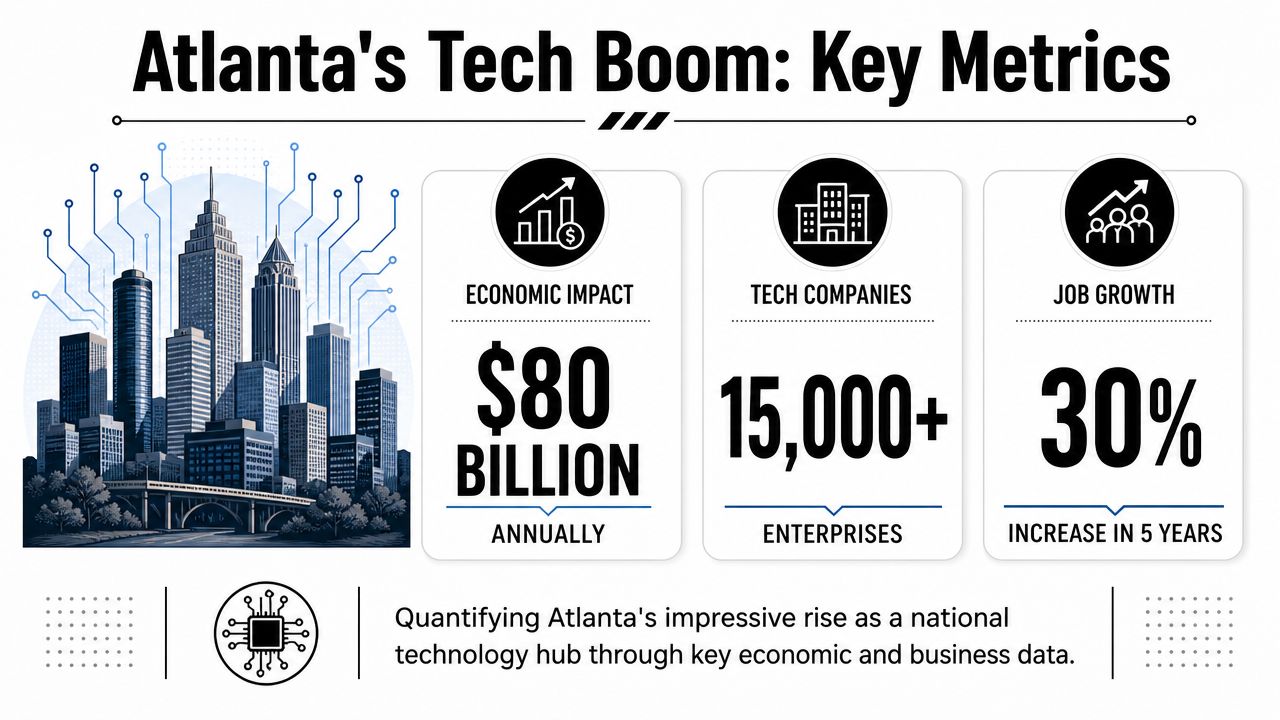
A 2026 industry snapshot says the Atlanta metro is home to more than 13,000 technology companies and about 144,000 tech professionals, while Georgia's tech sector carries an estimated $113 billion economic impact and Atlanta had become the eighth-largest tech workforce in the United States by 2022 according to this Atlanta technology industry snapshot. That scale changes day-to-day infrastructure work. More deployments mean more refreshes. More pilots mean more retired gear. More remote offices, lab environments, and security controls mean more drives, servers, switches, and mobile devices that eventually have to leave service safely.
That's where Atlanta's expanding role in tech-driven innovation becomes operational, not just economic. If you manage infrastructure in this market, you're not only supporting growth. You're also carrying the downstream burden of asset control, data destruction, chain of custody, and e-waste compliance.
Atlanta's Rise as a National Tech Powerhouse
CBRE's annual tech talent research has repeatedly kept Atlanta in the national conversation for tech hiring and office growth, which is the practical signal IT managers should pay attention to. A market that continues to add tech employers and technical staff also increases the volume of endpoints, servers, lab gear, network equipment, and mobile devices that will eventually need to be tracked, wiped, and retired under control.
Early context helps.
What this growth means inside the IT department
In a market like Atlanta, growth shows up in the asset register before it shows up anywhere else. New hires need laptops. New offices need switches, firewalls, access points, conference room systems, and spare inventory. Expansion projects also leave behind partially used equipment, short-term deployments, and devices that never make it cleanly back into inventory.
That changes infrastructure work in three specific ways:
- Refresh cycles tighten: Teams replace laptops, storage, collaboration hardware, and security appliances faster because the business is under pressure to deploy quickly and stay current.
- Asset visibility weakens under growth: Hiring, office moves, acquisitions, and project-based deployments create gaps between what procurement bought, what IT issued, and what is still sitting in the field.
- Disposition risk becomes a security issue: A retired SSD, decommissioned firewall, or forgotten test server can hold regulated data long after the business has moved on.
The practical shift is simple. Retirement cannot be treated as the last task in the lifecycle. It needs to be planned at procurement, documented at deployment, and verified at disposition.
Practical rule: If your asset disposition process begins when equipment is already stacked in a closet, you started too late.
Leadership teams also read Atlanta's growth as a cue to move faster on transformation. That expectation raises the pressure on internal IT to support expansion without losing control of retired hardware, audit records, or chain of custody. Broader discussions about Atlanta's role in digital transformation leadership are relevant for that reason. The visible story is innovation. The harder job is keeping the infrastructure behind it secure and governable.
Why the rise matters beyond branding
For operators, Atlanta's rise is less about reputation and more about density. More vendors, more implementation partners, more startups, and more enterprise activity can speed up deployment. They also create more churn in hardware inventories.
I see the same trade-off across growing environments. Fast expansion usually improves business capability while making asset recovery, data destruction, and documentation harder. As a result, every technology decision carries a disposal consequence. Atlanta's expanding role in tech-driven innovation has made lifecycle discipline a core management function instead of an afterthought.
The Engines Driving Atlanta's Tech Boom
Atlanta's growth has staying power because it isn't tied to one trend, one employer, or one narrow sector. The city benefits from a stack of reinforcing advantages. Companies can recruit from a deep labor pool, build closer to major customers across the Southeast, and run large operations without some of the friction associated with older coastal tech centers.
That matters because sustainable growth creates a predictable pattern for enterprise IT. When expansion is structural, hardware turnover doesn't spike once and disappear. It becomes a recurring operational condition.
Why companies keep building here
Atlanta works well for firms that need a mix of enterprise access and implementation speed. Large organizations can place engineering, support, cybersecurity, sales, and operations teams in the same metro. Startups can sell into local enterprise accounts. Universities and incubators keep feeding that cycle with founders, researchers, and early-stage technical talent.
The result is a market where technology moves from concept to production quickly. That sounds positive, and it is. But fast commercialization also means environments get rebuilt often. Test labs become business-critical systems. Pilot hardware turns into production hardware. Temporary deployments linger unless someone owns the full lifecycle.
A lot of that pressure shows up first in infrastructure teams. They're the ones who end up dealing with the retired servers from a completed migration, the access control hardware from an office redesign, or the network gear removed during a security overhaul.
Logistics and data center gravity
Atlanta also has a practical edge that IT teams feel immediately. It's a city built for movement, coordination, and regional reach. For organizations managing multiple sites, that lowers friction when they need to deploy equipment, support users, or consolidate retired assets.
That same advantage strengthens the local data center and colocation environment. As infrastructure footprints expand, so does the need for tighter handling of decommissioned hardware. Organizations planning rack retirements, server replacements, or facility transitions usually discover that disposal is the least forgiving part of the project. If chain of custody breaks at the end, the whole project carries risk.
That's why many local teams are paying closer attention to Atlanta's increasing need for data center services. Growth in compute capacity is only half the story. The other half is what happens when aging gear leaves the rack, leaves the room, and leaves your control.
The companies that handle growth best usually don't separate infrastructure strategy from disposal strategy. They plan them together.
What doesn't work in a fast-growth market
Some habits break down quickly in a city growing this fast:
| Common approach | What goes wrong |
|---|---|
| Holding retired gear until “the next cleanup” | Assets pile up without documentation or ownership |
| Letting each office manage disposal differently | Data handling becomes inconsistent |
| Treating refresh projects as procurement-only exercises | End-of-life costs and risks surface late |
| Assuming internal wiping is enough for every device | Verification and audit evidence often fall short |
What works is centralization. A single intake process. One chain of custody standard. One documentation model. One approved path for reuse, resale, recycling, or destruction.
A Deep Dive into Atlanta's Key Tech Sectors
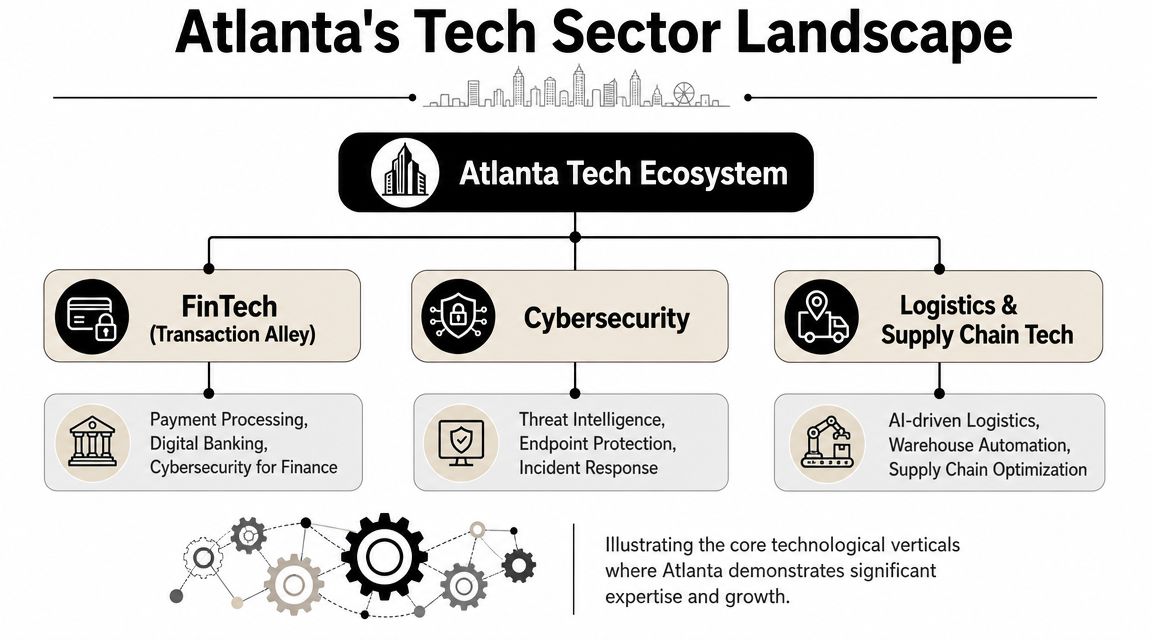
Atlanta's tech economy isn't broad in a vague sense. It has identifiable clusters that create specific infrastructure demands. If you manage IT in this market, it helps to understand not just that the city is growing, but which kinds of companies are driving the work.
A 2025 regional tech review reported that startups in Atlanta raised $1.2 billion in 2025 alone and that the city had at least six unicorn companies. The same source notes that Georgia hosts more than 14,000 technology companies generating more than $50 billion in annual economic impact in this regional review of Atlanta's startup and research ecosystem. That mix matters because different sectors retire different classes of equipment, carry different compliance burdens, and create different disposal risks.
Here's the sector view.
Fintech and payment infrastructure
Atlanta's fintech identity is well established in industry conversations because the city has long attracted payment, processing, and financial software activity. For IT managers, that usually means one thing first: sensitive data environments.
Even when payment data isn't stored directly on a device, adjacent systems still matter. Laptops used by finance teams, call center endpoints, test terminals, network devices, and retired storage can all hold credentials, logs, cached files, or integration data that shouldn't leave your control casually.
Practical takeaway:
- User endpoints need stronger offboarding controls than many teams expect.
- Lab and staging devices often contain production-adjacent data.
- Networking hardware can expose configurations and credentials if it's resold or discarded carelessly.
Cybersecurity and enterprise software
A growing cybersecurity presence creates a useful local ecosystem, but it also raises the standard for internal discipline. Security vendors, consultancies, and software teams often work with test appliances, high-turnover lab gear, and a larger volume of short-lifecycle hardware than a traditional office environment.
That creates a disposal pattern many companies underestimate. The highest-risk assets aren't always the obvious ones like old file servers. They're often the devices used in validation, demos, troubleshooting, incident response, or temporary secure environments.
A security-minded organization should treat the following as controlled assets at retirement:
- Appliances and firewalls
- Admin workstations
- External storage
- Legacy backup media
- Decommissioned switches and routers
For many Atlanta firms, this is why conversations around IT infrastructure security trends in Atlanta are increasingly tied to retirement workflows, not just active monitoring and prevention.
Health tech and logistics platforms
Health IT and logistics technology add another layer. In healthcare, retired devices can create compliance exposure even when they appear harmless. In logistics and operations environments, the challenge is often scale and geography. Equipment is spread across warehouses, offices, vehicles, support depots, and regional sites, which makes collection and verification harder.
If you can't prove where a retired device came from, who handled it, and how data was destroyed, you don't have a secure process. You have a hopeful one.
Atlanta's expanding role in tech-driven innovation is strongest where digital systems intersect with regulated operations. That's exactly where asset disposition has to be the most disciplined.
Talent Research and Infrastructure The Ecosystem's Foundation
Atlanta's growth doesn't rest on company count alone. It rests on a local system that keeps producing technical talent, commercial ideas, and deployable infrastructure. For enterprise IT leaders, that foundation matters because it affects how quickly new tools appear, how easy it is to hire for specialized roles, and how often internal teams are asked to support new platforms before standards have fully matured.
A useful description comes from Georgia Tech's own coverage of the ecosystem. Atlanta's universities, incubators, and public-private programs, especially those centered on Georgia Tech and ATDC, are described as the “secret weapon” for creating a flywheel effect in entrepreneurship by shortening the cycle from prototype to market in Georgia Tech's look at making Atlanta a top 5 tech hub. That shorter cycle helps the region. It also means IT teams see more frequent experimentation, replacement, and integration work.
What the talent pipeline changes for IT operations
When universities and incubators feed the local market well, enterprise teams benefit in obvious ways. Hiring is easier. Vendor conversations improve. Pilot projects get staffed faster.
Less obvious is the operational side. A healthy commercialization pipeline means organizations are constantly evaluating:
- New endpoint classes
- Specialized lab hardware
- Developer test environments
- AI and analytics infrastructure
- Network upgrades to support higher-bandwidth workloads
That cycle pushes retirement volume upward. The same ecosystem that makes Atlanta attractive for innovation also makes old equipment accumulate faster than policy usually anticipates.
Why infrastructure basics still decide outcomes
Plenty of teams get excited about new applications and overlook the underlying architecture. That's expensive. If your switching, segmentation, endpoint control, storage strategy, and physical asset tracking are inconsistent, every innovation project becomes harder to secure and harder to retire cleanly later.
For a quick operational refresher, this overview of the key components of network infrastructure is useful because it grounds planning in the physical and logical layers that IT teams have to manage. That context matters in Atlanta because local growth often shows up first as infrastructure sprawl, not just software adoption.
A better way to think about local innovation
Treat Atlanta's ecosystem as a source of opportunity and entropy at the same time.
Opportunity comes from talent, research, and commercial momentum. Entropy comes from unmanaged device growth, inconsistent standards, and a rising count of assets that eventually need sanitization or destruction. Teams that do well here don't resist innovation. They put guardrails around it.
Field note: The fastest-moving environments usually need the simplest retirement rules. Complexity at end of life creates delay, and delay creates risk.
That's the foundation IT managers should build on. Not just hiring. Not just partnerships. Controlled infrastructure from acquisition through disposition.
The Operational Impact on Enterprise IT Management
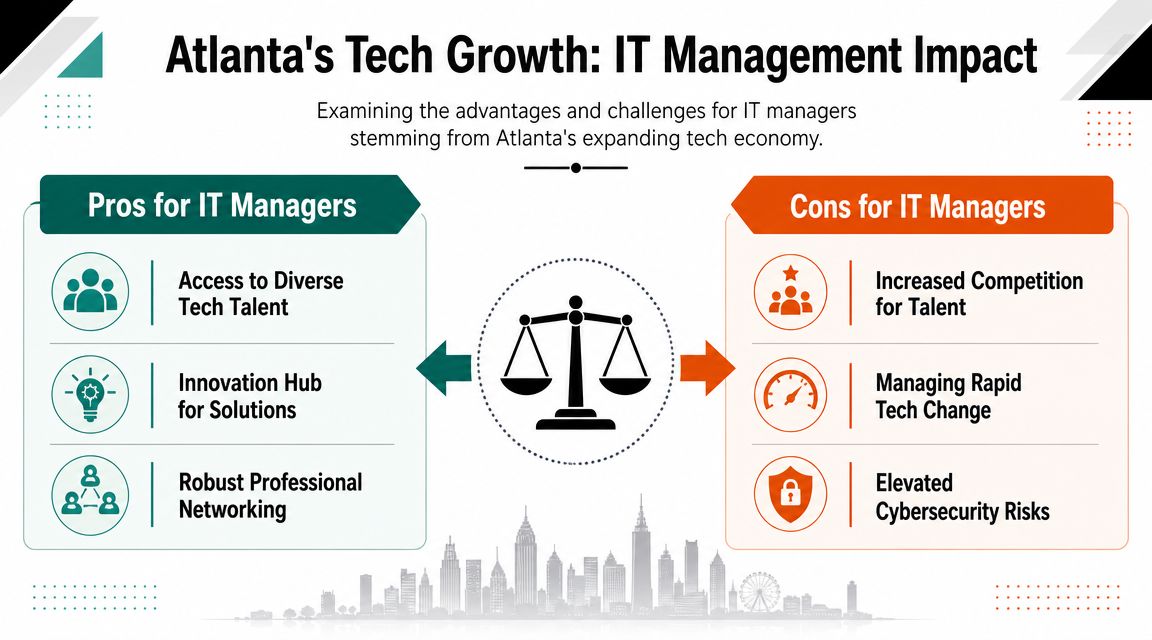
The strongest signal for IT leaders isn't just that Atlanta is growing. It's that investment has changed the density of the local technology environment. Independent reporting indicates Atlanta has attracted more than $11.5 billion in tech investment since 2018, which implies a deeper supplier and talent ecosystem and more hardware lifecycle pressure for enterprises, as noted in this report on Atlanta's recent tech investment activity.
That pressure lands directly on IT operations.
Faster refresh cycles create hidden exposure
In a slower environment, teams can get away with informal handling. One storage room. A spreadsheet that's mostly current. A quarterly cleanup. In Atlanta's current market, that breaks fast.
Common failure points include:
- Untracked laptops after user offboarding
- Retired SSDs stored without destruction status
- Network gear pulled during upgrades but never documented
- Branch-office equipment shipped back without sealed custody
- Test lab devices reused internally with no wipe verification
None of these issues look dramatic on their own. Together, they create breach risk, audit friction, and confusion over ownership.
Data security gets harder at the end of life
Most organizations invest heavily in active controls. EDR, MFA, segmentation, access reviews, and patching all matter. But a device at end of life still contains risk if retirement controls are weak. That's especially true in healthcare, finance, education, and public-sector environments where regulated data can live in more places than teams expect.
Three patterns consistently fail:
| Weak practice | Why it fails |
|---|---|
| Staff wipes devices manually with no verification trail | You can't prove the process was completed correctly |
| Equipment sits waiting for a future move or office project | Physical control degrades over time |
| Recycling is handled like junk removal | Data-bearing assets require security controls, not basic hauling |
The better model is to tie asset retirement to documented workflow. Inventory confirmation. Serialized intake. Sanitization standard. Exception handling for failed media. Certificate trail. Responsible downstream recycling.
That discipline becomes even more important when equipment moves among multiple sites. Teams managing pickups across branch offices or campus buildings often benefit from the same planning mindset used in field operations. A practical example is this guide for optimizing sales routes, not because IT asset pickup is sales, but because route logic, sequencing, and chain-of-custody timing matter when you're collecting sensitive devices from many locations.
What works and what doesn't
What works in Atlanta right now is boring, repeatable process:
- Pre-approved retirement triggers: Don't wait for ad hoc requests.
- Single ownership: One team governs the disposition standard.
- Documented handoff: Every move gets recorded.
- Media exception path: Failed drives go to physical destruction, not wishful wiping.
- Lifecycle policy alignment: Procurement, security, compliance, and facilities all follow the same playbook.
What doesn't work is fragmented responsibility. When desktop support, infrastructure, office managers, and third-party movers each improvise part of the process, risk spreads unobserved.
That's why mature teams formalize IT lifecycle management best practices before the next wave of upgrades hits. In Atlanta, the operational consequence of growth is simple. You will retire more equipment. The only question is whether you'll retire it under control.
An Action Plan for Secure IT Asset Disposition in Atlanta
A workable ITAD program doesn't need to be complicated. It needs to be consistent, documented, and defensible. If you're managing laptops, servers, network gear, or storage across the Atlanta metro, the goal is to make retirement as controlled as deployment.
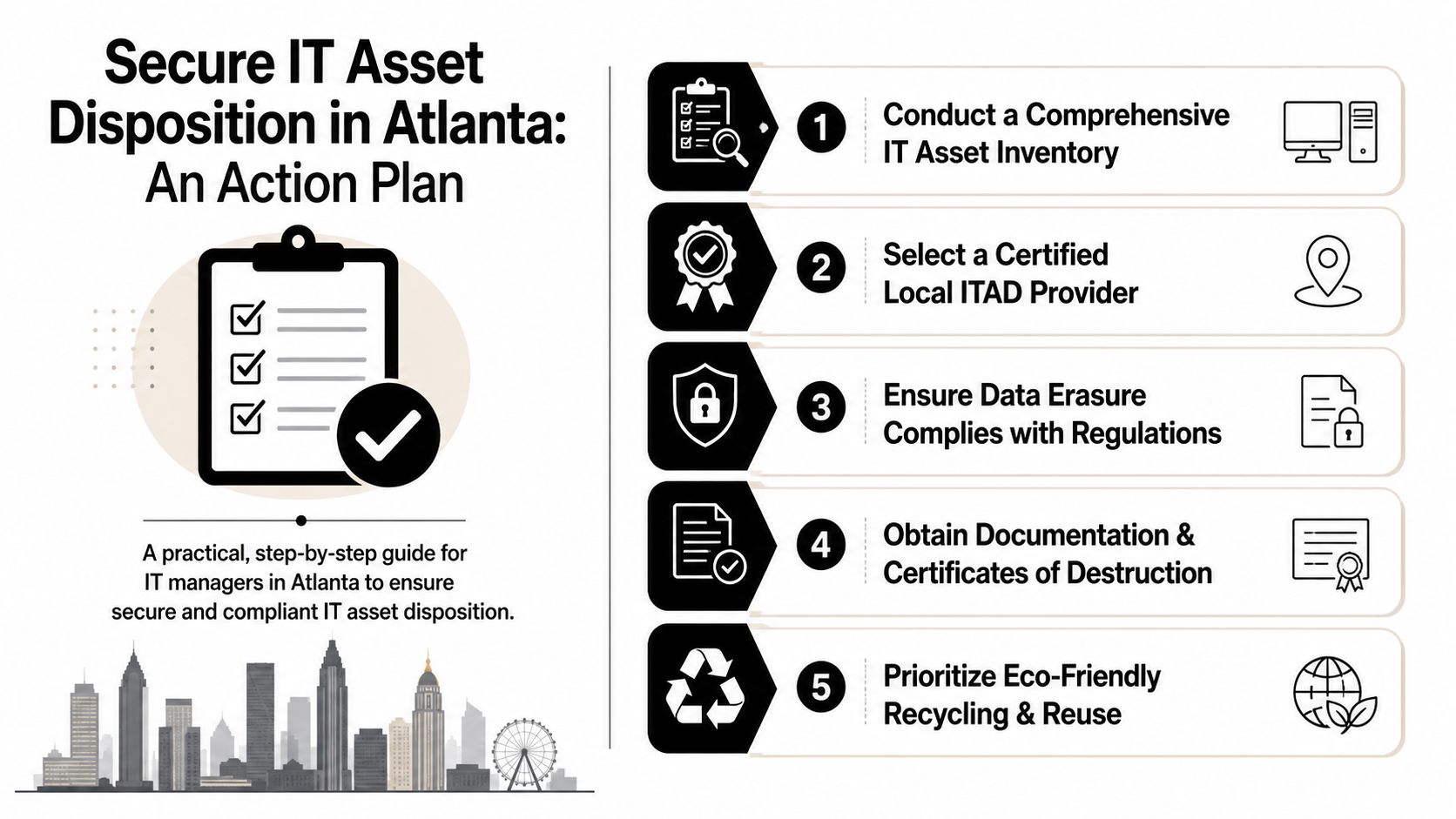
The five controls that matter most
Build a real inventory before pickup
Start with serial numbers, device type, assigned location, and data-bearing status. Separate working assets from failed assets. If the inventory is wrong at the start, every document after that is less useful.Define the sanitization standard
For reusable media, specify the approved wipe method in policy. Many organizations use DoD 5220.22-M as a benchmark for data wiping. For non-functional or obsolete media, require physical shredding or destruction. Don't leave failed-drive handling to technician judgment in the moment.Maintain chain of custody
Use sealed containers where appropriate, signed transfer records, and clear responsibility at each handoff. This matters most when equipment leaves a secured room, crosses departments, or moves between sites.Require disposition documentation
You need more than a pickup receipt. Ask for serialized reporting when applicable, certificates of destruction for media that was physically destroyed, and confirmation of downstream recycling or reuse channels.Choose a provider that fits your risk profile
A hospital, school district, law firm, and enterprise data center won't all need the same handling. Pick a local ITAD partner based on process control, data destruction options, logistics capability, and documentation quality. One Atlanta option is secure IT asset disposal in Atlanta, GA, which aligns with business pickup, DoD 5220.22-M wiping, and physical shredding for media that can't be sanitized for reuse.
A simple decision filter
Use this short checklist when reviewing your current process:
- Can we identify every retired data-bearing asset by location and status?
- Do we know which items were wiped and which were physically destroyed?
- Can we produce chain-of-custody records without reconstructing them later?
- Are e-waste and reusable equipment separated intentionally, not accidentally?
- Would our process hold up during a customer security review or internal audit?
If any answer is no, the process needs work.
Secure disposition isn't a cleanup task. It's a control point in the security program.
Atlanta's expanding role in tech-driven innovation is creating more equipment churn, more distributed infrastructure, and more reasons to tighten end-of-life handling. The organizations that stay ahead of that change are the ones that operationalize retirement before the next migration, office move, or hardware refresh begins.
Atlanta Computer Recycling helps Atlanta-area businesses handle secure electronics recycling and IT asset disposition for laptops, servers, network gear, storage media, and data center equipment. If your team needs a tighter process for pickup, wiping, shredding, or compliant downstream recycling, Atlanta Computer Recycling is a practical resource to evaluate alongside your existing lifecycle and security requirements.