Atlanta Scrap Iron Dealers: A Business Compliance Guide


You walk into a back room, a cage area, or a retired server room and see the same thing a lot of Atlanta businesses see. Old racks. Dead UPS units. Shelving. Chassis. Patch panels. Mixed cables. A few monitors that should've left the building months ago. None of it is productive anymore, but it still creates risk every day it sits there.
For a business, that pile isn’t just scrap. It’s a chain-of-custody problem, a data security problem, a facilities problem, and sometimes a missed recovery-value problem. If any of it came from IT infrastructure, you also have to decide where metal recycling ends and regulated asset disposition begins.
Your Guide to Commercial Scrap Iron Disposal in Atlanta
A commercial scrap project usually starts with a bad assumption. Someone sees steel and thinks, “Call a scrap yard.” That works for a clean load of shelving or structural steel. It does not work well for mixed business assets that include electronics, storage media, asset tags, or equipment that still needs to be tracked out of inventory.
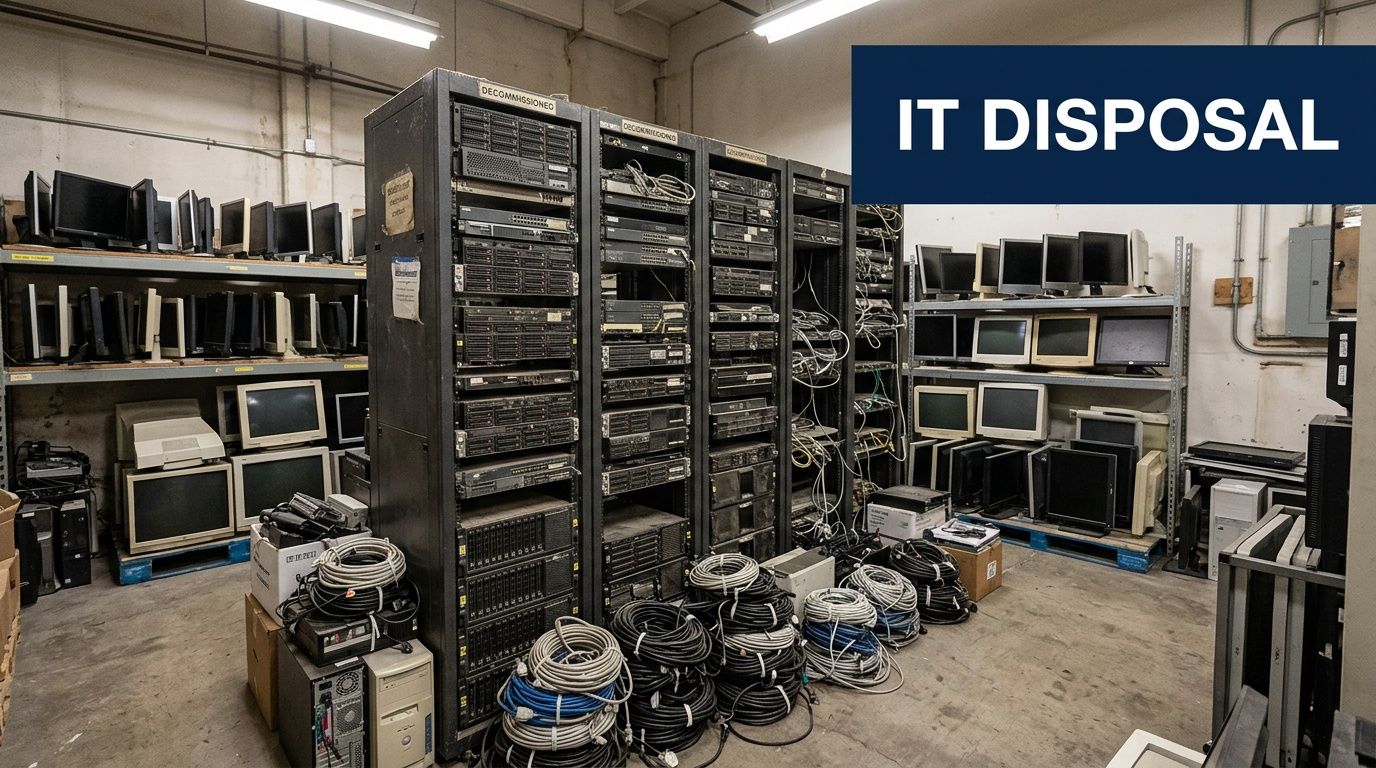
The right way to approach scrap iron dealers is to treat the job as an asset disposition project first and a commodity sale second. You identify what you have, separate clean ferrous material from mixed equipment, define who owns the chain of custody, and decide what requires secure handling before anything leaves the building. If you skip that order, you create avoidable exposure.
The scale of the market explains why process matters. The U.S. ferrous scrap industry was valued at $30.1 billion in 2012 and recycled over 55 million metric tons of iron and steel, according to industry figures on ferrous scrap recycling. Scrap iron dealers aren’t just hauling away junk. They’re feeding a large industrial supply chain that depends on clean, sortable material.
What your team should do first
Before you call anyone, get clear on four things:
- Material type: Separate obvious ferrous items like racks, cabinets, shelving, and steel frames from electronics and mixed e-waste.
- Security status: Flag anything that may contain drives, embedded storage, labels, patient data, user data, or network configuration history.
- Site constraints: Check dock access, elevator limits, pickup windows, and whether the building requires COI paperwork or after-hours work.
- Disposition goal: Decide whether you want simple removal, documented recycling, secure destruction, or full inventory-level reporting.
Practical rule: If an item once stored, processed, or touched business data, don’t classify it as “just metal” until that risk is closed.
For businesses that need a clearer path on commodity metals alongside e-waste separation, a dedicated metal recycling center for commercial material handling is a better starting point than a general public drop-off mindset.
What good management looks like
Good scrap disposition is boring on purpose. The load is identified correctly, removed safely, documented cleanly, and reconciled without surprises. That’s what protects your business. You’re not trying to win the highest line-item metal price on one pickup if the process creates a security hole or an audit problem later.
What Scrap Iron Dealers Actually Do
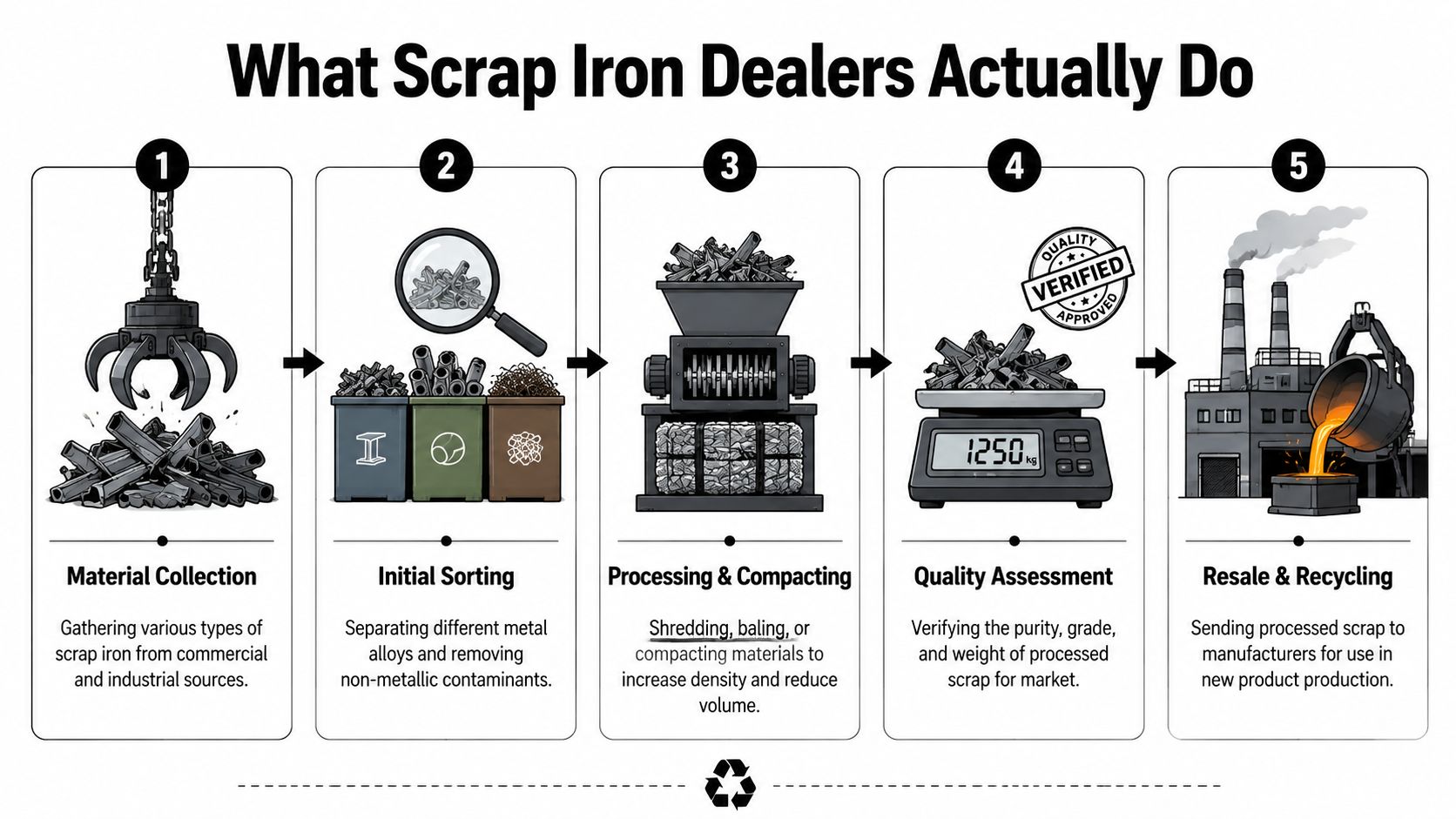
A professional scrap operation does a lot more than weigh a truck and cut a check. The better scrap iron dealers run a material flow process that starts with intake and ends with a saleable commodity grade. If you understand that workflow, you’ll ask better questions and package your load in a way that protects value.
From pickup to furnace-ready feedstock
At intake, the dealer’s team looks at what kind of material arrived and how mixed it is. Clean structural steel, empty steel cabinets, and sorted rack components are easier to process than a load of mixed electronics, plastic, cable, and light-gauge metal. The more mixed the stream, the more sorting labor and the higher the chance of downgrades.
The usual path looks like this:
Collection and receiving
Material is picked up or dropped off, logged, weighed, and visually reviewed.Initial sorting
Ferrous material is separated from non-ferrous metals and non-metal contamination. Magnets help with the first pass, but magnets don’t solve everything when the load includes composite equipment.Processing
Large pieces are cut down, shredded, or compacted. This makes transport easier and prepares the load for mill requirements.Assessment and grading
The dealer checks density, cleanliness, size, and alloy characteristics before assigning a market grade.Downstream sale
The processed material goes to mills, foundries, or other industrial buyers.
Why cleanliness changes everything
From a business side, the mistake I see most often is mixing recoverable steel with trash and low-value attachments. Rubber feet, plastic bezels, glass, batteries, power supplies, loose wire, and boards all make the load harder to grade. Even if the container looks “mostly metal,” mixed contamination changes the conversation fast.
That’s why seasoned operators prefer staged material. One gaylord for drives and media. One pallet for network gear. One area for stripped rack steel. One stream for batteries. One stream for general e-waste. That’s not bureaucracy. It’s how you avoid having a commodity buyer price your whole job like a problem load.
Clean segregation on your dock usually matters more than a tough negotiation on pickup day.
Operational maturity matters
The better dealers also invest in systems, not just equipment. They schedule trucks properly, control traffic flow in the yard, document inbound loads, and keep processing steps consistent. If you manage recurring disposals, tools built for AI for recycling businesses can help with intake communication, job coordination, and customer response handling, especially when your internal team is juggling facilities, IT, and vendor scheduling at the same time.
If your project includes items that may fall outside simple ferrous recovery, it helps to review heavy metals recycling requirements for mixed business waste before the load is quoted. That one step can prevent the wrong material from entering the wrong channel.
Decoding Scrap Iron Pricing and Grading
Scrap pricing feels inconsistent when you’re only looking at the pickup quote. It makes more sense when you understand how dealers grade material. They’re not paying for your intent. They’re paying for what a mill can use without extra processing, contamination losses, or quality claims downstream.
Price starts with grade, not with weight alone
Two steel loads can weigh the same and still settle at very different values. The difference usually comes from purity, density, size, and the amount of work the dealer has to do after pickup. A neat stack of stripped steel rack panels is one thing. A mixed tote of server shells, wire, plastics, and attachments is something else entirely.
Industry grading standards matter here. Scrap iron dealers sort material into recognized categories so downstream buyers know what they’re getting. When your load fits a clean grade, the dealer can move it more confidently. When it doesn’t, they build in discounting because the risk is now theirs.
Where technology improves your payout
Better equipment separates professional operators from guesswork. Dealers using X-Ray Fluorescence, or XRF, achieve over 95% accuracy in detecting contaminants. That supports premium pricing such as $250 to $350 per ton for #1 Heavy Melting Steel, compared with $150 to $200 per ton for contaminated material, based on reported pricing and inspection data for metal scrap transactions.
That spread matters in a commercial decommissioning job. If a dealer can verify that your load is clean, they can price it as a commodity. If they can’t, they’ll protect themselves by pricing it as uncertainty.
What works: pre-sorting, removing attachments, and asking how the dealer verifies grade.
What doesn’t: assuming “steel is steel” and expecting top value on a mixed load.
Common downgrade triggers
These are the issues that most often reduce a quote:
- Mixed materials: Plastic housings, circuit boards, insulation, and foam attached to steel frames.
- Hidden non-ferrous content: Aluminum parts, copper-bearing assemblies, and mixed fasteners.
- Moisture and debris: Dirt, trash, and residue create handling problems and downgrade confidence.
- Incomplete disassembly: Full electronic assemblies are not the same as cleaned ferrous scrap.
If you’re trying to maximize return from a broader cleanout, compare the metal side with other recoverable commodities such as bare bright copper pricing in the Atlanta market. That comparison often shows why separating streams before pickup is worth the labor.
The practical takeaway for IT and facilities teams
Don’t ask only, “What’s your price for scrap steel?” Ask, “What grade do you expect this to fall into, what contamination will reduce it, and how are you verifying that?” Those questions tell you very quickly whether the buyer has a real grading process or is just buying with a blanket discount.
How to Vet Scrap Iron Dealers in Atlanta
If you’re choosing between scrap iron dealers in Atlanta, don’t start with payout. Start with risk. A slightly better commodity rate doesn’t help if the vendor can’t document pickup, mishandles regulated material, or creates confusion about what left your site.
The screening questions that matter
A serious commercial vendor should be able to answer basic operational questions without dancing around them. You want direct answers on licensing, insurance, material acceptance, onsite procedures, and documentation. If the person quoting the job can’t explain their process clearly, that usually tells you what the actual pickup will look like.
Use this as a working checklist.
| Verification Area | Key Question | Why It Matters |
|---|---|---|
| Business legitimacy | Are you properly licensed to buy and process scrap in your operating area? | You need a real commercial partner, not an informal hauler. |
| Insurance | Can you provide proof of insurance before onsite work begins? | Your property team will usually require it, and it reduces exposure during loading. |
| Environmental handling | How do you separate scrap metal from regulated or special waste streams? | Mixed handling can create disposal and compliance problems. |
| Chain of custody | What documentation do you provide from pickup through final disposition? | You need an auditable record, especially for business assets. |
| Electronics crossover | What do you do if the load includes servers, drives, network gear, or batteries? | This determines whether they understand the line between scrap and e-waste. |
| Onsite labor | Are your crews trained to de-install and remove material without damaging the facility? | Cheap labor can become expensive if walls, floors, or docks get damaged. |
| Reporting | Will you provide weight tickets, asset summaries, or destruction records where needed? | Finance, compliance, and IT often all need different records. |
Red flags during the quote phase
You can usually spot a weak vendor before the truck ever arrives.
- They quote from a few photos only: Some jobs need a site walk because access, segregation, and labor drive the outcome.
- They treat all material as one pile: That’s a sign they’re not thinking about chain of custody or downstream compliance.
- They can’t explain exclusions: If they don’t know what they won’t take, they probably create surprises onsite.
- They avoid paperwork questions: Commercial recycling always involves documentation.
A useful benchmark is whether the vendor understands broader universal waste management responsibilities for business disposal programs. Even if your immediate project is mostly ferrous, the wrong item in the wrong container can shift the whole job.
Ask the vendor what happens when their crew finds batteries, drives, or mixed electronic assemblies halfway through loading. Their answer tells you whether they run a process or improvise one.
What a strong partner sounds like
A strong vendor talks about scope, segregation, access, packaging, paperwork, and contingencies. They ask whether your team needs after-hours pickup, dock scheduling, serial capture, escorts, or certificates. They don’t rush past those details because those details are the job.
Planning Logistics and Onsite De-Installation
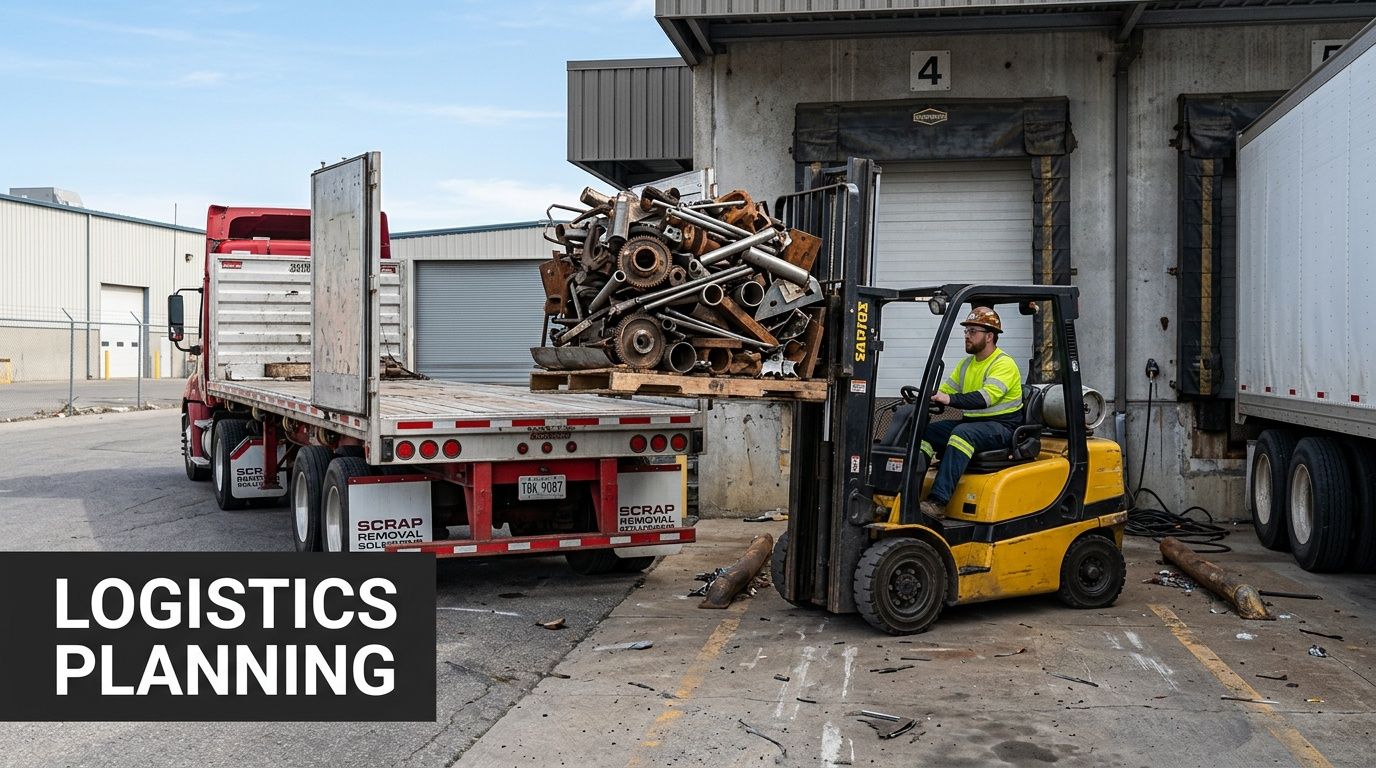
A commercial scrap removal project succeeds or fails in the staging phase. The metal itself is only part of the work. The rest is labor planning, traffic flow, equipment access, building protection, and keeping your operations running while the material leaves.
What a clean commercial pickup looks like
Let’s say you’re clearing a former server room, a warehouse corner, and a few satellite IDF closets. The efficient sequence is usually straightforward. The crew arrives with the right carts, pallets, lifting tools, and truck capacity. They separate what can move immediately from what needs de-installation first. Then they clear pathways, protect surfaces, stage material near the dock, and load in the order that keeps the building safe and the paperwork clean.
That beats the common bad version, where a truck arrives too early, the material isn’t segregated, nobody has labeled what contains storage media, and the facilities team is suddenly trying to manage loading traffic in the middle of the workday.
Server racks are a good example
Server racks look simple because they’re mostly steel, but they still need planning. Server racks can yield approximately 40% ferrous scrap by weight, and professional dealers use shearing and baling to process these materials efficiently, achieving a baled output density of 50 to 60 lbs per cubic foot, according to industry data on scrap metal recycling operations. That’s useful only if the racks arrive in a condition the processor can handle efficiently.
If racks are still loaded with PDUs, cable arms, patching, rails, or abandoned gear, your recovery value drops and your labor risk goes up. Businesses get better outcomes when they define beforehand which team is removing powered components, who verifies the racks are empty, and where stripped steel will be staged.
Three logistics decisions that save headaches
- Schedule around your operation: Early dock windows or after-hours work often prevent interference with receiving, shipping, or staff movement.
- Use the right container strategy: Loose loading, pallets, bins, and roll-offs each work best for different material types and site conditions.
- Assign one site lead: One person should coordinate access, escort requirements, staging approval, and signoff at the end.
If the crew has to decide onsite what’s scrap, what’s e-waste, and what still belongs to IT, the project is already off track.
The best removals feel uneventful. That’s because someone handled the sequencing before the truck arrived.
The ITAD Intersection When to Use a Specialist
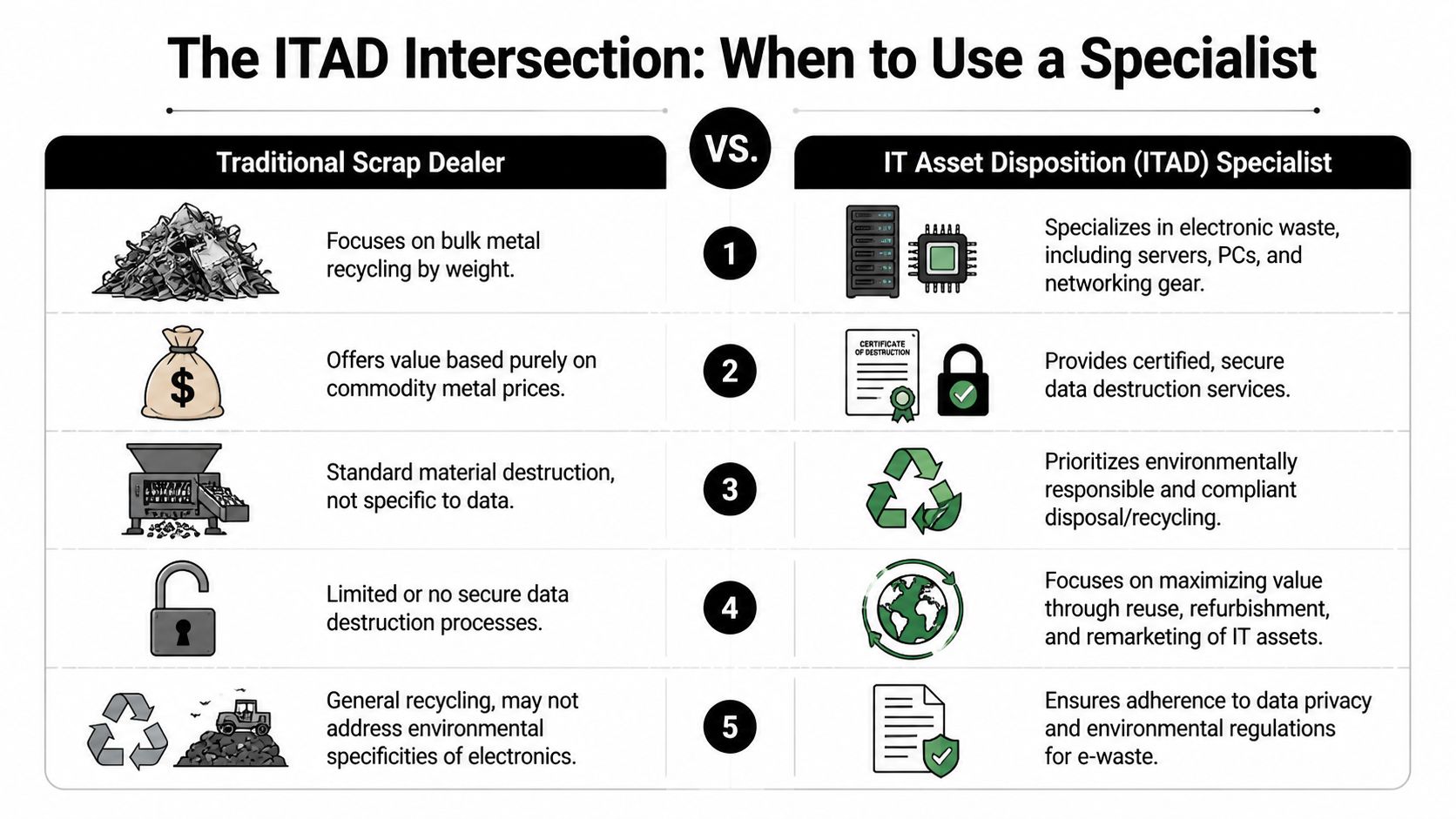
This is the point many businesses miss. If the metal you’re disposing of is attached to, built into, or shipped as part of an IT asset, a standard scrap path is often the wrong path. The issue isn’t whether the chassis is steel. The issue is whether the item carries data risk, compliance obligations, remarketing value, or environmental handling requirements that go beyond commodity recycling.
When scrap logic breaks down
Traditional scrap iron dealers are built to buy metal by grade and weight. That model works when the material is already a commodity. It does not work well when an item needs asset tracking, drive handling, serialized reconciliation, or documented destruction before any shredding or downstream recycling happens.
That difference matters more than many teams realize. Only 17.4% of global e-waste is formally recycled, and iron and steel make up about 20% by weight. A standard scrap yard may pay $0.05 per pound for the steel but overlook the data liability, according to e-waste recycling analysis focused on commodity recovery and security risk. In practice, a pile of retired servers is not a steel sale with some electronics attached. It’s a security-sensitive disposition project that happens to include steel.
What a specialist handles that a scrap yard usually doesn’t
A proper ITAD process starts with control, not scale weight.
- Asset identification: Devices are tracked as business assets, not just mixed scrap.
- Data destruction: Drives are wiped or physically destroyed under documented procedures before material recovery.
- Separation of value streams: Reuse, refurbishment, parts harvest, commodity recovery, and regulated recycling are treated differently.
- Audit support: The output includes records your compliance, legal, and finance teams can use.
A scrap yard may be excellent at processing clean ferrous loads. That doesn’t mean it’s equipped for hard drives in servers, SSDs hidden in appliances, or retired network gear with configuration data still on board.
The decision test
Use a specialist when any of the following are true:
- The equipment ever stored protected health information, financial data, employee records, or customer records.
- Your internal policy requires proof of destruction or audit-ready reporting.
- The project includes servers, SAN equipment, switches, firewalls, laptops, desktops, or multifunction devices.
- You need de-installation, packing, serialized handling, or coordinated removal across departments.
- You suspect some assets still have reuse or remarketing value.
Scrap value should be the final calculation, not the first decision.
What works in the real world
The best outcomes come from splitting the job correctly. Clean ferrous material that has no data or electronics issues can go through a standard metal recycling channel. Anything that crosses into IT asset territory should go through an ITAD workflow first. After secure handling, the residual steel can still enter the scrap market. You’re not giving up recovery. You’re sequencing the work in the right order.
That’s the operational difference between “getting rid of old equipment” and protecting your business while closing a disposition project properly.
Conclusion From Business Liability to Corporate Asset
Businesses that handle scrap well don’t treat it like trash. They treat it like a controlled output of operations. That mindset changes everything. You ask better questions, separate material earlier, document custody properly, and choose the right downstream path based on risk instead of convenience.
For clean ferrous loads, experienced scrap iron dealers play an important role. They sort, process, grade, and return metal to industrial use. But once the material overlaps with servers, office electronics, storage devices, or mixed e-waste, the job stops being a simple scrap transaction. It becomes a business compliance issue with financial, environmental, and security consequences.
The smart operating model
The most reliable model is simple:
- Use commodity recycling for clean metal
- Use ITAD controls for electronic assets
- Keep documentation aligned with what left your site
- Separate value recovery from security decisions
If you’re reviewing older equipment for potential recovery, secure disposition, or documented recycling, it helps to compare your options for old electronics for cash through a business-focused process. The point isn’t just to remove clutter. It’s to close the loop in a way that stands up to internal review.
When you run disposition that way, scrap stops being a recurring liability sitting in storage. It becomes a managed part of your asset lifecycle.
If your Atlanta business needs secure electronics recycling, documented data destruction, or a coordinated pickup for servers, racks, and end-of-life IT equipment, Atlanta Computer Recycling offers a practical commercial path from onsite de-installation through final disposition.