A Guide to Commercial Recycling in Atlanta for Businesses


For Atlanta businesses, managing retired IT assets is a critical operational function. How your company handles e-waste directly impacts data security, regulatory compliance, and your bottom line. This is not just about environmental responsibility; it's about executing a smart, secure, and profitable IT Asset Disposition (ITAD) strategy.
Why Smart Commercial Recycling in Atlanta Is a Business Imperative
In Atlanta's competitive business landscape, sustainability initiatives are becoming a key differentiator. Customers, partners, and investors increasingly expect companies to demonstrate environmental stewardship. A professionally managed commercial electronics recycling program is a clear indicator that your organization operates responsibly and efficiently.
This proactive approach to ITAD delivers tangible benefits that strengthen your business operations and financial health.
Financial and Reputational Advantages
Implementing a formal recycling plan for your business electronics does more than clear out storage space. It can unlock significant operational efficiencies and provide a competitive edge in the Atlanta market.
Here are the primary business gains:
- Reduced Disposal Costs: Landfill and waste management fees are a direct hit to your operating budget. E-waste often carries special disposal surcharges, so diverting these assets from the waste stream results in immediate, measurable cost savings.
- Enhanced Corporate Image: Modern stakeholders, from customers to potential hires, prefer to align with sustainable companies. Promoting your responsible recycling efforts builds brand equity, attracts talent, and strengthens customer loyalty.
- Improved Risk Management: A documented ITAD process is a cornerstone of corporate risk management. It mitigates the threat of data breaches from improperly disposed of devices and ensures compliance with environmental regulations.
For businesses aiming to demonstrate industry leadership, understanding the requirements for global compliance certification is a strategic advantage, particularly concerning environmental and data security standards.
Staying Ahead of Regulatory and Market Trends
The push for corporate sustainability is intensifying. Atlanta has already made significant strides, increasing municipal recycling rates from approximately 11% in 2017 to around 23% in 2023. This trend signals a growing regulatory and public expectation for businesses to manage their waste streams responsibly. Establishing a robust program now positions your company ahead of future mandates.
Furthermore, secure e-waste disposal is a critical component of data security. Improperly handled electronics represent a significant vulnerability for data breaches. To fully grasp the risks, it is essential to understand the environmental impact of electronic waste and why professional disposition is non-negotiable for any business.
Preparing Your Business Electronics for Recycling
Before any electronic asset leaves your facility, a formal decommissioning process is mandatory. This is not merely about unplugging old equipment; it is a critical procedure that protects corporate data, ensures accountability, and maximizes the potential return on your initial investment. The foundational step is to create a detailed inventory of all assets slated for disposition.
Consider this a final audit for your outgoing technology. Your inventory must go beyond a simple device count. Log specific details for each item, including asset tags, serial numbers, models, and the condition of all servers, laptops, printers, and mobile devices. This documentation establishes a secure chain of custody, which is essential for compliant IT asset disposition.
Sorting Assets for Maximum Value
With a complete inventory, the next step is to segment the equipment into strategic categories. Not all e-waste has the same disposition path. Some retired devices may retain significant market value, and proper sorting ensures you capitalize on these opportunities rather than prematurely scrapping valuable assets.
Your equipment will typically fall into one of two primary categories:
- Assets for Refurbishment: These are newer or in-demand devices suitable for remarketing and resale. This includes recent-generation laptops, servers, and networking gear that remain fully functional and hold value in the secondary market.
- Assets for Material Recovery: This category is for older, non-functional, or obsolete electronics. While they cannot be reused, they contain valuable commodities like copper, aluminum, and precious metals that can be reclaimed through certified recycling processes.
This strategic approach to recycling in Atlanta transforms a potential disposal cost into a revenue-generating activity. For detailed guidance on specific equipment, our guide on what to do with a laptop offers best practices for end-of-life management.
A common and costly mistake is treating all used electronics as scrap. I have personally witnessed a pallet of five-year-old servers, which a client was about to discard, get refurbished to generate thousands of dollars in value return. A precise inventory and professional assessment are crucial.
The infographic below highlights how this process directly benefits your business—from cost avoidance and brand protection to ensuring regulatory compliance.
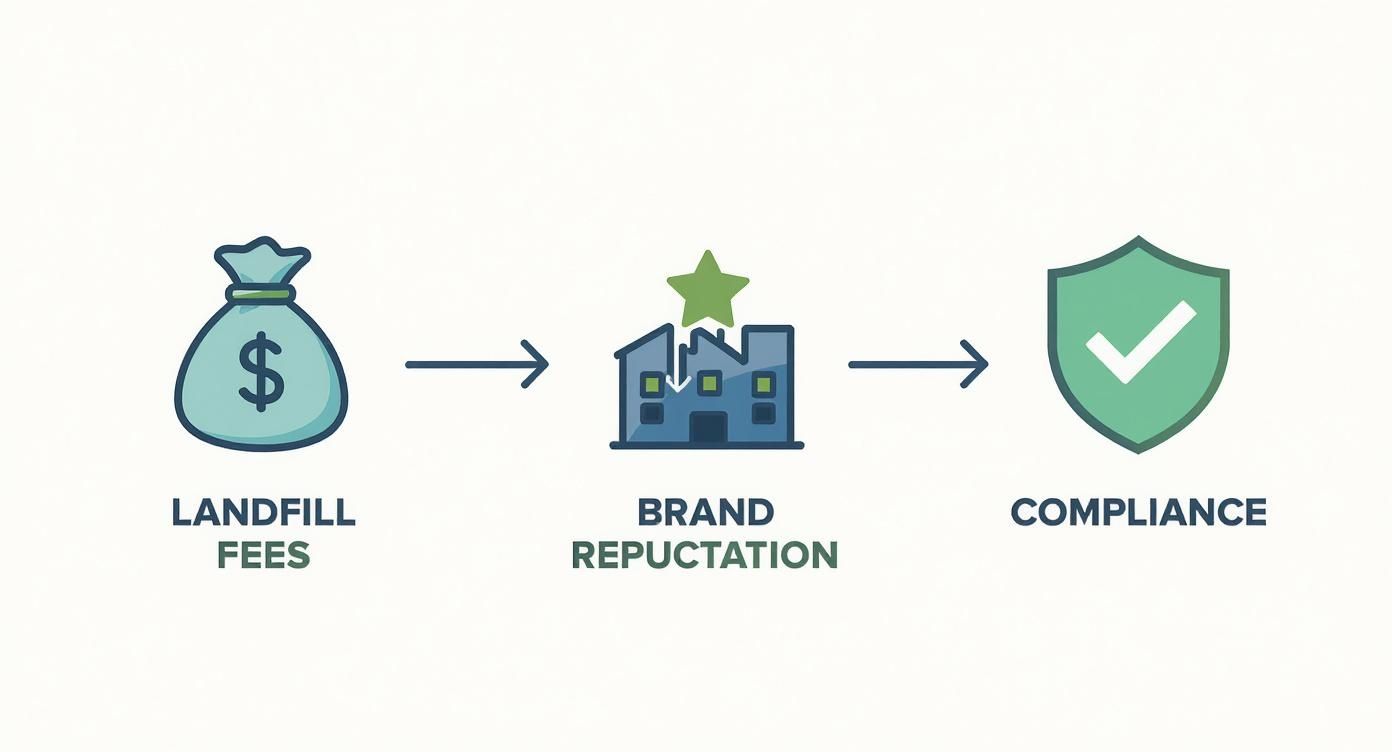
As you can see, a well-executed recycling program is a strategic business tool, not just a disposal task.
Finally, once all assets are sorted and documented, prepare them for pickup. Ensure all devices are disconnected from the network and consolidated in a secure, accessible location. Pack sensitive or high-value items carefully to prevent damage during transit, thereby protecting their resale value and ensuring a seamless pickup process.
Mastering Data Destruction to Ensure Compliance
When a business retires an electronic device, it initiates a critical data security protocol. For any organization handling proprietary, customer, or employee information, this is a pivotal moment in the asset lifecycle.
Standard file deletion is insufficient; residual data is often recoverable, exposing your company to significant breach risks. Improper data handling is a major corporate liability, carrying the potential for severe financial penalties, reputational damage, and loss of customer trust.
This is particularly true for regulated industries like healthcare or finance, where a single discarded hard drive can trigger a HIPAA violation with multi-million dollar fines. Therefore, selecting the appropriate data destruction method is not merely an IT task; it is a core component of your risk management strategy for commercial recycling in Atlanta.
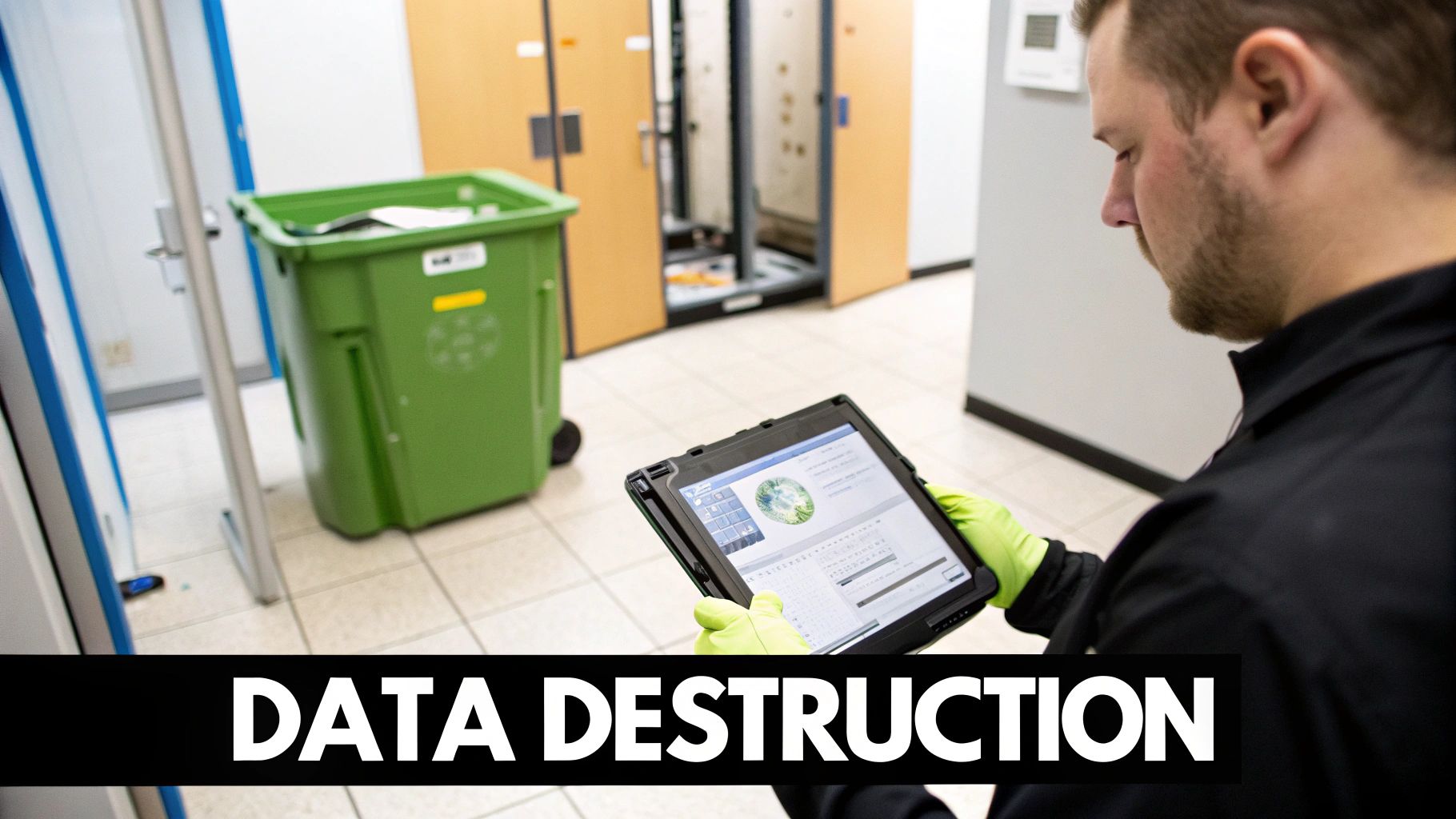
Comparing Destruction Methods
To ensure complete data sanitization, businesses can choose between two primary methods: software-based wiping and physical destruction. Each serves a distinct purpose, and understanding their applications is key to making a compliant and cost-effective decision.
Software-Based Wiping: This method uses specialized software to overwrite all data on a storage device with random characters. Standards such as DoD 5220.22-M mandate multiple overwrite passes to ensure the original data is completely irrecoverable. The primary business advantage is that the drive remains functional, allowing the asset to be refurbished and resold to recoup value.
Physical Destruction (Shredding): This is the definitive solution for data elimination. For end-of-life, damaged, or highly sensitive data-bearing devices, physical destruction provides 100% certainty. Industrial shredders pulverize hard drives, SSDs, and other media into small, unsalvageable fragments.
The choice depends on balancing asset value against security requirements. For a fleet of three-year-old laptops, data wiping preserves their resale value. For a ten-year-old server that processed sensitive financial records, shredding is the only acceptable risk mitigation strategy.
The Role of a Certified ITAD Partner
Managing this process internally can be complex and resource-intensive. A certified IT Asset Disposition (ITAD) partner provides a streamlined, documented, and auditable solution. A reputable ITAD vendor offers more than logistics; they deliver a comprehensive service that proves due diligence and compliance.
The most critical deliverable from your ITAD vendor is a Certificate of Data Destruction. This legal document serves as your official proof that data was destroyed in accordance with industry standards, protecting your business from future liability.
This documentation is essential for compliance audits and legal defense. When vetting a partner, inquire about their specific data destruction methodologies, chain-of-custody protocols, and environmental certifications. A qualified partner provides complete assurance that your retired assets are managed securely, ethically, and in full compliance with all regulations. You can explore our detailed guide on why a Certificate of Destruction is a mandatory component of this process.
Navigating Pickup Logistics and Choosing the Right Partner
With assets inventoried and data sanitized, the final logistical step is executing a secure and efficient pickup.
This process is more than scheduling a truck. Professional coordination ensures minimal disruption to your daily operations while maintaining a strict chain of custody for every asset. For businesses serious about secure recycling in Atlanta, this is where a professional partner demonstrates their operational excellence.
A qualified vendor will adapt to your business schedule, offering services after hours or during weekends to avoid operational downtime. Their team should arrive fully equipped to handle any scenario—from de-installing server racks in a data center to securely packing and palletizing laptops. A smooth, non-disruptive pickup is the hallmark of an experienced ITAD provider.

Vetting Your Atlanta Recycling Partner
Selecting the right ITAD partner is the most critical decision in the asset disposition process. Not all electronics recyclers operate under the same standards. Choosing an uncertified or unqualified vendor exposes your business to significant data security risks, environmental liability, and potential fines. The lowest-cost option often becomes the most expensive one due to unforeseen compliance failures.
Your due diligence must be thorough. A responsible recycler will provide transparent documentation for their entire process. This includes specialized items; for instance, if disposing of toner cartridges, you need assurance of proper handling. A resource like TonerConnect's information for shippers illustrates the level of logistical detail a professional operation should provide.
The most significant red flag is a vendor's reluctance to provide their certifications. If they cannot produce a current R2 or e-Stewards certificate, terminate the discussion. These credentials are the only verifiable proof that a vendor adheres to the highest industry standards for data security and environmental responsibility.
Your Essential Vetting Checklist
To aid in your selection process, use this checklist when interviewing potential e-waste recycling partners in the Atlanta area. Ask these questions directly and require documented proof for all claims.
The table below outlines key criteria, what to look for, and why each point is vital for protecting your business interests.
Atlanta Commercial Recycling Partner Vetting Checklist
Use this checklist to evaluate and compare potential e-waste and commercial recycling vendors in Atlanta.
| Evaluation Criteria | What to Look For | Why It Matters |
|---|---|---|
| Certifications | Current R2v3 or e-Stewards certification. Request a copy of the certificate and verify its authenticity. | These are the definitive industry standards, guaranteeing the vendor follows stringent protocols for data security, environmental safety, and downstream accountability. |
| Insurance Coverage | Proof of general liability, data breach (cyber), and pollution insurance policies with sufficient coverage limits. | This protects your business from financial liability in the event of a data breach or environmental incident linked to the vendor's services. |
| Chain of Custody | A clearly defined, documented process that tracks assets from pickup to final disposition. Request a sample serialization report. | This ensures full accountability and prevents asset loss. It provides a complete, auditable trail for every piece of equipment. |
| Proof of Data Destruction | A sample serialized Certificate of Data Destruction (CoDD) that itemizes individual assets by serial number. | This is your legal evidence of compliance with data privacy laws. A detailed CoDD is indispensable for any compliance audit. |
Making the right choice is paramount.
To begin your search, our overview of the top electronic waste recycling companies serving the Atlanta metro provides a list of partners who meet these stringent criteria.
Understanding What Happens to Your Recycled Assets
Once our truck departs with your retired electronics, the assets begin a new, highly controlled journey. For many businesses, this post-pickup phase is opaque. However, a commitment to responsible recycling in Atlanta requires transparency into the entire disposition lifecycle.
A certified IT Asset Disposition (ITAD) facility is a sophisticated processing environment, not a scrapyard. Upon arrival, your equipment is immediately reconciled against the pickup inventory, ensuring the chain of custody remains unbroken and every asset is accounted for.
Sorting for Value and Sustainability
The first internal stage is triage, where experienced technicians assess each item to determine its optimal disposition path. This is a strategic evaluation designed to maximize asset value while adhering to the highest environmental standards.
Your equipment is typically sorted into three primary streams:
- Remarketing: This is the highest-value and most sustainable outcome. Newer, functional equipment like recent-model laptops, servers, or networking gear is tested, refurbished, and prepared for resale on the secondary market. This extends the asset's useful life and can generate a financial return for your business.
- Component Harvesting: For devices that are non-functional but contain viable parts (e.g., RAM, CPUs, power supplies), our technicians will salvage these components for use in repairs, promoting a circular economy.
- Material Recovery: Equipment that has reached the absolute end of its functional life is designated for de-manufacturing and materials recycling.
This hierarchical approach—prioritizing reuse over recycling—is the key differentiator between a true ITAD partner and a basic scrap collector.
The De-Manufacturing and Recovery Process
Assets designated for material recovery undergo a systematic de-manufacturing process. Technicians manually dismantle the electronics to separate various materials and, critically, to isolate any hazardous components. Batteries are removed to mitigate fire risks, and items like mercury-containing lamps are handled according to strict environmental protocols.
The core principle of e-waste recycling is to convert retired technology from a liability into a valuable resource. By recovering these commodities, we support a circular economy and reduce the environmental impact of mining new raw materials.
Following manual disassembly, the remaining materials are processed through industrial shredders. Advanced separation technologies, including powerful magnets and optical sorters, then segregate the shredded material into pure commodity streams of steel, aluminum, copper, and plastics. These raw materials are then sold to certified smelters and manufacturers to be used in new products.
Early city programs like Cartlanta demonstrated that diverted materials create revenue, a concept that is even more relevant for businesses recycling high-value e-waste. You can learn more about how Atlanta's recycling programs established this model on Waste360.
Upon completion, you receive a final, detailed report confirming the disposition of every asset. This report is more than a receipt; it is your auditable proof of a secure, compliant, and environmentally responsible ITAD program. To see this entire process in detail, review our guide on what happens to recycled electronics.
Common Questions About Business Recycling in Atlanta
Even with a well-defined plan, specific questions often arise when implementing a commercial recycling program. For businesses in Atlanta, navigating the complexities of e-waste regulations, data security compliance, and service costs can be challenging.
Here are direct answers to the most frequent questions we receive from IT managers, compliance officers, and business owners.
What Are the Biggest Mistakes Businesses Make When Recycling Electronics?
The most common mistake is prioritizing low disposal cost over total risk management. Selecting a vendor based solely on a low quote without verifying their data destruction protocols and environmental certifications is a significant gamble. This decision can lead to catastrophic data breaches, regulatory fines, and brand damage.
Another frequent error is inadequate inventory management. Failing to track an electronic asset from deployment to its final disposition certificate creates security and accountability gaps. This is particularly risky for businesses that do not receive a serialized report confirming every device was processed.
Finally, many companies overlook the potential for value recovery. By treating all retired equipment as "scrap," they miss a significant opportunity to generate revenue from newer, remarketable devices, turning a potential asset into a cost center.
Is My Small Business Required to Have a Recycling Program?
While Atlanta has specific recycling ordinances for certain residential properties, the landscape for businesses is more complex and driven by broader regulations and commercial standards. Opting out of a formal program is a significant risk for any business.
Key considerations include:
- Lease Agreements: Many commercial landlords in Atlanta now mandate recycling program participation as a condition of the lease.
- Federal & State Regulations: Electronic waste is governed by strict EPA regulations at both federal and state levels due to its hazardous components. Improper disposal, such as placing old computers in a commercial dumpster, can result in serious environmental violations.
Engaging a certified e-waste recycler is the most effective way to ensure full compliance with all regulations governing IT asset disposition. It eliminates guesswork and provides a defensible audit trail.
How Much Does Commercial E-Waste Recycling Cost?
The cost of commercial recycling in Atlanta is not a flat fee but is based on several key variables. A reputable ITAD partner will provide a transparent, itemized quote detailing all service charges.
The primary cost drivers include:
- Volume and Type of Equipment: The total quantity of assets is a major factor. Certain items, like CRT monitors containing leaded glass, require specialized handling and incur higher processing fees.
- Data Destruction Services: The required level of data security directly impacts cost. On-site physical shredding, for instance, is a premium service compared to off-site software-based wiping.
- Logistics: Your location within the metro area, facility access (e.g., loading dock availability), and the need for on-site packing services will all influence the final price.
Crucially, a qualified partner will also provide a detailed proposal for any value return from remarketed assets. For newer equipment, this revenue share can often offset or even exceed the service fees, transforming your ITAD program from a cost center into a net positive for your budget.
Ready to implement a secure and compliant e-waste recycling program for your Atlanta business? Contact Atlanta Computer Recycling for a custom quote and see how our certified ITAD services can protect your data and your bottom line. Visit us at https://atlantacomputerrecycling.com to get started.