How to Recycle Old Lawn Mower Safely in 2026

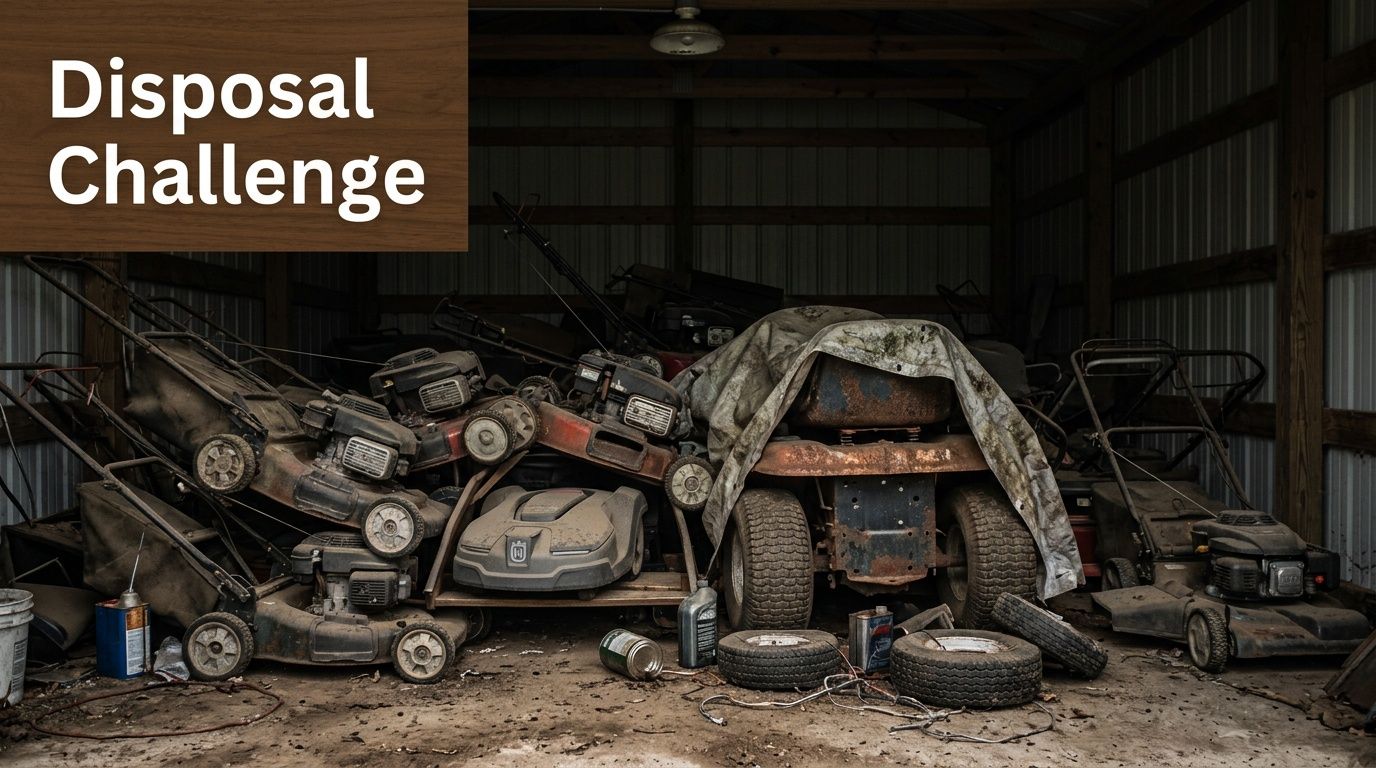
A facilities manager usually notices this problem late. The shed behind the building has a row of dead push mowers, one riding unit that nobody wants to repair, and a couple of robotic mowers that were bought during a pilot program and then abandoned when software support became a headache.
At that point, the job stops being yard maintenance and starts looking like asset disposition. Some units contain gasoline and oil. Some have lead-acid or lithium-ion batteries. Some now qualify as connected devices with stored settings, usage logs, and location history. If your organization is a hospital, school district, university, or corporate campus, that mix creates environmental, safety, and security exposure all at once.
Beyond the Curb Your Commercial Mower Disposal Challenge
Most advice on how to recycle old lawn mower equipment is written for homeowners. It assumes one machine, one Saturday, and one trip to a local drop-off site. That isn't how commercial projects work.
A business might be retiring a fleet after a grounds contract change, replacing gas units with electric models, or clearing old equipment from multiple properties before a renovation. The equipment is often mixed. A few mowers still run. Others are stripped for parts. The robotic units may still power on and connect to an app.
The waste stream is bigger than many teams realize. The EPA reported that in 2018, the U.S. generated 2.2 million tons of small appliance waste, a category that includes lawn mowers, and only 5.6% was recycled, leaving over 94% to go to landfill or incineration. The same EPA data notes that recycling steel uses 74% less energy than producing new steel from raw materials, which matters because mower decks and frames contain recoverable metal (EPA durable goods data).
Why organizations get this wrong
The common failure isn't bad intent. It's treating mowers like bulky junk instead of regulated equipment.
Teams often make one of these mistakes:
- They focus only on pickup: Hauling solves the space problem, but it doesn't solve fluid handling, battery segregation, or data-bearing components.
- They send whole units to scrap: That can work for simple metal recovery, but it often leaves value on the table and creates avoidable compliance issues.
- They split responsibility across departments: Facilities handles transport, maintenance drains fluids, and IT never gets notified that a robotic mower was network-connected.
A retired mower can sit in the same risk category as a retired printer, access control panel, or rugged tablet. It may look mechanical, but parts of the disposition process are administrative and digital.
If your team is evaluating downstream metal recovery options, it helps to understand how commercial recyclers and scrap operations differ. The right path depends on whether your priority is raw commodity value, audit documentation, secure sanitization, or all three.
Preparing Mower Fleets for Compliant Recycling
A facilities team can lose control of a mower disposal project before the truck even arrives. The failure point is usually preparation. Units get staged with fuel still in the tank, batteries stay installed, one robotic mower is mixed into a metal load, and nobody can prove what left the property.
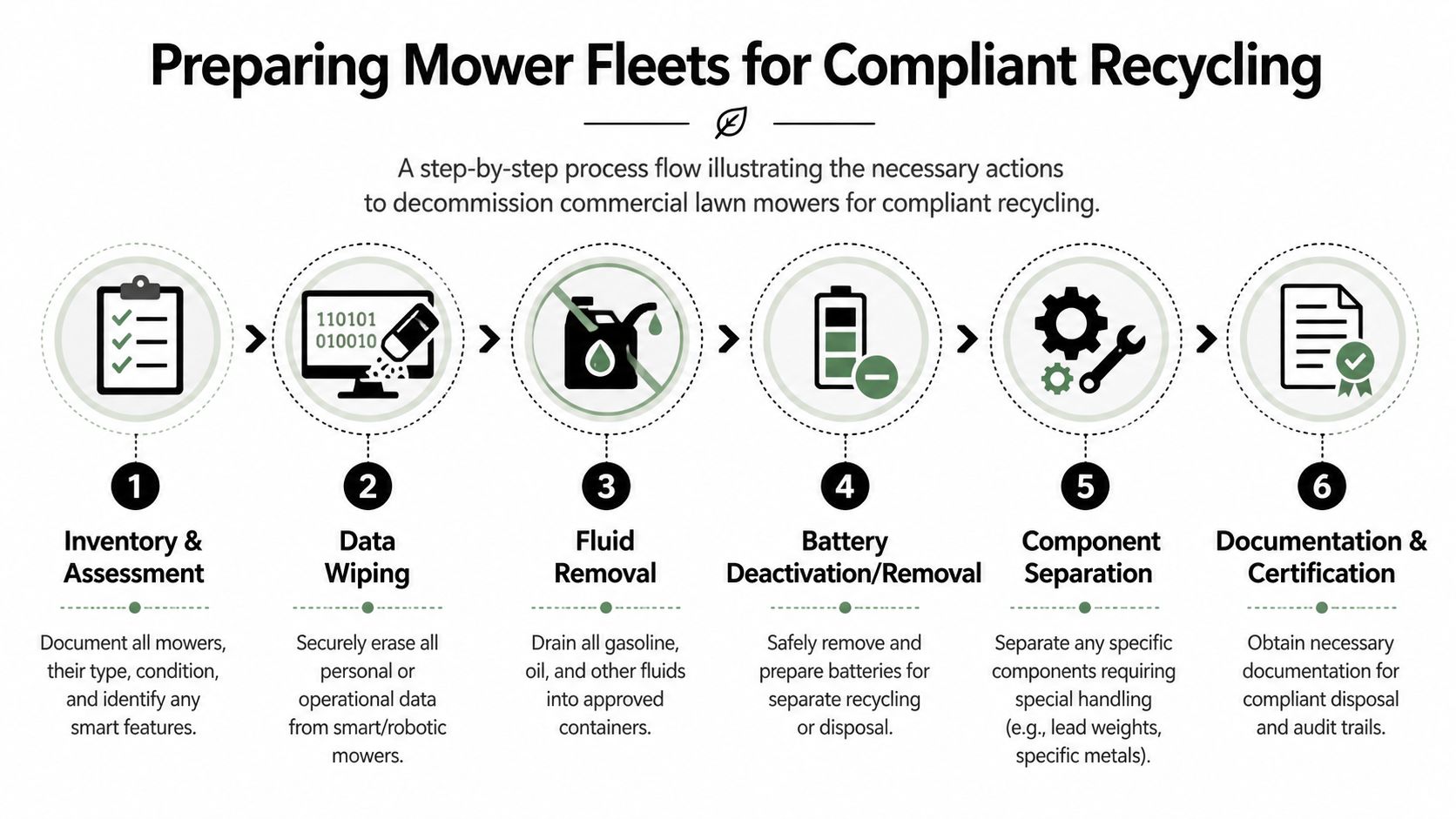
For organizations retiring multiple units, decommissioning needs the same discipline used for other regulated assets. The job is to identify each mower, remove immediate transport hazards, separate regulated materials, and document chain of custody before anything moves off site.
Start with inventory and segregation
Set up an intake sheet first. Record asset ID, model, power source, serial number if present, visible leaks, battery chemistry, and whether the unit has GPS, WiFi, Bluetooth, cellular connectivity, or app pairing.
That last field matters more than many facilities teams expect.
A mixed mower lot should then be separated into handling groups so the crew is not making decisions on the fly at the loading area:
- Gas-powered units require fluid removal and ignition control.
- Battery-electric units require battery isolation and charger review.
- Robotic or connected units require physical prep plus a separate data handling step.
- Parts-only or damaged units should be tagged for component recovery or controlled teardown.
This sorting step reduces misloads, keeps hazardous materials from getting mixed into scrap, and gives procurement, facilities, EHS, and IT a shared record of what is being retired.
Manage fuel, oil, and batteries as regulated material
Fluid and battery handling is where small disposal jobs turn into compliance problems. A few neglected units can create fire risk, spill exposure, and transport issues that are far more expensive than the recycling bill.
For organizations decommissioning larger fleets, fuel volumes and battery counts can push the project into regulated waste handling territory. Industry guidance on commercial mower disposal also notes that lead-acid and lithium-ion batteries are frequently mishandled, and NFPA reporting from 2024 tied battery mismanagement to an increase in landfill and waste facility fires (commercial mower disposal compliance concerns).
Use a controlled sequence instead of ad hoc draining in the yard:
- Drain gasoline into approved containers. Assign the task to a trained employee and label containers immediately.
- Drain engine oil into a separate stream. Mixed liquids create avoidable disposal complications.
- Remove batteries before transport. Keep lead-acid and lithium-ion batteries in different containers or pallets.
- Secure the staging area. Store drained units away from ignition sources and away from active maintenance traffic.
For teams building site procedures, these hazardous waste management guidelines are a useful operational reference because they frame disposal as a chain-of-custody issue, not just a cleanup task.
Practical rule: If the mower still contains fuel, oil, or an installed battery, it is not ready for pickup.
Disassemble only when the labor makes sense
Do not assume every unit should be torn down in-house. Some organizations get better recovery by removing batteries, electronics modules, and easy high-risk components, then sending the remaining chassis to a qualified downstream processor. Others waste technician time stripping low-value parts that the recycler would have handled faster.
Use three decision points.
| Decision point | In-house disassembly | Leave to downstream processor |
|---|---|---|
| Staff has mechanical skill and lockout procedures | Better fit | Poor fit |
| Need to isolate batteries, control boards, or tagged components before release | Better fit | Higher risk of mixed loads |
| Need speed, site clearance, and simple logistics | Poor fit | Better fit |
In practice, the strongest internal process removes what creates compliance, safety, or data exposure, then hands the rest to a recycler with documented downstream controls. If your team already manages batteries, lamps, and similar regulated streams across the property, align mower retirement with your broader universal waste management program. That keeps outdoor equipment from falling outside the controls you already use for shop electronics, backup batteries, and maintenance-room waste.
The Overlooked Risk Data Security in Smart Mowers
The disposal conversation changes the moment a mower connects to a network or mobile app. At that point, it isn't just outdoor equipment. It's an IoT asset.
That sounds obvious when you're looking at a robotic mower from a current vendor, but organizations still miss it. Facilities may own the device, grounds crews may use it, and IT may never see it in the asset register.
Why a robotic mower belongs in your ITAD workflow
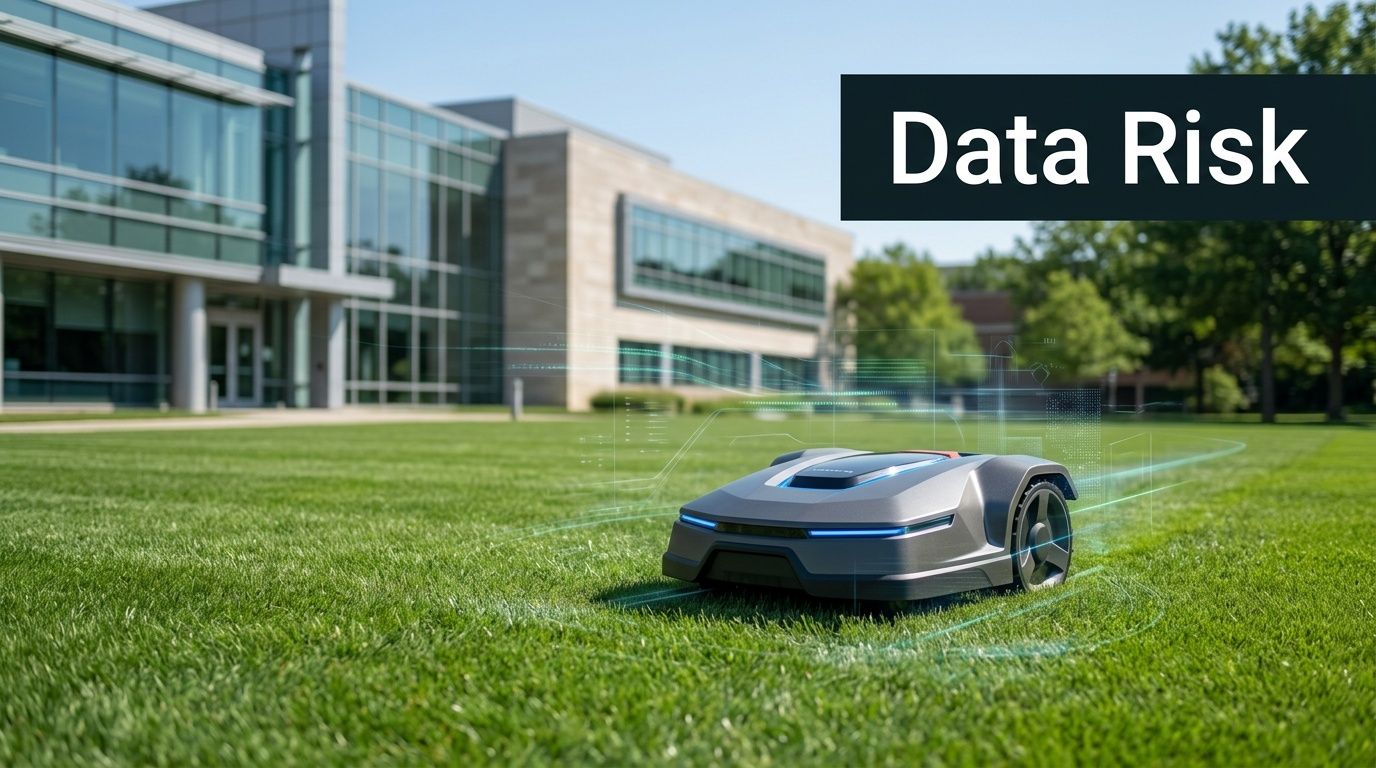
Modern robotic mowers can hold more than operational settings. Depending on the model, they may retain pairing data, route maps, maintenance logs, geofence information, and user account links. Standard mower recycling guides usually ignore that issue entirely.
That omission matters. The EPA noted that 60 million smart devices were improperly disposed of annually, with 15% containing residual data. The same smart mower guidance argues that connected lawn equipment should be treated like other data-bearing devices during disposal (smart mower recycling and residual data risk).
For a hospital campus, location history can reveal patrol or maintenance patterns. For a school district, app-linked devices may expose user associations or site layouts. For a corporate campus, GPS and network settings can disclose operational details that don't belong in a scrap stream.
What secure disposal looks like
Secure handling starts before the unit is powered down for the last time.
Use this sequence:
- Identify every connected mower: If it has an app, wireless module, GPS function, or firmware updates, treat it as data-bearing.
- Perform a factory reset: Do this while the device still powers on and before it leaves the property.
- Remove account bindings: Unpair mobile apps, revoke credentials, and document who performed the reset.
- Escalate failed resets: If the device won't boot or won't reset, route it for physical destruction of relevant boards or memory-bearing components.
A good primer on protecting IoT smart devices helps explain why connected field equipment needs the same security mindset as office electronics. The attack surface isn't limited to laptops and phones anymore.
If you wouldn't donate a WiFi-enabled time clock without clearing it first, don't send a robotic mower to recycling in working condition with its memory intact.
For organizations with any regulated data exposure, this belongs under formal IT asset destruction procedures. The mower may sit outside, but the governance standard should sit with IT, security, and compliance.
Choosing Your Organization's Disposal Path
A disposal decision for a mower fleet is an asset disposition decision, not a hauling decision. Once units are cleared for release, organizations usually choose among three channels: scrap, donation, or a recycler that can handle both equipment recovery and controlled asset disposition.
Those routes produce very different outcomes for compliance, documentation, labor, and residual value.
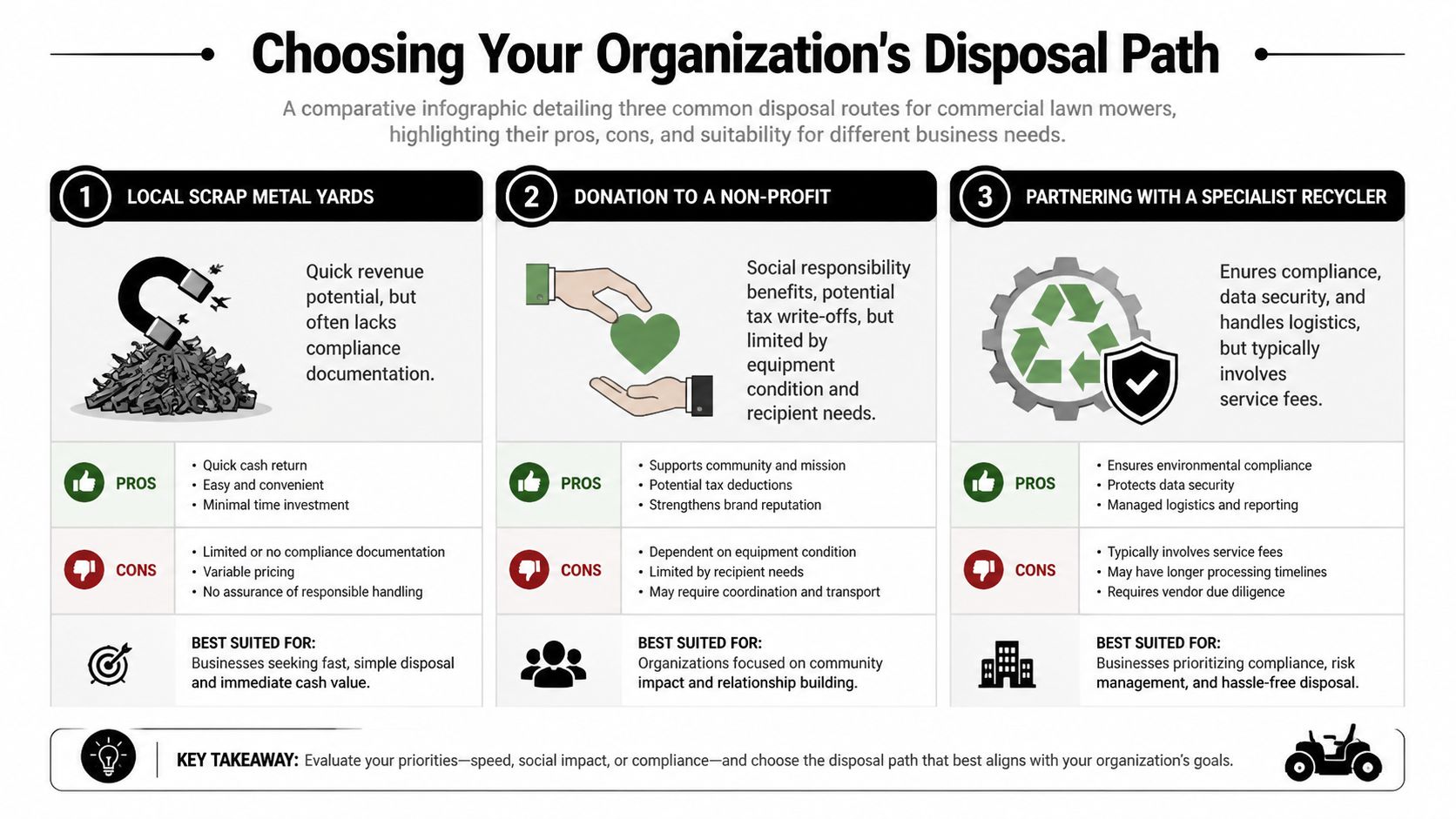
Side by side trade-offs
| Disposal route | Best use case | Main advantage | Main limitation |
|---|---|---|---|
| Local scrap yard | Simple metal-heavy units | Fast material recovery | Limited documentation and no built-in data sanitization |
| Donation | Working equipment with clear reuse value | Community benefit | Liability, condition screening, and no secure destruction |
| Specialist recycler | Mixed fleets and connected devices | Chain of custody and compliance support | Usually structured as a service project |
Scrap yards fit straightforward jobs. A drained, non-connected walk-behind mower with little reuse value can move through that channel efficiently, especially if the organization does not need asset-level reporting. The trade-off is control. Many yards are set up for commodity intake, not documented disposition of equipment that may contain batteries, telematics modules, or memory-bearing components.
Pre-sorting can improve returns, but it also adds internal labor. I usually advise facilities teams to price that labor accurately before assigning technicians to strip units for scrap. A few dollars in added recovery stops looking attractive when maintenance staff lose half a day on teardown, staging, and transport prep.
Donation requires a stricter screening standard than many teams expect.
A mower headed for reuse should be functional, safe, and free of unresolved account ties or embedded data risk. For commercial organizations, donation also raises questions about post-transfer liability, repair history, and whether the recipient can support the equipment. If those answers are unclear, donation shifts risk to another party and leaves your organization with weak documentation.
Specialist recyclers make sense when the fleet is mixed, the equipment includes smart or robotic units, or the organization needs evidence of proper handling. That often matters more than raw scrap value. If a robotic mower was tied to a campus app, a service account, or location data, the disposal standard should match the risk profile of the asset, not the appearance of the machine.
Decision test: Start with compliance, chain of custody, and risk. Then compare recovery value.
Some projects still have commodity upside. If your team is weighing service fees against resale or material recovery, it helps to review options for getting value back from older electronics through secondary markets. The key distinction is simple. Some old mowers are scrap metal. Others belong in the same disposition workflow you would use for regulated equipment with documentation requirements.
Streamlining Disposal with Atlanta Computer Recycling
Large organizations usually struggle with mower recycling for the same reason they struggle with mixed electronics cleanouts. The burden isn't merely moving the equipment. It's coordinating pickup, safe handling, documentation, and downstream processing without breaking internal controls.
A clean process pulls those pieces together. Facilities identifies and stages the fleet. Maintenance isolates fluids and batteries. IT reviews smart units for reset or destruction. Compliance keeps records. Transport moves only what has been cleared for release.
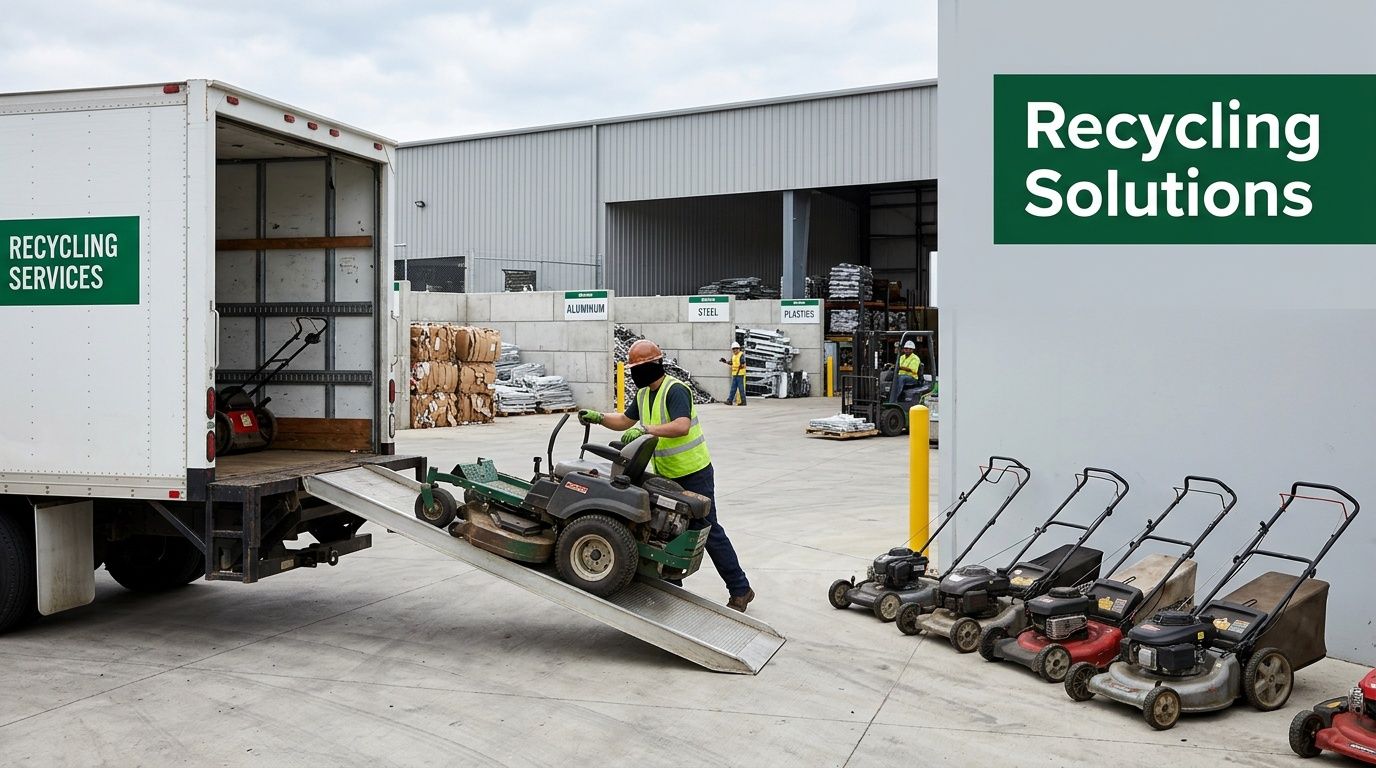
The integrated model works better
The reason specialist handling matters is simple. Commercial mower disposal sits at the intersection of multiple disciplines.
- Environmental compliance applies because fuel, oil, and batteries can't be treated like ordinary trash.
- Operational safety applies because staging, lifting, and transport can create fire and injury risk.
- Information security applies when robotic units or smart accessories store data.
- Audit readiness applies because regulated organizations need proof, not assumptions.
In practice, the best projects use one controlled handoff instead of a patchwork of vendors. That reduces the chance that a mower gets drained by one team, hauled by another, and processed by a third that has no knowledge of embedded electronics or recordkeeping requirements.
What a mature process delivers
A mature recycling workflow should produce clear outcomes:
- Removal without business disruption
- Separation of hazardous and non-hazardous components
- Disposition records suitable for internal review
- Data destruction controls for connected equipment
- A downstream path aligned with reuse, recycling, or destruction
That approach is what separates a cleanup job from a managed disposition project.
Frequently Asked Questions about Commercial Mower Recycling
Can riding mowers and commercial tractors be recycled the same way as push mowers
Not exactly. The basic principles are similar, but larger units create more transport, lifting, and fluid-handling complexity. Treat them as equipment-removal projects, not simple drop-offs. Confirm loading method, fluid status, battery type, and whether attachments need separate handling before scheduling release.
What documentation should a business request
Ask for records that match your risk profile. For connected units, require proof of data destruction or sanitization. For all units, maintain an internal inventory, release authorization, and downstream disposition record. If the fleet came from a regulated environment, keep the paperwork with the same discipline you'd use for retired computers or network gear.
Is it worth disassembling mowers before recycling
Sometimes. If you have skilled staff, safe workspace, and mostly metal units, selective disassembly can improve recovery. If your fleet includes smart devices, mixed batteries, or tight labor capacity, it's often better to prioritize controlled processing over squeezing out every bit of commodity value.
Can a business put old mowers in regular bulk trash
That usually creates more problems than it solves. Bulk trash programs aren't designed for fuel, oil, batteries, or embedded electronics. Even when a hauler accepts the item, your organization may still retain environmental or data-related exposure if the unit wasn't properly prepared.
How should Atlanta organizations handle mixed equipment lots
Use one inventory and one release process for the whole batch. That keeps lawn equipment, chargers, loose batteries, controllers, and related electronics from splitting into unmanaged side streams. If your team is planning a broader property cleanout, local commercial recycling support in Atlanta can help frame mower disposal inside a larger disposition plan.
If your organization needs a secure, compliant way to retire lawn equipment, robotic mowers, batteries, and related electronics, Atlanta Computer Recycling can help coordinate the project. Their commercial service model fits hospitals, schools, government sites, offices, and data-driven facilities that need more than a simple haul-away.