7 Electronics Recycling Event Near Me in Atlanta (2026)


Your Atlanta office has a storage room full of retired laptops, dead monitors, a few rack servers from the last refresh, and a pile of cables nobody wants to claim. You know it can't go in the dumpster, but a search for “electronics recycling event near me” turns up a messy mix of one-day drop-offs, community cleanups, and city pages that barely mention whether businesses are welcome.
That’s the main problem for commercial disposal. For a homeowner, an event may be enough. For a business, electronics recycling involves security, compliance, chain of custody, and labor. Someone in IT still has to decide whether drives are wiped or shredded, whether equipment can leave the building without documentation, and whether a Saturday event can handle anything more than a few carloads.
Three questions usually separate a workable option from a risky one:
- Data security: Does the provider address data destruction clearly, and will your team get documentation that supports internal policy or regulated environments such as HIPAA?
- Volume and logistics: Can the option handle office-scale quantities, or is it built for residents unloading a trunk?
- Operational control: Will anyone help with de-installation, inventory, pickup, and transport, or does your staff do all the work?
That distinction matters because the Americas generates just over 31 pounds of electronic waste per person annually, yet only 30% is recycled properly, according to ERI Direct’s e-waste recycling analysis. For businesses, that gap isn’t just an environmental issue. It’s a disposal and governance issue.
This list focuses on Atlanta-area options through a B2B lens. Some are useful for small office cleanouts. Some are better treated as community resources, not commercial workflows. One is an industry event worth attending if you manage enterprise disposition strategy. And for situations where public events fall short, I’ll be direct about when a dedicated ITAD partner like Atlanta Computer Recycling makes more sense.
1. Live Thrive – CHaRM (Center for Hard to Recycle Materials)
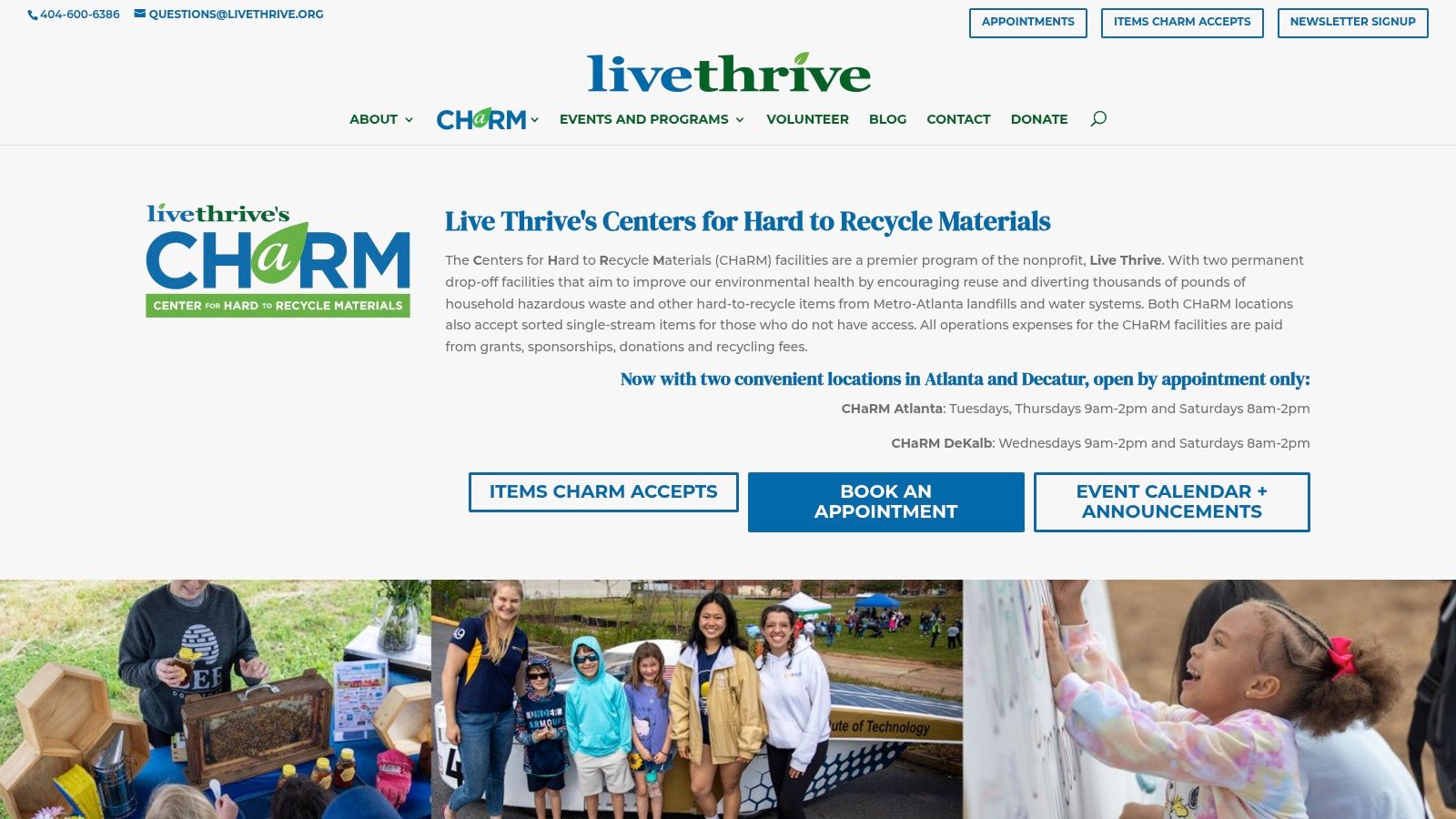
Live Thrive is one of the more dependable answers to “electronics recycling event near me” in Atlanta because it isn’t limited to a single annual collection day. CHaRM operates appointment-based drop-off centers in metro Atlanta and DeKalb, which gives small offices a year-round option instead of forcing staff to wait for a weekend event.
That structure is useful if you’ve got a modest amount of equipment and need predictability. You can review accepted items in advance, schedule a slot, and avoid the uncertainty that comes with large public collection lines. For businesses with a few laptops, monitors, and peripherals, that’s often enough.
Where CHaRM works well
CHaRM is strongest when the job looks like a controlled drop-off, not a commercial decommission. It publishes clear guidance on accepted materials, includes electronics and TVs, and shares how materials are handled. That transparency is better than what many public event listings provide.
It also runs periodic special services such as shredding days, which adds flexibility for organizations trying to clear out paper records and light e-waste in the same planning cycle.
- Best fit: Small offices with limited device counts and staff available to transport equipment.
- Operational advantage: Appointment scheduling reduces the chaos common at one-day public events.
- What stands out: Public-facing guidance is clearer than many municipal event pages.
For local context, CHaRM Atlanta recycling guidance from ACR is useful if you’re comparing drop-off convenience with business-grade pickup service.
Practical rule: If your team can load everything into a few vehicles without disrupting operations, CHaRM is worth considering. If the project needs pallets, serial tracking, or internal signoff at every handoff, it’s the wrong format.
Where businesses hit the ceiling
CHaRM isn’t built for bulk enterprise disposition. If you’re retiring a lab, closing a floor, or moving server hardware out of a data room, appointment drop-off becomes labor your own staff has to absorb. That usually means IT technicians spending time boxing equipment, staging it, and driving it over.
Some items may also carry fees, especially certain display categories. That’s normal in public recycling, but it reinforces the point that CHaRM is a practical community resource, not a full-service ITAD workflow.
The trade-off is simple. CHaRM is organized, transparent, and easier to trust than a random one-day event. But once the scope moves beyond small-volume office cleanup, dedicated business pickup and documented downstream handling become far more important than appointment convenience.
2. Gwinnett Clean & Beautiful – Earth Day Recycling Event
If you want a high-visibility public event with established local recognition, Gwinnett Clean & Beautiful is one of the strongest names in the region. Its Earth Day recycling event is set for Saturday, April 18, 2026, at the former Macy’s lot at Gwinnett Place Mall, and it’s designed for households and small businesses bringing mixed materials.
This kind of event works because expectations are usually straightforward. You drive in, unload, pay item-based fees where required, and leave. For a small office manager clearing a handful of monitors, printers, and miscellaneous electronics, that can be efficient enough.
Why small businesses use it
The biggest strength here is clarity. Common e-waste categories have posted fees, so teams can decide in advance whether the event is worth using or whether a commercial recycler is the better route. That’s better than showing up and learning the rules at the curb.
Gwinnett Clean & Beautiful also benefits from county-scale coordination. Traffic control, volunteer support, and broad public communication tend to make these events more orderly than ad hoc collection days.
- Good use case: A small branch office with mixed recyclable materials, not just IT hardware.
- What works: Clear event format, recognizable organizer, and simple intake model.
- What to confirm: Business eligibility, accepted-item details, and how electronics with data are handled.
For businesses in the area, Gwinnett County recycling support from ACR helps frame when a county event is enough and when commercial pickup is the safer choice.
The limitation most IT teams care about
A one-day event is still a one-day event. If your schedule slips, your truck breaks down, or the equipment isn’t ready, you wait for the next window or start the search all over again. That’s inconvenient for residents. For a business move or refresh, it can derail a disposal timeline.
There’s also a bigger issue the public-event format rarely explains well: data handling. Across the market, publicly available event information tends to emphasize convenience and environmental benefits while saying very little about data destruction standards, audit trails, or compliance documentation. That gap is exactly where business users get exposed.
Public event pages often answer “where do I drop this off?” but not “what proof do I get after it leaves my control?”
That doesn’t make the event bad. It just means you should treat it like a community recycling option, not an enterprise control process. If the assets contain sensitive data, or if your legal, healthcare, finance, or education team needs documentation, the burden of verification still lands on you.
3. Keep Cobb Beautiful – Spring 2026 Community Recycling Event
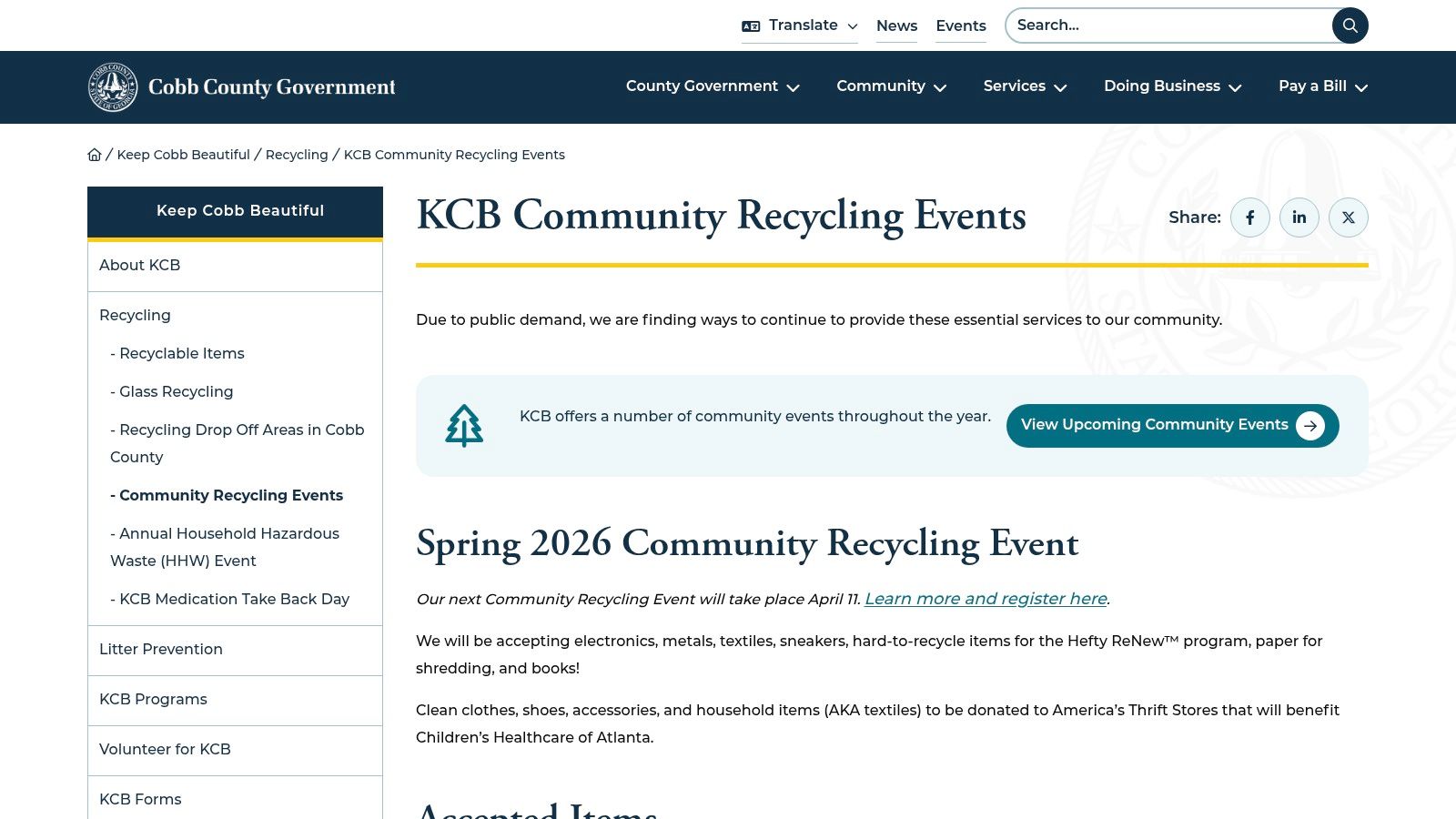
Keep Cobb Beautiful’s community recycling events are useful when your problem isn’t only electronics. Spring 2026 includes an April 11 event, and the format is built around broad material intake, not just IT gear. That makes it practical for schools, offices, and municipal departments trying to clear mixed storage rooms in one trip.
This is one of those cases where convenience matters more than specialization. If you’ve got old keyboards, a few monitors, some scrap metal, textile overflow, and assorted office leftovers, a county-backed multi-stream event can be easier than coordinating separate destinations.
Best use case for Cobb businesses
For small offices in Cobb County, the recurring spring and fall cadence is helpful. Teams can plan around it, especially if they already know they’ll have a modest volume of retired equipment at predictable times of year.
The county-supported setup also tends to reduce confusion. Strong publicity, established locations, and routine event operations make it easier for administrative staff to plan a drop-off without a lot of back-and-forth.
A few situations where this event makes sense:
- Office cleanout: You’re clearing one storage room, not decommissioning an environment.
- Mixed materials: You want one stop for electronics plus other recyclables.
- Local convenience: Your staff is already based in Cobb and can transport the load internally.
If you need a more business-focused option nearby, Marietta computer recycling support from ACR is the more relevant comparison point.
Where the event model falls short
Community events are great at intake. They’re not great at commercial process control. If your team needs serialized inventory, signoff by department, or documented removal from a server room, a weekend collection event won’t solve that.
You also need to verify fees and partner-specific handling before you go. Community events can involve multiple vendors, and that means accepted items and charges may vary by category. That’s manageable for residents. It gets messy fast when an IT manager is trying to dispose of business assets under policy.
Field note: The more stakeholders involved inside your organization, IT, facilities, compliance, finance, the less useful a community event becomes.
Keep Cobb Beautiful is a solid civic option. It isn’t a substitute for a managed ITAD project. Use it when simplicity matters and the asset count is small. Don’t use it when the disposal process itself has to stand up to scrutiny later.
4. Keep North Fulton Beautiful – Johns Creek Bulky Recycling Event
Keep North Fulton Beautiful’s Johns Creek Bulky Recycling Event is a good example of a municipal nonprofit event that sets expectations clearly. The May 9, 2026 event includes electronics among other bulky items and does a better job than many listings of spelling out what’s accepted and what isn’t.
That holds more significance than often realized. A lot of frustration at public recycling events comes from bad assumptions, not bad operations. When the organizer provides exclusions up front, your facilities or office staff can sort the load properly before anyone starts driving across town.
What it does well
The event is especially convenient for Johns Creek and North Fulton participants who want a local, staffed site rather than a long haul to a regional center. It also points people to year-round alternatives for items that aren’t part of the event scope, which is a practical touch.
For small businesses, that makes planning easier. If your office manager is handling a light cleanout, clarity on accepted items can save time and prevent rejected loads.
- Strong point: Clear exclusions reduce wasted trips.
- Good fit: Small-volume electronics mixed with bulky office odds and ends.
- Local benefit: Easier for North Fulton teams than navigating a broader metro option.
Businesses comparing local options can also review Johns Creek commercial recycling support from ACR when they need pickup and data handling instead of public-event drop-off.
Where it stops being a business solution
The event isn’t a complete answer for commercial electronics recycling. Not all electronics or appliances are accepted, some categories may involve vendor-set charges or suggested donations, and the event still runs on a fixed date with the usual possibility of vehicle queues.
This is still consumer-style logistics. Your team transports the equipment. Your team loads it. Your team manages whatever staging happens before and after the event. For a branch office purge, that may be fine. For a medical office, school district, or corporate refresh, it usually isn’t.
The broader market has another blind spot here. Consumer-facing “electronics recycling event near me” results rarely surface providers that handle bulk pickup, de-installation, and transport for organizations. Those services do exist, but they’re often buried on provider pages instead of appearing in event-focused searches.
That’s why Johns Creek’s event is best treated as a local convenience option, not a scalable disposal process. Use it for small, non-sensitive cleanouts. Move to a dedicated ITAD workflow when the project involves compliance, staffing constraints, or anything larger than what a few employees can unload comfortably.
5. Keep Douglasville Beautiful – Electronics & Metal Recycling Event
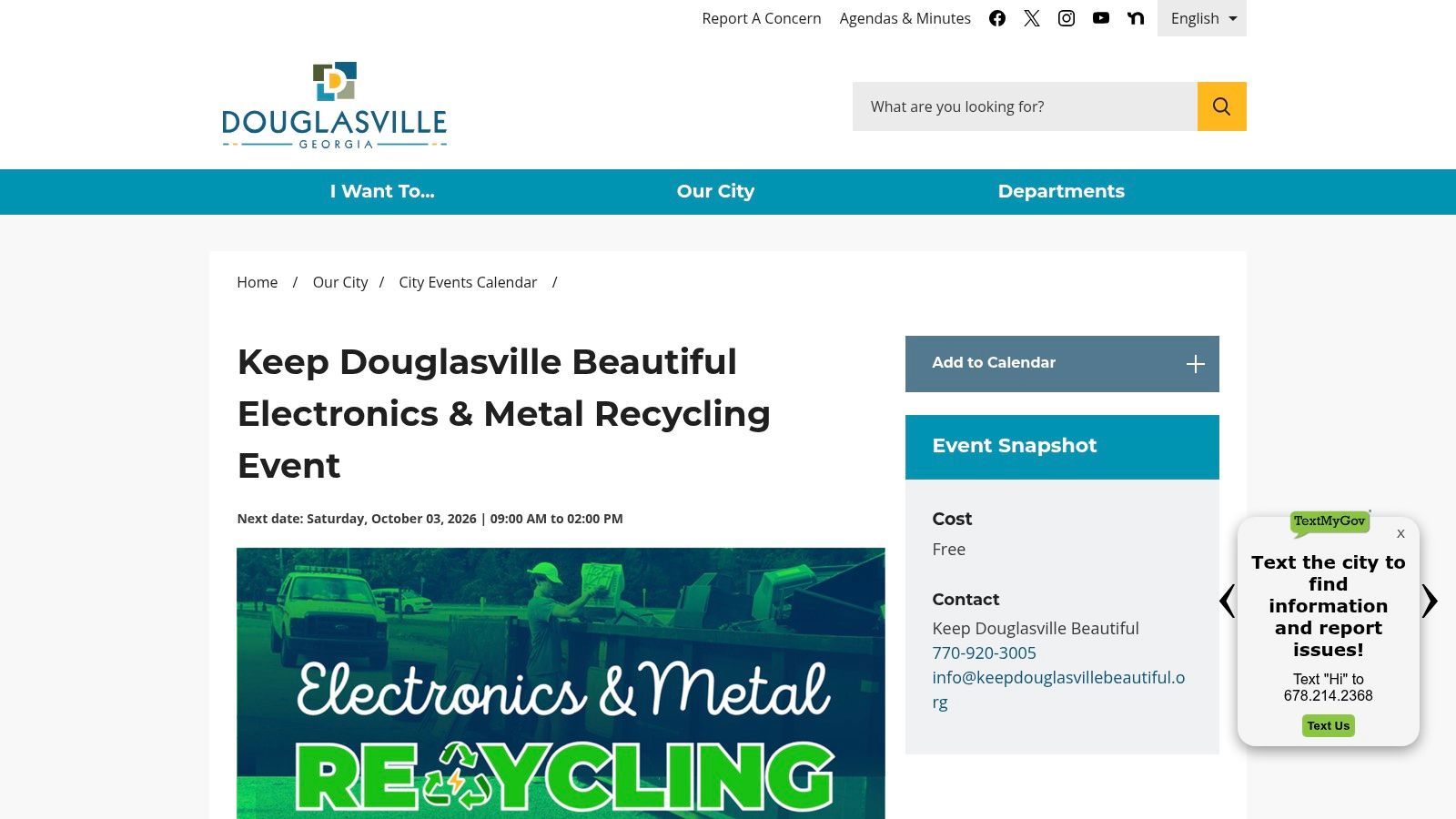
West of Atlanta, the City of Douglasville’s 2026 recycling events page is worth knowing if you want a community event that specifically calls out electronics and metals. The next 2026 date is announced for April 25, 2026, and the city-backed format makes it a practical regional option for residents and small organizations.
Not every business needs a full ITAD engagement. Sometimes the job really is just a controlled unload of old monitors, broken peripherals, and a small amount of scrap metal from a maintenance area or office storage room. This kind of event fits that scenario.
Why this option can be easier than larger county events
Douglasville has an advantage that doesn’t show up on most comparison lists. It can be less overwhelming than the biggest metro events. Smaller geography and city-backed coordination often translate into a more manageable drop-off experience for teams that don’t want to deal with a massive county collection day.
That makes it appealing for smaller organizations west of Atlanta, especially when the equipment load is modest and the goal is quick removal rather than formal asset disposition.
A few practical strengths stand out:
- Specific event scope: Electronics and metals are both named, so the event isn’t vague about relevance.
- Useful fallback rhythm: Biannual scheduling gives you another shot if one date doesn’t work.
- On-site assistance: Community event crews can make unloading easier for basic drop-offs.
The real trade-off
This is still an event window, not a service program. If you miss the date, have materials outside the published scope, or need handling beyond curbside intake, you’re back to searching again. That’s the pattern with most public recycling options.
For businesses, the harder question is labor. Who’s removing devices from desks? Who’s packing them so they don’t break in transit? Who’s documenting what left the building? Community events don’t answer those questions because they aren’t designed to.
“We can drop it off” isn’t the same as “we have a disposal process.”
That’s where many office managers underestimate the internal cost of using a public event. The event itself may be convenient. The prep work usually lands on your own staff. If the project involves anything sensitive, bulky, or repetitive, the savings disappear quickly once your team starts doing the recycler’s job.
Douglasville is a solid local event. Just be honest about the size of the problem before you commit employees to solving it by hand.
6. City of Norcross – Annual Spring Recycling & Clean-Up Day
The City of Norcross runs an annual Spring Recycling & Clean-Up Day that accepts a wide range of materials, including electronics. The 2026 event is scheduled for April 11, 2026, from 8 a.m. to 12 p.m., which makes it a compact, morning-only option for Northeast Atlanta suburbs.
That short time block can be either a benefit or a problem. If your load is ready and you’re local, it’s convenient. If your office needs extra prep time, multiple vehicles, or internal approvals before equipment leaves the site, a half-day event can feel tight.
Who should consider Norcross
Norcross is best for residents and very small offices that want a one-stop municipal event. City-hosted operations usually provide a clearer arrival point, better site staffing, and less ambiguity about where to unload than loosely organized collections.
It’s especially practical if your organization has a small amount of surplus equipment and other hard-to-recycle materials to move at the same time.
- Best fit: Small local organizations with light volumes.
- Operational plus: Defined date, location, and city-run structure.
- Important caveat: Confirm whether residency or ID requirements apply before sending staff.
If your business is based nearby but needs commercial handling, Norcross business recycling support from ACR is the more appropriate route.
What to verify before relying on it
The biggest risk with city events is assuming that “electronics accepted” means “all common office electronics accepted.” It often doesn’t. Specific accepted-item lists and any related fees are frequently published separately, and those details matter.
For business users, the other issue is documentation. Municipal events are designed around public collection, not enterprise records. You may get a clean drop-off experience, but you shouldn’t assume you’ll get chain-of-custody support, data destruction documentation, or itemized disposition records.
That’s why city clean-up days are best for low-risk, low-volume disposal. Once the assets are tied to regulated data, formal asset tracking, or a larger refresh cycle, the event format becomes too thin for business needs. It can solve the physical clutter problem. It usually doesn’t solve the governance problem.
7. E-Waste World Expo North America 2026
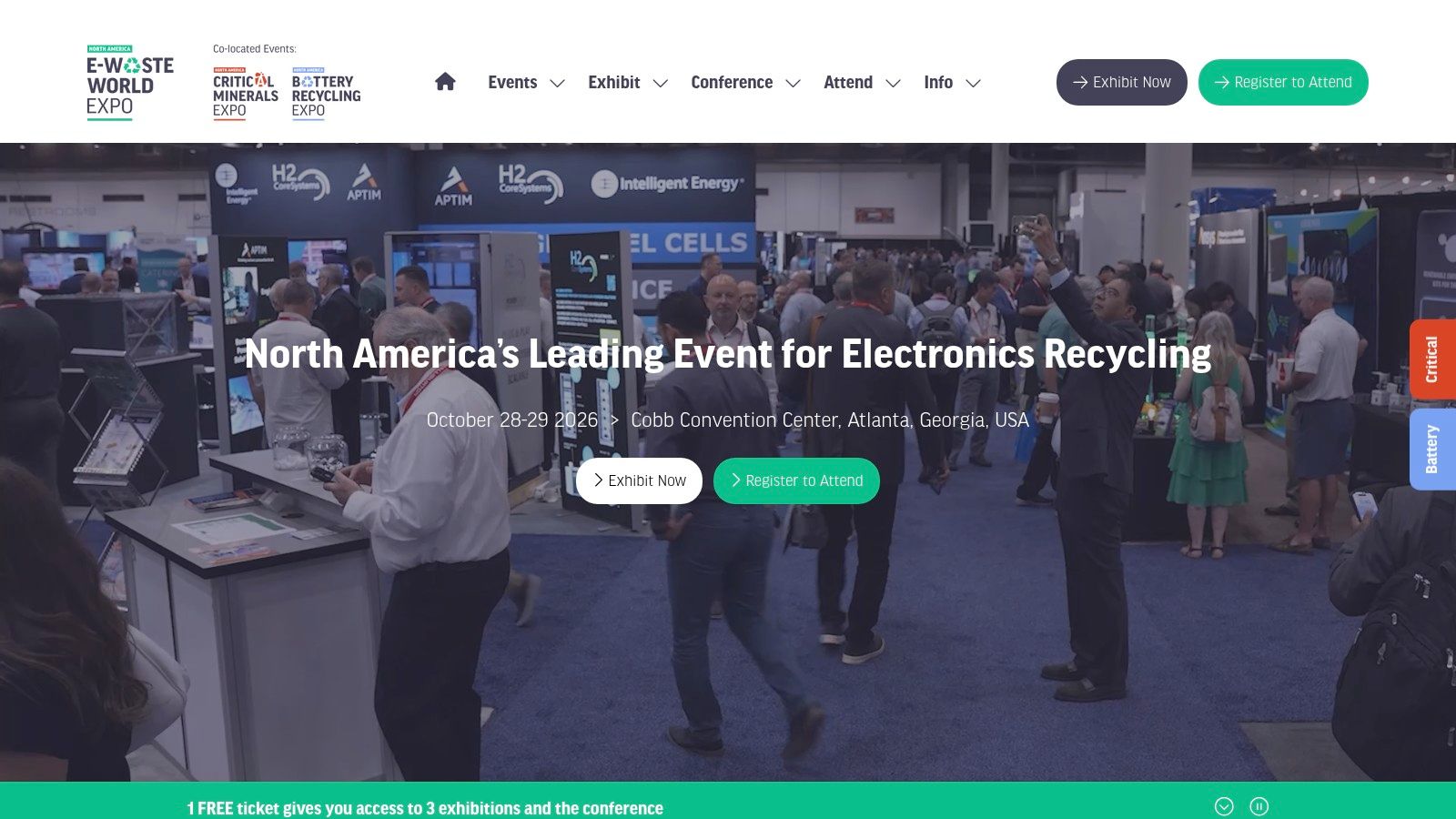
This one is different. E-Waste World Expo North America isn’t a drop-off event at all. It’s a two-day industry expo and conference at the Cobb Galleria and Cobb Convention Center on October 28 to 29, 2026, aimed at recyclers, OEMs, IT managers, sustainability leaders, and solution providers.
If you manage enterprise equipment disposal, this may be more valuable than any public collection event on this list. It gives you a place to evaluate recyclers, downstream processors, service models, and compliance conversations in person.
Why B2B teams should pay attention
Most searches for “electronics recycling event near me” push business users toward resident-focused options. That’s fine if you need to unload a few items. It’s not enough if you’re writing policy, planning a data center decommission, or trying to standardize disposal across multiple sites.
An industry expo solves a different problem. Instead of asking where to drop off equipment this weekend, you’re asking which vendors can support your organization repeatedly, securely, and at scale.
This event is useful for:
- Vendor evaluation: Compare multiple recyclers and ITAD providers in one place.
- Policy development: Learn how other organizations approach disposition, compliance, and downstream management.
- Project planning: Talk through decommissioning, pickups, inventory control, and media destruction with actual operators.
What it won’t do
It won’t take your old laptops off your hands. There’s no public e-waste intake on-site, and it doesn’t replace pickup, packing, or chain-of-custody services. You still need an operational partner to execute the work.
But for serious business users, that’s the point. A public drop-off event answers disposal as a transaction. A conference like this helps you evaluate disposal as a program.
Bottom line: If you’re responsible for more than one cleanup a year, stop thinking only in terms of events. Start evaluating providers, controls, and repeatable workflows.
For IT managers, procurement leads, and sustainability teams, that shift usually marks the point where community recycling stops being “good enough” and formal ITAD becomes the right tool.
7 Local Electronics Recycling Events – Quick Comparison
| Item | 🔄 Implementation Complexity | ⚡ Resource Requirements | 📊 Expected Outcomes | ⭐ Ideal Use Cases | 💡 Key Advantages |
|---|---|---|---|---|---|
| Live Thrive – CHaRM (Center for Hard to Recycle Materials) | Medium, appointment scheduling and intake controls | Low, drop-off only; small-volume handling | Responsible processing, transparent chain info | Residents & small offices with modest volumes | Transparent accepted-items list; year‑round appointments; education-focused |
| Gwinnett Clean & Beautiful – Earth Day Recycling Event | Medium, large one-day logistics and traffic control | Moderate, vendor staffing, on‑site fee collection | High-volume consolidated intake for mixed materials | Households & small businesses needing a one-stop drop-off | Clear per-item fees; county-backed scale and publicity |
| Keep Cobb Beautiful – Spring 2026 Community Recycling Event | Medium, event-day coordination, multiple streams | Moderate, county logistics, vendor partners | Broad-material diversion in a single visit | Residents wanting to clear multiple waste streams | Broad acceptance mix; strong local outreach and recurring cadence |
| Keep North Fulton Beautiful – Johns Creek Bulky Recycling Event | Low, date-certain, staffed municipal site | Low to moderate, staffing, clear exclusions | Targeted bulky-item diversion with clear guidance | Johns Creek/North Fulton residents with bulky items | Explicit acceptance/exclusion notes; municipal–nonprofit coordination |
| Keep Douglasville Beautiful – Electronics & Metal Recycling Event | Low, biannual scheduled events with on-site crews | Low, city-backed crews, limited scope | Reliable local collection with lower queues | Residents west of Atlanta; small organizations | Biannual fallback dates; fewer lines than larger county events |
| City of Norcross – Annual Spring Recycling & Clean-Up Day | Low, half-day municipal operation with set flow | Low, staffed city facility; short time window | One-stop drop-off for multiple hard-to-recycle streams | Northeast Atlanta residents consolidating materials | City-hosted clarity (time/location); organized traffic flow |
| E-Waste World Expo North America 2026 | High, two-day industry conference and expo | Moderate to high, registration, travel, time investment | Vendor vetting, policy insights, enterprise solutions | IT managers, sustainability leaders, large-scale projects | Direct access to certified vendors, sessions on compliance and best practices |
Beyond the Event: Scalable E-Waste Solutions for Your Business
The Atlanta-area events above all have value. They help residents, small offices, and local organizations keep electronics out of landfills. They also serve an important public education role. But most of them are still built around consumer behavior: load up a vehicle, arrive during a set window, unload, and move on.
That model breaks down quickly in commercial environments. A business rarely needs only disposal. It usually needs coordination. Someone has to identify what’s leaving, separate data-bearing devices, get approval from internal stakeholders, move equipment safely out of offices or server rooms, and document what happened afterward. Public events don’t usually cover that.
The market gap is obvious in practice. Public event information tends to focus on convenience and environmental benefits, while saying very little about data destruction standards, audit trails, or compliance-specific handling. For hospitals, schools, government agencies, and mid-sized companies with regulated or confidential information, that’s not a minor omission. It’s the core issue.
The same goes for logistics. Consumer-facing event results rarely surface the providers that handle de-installation, bulk pickup, asset tagging, and organized transport for medium to large organizations. Those services exist, but they’re often invisible when someone searches for a local recycling event. That’s why businesses often start with the wrong tool.
Atlanta Computer Recycling fills that gap with business-first IT asset disposition services across the metro area. Instead of asking your internal staff to act as movers, packers, and disposal coordinators, ACR handles the operational side in a way public events don’t.
What a commercial ITAD partner changes
A dedicated business recycler turns disposal into a managed process.
With Atlanta Computer Recycling, that includes on-site pickup and logistics, so your team doesn’t have to load retired equipment into personal or company vehicles and spend half a day at a public event. For larger projects, that matters immediately. It reduces disruption and keeps internal labor focused on business operations.
Data-bearing equipment gets the same level of attention. ACR provides free hard drive wiping to the DoD 5220.22-M 3-pass standard and also offers physical shredding for hard drives and other media, either on-site or off-site, with a Certificate of Destruction for audit purposes. For organizations dealing with HIPAA obligations or internal security policy, that documentation is often the deciding factor.
What works for businesses and what doesn’t
Public events work when all of the following are true:
- Low volume: You’ve only got a small number of devices.
- Low sensitivity: The equipment doesn’t present a major data security concern, or you’ve already handled media destruction internally.
- Self-managed labor: Your staff can pack, transport, unload, and verify everything without affecting operations too much.
A commercial ITAD service is the better fit when any of these are true:
- Bulk retirement: You’re disposing of office-wide or campus-wide equipment.
- Sensitive data: Devices may contain regulated, confidential, or institutional data.
- Operational complexity: You need pickup, de-installation, inventory control, or project coordination across departments.
Businesses get into trouble when they treat commercial disposal like a household errand.
That’s the practical takeaway. A recycling event can be useful. It just isn’t automatically appropriate because it appears in local search.
Why the decision matters
Improper disposal isn’t only a sustainability problem. It can become a records problem, a security problem, and an accountability problem. If you can’t explain how data-bearing assets moved from your facility to final disposition, you’ve left a gap in your internal controls.
That matters in every industry, but it matters even more in healthcare, education, government, and larger private-sector environments where devices move in batches and accountability follows them. A disciplined chain of custody, documented data destruction, and responsible downstream recycling aren’t extras. They’re the standard a business should expect.
If your organization needs scalable, secure electronics recycling in Atlanta, the right move isn’t another search for a generic electronics recycling event near me. It’s choosing a partner that can handle the full job. Atlanta Computer Recycling provides end-to-end ITAD support for businesses, schools, hospitals, government facilities, and data centers that need secure pickup, data destruction, and environmentally responsible disposition without creating extra work for internal teams.
If your business needs more than a simple drop-off, contact Atlanta Computer Recycling for a custom commercial e-waste and ITAD quote. ACR helps Atlanta organizations handle retired computers, servers, storage, network gear, and data-bearing devices with secure pickup, documented destruction options, and business-grade logistics.