Free E Waste Recycling Event Near Me: A Business Guide

You’re clearing out a storage room, retiring a rack, or replacing a floor of laptops. Someone on the team finds a Saturday flyer and says, “There’s a free e waste recycling event near me. Problem solved.”
For a homeowner with an old printer and a dead tablet, that can be a good answer.
For an IT manager, it usually isn’t. Business devices carry customer records, employee data, financial files, authentication tokens, email archives, and licensed software. Even when the hardware looks worthless, the liability attached to it often isn’t. The mistake I see most often is treating business e-waste like household clutter. It’s not clutter. It’s regulated, data-bearing inventory that needs documented disposition.
Searching for a Free E Waste Recycling Event Near Me
The search usually starts the same way. You’ve got aging desktops in a back office, a stack of failed hard drives from an infrastructure refresh, or network gear left over from a location move. Budget matters, so “free” looks efficient.

A public event listing feels reassuring because it suggests legitimacy. It has a date, a city logo, accepted items, maybe a drive-through format. If you’re trying to move equipment out quickly, that’s appealing. A lot of businesses start by checking public options such as an electronics recycling event near me page before they realize the main issue isn’t where to drop equipment off. It’s whether the process protects the organization after the equipment leaves the building.
Why the search term is understandable
“Free e waste recycling event near me” is a sensible first search because it matches a basic operational goal. Remove obsolete equipment, avoid landfill disposal, and keep the office moving.
That logic holds up for consumer cleanup days. It gets shaky when the assets belong to a company, school, hospital, or agency.
Free only describes the drop-off price. It doesn’t describe the risk you keep if the disposal process isn’t documented.
The hard part isn’t finding a place that will take electronics. The hard part is answering the questions that come later:
- Who handled the devices: Was there a recorded chain of custody from pickup to destruction?
- What happened to the drives: Were they wiped, shredded, tested for reuse, or just collected?
- What proof exists: Can you show a certificate, serial-level inventory, or destruction record during an audit?
- Who approved the method: Does it match your internal retention, privacy, and security policies?
If your assets contain business data, those questions matter more than whether the event is free.
Understanding Community E-Waste Recycling Events
A Saturday collection event can look like an easy answer. Cars line up, volunteers unload old TVs and laptops, and the community gets a simple way to keep electronics out of the landfill. For household cleanup, that model works well.
Community programs are built for volume, convenience, and environmental diversion. Cities, counties, and waste authorities set fixed dates, publish accepted-item lists, and move material through a public collection process that is meant to be accessible, not audit-ready. If you want a sense of how community recycling events are organized, that public-service structure is the starting point.
A clear example came from Charlottesville, Virginia. In September 2024, a free semiannual e-waste collection event hosted by the Rivanna Solid Waste Authority drew over 400 households and diverted approximately 35,000 pounds of electronics from landfills, according to the Charlottesville event notice. That is a strong result for residential recycling.
What they usually accept
Public events often accept a wide range of household electronics:
- Home office electronics: desktop computers, laptops, printers, scanners
- Entertainment gear: DVD players, VCRs, gaming systems, stereos
- Small communication devices: cell phones, corded and cordless phones
- Peripheral equipment: monitors, cameras, calculators, fax machines
If you are helping staff find local disposal options for personal devices, regional directories such as e-waste resources for Chicago can be useful because they show how municipalities and community groups make public recycling accessible.
Why businesses should read the fine print
The gap is not about good intentions. It is about operating design.
Residential events are set up to collect mixed electronics from the public quickly and safely. Business disposition requires documented control over assets, media, and downstream handling. Those are different jobs. In practice, I see IT managers get tripped up when a public event accepts the same device types they need to retire. Acceptance is not the same as documented disposition.
A homeowner dropping off an old printer usually needs convenience. An IT department retiring laptops, network gear, or storage devices needs records that stand up to internal review, customer questionnaires, and legal scrutiny. Community events can be well run and still leave that gap unaddressed.
Why Free Events Create Business Compliance Risks
The biggest problem with free public events isn’t that they’re careless. It’s that they’re built for a different user.
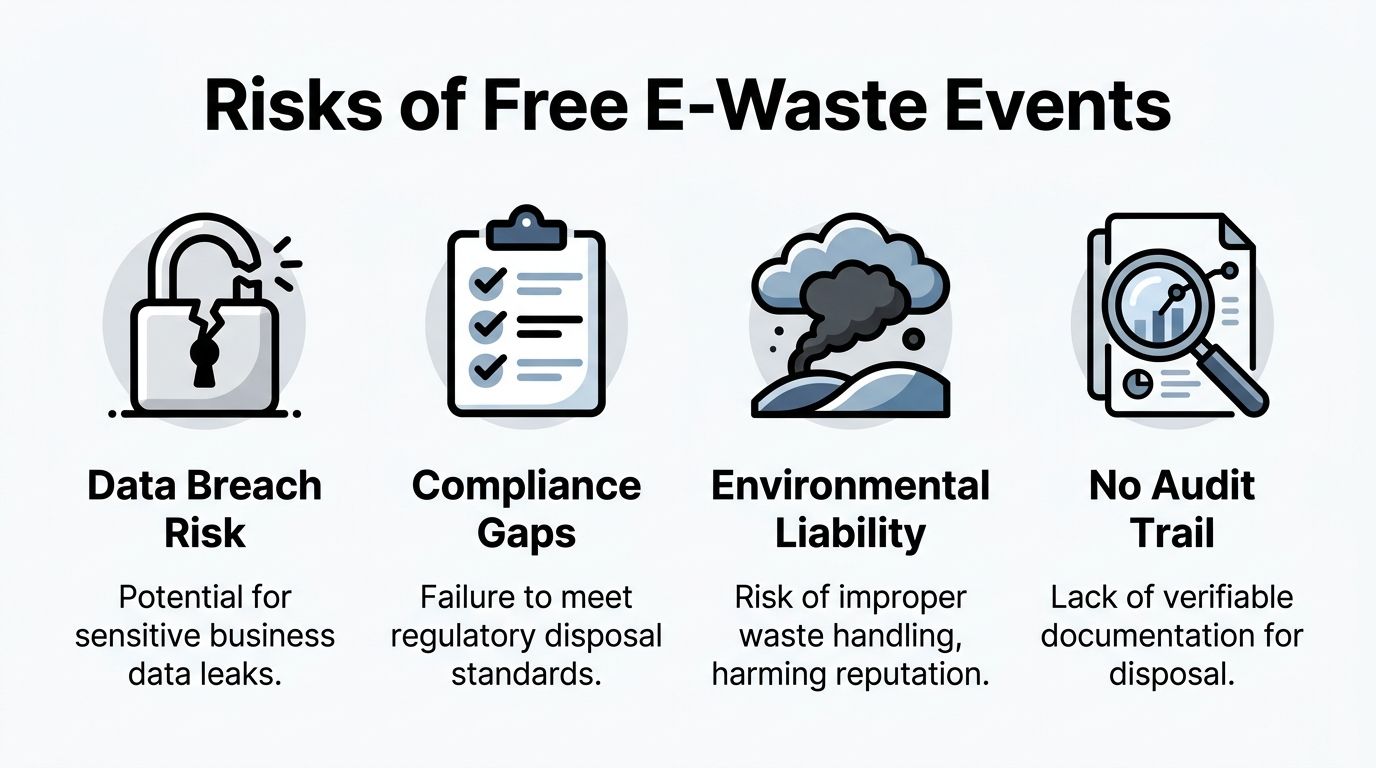
Businesses need more than responsible recycling. They need secure, verifiable disposition. That means proof of what left the site, who handled it, how data was destroyed, and where the material ultimately went.
A documented gap shows up again and again in community collection programs. Public event information often emphasizes accepted items and convenience, but offers little detail about destruction certificates, custody records, or standards-based data handling. The core issue is captured in this overview of the compliance gap in free e-waste recycling events, which notes that organizations handling sensitive information can’t rely on standard free events because they don’t address secure, verifiable data destruction.
The four risks IT managers actually own
Here’s where the liability sits in practice.
| Risk | What goes wrong | Why it matters to a business |
|---|---|---|
| Data exposure | Drives leave the building without verified sanitization or destruction | You may not be able to prove that sensitive data was protected |
| Documentation failure | No certificate of destruction or chain-of-custody record | Audit, legal, and policy reviews become harder to satisfy |
| Process mismatch | Consumer drop-off rules don’t reflect enterprise asset controls | Internal security procedures get bypassed |
| False economy | The event is free, but remediation after a mistake isn’t | Savings disappear if one unmanaged asset creates an incident |
Free collection is not the same as controlled disposition
A public event can remove hardware from your office. That’s not the same as closing the compliance loop.
For regulated organizations, the standard is higher. Healthcare groups, financial firms, schools, public agencies, and data center operators need a process that survives scrutiny after the truck leaves. If a device once held protected or confidential data, “we dropped it at a public event” is rarely the record your legal, compliance, or security team wants to stand behind.
Practical rule: If you need to prove what happened to a device, don’t use a disposal channel that gives you no proof.
There’s also an operational issue. Public events usually don’t align with enterprise logistics. They happen on fixed dates, often require staff to self-transport assets, and typically don’t integrate with internal decommissioning workflows. That creates gaps between IT, facilities, compliance, and procurement.
This is the same reason supply chain teams treat retired equipment as a governance issue, not just a cleanup task. If you’re already reviewing vendor controls and custody gaps in broader operations, the same discipline should apply to end-of-life electronics. A disposal workflow belongs inside your supply chain risk management strategies, not outside them.
How to Prepare Devices for Secure IT Asset Disposition
Once you stop treating disposal as a drop-off errand, the preparation process gets clearer. Secure IT asset disposition starts before a single device leaves the building.

Start with inventory, not boxes
Build an asset list first. That list should identify the device type, asset tag, serial number if available, location, assigned department, and whether the item contains data-bearing media. Don’t mix monitors, docks, switches, and hard drives into one generic “e-waste” line item.
That inventory does three things. It preserves accountability, supports downstream certificates, and keeps reusable assets from being handled like scrap.
Match the destruction method to the device
Not every device should be treated the same way. Working equipment with reusable value may be suitable for controlled wiping and redeployment or remarketing. Obsolete or failed media often belongs in physical destruction.
The technical benchmark that many IT managers recognize is DoD 5220.22-M wiping for hard drives. If you need a practical explanation of what a secure erasure process should involve before recycling, this guide on how to completely erase a hard drive is a useful baseline.
The environmental side matters too. According to the New Jersey electronics recycling guidance, improper disposal can leach heavy metals like lead into groundwater, while certified recycling can recover valuable materials with over 95% efficiency. That same guidance notes that pairing secure wiping with certified recycling helps organizations address both environmental handling and data security obligations under standards such as HIPAA, as detailed in the electronics recycling process overview.
A simple prep checklist that works
- Separate data-bearing assets: hard drives, laptops, servers, copiers, firewalls, and multifunction devices need stricter handling than cables or keyboards.
- Pause ad hoc disposal: don’t let departments hand-carry old devices out without IT review.
- Confirm retention requirements: legal hold, records retention, and departmental policies should be checked before destruction.
- Use documented sanitization paths: wiping, degaussing where appropriate, or physical shredding should be selected intentionally.
- Preserve the paperwork: inventory reports, pickup records, and destruction certificates should stay with the project file.
Good ITAD prep looks a lot like good migration prep. Teams that plan data movement carefully also plan data destruction carefully.
That’s one reason organizations investing in infrastructure changes often think about retirement and migration together. If your team is already reviewing architecture and security controls around secure cloud migration services, apply that same discipline to the hardware leaving your environment. The risk profile changes, but the need for control doesn’t.
Choosing a Secure ITAD Partner in Atlanta
For business e-waste, the right question isn’t “Where can I dump this for free?” It’s “Which partner can remove this equipment without creating a compliance problem for my team?”
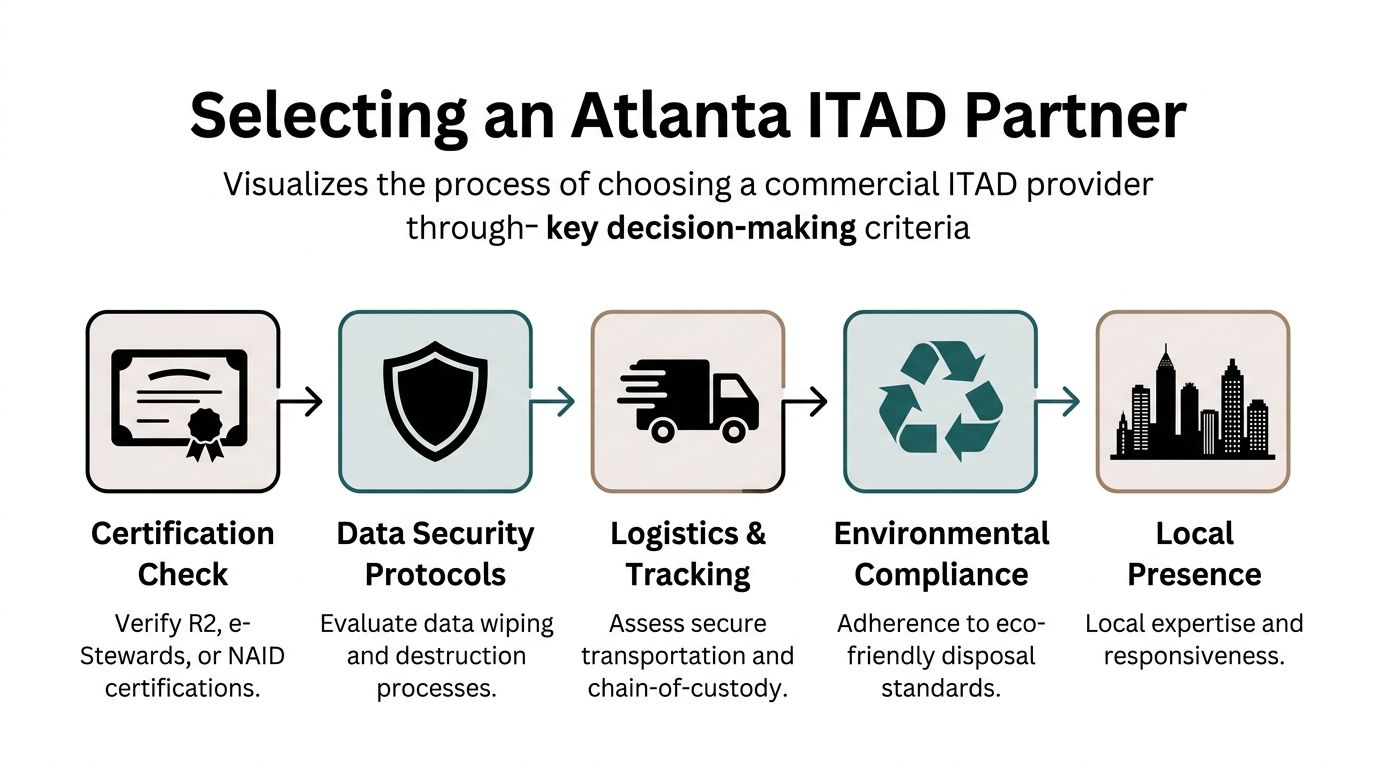
What to look for first
A business-grade ITAD provider should be able to answer five questions without hesitation.
Can they handle bulk commercial volume?
Public events often cap or restrict commercial loads. A business partner should be equipped for office refreshes, warehouse cleanouts, and data center retirements.Do they provide chain-of-custody records?
If there’s no custody trail, there’s no reliable way to show who controlled the assets from pickup through final disposition.What is the destruction method for data-bearing media?
Ask whether they support wiping, physical shredding, or both, and how the method is matched to asset condition.Can they issue destruction and recycling documentation?
Your audit file should not depend on verbal assurances.Do they operate locally enough to be responsive?
Logistics matter. The best policy in the world doesn’t help if pickups are delayed or onsite coordination is weak.
The non-negotiables for regulated environments
Free event limitations become obvious here. According to the NYC-focused business guidance from Big Reuse, free e-waste events often have commercial volume limits and lack the audit trails businesses need, while professional services provide chain-of-custody forms and certified destruction, including hard drive shredding to 2mm particles, as described in this overview of free e-waste collection limits and business requirements.
That’s the dividing line. Residential access programs are designed to collect household electronics responsibly. A commercial ITAD partner is designed to document every step.
A quick comparison that keeps the decision honest
| Requirement | Community event | Professional ITAD partner |
|---|---|---|
| Household convenience | Strong | Varies by provider |
| Bulk business pickup | Usually limited | Core service |
| Chain of custody | Often unavailable | Standard expectation |
| Documented destruction | Often unclear | Required for serious projects |
| Alignment with audits | Weak fit | Strong fit when records are complete |
If your team would need to explain the disposal decision to compliance, legal, or executive leadership, choose the option that comes with records, not assumptions.
When you evaluate providers in the Atlanta market, use those criteria first and marketing language second. Lists of local e-waste recycling companies can help you compare options, but the provider you choose should be measured by documentation, security controls, logistics, and commercial readiness.
Moving Beyond 'Free' to Truly Responsible E-Waste Management
A free community event can be the right answer for a resident cleaning out a garage. It usually isn’t the right answer for an organization retiring business assets.
The distinction isn’t philosophical. It’s operational. Businesses need documented custody, verified data destruction, controlled logistics, and records they can produce later. Without those elements, the disposal may still be environmentally well intentioned, but it won’t meet the standard most IT managers are expected to uphold.
That’s why the phrase free e waste recycling event near me can send business users in the wrong direction. It frames the problem as a drop-off search. The actual problem is risk transfer. If the disposal method doesn’t transfer risk safely and document that transfer, the organization still owns the exposure.
For Atlanta companies, the responsible path is straightforward. Use public events for household awareness and community diversion. Use a professional ITAD process for business equipment, especially anything data-bearing, regulated, bulk, or tied to internal asset controls.
Frequently Asked Questions About Business E-Waste
Can a business ever use a free public event?
Sometimes for non-data-bearing peripherals in very small quantities, but only if your internal policy allows it and the assets carry no meaningful compliance risk. For most organizations, the safer approach is to keep all company electronics inside one documented process. Mixed handling creates confusion later.
If we wipe drives ourselves, can we use a public event after that?
That depends on how disciplined your internal process is, but many teams overestimate how complete their records are. A wipe without custody documentation, serial tracking, and final disposition records still leaves gaps. If a device was missed, swapped, or misclassified, you may have no clean way to prove what happened.
What documentation should we ask for from a disposal vendor?
Ask for asset inventory reporting, chain-of-custody documentation, and certificates covering data destruction and recycling. The exact format can vary, but the records should let you connect devices or media to a specific disposition outcome.
Are public programs always free, even for computers and hard drives?
No. Some public programs have started charging for data-heavy devices. Danville’s published recycling information notes fees for computers and hard drives at certain electronics events, specifically $5 for computers and $5 for hard drives, which reflects the actual cost of secure handling, as shown in the Danville recycling program details. That’s a useful reminder that “free” often has limits once data-bearing equipment enters the picture.
What if we only have a few laptops?
The quantity doesn’t change the obligation. A small batch of laptops can still contain sensitive data. If the devices are business-owned, treat them as controlled assets, not as household donations.
If your organization needs a documented, secure path for retiring computers, laptops, servers, drives, or network equipment, talk with Atlanta Computer Recycling. They specialize in business-to-business electronics recycling and IT asset disposition across the Atlanta metro area, with services built around secure data handling, compliant logistics, and responsible recycling.