Find an E Recycling Event Near Me: 7 Atlanta Options 2026


An office hardware refresh often starts the same way. A few leased desktops are due back, retired monitors stack up in a storage room, and someone asks what to do with the old switch stack left behind after the last network upgrade. Searching for an e recycling event near me in Atlanta is a sensible first step. For residents, that search can solve the problem quickly.
Community collection events are built for household volumes. They work well for a closet cleanout, a garage full of cables, or a home office with a printer and an aging laptop. They are local, convenient, and often low cost. That makes them a good public resource.
Business equipment changes the equation.
Once a company is disposing of laptops, failed drives, phones, printers, rack gear, or network hardware, recycling is no longer just a matter of finding a drop-off. The job includes asset tracking, secure transport, documented data destruction, scheduling pickups, and keeping employees out of ad hoc disposal work. If regulated data is involved, the liability is higher. If the load is large, community events can become inefficient or flatly unsuitable.
Atlanta businesses run into this problem all the time. Old hardware accumulates faster than internal teams expect, especially during office moves, lease returns, technology refreshes, and consolidations. If you are relocating equipment before disposition, these professional tips for moving electronics can help reduce breakage and confusion.
The local events covered below are worth knowing about because they serve residents well. They also demonstrate an important operational divide. Community programs help households clear space responsibly, while businesses usually need a dedicated commercial recycler that can handle volume, protect data, document the process, and reduce legal and operational risk.
1. City of Atlanta Atlanta Recycles Day Greenbriar Mall
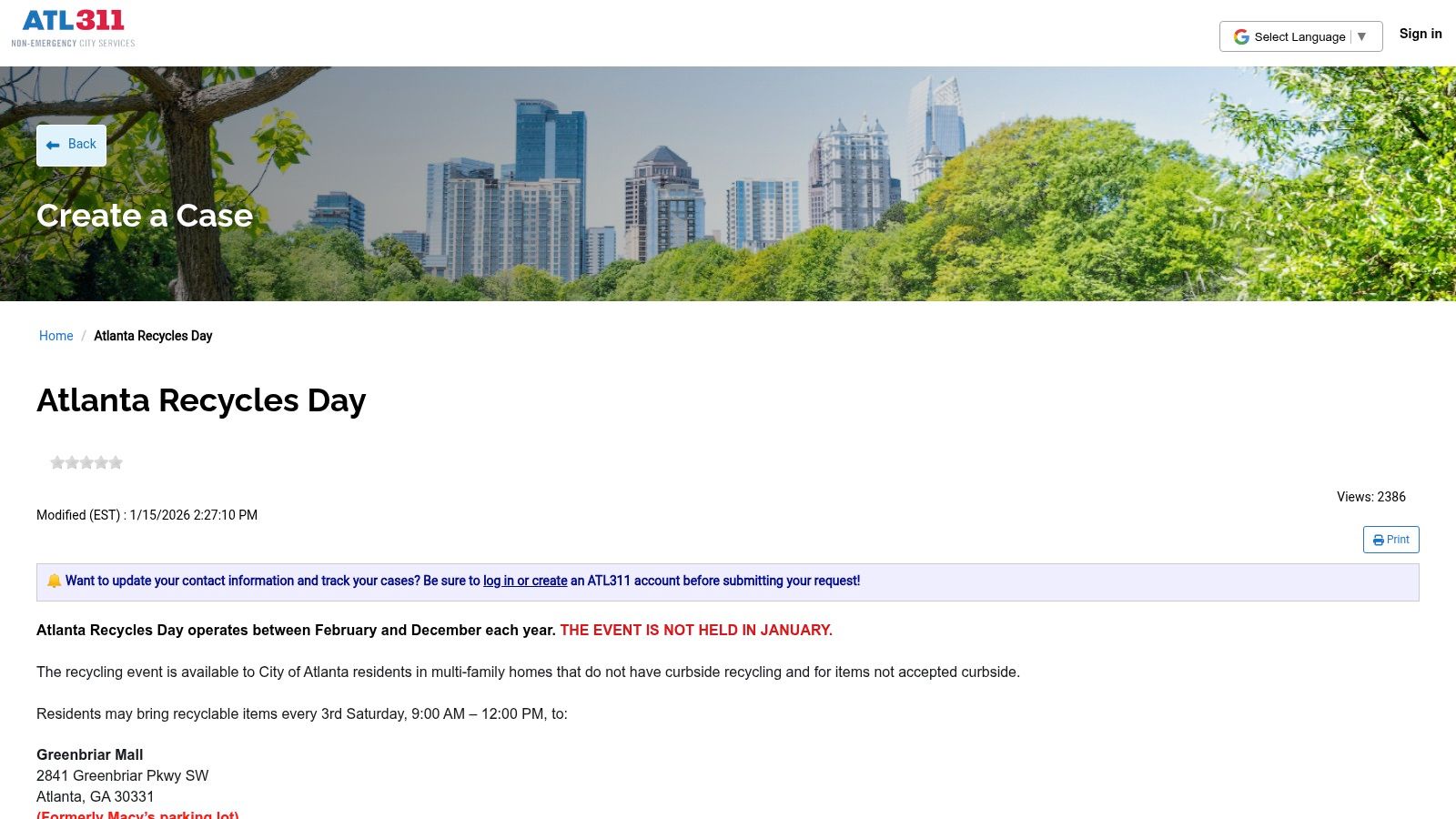
If you want a dependable city-run answer to the e recycling event near me search, Atlanta Recycles Day is one of the strongest options inside city limits. It’s a recurring drive-through event at Greenbriar Mall, which immediately makes it more practical than one-off popups that disappear for most of the year.
The biggest advantage is predictability. A recurring municipal event is easier to remember, easier to plan around, and usually better organized than occasional charity collections or retailer parking-lot drives. City staff manage traffic and collections, and the city also provides guidance through its Waste Wizard tool on items that don’t belong in curbside pickup.
What works well here
For residents, this event solves the common “I have a few things but nowhere to take them” problem. You stay in the vehicle, unload through an established process, and can often handle paper shredding in the same trip.
- Reliable schedule: The recurring cadence makes this better than events you have to chase on social media every few months.
- Clear municipal rules: City staff and published guidance remove some of the confusion around accepted versus rejected items.
- Useful add-on service: On-site paper shredding helps households clear both physical records and small electronics in one stop.
Practical rule: If you only have a few personal devices and some paper records, a city-run event like this is exactly the kind of option that makes sense.
Businesses should read the fine print before loading a box truck. This event is intended for city residents and for residential-style loads. It isn’t designed for office decommissions, multi-floor cleanouts, or palletized equipment. If you’re comparing local options for commercial disposal, Atlanta electronics recycling event options for business needs are a better fit than trying to force a resident event to handle enterprise hardware.
Where it falls short for companies
Morning-only windows are manageable for a homeowner. They’re a poor fit for facilities teams, IT managers, or office administrators trying to coordinate labor, loading, transport, and documentation around business hours.
It also doesn’t solve the bigger issue for commercial users. Dropping equipment at a resident-focused event isn’t the same as having asset tracking, data destruction records, and a documented handoff process. If your retired devices came from a clinic, finance team, school, or public agency, that gap matters more than convenience.
Use the City of Atlanta event page to confirm current details before you go.
2. Keep North Fulton Beautiful Johns Creek Bulky Recycling Event
Johns Creek’s bulky recycling event is the kind of program residents appreciate because it accepts more than the usual basics. That’s the main reason it stands out. If you’ve been turned away elsewhere for an older TV or a mixed load that includes accessories and batteries, this event is more accommodating than many city collections.
Pre-registration is part of the process, and that’s both a strength and a limitation. It improves flow on event day and keeps unloading more orderly, but it also means you can’t treat it like an always-available drop-off point.
Best use case
This is a smart option for a resident household doing a real cleanout rather than dropping off one laptop. The broad acceptance list gives it more utility than events that only want a narrow set of items.
- Wide electronics scope: TVs, computers, monitors, and common accessories are part of the draw.
- Organized entry: Pre-registration and residency verification reduce confusion at the gate.
- Low-friction for households: Free attendance, with donations welcome, keeps the barrier to entry low.
What doesn’t work is trying to repurpose a resident event into a commercial outlet. Non-residents and businesses aren’t the intended audience. That’s common, not unusual. In fact, much of the search space for “e recycling event near me” is dominated by resident-only programs that leave business users without a dependable commercial path. The pattern is documented in the review of event restrictions and business exclusions tied to Sunnking’s event coverage and related resident-only recycling searches.
Resident events are great at diverting home electronics. They’re rarely built to handle office inventory, pickup scheduling, or business compliance needs.
The business reality
For an Atlanta company, the main trade-off is simple. This type of event is easier than doing nothing, but it still pushes the burden onto your staff. Someone has to register, sort loads, verify eligibility, transport equipment, wait in line, and hope the event’s acceptance rules match what came out of your office.
That’s why companies usually move from “event near me” searches to dedicated service providers. If your load includes company-owned devices, mixed IT gear, or anything from a formal refresh cycle, a commercial electronics recycler in Atlanta is usually the more operationally sound choice.
Check current scheduling and registration details on the Keep North Fulton Beautiful event page.
3. Gwinnett Clean and Beautiful Earth Day Recycling Event
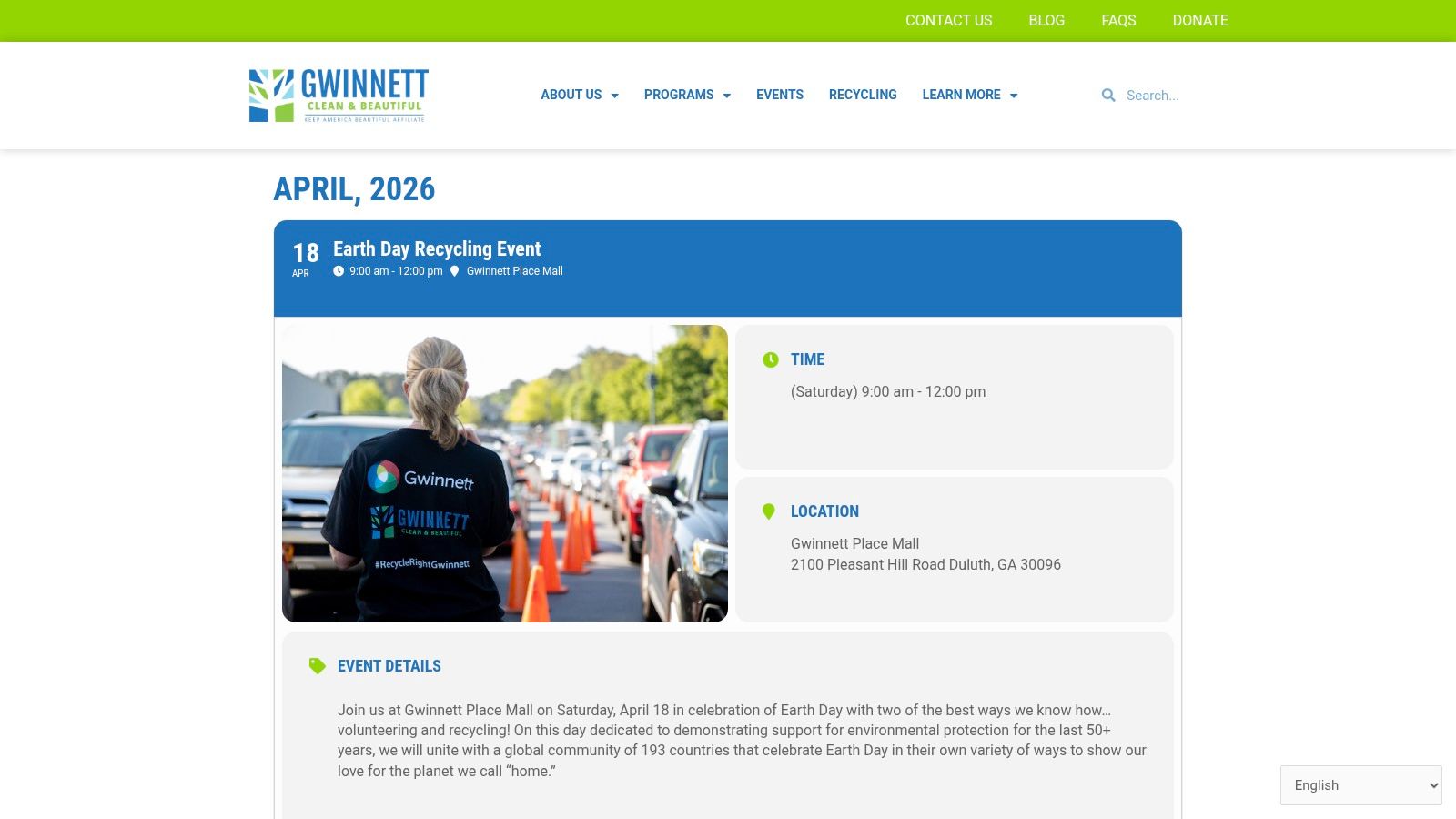
Gwinnett Clean and Beautiful’s Earth Day event is one of the more useful one-stop collections in the metro area because it combines multiple hard-to-recycle streams. That matters if the garage or shed cleanout includes paint, tires, clothing, shoes, and electronics in the same trip.
From a practical standpoint, this is the kind of event that’s worth waiting for if you’re a resident with a bigger backlog. Volunteer-assisted unloading and a drive-through setup usually make these large county events move faster than smaller neighborhood collections, even when turnout is heavy.
Why residents like it
The attraction here isn’t just electronics. It’s consolidation. One event can clear several categories of hard-to-handle materials, which reduces the number of disposal stops you need to make.
- Multi-stream convenience: Electronics, paint, tires, textiles, and shredding can be handled together.
- Clear rules: The fee structure for certain items is posted in advance, which avoids surprises.
- Large-event staffing: Volunteer support helps keep traffic moving and reduces unloading headaches.
There’s also a pricing reality that’s useful to see upfront. Some electronics carry fees, especially televisions, monitors, and printers. For residential users, that’s not unusual. For business users, though, per-item event pricing can become inefficient fast if you’re dealing with volume.
Where events stop making sense
For a homeowner, paying item fees at an annual collection can still be worthwhile. For an office with many screens or printer devices, it quickly turns into a labor and budgeting problem. You’re still sending employees off-site, still working around a once-a-year calendar, and still not getting the pickup and disposition workflow that commercial programs need.
That’s one reason Atlanta businesses often look for free electronics recycling event alternatives built for commercial pickups instead of relying on community collection days.
If your retired equipment is stacked in a server closet instead of a garage, the bottleneck isn’t disposal alone. It’s controlled removal, documentation, and keeping staff focused on work.
The annual timing is the other major limitation. Good residential programs often happen once and draw big crowds. That works for spring cleaning. It doesn’t work for a hospital refresh, campus lab turnover, or phased office move.
You can review accepted items and current details on the Gwinnett Clean and Beautiful Earth Day event page.
4. Keep Cobb Beautiful Community Recycling Event
Cobb County’s community recycling events are practical because they’re broad, not narrow. Electronics are only one part of the offering. Metals, textiles, sneakers, and special-stream materials can often go at the same event, which makes these useful for households that want to clear out more than a drawer of old cables.
The county-run setup also helps. When local government and event staff plan traffic and unloading in advance, the experience is usually smoother than informal collection drives where accepted items are vaguely defined and lines build without direction.
Strong fit for mixed cleanouts
This is a good model for residents and very small office-like cleanouts where the load looks more like “storage room overflow” than structured IT disposition. Secure paper shredding adds another layer of convenience, especially when people are purging home files at the same time.
A few traits make this type of event work well:
- Broader household usefulness: Electronics are only one category, so the trip feels more worthwhile.
- Managed flow: County communications and staff support reduce confusion on arrival.
- Easier unloading: Volunteers and onsite workers can help move materials efficiently.
The weakness is timing. These events are seasonal, so availability depends on the county calendar. That means they’re not a reliable answer when equipment has to leave a site on your schedule, not the county’s.
Business caution
Some small offices are tempted to treat county events as an informal outlet for old monitors, keyboards, or a few PCs. That can work only when the load is minimal and the event rules allow it. Once the equipment came from a business environment, especially one with regulated records, that casual approach starts to create unnecessary risk.
The bigger issue isn’t whether an event can physically take a monitor. It’s whether your organization can prove who handled each device, when it changed hands, and how data-bearing media were processed. Community events generally aren’t designed around those questions. They’re designed around diversion and convenience.
That’s why companies with recurring tech turnover usually stop searching for public events and move toward scheduled commercial service instead. For residents, county events are useful. For organizations, they’re rarely enough on their own.
Use the Cobb County community recycling event listing to verify the next date and posted event rules.
5. City of Douglasville and Keep Douglasville Beautiful Electronics and Metal Recycling
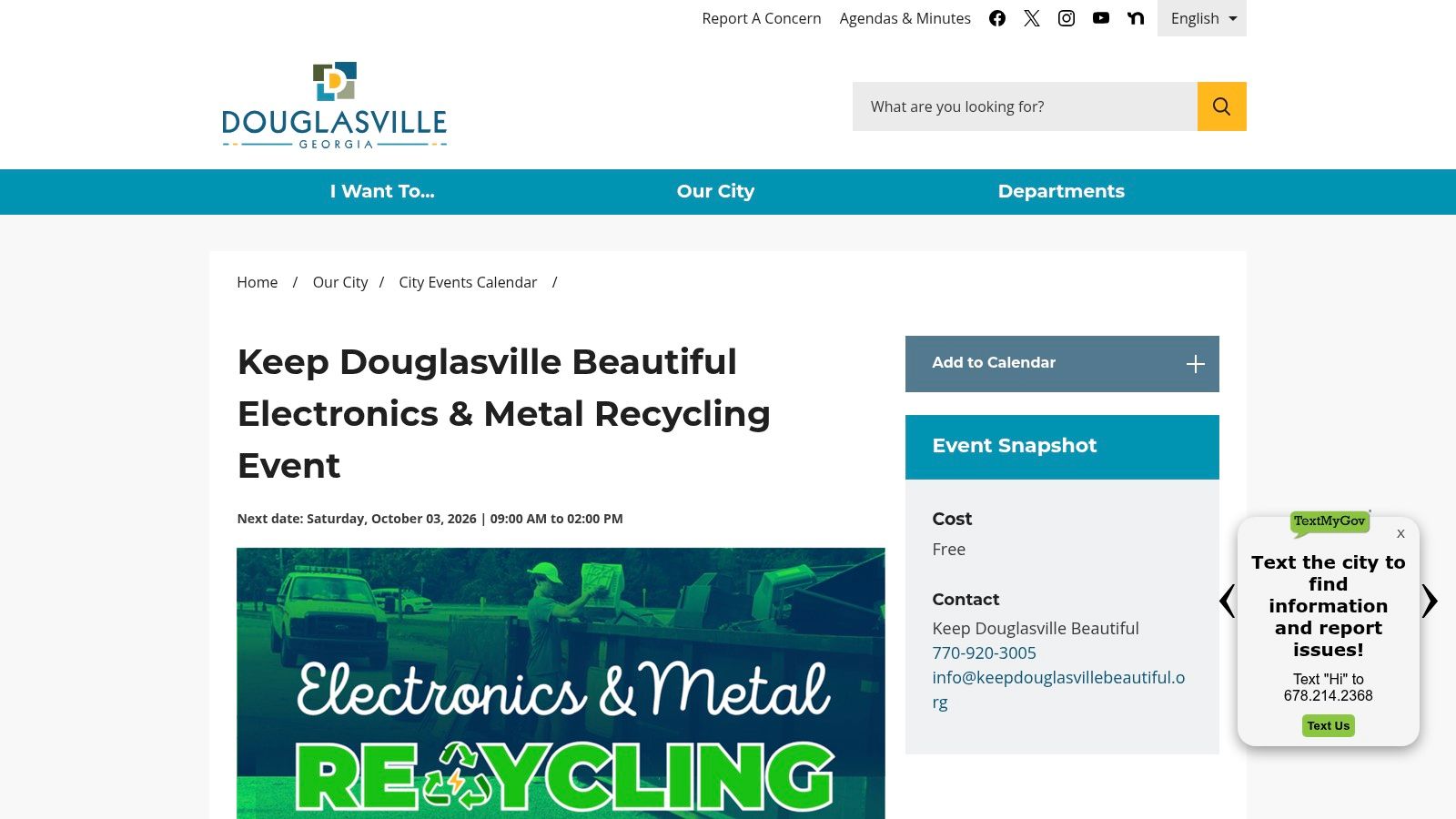
A Douglasville resident clearing out a garage can wait for a spring or fall recycling date, load up a few TVs, metal items, and small electronics, and be done in one trip. That is exactly what this event is built for. The city and Keep Douglasville Beautiful make the process clear, public, and predictable for households.
That predictability is a key strength here. Douglasville posts future dates in advance, which gives residents time to sort materials and avoid the guesswork that comes with many one-off community collections. For homeowners trying to clear space without sending electronics to the landfill, that matters.
Where Douglasville works well
This event stands out because it covers more than basic electronics. The accepted material mix can make one drop-off trip far more efficient for a household cleanup project.
- Scheduled dates on the calendar: Residents can plan around known collection windows.
- Broader material acceptance: Electronics, scrap metal, clothing, shoes, and home goods increase the value of the trip.
- Screen recycling availability: TVs are often accepted, though posted fees and item rules should be checked in advance.
That resident-friendly structure also shows why businesses should be careful about treating public events as a disposal plan. A twice-yearly collection is manageable for a home basement cleanout. It does not fit office moves, equipment refresh cycles, lease exits, or multi-site IT turnover.
The bigger concern is not convenience. It is control. Once devices came from a business environment, especially laptops, desktops, servers, or phones that may hold company or customer data, the standard changes. Staff need documented handling, secure transport, and a clear record of what happened to each asset. Public drop-off events usually are not designed to provide that level of accountability.
For that reason, companies searching for a practical local option are usually better served by a commercial e-waste recycling service near Atlanta than by waiting for the next city event and assigning employees to haul retired equipment themselves.
Residents can still get real value from Douglasville’s program. Businesses usually need a dedicated service built around security, volume, and liability.
You can confirm current details on the Douglasville recycling events page.
6. City of Peachtree Corners Earth Day on the Green
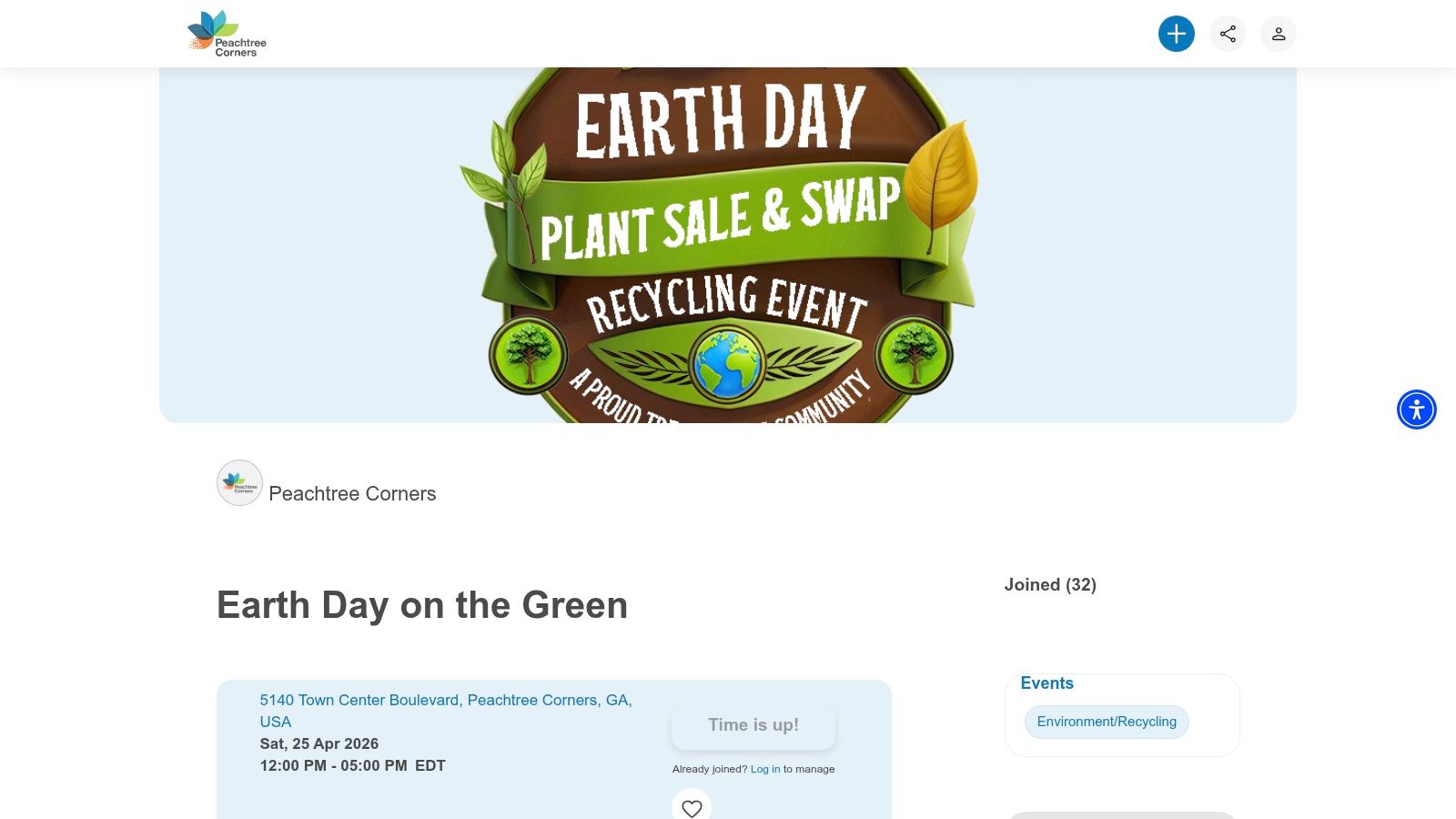
Peachtree Corners takes a different approach. Earth Day on the Green is less like a pure disposal event and more like a community sustainability festival with recycling built in. That changes the experience. It feels more accessible for families, homeowners, and light household drop-offs than an industrial-style collection line.
For residents with a small amount of e-waste, that’s a plus. The setting is central, the event usually combines education with services, and free shredding adds practical value without making the day feel like a chore.
Best for light drop-offs
This is a good fit when you have a handful of personal electronics, not a vehicle full of corporate hardware. The festival format makes it easy to incorporate recycling into a larger outing, especially for people who like community events but might otherwise put off proper disposal.
A few advantages are clear:
- Low-pressure environment: The event feels welcoming, which increases participation for households.
- Education plus disposal: Eco-vendors and outreach help people understand what belongs where.
- Convenient extras: Shredding and related activities make the trip more worthwhile.
That said, the same community-focused format makes it less suitable for anything operationally heavy. Large business loads, palletized equipment, or racks of obsolete devices don’t fit naturally into a family-oriented Earth Day setting.
Community festivals can encourage recycling behavior. They aren’t a substitute for managed commercial disposition when devices contain business data or move in volume.
Where companies should draw the line
This is one of the clearest examples of the split between public recycling and business recycling. A homeowner dropping off a printer and two cables is exactly the intended use. An IT manager trying to unload retired workstations from a refresh cycle is not.
The data issue matters as much as the logistics. Research on public event coverage shows that event pages often focus on accepted items while leaving data wiping standards, chain of custody, and compliance verification unclear, a problem highlighted in the review tied to the University of Rochester E-Cycle Day event information. That lack of detail may be acceptable for household devices. It isn’t enough for healthcare, government, or education environments.
Check the latest details on the Peachtree Corners community event page.
7. City of Dunwoody Electronics Recycling Event
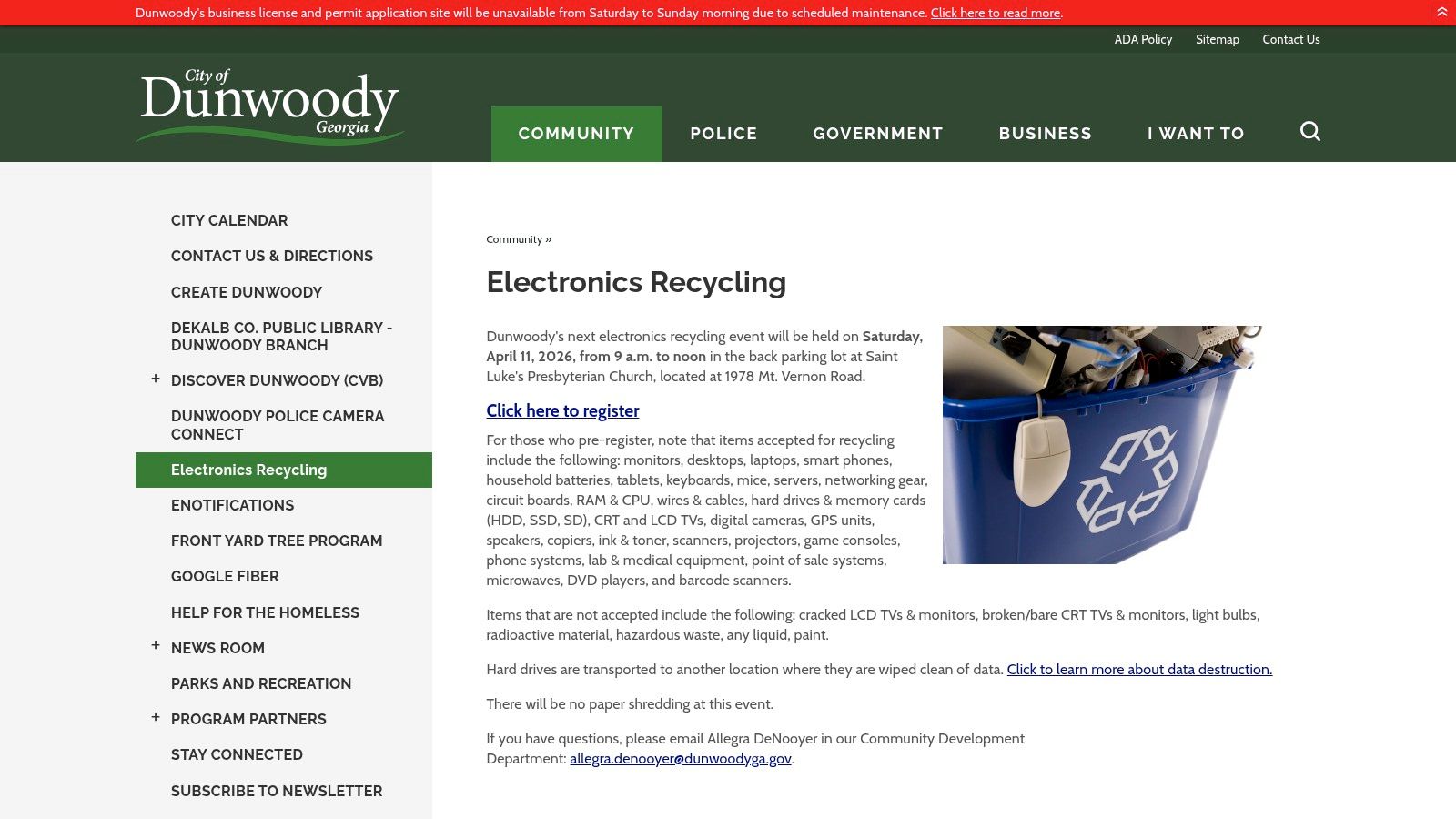
A Dunwoody resident cleaning out a home office can get real value from this event. The accepted-item list often reaches beyond basic household electronics and includes equipment like computers, networking gear, monitors, and other tech accessories that many city collections leave out.
That wider scope makes the event more practical for households with unusually technical loads. A garage with old routers, a retired desktop, spare switches, battery backups, and tangled peripherals is a better fit here than at a general recycling day built around lighter residential items.
What makes this event useful
Pre-registration usually improves the experience. It helps the city control traffic, set expectations before drop-off, and reduce confusion about what will be taken on site.
A few details stand out:
- Broader electronics acceptance: Networking equipment and more specialized devices get attention here, not just obvious consumer items.
- Clear event instructions: City notices typically spell out timing, location, and any restrictions before the event date.
- Good local access: North DeKalb residents can use a nearby option instead of hauling equipment across metro Atlanta.
That said, businesses should read the item list carefully and stop there. An event can accept servers or other office hardware without offering the controls a company needs for disposal. Accepted items are only one part of the job. They do not confirm serialized inventory, chain of custody, data destruction standards, or reporting that supports internal policy and regulatory requirements.
This is the line between a helpful community event and a commercial recycling service. For residents, Dunwoody’s program can solve a real problem. For companies, volume, liability, and data-bearing devices change the decision.
A business clearing out ten laptops has a different risk profile than a resident dropping off one old PC. A business retiring racks of equipment, failed drives, or office electronics from a refresh cycle needs scheduled pickup, documented handling, and a vendor built for commercial accountability. If that is your situation, start with a provider focused on secure electronics recycling for Atlanta businesses rather than relying on an occasional public event.
Use the Dunwoody city website to check the next event date and registration details.
7 Local Electronics Recycling Events Comparison
| Event | 🔄 Complexity | ⚡ Resource requirements | 📊 Expected outcomes | 💡 Ideal use cases | ⭐ Key advantages |
|---|---|---|---|---|---|
| City of Atlanta, Atlanta Recycles Day (Greenbriar Mall) | Low, city‑run monthly drive‑through with staff traffic control | Moderate, city staff, collection trucks, on‑site shredder | Good residential diversion of odd items; secure shredding available | Multifamily residents without curbside service; small residential loads | Reliable monthly cadence; no vendor upsell; on‑site shredding |
| Keep North Fulton Beautiful, Johns Creek Bulky Recycling Event | Medium, one‑day event with pre‑registration and residency checks | Moderate, staff, drop‑off zones; accepts CRT/LCD TVs | Broad electronics acceptance including TVs; efficient when preregistered | Residents with large electronics/TVs needing a single drop‑off day | Broad acceptance including TVs; well‑organized; free entry |
| Gwinnett Clean & Beautiful, Earth Day Recycling Event | High, large countywide, multi‑stream coordination and volunteer ops | High, volunteers, staff, multiple collection streams, fee processing, shredding | High impact diversion across electronics, paint, tires, textiles; good for big cleanouts | Large residential cleanouts and multi‑material disposals (spring event) | Combines multiple streams in one stop; large scale; volunteer‑assisted throughput |
| Keep Cobb Beautiful, Community Recycling Event | Medium, seasonal county events with traffic planning and staff | Moderate, staff/volunteers, shredding, special streams (Hefty ReNew) | Effective mixed‑material diversion for households and small offices | Mixed home or small office cleanouts during seasonal events | Multi‑material acceptance; county coordination reduces wait/confusion |
| City of Douglasville + Keep Douglasville Beautiful, Electronics & Metal Recycling | Low–Medium, biannual drive‑through with posted dates | Low–Moderate, staff, collection vehicles; small per‑screen TV fees | Reliable scheduled option; accepts TVs/monitors with small fee | Residents planning ahead for bulky electronics or metal recycling | Clear posted schedule; accepts TVs with small fee; community‑focused |
| City of Peachtree Corners, Earth Day on the Green | Low, festival‑style annual event combining outreach and recycling | Low, vendor booths, staff, shredding; geared to light loads | Good outreach and light e‑waste diversion; family engagement | Light residential e‑waste, community education, family participation | Combines recycling with outreach and activities; family‑friendly |
| City of Dunwoody, Electronics Recycling Event | Medium, date‑specific with pre‑registration encouraged and traffic control | Moderate, staff, handling for IT gear and consumer electronics; possible fees | High value for tech‑heavy collections; efficient with preregistration | IT decommissions, servers/network gear, tech‑heavy residential drop‑offs | Extensive accepted items including servers/network gear; pre‑registration improves flow |
The Professional Solution for Atlanta's Business E-Waste
A neighborhood recycling day solves a real problem for residents. You clear out a few old laptops, a dead printer, maybe a box of cables, drive to the event, and the material is gone in an hour. That model works for households.
It does not match what businesses need.
Commercial e-waste projects involve chain of custody, data-bearing devices, pickup logistics, building access, asset counts, and documented disposition. A city event is designed for public drop-off. Business IT asset disposition requires scheduled handling, security controls, and records that stand up to internal audits and compliance reviews.
The gap becomes obvious as soon as a company tries to use a community event for business equipment. Event hours are limited. Accepted items can change. Many programs are resident-focused, capped by volume, or built for light loads. A few desktop towers from a home office may fit. A department refresh, clinic cleanout, school lab replacement, or server retirement usually does not.
The bigger concern is liability.
Businesses need to know who handled each device, how data was destroyed, where materials went next, and what paperwork supports the transfer. That requirement is especially important for healthcare providers, schools, government offices, law firms, and any organization managing confidential employee, customer, student, or patient information. Public event pages typically explain where to park and what items are accepted. They rarely offer the documentation and controlled process a commercial client expects.
Atlanta Computer Recycling is built for that business requirement. ACR provides scheduled pickup, on-site logistics, and ITAD support across metro Atlanta. Instead of assigning employees to collect equipment, load vehicles, wait in line, and hope the event can take everything, companies can set a pickup window and move the project through an organized commercial process.
Data destruction is another clear dividing line. ACR offers free hard drive wiping using the DoD 5220.22-M 3-pass standard, along with physical shredding for obsolete or failed media. For organizations dealing with HIPAA obligations or other sensitive records, that level of control is the point. A community collection event is not set up to manage that risk on a business's behalf.
Operations matter too. Equipment is often spread across offices, classrooms, labs, clinics, storage areas, and server rooms. Removal may require de-installation, packing, palletizing, coordinated pickup, and transport planning. A dedicated commercial recycler works around your schedule and facility requirements. Public events require your staff to work around theirs.
Scale changes the decision further. As noted earlier, electronics recovery affects both environmental performance and business risk. Companies control a large share of reusable and recyclable equipment, and poor handling creates avoidable exposure. Missed data destruction, incomplete records, and improvised transport are far more expensive than choosing the right recycler at the start.
For a small office cleanout, ACR gives businesses a direct path that protects staff time. For larger projects, including data center decommissions, the company coordinates removal so retired assets leave the site securely and with proper documentation. That is usually the actual answer behind an "e recycling event near me" search. Residents may need the next community collection date. Businesses usually need a commercial service built for security, volume, and accountability.
Atlanta businesses do not need another resident-only event listing. They need a recycler that can show up, handle equipment correctly, protect data, and document the job. Atlanta Computer Recycling provides scheduled pickups, secure ITAD services, hard drive wiping, media shredding, and support for everything from office cleanouts to data center decommissions across the metro area. If you’re ready to clear out retired tech without creating compliance or operational headaches, contact ACR for an efficient commercial recycling program.