Charm Atlanta: Boost Your Brand, Manage E-Waste


You’re probably seeing charm atlanta mentioned in local sustainability conversations and wondering whether it’s relevant to your job or just another resident recycling program that doesn’t touch commercial IT. That uncertainty is common, especially if you manage office refreshes, clinic closures, school device turnover, or data center hardware retirement.
The short answer is yes, it matters. But not in the way many business teams assume.
For Atlanta residents, CHaRM is a respected local outlet for hard-to-recycle materials. For businesses, it’s better understood as a signal. It shows what the city values, what employees notice, and what customers increasingly expect from organizations that generate electronic waste. The operational side is different. A company can absolutely align itself with the spirit of CHaRM and local sustainability, but that doesn’t mean a residential drop-off model is the right path for bulk laptops, servers, storage, or devices carrying regulated data.
What Is Charm Atlanta and Why Should Your Business Care

In Atlanta, charm atlanta typically refers to CHaRM, the Center for Hard to Recycle Materials operated by Live Thrive. It’s a recognizable part of the city’s sustainability culture. If you work in IT, facilities, procurement, or operations, that name can surface in meetings for the wrong reason. Someone says, “Can’t we just take it to CHaRM?” and suddenly a residential recycling idea gets treated like a commercial disposition plan.
That’s where confusion creates risk.
A business should care about CHaRM for two reasons. First, it reflects a local expectation that organizations handle waste responsibly. Second, it forces a practical decision about which disposal path fits which material stream. A few employee-owned devices or small miscellaneous items might fit a community drop-off mindset. A pallet of retired desktops, a stack of encrypted drives, or decommissioned network gear does not.
Why the name keeps coming up
Atlanta companies want local credibility. They don’t want sustainability language that sounds imported from a corporate template. CHaRM gives them a local reference point. It’s tangible, familiar, and tied to visible environmental action in the city.
That matters for branding, recruiting, and stakeholder trust. It also matters for internal education. Teams need to know the difference between “supporting local sustainability values” and “using a process that can withstand audit, legal review, and security scrutiny.”
Practical rule: Use CHaRM as a community sustainability reference. Use a commercial ITAD process for business electronics that require chain of custody, secure sanitization, and project logistics.
The operational question behind the branding question
The main issue isn’t whether CHaRM is good. It is. The issue is fit.
If your business is building an electronics recycling policy, start by separating community engagement from asset disposition controls. They overlap in mission, not in execution. A useful starting point is reviewing local electronics recycling options in Atlanta and then mapping each option to the type of asset, data risk, and volume involved.
That’s the practical frame. CHaRM helps define Atlanta’s sustainability ethos. Businesses still need the right tool for the job.
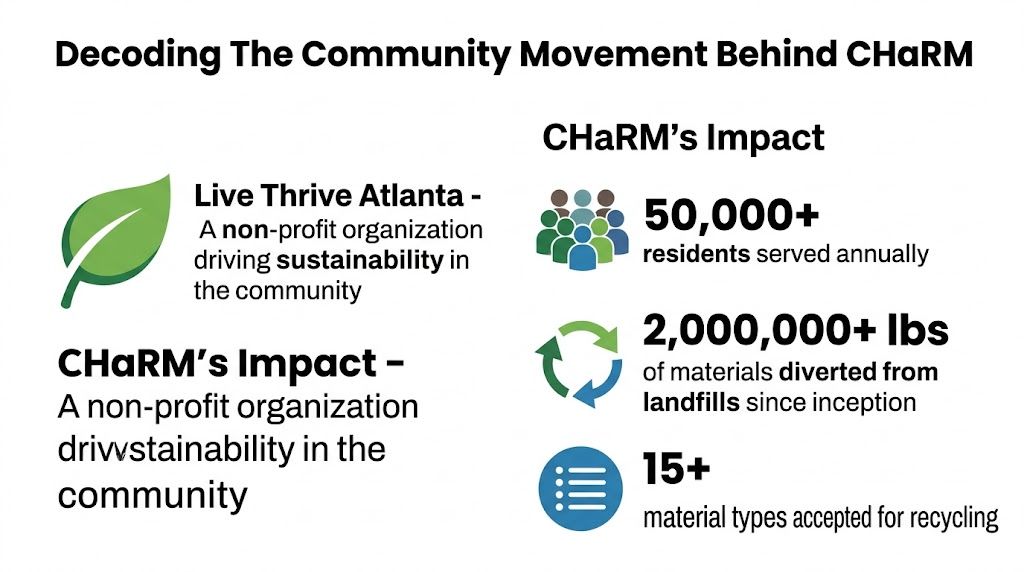
Decoding The Community Movement Behind CHaRM
A facilities lead in Atlanta cleaning out a garage has one problem. An IT manager retiring 400 laptops has another. Both are dealing with unwanted material, but only one job can run through a public drop-off recycling program.
CHaRM stands for Center for Hard to Recycle Materials. It is part of Live Thrive, the nonprofit created after founder Peggy Ratcliffe saw how hard it was to dispose of specialty and hazardous household items during a family cleanout. That origin explains why CHaRM has earned so much local goodwill. It was built around a real household need, and Atlanta residents responded.
Atlanta Magazine’s profile of CHaRM notes that the Atlanta site opened in 2015 and, by 2022, had diverted millions of pounds of material from landfills. The same reporting describes heavy public usage and a broad mix of accepted materials, including paint, chemicals, appliances, cardboard, plastics, and other items that curbside programs often reject.
That matters because it shows CHaRM is not a symbolic green project. It is working infrastructure.
Live Thrive also expanded the model. According to Live Thrive’s first-anniversary announcement for CHaRM DeKalb, the DeKalb location handled a large volume of material in its first year despite limited operating days. The organization also reported that, together, its sites diverted millions of pounds in 2024, including large paint, chemical, and cardboard volumes.
For business leaders, the branding lesson is straightforward. CHaRM reflects a visible Atlanta habit of handling difficult waste streams responsibly. Referencing that local culture can strengthen sustainability messaging, especially for employers trying to show that their environmental commitments are tied to the city they operate in, not copied from a national template.
The operational lesson is different.
Commercial electronics do not fit the CHaRM model just because they are recyclable. Business devices carry data exposure, chain-of-custody requirements, internal approval workflows, and, in many cases, retention or destruction obligations. A resident dropping off old paint and a company decommissioning encrypted endpoints are using different systems for good reason.
Live Thrive explains on its CHaRM program page that the program runs through grants, sponsorships, donations, and recycling fees rather than standard municipal tax funding. That structure supports a strong community service. It does not replace commercial ITAD controls such as serialized asset tracking, documented sanitization, audit-ready reporting, and scheduled logistics across multiple sites.
Companies that want to connect sustainability claims to execution should pair local community awareness with a formal process. Many teams use policy frameworks to implement an Environmental Management System and then map electronics retirement to secure downstream handling. For Atlanta organizations, that usually means learning where public programs fit and where a business-grade e-waste recycling service in Atlanta is the better choice.
That is the right tool for the job.
How Sustainability Branding Connects to Atlanta's Identity
An Atlanta company doesn’t build credibility by publishing generic ESG copy. It builds credibility by showing that its actions fit the city it operates in. That’s why the idea behind charm atlanta matters for branding. CHaRM has become part of the local sustainability vocabulary, and companies that understand that can make their environmental programs feel more real, more local, and less performative.
Local sustainability reads differently than national boilerplate
Employees notice whether a company’s sustainability efforts feel abstract or specific. Customers do too. Saying you reduce waste is broad. Showing that your policies align with the kind of responsible material handling Atlanta residents already recognize is stronger. It connects your company to a shared local standard.
That doesn’t mean putting a CHaRM logo on a slide deck or implying a partnership where none exists. It means building a program that reflects the same values. Responsible diversion. Thoughtful handling of difficult materials. Clear processes instead of wishful recycling.
Why this matters more in a growing tech market
Metro Atlanta’s data center sector is a major force in the regional economy. Through 2023, the sector contributed $25.7 billion to Georgia GDP, generated $1.8 billion in tax revenue, and included 97 operating facilities with 27 in planning stages, according to the Atlanta Regional Commission’s data center analysis. That same source notes that 2024 announcements alone represent 30 million square feet of new capacity requiring $40 billion investment.
For business leaders, this changes the conversation. Electronics disposition isn’t a side issue anymore. In a market adding infrastructure at that scale, retired servers, storage arrays, networking hardware, and supporting electronics become part of corporate reputation. If your company operates in this environment, sustainable IT disposition affects how peers, regulators, employees, and enterprise customers read your maturity.
Turning sustainability into an operating discipline
Branding works when operations support it. That means tying e-waste handling to policy, accountability, and reporting. Many organizations formalize this through an environmental framework or by choosing to implement an Environmental Management System so sustainability actions are documented rather than improvised.
A similar mindset applies to electronics programs built around reuse, controlled recycling, and landfill avoidance. If you want a local lens on that approach, the circular model behind electronics reuse and circular economy thinking in Atlanta offers a practical way to connect disposal decisions to brand value.
A company earns sustainability credibility when marketing language matches what the operations team can prove.
Residential Recycling vs Commercial ITAD The Critical Divide
This is the line many organizations blur. CHaRM is valuable. It is also not designed as a full commercial IT asset disposition program.
For businesses, the core issue is not whether electronics can be dropped off somewhere. The issue is whether the process covers data destruction, chain of custody, bulk handling, project timing, audit support, and compliance documentation. If those elements are missing or unclear, the risk sits with the business, not the recycler.
Where the gap shows up
Live Thrive’s electronics guidance confirms that CHaRM accepts electronics, including old computers, but it doesn’t clearly detail business volume limits or mention certified data destruction standards such as DoD 5220.22-M or NIST SP 800-88 on that program page, which creates a compliance gap for organizations handling sensitive information, as noted in Live Thrive’s electronics recycling overview.
That matters for hospitals, school systems, law firms, finance teams, and enterprises retiring endpoint fleets. If a process can’t clearly answer how drives are sanitized, what documentation is issued, and how assets are controlled from pickup through final disposition, it isn’t sufficient for regulated or risk-sensitive environments.
Side-by-side comparison
| Feature | CHaRM (Residential Focus) | Atlanta Computer Recycling (Commercial Focus) |
|---|---|---|
| Primary audience | Residents and community users | Businesses, institutions, and organizations |
| Electronics intake model | Drop-off oriented | Coordinated commercial service |
| Data destruction standards | Not clearly detailed in the cited electronics guidance | Commercial ITAD programs typically require defined sanitization and destruction processes |
| Pickup and de-installation | No pickup service described in the cited business-gap material | Commercial projects often require on-site pickup, packing, and de-installation |
| Bulk project fit | Limited clarity for large-volume business loads | Designed for office closures, refresh cycles, and data center work |
| Audit trail | Not clearly addressed for business e-waste in the cited material | Business ITAD should provide asset-level or project-level documentation |
| Time-sensitive scheduling | Appointment-based model | Commercial programs are built around project windows and operational deadlines |
For organizations comparing service models, a dedicated ITAD program in Atlanta is a different category of service, not a premium version of household recycling.
What businesses actually need
A compliant commercial workflow usually requires several controls working together:
- Documented custody: Someone signs for equipment, tracks transfer, and records what left the site.
- Defined sanitization: Drives are wiped or destroyed under a stated standard, not according to an informal promise.
- Project logistics: The provider can handle carts, pallets, server rooms, loading docks, and access restrictions.
- Reporting: Your team receives documentation suitable for internal audit, sustainability reporting, and legal review.
- Risk segregation: Reusable devices, scrap units, batteries, drives, and mixed peripherals are separated intentionally.
What works and what doesn’t
What works is using CHaRM for what it was built to do. It’s a strong community resource for hard-to-recycle materials and smaller-scale public drop-off use.
What doesn’t work is treating a residential-oriented model like a substitute for enterprise ITAD. The mismatch usually appears late, when a team asks for serial-based reporting, destruction evidence, on-site handling, or a pickup timeline that aligns with a move, merger, or decommissioning date.
An IT Manager's Playbook for Sustainable Asset Disposition
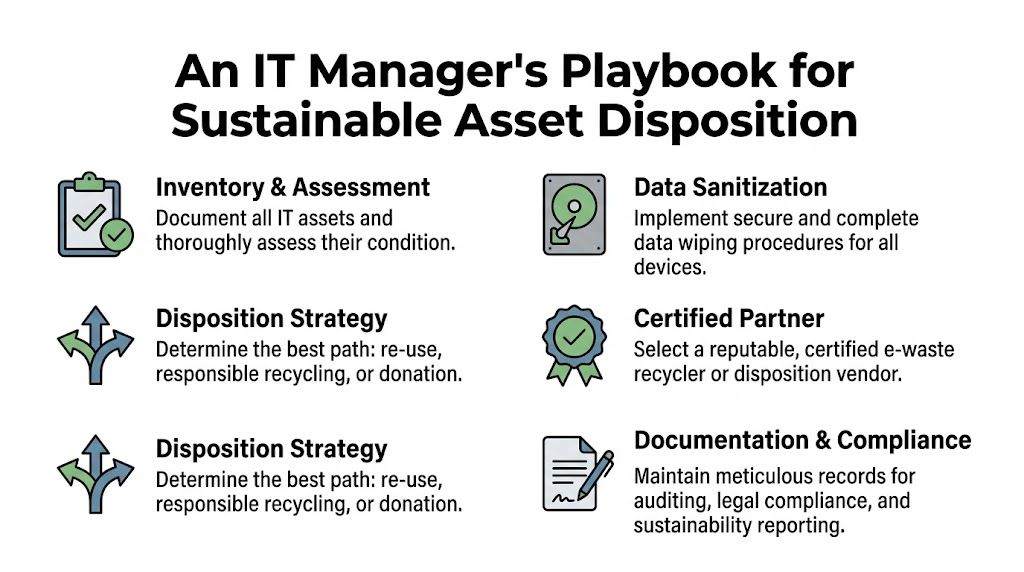
A workable ITAD process doesn’t start with a truck. It starts with internal clarity. If your team is retiring assets and wants the program to support both sustainability goals and compliance requirements, use a playbook that removes ambiguity before equipment leaves the building.
Step one inventory the retirement stream
Build a clean list of what’s leaving service. That includes desktops, laptops, monitors, servers, switches, storage, loose drives, and accessories. Separate gear by condition and by data risk.
This sounds basic, but it prevents the two most common breakdowns in disposition projects. First, mixed loads arrive without clear counts. Second, high-risk devices get packed like low-risk scrap.
Step two define your data handling standard
Write down the sanitization rule before you choose a vendor. If your organization handles regulated data, this shouldn’t be left to verbal assurances. Your legal, compliance, security, and infrastructure teams should all know when wiping is acceptable, when shredding is required, and what evidence must come back.
Teams that want to strengthen internal awareness often review broader information security practices so asset disposition isn’t treated as a facilities task when it’s really a security control.
Field note: A retired laptop is still a security object until the organization can prove the data is gone.
Step three vet the logistics, not just the recycling claim
Residential-style options often prove insufficient for commercial projects. Live Thrive’s CHaRM location details and operating constraints indicate appointment requirements, sorting expectations, and weather-related closures in 2026, which make the model difficult for time-sensitive decommissioning work, according to CHaRM location and operational details.
An IT manager should ask operational questions such as:
- Pickup capability: Can the provider remove equipment from offices, labs, closets, and data rooms?
- Packaging support: Will they supply labor or guidance for boxing, palletizing, and staging?
- Schedule reliability: Can they commit to your move date, project window, or cutover plan?
- Mixed material handling: How do they separate drives, reusable endpoints, scrap metal, batteries, and peripherals?
Step four require documentation that serves more than one team
Disposition paperwork shouldn’t only satisfy IT. It should also help procurement, compliance, sustainability, and finance. The best documentation supports multiple internal uses at once: proof of removal, record of sanitization, and evidence for environmental reporting.
A practical internal checklist often includes:
- Asset manifest for what left the site.
- Sanitization or destruction record for data-bearing media.
- Disposition summary showing whether assets were reused, recycled, or otherwise processed.
- Project contact trail listing who approved the transfer and who received the material.
Step five connect the program to sustainability reporting
If the company talks publicly about environmental responsibility, retired electronics belong in that conversation. Tie device retirement to your existing reporting process rather than leaving it buried in help desk tickets or warehouse notes.
That’s how you capture the branding value of charm atlanta without creating a security blind spot. You borrow the local ethos. You don’t borrow the wrong operating model.
Case Study How an Atlanta Healthcare System Handled E-Waste
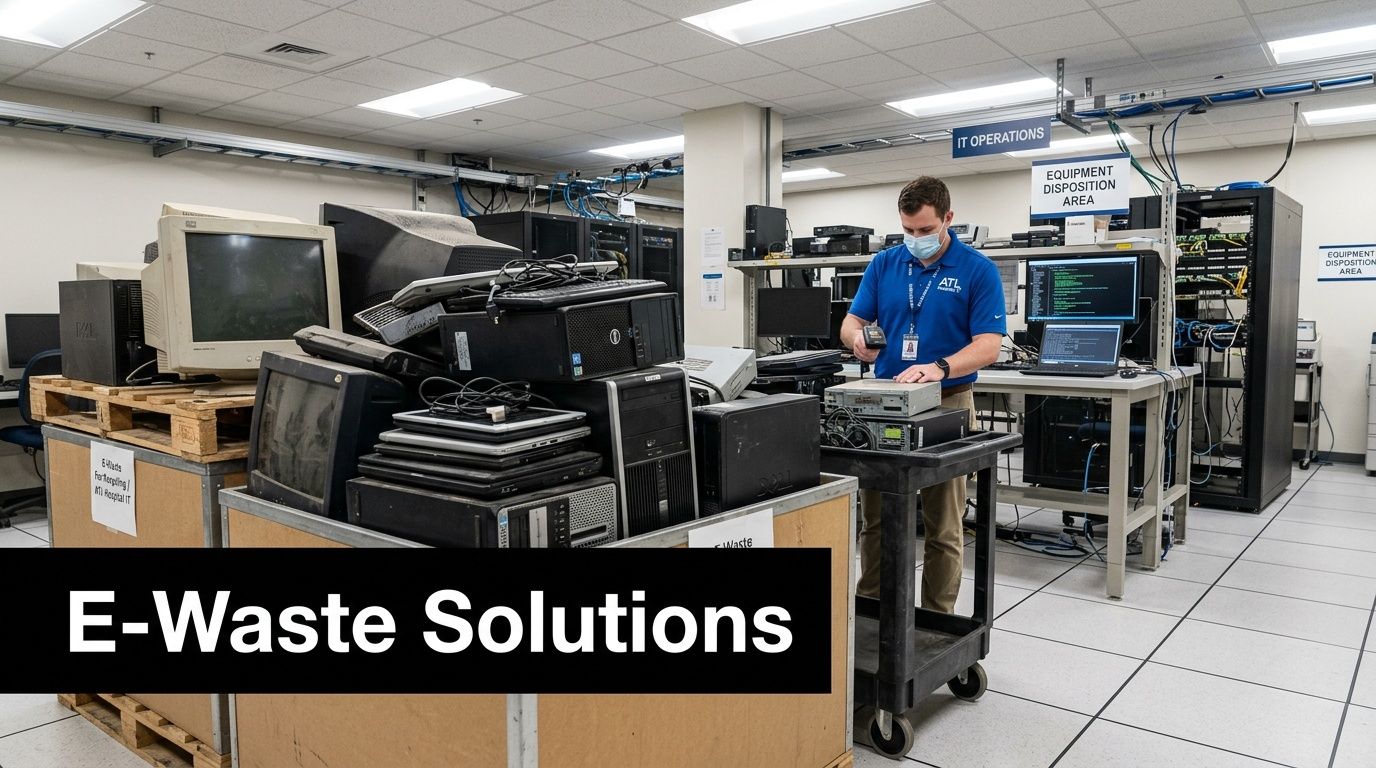
A healthcare organization in metro Atlanta closed a satellite clinic and needed to retire a mixed batch of devices. The equipment included workstations at intake desks, back-office laptops, monitors, printers, network hardware, and several servers that had supported local applications. The sustainability team wanted landfill diversion. The compliance team wanted certainty around protected health information. Facilities wanted the space cleared on schedule.
Why CHaRM was discussed and then ruled out
Someone on the project team mentioned CHaRM because it’s well known locally and clearly aligned with environmental goals. That instinct was reasonable. The team wanted a responsible outlet. But once legal and IT security reviewed the requirement set, the fit fell apart.
The clinic wasn’t dealing with a few resident-style drop-offs. It had a site closure, data-bearing assets, internal signoff requirements, and a narrow schedule. The question shifted from “Where can we recycle this?” to “How do we control this from rack and desk to final disposition?”
What the team prioritized instead
They built the project around a few core principles:
- Protected data handling: every drive had to be sanitized or physically destroyed under documented procedure.
- On-site coordination: staff couldn’t spend days sorting and transporting devices themselves.
- Chain of custody: compliance needed a record of who handled the equipment.
- Minimal disruption: the closure schedule couldn’t depend on appointment slots or ad hoc transport.
For healthcare organizations, that’s the standard. Sustainability matters, but it sits beside privacy, operational continuity, and defensible documentation. Teams in that position usually need a provider experienced with HIPAA-compliant electronics recycling in Atlanta, not a public drop-off workflow.
In healthcare, disposal is never just disposal. It’s a privacy event, an operations event, and a records event at the same time.
How the project likely succeeds
A well-run commercial process for that clinic would include an on-site assessment, controlled packing, removal of equipment by trained personnel, sanitization or shredding of media, and final reporting suitable for audit files. Reusable equipment would be separated from nonfunctional gear. Scrap streams would be processed responsibly. The organization would leave with proof, not just confidence.
That’s the practical lesson. The hospital could still communicate its commitment to Atlanta’s environmental values. It just couldn’t outsource security judgment to a program designed for a different audience.
Conclusion Building a Greener and More Secure Atlanta
CHaRM has earned its place in Atlanta’s sustainability story. It gives residents a practical outlet for hard-to-recycle materials and shows what community-focused environmental action can look like when it’s well run.
For businesses, the lesson is more precise. You can embrace the charm atlanta ethos without forcing a residential model onto commercial risk. That means treating sustainability and security as parallel requirements, not competing ones. It also means recognizing that office closures, healthcare hardware retirement, school device refreshes, and data center decommissioning need controls that public drop-off programs were never built to provide.
The strongest companies in Atlanta will be the ones that make both commitments visible. They’ll support local environmental values, and they’ll handle retired IT assets with the rigor their customers, employees, and regulators expect.
If your organization needs a business-ready path for electronics recycling, data destruction, office cleanouts, or data center decommissioning, Atlanta Computer Recycling provides commercial ITAD support across the metro area with secure handling, practical logistics, and sustainability-minded disposition.