Atlanta Falcons vs LA Rams: A Strategic Business Playbook


Monday night games are supposed to be entertainment. For a lot of Atlanta IT leaders, they also feel familiar. You watch a close Falcons game, see momentum swing on one decision, one turnover, one missed assignment, and it looks a lot like your week.
A refresh project gets approved late. Storage arrays need to come out of a live environment without disrupting users. Laptops from multiple offices need chain-of-custody tracking. Legal wants certainty on data destruction. Finance wants value recovery. Security wants zero surprises. In that setting, atlanta falcons vs la rams stops being just a sports topic and starts looking like a management case study.
The Falcons and Rams matchup offers a useful lens because it combines long-term trend data, game-day execution, and environmental factors that don't always show up cleanly in the box score. That's the same mix you deal with in IT asset disposition. Historical patterns matter. Controls matter more. And under pressure, the team that protects against avoidable mistakes usually gives itself the better chance to win.
Before getting into the lessons, it helps to frame the comparison directly.
| Decision area | Falcons vs Rams lesson | ITAD translation |
|---|---|---|
| Historical performance | Long rivalries expose real patterns, not isolated results | Review asset lifecycle history before setting disposal policy |
| Offense vs defense | Production alone doesn't guarantee a win | Balance efficiency goals with security and compliance controls |
| Specialized assets | One elite capability can tilt the entire outcome | Use specialist services for decommissioning and media handling |
| Winning margins | Turnovers and discipline decide close games | Chain of custody, documentation, and error prevention matter most |
| Home-field edge | Local conditions shape performance under pressure | Local partners often execute faster and with less friction |
More Than a Game An Executive's View from the Sidelines
An Atlanta operations leader doesn't need a lecture on pressure. You already know what it feels like when business wants speed and the risk team wants certainty. That's why this matchup lands differently. The coaching decisions, the pacing, the response after mistakes, all of it maps well to how companies should think about retiring technology.
The sports headline is simple. The management lesson isn't. In a close contest, nobody wins because they had the best slide deck. They win because they allocated resources correctly, protected against downside, and executed when the window opened. That's exactly how strong ITAD programs work.
What executives actually recognize in this matchup
The useful parallel isn't “football is like business.” That's too broad to matter. The sharper point is that both environments punish loose process.
A team can move the ball well and still lose if it gives away possessions. An enterprise can modernize aggressively and still create risk if retired devices leave the building without clear handling controls. Leaders don't get judged on activity. They get judged on outcomes and exposure.
Practical rule: If the project carries data, compliance, logistics, and timing risk at the same time, don't evaluate it as a disposal task. Evaluate it as an execution task.
That distinction changes behavior. It pushes teams to ask better questions:
- What breaks first: Is the weak point packing, pickup coordination, documentation, or sanitization?
- Who owns decisions: Does security sign off on destruction standards, or is procurement improvising?
- Where's the exposure: Are you worried about downtime, data remanence, misplaced assets, or audit defensibility?
For Atlanta readers who follow the local context around the team, the broader civic connection is part of why this analogy works so well, especially in discussions around Atlanta Falcons business and community context.
Sideline view versus scoreboard view
Executives who manage infrastructure know the scoreboard often hides the full story. A project can finish on time and still leave behind bad records, unclear inventory reconciliation, or media-handling gaps that become painful later.
That's why the atlanta falcons vs la rams lens is useful. It forces attention onto the parts of execution that aren't flashy. Who controlled the situation. Who handled pressure cleanly. Who avoided the self-inflicted problem.
Those are the same questions worth asking before your next office closure, hardware refresh, or data center retirement.
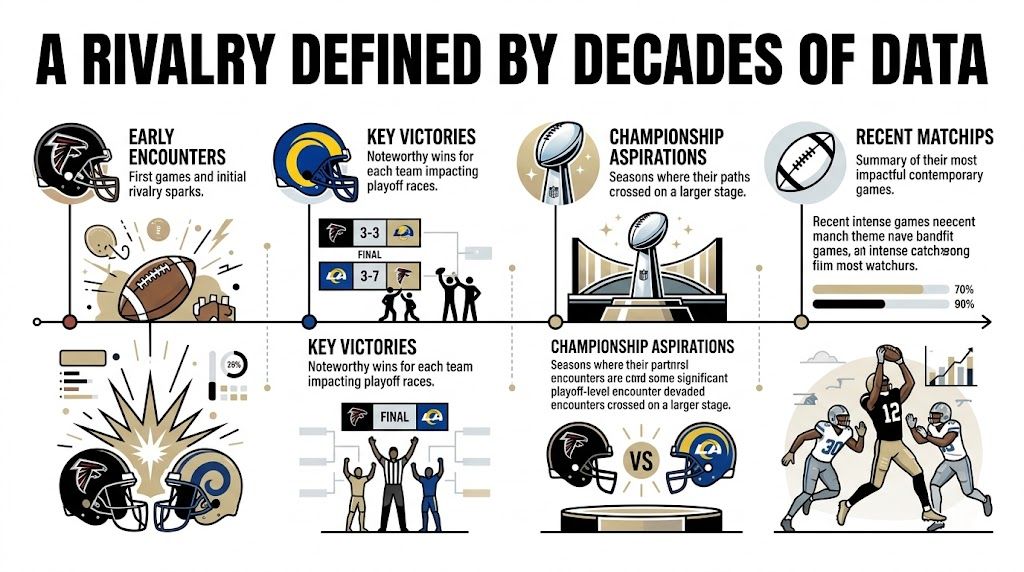
A Rivalry Defined by Decades of Data
The long view matters because isolated wins can fool people. A single project can go smoothly for accidental reasons. A single game can swing on one bounce. But over time, patterns become hard to ignore.
The Falcons and Rams have played 82 games since September 11, 1966, and the Rams hold an all-time record of 49 wins, 29 losses, and 2 ties in the series, according to the Falcons-Rams head-to-head record at FootballDB. That's not random variance. It's a trend line.
What historical datasets actually tell you
In football, a rivalry this long reveals structural truth. Some teams match up better over time because of philosophy, roster construction, coaching identity, or depth. In ITAD, you see the same thing when you look at years of asset retirement history instead of one quarter's cleanup effort.
Organizations that study their own patterns usually uncover issues like these:
- Refresh timing drift: Assets stay in service too long, then leave in a rushed batch.
- Policy inconsistency: Different offices follow different pickup, storage, or data-wiping practices.
- Blind spots in reconciliation: Teams know what they bought, but not always what left the environment.
The point isn't to admire history. It's to use it. That's the same mindset behind good strategic review work. If you want a practical framework for turning past performance into better decisions, Bruce and Eddy's guide on how to conduct competitor analysis that drives growth is useful because it emphasizes pattern recognition over one-off anecdotes.
Dominance, upset potential, and planning value
The same head-to-head data also shows why planning can't be simplistic. The Rams' edge across the series is clear, yet the rivalry still includes sharp reversals. Atlanta's largest victory in the series was a 47-17 playoff win on January 15, 2005, while the Rams' most lopsided win was 59-0 on October 17, 1976, both documented in the historical series record.
That matters in business because historical disadvantage doesn't mean current inevitability. Legacy process problems can be corrected. A poor past audit cycle doesn't guarantee the next one will go badly. But you only improve if you understand your baseline first.
Historical data shouldn't make you pessimistic or optimistic. It should make you specific.
When I review ITAD programs, the healthiest sign isn't ambition. It's evidence. Teams that can show a clean record of inventory control, retirement timing, and media handling usually make better decisions under pressure because they aren't guessing. They're operating from history.
Offensive Firepower Versus Defensive Integrity
Some organizations lean heavily toward offense. They prioritize speed, deployment, consolidation, refresh cadence, and cost control. Others lean toward defense. They focus on governance, retention rules, auditability, and security controls. Most problems show up when leadership treats those as competing camps instead of linked requirements.
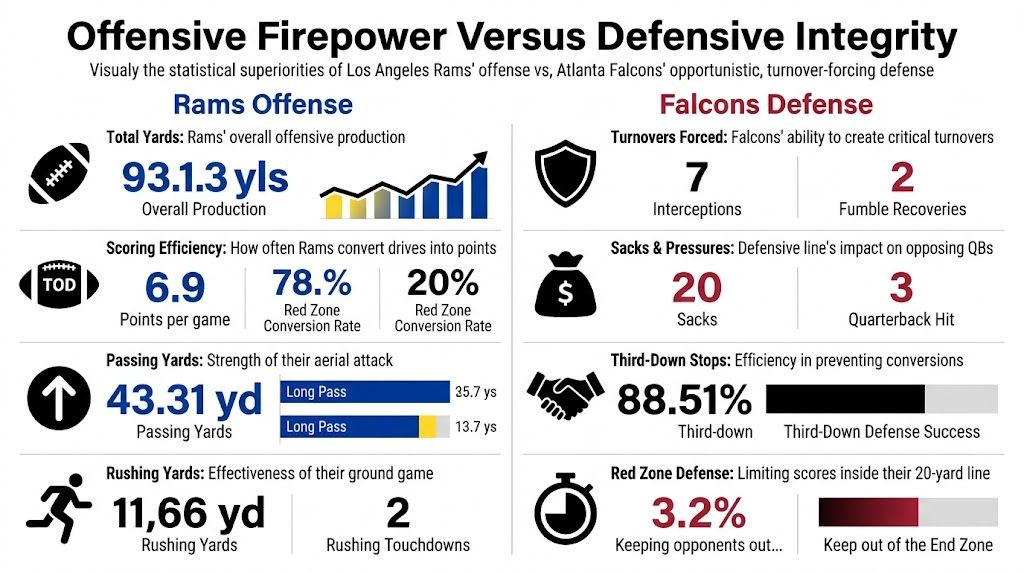
The Week 17 Rams-Falcons matchup is a clean example of that tension. Season-long efficiency metrics favored Los Angeles in several categories. The Rams posted 30.5 points per game versus Atlanta's 20.5, and 6.2 yards per play versus 5.5, according to the Rams-Falcons 2025 efficiency profile at TeamRankings. On paper, that's the kind of profile that usually drives confidence.
Why better output doesn't always win
Those Rams numbers represent throughput. In IT terms, that's the organization that moves quickly, scales projects, and gets measurable production from its systems. There's nothing wrong with that. Most companies need more of it.
But offensive output only matters if it survives contact with risk.
Atlanta won by forcing key turnovers despite entering the game with weaker season-long efficiency metrics, as shown in that same TeamRankings comparison. That's the lesson many IT leaders need to keep in view. A business can have excellent operational velocity and still lose badly if it mishandles data-bearing assets at end of life.
The business version of offense and defense
Here's how I frame it for enterprise teams:
| Football concept | Business equivalent | Failure mode |
|---|---|---|
| Offensive firepower | Fast refreshes, deployment speed, consolidation | Rushed disposition with weak controls |
| Defensive integrity | Data destruction, audit trail, chain of custody | Slowdowns if security is bolted on too late |
| Balanced game plan | Security built into operations | Fewer surprises during retirements |
A lot of internal friction comes from sequencing. Companies push hardware out of production first, then ask security how to handle the retired estate. That's backward. Security and compliance controls should shape the process before equipment starts moving.
The best ITAD programs don't slow the business down. They remove the need for emergency fixes after assets have already changed hands.
What works and what doesn't
What works:
- Predefined media handling standards: Teams know when wiping is acceptable and when shredding is required.
- Role clarity: Security, infrastructure, facilities, and procurement each have a real decision owner.
- Exception control: Odd assets don't get ad hoc treatment just because the project manager is in a hurry.
What doesn't:
- Throughput-only thinking: Measuring success by how quickly equipment leaves the floor.
- Late compliance involvement: Asking for documentation after pickup is complete.
- Mixed vendor practices: Letting one provider handle logistics and another improvise sanitization standards.
The atlanta falcons vs la rams comparison makes one thing clear. High-output systems are valuable. But in a high-stakes environment, defensive integrity is what keeps strong performance from turning into preventable loss.
The Game-Changing Playbook for Specialized Assets
General capability is useful until a specialized requirement lands on your desk. That's when average process stops being enough.
The Falcons' win over the Rams gives a sharp example. In Atlanta's 27-24 victory on December 29, 2025, Bijan Robinson delivered 195 rushing yards and 229 total scrimmage yards, according to ESPN's Rams-Falcons game recap and box score. He wasn't just productive. He dictated the shape of the game.

When one asset changes the operating model
Most organizations treat retired equipment as a volume problem. That's understandable. There are pallets to move, devices to track, users to support, and deadlines to hit. But some situations aren't volume problems. They're specialist problems.
Think about:
- Data center shutdowns: Rack-by-rack removal requires sequencing, de-installation discipline, and logistics control.
- High-sensitivity media: Standard handling isn't enough when the risk profile is high.
- Complex mixed estates: Servers, storage, networking gear, and user devices don't retire cleanly under a one-size-fits-all workflow.
That's where specialist capability earns its keep. Robinson's performance is a good analogy because it shows what happens when one capability is decisive enough to force the opponent to adjust. In ITAD, specialist services do the same thing. They reduce uncertainty, compress decision cycles, and prevent the project from being governed by its hardest edge case.
Matching capability to the assignment
A routine laptop rotation doesn't need the same operating model as a facility closure or enterprise decommissioning project. Leaders get into trouble when they pretend it does.
The better approach is to classify work by complexity:
- Routine retirements can follow standard collection, inventory, and sanitization workflows.
- Sensitive media events need tighter oversight and stronger proof.
- Facility or infrastructure projects require dedicated planning and field execution.
Teams facing the third category should think in terms similar to Atlanta data center equipment recycling and decommissioning support, where the challenge isn't just disposition. It's coordinated removal, controlled handling, and minimal disruption to the operating environment.
The wrong specialist doesn't just add cost. It adds confusion. The right specialist removes bottlenecks the rest of the team can't solve alone.
That's the practical takeaway from this game example. Some assets don't just contribute. They become the plan.
Winning in the Margins Turnovers and Discipline
Close games expose sloppiness. So do audits, office moves, and infrastructure retirements. A team can look fine at a high level and still lose on avoidable errors.
The Rams and Falcons finished with similar yardage in their Week 17 meeting, but the details told the story. The Rams had 363 total yards to Atlanta's 345, while first downs were 16 to 15, according to the official Rams at Falcons box score. Yet Atlanta finished with zero turnovers and forced three interceptions, which decided the game.

Why margin management beats broad optimism
This is the part many organizations underestimate. They focus on the visible work. Devices collected. Rooms cleared. Equipment loaded. Reports delivered. But the margin work determines whether those actions stand up later.
In ITAD, your turnovers are things like:
- Broken chain of custody
- Unreconciled inventory counts
- Missing serial documentation
- Improper media segregation
- Inconsistent destruction records
None of those problems look dramatic in real time. They become dramatic when legal, compliance, or internal audit starts asking questions.
The discipline that actually matters
A close read of the game box score shows that comparable production didn't matter as much as error control. That's exactly how retirement programs behave. If one provider moves assets quickly but creates documentation gaps, that speed has negative value.
I usually tell teams to evaluate margin discipline with a short checklist:
| Margin area | Football equivalent | ITAD question |
|---|---|---|
| Ball security | Protecting possessions | Can every asset be tracked from pickup to final disposition? |
| Penalty control | Avoiding free yards | Are compliance steps embedded, not improvised? |
| Conversion discipline | Finishing drives | Does documentation close the loop after the physical work ends? |
Small execution errors don't stay small once regulated data is involved.
That sentence sounds severe, but experienced admins know it's true. The cleanest projects are rarely the most glamorous. They're the ones where every handoff is documented, every exception is resolved quickly, and every device follows the same accountable path.
The atlanta falcons vs la rams example is useful here because it strips away the myth that “better overall” always wins. In tight environments, disciplined operators beat talented but careless ones more often than leadership likes to admit.
The Unseen Advantage Executing with a Local Partner
National scale sounds reassuring until you need immediate coordination. Then geography starts to matter again.
Falcons recaps focused heavily on the obvious plays, but they often missed the impact of crowd noise at Mercedes-Benz Stadium and how that environment disrupted the Rams' late-game rhythm, as discussed in the Falcons game breakdown of the Rams win. That's the part of high-stakes execution people tend to underrate. Context changes performance.

Local conditions create real operational advantage
For Atlanta-based businesses, local partnership has a similar effect. It doesn't replace process, but it can improve execution in ways that a distant provider often can't.
The advantage usually shows up in practical places:
- Faster coordination: Scheduling changes are easier when the partner operates in your region.
- Better site familiarity: Multi-building campuses, loading restrictions, and downtown access issues get handled with less confusion.
- Clearer accountability: It's easier to resolve edge cases when the operating team is nearby and knows the market.
You see the same logic in other logistics-heavy industries. Businesses looking at finding FBA prep services near me often aren't just chasing convenience. They're trying to reduce shipping friction, communication lag, and handling surprises. ITAD decisions benefit from that same local-first thinking.
Why this matters under pressure
The biggest value of a local partner isn't sentiment. It's control.
When a project changes scope, an office needs a faster pickup window, or an internal stakeholder demands on-site visibility, proximity helps. It reduces the translation layer between request and execution. That's especially important for organizations that need coordinated ITAD services in Atlanta for business environments, where timing, chain of custody, and site logistics often collide.
Local support matters most when the plan changes halfway through the job.
That's the hidden lesson from home-field advantage. Not every benefit appears in a formal scorecard. Some of the most important ones show up in how calmly the team handles pressure, noise, and late adjustments.
Building Your Championship ITAD Game Plan
Strong ITAD programs don't happen because a vendor promises the right things. They happen because leadership builds a playbook that matches real operating risk. The Falcons-Rams analogy is helpful only if it turns into action.
The cleanest approach is to build your plan around four decisions.
Build your defense first
Security controls shouldn't be layered on after infrastructure or facilities teams have already scheduled removals. Set the handling rules before the first asset moves.
That means deciding, in advance, how your organization treats media sanitization, physical destruction, inventory capture, and documentation retention. If your policy still depends on email threads and verbal confirmation, the defense is weak no matter how efficient the project feels.
Know when to deploy specialists
Not every job needs the same level of support. Treating all retirement work as standard pickup volume creates two problems. Simple jobs become overmanaged, and complex jobs become underplanned.
Use a simple classification model:
- Low complexity: Standard user-device refreshes with predictable volumes
- Medium complexity: Multi-site collections with tighter timing or documentation needs
- High complexity: Data center decommissioning, closures, or highly sensitive media events
The goal is fit, not excess.
Win the margins on process
Most failures don't start with bad intent. They start with weak handoffs.
Make these controls visible:
- Asset counts should reconcile before and after movement.
- Chain of custody should be documented at each transfer point.
- Destruction evidence should be tied back to the assets in scope.
- Exception handling should have an owner, not a vague note for later.
A key distinction for operations teams lies not in policy language, but in repeatable execution.
Use geography as a strategic variable
A local partner won't fix a vague policy or poor internal ownership. But when the basics are in place, local execution can improve responsiveness, site coordination, and stakeholder confidence.
That matters most when your environment is dynamic. Office consolidations, hospital equipment retirements, higher education refresh cycles, and public-sector cleanouts rarely proceed exactly as planned. Leaders should treat regional presence as an operational factor, not a branding detail.
Build your ITAD plan the same way good teams approach close games. Protect the downside first, assign specialists where they matter, and don't give away easy mistakes.
If you're an Atlanta-based IT manager, that's the practical lesson from atlanta falcons vs la rams. Historical data matters. Output matters. But under pressure, the winner is usually the team with the clearer controls and the cleaner execution.
Atlanta businesses that need a reliable partner for secure, sustainable IT asset disposition can work with Atlanta Computer Recycling for business-focused pickup, data destruction, electronics recycling, and data center decommissioning support across the metro area.