Certificate of Data Destruction: Your Audit-Proof Guide

You may already have a stack of retired laptops in a storage room, a few decommissioned servers waiting on a pallet, and an auditor or compliance officer who assumes the disposal paperwork is handled. That's where companies get exposed. The equipment is out of production, but the data risk is still active until you can prove the media was sanitized or destroyed correctly.
A lot of IT managers learn this too late. They have a pickup record, maybe an invoice, maybe a spreadsheet from a recycler, but not the one document that matters when legal, compliance, or security asks for proof. A certificate of data destruction is that proof. It's what separates “we believe those drives were handled” from “we can document exactly what happened to each asset.”
What Is a Certificate of Data Destruction
A certificate of data destruction is a formal record showing that data-bearing devices were sanitized or destroyed using a defined method, and that the work can be tied back to specific assets. It isn't a pickup receipt. It isn't a recycling manifest. It isn't a vague statement that “all materials were processed.”
It's the document your business relies on when someone asks a simple, uncomfortable question: Can you prove that data from these retired devices is unrecoverable?
That matters because disposal is now part of the security lifecycle, not just facilities cleanup. Global e-waste reached 62 million metric tons in 2022, and only 22.3% was formally documented and recycled. In the U.S., over 1,800 data breaches were reported in 2023, with an average cost of $4.88 million, and many stemmed from improperly disposed endpoints, according to Zero Tech Waste's overview of data destruction certificates.
More than a receipt
A valid certificate of data destruction functions like a liability document. It records what was destroyed, how it was destroyed, when it happened, and who performed or verified the work. If your organization handles customer records, employee data, financial information, regulated health data, research files, or internal credentials, that record becomes part of your audit trail.
Practical rule: If the document can't identify the asset, the sanitization method, and the verification outcome, it won't protect you when scrutiny starts.
In practice, you should think of the certificate as the final control in the asset disposition process. Inventory and pickup matter. Chain of custody matters. Sanitization matters. But until those actions are documented in a defensible certificate, your records are incomplete.
What it should do for your business
A proper certificate should let you answer four questions without hesitation:
- Which exact device was processed
- Which destruction or erasure method was used
- Whether the result was verified
- How custody was maintained from pickup to final disposition
If you need a concrete example of what this documentation is meant to support, review a certificate of destruction process for business IT assets. The key idea is simple. Your business needs proof that survives an audit, not paperwork that only looks official.
Why Your Business Needs Proof of Data Destruction
The compliance side of disposal changed when data destruction stopped being treated as an informal housekeeping task. Formal certificates gained momentum after the Sarbanes-Oxley Act of 2002 required auditable proof of financial data disposal. Then the HITECH Act amendments in 2009 required healthcare entities to document PHI disposal, and over 500 major breaches have been reported to HHS annually since 2010 involving improper e-waste handling, as described in this history of data destruction certificates and audit trails.
If you manage IT for a hospital, financial firm, school system, law office, manufacturer, or public company, this lands directly on your desk. Your security controls don't end when a server is unplugged. They end when you can prove data was rendered unrecoverable.
Where businesses get exposed
Most disposal failures don't start with a dramatic breach. They start with routine assumptions:
- Facilities handled it: Equipment was removed, but no technical sanitization record exists.
- The vendor sent a summary: The summary lists “20 drives destroyed,” but not which drives.
- The devices were old anyway: Age doesn't reduce the sensitivity of stored data.
- The recycler said they're compliant: Vendor claims don't replace documentable evidence.
Those assumptions collapse fast during audits, investigations, insurance reviews, and legal discovery.
If your documentation stops at “picked up for recycling,” you haven't documented destruction. You've documented transfer.
Why this matters beyond IT
Data disposal is part of a broader records-governance problem. Businesses that already deal with retention and privacy obligations in areas like surveillance, HR records, and customer files usually recognize the pattern. If your team also handles video retention, this guide to managing business CCTV data legally is useful because it shows the same principle at work: compliance depends on retention, handling, and documented proof, not just good intentions.
For IT assets, the certificate becomes your evidence package. Legal wants it because it shows disposal was controlled. Compliance wants it because it closes the loop. Security wants it because an unverified endpoint is still a breach vector.
The business case is straightforward
You don't maintain this documentation because it's administratively tidy. You maintain it because it reduces operational and legal risk.
A strong certificate helps you:
- Answer auditors quickly: You can produce named assets, dates, methods, and verification.
- Defend vendor oversight: You can show that the disposal provider followed a documented process.
- Protect regulated data: PHI, financial records, student data, and client information all require proof-minded handling.
- Avoid false confidence: The wrong paperwork creates risk because teams assume the issue is closed.
For organizations reviewing vendors, data destruction certification requirements for secure ITAD are worth evaluating before your next refresh or decommission. It's far easier to set documentation standards upfront than to chase missing records after the fact.
The Essential Elements of a Valid Certificate
A real certificate of data destruction is detailed because auditors look for traceability, not ceremony. According to Blancco's guidance on must-have certificate elements, a compliant certificate should contain around ten core elements, including a chain-of-custody summary and a link between a hard drive's serial number and its parent computer. For physical destruction, NSA standards require shredding hard drives to 2 to 5 millimeter particles, and that specification must be documented to support liability mitigation and audits tied to frameworks like SOC 2 or ISO 27001.
That tells you something important right away. A certificate is only as strong as its detail.
What auditors actually need to see
An auditor is trying to confirm three things:
- The asset in question is identifiable.
- The sanitization method was appropriate and recorded.
- The process was controlled from custody to completion.
If any one of those fails, the document weakens fast. A nice logo, company letterhead, and a signature don't fix missing traceability.
Audit-Proof Certificate Checklist
| Element | Why It's Required for Audits |
|---|---|
| Unique asset serial number | Proves the exact device was processed, not just a batch of similar equipment. |
| Parent-child relationship between drive and host device | Shows how a removed hard drive ties back to the original laptop, desktop, or server. |
| Chain-of-custody summary | Documents who controlled the asset from pickup through destruction or erasure. |
| Destruction or sanitization method | Establishes whether the vendor used wiping, degaussing, shredding, or another defined method. |
| Reference to the applicable standard | Shows the work followed a recognized framework such as NIST 800-88 or a documented physical destruction specification. |
| Verification result | Confirms the method wasn't just performed, but checked and recorded. |
| Date and time information | Places the event in an auditable timeline. |
| Location of processing | Shows whether the work happened on-site or at a facility. |
| Technician or operator identification | Establishes accountability for who performed or supervised the work. |
| Physical destruction detail, including particle size where relevant | Supports claims that media was reduced to a non-recoverable state under documented criteria. |
The parent-child link is non-negotiable
This is one of the most overlooked details. In the field, hard drives are often removed from desktops, servers, storage arrays, and laptops before final processing. If the certificate only lists destroyed drives without tying those drives back to their original assets, you can end up with a gap in your records.
That gap matters when legal or compliance asks, “Was the drive from this retired finance server destroyed?” If your vendor can't show that link, your answer turns into guesswork.
What works: asset-level certificates with drive serials tied back to host equipment.
What fails: summaries that list totals, pallet counts, or generic categories.
Method without verification isn't enough
A certificate should also spell out the sanitization method in a way an auditor can evaluate. “Drive wiped” is weak. “Destroyed” is also weak if it doesn't say how. A stronger certificate identifies the method clearly and records the result.
For physical destruction, documentation should reflect the destruction specification. For logical sanitization, the certificate should identify the erasure standard and outcome. Ambiguity is the enemy here.
Use a template, but don't trust templates blindly
Templates help standardize intake, serial tracking, and reporting. They also make it easier for procurement and compliance teams to evaluate vendors before a project starts. If you want a baseline for internal review, compare your current paperwork against a certificate of destruction template for IT asset disposition.
A template is useful. A completed, asset-specific, verified certificate is what protects you.
How Data Is Securely Destroyed and Documented
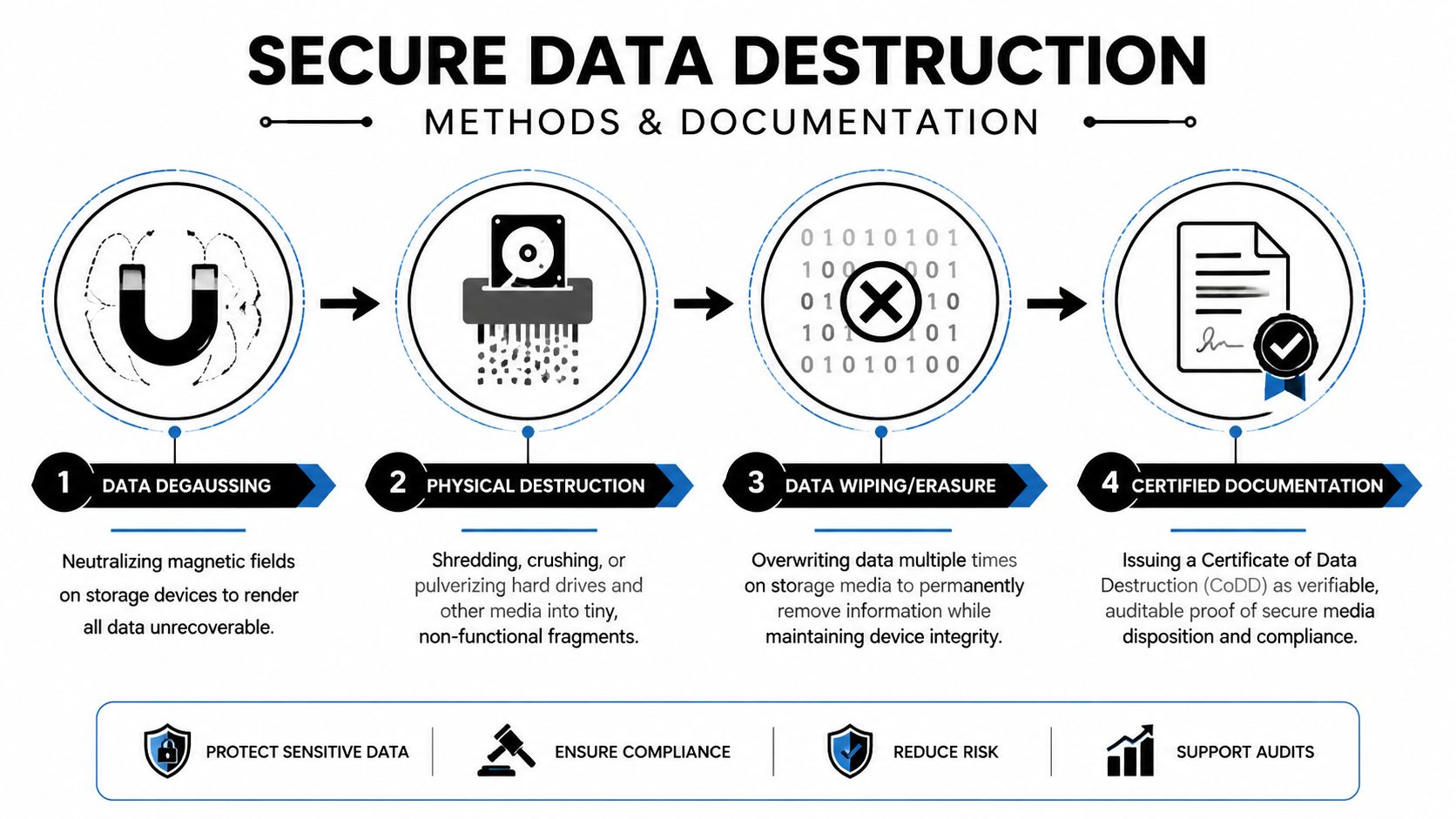
The certificate only has value if the underlying process is sound. NIST 800-88 defines three sanitization levels: Clear, Purge, and Destroy. Clear refers to overwriting. Purge includes secure erasure or degaussing. Destroy means physical destruction. For HIPAA-driven workflows, the Purge level must be verified and documented on the certificate for every asset to create a defensible audit trail, as outlined in this explanation of NIST 800-88 verification requirements.
Matching the method to the media
Not every device should be handled the same way. The right method depends on the media type, the intended disposition, and your compliance obligations.
- Data wiping or secure erasure fits assets you want to reuse, redeploy, or remarket. The device remains functional, but the data is removed using a standards-based process.
- Degaussing is used for magnetic media when you need to neutralize recorded data magnetically. It's effective for the right media types, but it also affects device usability.
- Physical destruction is the end-of-life option when reuse doesn't matter or risk tolerance is low. Shredding, crushing, or similar methods are used to render media unusable.
That choice should appear on the certificate in plain language. If your vendor can't explain why one method was used instead of another, the documentation usually reflects that weakness.
The chain of custody that should back the certificate
The paperwork should trace a process, not just a result. In a disciplined workflow, the vendor inventories assets, records identifiers, secures transport or on-site handling, performs sanitization, verifies the outcome where applicable, and then issues certificates tied to those assets.
A sound chain of custody usually includes:
- Asset intake with serial capture and device matching
- Controlled handling during removal, packing, loading, or on-site processing
- Method execution using the selected sanitization or destruction process
- Verification and reporting that feeds the final certificate
A certificate should read like the final page of a controlled process, not the first piece of documentation created after the work is done.
What works in practice
For reusable equipment, software-based erasure with verification usually gives the strongest combination of security and asset value preservation. For failed drives, obsolete media, or highly sensitive environments, physical destruction often makes more sense. The mistake is treating every device as if one method solves every risk.
What matters most is alignment. The media, the method, the verification step, and the certificate all need to match.
Spotting Red Flags in a Destruction Certificate
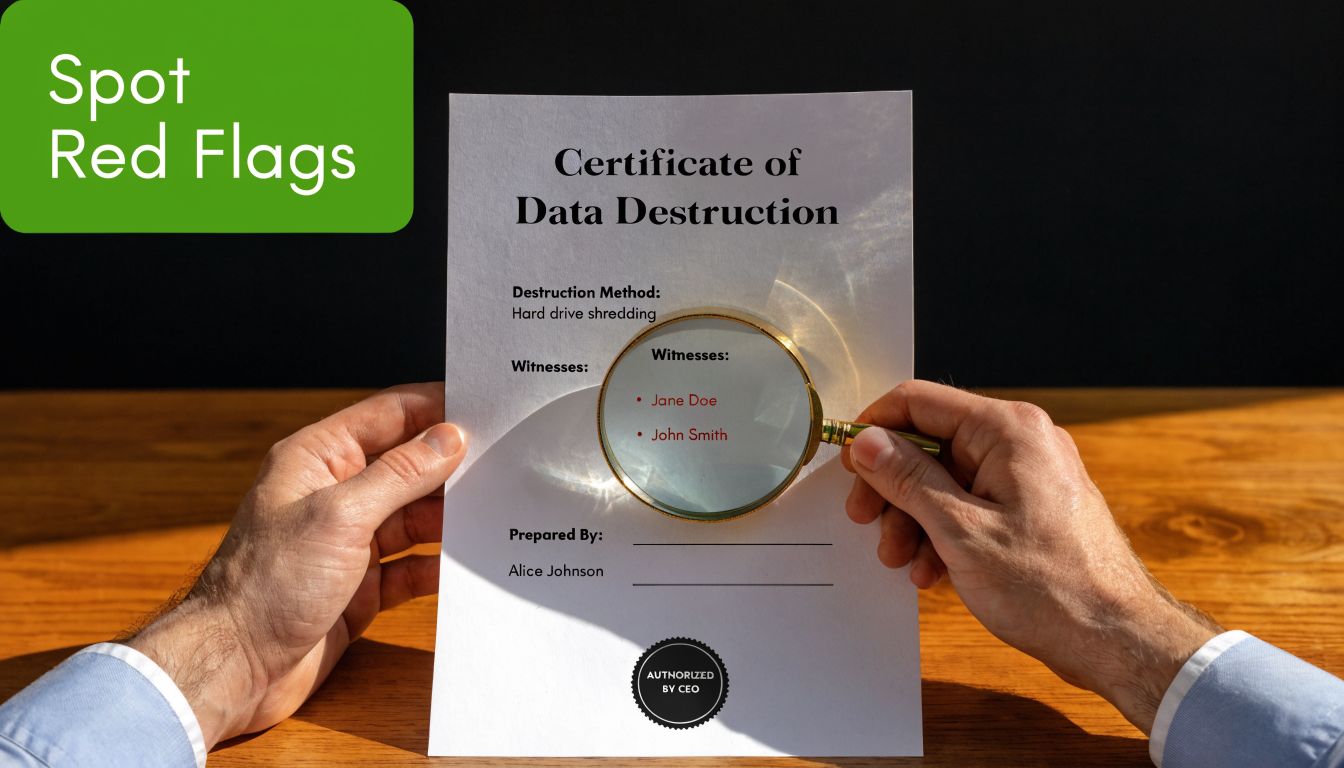
The fastest way to get burned is to assume any certificate with a signature and company logo is good enough. It isn't. One of the most common reasons a certificate fails a HIPAA or SOC 2 review is the lack of a parent-child relationship linking a destroyed hard drive back to its original device. Certificates that reference batch numbers instead of individual serial numbers are often rejected because they don't provide the traceable proof auditors expect, as noted in FirmGuard's discussion of non-negotiable certificate requirements.
Red flags that should stop you
If you receive a certificate with any of the issues below, don't file it away and move on. Push back.
Batch-only reporting
“Lot 17 destroyed” tells you almost nothing. You need asset-level identification.No parent device reference
If a drive was removed from a workstation or server, the certificate should connect that drive to the original host asset.Vague method language
Terms like “processed,” “wiped,” or “destroyed” without a defined method aren't sufficient.No verification result
If there's no pass/fail status or no evidence of verification, you're relying on trust instead of proof.Missing custody detail
A valid document should reflect where the device went, who handled it, and when the disposition occurred.One certificate for everything with no itemization
Summary letters are not a substitute for asset-specific documentation.
A quick rejection test
Ask these questions before you accept the certificate:
| Question | If the answer is no |
|---|---|
| Can I identify each device individually? | The certificate is too vague for audit defense. |
| Can I trace a removed drive back to its original system? | You have a chain-of-evidence problem. |
| Does the document specify the sanitization or destruction method? | The certificate lacks technical defensibility. |
| Is there a verification result or documented outcome? | You can't prove the process succeeded. |
| Does it show custody from pickup to completion? | Your audit trail is incomplete. |
If your vendor gives you a certificate that could apply to anyone's equipment, it doesn't protect your business.
The practical standard to apply
Don't ask whether the certificate looks official. Ask whether your legal team, auditor, privacy officer, or cyber insurer would accept it as evidence. That's the standard.
If you're reviewing disposal providers, compare their documentation expectations with the broader practices used by electronic waste disposal companies serving business IT environments. The strongest vendors welcome document scrutiny. Weak vendors try to rush past it.
How ACR Delivers Certified Data Destruction in Atlanta
For Atlanta businesses, the critical issue isn't whether certified destruction exists. It's whether the provider can execute it cleanly under normal office pickups, multi-site refreshes, and high-pressure decommissions.
Routine office pickups
In a standard business pickup, the process should start with asset identification and secure handling before anything leaves the site. Laptops, desktops, and loose drives need to be accounted for in a way that supports later certificate generation. That means inventory discipline, controlled packing, and a record that follows the equipment into the next step.
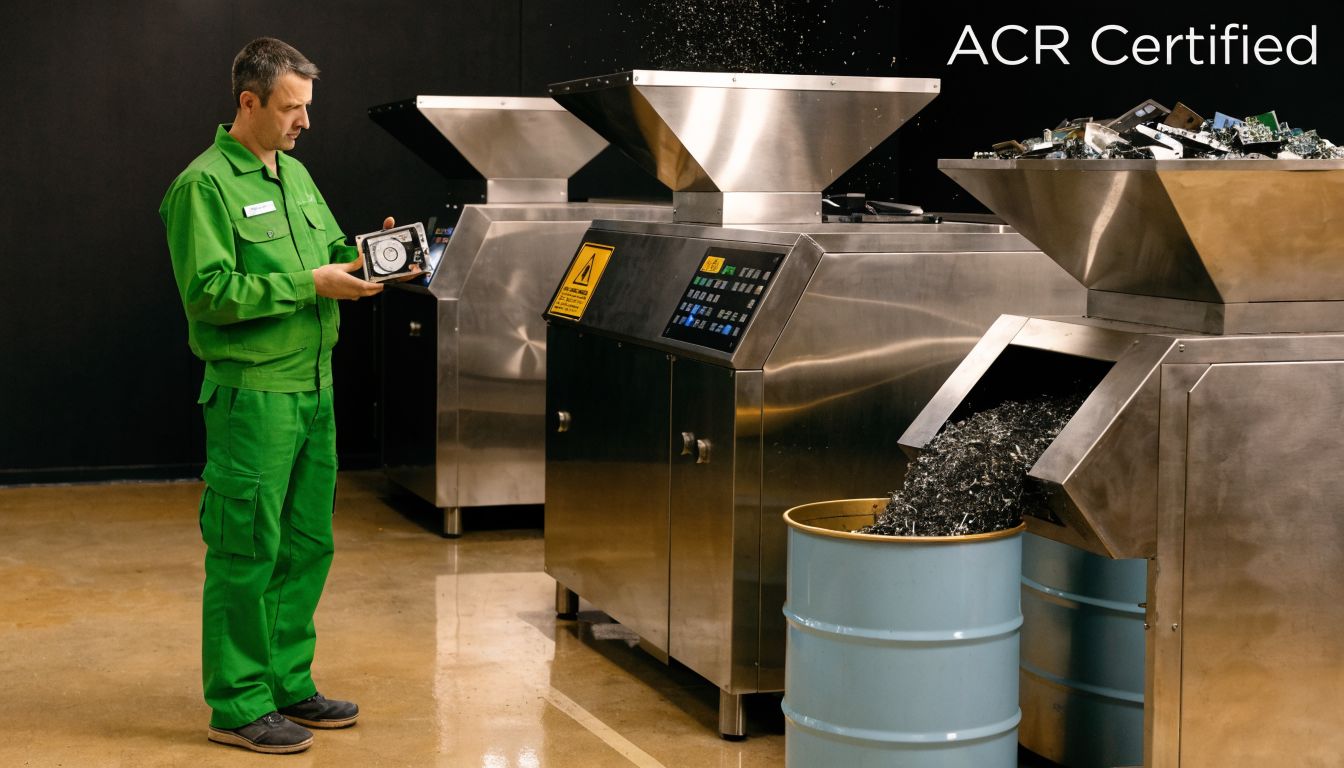
For reusable equipment, ACR uses DoD 5220.22-M 3-pass wiping as part of its service offering, with physical shredding for obsolete or non-functional media. That combination matters because not every asset should be destroyed outright, and not every asset is suitable for resale or redeployment. The method has to fit the asset.
Bulk decommissions for schools and healthcare
Large school refreshes and healthcare cleanouts create a different challenge. The issue isn't just destruction. It's scale, timing, and proof across many devices moving through the same project window. In those jobs, documentation has to stay asset-specific even when the pickup volume is high.
That means your provider needs a repeatable system for:
- Capturing identifiers before equipment gets mixed together
- Separating reusable from obsolete media based on condition and policy
- Applying the right sanitization path to each asset class
- Producing certificates that stay traceable back to each device
Weak vendors slip into batch paperwork during these processes. Strong providers keep the documentation granular even when the project is large.
Data center takedowns
Data center work raises the stakes because the assets are denser, the dependencies are tighter, and the custody chain can get messy fast. Drives may be pulled from servers, storage arrays, and networked infrastructure in phases. If the process isn't controlled, you can lose the link between component media and the systems they came from.
For that reason, the certificate process has to track not only the drive itself but its relationship to the parent equipment wherever applicable. That's what preserves auditability when racks are coming down quickly and multiple teams are involved.
The best data destruction process is boring on purpose. Every asset is logged. Every step is repeatable. Every certificate can stand on its own.
Why the local execution matters
Atlanta organizations don't need generic disposal. They need a provider that can handle office moves, healthcare cleanouts, school refreshes, and decommissions without breaking the paper trail. ACR's business model is built around commercial pickups, de-installation, logistics, wiping, shredding, and documented final disposition for the Atlanta metro.
If you're evaluating providers for a current refresh, closure, or decommission, review ACR's certified data destruction services against the checklist above. The right question isn't whether a vendor issues certificates. It's whether their certificates would still hold up when someone challenges them.
If your business needs defensible proof that retired laptops, servers, and hard drives were handled correctly, Atlanta Computer Recycling can help you build a documented, audit-ready disposal process from pickup through final certificate.