Temperature in lawrenceville ga: Lawrenceville GA Temperatur


If you're planning a server refresh, office closure, lab cleanout, or full rack retirement in Lawrenceville, weather probably isn't the line item getting attention. Data wiping is. Chain of custody is. Pickup timing is. Access badges, elevators, dock coordination, and certificates are.
That makes sense until gear sits for two days in a staging room, a loading area gets backed up in wet conditions, or drives move from cool indoor air into heavy outdoor humidity. Then the local climate stops being background noise and starts affecting asset value, wipe reliability, and project timing.
For commercial IT teams, temperature in Lawrenceville GA isn't just a comfort issue. It's an operational risk. Servers, storage arrays, network switches, laptops, and loose drives all react to heat, moisture, and rapid temperature change. If you're responsible for secure disposition, those conditions can create avoidable problems right before equipment leaves your control.
Your IT Decommissioning Plan Has a Weather Problem
An IT manager in Lawrenceville usually starts a decommissioning project with the right priorities. Lock down data. Inventory assets. Separate reuse candidates from scrap. Coordinate facilities access. Keep the business running while equipment comes out.
Then the practical issues begin. Retired gear gets stacked in a former conference room. A few pallets wait near a dock because the freight elevator is booked. A server room runs warmer than expected once part of the cooling load changes during shutdown. None of that looks serious on paper.
It becomes serious when environmental exposure affects the hardware before final disposition.
A drive that was stable in a conditioned room may not behave the same way after sitting in heat and humidity. Corrosion risk doesn't announce itself. Condensation doesn't show up in your asset spreadsheet. If equipment is being held for resale evaluation, redeployment, or verified wiping, those hidden changes can reduce options fast.
Operational reality: the last stage of an asset's life is often the least protected, even though it's the stage with the most compliance exposure.
This is why decommissioning plans need more than a removal date. They need a local handling plan that accounts for storage conditions, movement timing, and weather-sensitive logistics. That matters in office closures, hospital upgrades, school refreshes, and especially in larger data center decommissioning projects in Atlanta, where asset density and timing pressure amplify every small mistake.
What works is simple but disciplined. Keep assets in conditioned space as long as possible. Shrink the time between disconnect and pickup. Avoid staging electronics in rooms that weren't meant to hold them. Treat weather as part of chain-of-custody planning, not as a facilities footnote.
What doesn't work is assuming retired hardware is already "dead" and therefore safe to store anywhere. In ITAD, that assumption creates preventable risk.
Lawrenceville's Climate Profile for IT Planners
Lawrenceville has a humid subtropical climate, and that matters more to IT operations than many teams realize. The city typically ranges from 35°F to 89°F, rarely falls below 23°F or exceeds 95°F, and averages 55 inches of annual precipitation, according to year-round Lawrenceville weather data.
For an IT planner, those numbers describe more than seasons. They describe the environment your retired equipment will pass through during staging, transport, and disposition.
What those conditions mean in practice
A mild winter doesn't eliminate risk. It changes the type of risk. You may not be battling long periods of severe cold, but you still have cool mornings, wet conditions, and temperature transitions that affect electronics moving between indoor and outdoor environments.
Summer creates a different problem set. Warm air, moisture, and enclosed loading areas can turn a routine pickup into a heat-management issue if equipment is packed tightly, wrapped too early, or left waiting.
A simple weather summary misses the operational point. IT assets are sensitive not only to peak heat, but also to how long they sit in uncontrolled conditions and how often they move between them.
Why climate data matters to disposition planning
Thermal behavior determines whether equipment remains a reuse candidate, whether diagnostics still make sense, and whether wiping should happen before or after physical movement. Teams that understand thermal characteristics make better handling decisions because they stop treating all retired hardware the same.
Use the local climate as a planning filter:
- For server and storage gear: avoid assuming a powered-down system is environmentally stable just because it's no longer in production.
- For endpoint fleets: laptops and small devices are easier to move, but they're also easier to leave in carts, offices, or vehicles that drift outside ideal conditions.
- For network closets and branch sites: small projects often get less oversight, which is exactly why they get staged poorly.
In Gwinnett County, this becomes a recurring operational issue rather than a one-off exception. That's especially true for distributed organizations managing refreshes across offices, schools, and public facilities. Local logistics matter just as much as the asset list, which is why teams often look at county-specific disposal coordination when planning projects in and around Gwinnett County, Georgia.
The takeaway is straightforward. In Lawrenceville, climate isn't extreme every day. It's persistent enough to affect ITAD decisions all year.
How Heat and Humidity Endanger Your IT Assets
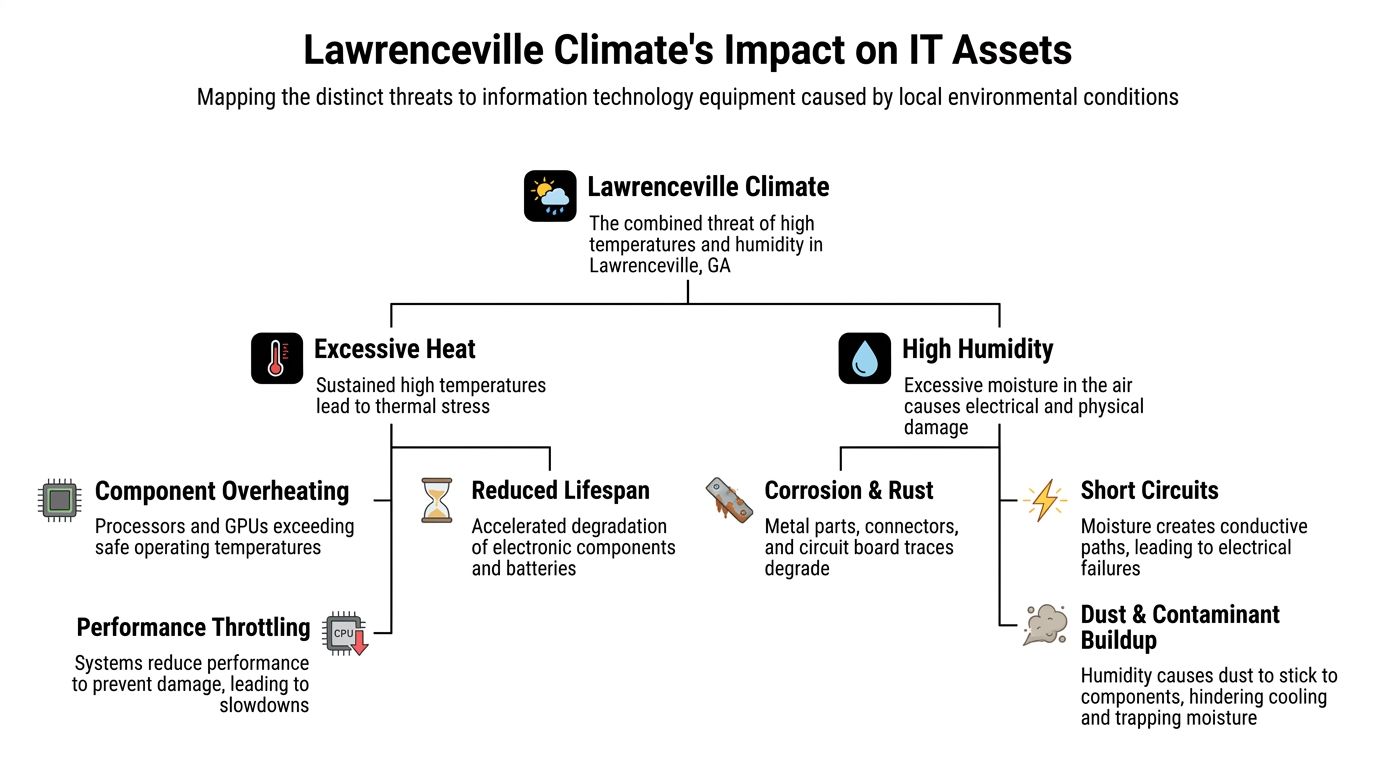
Heat alone is a problem. Humidity alone is a problem. Together, they change how retired equipment behaves during the exact window when you're trying to preserve options and control data risk.
High summer humidity in Lawrenceville can push the heat index above 100°F, and those conditions can cause server CPUs to reduce clock speeds by up to 30% while increasing legacy HDD failure rates by 15% to 25%, based on the Lawrenceville climate reference at My Perfect Weather.
Heat cuts performance before it causes obvious failure
IT managers notice catastrophic failure. They don't catch the quieter problem first, which is degraded behavior.
A server under thermal stress behaves like a car engine stuck in summer traffic. It protects itself. Fans ramp. Performance drops. Internal components absorb more strain than they should. If you're trying to run diagnostics, verify function, or complete wiping tasks on aging hardware, that matters.
What works is finishing erase and validation work in conditioned space before long exposure to outdoor loading conditions. What doesn't work is assuming a device that powers on after sitting in heat is still behaving normally.
Humidity creates electrical and physical risk
Moisture in the air doesn't need visible water to cause trouble. It can contribute to corrosion on connectors, contamination buildup inside systems, and conductive paths where you don't want them. Loose drives, open-chassis gear, and partially disassembled equipment are vulnerable.
This gets worse when teams depopulate racks and leave gear sitting in mixed environments. A cool room, a humid hallway, a warm dock, and a truck aren't separate events to the hardware. They're one chain of exposure.
Store retired electronics like evidence, not like office surplus. The moment they leave controlled production space, their condition starts changing.
Risk tiers for temporary handling
The exact tolerance of a given device depends on manufacturer specs, age, dust load, and recent operating history. Still, a simple risk model helps teams make better staging decisions.
| Condition | Temperature Range (°F) | Relative Humidity (RH) | Risk to Equipment |
|---|---|---|---|
| Controlled indoor handling | Lower end of normal conditioned office or server room environments | Moderate, stable indoor RH | Lowest practical risk for staging, wiping, testing, and packing |
| Warm indoor or short dock exposure | Increased but not extreme indoor heat | Rising or inconsistent RH | Increased stress on older servers, storage, batteries, and loose media |
| Hot and humid exposure | Approaching upper local outdoor range | High RH and sticky air conditions | High risk of throttling, condensation during transitions, corrosion, and media instability |
| Mixed indoor-outdoor cycling | Rapid movement across temperature differences | RH changes during movement | Increased risk even when exposure time is short |
What experienced teams do differently
Strong ITAD handling in north metro Atlanta comes down to a few habits:
- Stage late: Disconnect closer to pickup time instead of building a long holding period.
- Wipe before movement: Complete data destruction tasks in the most stable environment available.
- Separate reuse from scrap early: Reuse candidates deserve tighter handling controls because condition still affects outcome.
- Watch local weather: Teams dealing with similar metro conditions often apply the same discipline discussed in regional planning around weather in Sandy Springs, Georgia.
If you're responsible for both security and asset recovery, heat and humidity aren't maintenance issues anymore. They're disposition variables.
Why Temperature Volatility Complicates Decommissioning
Steady heat is easy to recognize. Rapid temperature change is easier to underestimate.
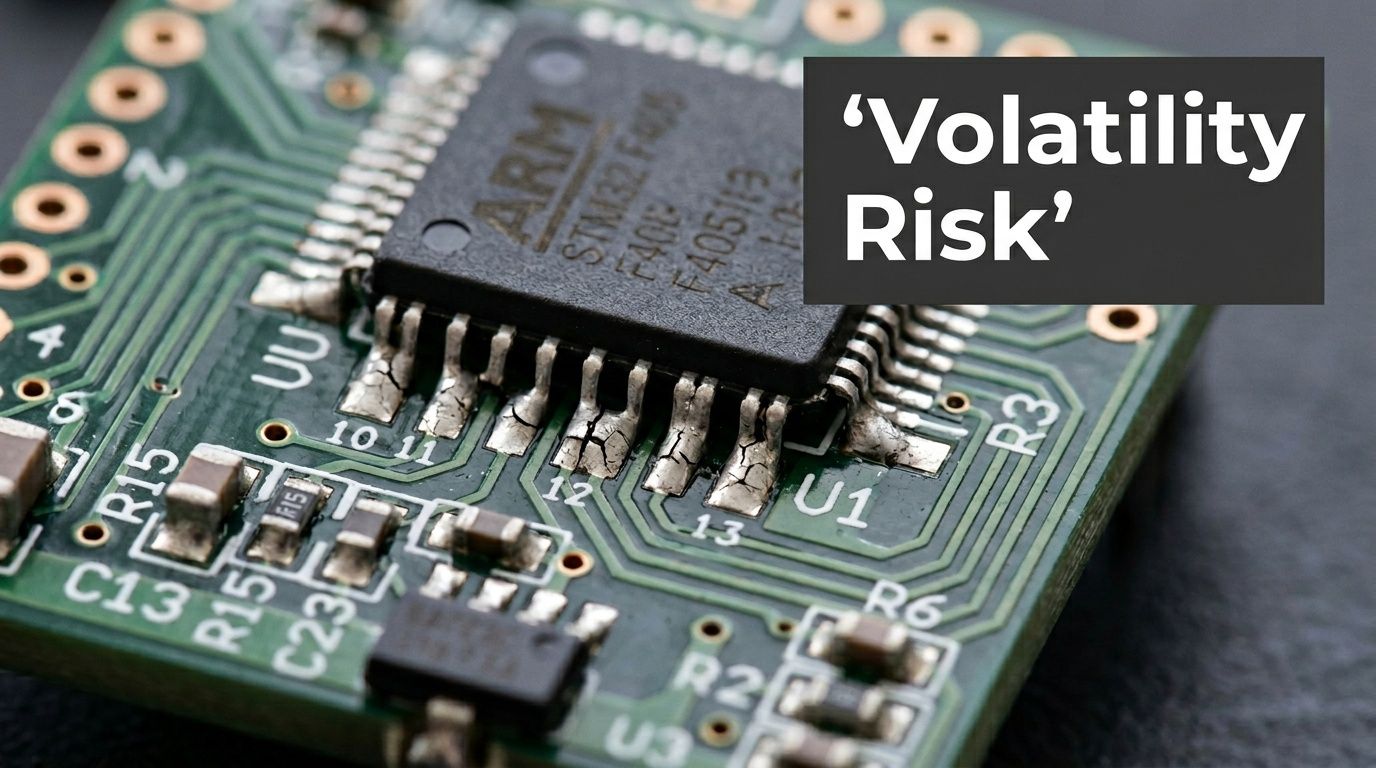
Lawrenceville can see forecasts ranging from 84°F highs to 15°F lows within short periods, with wind chills dropping to -4°F, according to WeatherBug's Lawrenceville forecast data. For stored electronics, that kind of swing creates thermal stress even when equipment isn't powered on.
The hidden problem is expansion and contraction
Circuit boards, solder joints, metal connectors, and drive assemblies don't all respond to temperature changes at the same rate. Move equipment through sharp swings often enough, or let it sit in marginal storage long enough, and you increase the chance of small physical failures.
Those failures aren't dramatic. A cracked solder joint may show up as an intermittent issue. A storage device may pass one check and fail the next. A switch may boot but lose reliability under load.
This is why "it was working when we unplugged it" isn't much protection during decommissioning.
Volatility punishes bad staging decisions
The most common mistake is using whatever space is available. That means:
- A loading dock room that gets cool overnight and warm by afternoon
- A warehouse corner with poor insulation
- A parked vehicle holding equipment longer than planned
- A temporary swing space with no humidity control
None of those spaces are neutral. They're transition zones, and transition zones are where electronics pick up risk.
Fast temperature swings are a supply chain problem as much as a facilities problem. The asset may be secure on paper and still be physically degraded before it reaches final disposition.
That overlap is why decommissioning leaders should treat staging conditions as part of broader supply chain risk management strategies. Chain of custody isn't only about who touched the asset. It's also about what conditions the asset moved through while in your custody.
The practical test is simple. If you wouldn't store active spares in that room, don't store retired assets with data-bearing media there either.
Strategic Scheduling for E-Waste Pickups in Lawrenceville
A pickup date by itself isn't enough. In Lawrenceville, scheduling has to account for wet conditions, temperature patterns, building access, and how long equipment will sit once it's disconnected.
Annual precipitation averages 55 inches, and that affects loading conditions and moisture exposure during transport, as noted in the KLZU weather observations reference. For ITAD work, that means the calendar matters less than the handling window around the pickup.
Better timing reduces avoidable risk
Early coordination beats heroic day-of adjustments. If you know you'll be retiring racks, desktop fleets, or mixed storage devices, schedule around the building's real constraints instead of only the project's target date.
A few patterns work consistently well:
- Early-day removals in warmer months: Equipment spends less time sitting in peak heat.
- Short disconnect-to-load windows: Assets go from controlled space to transport with fewer pauses.
- Staggered pickups for large projects: Smaller waves reduce dock congestion and idle exposure.
- Dry-path planning: Confirm covered access routes, pallet wrap timing, and elevator timing before the truck arrives.
Seasonal thinking beats generic scheduling
Different seasons create different handling priorities.
| Season pattern | Main concern | Smarter move |
|---|---|---|
| Warm and humid periods | Heat buildup and moisture exposure during staging | Schedule earlier in the day and minimize dock dwell time |
| Wet stretches | Moisture during loading and transport | Use covered transfer paths and delay wrapping that traps damp air |
| Cooler periods with swings | Condensation during movement between environments | Let gear acclimate in a controlled area before packing or testing |
A lot of teams make the mistake of disconnecting everything the day before because it feels organized. In practice, that adds risk. Unless the room must be cleared immediately, compressed staging is usually safer than extended staging.
What to coordinate before the truck arrives
Use a short pre-pickup checklist:
- Confirm storage location: Keep assets in conditioned indoor space until the final move.
- Map the route: Know where rain exposure, dock delays, or door bottlenecks can happen.
- Separate fragile media: Loose drives, tape, and small network appliances shouldn't be buried inside a general pile.
- Assign a site lead: One person should control release timing, access, and final verification.
- Book the right service window: If you're planning a business IT equipment pickup in Atlanta, align the window with your building operations, not just your asset list.
Good scheduling doesn't eliminate Lawrenceville weather. It keeps weather from dictating the project.
Practical Steps to Mitigate Climate-Related IT Risks
If your equipment is already staged or your project is approaching, there are still practical ways to reduce exposure. None of them are complicated. They just require discipline.
Humidity in Lawrenceville can swing from 19% to over 79%, creating corrosion risk for stored electronics and accelerating oxidation on connectors and circuit boards, according to AccuWeather's Lawrenceville hourly weather reference.

Use a storage standard, not a spare room
Retired equipment should go into a space you can describe clearly: conditioned, dry, supervised, and away from exterior doors. If you can't say that about the room, it's a temporary hazard, not a staging area.
Avoid these locations when possible:
- Basements or ground-level utility areas: They hold damp air.
- Uninsulated warehouse edges: They amplify outdoor changes.
- Loading docks: Good for movement, bad for waiting.
- Vehicles: Fine for transit, poor for storage.
For facilities teams trying to improve the room itself, practical building guidance on how to reduce humidity can help frame short-term mitigation steps before assets are moved.
Protect the gear according to its condition
Not every asset needs the same treatment. A sealed laptop fleet isn't the same as open rack gear or a box of loose drives.
Use this triage approach:
- For reuse candidates: Keep them in the best indoor conditions available. Preserve labels, accessories, and configuration integrity.
- For data-bearing media: Prioritize secure indoor hold and minimal handling. These assets carry the highest security consequence.
- For obsolete scrap: Don't treat it carelessly just because it has low resale value. It can still carry data and still fail in messy ways during transport.
Do the sensitive work before exposure
If you still need final checks, complete them before assets leave a controlled environment.
That includes:
- wipe verification
- drive health review
- serial reconciliation
- photo documentation
- packing decisions for fragile items
The best time to discover a failing drive is before pickup, not after it has been heat-soaked, moved twice, and mixed into a bulk load.
A practical holding checklist
Use this when equipment will wait on site for any length of time:
- Keep it off the floor: Use pallets, carts, or shelving to avoid moisture transfer and accidental contact.
- Leave airflow around stacks: Packed too tightly, equipment traps heat and damp air.
- Bag small media carefully: Use protective packaging for loose drives and accessories rather than open bins.
- Control access: Limit who can enter the holding area and who can move assets.
- Inspect daily: Look for leaks, HVAC drift, or signs that gear has been relocated without approval.
The goal isn't perfection. It's avoiding the common mistakes that turn a straightforward disposition project into a preventable loss.
Partner with a Climate-Aware ITAD Expert
Most weather coverage tells you what to wear or whether to carry an umbrella. It doesn't tell you what local conditions can do to retired servers, loose drives, batteries, or network gear waiting for pickup.
For IT managers, that's the gap that matters. In Lawrenceville, temperature in Lawrenceville GA affects more than comfort. Sustained heat can reduce performance and stress hardware. Humidity can accelerate corrosion and increase handling risk. Fast temperature swings can damage equipment that looked fine when it came out of service.
Those aren't abstract concerns. They affect whether wiping succeeds cleanly, whether reuse remains possible, whether logistics stay on schedule, and whether assets remain controlled from disconnect through final disposition.
A capable ITAD partner should understand all of that before the truck is scheduled. They should know when staging plans are risky, when pickup timing should change, and when environmental exposure can compromise the outcome of the project.
That matters most for organizations with real compliance pressure. Hospitals, school systems, public agencies, enterprises with distributed sites, and data center operators don't need generic e-waste removal. They need a process that accounts for local operating conditions and protects data until the final step.
If you're planning a pickup, office cleanout, server retirement, or larger decommissioning project, Atlanta Computer Recycling can help you manage the process with secure handling, business-focused logistics, and practical ITAD support built for the conditions of the Atlanta metro area.