A Business Leader’s Playbook for Data Center Decommissioning in Atlanta GA

A successful data center decommissioning in Atlanta begins long before the first server is powered down. This guide provides a strategic plan for business leaders to ensure a smooth, secure, and cost-effective project, moving beyond generic advice to address the specific commercial challenges your organization will face in the metro area.
Your Strategic Decommissioning Blueprint
In our experience, a successful data center decommissioning is 90% planning and 10% execution. Initiating physical work without a detailed strategy is a direct path to budget overruns, operational delays, and significant security vulnerabilities. Your project blueprint should be the core document defining every step, from initial asset valuation to the final certificate of destruction.
A vague plan invites operational chaos. A detailed one ensures every stakeholder—from your IT department to your chosen decommissioning partner—understands the objectives, timelines, and their specific responsibilities. This framework transforms a complex logistical puzzle into a clear, manageable business process.
The entire project is built on three foundational pillars: a meticulous inventory, a well-defined project team, and carefully planned logistics.
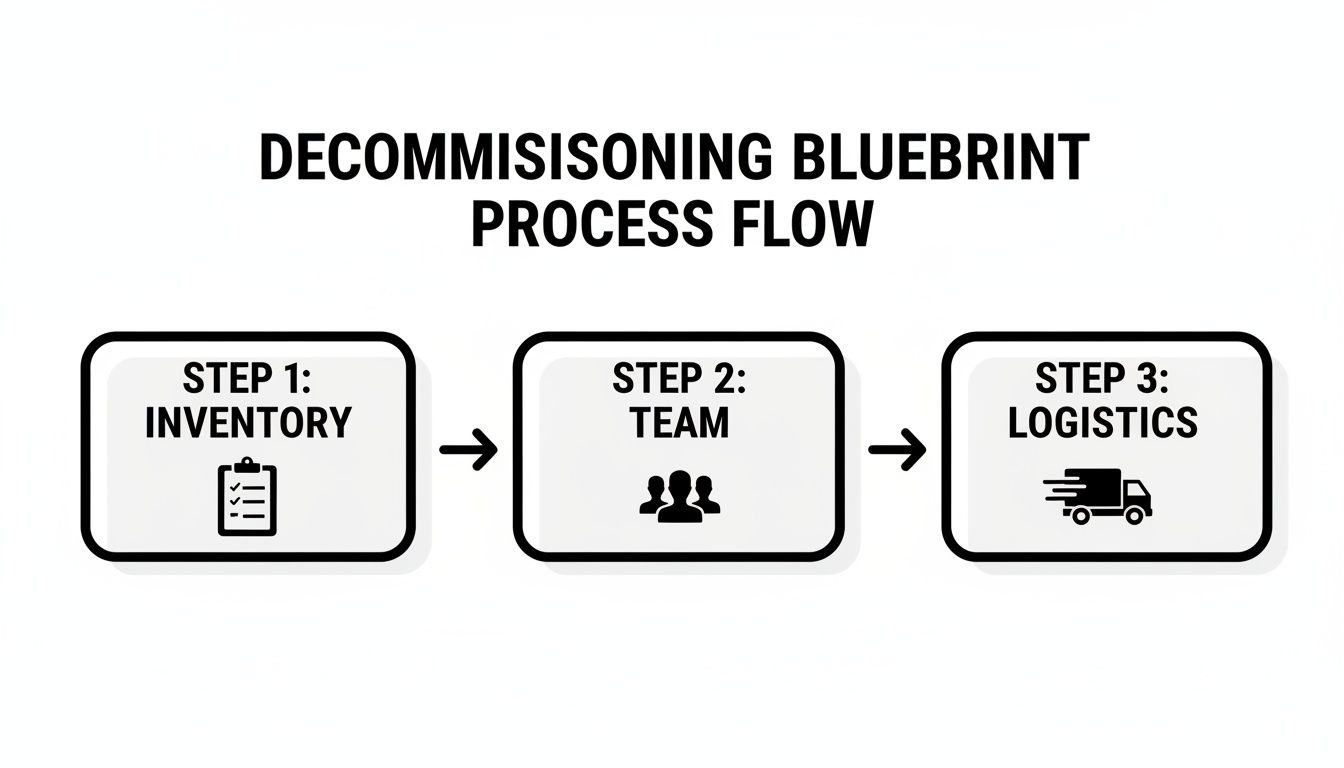
Without a clear understanding of your assets (inventory), who is responsible for them (team), and how they will be handled (logistics), a project of this scale cannot proceed efficiently or securely.
Conduct a Comprehensive Asset Inventory
The first priority is to know exactly what hardware your business is dealing with. A detailed asset inventory is more than a simple count; it is a critical business intelligence exercise. You must capture serial numbers, asset tags, make, model, and the physical location of every piece of equipment slated for removal.
This data enables informed financial decisions. For instance, you can identify newer servers for redeployment to other corporate sites or pinpoint high-demand components with significant resale value. This shifts the project's focus from a cost center to a potential source of revenue recovery. For a more detailed guide on what to track, consult our complete server decommissioning checklist.
To help you initiate the process, here is a checklist for the initial scoping phase.
Atlanta Decommissioning Project Scoping Checklist
| Phase | Key Task | Objective |
|---|---|---|
| Inventory | Catalog All Assets | Create a complete list with serial numbers, models, and locations for financial valuation. |
| Inventory | Identify Data-Bearing Devices | Flag all hard drives, SSDs, and storage media for secure, compliant data sanitization. |
| Team | Assign Project Manager | Designate a single point of contact to manage the project and vendor relationships. |
| Team | Assemble Core Stakeholders | Involve IT, Facilities, and Security/Compliance leadership from project inception. |
| Logistics | Review Site Access | Document loading dock regulations, freight elevator schedules, and security protocols. |
| Logistics | Set Preliminary Timeline | Establish a target start and end date for the physical decommissioning activities. |
This checklist forms the backbone of your initial plan, ensuring no critical business details are overlooked before you engage vendors or begin moving hardware.
Assemble Your Decommissioning Project Team
No data center project is a solo endeavor. It requires a cross-functional team with clearly defined roles to prevent miscommunication and ensure accountability.
Your core team should always include:
- Project Manager: The central point of accountability who owns the timeline, budget, and all vendor communications.
- IT Lead: Responsible for data migration, mapping network dependencies, and providing technical oversight.
- Facilities Manager: Your on-site expert for building access, power, cooling, and loading dock logistics.
- Security/Compliance Officer: Ensures all data destruction methods meet corporate policies and regulatory mandates like HIPAA or PCI-DSS.
A common oversight we observe is the failure to assign a single, empowered project manager. When responsibility is diffused across multiple departments, critical tasks are inevitably missed, leading to costly delays and increased risk.
Address Atlanta-Specific Logistical Hurdles
Planning logistics for a decommissioning project in the Atlanta metro area presents a unique set of commercial challenges. The high density of corporate and colocation facilities has created a complex environment for any large-scale IT project.
Georgia's data center market has seen explosive growth, with more than 150 data centers now operating across the metro Atlanta region as of 2026. This boom signifies a future wave of equipment lifecycle projects, heightening demand for expert decommissioning services and impacting everything from traffic to building access.
For example, coordinating with building management in a Buckhead high-rise requires navigating strict elevator schedules and limited freight access times. A project in a suburban Alpharetta or Suwanee technology park may present different challenges, such as ensuring a secure perimeter around a ground-level loading bay. Your project plan must account for these site-specific variables from the outset.
Navigating Data Security and Compliance Mandates

With a project plan in place, your focus must shift to the most critical aspect of any data center decommissioning in Atlanta, GA: data security. For any business in finance, healthcare, or government sectors, this is not merely a best practice—it is a legal minefield where one misstep can result in millions in fines and irreparable damage to client trust.
Let's be clear: non-compliance is not an option. Regulatory bodies are unforgiving, and a poorly executed decommissioning project represents a significant compliance failure. Every hard drive, SSD, and backup tape is a liability until you possess auditable proof of its data sanitization.
This phase of the project represents the highest level of risk to your business. Proper execution requires a thorough understanding of the specific standards governing your industry and the precise methods to meet them.
Understanding Key Compliance Standards
For any Atlanta-based business, several key standards dictate how data must be handled. While the regulations may seem complex, they all share one objective: ensuring sensitive information is 100% unrecoverable.
- NIST 800-88: This is the gold standard for media sanitization, published by the National Institute of Standards and Technology. It outlines three methods—Clear, Purge, and Destroy. For a decommissioning project, your business will almost always utilize Purge (secure software erasure) or Destroy (physical shredding).
- HIPAA: The Health Insurance Portability and Accountability Act is non-negotiable for any organization handling Protected Health Information (PHI). HIPAA requires that PHI is rendered "unusable, unreadable, or indecipherable" before any device is disposed of.
- GDPR: Even with a data center in Atlanta, if your company processes data on EU residents, the General Data Protection Regulation applies. GDPR's data privacy rules carry some of the most severe penalties in the world.
The core principle is straightforward: if data exists on a device, you must have a documented, auditable process to prove its proper destruction. A Certificate of Data Destruction is not optional; it is your legal defense in the event of an audit.
To navigate compliance and protect sensitive information during decommissioning, a deep understanding of comprehensive data center security is paramount. This knowledge forms the bedrock of a secure asset disposition strategy.
Data Erasure vs. Physical Destruction
After identifying all data-bearing devices in your inventory, you have two primary sanitization options: secure software erasure or physical destruction. This is not an arbitrary choice—it is a strategic decision based on the hardware's age, condition, potential resale value, and your organization's internal security policies.
Secure Data Erasure (NIST 800-88 Purge) is the process of using specialized software to overwrite every sector of a drive with random data, rendering the original information irretrievable. This is the preferred method for newer, functional drives with remaining resale value. It preserves the hardware's value while guaranteeing complete data security.
Physical Destruction (NIST 800-88 Destroy) is the definitive solution for older, failed, or non-functional media. The process involves feeding the drives into an industrial shredder that reduces them to small, unrecoverable fragments. For maximum security, on-site shredding—where a mobile shred truck comes to your Atlanta facility—allows you to witness the destruction firsthand. You can learn more about this critical topic in our complete guide to compliant IT disposal.
In most cases, a hybrid approach is the most commercially sensible. You can erase and remarket newer assets to recoup your investment while shredding older media to eliminate all risk. The key is ensuring every drive is tracked and accounted for. A serialized Certificate of Data Destruction, listing the unique serial number of every drive that was wiped or shredded, establishes an unbroken chain of custody and provides the definitive proof required for any compliance audit.
Mastering Secure Logistics and Chain of Custody
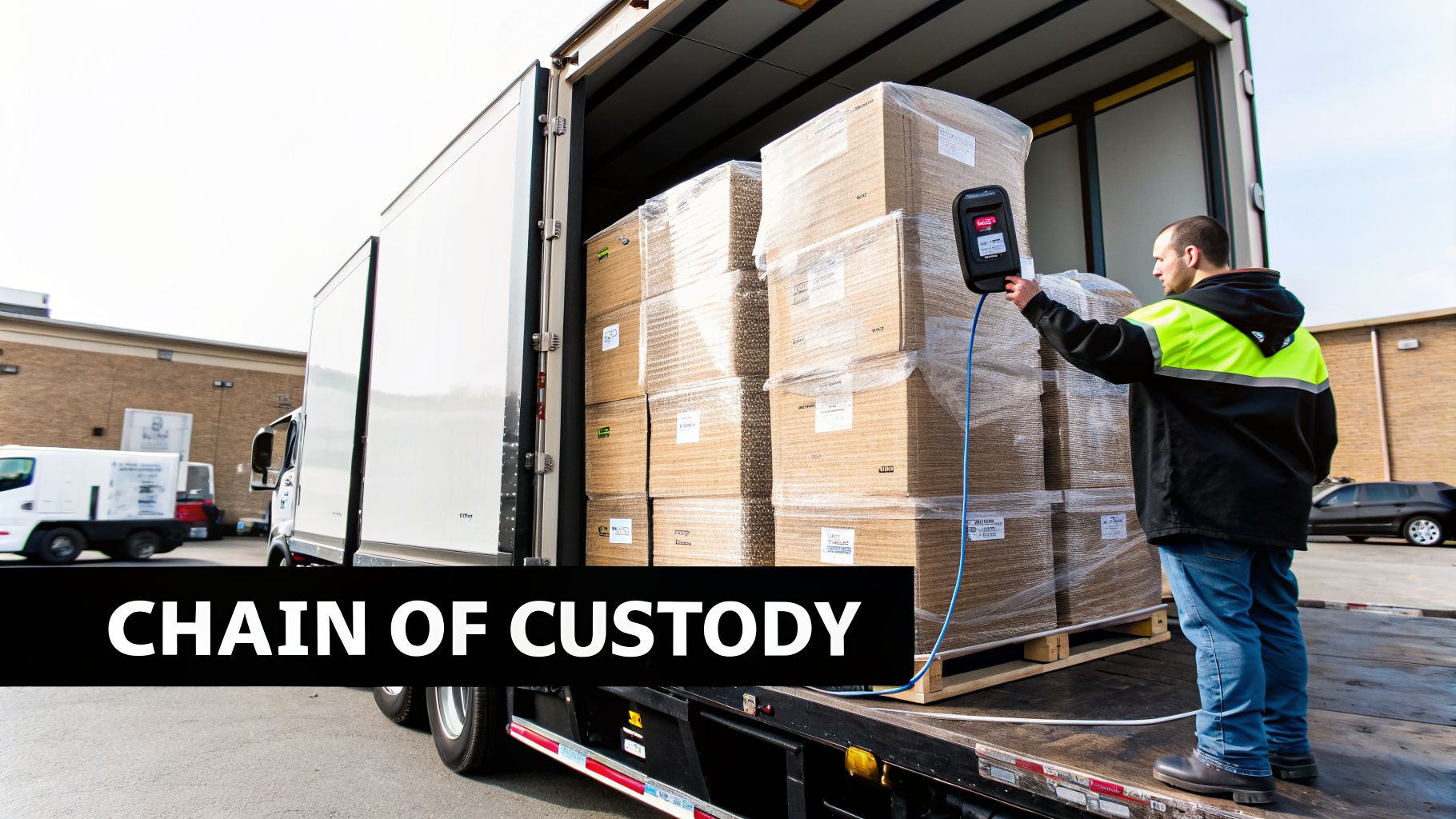
Once data is sanitized, your focus must pivot to the physical hardware. Every server, switch, and rack is a corporate asset and a physical liability until it is properly accounted for and processed. This is where a robust chain of custody is essential—it provides an unbroken, documented trail that follows every asset from its rack position to its final disposition.
View this not as a mere logistical step, but as a core component of your risk management strategy. An airtight chain of custody is your auditable proof for stakeholders and regulators that every piece of equipment was handled securely at every stage. Without it, you expose your business to theft, loss, and significant compliance risks.
The scale of IT hardware in Georgia is immense. With the state projected to forgo $2.5 billion in tax revenue from data center exemptions in fiscal year 2026 alone, the amount of installed equipment is staggering. All of that hardware—billions of dollars in servers and networking equipment—will eventually require a secure data center decommissioning Atlanta GA plan. This makes chain of custody more critical than ever, as highlighted by a state-level financial analysis.
On-Site De-Installation and Secure Packing
The chain of custody begins the moment a technician unplugs a server. Your ITAD partner's on-site team should operate with precision, systematically de-racking, labeling, and scanning each device against the master asset list. This is the point where digital records meet physical hardware.
Each asset tag must be scanned and its serial number recorded before the asset is moved. This initial scan is the first link in the custody chain.
From there, professional packing is critical. Servers are not simply placed on a pallet; they must be carefully arranged and shielded to prevent damage, particularly if they are designated for resale. Using materials like protective bubblewrap is essential for protecting the value of sensitive IT components. Once packed, pallets are shrink-wrapped in opaque black plastic, securing the assets and concealing them from view.
Establishing an Unbreakable Chain of Custody
A dependable chain of custody is built on meticulous, serialized documentation. Every time an asset changes hands or location, a record is created and signed. Your business should demand full transparency and access to this documentation throughout the project.
Your documentation package must always include:
- Initial Asset Inventory: The master list from your planning phase.
- On-Site Bill of Lading: A detailed manifest, signed by both your project manager and the ITAD team lead before any assets leave your premises. It confirms the exact items being transferred.
- Serialized Pallet IDs: Each wrapped pallet receives a unique ID, tracked from your loading dock to the processing facility.
- Secure Transit Records: GPS tracking data and transport logs provide a minute-by-minute account of the journey.
Pro Tip: Insist on a pre-project site walk. Your ITAD vendor should visit your Atlanta data center to map the entire extraction path, from server rows to the loading dock. This allows them to identify any logistical obstacles or security checkpoints in advance, preventing delays on pickup day.
High-Security Transport and Logistics
With your assets packed and documented, secure transport is the final component of the on-site process. For any business in the Atlanta area—especially those handling sensitive data or high-value equipment—standard freight shipping is inadequate.
Your transport plan must include these non-negotiable security features:
- Sealed, Lockable Trucks: The vehicle must be sealed at your location with the seal number recorded on the bill of lading. That seal should only be broken upon arrival at the secure facility.
- GPS Tracking: Real-time GPS provides complete visibility, allowing you to monitor the truck’s progress from your dock to its destination.
- Two-Person Teams: The truck must be staffed with at least two background-checked, uniformed technicians.
- Direct-to-Facility Routes: The truck must travel directly to the processing facility with no unauthorized stops.
This level of detail ensures the physical security of your assets is as robust as the digital security measures you have implemented. It closes the on-site security loop, providing complete peace of mind as your hardware begins its final journey. You can learn more by reading our guide on supply chain risk management strategies.
Maximizing Asset Value and Hitting Your Sustainability Goals
Viewing a data center decommissioning as merely a line-item expense is a significant strategic error. A modern, business-oriented approach treats it as a value recovery initiative and an opportunity to substantiate corporate sustainability claims. Executed correctly, this project can generate a surprising ROI that offsets costs, transforming a logistical challenge into a victory for your budget and brand.
This represents a fundamental shift in perspective. Instead of simply paying for old equipment to be removed, your organization is actively recovering the maximum financial and environmental value remaining in every asset. This is how a strategic data center decommissioning in Atlanta GA ceases to be a cost center and becomes a value-adding initiative.
Identifying and Remarketing Valuable Assets
Do not view your retired hardware as scrap—it is a portfolio of assets with hidden revenue potential. The key is identifying which components have a viable second life and legitimate resale value. This is where a skilled IT Asset Disposition (ITAD) partner is indispensable; they serve as your expert guide to the global secondary IT market.
We consistently see strong demand and value in specific classes of equipment:
- Enterprise Servers and CPUs: Newer generation models from Dell, HPE, and Cisco are always in high demand.
- High-Capacity Storage Arrays: SANs and NAS devices, particularly those equipped with SSDs, can yield a significant return.
- Networking Gear: High-speed switches, routers, and firewalls from major manufacturers are consistently marketable.
A qualified partner will conduct a full audit, testing and grading each component to determine its market value. They then leverage their established sales channels to find qualified buyers, managing everything from secure data wiping and cosmetic refurbishment to the final sale. The resulting revenue is shared back with your company, converting potential e-waste into a tangible financial return.
The Critical Role of Certified E-Waste Recycling
Not all equipment can be resold. Aging servers, failed components, and custom-built hardware may have reached the end of their operational life. For these assets, the focus must shift to responsible, certified recycling. This is not merely about environmental stewardship—it is about mitigating significant corporate risk.
If your company-branded equipment ends up in a landfill, the reputational damage can be severe, not to mention the environmental consequences. This is why you must verify your recycling partner’s credentials.
A vendor’s promise to "recycle everything" is meaningless without proof. Insist on working exclusively with partners who use R2v3 or e-Stewards certified downstream facilities. These certifications are your only guarantee of ethical, compliant, and environmentally sound processing.
These certifications are the industry gold standard, ensuring hazardous materials are managed safely and that every step of the recycling process is fully auditable. To see exactly how we manage this, review our certified approach to data center equipment recycling.
Turning Sustainability Goals into a Brand Asset
A well-documented, sustainable, and transparent decommissioning project is a powerful narrative for your company. It provides tangible proof of your commitment to environmental responsibility, which resonates with customers, investors, and employees. By choosing certified recycling and prioritizing reuse, you are not just fulfilling a compliance requirement; you are actively building brand equity.
The explosive growth of data centers in Georgia makes this more critical than ever. In 2023, Georgia Power’s planning documents revealed an unprecedented energy demand from new data centers, forcing utilities to increase power generation. The sheer volume of hardware entering these facilities today will create a massive wave of decommissioning projects tomorrow. You can read more about the scale of this energy demand and its implications for our state.
When your ITAD partner provides a final report detailing the exact weight of materials diverted from landfills and which components were sold for reuse, you receive hard data for your CSR and ESG reports. This documentation transforms a back-office IT task into a public-facing achievement, proving your company is part of the solution.
Selecting Your Ideal Decommissioning Partner in Atlanta
The ultimate success of your data center decommissioning hinges on one critical decision: selecting the right IT Asset Disposition (ITAD) partner. This goes beyond finding a vendor to remove old equipment. You are selecting a trusted advisor who will protect your business from the substantial risks of data breaches, environmental liabilities, and compliance penalties.
While the Atlanta market offers numerous options, only a select few can provide the security, transparency, and auditable documentation your business requires. The wrong choice can be catastrophic—imagine company-branded assets discovered in a landfill or a data breach traced back to improperly sanitized drives. A true partner for a data center decommissioning in Atlanta GA acts as an extension of your own team, guaranteeing a secure and efficient process from the initial assessment to the final reporting.
Core Qualifications and Certifications
When vetting potential partners, do not be swayed by a slick presentation or an unusually low price. Your first action should be to verify their credentials. Key industry certifications are non-negotiable, as they prove a vendor’s processes have been independently audited for security and environmental compliance.
Insist on seeing current proof of these certifications:
- R2v3 (Responsible Recycling): This is the leading standard for electronics recycling. It mandates environmental safety, data security, and worker health, and it proves their downstream recycling chain is 100% accountable.
- e-Stewards: Another rigorous standard with a strong focus on preventing the illegal export of hazardous e-waste.
- NAID AAA: This certification is absolutely critical for data destruction. It verifies that a vendor’s methods for wiping, shredding, and destroying data-bearing media meet the highest security protocols in the industry.
A vendor’s claim to be "green" or "secure" is merely talk without these certifications. If they cannot produce current R2v3 or NAID AAA certificates, it is a significant red flag. This is the simplest and most effective way to vet a potential partner.
Essential Insurance Coverage
Beyond certifications, your partner must carry specific insurance policies that protect your business from the inherent risks of a decommissioning project. A standard general liability policy is insufficient.
Your due diligence must confirm they hold adequate coverage for:
- Cyber Liability Insurance: This protects against the significant financial losses resulting from a data breach that occurs while your assets are in their custody.
- Pollution Liability Insurance: This covers cleanup costs and legal fees if their recycling process leads to an environmental contamination event.
Requesting a Certificate of Insurance (COI) is a standard and necessary step in the vetting process. This document proves they have the financial backing to manage a worst-case scenario, ensuring your company is not exposed to financial or legal liability.
ITAD Vendor Vetting Checklist
To help you compare potential partners effectively, we have developed a simple vetting checklist. Use this to structure your inquiries and evaluate how each vendor measures up against the criteria that are most critical for a secure and compliant project.
| Evaluation Criterion | Atlanta Computer Recycling | Other Vendor 1 | Other Vendor 2 |
|---|---|---|---|
| R2v3 Certified | Yes | ||
| NAID AAA Certified | Yes | ||
| Cyber Liability Insurance | Yes | ||
| Pollution Liability Insurance | Yes | ||
| On-Site Data Shredding | Yes | ||
| Secure Chain of Custody | Yes | ||
| Detailed Asset Reporting | Yes | ||
| Local Atlanta Operations | Yes |
This checklist covers the non-negotiables. A "no" on any of these core items should be considered a major red flag that requires serious justification from the vendor.
Understanding Vendor Pricing Models
Comparing quotes can be challenging, as pricing models vary widely. Some vendors charge a flat project fee, others bill by the hour or by weight, and some use a revenue-sharing model where the value of remarketed assets can offset your costs.
To make an accurate comparison, you must demand a quote that clearly itemizes every cost. Be wary of vague "logistics" fees or a lack of detail on data destruction charges. A transparent quote from a reputable ITAD vendor will break down each service, providing a clear and honest picture of the total investment.
For a deeper look at the services that should be itemized in any decommissioning quote, explore our complete overview of ITAD services in Atlanta, GA. It is the best way to understand the full scope of work and ensure there are no surprises or hidden costs.
Atlanta Data Center Decommissioning FAQs
When planning a project of this magnitude, several key questions consistently arise. As specialists in data center decommissioning in Atlanta, GA, we have guided countless IT and business leaders through this process. Here are the straightforward answers we provide our clients to help them plan and budget effectively.
What Is the Average Cost for Data Center Decommissioning in Atlanta, GA?
This is often the first question, and the answer is entirely dependent on the specific project. A smaller engagement involving a few server racks might cost a few thousand dollars, while a full-scale liquidation of a large enterprise data center can easily run into the tens of thousands.
The final cost is not a flat rate; it is determined by several critical variables:
- Volume of Equipment: The total number of servers, racks, drives, and networking devices is the single largest cost driver.
- Data Destruction Method: On-site hard drive shredding, for example, requires specialized equipment and personnel, making it a premium service compared to off-site destruction or software-based erasure.
- Logistical Complexity: Factors such as securing loading dock access in a high-rise, navigating union labor requirements, or scheduling after-hours work can all impact the bottom line.
The most important concept for business leaders to grasp is the difference between gross cost and net cost. For many projects, the value we recover by remarketing newer equipment can significantly reduce or even completely offset your project expenses. A firm quote can only be provided after a detailed, on-site assessment from a certified ITAD partner.
How Long Does a Typical Decommissioning Project Take?
Similar to cost, the timeline is directly tied to the project's scope and the quality of the initial planning. A project with a clear, organized inventory and plan will always proceed more efficiently.
Based on our experience across the Atlanta metro, here are general timeframes for the on-site phase:
- Small Project (1-5 Racks): On-site work can often be completed in a single business day.
- Medium Project (10-30 Racks): Plan for 2-5 days of on-site activity for de-installation, packing, and secure removal.
- Large-Scale Project (30+ Racks): These complex undertakings can require a week or more of coordinated on-site work.
Note that these estimates cover the physical, on-site labor. The total project timeline—from the initial planning meeting to the delivery of final reports—will span several weeks or even months. A detailed project plan, created in partnership with your decommissioning provider, is the best tool for establishing a predictable schedule.
Does My Team Need to Be On-Site During the Process?
While our certified team handles all physical work, having a designated point of contact from your company is crucial for accountability. We require your project manager to be on-site at the start to grant our team access and formally approve the scope of work.
That same individual should be present at the conclusion of the on-site phase to inspect the cleared space and sign the final bill of lading. This document is critical, as it formally transfers custody of all assets from your facility to our firm.
For projects with stringent security requirements, it is common for clients in finance or healthcare to have a representative present to witness the entire process. Observing on-site data destruction, for example, provides an additional layer of verification and absolute peace of mind.
What if Our Retired Equipment Still Has Resale Value?
This is a central component of a modern decommissioning strategy. Our objective is to maximize the value of your retired IT assets, transforming a necessary expense into a financial return for your business. A full-service ITAD partner should offer this as a standard part of their service.
We manage the entire asset recovery process on your behalf:
- Audit and Test: Each asset is inventoried and tested to determine its functional condition and current market value.
- Secure Data Wiping: All data-bearing devices are sanitized to NIST 800-88 standards, rendering them safe for resale.
- Global Remarketing: We leverage our established secondary market channels to find qualified buyers and secure the best possible price for your equipment.
The revenue generated is then shared back with your company through a completely transparent, pre-agreed financial model. This is the most effective way to realize a significant financial return on your retired IT hardware and make your decommissioning project a budget-positive initiative.
Ready to plan your data center decommissioning with a trusted, certified local partner? The team at Atlanta Computer Recycling has the expertise to ensure your project is secure, compliant, and cost-effective. Contact us today for a no-obligation consultation and site assessment. Learn more at https://atlantacomputerrecycling.com.