Recycling Electronics at Best Buy: A Guide for Businesses?

A lot of IT managers end up in the same spot. An office refresh is done, the storage room is full, and now there are retired laptops, a stack of monitors, a few access points, some dead hard drives, and maybe an old server or two waiting for a decision.
At first glance, recycling electronics at Best Buy sounds like the simple answer. Everyone knows the brand. The stores are close. Some items are accepted for free. For a small pile of personal devices, that convenience is real.
For business equipment, the decision gets harder fast. The issue usually isn't whether the material will be recycled. The issue is whether the disposal method matches your risk profile, compliance obligations, chain of custody needs, and operational reality. Teams that already depend on structured professional IT solutions usually understand this in other parts of their environment. Asset retirement needs the same discipline.
That distinction matters most when you're handling regulated data, coordinating an office closure, or trying to document a defensible disposition process for auditors. If you need a quick primer on what a formal disposition program covers, this overview of IT asset disposition services is useful context before choosing a recycling path.
The IT Manager's Dilemma with E-Waste
The pressure usually comes from three directions at once.
Finance wants the room cleared. Operations doesn't want another project that disrupts users. Compliance wants proof that data-bearing devices were handled correctly. Those goals don't always line up with the cheapest or fastest-looking option.
A consumer recycling counter works well when the user owns the device, knows what's on it, and can accept some ambiguity. Business environments are different. Assets move through many hands, records are often incomplete, and one overlooked drive can turn a routine cleanup into a legal problem.
Why the easy option becomes risky
A familiar retail program can create a false sense of safety. People assume that if a national retailer accepts electronics, it must also be suitable for retired company assets. That's not always true.
For business disposal, key questions are more specific:
- Who controlled the device from handoff to final processing
- What proof exists that data was destroyed
- How were bulk items packed, transported, and inventoried
- What happens when the load includes servers, switches, loose drives, and mixed-condition hardware
A retail drop-off model isn't built around those questions. A professional ITAD model is.
Operational rule: If your disposal plan depends on individual employees making separate trips with company equipment, you don't have a disposal process. You have a chain-of-custody gap.
What usually gets overlooked
Many organizations focus on the front-end convenience and ignore the back-end accountability. That mistake shows up later, during an audit, an internal security review, or an office move that reveals more equipment than anyone expected.
The right comparison isn't "Can Best Buy recycle electronics?" It clearly can. The right comparison is "Is a consumer drop-off service the right control framework for business assets?" In many commercial settings, the answer is no.
Understanding the Two Electronics Recycling Models
Before comparing details, it helps to separate the two service models clearly. They serve different users and solve different problems.
Best Buy's program is a large-scale public recycling channel for consumers. Since launching in 2009, Best Buy has become the nation's largest retail collector of e-waste, diverting over 2.7 billion pounds of electronics and appliances from landfills and collecting over 400 pounds per minute while stores are open, according to Best Buy's recycling guidelines.
| Criteria | Best Buy consumer recycling | Professional ITAD partner |
|---|---|---|
| Primary user | Households and individual device owners | Businesses, institutions, and public sector organizations |
| Main objective | Convenience and consumer e-waste diversion | Risk management, compliance, logistics, and reporting |
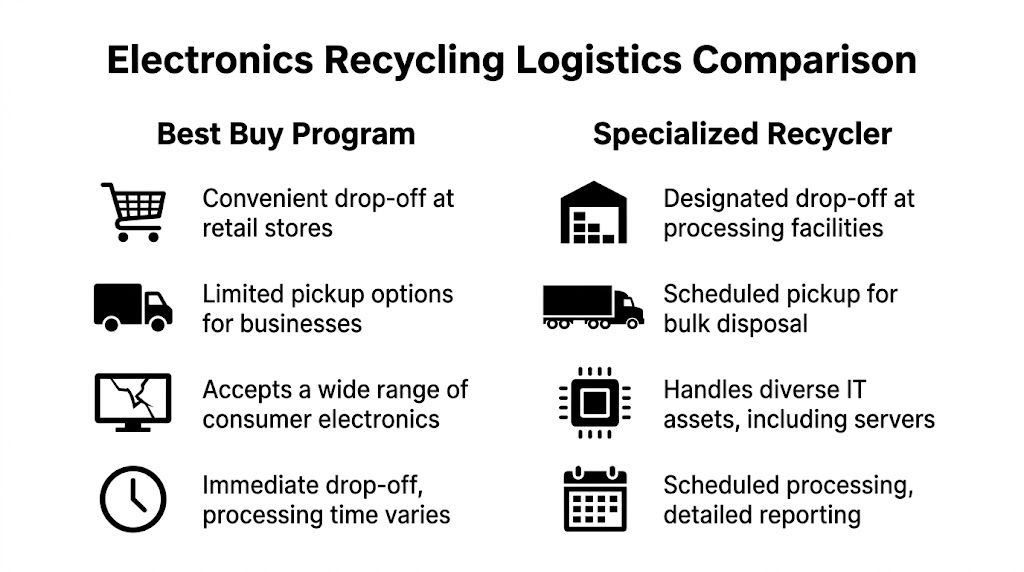
| Drop-off model | Retail-store based | Scheduled pickup, facility intake, or project-based service |
| Typical assets | Personal laptops, tablets, TVs, small electronics | Laptops, desktops, servers, storage, network gear, mixed bulk loads |
| Documentation depth | Consumer-oriented receipt and program rules | Asset tracking, destruction records, and disposition reporting |
| Best fit | Small personal quantities | Bulk business retirement and regulated environments |
Best Buy's model works for public access
That's an important achievement. A retailer with broad geographic coverage can capture items that might otherwise sit in closets or end up discarded improperly. For households, that's a meaningful environmental service.
The model is built around ease of participation. A customer checks accepted items, brings in a manageable number of devices, and leaves them with the store. That simplicity is exactly why the program has scale.
ITAD is a different category entirely
Professional ITAD isn't just "recycling for companies." It's closer to a controlled disposition process that happens to include reuse, remarketing, recycling, data destruction, transport, and reporting.
That distinction matters because business assets create different demands. A school district replacing classroom devices, a hospital retiring workstations, or a company closing an office isn't just trying to keep material out of landfills. They're trying to move equipment without losing custody, exposing data, or stalling operations.
Organizations evaluating local disposal paths often compare retail convenience against specialized channels such as Atlanta-area electronics recycling options. The smarter comparison is narrower than that. It asks whether the asset stream is consumer-style or enterprise-style.
Best Buy's program is a strong consumer recycling outlet. ITAD is a business control system. Treating them as interchangeable leads to bad decisions.
Comparing Service Scope and Logistics
The biggest practical difference shows up before anyone talks about compliance. It shows up in the loading dock, the server room, the school media center, or the closet where retired equipment keeps piling up.
Best Buy's consumer program is not designed for bulk commercial disposal. Policies often limit drop-offs to three items per household per day, and the program doesn't provide on-site pickup of servers or network gear for office closures. Paid haul-away services typically apply to single large appliances or TVs rather than coordinated logistics for business projects, as summarized by Less Is More's Best Buy program overview.
What "accepted items" means in practice
A lot of business users stop at the accepted-items list and miss the operational limits around it. Yes, a retailer may accept certain electronics. That doesn't mean the program is built to receive a decommissioned branch office.
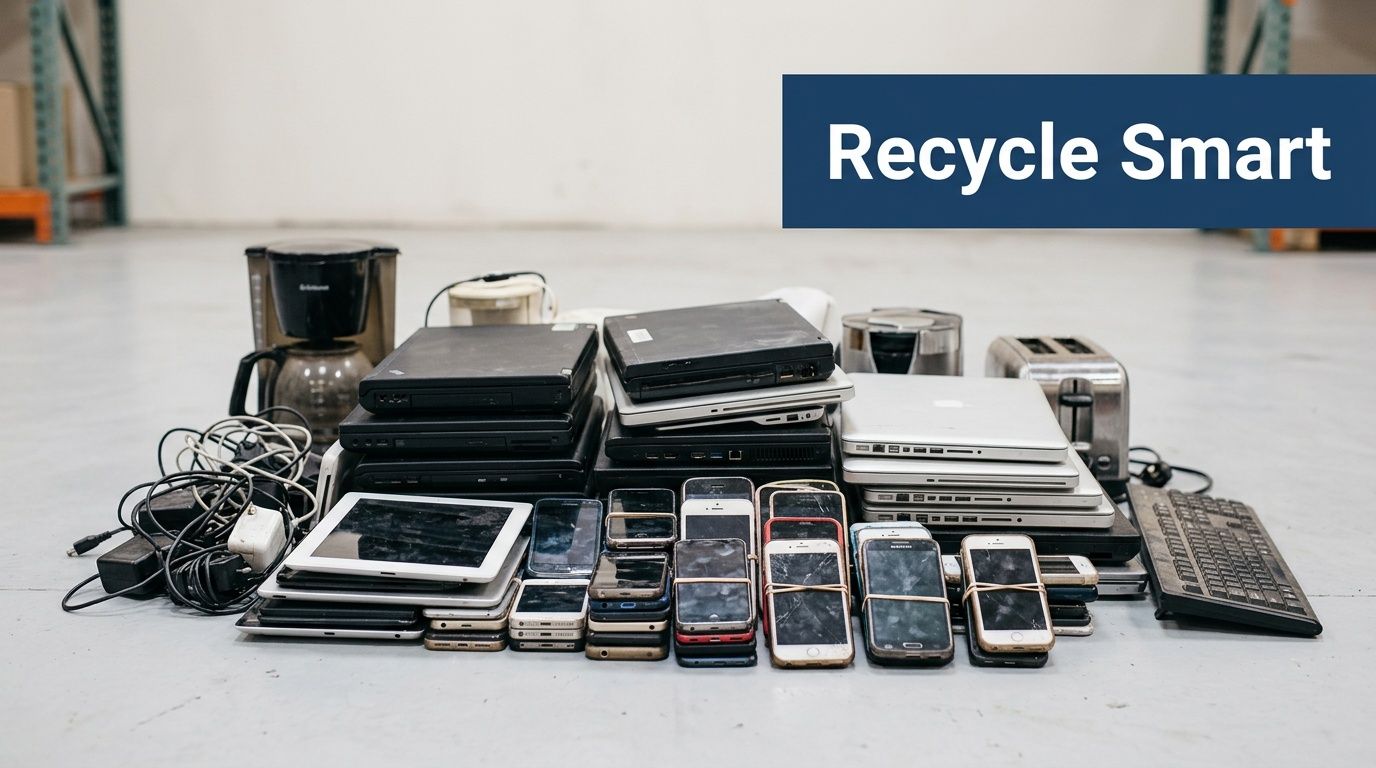
Business loads are messy. A real retirement batch might include:
- Mixed form factors like docks, mini PCs, phones, printers, and cabling
- Infrastructure gear such as switches, firewalls, UPS units, and rack equipment
- Storage media pulled from failed or partially inventoried systems
- Damaged hardware that cannot easily be handed over one item at a time
That kind of load needs staging, sorting, and transport planning. A consumer counter isn't meant to absorb it efficiently.
The hidden labor cost of "free"
Retail recycling often looks inexpensive because the visible fee is low or nonexistent for some items. For a business, the more relevant cost is internal labor.
Someone has to do all of this:
- Pull assets from service without disrupting users.
- Verify what can legally leave the site and what still contains records.
- Box or transport devices in employee vehicles or company vans.
- Split loads across days or locations if volume policies apply.
- Track what was dropped off in case questions come up later.
That isn't free. It's unmanaged labor, plus risk.
A professional pickup model costs money, but it often replaces many smaller hidden costs with one scheduled process. If you need a practical example of how business collections are usually structured, these IT equipment pickup services in Atlanta show the kind of workflow business clients generally need: coordinated pickup, less staff disruption, and a clear handoff.
On-site realities matter more than policy pages
The policy page rarely reflects the actual burden on your team. An IT manager trying to dispose of business assets isn't asking, "Can someone technically bring this device somewhere?" The essential question is, "Can we clear this equipment safely, quickly, and with minimal interruption?"
Here's where retail breaks down for commercial use:
| Operational issue | Consumer drop-off outcome | ITAD-style outcome |
|---|---|---|
| Office closure | Staff must sort and transport items manually | Pickup and project coordination are planned in advance |
| Server removal | Usually outside normal consumer workflow | Common part of business disposition work |
| Bulk laptop refresh | Daily limits and repeated trips create friction | Batch handling is expected |
| Multi-site retirement | Decentralized handoffs create inconsistency | Centralized reporting is possible |
Where consumer convenience still makes sense
Not every business asset requires a full ITAD event. A very small company with one non-sensitive accessory or an owner-managed device may decide a local retail drop-off is good enough.
That use case is narrow. It usually works only when all of the following are true:
- The item isn't part of a bulk retirement
- No regulated or sensitive data is involved
- The owner can wipe and document the device independently
- No formal destruction or custody record is required
Convenience works best at small scale. The moment you add volume, mixed equipment, or accountability requirements, logistics stop being simple.
Analyzing Data Security and Compliance Risks
The consumer-versus-business distinction then becomes decisive.
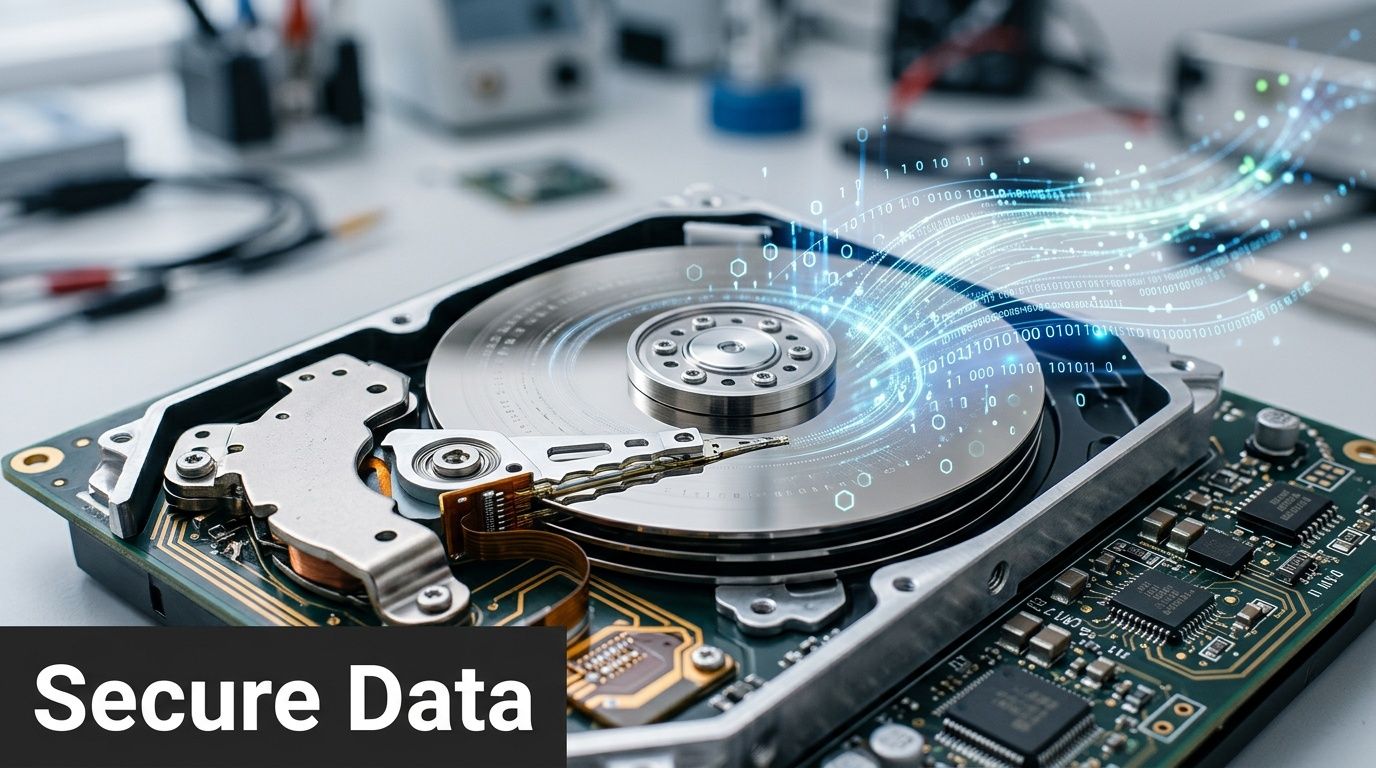
A critical gap in consumer recycling programs for business use is the lack of specific data security protocols. While Best Buy's recycling partners are required to render data unrecoverable, the program doesn't offer services like DoD 5220.22-M 3-pass wiping, chain-of-custody documentation, or Certificates of Destruction, which businesses need when they must prove HIPAA compliance, according to Green City Recycler's review of Best Buy recycling.
Rendering data unrecoverable isn't the same as proving it
That difference gets missed all the time.
A consumer program may route devices to responsible downstream processors. That says something useful about environmental handling. It does not give a business the same evidentiary record as a managed destruction workflow.
For regulated organizations, the issue isn't just outcome. It's proof.
A compliance team, outside auditor, legal department, or security officer may need to answer questions like:
- Which serial-numbered assets left the building
- Who handled them at each transfer point
- Whether drives were wiped or physically destroyed
- When destruction occurred
- What document supports the disposition decision
A general retail receipt doesn't answer those questions well enough.
Why chain of custody changes the risk calculation
In consumer recycling, custody is usually informal. A person shows up, drops off an item, and trusts the program. That's fine for many personal devices after self-wiping.
Business environments need something stronger. Healthcare organizations, schools, and public agencies often can't rely on trust alone. They need documented handoff, controlled transport, and records they can keep.
If your organization handles patient information, student records, employee files, legal documents, or customer data, then device disposal becomes part of your security program. It isn't just a sustainability task. For teams with healthcare obligations, this is why dedicated HIPAA-compliant electronics recycling practices matter so much more than a generic drop-off option.
A recycled hard drive and a documented destroyed hard drive are not the same thing in an audit.
Common business mistakes
The most common errors are procedural, not technical.
Relying on end users to wipe devices
Users forget steps, skip verification, or misunderstand what data remains on SSDs, external drives, and embedded storage.Letting departments dispose of assets independently
Distributed drop-offs create blind spots. IT loses visibility, and no one can reconstruct the full asset trail later.Treating all devices as equal
A keyboard and a database server are both electronics. They are not the same risk.Assuming downstream destruction solves upstream handling
Even if a processor destroys media eventually, the vulnerable period is everything that happens before that point.
Compliance is operational, not theoretical
Most security failures in disposition don't happen because someone wanted to take a shortcut. They happen because the disposal method didn't match the environment.
A consumer program can be perfectly responsible for household recycling and still be the wrong answer for a medical practice, a university department, or a company retiring storage arrays. Businesses need a disposal path that treats data-bearing equipment as controlled material from the moment it leaves service.
Evaluating Environmental Certifications
Environmental responsibility still matters, and it's worth being precise about what good recycling looks like.
Best Buy requires its recycling partners to maintain R2 or e-Stewards certifications and to follow a hierarchy that prioritizes reuse before recycling. At the same time, the program caps free laptop recycling at five per household per day and charges fees for some items like monitors, which makes it impractical for scalable business asset disposition, based on the program details discussed in Best Buy's published guidelines cited earlier.
What certifications do tell you
R2 and e-Stewards are meaningful signals. They indicate that downstream processing is expected to meet recognized standards rather than informal scrap handling.
That matters because businesses shouldn't judge a recycler only by whether it picks up equipment. They should also care how materials are managed after pickup. A certified downstream path reduces the chance that devices are exported, dumped, or handled without environmental controls.
What certifications don't tell you by themselves
Certifications don't automatically solve the business-side questions about inventory control, reporting, or service design. A consumer program can route material responsibly and still offer limited visibility into your specific asset stream.
That's the practical difference.
With a business-focused recycler, organizations usually want to know:
- Which assets were reused or remarketed
- Which units had no recovery value and went to recycling
- What happened to storage media
- What records will be retained for internal and external review
Businesses that care about sustainability usually also care about transparency. That's why a more customized environmentally responsible electronics recycling approach tends to fit commercial programs better than a retail counter model.
Sustainability isn't only about where the material ends up. It's also about whether your organization can see and document how the disposition happened.
Reuse creates both environmental and financial value
The reuse-first hierarchy is important because the greenest outcome often isn't shredding or raw material recovery. It's extending the life of usable equipment where appropriate.
For businesses, that can intersect with asset value recovery. A professional ITAD process may separate resale-worthy equipment from scrap, which can help offset service costs. Retail consumer recycling doesn't usually function as a detailed, organization-level recovery program for mixed enterprise assets.
A Decision Workflow for Your IT Assets
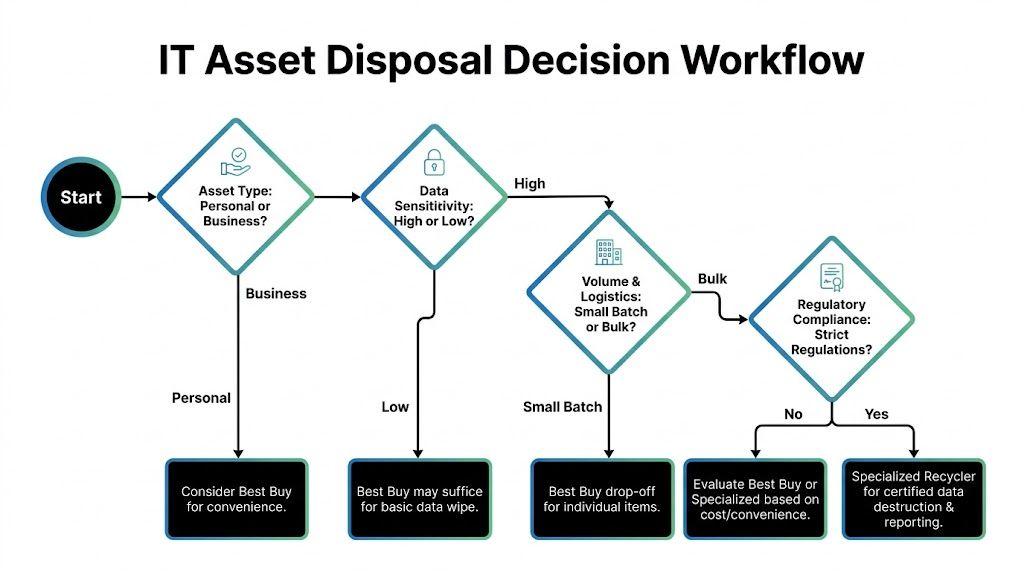
Most disposal decisions become easier when you stop asking one big question and start asking four smaller ones: What is the asset, what data does it hold, how much volume is involved, and what proof do we need afterward?
That framework keeps convenience from overruling judgment.
When Best Buy may be reasonable
A retail program can fit a narrow business scenario. Think owner-operated firms, one-off peripheral disposal, or a single non-sensitive device where the owner can personally control the wipe and drop-off.
That can work when the asset is simple, the stakes are low, and there is no requirement for formal documentation.
Use that route only if each statement below is true:
- The device count is very small
- No regulated, confidential, or client data is involved
- You have personally verified data removal
- No auditor, customer, insurer, or internal policy requires destruction records
- You don't need pickup, de-installation, or centralized reporting
When a professional ITAD process is the responsible choice
For most organizations, the threshold comes sooner than expected. Once devices belong to the business and carry institutional risk, disposal needs more structure.
Use a professional ITAD partner when any of these conditions apply:
The load includes servers, storage, or network gear
These assets usually involve infrastructure dependencies, embedded storage, or removal complexity that doesn't fit a retail drop-off path.You're disposing of equipment in batches
Even modest refresh projects create tracking problems when staff make separate drop-offs.Your industry is regulated
Healthcare, education, finance, government, and many enterprise environments need documented handling, not just a general recycling option.You need proof
If legal, security, or procurement teams may ask for destruction evidence later, get it at the time of disposition. Don't try to reconstruct the event after the fact.Operations can't absorb the manual work
Office closures and decommissions fail when disposal depends on ad hoc staff effort.
If a disposal decision would be hard to defend in front of an auditor, it isn't the right decision.
A simple review before anything leaves the building
Run every retirement batch through this quick screen:
| Question | If yes | If no |
|---|---|---|
| Does it store or process business data | Use managed ITAD controls | Continue review |
| Is the volume larger than a few isolated items | Plan coordinated pickup or intake | A limited retail option may be possible |
| Do you need serial-level accountability | Require documented workflow | Simpler handling may be acceptable |
| Would a failed handoff create legal or reputational exposure | Avoid consumer disposal channels | Low-risk consumer handling may suffice |
The key is consistency. Good disposition programs aren't built asset by asset under deadline pressure. They're built from repeatable rules.
Frequently Asked Questions for Business E-Waste
Is Best Buy's trade-in program a business disposal strategy
Not really.
Trade-in programs can make sense for a few current-model devices with obvious residual value. That's a narrow asset recovery use case, not a disposal framework for mixed business hardware. Most commercial retirement loads include low-value accessories, aging desktops, broken monitors, storage devices, and infrastructure equipment that don't fit neatly into trade-in workflows.
For business disposition, trade-in also leaves major unanswered questions about custody, reporting, and standardized handling across many assets. It can complement a broader lifecycle plan for a handful of devices. It shouldn't replace one.
Can't we ask employees to drop off their old work laptops themselves
You can. You probably shouldn't.
Once employees handle decentralized disposal, your organization loses control over timing, records, consistency, and verification. Some users will wipe correctly. Some won't. Some will forget to turn in accessories or drives. Some will hold equipment for months.
That creates four problems at once:
- Security risk because data handling becomes inconsistent
- Asset management gaps because inventory closure depends on employee follow-through
- Policy drift because each department improvises
- Weak audit posture because there is no central evidence trail
A controlled collection process is slower to set up, but far safer to defend.
The moment disposal becomes voluntary and decentralized, accountability becomes fuzzy.
Isn't free retail recycling cheaper than paid ITAD
Only if you ignore internal labor, transport time, project delays, and the cost of weak documentation.
The apparent savings from recycling electronics at Best Buy can disappear quickly when your team spends hours sorting assets, making repeated trips, coordinating staff, and answering follow-up questions later. Then add the harder-to-measure cost of uncertainty. If no one can prove what happened to a retired drive, the process wasn't cheap. It was incomplete.
Paid ITAD services are easier to budget because they bundle the things businesses usually need anyway:
- Pickup and logistics
- Batch handling
- Documented destruction
- Clearer chain of custody
- Disposition records for internal files
In many organizations, the right comparison isn't "free versus paid." It's "uncontrolled effort versus managed process."
What about a tiny office with only one or two devices
That is the strongest argument for using a consumer recycling program.
If the devices are low-risk, the owner controls them directly, data has been properly removed, and no reporting obligation exists, a retail option may be practical. That's especially true for small accessories or isolated equipment with little operational significance.
The key is not to generalize from that exception. What works for a two-device cleanup doesn't scale to a clinic, district office, warehouse network refresh, or office closure.
If a program is environmentally responsible, isn't that enough
For household recycling, often yes.
For businesses, environmental responsibility is only one part of the decision. The other parts are security, legal defensibility, operational efficiency, and documentation. A responsible downstream recycler does not automatically give you a responsible business process.
That's the main takeaway. Best Buy is a valid consumer recycling channel. It isn't a substitute for a business ITAD workflow when the assets, data, and risks are commercial.
If you're managing business e-waste in Atlanta and need a process built for pickup, secure data handling, compliance, and bulk commercial disposition, Atlanta Computer Recycling is built for that job. Their team works with companies, schools, healthcare organizations, and public agencies that can't rely on consumer drop-off workflows for retired IT assets.