Charm Atlanta Hill Street: Complete Business ITAD Guide


Your office refresh is done. The new laptops are deployed, the retired desktops are stacked in a conference room, and someone just asked where the old switches, monitors, batteries, and half-empty paint cans from the maintenance closet are supposed to go.
That’s usually when charm atlanta hill street enters the conversation.
For Atlanta businesses, CHaRM is a legitimate and valuable local resource. But from an IT manager’s perspective, the key question isn’t whether CHaRM does good work. It does. The question is whether it fits the operational, security, and documentation standards that come with business electronics, regulated data, and bulk removals.
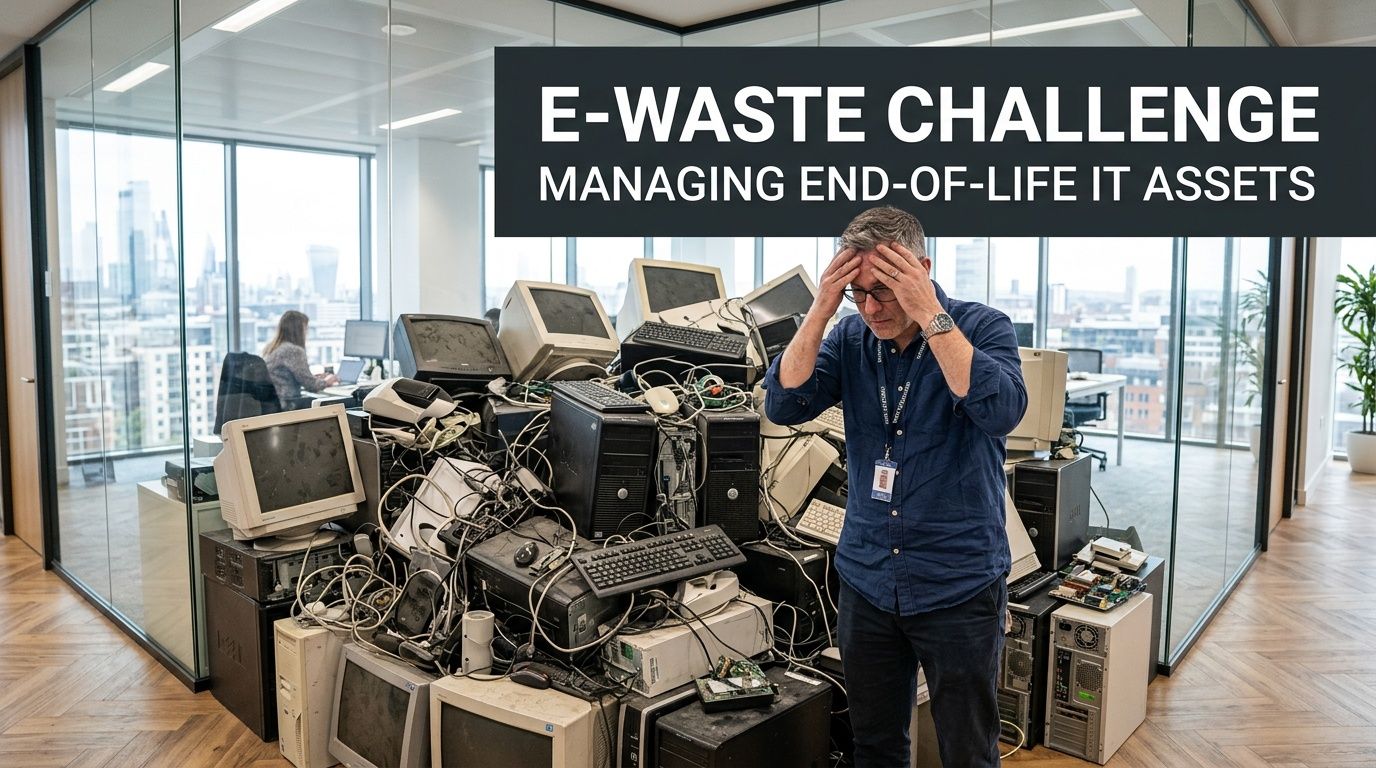
A lot of Atlanta recycling advice is written for residents. That’s useful if you’re dropping off a few household items. It’s less useful if you’re managing a lease exit, a clinic hardware replacement, or a server room cleanup where chain of custody matters as much as landfill diversion.
Businesses need a more practical lens. Some materials belong at CHaRM. Many business-critical assets don’t.
An Atlanta Business Guide to E-Waste Disposal
Atlanta IT teams usually run into disposal problems at the worst time. A migration finishes. An office closes. A compliance review flags old storage media still sitting on site. What looked like “junk removal” turns into a mix of data risk, transport logistics, and recycling decisions.
CHaRM on Hill Street is often one of the first names local teams hear because it’s visible, mission-driven, and helpful for the public. That makes sense. It fills a real gap for hard-to-recycle materials that curbside programs won’t touch.
For a business, though, the standard is different. You’re not only trying to recycle responsibly. You’re trying to answer questions like these:
- Where does the data-bearing equipment go
- Who documents handoff and destruction
- How do we move volume without tying up staff time
- What happens if the load includes mixed materials
Practical rule: If the item once stored company data, touched regulated workflows, or requires coordinated pickup, treat it as an ITAD decision first and a recycling decision second.
That’s where many teams misread CHaRM’s role. It’s best understood as a community recycling facility, not a full commercial disposition program. For certain non-sensitive materials, that’s fine. For computers, servers, hard drives, network gear, and office cleanouts, it usually isn’t enough.
What Exactly Is CHaRM on Hill Street?
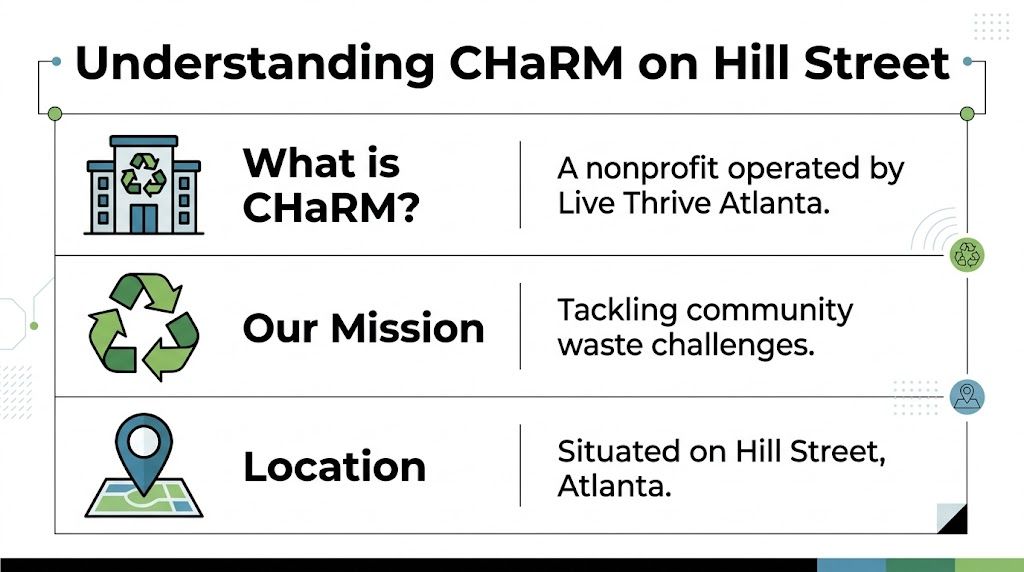
CHaRM stands for the Center for Hard to Recycle Materials. The Hill Street facility at 1110 Hill Street SE is operated by Live Thrive and was created to address materials that normal city collection programs don’t accept.
It opened in 2015 as Atlanta’s first permanent drop-off center for hard-to-recycle materials, according to Saporta Report’s coverage of CHaRM Atlanta. That matters because it explains why CHaRM has such a strong local reputation. It wasn’t built as a niche convenience. It was built to solve a citywide disposal gap.
Why CHaRM matters in Atlanta
By 2021, the Hill Street site was serving 62,680 visitors and diverted 4.8 million pounds of hazardous waste, electronics, paints, chemicals, and other difficult items from landfills and water systems, as reported in this CHaRM Atlanta profile. For the city, that’s substantial environmental infrastructure, not a side project.
CHaRM’s value is easiest to understand in practical terms. It gives residents and small generators a destination for materials that would otherwise linger in garages, storage rooms, or illegal dump streams.
What it is and what it is not
From a business operations standpoint, CHaRM is best seen as:
| Role | Fit |
|---|---|
| Public drop-off resource | Strong fit |
| Hard-to-recycle household materials outlet | Strong fit |
| Business IT asset disposition program | Weak fit |
| Secure data destruction workflow | Weak fit |
CHaRM solves an environmental access problem for the public. It doesn’t solve the full custody, compliance, and scale problem that business disposals create.
That distinction matters because many organizations assume any electronics recycler can also handle enterprise retirement workflows. CHaRM’s model was built around public access and diversion. Business ITAD requires a different operating model.
Accepted Materials and Disposal Fees
If you’re evaluating charm atlanta hill street for a small company drop-off, the accepted-materials list is the first place to look. CHaRM handles a broad mix of hard-to-recycle items, especially materials that facilities teams and office managers tend to accumulate outside normal waste streams.
What CHaRM accepts
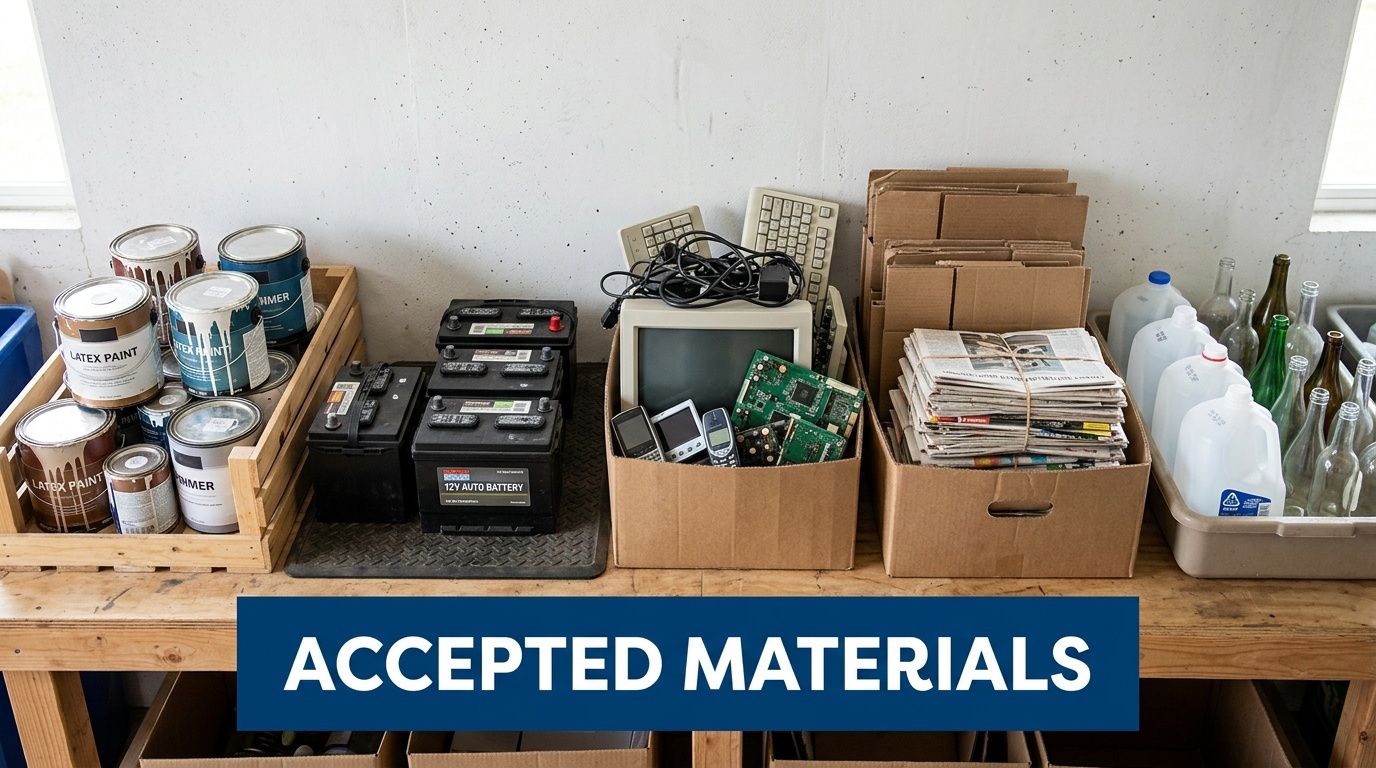
Based on Live Thrive’s Atlanta sitemap for CHaRM services, the site accepts categories that include:
- Chemicals and paint for weighed disposal
- Electronics and appliances in accepted categories
- Styrofoam and foam polystyrene
- Tires, with a per-item charge
- Thermostats, with a per-item charge
- Cardboard and selected plastics
- Single-stream sorted materials for users who need a non-curbside option
The site also expanded to accept polypropylene plastics (#5) and foam polystyrene, and a $41,000 Foam Recycling Coalition grant supported installation of an onsite densifier, according to the same Live Thrive resource.
How the fee structure works
For chemicals and paint, CHaRM uses a tiered pricing model for residents and a flat rate for businesses. Live Thrive’s posted CHaRM Atlanta fee structure states that residents get the first 20 pounds free, then pay $0.50 per pound up to 100 pounds total, $0.65 per pound for 101 to 199 pounds, and $0.75 per pound for 200 pounds and above. Businesses pay $0.85 per pound.
That pricing tells you a lot about the intended user. Small residential drop-offs are encouraged. Commercial loads are accepted more cautiously and at a higher per-pound rate.
A few other posted charges also matter for planning:
- Tires are $2 each
- Thermostats are $5 each
What works well
CHaRM makes sense when your business has a small, mixed load of non-data-bearing materials. Think leftover paint from a suite refresh, a few thermostats, or packaging foam from an equipment rollout.
What doesn’t work well is trying to stretch that model into bulk commercial electronics disposition. The fee structure, manual drop-off process, and item mix can turn a simple cleanup into a staff-heavy errand.
Why CHaRM Fails to Meet Business ITAD Requirements
The gap isn’t environmental intent. The gap is operating model.
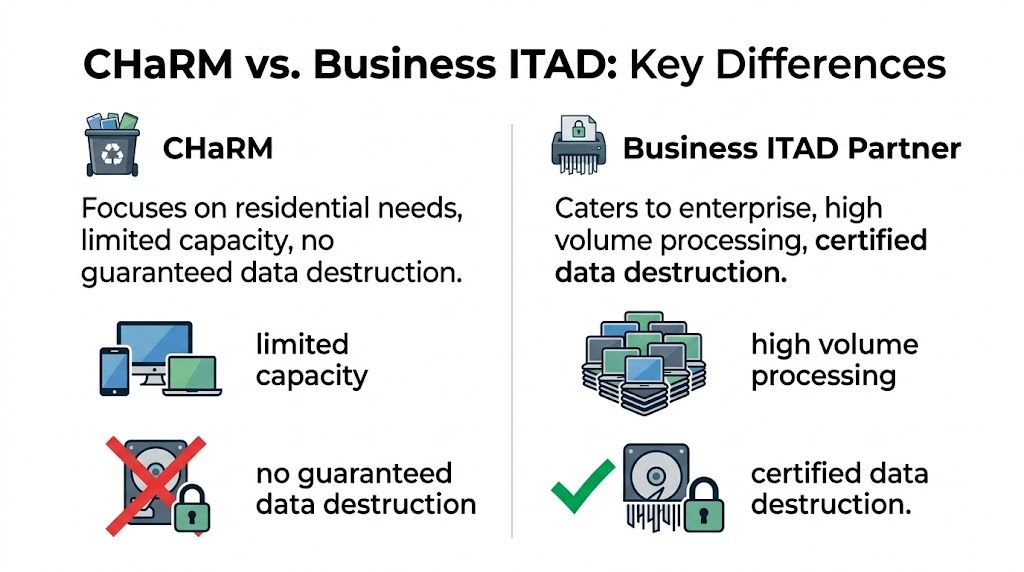
CHaRM is useful for public recycling. Business ITAD requires documented custody, secure data handling, scalable removal, and predictable processing. Those are different jobs.
Data security is the first blocker
For most Atlanta IT managers, the deciding issue is simple. Any device that held data can’t be treated like general recycling.
ATL311’s CHaRM guidance states that document shredding is limited to specific appointment-only events at the DeKalb site. That model doesn’t support ongoing business data-destruction needs, and it doesn’t address enterprise media workflows such as routine drive sanitization, storage-array retirement, or chain-of-custody documentation.
That matters even more if your environment includes healthcare records, student data, financial systems, HR files, or legal archives. Physical disposal is only one layer. Teams also need policies for backup retention, recovery risk, and cloud data protection so retired hardware doesn’t become the only part of the lifecycle they secure.
If your disposal plan starts with “we’ll load it in a van and drop it off,” it’s probably missing the control points auditors care about.
Logistics don’t fit business operations
CHaRM has no pickup service. That alone rules it out for many office moves, branch closures, and data center projects. Someone on your staff has to stage, load, transport, unload, and manage the appointment.
For a resident with a trunk load, that’s workable. For an IT department with racks, desktops, monitors, printers, loose cables, and mixed hazardous materials, it creates friction fast.
Use this test:
| Requirement | CHaRM fit |
|---|---|
| On-site pickup | No |
| De-installation and packing | Not its role |
| Bulk truck-friendly workflow | Unclear |
| Enterprise documentation | Limited for ITAD use |
A business disposition plan should reduce operational burden, not shift it onto internal staff.
Scale and compliance are separate problems
Even if a team is willing to self-haul equipment, CHaRM still isn’t positioned as a commercial ITAD platform. Live Thrive’s CHaRM information for the public focuses on household items and doesn’t provide the process detail businesses need for servers, bulk computers, or formal decommissioning.
That’s the core issue. IT managers aren’t just disposing of objects. They’re closing out assets, reducing exposure, and documenting the outcome.
A Smarter Hybrid Disposal Strategy for Your Company
The practical answer for many Atlanta organizations is a hybrid disposal model. Use charm atlanta hill street where it fits. Use a business ITAD workflow where it doesn’t.
That split keeps your team environmentally responsible without forcing a community drop-off center to do work it wasn’t built to handle.

What should go to CHaRM
CHaRM works best for small-volume, non-sensitive materials that fall outside curbside pickup and don’t require custody documentation.
Good candidates include:
- Facility leftovers such as paint, approved chemicals, and thermostats
- Packaging waste like accepted foam and cardboard
- Miscellaneous hard-to-recycle items that don’t contain business data
What should stay in an ITAD channel
Live Thrive’s main CHaRM information leaves a clear gap around business electronics, bulk servers, certified data sanitization, and commercial decommissioning logistics. That means items like these belong in a dedicated business process:
- Laptops and desktops from refresh cycles
- Servers, storage gear, and network hardware
- Hard drives and other media
- Departmental cleanouts tied to audits, relocations, or closures
A mixed load should be separated before transport. Data-bearing assets follow a secure disposition chain. Non-sensitive facility waste can follow a public recycling path.
A useful operational buffer
When companies are moving fast, staging becomes its own problem. During relocations or phased refreshes, short-term offsite storage solutions can help facilities and IT teams keep retired equipment organized until each category goes to the correct downstream channel.
If some of your retired hardware still has residual value, it also makes sense to evaluate options for recovering value from old electronics before everything gets treated as scrap. That’s especially relevant when assets are obsolete for your environment but still reusable in secondary markets.
A hybrid plan is less glamorous than a one-stop answer, but it’s usually the most reliable one.
Logistics for Visiting CHaRM Hill Street
If you’re using charm atlanta hill street for a small, appropriate business drop-off, keep the visit tight and intentional. The facility is at 1110 Hill Street SE and operates on an appointment-only model with a QR code check-in. Available times listed in the verified material are Tuesday, Thursday, and Saturday, with posted hours noted as 9am to 2pm in one source and Saturday 8am to 2pm in another operational reference, so confirm your slot when booking.
CHaRM is also described as accessible by public transit, including MARTA and bus access, but the Atlanta Science Festival CHaRM tour page notes there’s no specific guidance for commercial vans or trucks beyond being told to consult check-in attendant. For business users, that’s the giveaway. The site is built around managed public drop-off, not fleet-based commercial intake.
Before sending anyone over, do three things:
- Separate your load first so data-bearing electronics don’t end up mixed with general recyclable material
- Confirm accepted items and fees before the appointment
- Use a small vehicle if possible because large-load business traffic isn’t clearly accommodated
If the job involves more than a modest drop-off, it’s the wrong venue.
If your team needs secure, business-grade electronics recycling in Atlanta, Atlanta Computer Recycling is built for that workflow. They handle commercial pickups, bulk IT equipment, data-bearing devices, and decommissioning projects with the kind of operational support CHaRM wasn’t designed to provide. For IT managers, schools, healthcare groups, and public sector teams, that means less staff disruption and a cleaner path from retired asset to documented final disposition.