Buckhead computer recycling: A Guide to Secure Commercial ITAD

For any business in Buckhead, obsolete IT equipment is more than just clutter—it's a significant operational and financial liability. Professional Buckhead computer recycling is not merely a disposal task; it's a critical component of corporate strategy for protecting sensitive data, ensuring regulatory compliance, and safeguarding your company's reputation. It transforms a complex logistical challenge into a secure, documented, and streamlined business process.
Why Secure Computer Recycling Is a Business Imperative
Imagine your decommissioned servers, legacy office laptops, and stacks of retired hard drives as an unlocked filing cabinet. Inside sits years of your most critical corporate information: client financial records, confidential employee data (PII), proprietary trade secrets, and protected health information (PHI). Simply "wiping" a drive with standard software or stashing old equipment in a storage closet is akin to leaving the key to that cabinet dangling from the front door.
In Buckhead's competitive commercial landscape, the stakes couldn't be higher. Technology refresh cycles are accelerating, creating a constant flow of new assets arriving and old assets requiring disposition. This isn't just a logistics problem—it’s a major security and compliance risk waiting to materialize.
From Unused Tech to Unseen Threats
Retired electronics collecting dust in a back office pose tangible threats if not managed correctly. The consequences of improper disposal or neglect extend far beyond wasted commercial real estate.
Here are the key risks your organization is facing:
- Data Breaches: Even formatted drives can have their data recovered, making them a goldmine for corporate espionage or identity theft. A single compromised device can lead to devastating financial losses and irreparable damage to your corporate brand.
- Compliance Violations: Regulations like HIPAA, FACTA, and SOX are incredibly strict about data protection. Failure to properly destroy sensitive information can result in crippling fines and significant legal jeopardy.
- Environmental Non-Compliance: Improperly dumping e-waste can also lead to fines and tarnish your company's public image and ESG (Environmental, Social, and Governance) scores. You can learn more about the environmental impact of electronic waste in our detailed guide.
Think of a professional IT Asset Disposition (ITAD) plan as your company's frontline defense against these threats. It's the process that ensures every single retired asset is accounted for, sanitized, and recycled according to the highest industry and legal standards.
The Growing Need for Professional Disposal
Businesses are a primary source of electronic waste. Projections show that in 2025, North America will command the global electronic scrap market with a 39.2% share. More tellingly, businesses are expected to drive 39.3% of this growth, driven by frequent technology upgrades. In Buckhead's office towers and data centers, where regulatory compliance is non-negotiable, professional recycling is the only viable method to shield your organization from breaches and penalties.
This global problem has very local consequences. To get a feel for the bigger picture, resources like a comprehensive guide to mobile phone recycling show just how much value and environmental benefit can come from properly handling all electronics. Choosing a certified partner for Buckhead computer recycling isn't just about clearing out old equipment—it's about protecting your bottom line.
From Liability to Asset with ITAD Strategy
When your Buckhead business retires a batch of computers, you're not just left with old hardware—you're holding a significant liability. But with a strategic approach, you can convert that risk into a managed, and even valuable, asset. That is the core purpose of IT Asset Disposition (ITAD), a formal strategy for managing your company's retired technology from decommissioning to final disposition.
Instead of viewing old equipment as scrap destined for a dumpster, an ITAD strategy treats it with the same diligence you gave it on day one. Think of it as a reverse logistics operation. You had a plan for deploying those servers and laptops; ITAD is the professional plan for their exit, designed to protect your investment by mitigating risks and recovering any residual value.
This is far more than a simple e-waste drop-off. A true ITAD program is a multi-stage security and financial operation.
The Core Stages of ITAD
A professional partner manages every single step, ensuring nothing is left to chance. This methodical approach is what separates basic disposal from a secure, compliant Buckhead computer recycling solution.
The key stages always include:
- Secure Chain of Custody: From the moment equipment leaves your premises, its location is tracked. This documented journey provides auditable proof that assets are never lost or compromised.
- Certified Data Sanitization: Every hard drive and storage device undergoes certified data destruction. This is not a simple "delete"—it's a permanent, forensic-level erasure that makes data completely unrecoverable.
- Asset Remarketing: If your devices retain functional and market value, they can be refurbished and sold. This allows your business to recover a portion of its original IT investment.
- Responsible Recycling: For equipment that has reached its end-of-life, every component is de-manufactured. Materials are responsibly recycled according to strict environmental standards, guaranteeing nothing ends up in a landfill.
This process flow illustrates how a business can shift from a position of risk to one of strategic control.
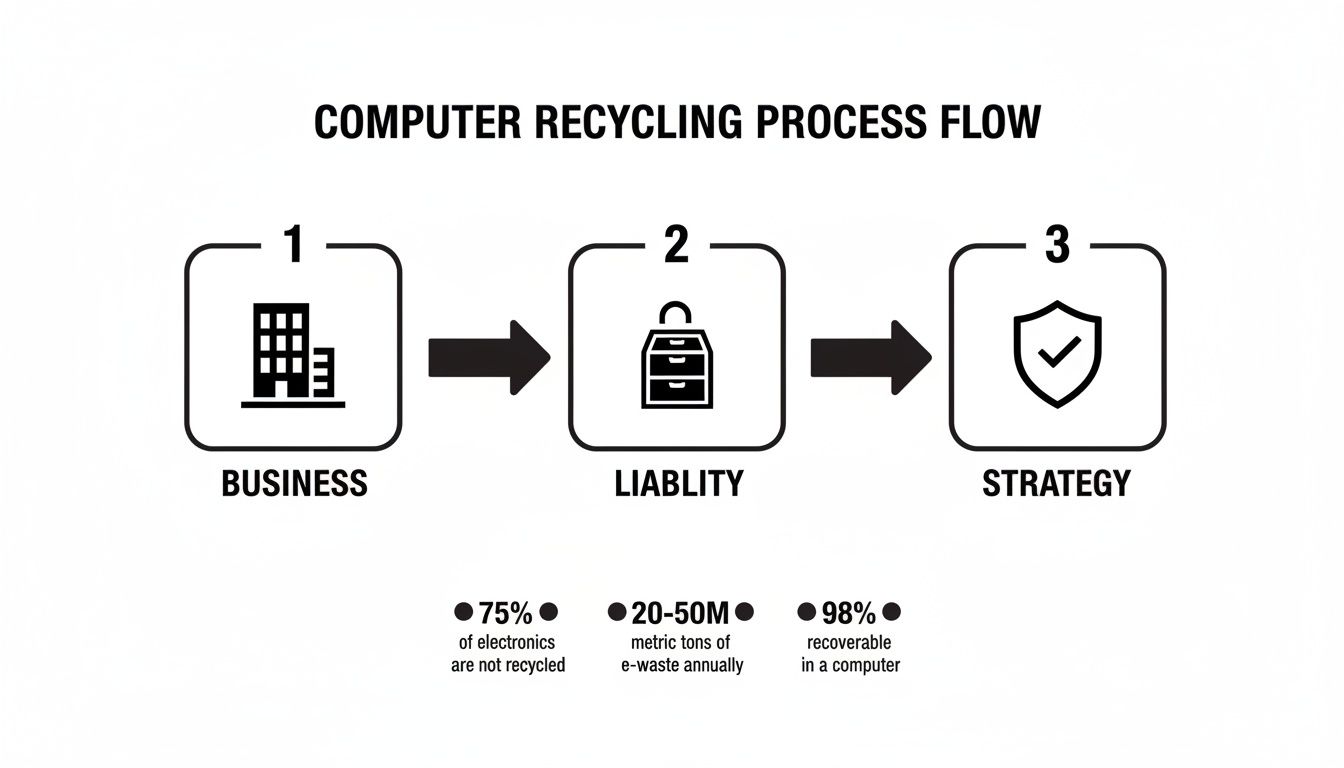
The image effectively communicates the critical shift from viewing retired technology as an unsecured liability to managing it with a secure, strategic framework.
Why a Strategic Plan Matters
Without a formal ITAD plan, your business is exposed. A single laptop misplaced during an office relocation could trigger a data breach. Disposing of equipment in the wrong container can lead to hefty environmental fines. These are not hypothetical scenarios; they are common occurrences when the final phase of the IT lifecycle is neglected.
By implementing an ITAD strategy, you gain a documented, defensible process. It provides the necessary proof for compliance audits and offers peace of mind that your company's reputation and data are protected.
Ultimately, choosing a comprehensive plan for Buckhead computer recycling means you are actively managing risk, not just disposing of old assets. You gain security, regulatory compliance, and potential financial returns, turning a former logistical headache into a well-managed business function.
If you're ready to learn more, you can explore our detailed explanation of what IT Asset Disposition is and see how it can directly benefit your organization.
Making Your Company Data Unrecoverable
For any business in Buckhead managing computer recycling, one objective supersedes all others: ensuring sensitive corporate data is irretrievably destroyed. Simply hitting 'delete' or performing a standard format on a hard drive is grossly inadequate for corporate data security. These actions only remove the pointers to your files, leaving the actual information intact and easily recoverable with off-the-shelf software.
Think of it as removing the table of contents from a sensitive corporate binder. All the confidential chapters remain, waiting for an unauthorized party to find them. For a business, that could mean exposing client financials, employee PII, or your most valuable intellectual property.
The Two Pillars of Data Destruction
To truly protect your organization, professional IT recyclers rely on two proven methods for permanent data destruction. Each serves a specific purpose and provides an unbreakable layer of security, ensuring your digital information is never compromised. Understanding these options is key to a sound ITAD strategy.
The two primary methods are:
- Software-Based Data Wiping: A deep, forensic-level digital sanitization process.
- Physical Hard Drive Shredding: The complete mechanical destruction of the storage media itself.
This commitment to proper data handling is more critical than ever. Global e-waste generation exploded to a staggering 62 million tonnes in 2022, yet documented recycling rates are alarmingly low. This crisis hits tech-heavy commercial districts like Buckhead particularly hard, where professional ITAD services are essential for managing the constant churn of retired assets securely and sustainably. To see the full scope of this trend, you can explore the full 2024 e-waste report.
To make the choice clearer, we’ve broken down how each data destruction method works and its ideal business application.
Data Destruction Methods Explained
| Method | Process | Best For | Outcome |
|---|---|---|---|
| DoD Wiping | Overwrites every sector of a drive multiple times with random data using specialized software. | Drives that are still functional and have resale or redeployment value. | Data is forensically unrecoverable, but the physical drive remains intact and usable. |
| Physical Shredding | Feeds the entire drive into an industrial shredder that grinds it into small metal fragments. | End-of-life, failed, or outdated drives, or for maximum-security scenarios. | The drive is completely destroyed, making data recovery physically impossible. |
Ultimately, choosing the right method—or even a combination of both—is about aligning your security requirements with your asset management goals.
DoD Wiping: The Digital Bleach
Software-based data wiping, often using the DoD 5220.22-M 3-pass standard, is like digitally bleaching a hard drive. It doesn't just delete files; it methodically overwrites every single sector of the drive with random patterns of ones and zeros, multiple times over. Once this process is complete, the original data is rendered completely invisible and impossible to reconstruct.
This approach is ideal for drives that retain value and can be refurbished for resale. By preserving the hardware, your company can potentially recover a portion of its initial investment while still guaranteeing total data security.
The Certificate of Data Destruction you receive after this process is your legal proof and audit trail. It’s the official document that confirms your company has met its compliance obligations for regulations like HIPAA, protecting you from potential fines and legal action.
Physical Shredding: The Digital Woodchipper
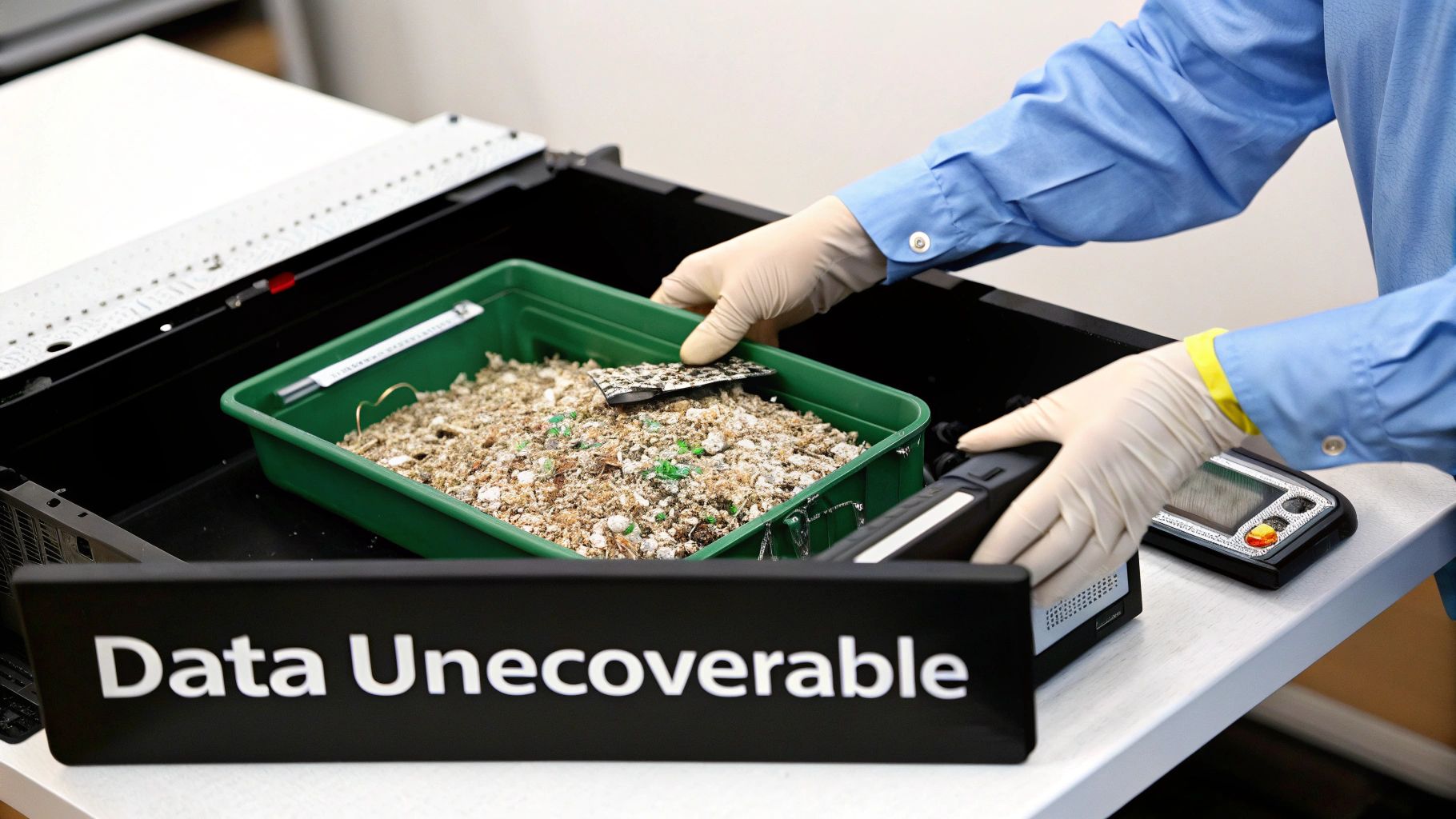
For drives that are non-functional, obsolete, or contain exceptionally sensitive information, physical destruction is the ultimate failsafe. Think of it as a digital woodchipper for your data. The hard drive is fed into an industrial shredder that pulverizes it into small, unrecognizable metal fragments.
There is no software, technique, or technology that can recover data from a physically shredded drive. It is the most absolute form of data destruction available, offering complete peace of mind. Many businesses in the Buckhead area, particularly in finance and healthcare, opt for this method for their most critical assets to eliminate any possibility of a breach. You can review our process for secure data destruction services to see exactly how this works.
How a Professional Pickup Process Works
Once your data destruction strategy is in place, the next critical step is removing the retired equipment from your office without disrupting business operations. A professional Buckhead computer recycling pickup is not just a hauling service; it’s a coordinated logistical operation. The objective is to be efficient, secure, and minimally intrusive to your workflow, whether we're clearing out a small server closet or decommissioning an entire office floor.
The process begins long before our truck arrives. It starts with a straightforward consultation to scope the project and understand your specific requirements. This initial planning is key to ensuring a flawless execution.
From Initial Assessment to On-Site Execution
First, we work with your team to create a detailed inventory of the assets slated for disposition. This can be as simple as a count of desktops, laptops, servers, and monitors. This information allows our team to determine the right crew size, truck capacity, and any specialized equipment needed for the job.
Once the scope is defined, we schedule the pickup at a time that minimizes disruption to your business, often after hours or on a weekend. Our goal is to make the process as seamless as possible for your IT and facilities teams.
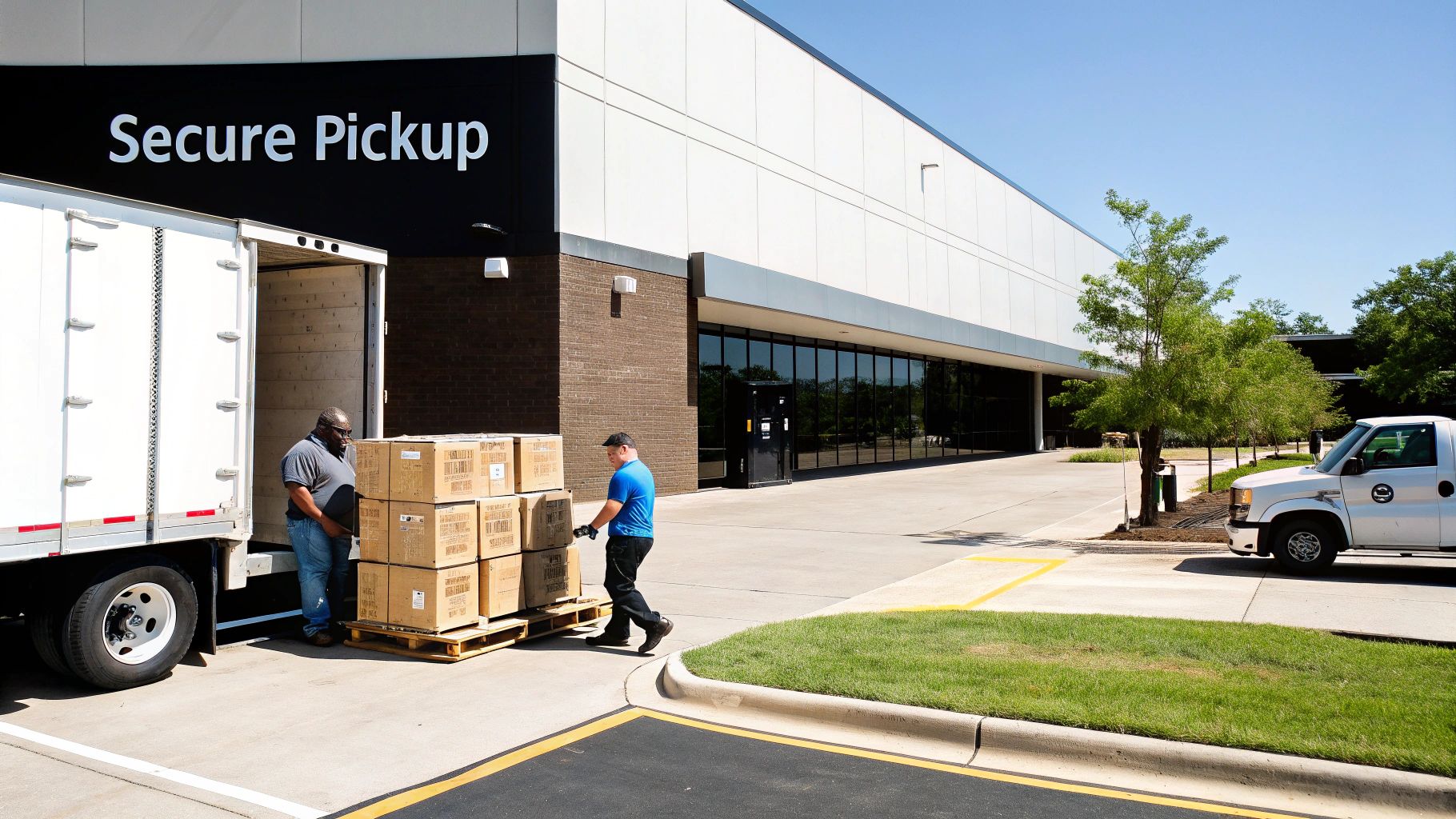
A well-executed pickup feels less like a disposal service and more like a professional logistics operation. The team arrives prepared, works methodically, and leaves your space clean and clear, allowing your staff to remain focused on their core responsibilities.
On the scheduled day, our trained and insured crew arrives with all necessary equipment—dollies, pallet jacks, packing materials, and security cages. Their job is to manage all the heavy lifting and secure transport, ensuring every asset is accounted for from the moment it leaves your building. This documented chain of custody is a cornerstone of any professional ITAD service.
Preparing Your Assets for a Smooth Pickup
While our team manages the heavy logistics, some simple preparation on your end can significantly streamline the process. A few steps can help our crew work more quickly and safely.
Here are a few best practices to get everything ready:
- Consolidate Equipment: If possible, gather all electronics in a designated, easily accessible area. This prevents our crew from having to search for items across multiple offices or floors.
- Disconnect Peripherals: Unplug keyboards, mice, monitors, and power cords from all computers. Bundling these accessories keeps the workspace organized and efficient.
- Document Key Assets: For high-value equipment like servers or network switches, noting the serial numbers for your own records provides an additional layer of tracking and accountability.
Taking these small steps can seriously accelerate the on-site work, minimizing the time our crew spends in your workspace. This collaborative planning is what distinguishes a top-tier Buckhead computer recycling service.
If you're planning a large-scale cleanout, it helps to understand the full scope of a professional service. You can learn more by checking out our detailed guide on the commercial computer pickup process and how we tailor it for business needs. From secure packing and palletizing to fully documented transport, every step is designed to protect your assets and your business.
The Financial Case for Certified IT Recycling
When your Buckhead business retires IT equipment, the conversation often centers on data security and environmental responsibility. While those are critical, a professional Buckhead computer recycling program is also one of the soundest financial decisions a company can make. It’s easy to view IT Asset Disposition (ITAD) as a simple expense, but that’s a shortsighted perspective. A better framework is to see it as an investment in risk mitigation that can also generate unexpected revenue.
The reality is, the cost of inaction far exceeds the cost of a certified recycling program. A single data breach from a forgotten laptop can trigger crippling regulatory fines, costly litigation, and long-term damage to your brand’s reputation. Similarly, being cited for illegal e-waste dumping comes with its own steep penalties. These are massive, unmanaged financial liabilities.
Understanding the Direct Costs and How to Manage Them
The cost of professional ITAD services is not arbitrary; it's transparent and based on several key factors. Understanding these drivers allows you to plan effectively and recognize the clear value proposition.
Here’s what typically shapes a quote:
- Volume of Equipment: Like any bulk service, larger quantities of assets typically reduce the per-unit cost, making a full office cleanout highly efficient.
- Type of Equipment: Modern laptops, servers, and networking gear often have residual market value, which can offset or even cover recycling costs. Older, heavier items like CRT monitors may incur a small disposal fee.
- Logistical Needs: Services like on-site de-installation from server racks, professional packing, or navigating a Buckhead high-rise can influence the final price.
This is not just a local concern—it's a massive global industry. The electronic waste recycling market reached USD 80.4 billion worldwide in 2025, with North America accounting for 37% of that. The computer scrap market alone is projected to grow from USD 34.94 billion in 2025 to USD 57.25 billion by 2032, driven almost entirely by commercial e-waste from offices and data centers.
A certified ITAD partner provides a detailed, upfront quote. This financial clarity transforms an unknown liability into a predictable, manageable operational cost. No surprise fees, no hidden charges.
Uncovering the Hidden ROI of Smart Recycling
Beyond avoiding catastrophic fines, a strategic approach to Buckhead computer recycling delivers tangible financial returns. This "hidden ROI" is what elevates a disposal task into a value-generating activity for your business. The primary opportunity here is asset value recovery.
Functional IT hardware, especially enterprise-grade servers, laptops, and networking switches, often retains significant value on the secondary market. A professional ITAD provider has the expertise and network to securely wipe, test, and remarket these assets on your behalf. This process converts depreciated hardware from a liability in a storage closet into revenue for your company. You can see how we handle this by checking out our guide to Atlanta IT asset liquidation.
The Intangible Value of Corporate Responsibility
Finally, the financial case isn’t limited to direct costs and returns. Demonstrating a tangible commitment to secure, sustainable practices builds significant brand equity. Today's customers, business partners, and top-tier job candidates are increasingly drawn to companies that operate responsibly.
By partnering with a certified recycler, you gain:
- Enhanced Brand Reputation: Publicizing your commitment to data security and environmental stewardship provides a significant boost to your corporate image.
- Improved Stakeholder Trust: A documented, compliant recycling program gives investors, board members, and clients confidence that you are managing risk professionally.
- A Clear Competitive Advantage: In a crowded marketplace, proving you are a responsible corporate citizen can be a powerful differentiator.
When you aggregate the catastrophic costs avoided, the direct revenue recovered, and the long-term value of a stellar reputation, the financial argument is crystal clear. Professional IT recycling isn’t an expense. It’s one of the smartest investments a modern business can make.
Answering Your Business Recycling Questions
For business leaders in Buckhead investigating professional IT recycling, it's natural to have questions about cost, security, and logistics. We’ve compiled straightforward answers to the most common inquiries from our commercial clients to help you make an informed decision for your IT asset disposition plan.
What Does It Cost for a Business to Recycle Computers in Buckhead?
The cost for a professional Buckhead computer recycling service is determined by a few key factors: the total volume and type of equipment, the level of on-site service required (e.g., server de-installation), and your chosen data destruction method.
However, for many commercial pickups involving a good mix of servers, computers, and laptops, the service can often be very low-cost or even free of charge. This is possible because the value recovered from remarketing reusable assets and recycling raw materials can offset our service fees.
Standard DoD 3-pass data wiping is typically included at no extra cost for qualifying equipment. If you require physical hard drive shredding for maximum security, a small per-drive fee may apply. The best approach is to request a custom quote based on your specific inventory for transparent, all-inclusive pricing.
How Do I Prove My Company's Sensitive Data Was Destroyed?
This is a critical question, and the answer lies in our documented, auditable process. Simply deleting files is insufficient. We guarantee data is permanently eliminated using industry-best practices. Our standard procedure is a DoD 5220.22-M 3-pass wipe, which overwrites the entire drive multiple times, making the original data forensically unrecoverable.
For non-functional drives or for clients requiring the absolute highest level of security assurance, we also offer physical shredding services.
Regardless of the method used, we issue a formal Certificate of Data Destruction upon completion. This legal document serves as your official record and audit trail, proving that your data was permanently destroyed in compliance with regulations like HIPAA and providing essential documentation for your internal security policies.
What IT Equipment Do You Take Besides Computers?
While our name highlights computer recycling, we provide a comprehensive IT asset disposition service for businesses. We understand that a technology refresh involves far more than just desktops and laptops. Our objective is to be your single point of contact for an entire IT infrastructure cleanout.
We manage a wide range of corporate technology, ensuring every item is handled securely and responsibly.
- Data Center Hardware: Servers (rack, tower, blade), storage area networks (SANs), and server enclosures.
- Networking Equipment: Switches, routers, firewalls, and wireless access points.
- Power Management: Uninterruptible Power Supply (UPS) battery backups and Power Distribution Units (PDUs).
- Office Peripherals: Printers, scanners, copiers, and multifunction devices.
- Communication Systems: VoIP phones, headsets, and conference room A/V equipment.
- Cables and Accessories: All associated power cords, data cables, keyboards, and mice.
What Is the First Step to Arrange a Pickup for My Office?
Getting started is simple and designed to be efficient for busy IT managers and office coordinators. There are no complex forms or bureaucratic hurdles.
The first step is to contact us for a no-obligation consultation. You can call our office directly or fill out the brief request form on our website to initiate the process.
We will then discuss your inventory, its location within your Buckhead office, and any specific security or logistical requirements—such as coordinating with building management in a high-rise or scheduling an after-hours pickup. Based on this conversation, we will provide a clear, transparent proposal. Once you approve, we schedule a pickup time that suits your operational needs, and our professional team handles everything from there, ensuring a smooth and secure process from start to finish.
Ready to clear out your retired IT assets securely and responsibly? The team at Atlanta Computer Recycling is here to help. We provide a complete, documented solution for businesses throughout the Buckhead area, ensuring your data is destroyed and your equipment is handled in an environmentally sound manner. Contact us today for a free, no-obligation quote and see how easy professional IT recycling can be.