Your Business Guide to Midtown Atlanta Recycling for IT Assets

For any business in Midtown Atlanta, managing IT asset disposition is a critical operational function, not just a recycling task. A common—and potentially catastrophic—mistake is treating obsolete corporate electronics like residential waste by tossing them into the city's standard blue bins.
While municipal programs are effective for consumer goods like bottles and paper, they are completely unequipped to handle the security, compliance, and logistical complexities of corporate IT assets. The simple truth is that standard recycling processes offer zero data protection, leaving your company's proprietary and client data exposed to significant risk.
Why Standard Midtown Recycling Fails Your Business IT Assets

Midtown Atlanta's public recycling programs serve an important community purpose. In 2023, the city’s municipal efforts collected nearly 20,000 tons of recyclables from residential sources, demonstrating a strong commitment to sustainability.
However, this residential success creates a dangerously false sense of security for businesses. The municipal system is designed for consumer materials like cardboard and glass—not for complex enterprise-grade electronics laden with hazardous materials and, more importantly, sensitive corporate data.
The Critical Difference for Businesses
A useful analogy: a company wouldn't send sensitive legal documents through standard, unsealed mail. It would use a bonded, tracked courier. The same logic applies to corporate IT assets. Disposing of a server or a batch of company laptops through a public recycling stream is equivalent to leaving an unlocked filing cabinet on the curb.
This approach exposes your business to severe threats that municipal services were never designed to mitigate:
- Data Security Breaches: A simple "delete" function is insufficient. Hard drives can still hold recoverable data, putting confidential client lists, financial records, and employee information at risk without certified data destruction.
- Regulatory Non-Compliance: Businesses in healthcare (HIPAA), finance, or legal sectors are bound by stringent data privacy regulations. Improper disposal is not just a procedural error; it can lead to severe fines and legal action.
- Environmental Hazards: Enterprise electronics contain lead, mercury, and cadmium. These materials require specialized handling to prevent environmental contamination—a process standard recycling facilities are not equipped for.
The core issue is this: municipal recycling focuses on recovering raw materials, not securing sensitive information. For any business, the data on a device is invariably more valuable—and more dangerous if exposed—than the physical hardware itself.
Moving Beyond the Blue Bin: A Clear Comparison
For businesses, the goal is not merely "recycling." It is secure and compliant IT Asset Disposition (ITAD)—a deliberate, documented process designed to protect your organization from operational, financial, and reputational risk.
Let’s compare the real-world outcomes of using a municipal bin versus engaging a specialist.
Commercial E-Waste vs Residential Recycling: A Comparison
| Consideration | Municipal Curbside Recycling | Specialized E-Waste Recycling (ACR) |
|---|---|---|
| Data Security | None. Drives are untreated, leaving data exposed. | Certified data wiping and physical shredding. |
| Compliance | No documentation for HIPAA, FACTA, or PCI. | Provides Certificates of Destruction for audits. |
| Chain of Custody | None. Assets are mixed and untracked. | Secure, documented tracking from pickup to disposal. |
| Logistics | You drop it off, or it's collected with general waste. | On-site pickup, palletizing, and secure transport. |
| Environmental | Basic sorting; hazardous materials may be mishandled. | R2v3/RIOS certified processing for all materials. |
| Value Recovery | Zero. All items are treated as scrap. | Identifies reusable assets for potential remarketing. |
The table makes the distinction clear. One path represents a gamble with your company's security and reputation; the other is a professional service engineered to eliminate risk.
If this is a new concept for your organization, it is worth understanding what IT asset disposition entails and why it is a critical function for any modern enterprise. It’s the difference between simply disposing of old equipment and strategically protecting your business.
Protecting Your Data During Electronics Disposal
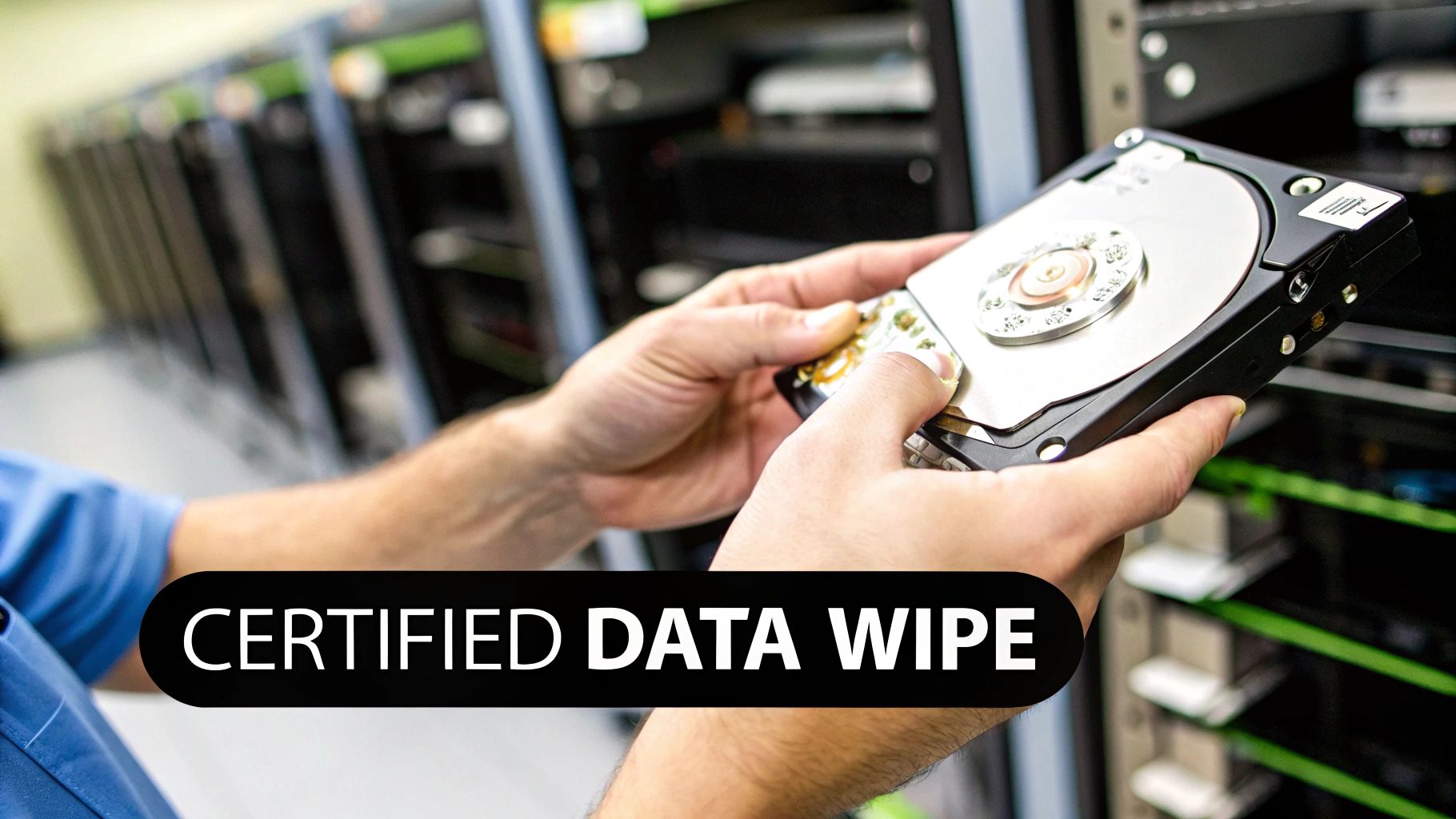
When an obsolete computer, server, or hard drive leaves your premises, the greatest risk is not the hardware—it's the data it contains. Disposing of IT equipment is fundamentally a data security task, and treating it as anything less creates a direct threat to your business.
Simply dragging files to the recycle bin provides a false sense of security. The file is not truly erased; the operating system has merely marked its space as available for new data. Until it is overwritten, the information remains recoverable.
Certified data wiping, conversely, is the digital equivalent of professional cross-cut shredding. The information isn't just discarded; it's systematically destroyed, converting readable data into meaningless noise. Before disposing of any electronics, it is critical to understand how to wipe your data correctly to protect your organization.
The Gold Standard for Data Destruction
For any business, the benchmark for secure data erasure is the DoD 5220.22-M 3-pass standard. This rigorous methodology, formerly used by the Department of Defense, ensures complete data sanitization.
Here is a breakdown of the process:
- Pass One: The entire drive is overwritten with a pattern of zeros.
- Pass Two: It is immediately overwritten again, this time with a pattern of ones.
- Pass Three: A final pass overwrites the drive with random characters.
This multi-pass process scrambles the drive's magnetic surface so thoroughly that the original data becomes virtually impossible to recover, even with advanced forensic tools. This methodical approach provides a verifiable guarantee of destruction. Understanding this process demystifies secure data destruction and highlights its importance.
For any Midtown Atlanta business, particularly those managing sensitive data, certified data wiping isn’t just a best practice—it's a fundamental risk management control. It transforms a potential liability into a documented, secure, and closed loop.
Why This Matters for Midtown's Key Industries
Midtown Atlanta is a major hub for healthcare, finance, and legal firms. In these sectors, data security is not just an internal policy; it is a legal requirement enforced by stringent regulations.
Healthcare (HIPAA): The Health Insurance Portability and Accountability Act mandates the secure handling of all Protected Health Information (PHI). The improper disposal of a single workstation containing patient records can lead to fines reaching millions of dollars per incident.
Finance and Legal: These industries are built on client trust and handle vast amounts of personally identifiable information (PII) and confidential data. A data breach originating from a discarded hard drive can irrevocably damage that trust and trigger severe legal consequences.
Failing to properly sanitize retired IT assets is a direct violation of these compliance standards. Engaging a certified Midtown Atlanta recycling partner that provides documented data destruction is the only way to ensure your organization remains compliant, secure, and protected from the devastating financial and reputational damage of a data breach.
Streamlining E-Waste Pickup in Midtown's Urban Core
Retrieving obsolete IT equipment from a high-rise office on Peachtree Street presents unique logistical challenges. For any facilities manager, Midtown Atlanta's dense urban environment—with its persistent traffic, limited parking, and strict building regulations—can transform a simple equipment refresh into a complex operational project.
This is precisely where a professional e-waste pickup service becomes indispensable. It is not merely a hauling service; it is a coordinated operation designed to navigate the constraints of a busy commercial district. Consider it a "white-glove" logistics service specifically for your technology assets.
The entire process is engineered to minimize disruption to your business operations. Instead of reassigning your internal teams from their core responsibilities, trained technicians manage every step of the removal, ensuring your business continues to operate smoothly while obsolete equipment is securely and efficiently removed.
Navigating the Midtown Logistics Maze
A successful pickup in a location like Midtown requires meticulous planning and flawless execution. Professional services are structured to manage the common logistical hurdles that can derail an in-house removal effort.
Key components of a smooth operation include:
- On-Site De-installation: Technicians safely disconnect and remove equipment from server racks, network closets, and individual workstations, freeing up your IT team's valuable time.
- Building Coordination: Experienced crews coordinate directly with your building’s management to schedule freight elevator access and reserve loading dock space, ensuring full compliance with all property rules.
- Secure Packing and Transport: All assets are professionally packed, palletized, and loaded into secure vehicles at your location. This establishes a clear and unbroken chain of custody from your office to the processing facility.
For facilities managers, this approach resolves significant operational headaches. A specialized Midtown Atlanta recycling partner understands that your schedule is tight and building access is restricted. They will plan the entire removal around your business hours, often after 5 PM or on a weekend, to avoid disrupting daily workflow or congesting common areas. Learn more about how a well-planned commercial computer pickup service can simplify your next IT refresh.
The objective is to make the entire process seamless for your business. A professional e-waste partner manages the elevators, security protocols, and traffic so your team can remain focused on their primary responsibilities.
This specialized service transforms a potentially chaotic project into a predictable, managed process. Instead of your staff struggling with heavy servers in crowded hallways, you receive a swift, secure, and compliant removal. The result is a clean, clutter-free office, ready for your next technology deployment without the logistical burden.
What Happens to Your IT Assets After Pickup?
Once our secure truck departs from your Midtown Atlanta office with your company's retired IT equipment, what is the next step? The process is not a simple trip to a landfill. Instead, it marks the beginning of a highly controlled workflow guided by the principle of Reuse, Recover, and Recycle.
The optimal and most sustainable outcome is to extend the life of functional equipment. We prioritize refurbishing usable laptops, servers, and monitors. After thorough testing and any necessary repairs, these assets can be remarketed, re-entering the circular economy instead of becoming waste. This is always our primary objective.
From Your Office to Our Secure Facility
The journey from your server room to our processing center is a critical first step. The entire process is built around maintaining an unbroken, secure chain of custody.
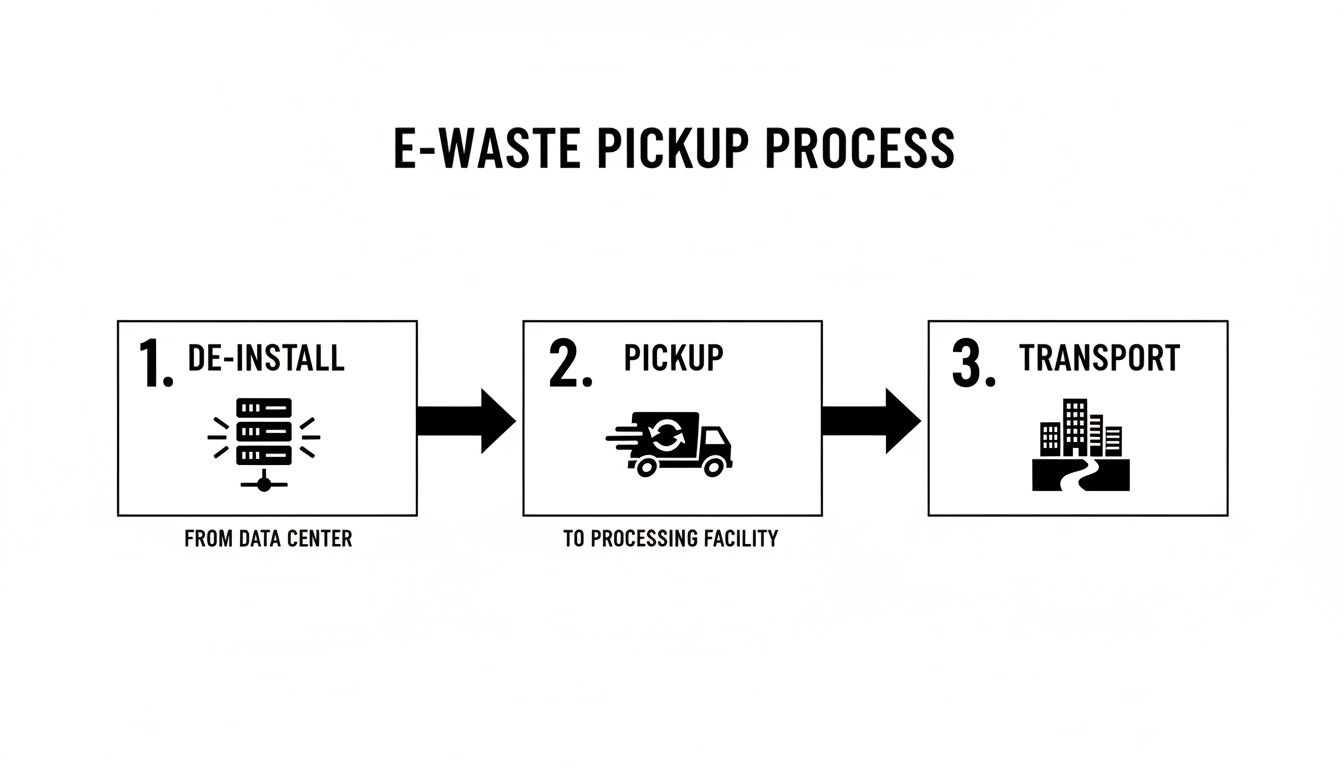
From the moment our team de-installs the first server rack until it arrives at our facility, your assets are meticulously tracked and protected without exception.
The Breakdown and Recovery Process
For equipment that is too old, damaged, or obsolete for reuse, we proceed to material recovery. This involves a careful, manual deconstruction process where our technicians dismantle each device by hand in a reverse assembly line.
The goal is to segregate all components into clean, individual material streams that can be used in the manufacturing of new products.
- Metals: We recover steel, aluminum, and copper, as well as precious metals like gold and silver from circuit boards.
- Plastics: Casings from monitors, keyboards, and printers are shredded and sorted by polymer type for recycling.
- Glass: Screens from CRT monitors and modern flat panels are carefully separated for specialized processing.
This responsible, domestic process is fundamentally different from the practices of uncertified recyclers who may export e-waste overseas, where it is often dismantled improperly, creating environmental hazards. It is also important to note that many electronics contain materials classified under the nine classes of dangerous goods, which necessitates professional handling.
A certified, zero-landfill policy is your assurance that every component is handled ethically and domestically. It protects your brand’s reputation and ensures your company meets its corporate social responsibility commitments.
Even with the city’s best efforts, Atlanta’s recycling programs have limitations. A 2025 audit noted significant challenges in servicing multifamily buildings, which constitute 50% of the housing in areas like Midtown. This underscores why businesses require a specialized partner capable of providing the documented, compliant solutions that municipal services cannot.
Working with a certified Midtown Atlanta recycling specialist provides transparency and accountability throughout the entire process. For a more detailed overview, you can explore what happens to recycled electronics in our in-depth guide.
How to Implement a Corporate E-Waste Program
Establishing a formal e-waste program is a matter of creating a straightforward, repeatable process. For IT and facilities managers in Midtown Atlanta, transforming a disorganized accumulation of old equipment into a secure, compliant disposal system is an achievable goal. The process begins with a clear understanding of your asset inventory.
The first step is to conduct a thorough asset inventory. This involves creating a detailed list of all electronics slated for disposal—from servers and laptops to monitors and networking gear. This documentation serves as the foundation for tracking each device and ensuring complete accountability.
Once the inventory is complete, the next critical step is asset segregation. A keyboard is fundamentally different from a hard drive containing sensitive client data, and they require different handling protocols. You must separate devices that store data from those that do not to ensure that your data-bearing assets receive the high-security processing they require.
Building Your Action Plan
With your inventory sorted, you can develop a clear action plan. This is the point where you transition from internal preparation to engaging a professional partner for your Midtown Atlanta recycling needs. A structured approach ensures no detail is overlooked.
- Categorize Your Inventory: Group items into logical categories such as "Data-Bearing (High Risk)," "Non-Data (Low Risk)," and "Potentially Reusable."
- Define Your Security Needs: For each data-bearing device, determine whether you require certified data wiping, physical shredding, or a combination of both.
- Schedule a Consultation: Contact a certified ITAD provider to review your inventory, discuss building logistics, and schedule a pickup.
A well-documented plan transforms e-waste disposal from a recurring logistical challenge into a routine operational task. It provides your team with a clear roadmap and serves as a checklist for your recycling partner, ensuring total accountability from start to finish.
Choosing the Right ITAD Partner
Selecting the right vendor is the most critical decision in this process. This partner becomes a custodian of your company's sensitive data and, by extension, its reputation. Conducting thorough due diligence is not just advisable—it is essential.
While the city is making progress, a recent audit revealed Atlanta's overall recycling rate is just 23%, lagging behind federal standards. The audit also highlighted inconsistent service for commercial buildings, which is precisely why businesses need a dedicated partner to address this gap.
To assist in vetting potential partners, we have developed a concise checklist.
IT Asset Disposition Checklist for Your Business
Use this checklist to guide your conversations and ensure you cover all critical areas before entering into a service agreement.
| Checklist Item | Key Questions to Ask | Why It Matters |
|---|---|---|
| Certifications | Are they R2v3 or e-Stewards certified? Can you provide proof? | These are the premier industry standards for responsible e-recycling and data security. Uncertified vendors pose a significant risk. |
| Data Destruction Methods | What are your specific processes for wiping and shredding? Will I receive a Certificate of Destruction? | You require verifiable proof that data was destroyed to meet compliance standards and protect your company from liability. |
| Chain of Custody | How do you secure assets from our office to your facility? Do you use sealed, GPS-tracked trucks? | A secure chain of custody prevents data breaches during transit. Any security gap is a potential point of failure. |
| Logistics & On-Site Services | Do you offer on-site hard drive shredding? How do you handle pickups in a busy office building? | On-site services provide maximum security for highly sensitive data. A professional partner knows how to operate efficiently without disrupting your business. |
| Reporting & Transparency | Will we get a serialized report detailing the final disposition of each asset? | Detailed reporting provides an auditable trail for compliance and confirms that every asset was handled according to the agreed-upon protocol. |
Asking these questions will help you select a partner who can genuinely protect your business interests. For a more comprehensive look, our guide on corporate e-waste recycling offers additional insights for businesses.
By following these steps, you can implement a secure, compliant, and efficient program that not only protects your data but also aligns with your company’s sustainability objectives.
Your E-Waste Recycling Questions, Answered
Even with a well-defined strategy, specific questions often arise. When your company’s data security and compliance are at stake, you require direct, practical answers. Here, we address some of the most common inquiries we receive from businesses in Midtown Atlanta.
The objective is to provide clear information to help you move forward with confidence, knowing your assets and reputation are protected.
What Does E-Waste Recycling Cost?
This is a frequent and important question. The answer depends entirely on your inventory. For many businesses, the service can be low-cost or even generate a return, particularly if your retired IT assets retain residual value.
The financial model is similar to fleet vehicle disposition. A newer, functional asset may have a positive value, while an older, non-working one will have a disposal cost.
- Valuable Assets: Newer servers, business-class laptops, and networking equipment can often be refurbished and remarketed. The value recovered from these items can offset or completely cover the costs of logistics and data destruction.
- Legacy Equipment: Conversely, older items like CRT monitors or broken office printers have no resale value and incur costs for responsible de-manufacturing and recycling. These items typically have a transparent recycling fee.
A professional ITAD partner will always provide an itemized quote upfront, ensuring full transparency before any services are rendered.
How Can I Be Certain My Data Is Destroyed?
This is the most critical question for any business. The answer is rooted in one word: documentation. You should never have to rely on a vendor's verbal assurance. True data security is proven with a clear, auditable paper trail.
When you work with a certified provider for Midtown Atlanta recycling, you receive a Certificate of Destruction. This is not merely a receipt; it is a legal document that serves as official proof that your data was permanently eliminated according to strict industry standards.
Your Certificate of Destruction is your ultimate safeguard. It details the serial numbers of the specific drives that were sanitized or shredded, the methods used, and the date of destruction. This provides an ironclad record for compliance audits.
This document is a non-negotiable deliverable. It is what distinguishes a professional IT Asset Disposition (ITAD) firm from a simple hauling service and is essential for meeting regulations like HIPAA.
What Types of Equipment Do You Accept?
As a general rule, if it plugs into a wall or runs on a battery, we can almost certainly process it. Our services extend far beyond just computers and monitors.
Our process is designed to be a comprehensive, single-source solution for all your corporate IT and electronic equipment. Our teams regularly manage pickups that include:
- Computers, Laptops, and Servers
- Monitors (LCD, LED, and CRTs)
- Networking Gear (Switches, Routers, Firewalls)
- Data Center Equipment (Racks, UPS, Cabling)
- Printers, Scanners, and Office Phones
- Mobile Devices and Tablets
If you have specialized or unusual electronic equipment, please inquire. It is highly likely we can process it securely and responsibly, ensuring no asset from your facility is disposed of improperly.
Ready to create a secure, compliant, and hassle-free e-waste program for your Midtown Atlanta business? Atlanta Computer Recycling provides documented data destruction and responsible electronics recycling tailored for commercial needs. Contact us today for a free consultation and quote.