Electronic Shredding for Businesses: Secure, Compliant Data Destruction

That stack of retired laptops, servers, and old hard drives in your company’s storage closet isn't just taking up space—it’s a ticking time bomb of data breach liability. When your business searches for electronic shredding near me, you're taking the single most important step in protecting your enterprise from devastating financial and reputational damage. This guide will show you exactly why professional shredding is the only way to guarantee your sensitive corporate data is gone for good.
Beyond Wiping: Why Physical Destruction Is Non-Negotiable for Businesses
Simply wiping or reformatting a hard drive just doesn't cut it anymore when it comes to securing your company’s confidential information.
Think of an old company hard drive as a locked filing cabinet crammed with sensitive client records, financial statements, and proprietary strategies. Using data wiping software is like shredding the paper index inside that cabinet; a determined threat actor with the right tools could still painstakingly piece the actual documents back together. In fact, sophisticated data recovery software can often restore files that were supposedly "deleted."
This leaves your business dangerously exposed. A single discarded drive could contain enough information to trigger a massive data breach, leading to regulatory fines, legal action, and a permanent loss of customer trust.
The Only True Guarantee of Data Elimination
Physical electronic shredding offers the only absolute guarantee that your corporate data is gone forever.
Instead of just erasing the index, this process is like melting the entire filing cabinet—documents and all—into a solid, unrecognizable block of metal. The data isn't just erased; it is physically annihilated, making recovery completely impossible. This is the definitive endpoint for any data-bearing device.
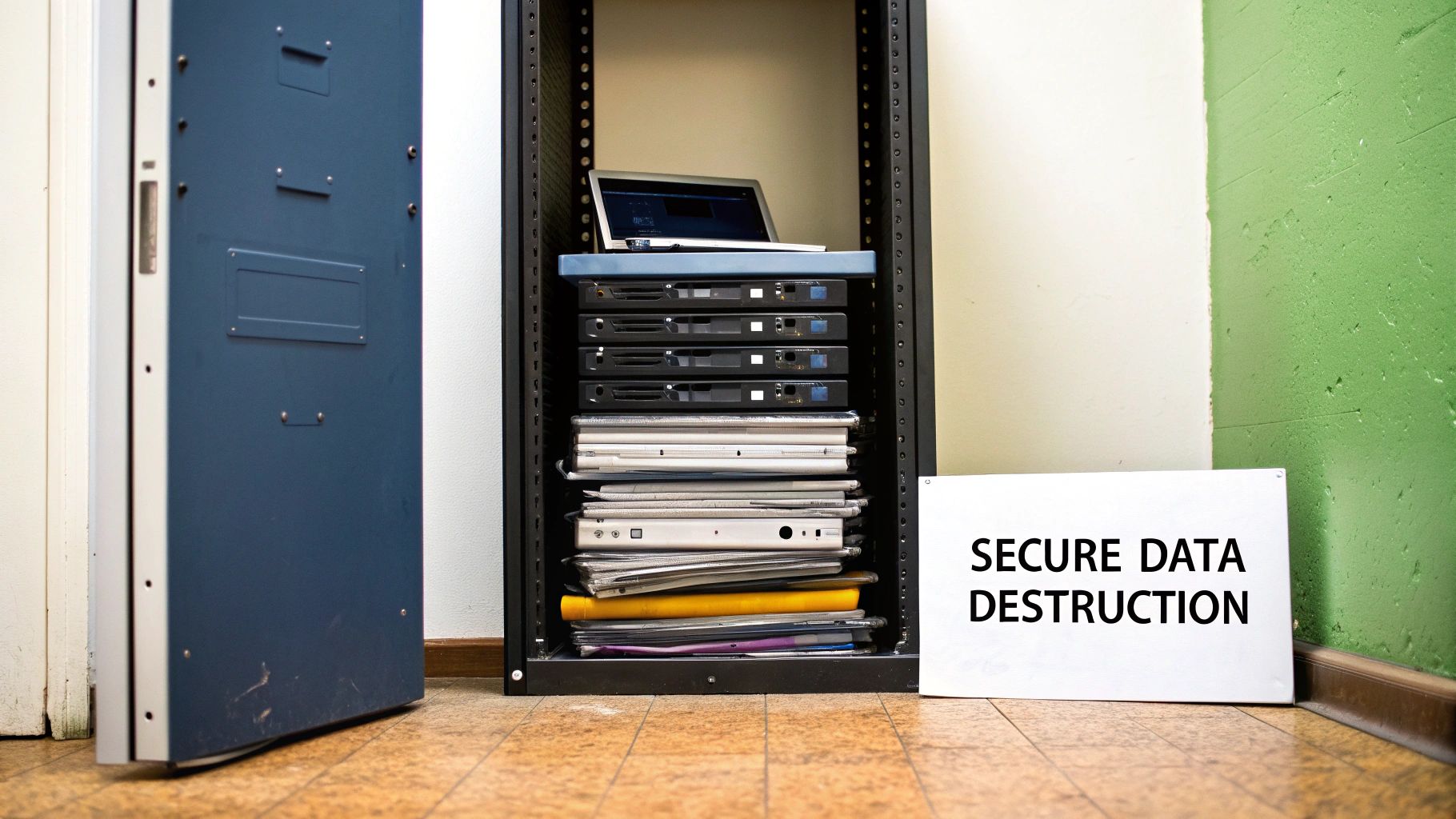
For businesses managing sensitive data, this isn't an optional step—it's a fundamental part of a robust security and compliance strategy.
When an asset reaches the end of its lifecycle, its data must be verifiably destroyed. Physical shredding provides an auditable, foolproof method that stands up to the strictest compliance requirements, from HIPAA to GLBA.
This process transforms a potential liability into a secure and closed chapter. You can learn more about the specifics of the process by exploring our guide on professional hard drive destruction. Partnering with a certified specialist ensures that every retired server, laptop, and mobile device is handled with the highest level of security, turning risk into peace of mind.
Choosing Your Service: On-Site vs. Off-Site Electronic Shredding
Once you’ve decided that physical destruction is the right path, the next question is simple: where should it happen? The choice between on-site and off-site electronic shredding is a big one, directly impacting your security protocols, internal workflow, and budget.
Getting to know the ins and outs of each model is the key to picking the service that truly fits your organization’s needs. Your decision really comes down to your company's risk tolerance, compliance demands, and how your team operates day-to-day. Both methods get the job done securely, but they’re built for different priorities.

On-Site Shredding: The Ultimate in Witnessed Destruction
On-site shredding, often called mobile shredding, brings the entire destruction process right to your curb. We roll up to your facility with a specialized, industrial-grade shredding truck ready to pulverize hard drives, SSDs, and other media right in your parking lot.
This is the service for organizations that demand ultimate transparency and peace of mind. Your IT or security team can physically watch every single device get destroyed, confirming with their own eyes that your data is gone for good. For businesses in tightly regulated fields like healthcare or finance, this witnessed destruction adds a bulletproof layer of security and proof.
When you can see the process from start to finish, there are zero questions about the chain of custody. You can learn more about how it all works by exploring options for on-site shredding near me.
Key Benefit: On-site shredding gives you real-time, witnessed verification. It’s the gold standard for organizations with the absolute strictest security mandates or for any business that needs certainty that sensitive data never leaves the property intact.
The process itself is clean and simple. Our technicians scan and inventory your assets on the spot before they’re fed into the shredder. This creates a meticulous record that lines up perfectly with the final Certificate of Destruction, giving you a complete, auditable trail from your server room to a pile of shredded particles.
Off-Site Shredding: Secure Logistics and Plant-Based Efficiency
Off-site shredding, or plant-based shredding, is a highly secure and efficient alternative that relies on a rock-solid, documented chain of custody. We protect your assets from the moment they leave your facility until their final destruction at our certified processing plant.
It starts with our trained technicians arriving at your location to securely pack your electronics into locked, tamper-evident containers. These containers are then loaded into GPS-tracked vehicles and driven directly to our secure, access-controlled facility.
Once at the plant, we weigh and inventory the containers before moving them into a monitored destruction area. The entire shredding process is often recorded on camera, providing a verifiable record of destruction. Even though you don’t see it in person, the strict protocols ensure a secure and fully auditable path. This model is often a more cost-effective choice for larger projects and can be less disruptive to your daily operations.
Comparing Your Options: On-Site vs. Off-Site Shredding
Making the right choice means weighing things like your security needs, budget, and internal resources. Both options deliver certified destruction, but they are definitely tailored to different business priorities.
To help you decide, we've put together a quick comparison of the two models. This table breaks down the essential differences to help you select the ideal service for your next IT asset disposition project.
On-Site vs Off-Site Shredding: Which Model Fits Your Business Needs?
| Feature | On-Site Shredding | Off-Site Shredding |
|---|---|---|
| Security | Maximum. Assets are destroyed before leaving your premises. You can witness the entire process firsthand. | High. Relies on a secure, unbroken chain of custody with locked transport and monitored facilities. |
| Verification | Immediate and visual. Your team can watch as each drive is physically destroyed. | Documented. Verification is provided through a Certificate of Destruction and detailed audit trails. |
| Cost | Generally higher due to the logistics of bringing specialized equipment and personnel to your location. | Often more cost-effective, especially for large quantities, due to centralized processing efficiencies. |
| Best For | Businesses with strict compliance needs (HIPAA, FACTA), highly sensitive data, or internal policies requiring witnessed destruction. | Organizations with large volumes of assets, budget constraints, or those seeking a less disruptive on-premise process. |
Ultimately, whether you need the absolute certainty of on-site shredding or the streamlined efficiency of off-site processing, the goal is the same: secure, verifiable, and permanent data destruction.
Meeting Compliance Mandates with Certified Data Destruction
For any business in healthcare, finance, or law, getting rid of old data isn't just spring cleaning—it's a serious legal obligation. When you're dealing with sensitive customer or patient information, your search for "electronic shredding near me" is really a search for a compliance partner you can trust. Because if you get it wrong, you’re not just facing a security risk; you’re looking at steep fines and a damaged reputation.
Regulations like HIPAA, FACTA, and GLBA don't mess around. They have strict rules about protecting personal information, and that includes when you’re throwing the hardware away. Physically destroying the drive is the only surefire way to meet those rules. There’s no ambiguity, no chance of recovery—just total peace of mind.
The Certificate of Destruction: Your Audit-Proof Shield
Once we’ve shredded your media, you get a Certificate of Destruction. This isn't just a receipt. It's your legally defensible proof that you did your due diligence and protected your sensitive data. Think of it as your get-out-of-jail-free card during an audit or legal dispute.
A proper Certificate of Destruction is a formal, detailed record that proves secure disposal happened. It’s the official death certificate for your data, closing the loop on your compliance duties for good.
For this document to hold up under scrutiny, it has to include specific details:
- A Unique Serial Number to track and verify the job.
- The Date of Destruction, so there’s no question when the service was done.
- The Method of Destruction, which will clearly state physical shredding.
- An Itemized List of Destroyed Media, including the serial number of every single hard drive.
- The Name of the Certified Vendor—that’s us.
- A Statement of Confidentiality, confirming the data was secure from start to finish.
This isn’t just paperwork; it’s what makes the entire process defensible. You can get a deeper look at what goes into this critical document in our complete guide to the Certificate of Destruction.
Understanding the Unbroken Chain of Custody
The backbone of any compliant shredding process is the chain of custody. This is simply a chronological paper trail that documents every single person who touches your assets, from the moment they leave your office to the second they’re turned into tiny metal fragments.
A secure chain of custody means there are no gaps, no unsupervised moments, and no opportunities for a hard drive to "walk away." It's a transparent, trackable journey that guarantees accountability every step of the way.
It’s just like shipping a priceless piece of art. You wouldn't just give it to any guy with a van. You’d use a bonded, insured service that documents every handoff and tracks the truck in real time. We treat your data with that same level of meticulous, verifiable security.
Here’s what that process looks like in practice:
- Secure Collection: Our trained, vetted technicians show up at your location to inventory and seal your assets in locked, tamper-evident containers.
- GPS-Tracked Transport: For off-site services, your assets are moved in a secure, GPS-tracked vehicle straight to our destruction facility. No side trips.
- Secure Facility Check-In: When the containers arrive, they are logged, weighed, and moved into a secure, access-controlled area to await destruction.
- Verified Destruction: We shred the media, often recording the process and matching the shredded items against the original inventory list.
This rock-solid process is what allows us to issue a Certificate of Destruction that you can actually rely on. For industries with specific mandates, it's also crucial to understand how a vendor approaches things like HIPAA-compliant data handling. When you vet a partner’s chain of custody, you’re making sure your data destruction isn't just secure, but completely audit-proof.
Your Step-by-Step Guide to a Secure Shredding Project
Kicking off a professional electronic shredding project is a refreshingly simple process, built from the ground up for business efficiency. From that first phone call to the moment you receive your final certificate, every step is designed to give you total peace of mind and an auditable paper trail. Let's walk through exactly what to expect.
Initial Consultation and Quote
It all starts with a straightforward conversation. When you first reach out, our goal is to get a clear picture of your project's scope. To build an accurate quote, we'll need a few key details.
Be ready to share things like:
- Asset Inventory: A rough idea of what you have (e.g., about 150 laptops, 25 servers, and maybe 500 loose hard drives).
- Service Preference: Let us know if you'd prefer on-site shredding right at your location or if our off-site service works better.
- Location Logistics: Any important details about your building, like if there's a loading dock or specific security checkpoints we need to know about.
- Reporting Needs: If you need serialized tracking for your internal asset management, just say the word.
With that information, we’ll provide a clear, upfront quote with no hidden surprises. It’s all about transparency so you can budget for your IT asset disposition (ITAD) without any guesswork.
Scheduling and Day-Of Expectations
Once you give the quote the green light, scheduling is a breeze. We'll lock in a date and time that causes the least disruption to your team and daily operations.
On the scheduled day, our team of trained, background-checked technicians will arrive ready to go. They handle all the logistics securely and efficiently. They’ll inventory the assets on the spot, pack all data-bearing devices into locked containers, and get them ready for destruction—either on-site or back at our facility.
While physical destruction is the gold standard for corporate assets, sometimes a simple wipe is all that's needed for personal devices. For example, resetting an iPhone to factory settings is a common step for individuals. For business-critical data, however, nothing beats the certainty of shredding.
This process is designed as a closed-loop system, which is just a way of saying we maintain an unbroken chain of custody from start to finish.
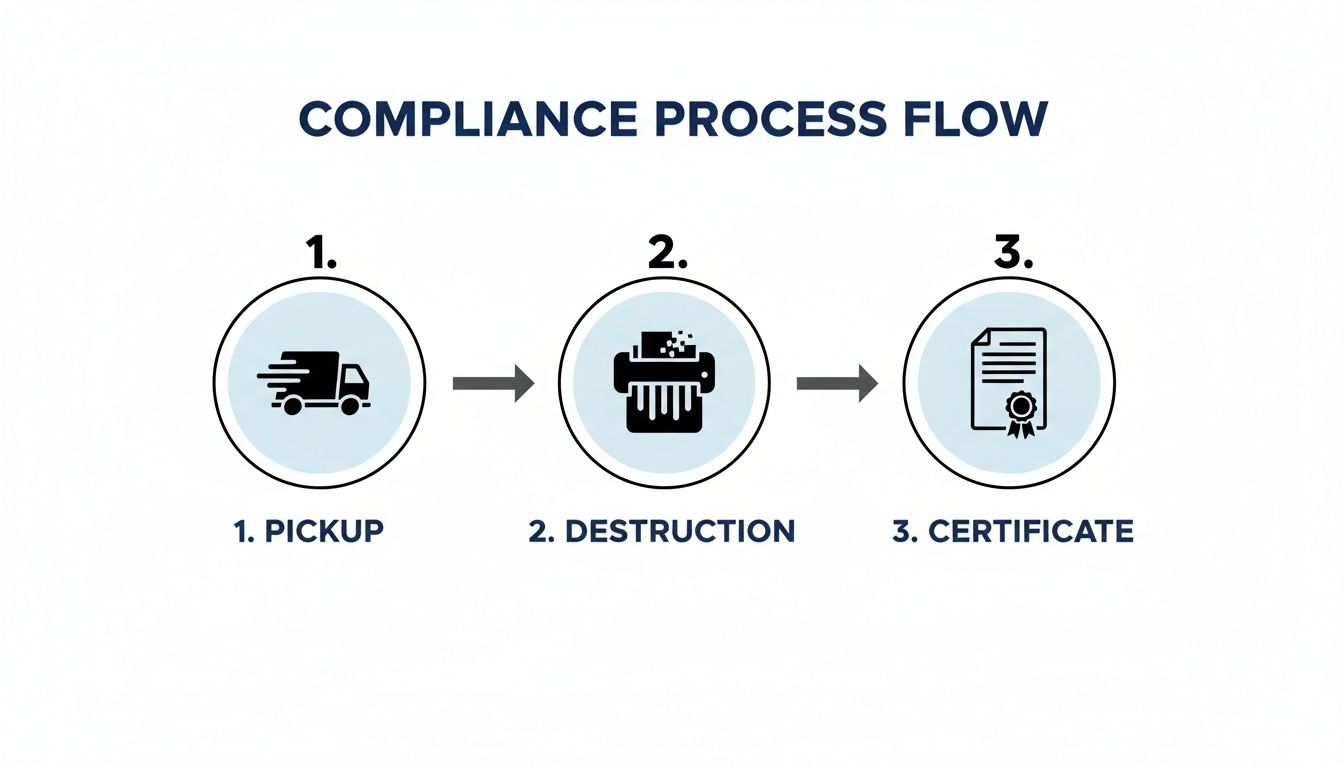
For IT managers, seeing this clear workflow provides confidence that the job will be done right, delivering verifiable, compliant results every time.
IT Manager’s Prep Checklist
A little prep work on your end can make the entire shredding project go incredibly smoothly. This quick checklist helps IT managers get everything lined up before our technicians arrive, which saves time and makes for a seamless handoff.
Pro Tip: The single best thing you can do to speed up the process is to consolidate all the devices into one secure, accessible area before we get there. It can dramatically cut down on the time our team needs to be on-site.
Here’s a quick list to get you ready:
-
Consolidate All Assets: Gather every device on your list—laptops, servers, loose drives, you name it—and move them to a single spot. A locked storage room or a cleared-out corner of the IT department is perfect.
-
Ensure Clear Access: Make sure there’s a clear path from where the gear is stored to the loading dock or building exit. This keeps things moving safely and quickly.
-
Remove from Racks (If Possible): If you're getting rid of old servers or network equipment, having them already pulled from the racks is a huge help. Our team can absolutely handle the de-installation, but pre-staging the gear makes things even more efficient.
-
Inform Your Security Team: A quick heads-up to your building security or front desk staff about our scheduled arrival ensures our technicians can get in without a hitch.
Following these simple steps helps guarantee your electronic shredding service is fast, efficient, and totally undisruptive. For a deeper dive, feel free to explore our full range of hard drive shredding services near me.
Beyond the Shredder: Sustainable E-Waste Recycling
Data security might be what brought you here, but the story doesn't end when a hard drive is pulverized. Physical destruction is just step one in a responsible IT lifecycle. The real question for any forward-thinking business is: what happens to the pile of scrap left behind?
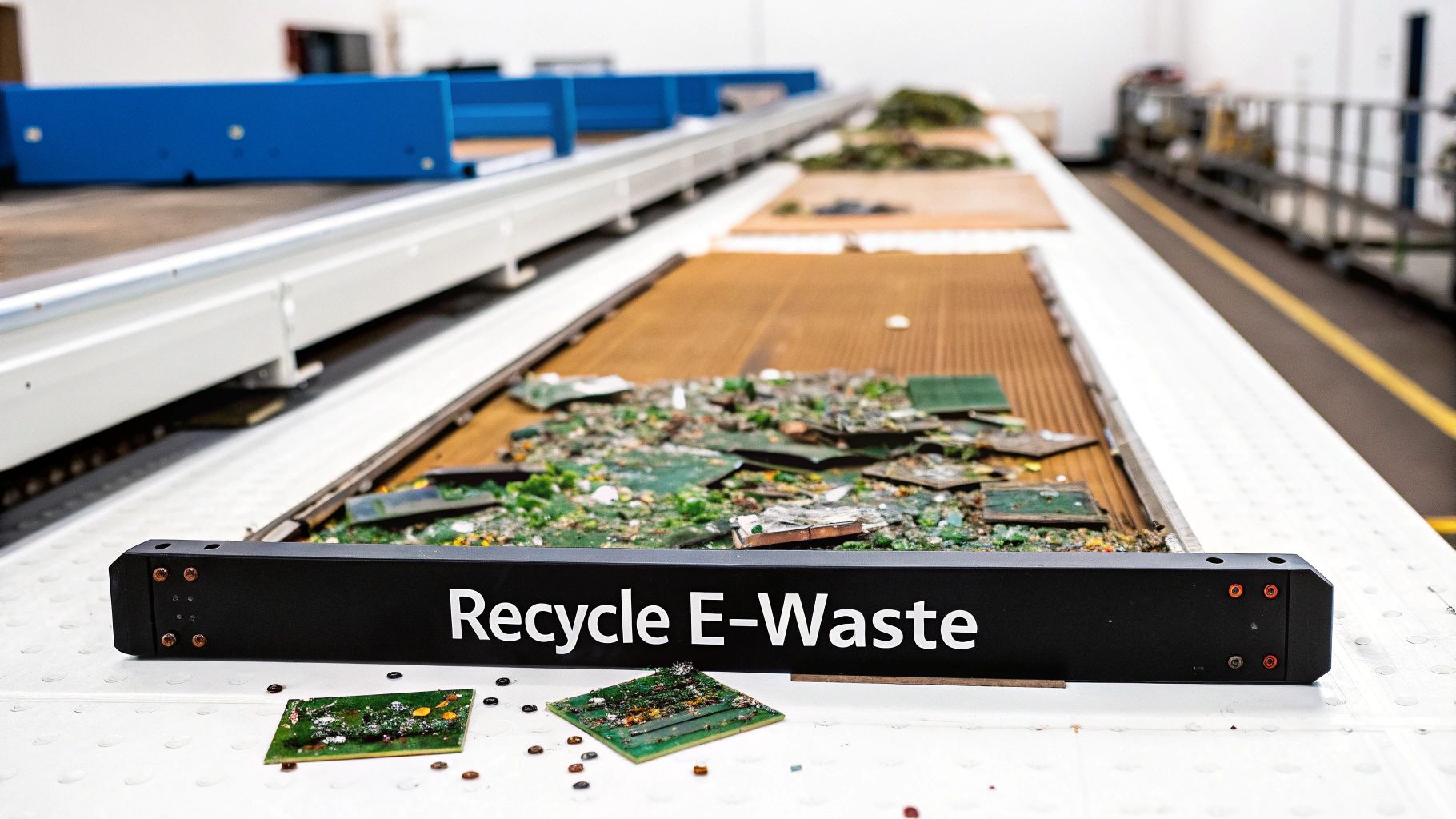
After shredding, you're left with a mix of aluminum, steel, plastics, and circuit board fragments. A true partner ensures this material never even gets close to a landfill. Instead, it enters a certified recycling stream, where it’s treated as a valuable resource, not as trash.
From Shredded Scrap to Valuable Commodities
Think of a shredded hard drive like a dismantled car. You wouldn’t just dump the whole thing in a field. You’d separate the steel, aluminum, glass, and plastic to be melted down and forged into something new. The exact same principle applies here.
Using advanced separation technologies, the shredded particles are meticulously sorted. Powerful magnets pull out ferrous metals like steel, while eddy currents isolate non-ferrous metals like aluminum and copper. The remaining materials are then processed to safely reclaim other valuable elements and properly manage any hazardous components.
This downstream process is critical for two big reasons:
- Resource Recovery: It reclaims valuable materials, reducing the massive environmental toll of new mining operations.
- Hazardous Waste Management: It prevents toxic elements like lead and mercury from seeping into our soil and water.
Confronting the E-Waste Crisis Head-On
Choosing a certified shredding and recycling partner isn't just a business decision; it’s a direct action against the global e-waste crisis. The scale of this problem is simply staggering and demands corporate accountability.
In 2022, the world generated an astonishing 62 million tonnes of electronic waste—an 82% increase from 2010. This mountain of discarded tech is projected to hit 82 million tonnes by 2030. Even more shocking? Only 22.3% of this e-waste was properly recycled, leaving an estimated US$62 billion in recoverable resources to rot in landfills. You can see the full picture in the official e-waste monitoring report.
By partnering with a certified ITAD provider, your business actively diverts e-waste from this destructive path. You ensure your retired assets contribute to the solution, not the problem.
This commitment turns a routine data destruction project into a powerful statement about your company's values. It’s a clear demonstration of environmental stewardship that resonates with clients, employees, and stakeholders alike.
Upholding Your Corporate Social Responsibility Goals
Ultimately, selecting the right partner for electronic shredding is about more than security—it’s about aligning your operations with your corporate values. A certified provider gives you the assurance that your end-of-life IT assets are handled in an environmentally sound manner from start to finish.
This choice directly supports a circular economy, where materials are kept in use for as long as possible. It’s an approach that minimizes waste and shrinks your company’s environmental footprint. By exploring professional Atlanta electronics recycling, you can ensure your data security and sustainability goals are met at the same time.
Frequently Asked Questions About Electronic Shredding
Even after you've decided on electronic shredding, it's natural to have a few lingering questions. Most of the IT and business leaders we talk to want to iron out the final details before moving forward. We've gathered the most common queries right here to give you the clear, practical answers you need to act with confidence.
Is Data Wiping Not Good Enough? Why Do I Need Physical Shredding?
This is probably the single most important question an IT manager can ask. Data wiping software absolutely has its place—it’s a great tool for sanitizing drives you plan on reusing or redeploying inside your own company. But when it comes to getting rid of assets for good, it’s not a complete solution.
For starters, a successful software wipe isn't even possible on old, damaged, or non-working drives. And with modern solid-state drives (SSDs), their internal wear-leveling technology means standard wiping tools often miss entire blocks of data. Physical shredding is the only way to be 100% certain the data is gone forever, no matter what kind of drive it is or what condition it's in.
Physical destruction completely removes any lingering risk and gives you a Certificate of Destruction. That document is your definitive proof of compliance, shielding your business from liability and satisfying even the toughest auditors.
Shredding changes the conversation entirely. Instead of asking, "Did we erase the data correctly?" you can state with certainty, "The device that held the data no longer exists." That absolute finality is why it's the gold standard for any business that takes data security seriously. When you search for "electronic shredding near me," you're looking for that guaranteed endpoint.
What Types of Electronics Can You Shred Besides Hard Drives?
While hard drives are what we see most often, our industrial shredders are built to destroy a whole range of devices that store sensitive information. If it holds data, we can make sure that data is gone for good.
Our process is designed to handle all sorts of modern and legacy media, including:
- Solid-State Drives (SSDs) from laptops, servers, and other high-performance machines.
- Backup Tapes, including common formats like LTO and DLT.
- Removable Media like USB flash drives, memory cards, and external hard drives.
- Optical Media such as CDs, DVDs, and Blu-ray discs.
- Entire Mobile Devices, including smartphones and tablets.
For larger equipment like servers or laptops, we take a two-step approach. First, we physically remove and shred all the internal storage components. Then, the leftover chassis, motherboards, and power supplies—now completely free of data—are responsibly recycled. This guarantees total data security while making sure we recover as much material as possible in an environmentally friendly way.
How Is the Cost for Electronic Shredding Services Determined?
We base our pricing on a few straightforward factors to make sure your quote is a perfect match for your project. Our goal is to provide transparent, upfront pricing with no surprises, so you can budget with confidence.
The main variables that shape the cost are:
- Quantity or Weight: The total number of devices or the bulk weight of the material is the biggest factor.
- Service Type: On-site shredding, where we bring a mobile shred truck to your location, has different logistical costs than off-site shredding at our secure facility.
- Additional Services: If you need anything extra, like serialized asset reporting for your inventory or help with on-site de-installation of servers, we can factor that into the price.
We always provide a detailed, no-obligation quote after a quick chat to understand your needs. In some cases, if your project includes newer IT equipment that can be refurbished and resold, we can use the value from those assets to offset your data destruction costs. Sometimes, it can even make the project cost-neutral. The best way to get an exact number is to connect with our team and talk through your inventory.
Can You Handle Large-Scale Projects Like a Data Center Decommissioning?
Absolutely. Large-scale electronic shredding projects are our specialty. We regularly manage full data center shutdowns, campus-wide IT cleanouts, and major office moves for our commercial clients. Our team has the equipment, logistics, and expertise to handle projects involving thousands of assets securely and on schedule.
We get that massive projects demand careful planning to avoid disrupting your business. Our process covers the entire lifecycle, from the initial inventory and de-installation right through to secure transport and certified destruction. We’ll work hand-in-hand with your IT and facilities teams to build a project plan that hits your deadlines and meets your security protocols. For any business searching "electronic shredding near me" for a major undertaking, having a partner with proven experience in this space is non-negotiable.
Ready to secure your retired IT assets and ensure total compliance? Atlanta Computer Recycling provides certified, reliable electronic shredding services for businesses across the metro area. Contact us today for a free, no-obligation quote and take the first step toward complete peace of mind.