Finding Hard Drive Shredging Services Near Me: A Complete Business Guide

When your company searches for "hard drive shredding services near me," it signifies an understanding of a critical business truth: retired hard drives aren't just IT clutter. They're potential data liabilities waiting to detonate. A professional shredding service is the only guaranteed method to permanently destroy sensitive corporate data, ensuring your organization avoids a catastrophic breach and remains compliant with privacy laws. It’s the non-negotiable final step in your IT asset disposition (ITAD) strategy.
Why Secure Hard Drive Shredding Is a Non-Negotiable Business Priority
That stack of old hard drives piling up in a storage closet can feel like a low-priority task, but every single one of those devices represents a massive financial and reputational risk. For IT managers, compliance officers, and business leaders, this isn't about housekeeping—it's strategic risk mitigation. Improper disposal of data-bearing assets is a direct threat to your bottom line and brand integrity.
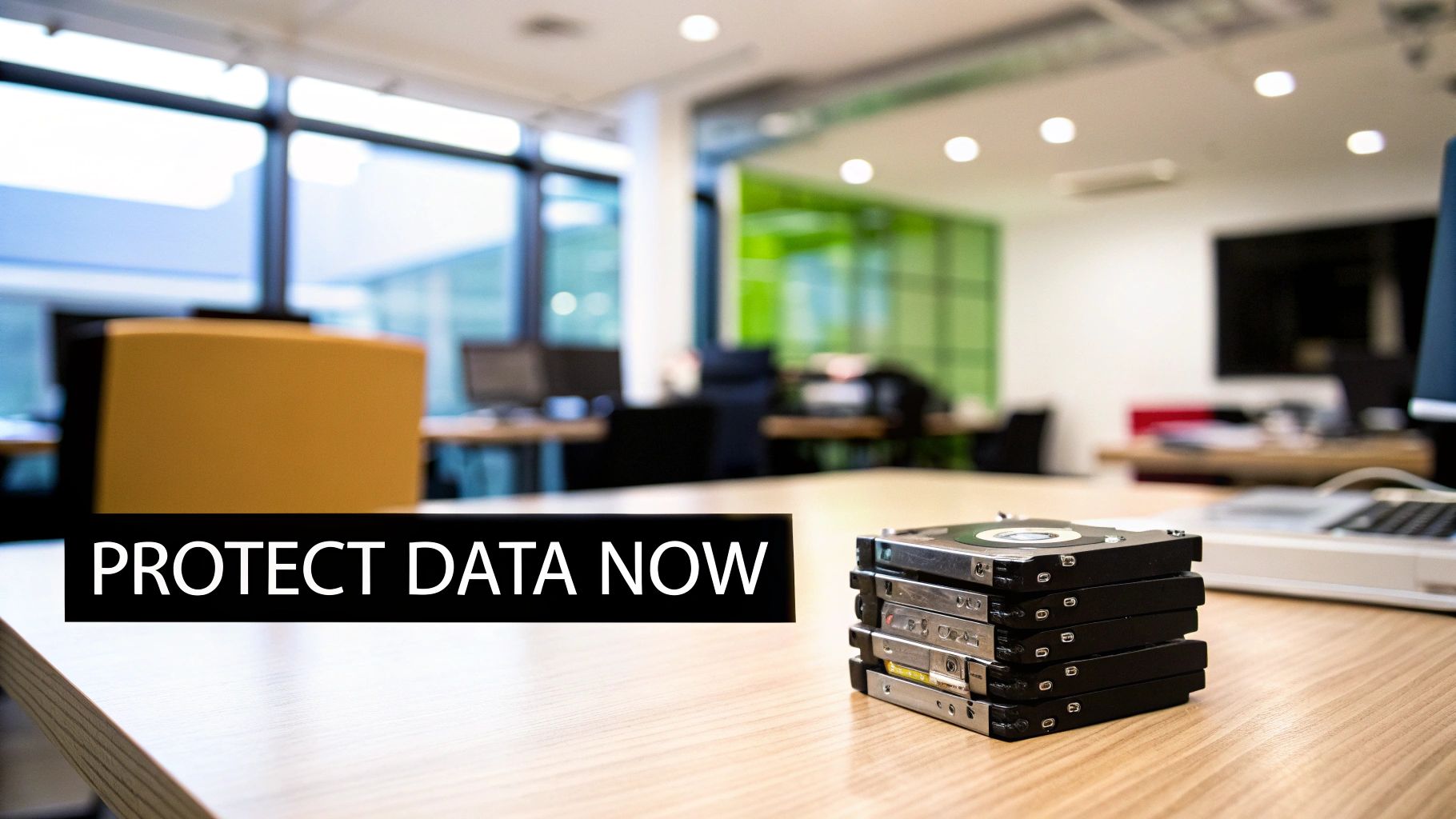
The stakes couldn't be higher. Data breaches now cost businesses an average of $4.45 million globally. Suddenly, a professional destruction service looks like a smart, affordable investment compared to risky in-house methods that often fail. Driven by strict regulations like GDPR and HIPAA, the market for these services is exploding and projected to hit $5.05 billion by 2035.
The True Cost of Inaction
Ignoring proper data destruction can unleash a storm of consequences that go far beyond a single data breach. The potential fallout is severe:
- Steep Regulatory Fines: Violating data privacy laws like HIPAA can trigger fines reaching millions of dollars for just one incident.
- Irreversible Reputational Damage: A public data breach can shatter customer trust and partner confidence that takes years to rebuild, if ever.
- Legal Liability: Your business could face class-action lawsuits from customers, clients, and even employees whose data was compromised.
- Loss of Intellectual Property: Those old drives might hold trade secrets, R&D data, or strategic plans that could end up in a competitor's hands.
To really drive this home, think of secure hard drive shredding as a key part of a broader layered security approach. Physical data destruction is the final, definitive layer that ensures a retired asset can never become a future vulnerability.
For any business, especially those in regulated industries like healthcare or finance, a Certificate of Destruction isn't just a piece of paper. It's your legal proof of due diligence, demonstrating you took every necessary step to protect sensitive information from creation to final disposal.
Ultimately, bringing in a professional service for secure hard drive destruction is a proactive move for business continuity. It turns a potential liability into a verified, compliant, and secure endpoint for your company's data.
Before you can get a realistic quote for hard drive shredding, you have to know exactly what you’re dealing with. An internal audit is the first step, turning that vague pile of old equipment in the storage closet into a clear, itemized list.
This process is about more than just counting boxes. It’s a crucial step for getting accurate pricing and, more importantly, making sure the shredding service you choose actually meets your security and compliance needs.
Building Your Asset Inventory
Start by creating a detailed inventory of every single piece of media that needs to go. This isn’t just about old desktop towers; you need to hunt down every device that could possibly hold sensitive data. Think comprehensively.
A thorough audit means looking beyond the obvious. Your goal is a complete catalog of everything slated for destruction.
- Traditional Hard Disk Drives (HDDs): These are the low-hanging fruit. Catalog all the drives from decommissioned servers, desktops, and laptops.
- Solid-State Drives (SSDs): Don't forget these. SSDs are in most newer laptops, servers, and external drives, and they often need a different shredding process to be destroyed properly.
- Backup Tapes: This is where company history lives. Old LTO, DLT, or DDS tapes can hold years of archived—and highly sensitive—company data.
- Company Mobile Devices: Round up all the old company-issued smartphones and tablets. They're packed with emails, contact lists, and internal documents.
This inventory is the foundation of your entire data destruction plan. For a deeper look at organizing these assets, our guide on IT asset management best practices offers a solid framework to keep data-bearing devices from slipping through the cracks.
Classifying Data Sensitivity
Once you know what you have, you need to figure out what kind of data is on it. This is where the real risk assessment comes in. The sensitivity of the data directly dictates the level of security and documentation you'll need from a shredding vendor.
Not all corporate data is created equal. Think about the potential fallout if the information on a device was exposed. A drive from an old marketing PC probably carries less risk than a finance department server holding years of financial records.
A common mistake is treating all old hardware the same. A drive containing customer Social Security numbers or protected health information (PHI) carries a much higher risk—and stricter legal requirements—than one with old project files.
Create a few simple categories to guide your conversations with potential vendors:
- High-Risk Data: This is your crown-jewel information—PII, PHI, financial records, and intellectual property. These assets demand the highest level of security, like witnessed on-site shredding and serialized reporting.
- Moderate-Risk Data: Think internal communications, employee records, and operational data. It’s sensitive, for sure, but not necessarily governed by the same strict regulations as high-risk data.
- Low-Risk Data: This would be devices used for non-critical functions that you’re confident hold no sensitive information.
Armed with this audit, you can approach vendors with exact specifications. You'll be able to find a shredding service that aligns perfectly with your security posture and keeps you compliant, without paying for services you don’t need.
On-Site vs. Off-Site Shredding: Which Is Right for Your Business?
After you’ve completed your internal audit and have a clear inventory, the first big decision your business will face is how to get the job done. The choice really boils down to two main options: on-site mobile shredding, where the destruction happens right at your facility, or off-site shredding, where your drives are securely transported to a specialized plant.
Each path has its own set of trade-offs, and the right answer depends entirely on your data's sensitivity, the sheer volume of media you need to destroy, and your organization's risk tolerance.
For a healthcare provider managing patient records or a financial firm handling sensitive client data, the answer is often cut and dry. They need absolute certainty. The peace of mind that comes from physically watching every single hard drive get pulverized is invaluable. It completely eliminates any chain-of-custody questions and provides undeniable proof that you’ve met your compliance obligations.
The Case for On-Site Mobile Shredding
On-site shredding literally brings the entire destruction process to your parking lot. A specialized, high-security truck rolls up, equipped with an industrial-grade shredder powerful enough to turn hard drives into small, unrecognizable pieces of metal.
Your team can personally witness the entire process, from your IT assets being loaded into the shredder to the final pile of shredded material. This is the gold standard for any organization that can't afford even a hint of risk.
The biggest win here is maximum security and total transparency. There’s no wondering what happened to your drives after they left your sight. You see it happen, right then and there. This immediate, visual verification is absolutely critical for industries bound by strict regulations like HIPAA, SOX, or PCI DSS. If you're considering this route, it's worth exploring the specifics of on-site shredding services near you to see how the process works from start to finish.
This flowchart can help you visualize the decision-making process.
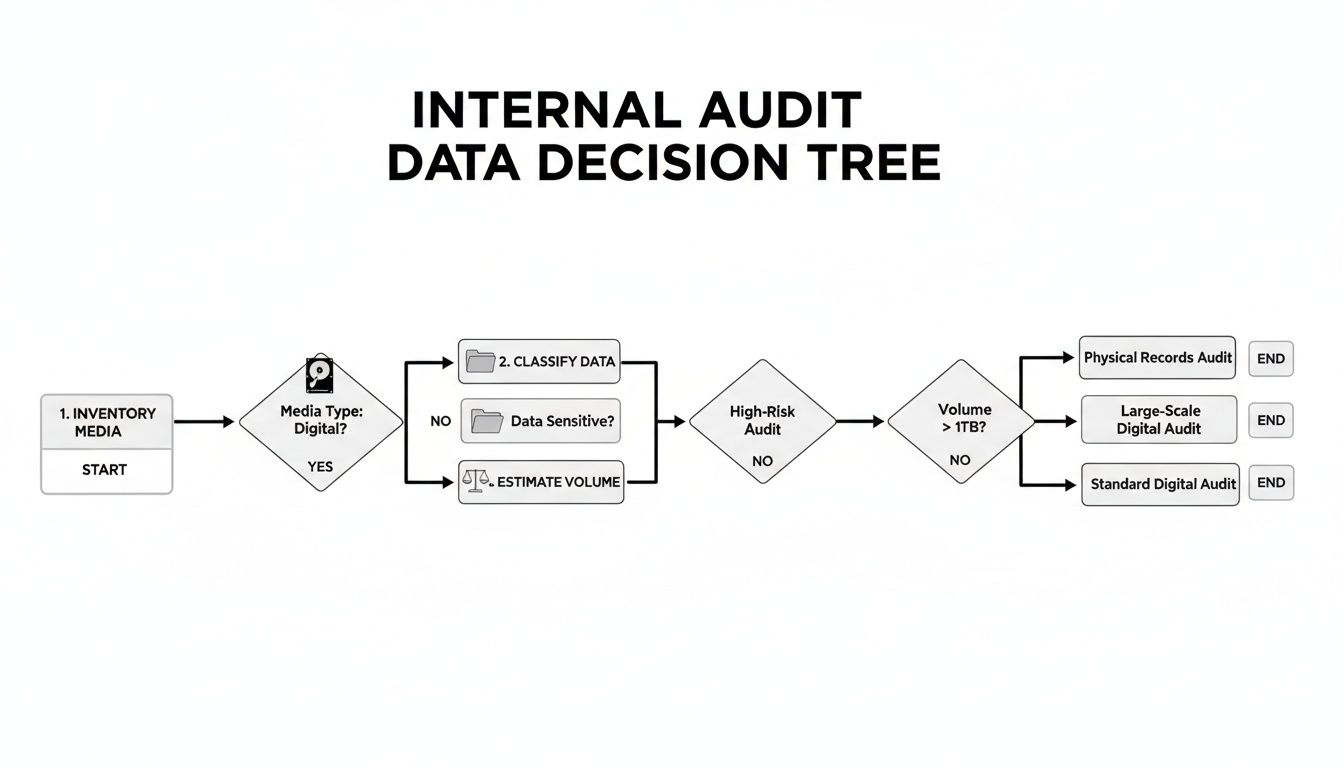
As you can see, figuring out just how sensitive your data is upfront is the single most important step. It will guide every other choice you make.
When Off-Site Shredding Makes Sense
On the flip side, imagine a large enterprise decommissioning a data center with thousands of drives. Trying to shred all of that on-site would be a logistical nightmare. In these high-volume scenarios, off-site (or plant-based) shredding is often the more practical and cost-effective solution.
With off-site shredding, a certified vendor arrives to collect your assets in locked, tamper-evident containers. From that moment on, a strict chain of custody is maintained:
- Secure Transport: All assets are moved in GPS-tracked, secure vehicles.
- Controlled Facilities: The shredding takes place in a highly secure, monitored plant with limited, documented access.
- Verified Destruction: You still receive a serialized Certificate of Destruction as your legal proof that the job was done right.
On-Site vs Off-Site Shredding Service Comparison
To help you weigh the options, here’s a straightforward breakdown of how on-site and off-site services stack up against each other.
| Factor | On-Site Shredding | Off-Site Shredding |
|---|---|---|
| Security | Highest level; witnessed destruction eliminates chain-of-custody risk. | High; relies on a strict, documented chain of custody and secure facility. |
| Compliance | Ideal for strict regulations like HIPAA/SOX due to visual proof. | Fully compliant with most regulations, with proper documentation. |
| Cost | Generally higher due to specialized trucks and on-location service. | More cost-effective, especially for high-volume or recurring needs. |
| Convenience | Highly convenient for smaller batches; no internal transport needed. | Requires secure packing and pickup; better for large-scale projects. |
| Logistics | Requires space for the truck and can be disruptive to operations. | Minimal on-site disruption; the vendor handles the heavy lifting. |
| Best For | Highly sensitive data, regulated industries, or peace-of-mind. | Large volumes of media, budget-conscious projects, routine disposals. |
Ultimately, there’s no single "best" answer. Your decision will always come back to your organization’s unique needs—balancing risk, compliance requirements, operational scale, and budget. By understanding the processes and protocols for each method, you can make an informed choice that best protects your business.
How to Vet Local Shredding Providers
Once you start searching for "hard drive shredding services near me," you'll quickly discover a wide gap between professional, certified operators and smaller outfits that might not have the right credentials. Protecting your business means you have to dig deeper than just the price-per-drive.
Vetting potential vendors is a critical step. Think of it as a job interview for a partner who will be handling your company’s most sensitive digital assets. A casual approach simply won't cut it when your data, reputation, and legal standing are on the line.
When you start your search, you'll see a lot of local companies trying to stand out online. It can even be helpful to understand how they do it; for instance, learning how to rank higher on Google Maps shows you the methods legitimate companies use to reach customers like you.
Look for NAID AAA Certification
Your first question—and really, the most important one—should always be about certifications. In the data destruction industry, the gold standard is NAID AAA Certification. This isn't just some badge they can buy; it's a tough, third-party verification that proves a provider meets the highest security standards in the business.
A NAID AAA certified company is subject to unannounced, on-site audits that cover everything:
- Employee background checks and screening.
- The physical security of their facilities and trucks.
- The integrity of their chain-of-custody process.
- Their downstream recycling partners.
The data destruction services market is booming, expected to hit nearly $12 billion soon. A big driver for this growth? The staggering fact that 70% of stolen data comes from lost or improperly discarded devices. Choosing a certified provider gives you documented proof of due diligence, which is invaluable if you ever face a compliance audit.
Verify Their Insurance and Employee Screening
Beyond certifications, you need to see their insurance policy. Don't just take their word for it—ask for a copy of their Certificate of Insurance. A professional service should carry millions in general liability and, just as importantly, professional liability (also known as errors and omissions) coverage. This protects your business in the unlikely event of a data breach caused by their team.
Speaking of their team, how do they hire? All employees with access to your sensitive media should undergo thorough criminal background checks and drug screenings. Reputable companies are transparent about this and will have no problem sharing the details of their personnel security protocols.
Any hesitation to provide proof of insurance or details on employee screening is a major red flag. A secure, professional vendor will be proud to demonstrate their commitment to protecting your assets and will have this documentation ready.
Understand Their Destruction Methods for HDDs vs SSDs
Finally, don't assume a shredder is just a shredder. Your IT inventory is likely a mix of traditional hard disk drives (HDDs) and solid-state drives (SSDs), and they can't be destroyed the same way.
- HDDs store data on magnetic platters. A standard shredder that breaks them into quarter-sized pieces is usually sufficient.
- SSDs are completely different. They store data on tiny memory chips scattered across a circuit board. To be truly destroyed, SSDs must be pulverized into particles of 2mm or less to ensure every single chip is obliterated.
Ask the provider to explain their specific process for both types of media. If they give you a one-size-fits-all answer, they probably don't have the right equipment to handle your SSDs securely. For businesses with a mix of hardware, it’s always smart to work with one of the top electronic waste disposal companies that truly understands these technical differences.
Managing the Process and Securing Your Certificate of Destruction
You’ve done the research and picked your provider. Now comes the most important part: managing the actual shred day and getting that all-important piece of paper that proves your data is gone forever. This is where your diligence pays off, turning plans into a secure, verifiable result.
A little prep work on your end is the key to making sure everything goes off without a hitch.
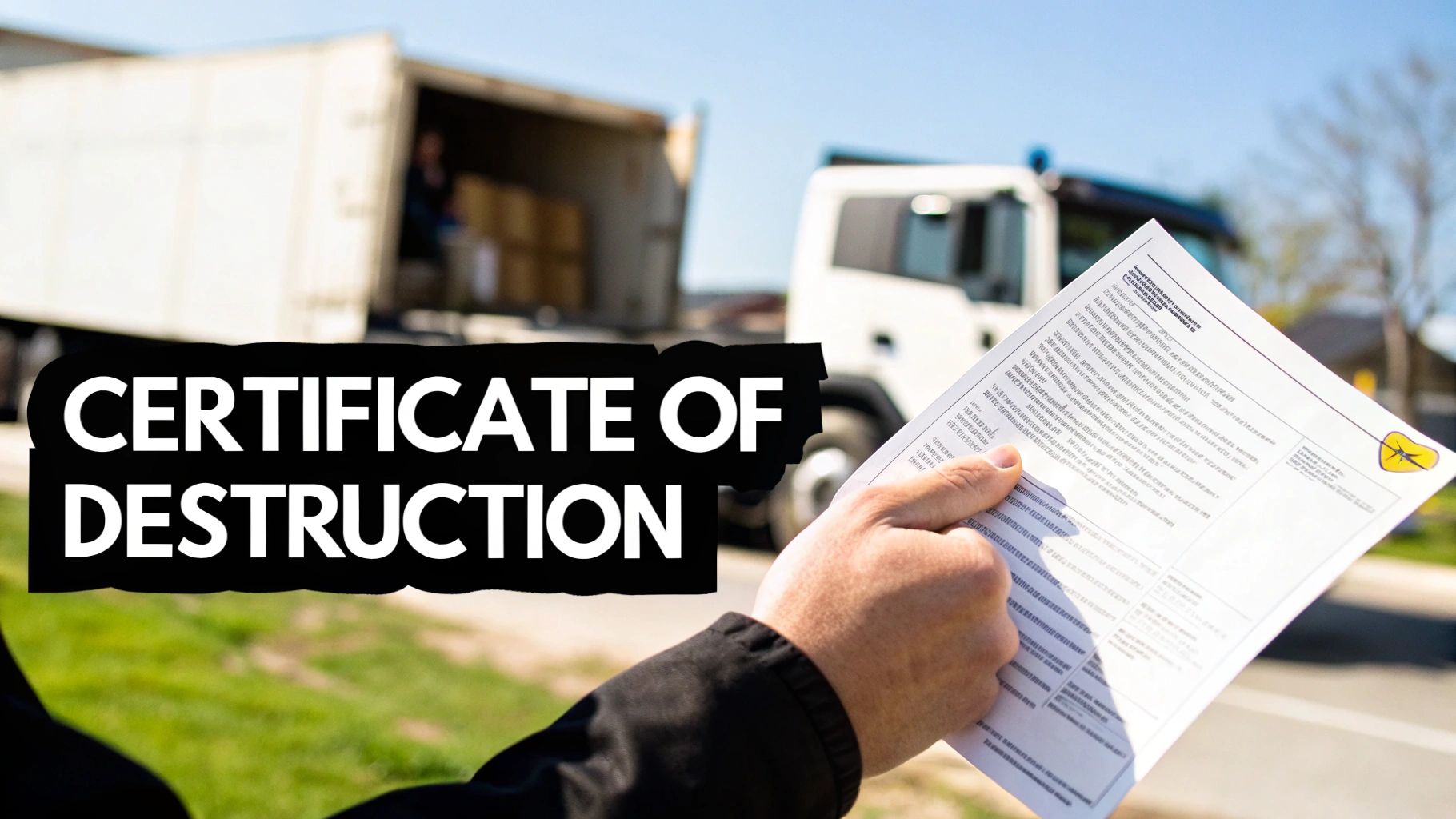
Whether the truck is coming to you or you’re sending your drives off-site, the logistics are what make or break the security of the whole operation. Getting organized ahead of time ensures the process is efficient and minimizes disruption to your business.
Preparing for Service Day
If you’ve scheduled an on-site shred, the best thing you can do is gather all the hard drives and other media in one, easy-to-reach spot. Clear a path for the technicians and their gear, and assign someone from your IT team to be their dedicated point of contact. This person’s job is to watch the entire process, from the first drive to the last.
For an off-site service, your main role is to oversee a secure handoff. Before the crew arrives, double-check that your inventory list is a perfect match for the drives they’re about to collect. You'll want to watch as they load everything into locked, tamper-evident containers and make sure you get a signed receipt before they drive away.
Decoding Your Certificate of Destruction
The single most critical document you'll receive is the Certificate of Destruction. This isn't just a receipt—it’s your legal proof that the data has been properly sanitized, and it's a vital part of your compliance records. A legitimate certificate is your shield in an audit.
A proper certificate isn't just a piece of paper; it must have specific, non-negotiable details to be valid.
- A Unique Serial Number: This ties the document directly to your specific service order.
- Your Company’s Information: It needs to clearly list your business name and the service address.
- Date and Location of Destruction: This gives you a precise record of when and where the data met its end.
- A Detailed List of Destroyed Media: For absolute accountability, this list should include the serial numbers of every single hard drive.
- An Authorized Signature: A representative from the shredding company has to sign and date the certificate, attesting that the job was completed as described.
Never accept a generic or incomplete certificate. This document is the definitive proof that you’ve met your due diligence obligations under rules like HIPAA or GDPR. It closes the loop on your IT asset disposal and protects your company from liability.
This final step is non-negotiable. To really dig into the details, our complete overview explains what makes a valid Certificate of Destruction for hard drives. Securing this document is the final confirmation that your search for "hard drive shredding services near me" has successfully protected your business.
Common Questions About Hard Drive Shredding
Even with a solid plan, you're bound to have a few questions when you start looking for a "hard drive shredding service near me." Here are some of the most common things IT managers and business leaders ask when they're navigating this for the first time.
Is Wiping or Degaussing a Drive Good Enough?
While software wiping and degaussing (blasting a drive with a powerful magnet) have their uses, they aren't foolproof for business-level security. A software wipe can easily be done wrong or fail silently, and degaussing is completely useless on modern solid-state drives (SSDs).
Physical shredding is the only way to be 100% certain that your data is gone forever. More importantly, it gives you a clear, defensible audit trail with a Certificate of Destruction—something you absolutely need to prove compliance with regulations like HIPAA or GDPR.
How Much Do Hard Drive Shredding Services Usually Cost?
Pricing really depends on a few key factors. The total number of drives, whether you choose on-site or off-site service (on-site is typically a bit more), and your location all play a role.
As a general rule of thumb, most professional vendors charge per drive, often somewhere in the $5 to $15 per unit range.
- Volume Discounts: If you have a large batch of drives, you can almost always get a better per-unit price.
- Minimum Fees: Don't forget to ask about minimum service charges, which are common for on-site shredding jobs.
- Detailed Quotes: Always insist on an itemized quote that breaks down every cost before you sign anything.
Can You Shred SSDs the Same Way as Regular Hard Drives?
No, and this is a huge deal. SSDs and traditional spinning hard disk drives (HDDs) are built completely differently and need separate destruction methods. HDDs store data on big magnetic platters, but SSDs use a bunch of tiny memory chips scattered across a circuit board.
To be absolutely sure the data is gone, SSDs have to be shredded into much smaller pieces—usually 2mm or less—to guarantee every single one of those little memory chips is obliterated. It's critical to confirm that your vendor uses specialized equipment designed specifically for SSD destruction if you have them in your inventory.
A one-size-fits-all shredding process is a major red flag. A reputable company will always ask what kind of media you have and explain how they securely handle both HDDs and SSDs.
What Is a Certificate of Destruction and Why Does It Matter So Much?
A Certificate of Destruction is a formal, legal document the shredding company gives you. It's your official proof that you disposed of your data securely and in compliance with the law. Honestly, it's the single most important piece of paper you'll get from the entire service.
This document is your get-out-of-jail-free card for any internal or external compliance audits. It proves your company did its due diligence to protect sensitive information, closing the loop on the IT asset lifecycle and protecting you from any future liability.
For businesses in the Atlanta metro area, Atlanta Computer Recycling offers secure, compliant, and documented hard drive shredding services tailored for commercial clients. We handle everything from on-site pickups to providing a detailed Certificate of Destruction, ensuring your sensitive data is gone for good. Protect your business today by visiting us at https://atlantacomputerrecycling.com.